

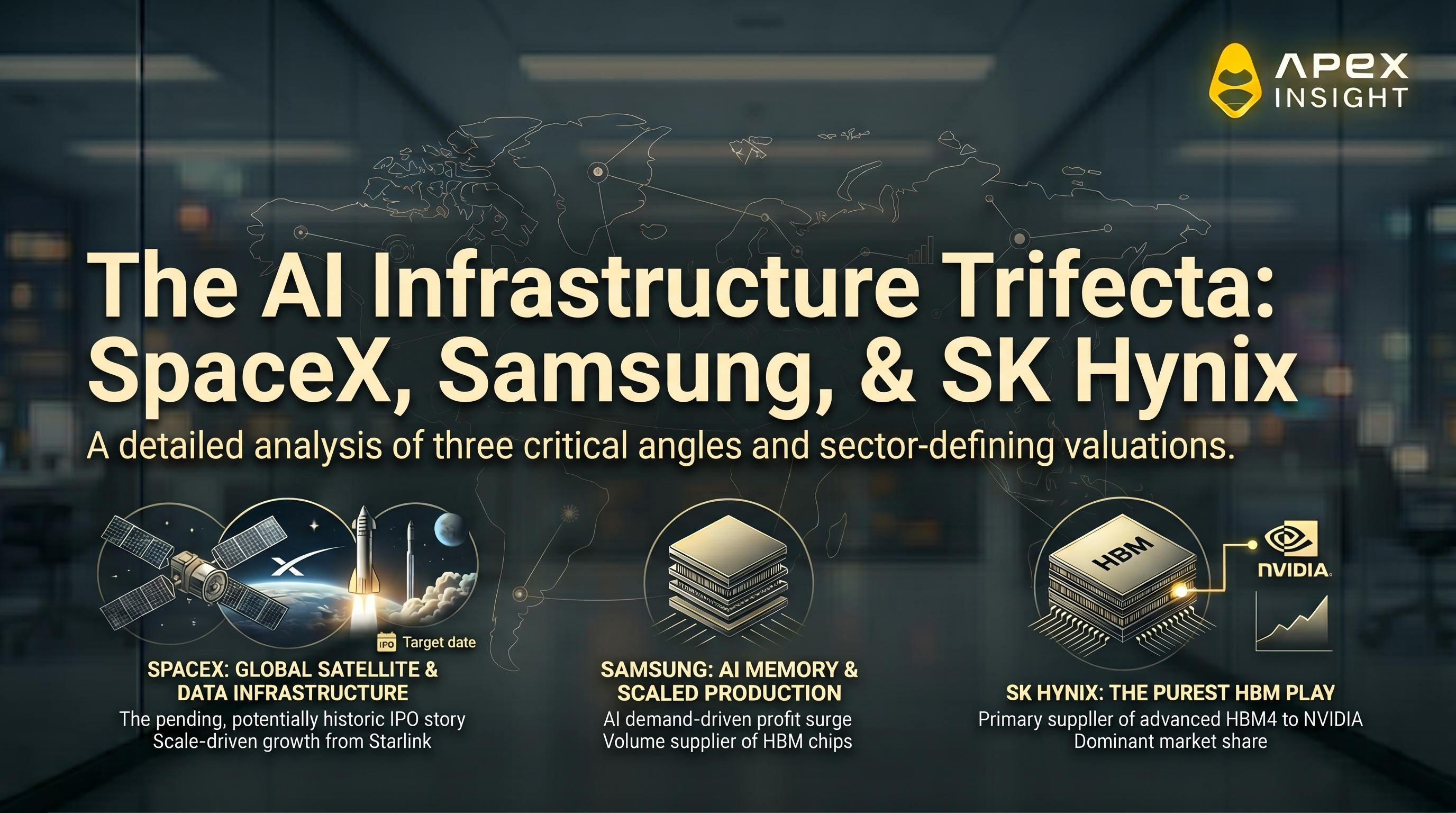
Three of the most-watched names in the market right now run on the same engine: the AI infrastructure boom. SpaceX is racing toward what could be the largest IPO in history, Samsung just posted a blowout quarter on AI memory, and SK Hynix has quietly become Nvidia's most important memory supplier. Here's the narrative on each, and how traders can actually get exposure to all three, including the ones you can't yet buy on a normal brokerage.
SpaceX: the biggest IPO in history is almost here
SpaceX is the headline pre-IPO rocket play of 2026. After years of staying private, Elon Musk's launch-and-satellite company filed for an IPO in late May 2026 and is targeting a debut on the Nasdaq under the ticker SPCX (CNBC).
The numbers are eye-watering. SpaceX is targeting a fixed IPO price of $135 per share and plans to sell roughly 555.6 million shares, a raise of about $75 billion, which would make it the largest IPO ever, and an implied valuation in the $1.7–1.8 trillion range (CNBC; Satellite Today). For context, an insider share sale in December 2025 had valued the company closer to $800 billion (Sacra), so the IPO is asking the public market to roughly double that in six months.
One important caveat: you'll see "June 12" attached to this listing everywhere. Treat it as a target, not a confirmed fact. Reporting points to SpaceX being expected to begin trading on or around June 12, 2026 (Unchained), but IPO dates slip, and no exchange has stamped that date in stone.
What's the bull case underneath the hype? Two things. First, Starlink: the satellite-internet business is now the cash engine, and SpaceX reported around $18.7 billion in total revenue for the period, albeit with a roughly $4.9 billion net loss as it reinvests heavily (Satellite Today). Second, the pitch itself leans hard on AI: SpaceX is framing its satellite network and data infrastructure as AI-era plumbing, which is exactly the story this market wants to buy (Satellite Today).
The catch for retail: SpaceX is still private until that bell actually rings, so most people can't own a single real share yet. We'll come back to how traders are getting around that.
Samsung: the world's biggest memory and phone maker, back on offense
Samsung Electronics is the world's largest memory-chip maker and the world's largest smartphone maker, a rare double. For a couple of years its memory business was a drag. That story has flipped.
Samsung's Q1 2026 operating profit surged 756% year-over-year to roughly 57.2 trillion won, a blowout driven almost entirely by AI demand (KED Global). The eye-opener is the mix: the semiconductor division contributed around 94% of total operating profit (TradingKey). In other words, the phone giant is now, on the bottom line, mostly a memory company again, and memory is where the AI money is.
The clearest signal of how tight the market is: Samsung has sold out its entire 2026 HBM (high-bandwidth memory) capacity (KED Global). When a manufacturer of Samsung's scale is sold out a year ahead, it tells you AI accelerators are devouring memory faster than the industry can build it.
The honest tension in the Samsung story: it is not the leader in the most lucrative corner of this boom. In the race to supply next-generation HBM4 to Nvidia, Samsung has been playing catch-up to its smaller rival (TrendForce). Which brings us to that rival.
SK Hynix: Nvidia's go-to memory supplier
If you want the purest large-cap bet on AI memory, SK Hynix is it. The company is the global leader in high-bandwidth memory, holding roughly a 57% revenue share of the HBM market, well ahead of Samsung (CNBC). HBM is the specialized memory that sits next to Nvidia's GPUs, and SK Hynix is the supplier Nvidia leans on hardest: it's reportedly set to provide about two-thirds of Nvidia's HBM4 (TrendForce).
That dominance is showing up in the financials in a historic way. SK Hynix posted a record full-year 2025 operating profit of about 47.2 trillion won, beating Samsung (≈43.6 trillion won) for the first time ever (CNBC). For a company a fraction of Samsung's overall size, out-earning the giant is a genuine changing-of-the-guard moment in chips.
The market has noticed. Analysts have been chasing the stock higher: one brokerage lifted its target price by 40% to 28 million won (Seoul Economic Daily), as the rally pushes SK Hynix toward the trillion-dollar-conversation tier of AI winners. The bear case is simply the flip side of the bull case: memory is cyclical, and a company this levered to one customer's GPU roadmap rises and falls with AI capex.
How retail traders can actually trade these three
Here's the practical problem. SpaceX isn't public yet. Samsung and SK Hynix are public, but they trade in South Korea, which means most non-Korean retail traders hit friction (foreign-exchange, custody, and access hurdles) just to get a position. So how are traders getting exposure today?
This is where ApeX Omni comes in. ApeX Omni is a decentralized perpetual futures exchange that offers leveraged exposure to real-world assets (RWAs), including stocks such as SpaceX, Samsung, and SK Hynix. For retail traders, the appeal is simple: one venue to go long or short on a pre-IPO rocket story and two Korean memory leaders, without opening a Korean brokerage account or waiting for an IPO listing.
Beyond these names, the platform lists RWA perpetuals on major U.S. equities and ETFs, including Nvidia, Tesla, Invesco QQQ, and SPDR S&P 500, with leverage of up to 50x.
What you can trade includes:
Major U.S. stocks: Apple, Microsoft, NVIDIA, Tesla, Amazon, Meta, Coinbase, and more
ETFs and indices: SPY (the S&P 500 ETF) and QQQ (the Nasdaq-100 ETF)
Commodities and precious metals: Gold, Silver, WTI and Brent crude oil, and Natural Gas
Key features for traders include:
USDT settlement: All positions settle on-chain in stablecoins
Chainlink oracle pricing: Designed to provide fair, manipulation-resistant pricing
Cross-collateral support: Move funds between Funding, Perp, and RWA accounts
Separate risk management: RWA positions are margined and liquidated independently from crypto perpetuals
Low fees: Up to 0% maker and 0.025% taker fees through the VIP Program
Extended trading hours: RWA markets trade 24 hours a day, five days a week, with select pairs available 24/7
Before trading, remember that perpetual futures are leveraged derivatives. While leverage can amplify gains, it can also accelerate losses. Understand margin requirements and liquidation risks, and only trade with capital you can afford to lose.
The takeaway
SpaceX, Samsung, and SK Hynix are three different ways to play the same AI-infrastructure wave: a once-in-a-generation IPO, a memory-and-mobile giant back on offense, and the pure-play HBM leader sitting at the center of Nvidia's supply chain. The fundamentals are real and well-documented, but two things deserve a trader's discipline: SpaceX's June 12 listing is a target, not a confirmed date, and the easiest way to trade all three (perps on a venue like ApeX Omni) gives you price exposure, not ownership. Know which one you're buying, and trade the story on its merits, not the hype around the date.
This article is for educational and informational purposes only and is not financial, investment, or legal advice. Do your own research and consult a licensed professional before investing.