

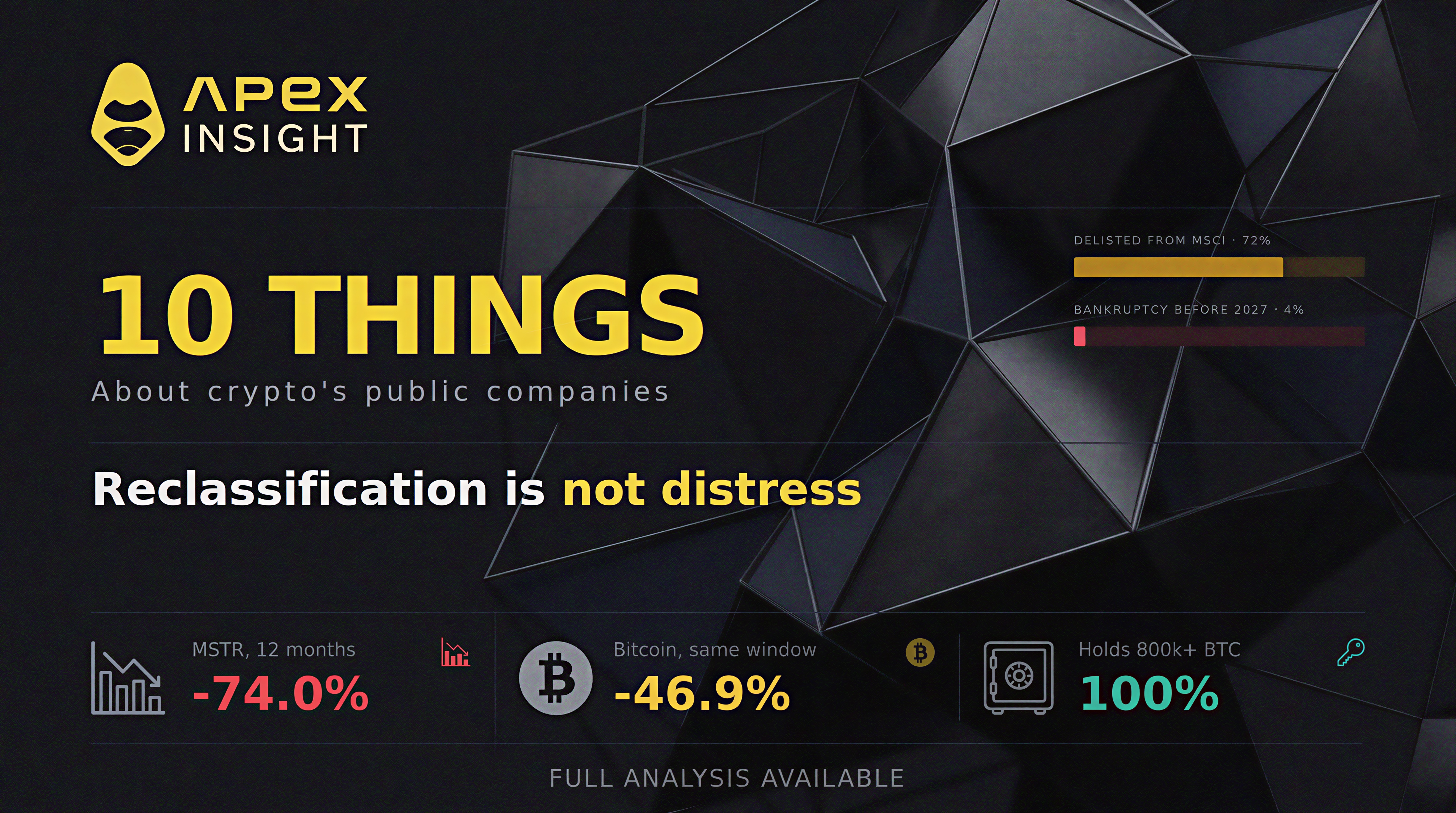
Note: All market prices, equity prices and on-chain figures in this article are as of August 13, 2026. Everything here moves continuously, so the numbers below will have shifted by the time you read them.
1. The delisting call is the strongest on the board, and the thinnest
MicroStrategy being delisted from the MSCI index by December 31 prices at 72 percent. That is the highest conviction reading anywhere in this dataset, and it needs a caveat before it can be used.
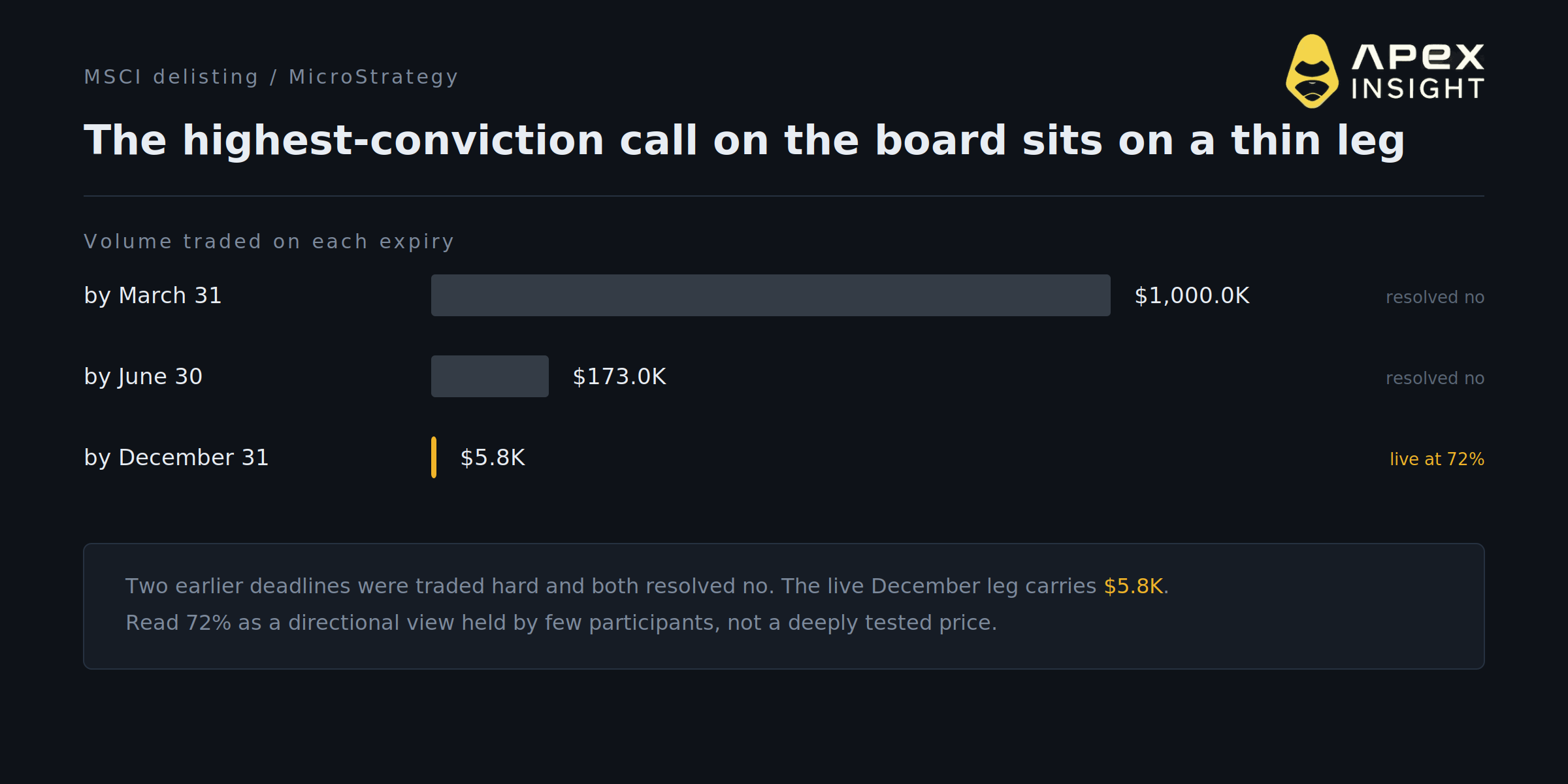
The market carries $1.18M in total volume, but almost all of it traded on two earlier deadlines that have both resolved no. The March leg took $1.0M. The June leg took $173K. The live December leg carries $5.8K.
So the 72 percent is real but lightly held. Treat it as a directional view from a small number of participants rather than a deeply tested price, and note the pattern it implies: the market has twice expected this to happen sooner than it did, and has twice been wrong on timing while holding the underlying view.
2. Bankruptcy prices below JetBlue and Xerox
The most useful bankruptcy market is the one that prices several companies against each other, because the resolution date and the participants are identical across every name.
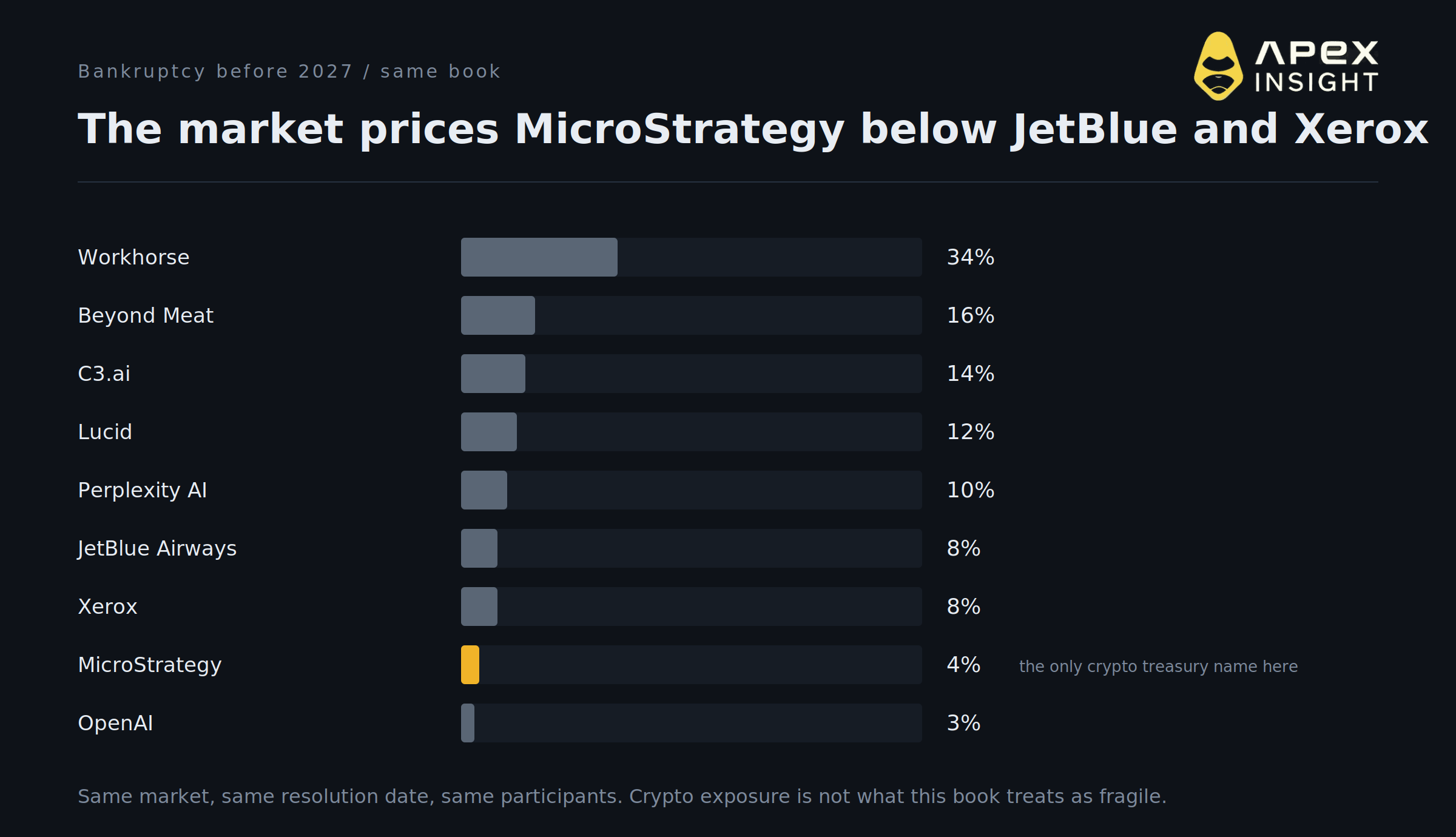
MicroStrategy prices at 4 percent in that book and 3 percent in its own standalone market on $191.8K of volume. Workhorse prices at 34 percent, Beyond Meat at 16, C3.ai at 14, Lucid at 12, JetBlue and Xerox at 8 apiece.
The crypto treasury company with a 74 percent equity drawdown is priced as less likely to fail than an airline and a printer manufacturer. Whatever the market thinks is wrong with the stock, insolvency is not on the list.
3. The forced-sale mechanism is not priced
The specific fear around leveraged treasury companies is a collateral spiral: the asset falls, the loans get marked down, the company is forced to sell into weakness.
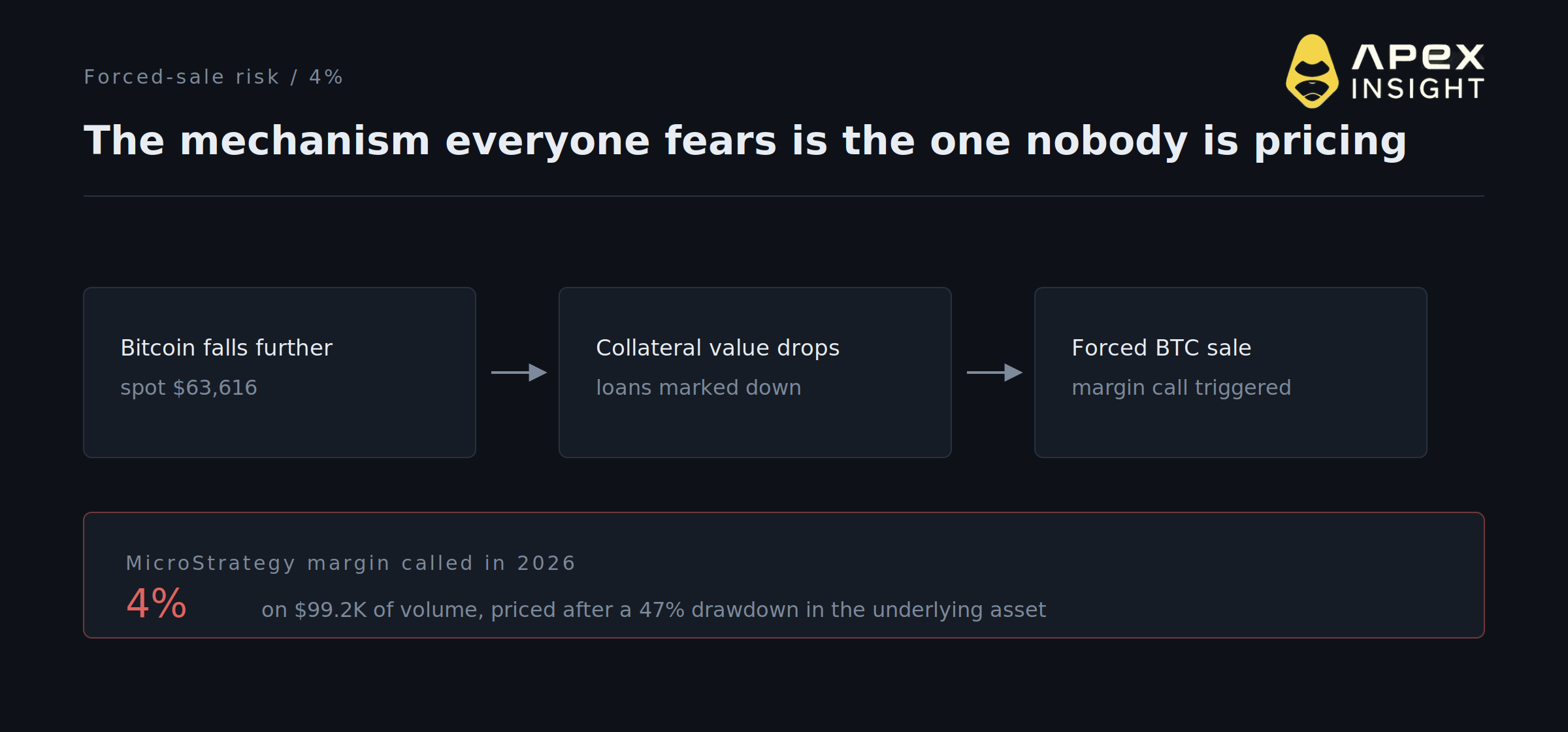
A margin call in 2026 prices at 4 percent on $99.2K of volume. That price exists after Bitcoin has already fallen 47 percent over twelve months, which is the condition under which the spiral was supposed to trigger.
This is the most testable claim in the article. If the mechanism were live, this contract should have repriced during the drawdown. It did not. Either the market is wrong about the capital structure, or the capital structure is more robust than the narrative assumes.
4. Accumulation is settled. The pace is not.
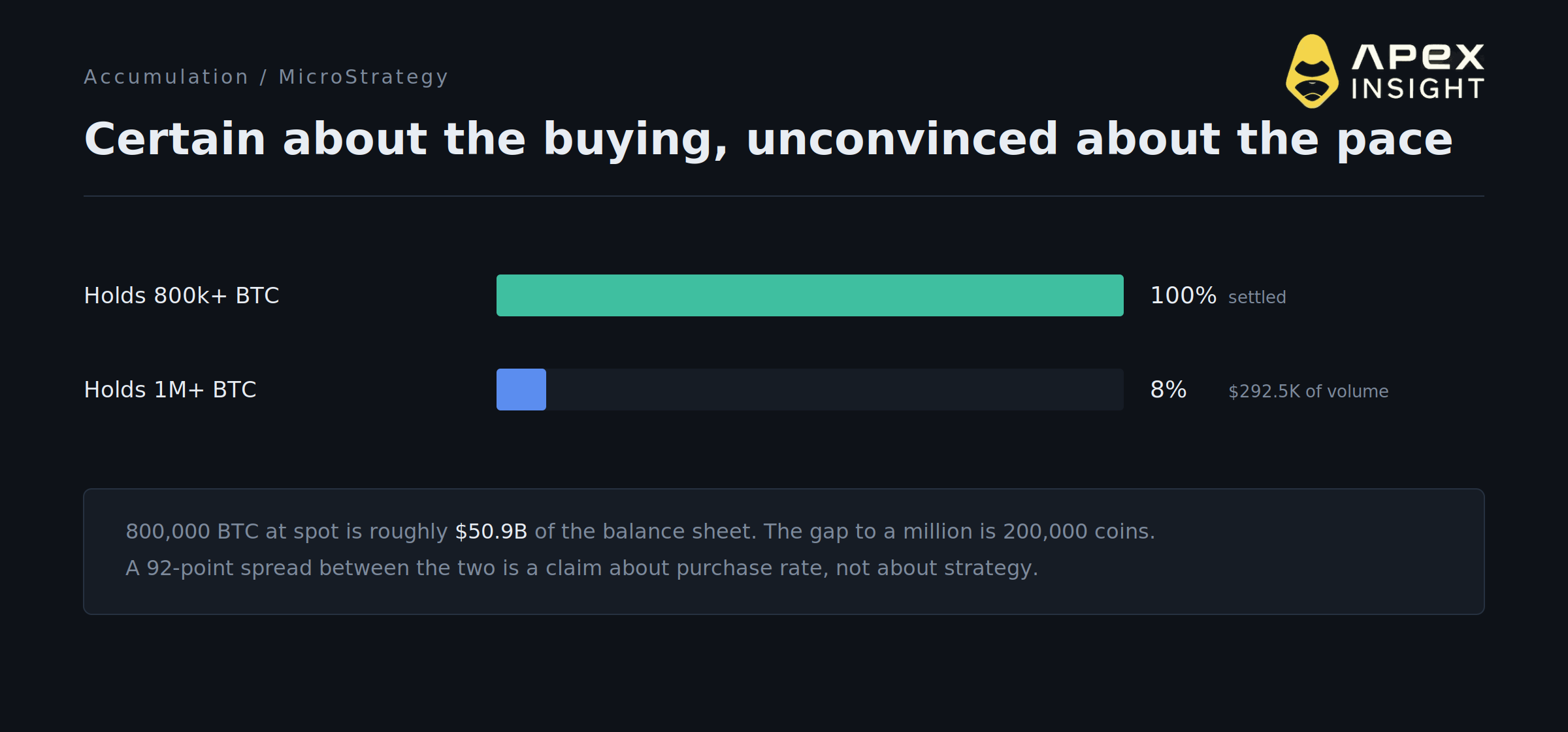
Holding 800,000 or more Bitcoin by December 31 sits settled at 100 percent. Holding a million or more prices at 8 percent on $292.5K.
At spot, 800,000 coins is roughly $50.9B of balance sheet. The gap between the two contracts is 200,000 coins inside four and a half months, and the 92-point spread between them is a claim about purchase rate rather than about the strategy itself.
For anyone modelling flows, that spread is the cleanest available read on how much buying the market expects from the single largest corporate buyer. The answer is: continued, but not accelerating.
5. The equity fell 1.6 times harder than the asset
MicroStrategy trades at $97.10 against a 52-week high of $372.62 and a low of $81.81. Bitcoin has fallen 46.9 percent over the same period, from $118,388 to $62,875. Coinbase has fallen 52.6 percent, Ethereum 58.9 percent.
A 1.6 times downside beta to the underlying asset is what a leveraged treasury vehicle is supposed to deliver, and it is delivering it. That is the product working as designed, in the direction nobody wanted.
The important point is that this is a re-rating of the premium, not a signal about solvency. Points 2 and 3 price the solvency question separately, and price it low. Holding both readings at once is the entire argument of this piece.
6. Legal and key-man risk price as tails
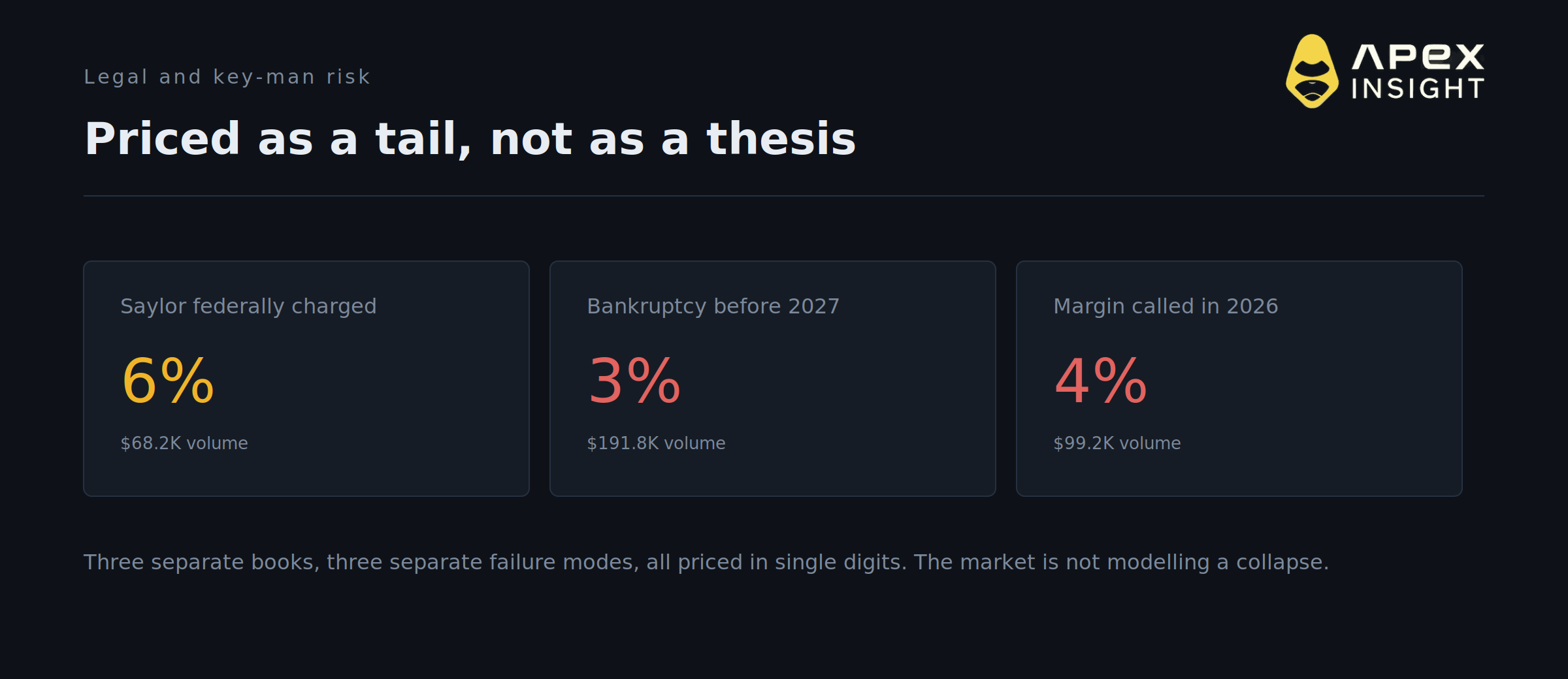
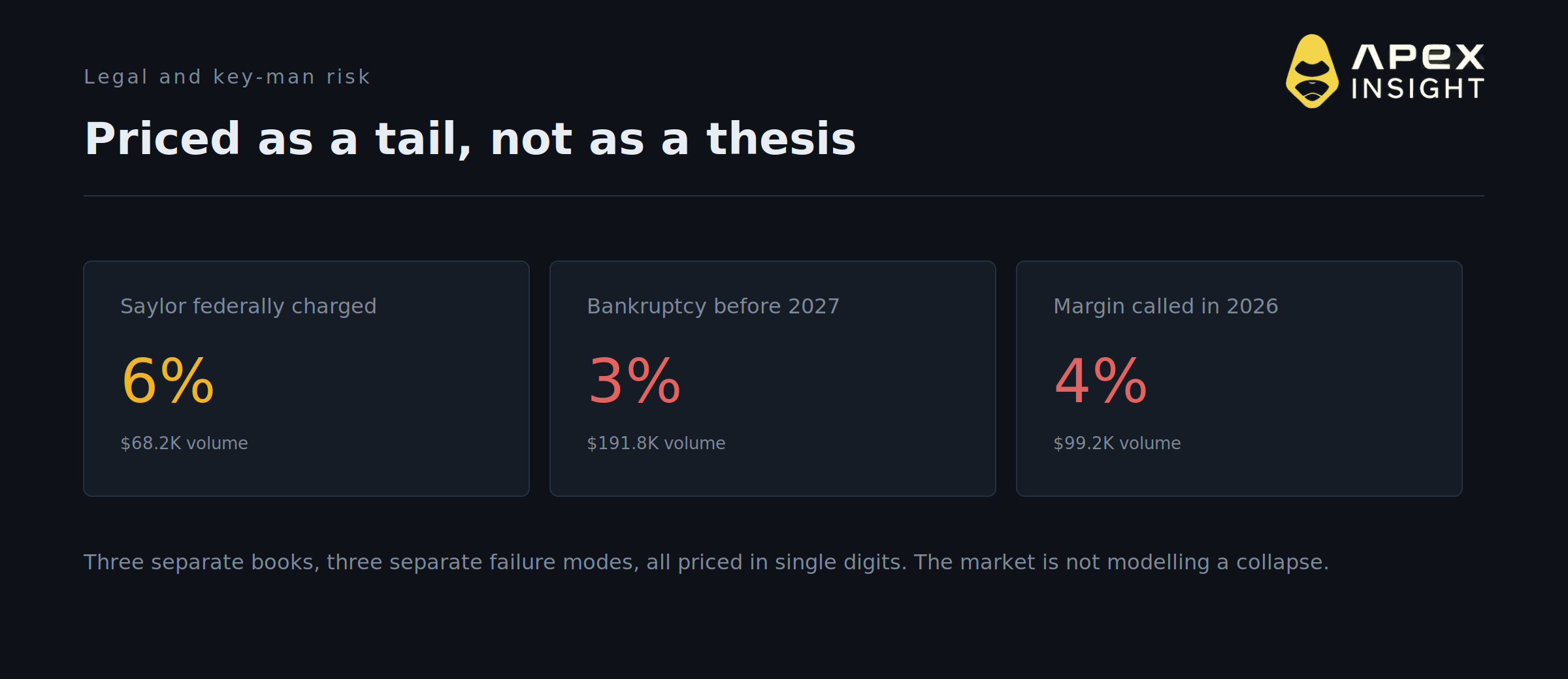
Michael Saylor being federally charged by December 31 prices at 6 percent on $68.2K. Bankruptcy prices at 3 percent. A margin call prices at 4 percent.
Three different failure modes, three separate books, all in single digits. Any thesis that requires two of them to land is running into the same joint probability problem that catches people out in election forecasting. Stacking two 5 percent events gets you to a quarter of a percent, not to 10 percent.
7. Bitmine is the same trade priced as a coin flip
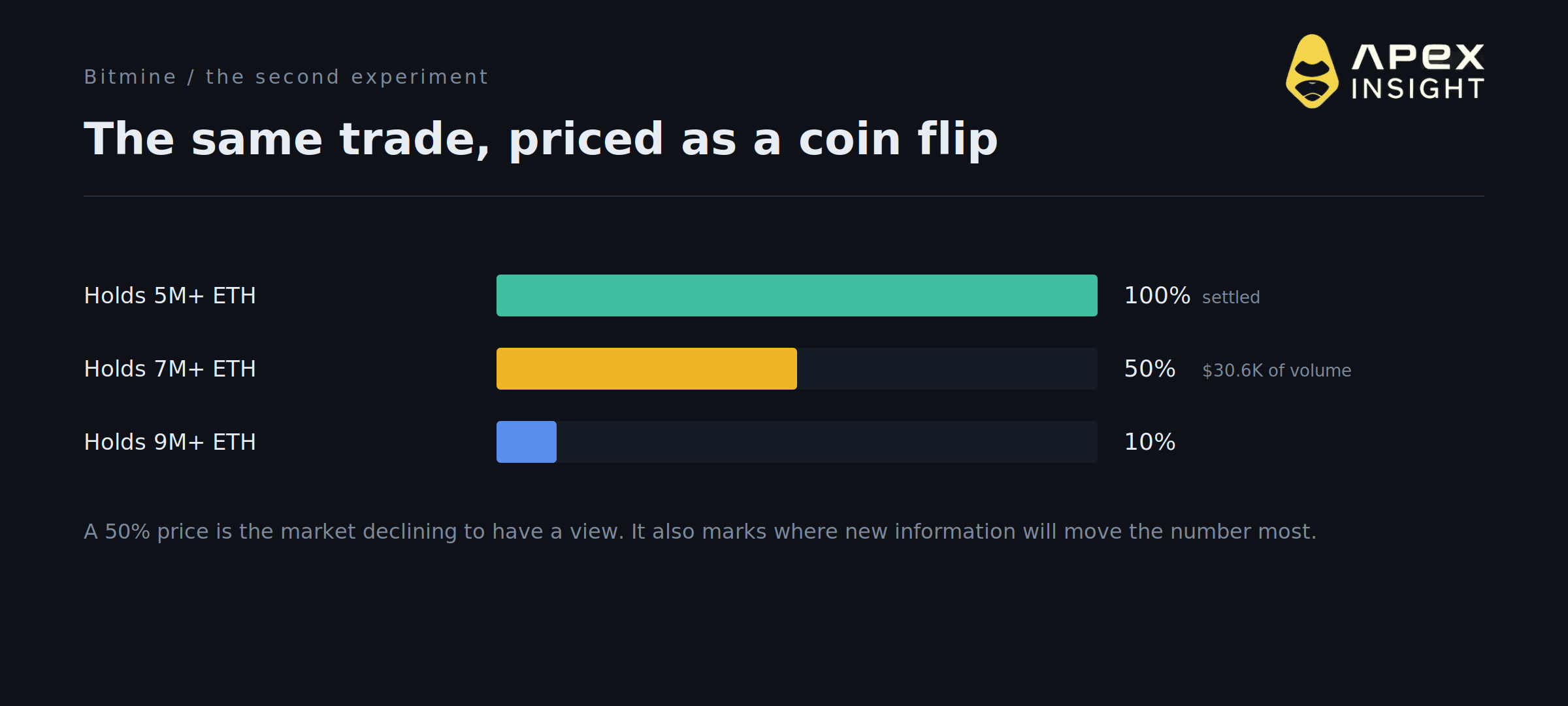
Bitmine holding more than 5M ETH is settled. More than 7M prices at 50 percent on $30.6K. More than 9M prices at 10 percent.
A price sitting exactly at 50 is the market declining to have a view, which makes it the most informative contract in this group. Everything settled or in single digits has finished repricing. This one has not, so it is where incremental information will move the number most.
It is also the Ethereum-denominated version of the MicroStrategy question, which makes it a useful control. If treasury companies as a category were being repriced, you would expect it to show here too. It is not showing.
8. The listing window prices shut for this year
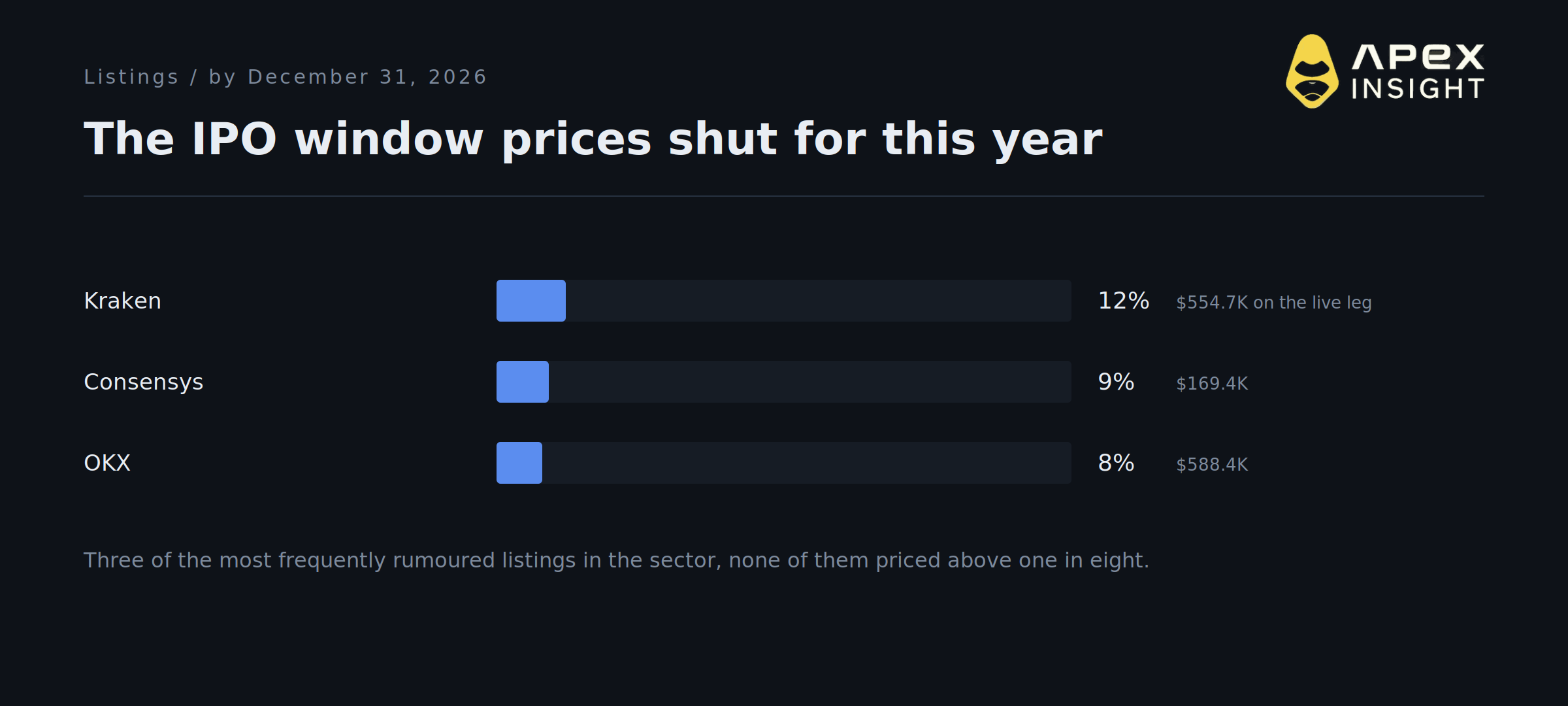
Kraken completing an IPO by December 31, 2026 prices at 12 percent, with $554.7K on the live leg. Consensys prices at 9 percent. OKX prices at 8 percent on $588.4K.
Three of the most persistently rumoured listings in the sector, none priced above one in eight. Note also that Kraken's earlier expiries, including March 2026, carried more volume than the live December leg and resolved no. Same pattern as the delisting market: the sector keeps expecting these events earlier than they arrive.
9. Kraken's valuation ladder points down
The listing probability tells you whether a deal happens. The valuation ladder tells you what the market thinks the business is worth in the meantime, and here the two are consistent.
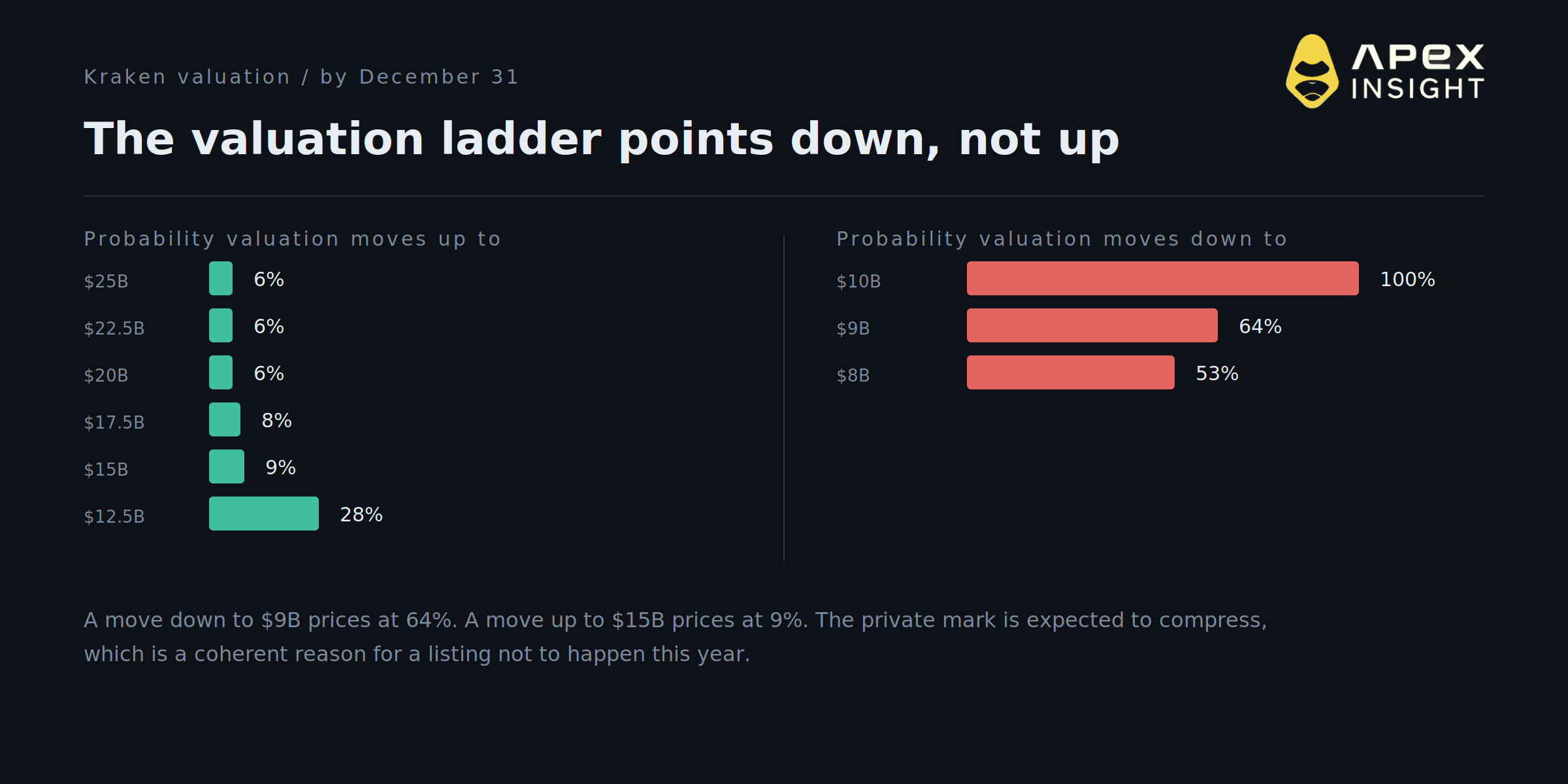
A move down to $10B is settled. Down to $9B prices at 64 percent, and down to $8B at 53 percent. On the upside, $12.5B prices at 28 percent, $15B at 9 percent, and everything above $17.5B sits between 6 and 8 percent.
Read together with point 8, this is coherent rather than contradictory. A company whose private mark is expected to compress is a company with a good reason not to list into this tape. The valuation ladder is effectively explaining the listing probability.
10. Corporates still outprice governments, under a hard ceiling
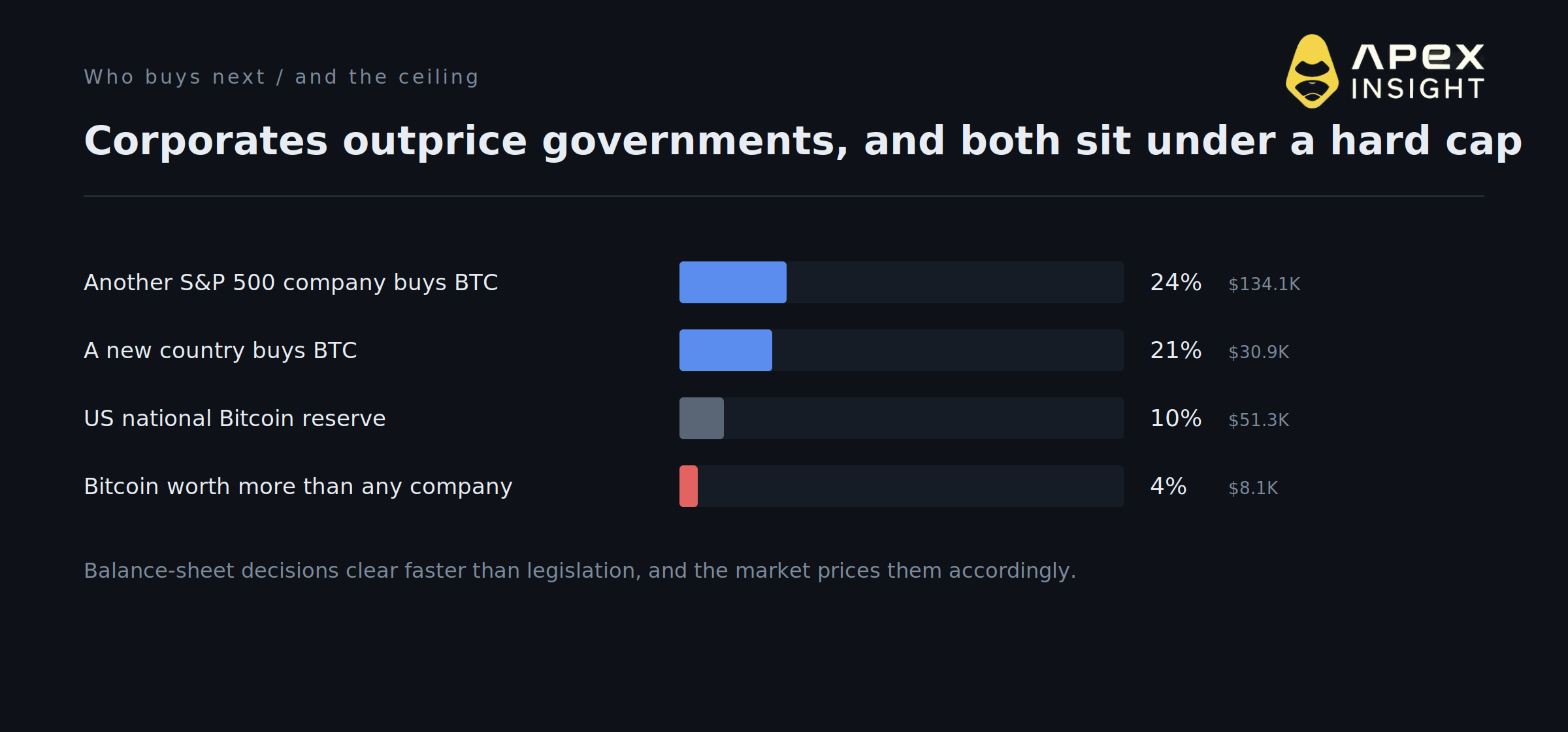
Another S&P 500 company buying Bitcoin by December 31 prices at 24 percent. A new sovereign buyer prices at 21 percent. A formal US reserve prices at 10 percent. Bitcoin becoming more valuable than any single company before 2027 prices at 4 percent.
Balance sheet decisions clear faster than legislation, and the ordering reflects that. The last contract is the ceiling on the whole complex: at a $1.28T market capitalisation, Bitcoin overtaking the largest listed company is priced as a tail event, which caps how far the corporate adoption story can run inside this timeframe.
What this adds up to
The market is making a distinction that most commentary does not. MicroStrategy's equity has been severely re-rated, and the market expects that re-rating to continue into an index exclusion. It does not expect insolvency, a forced sale, or an end to accumulation. Those are different questions with different answers, and conflating them produces a thesis the prices do not support in either direction.
The same discipline applies across the sector. Listings are priced shut for the year, and the valuation ladders explain why rather than contradicting it. The second treasury experiment prices as a genuine coin flip. Corporate buyers still price above sovereign ones.
Two things are worth watching from here. The first is whether the margin call contract moves at all on further Bitcoin weakness, because it has been conspicuously stable through a 47 percent drawdown. The second is the Bitmine 7M contract, which is the only number in this article sitting where new information can move it meaningfully.
Where to watch it
Every market in this article is live on ApeX Omni, where Polymarket's order books are integrated directly: the same liquidity and the same settlement source, minus the KYC. The board carries the full expiry structure rather than a single headline probability, so you can see which legs have resolved, which are live, and how much volume actually sits behind the number you are reading.
We appreciate your continued support.
Published by ApeX. For informational and educational purposes only. Not investment advice, and not a forecast or endorsement of any outcome. Trading involves risk, including total loss.