

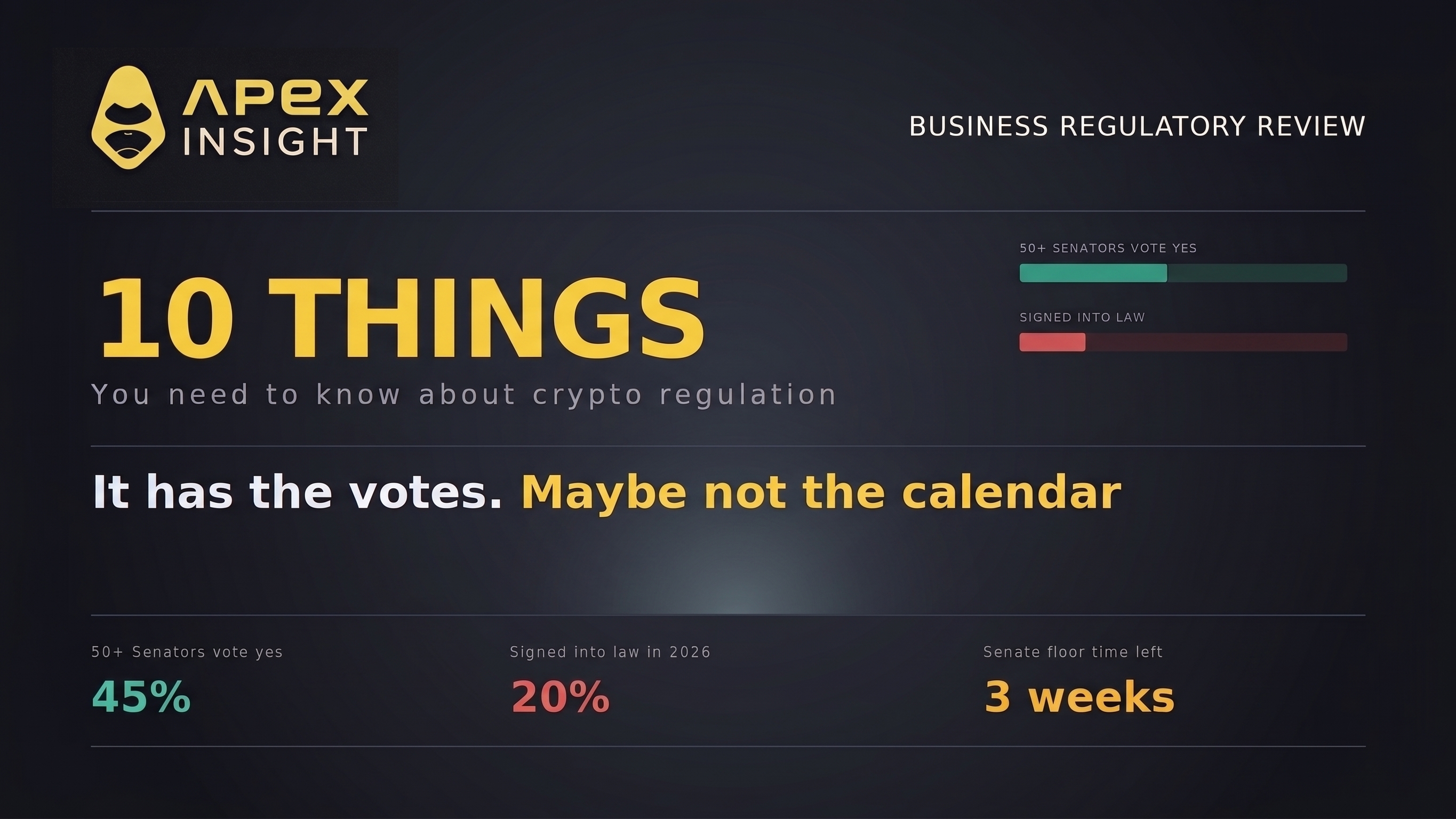
Note: All market prices are as of 13 August 2026 and legislative status as of 12 August. This is a fast-moving file: the September vote is scheduled, and any of these numbers can reprice on a single procedural announcement.
1. The votes and the law are priced very differently
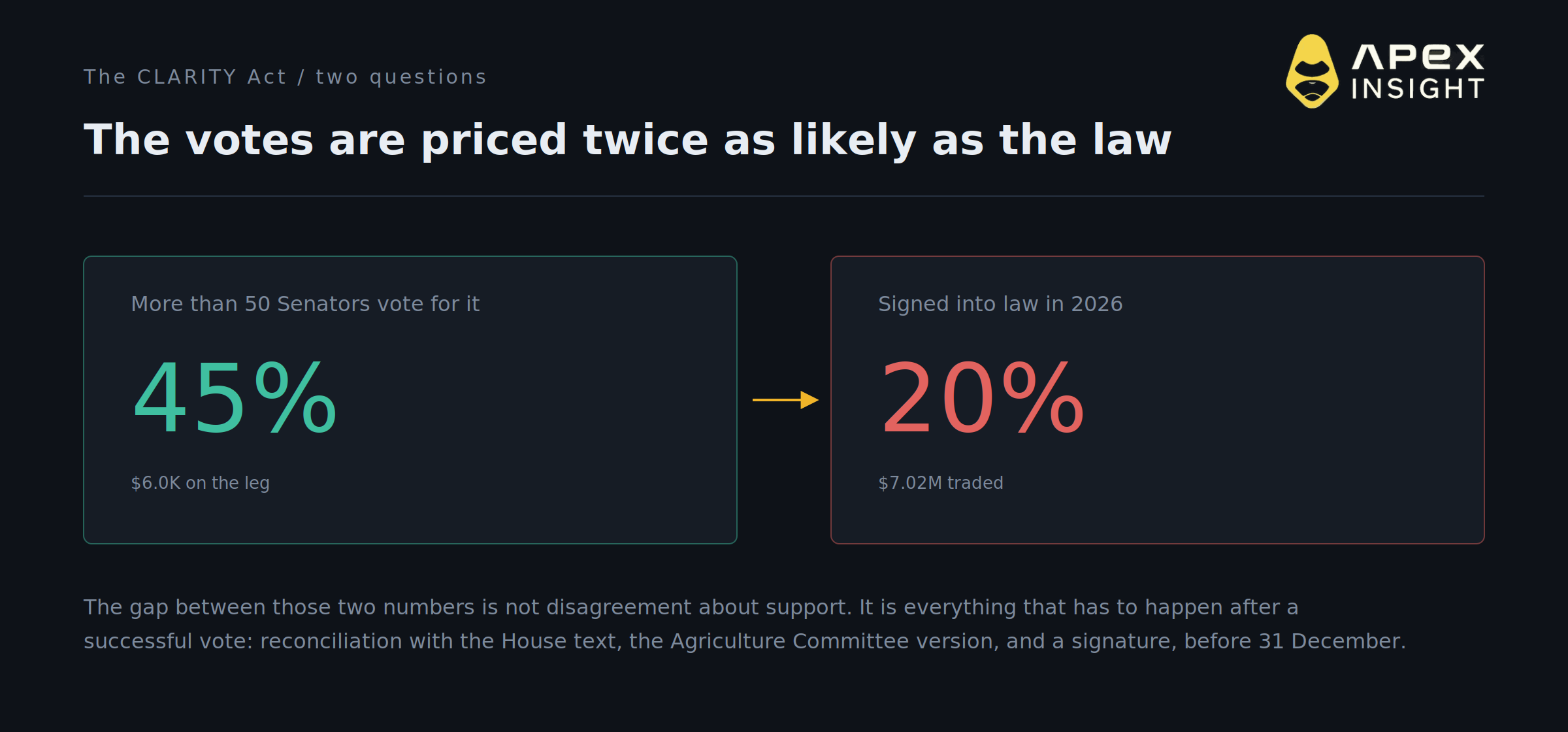
More than 50 Senators voting for the CLARITY Act prices at 45 percent. The Act being signed into law in 2026 prices at 20 percent on $7.02M, the deepest crypto policy book available.
A market that thought the bill lacked support would price both low. A market that thought passage was procedural would price both high. Pricing the vote at more than twice the law is a specific claim: the support is plausibly there, and the remaining risk sits in everything that happens after a successful floor vote.
That remainder is concrete. The Senate text merges the Banking and Agriculture Committee versions and still has to reconcile with the House-passed bill. Then it needs a signature. All of it has to fit inside what is left of the year.
2. The bill already cleared committee with votes to spare
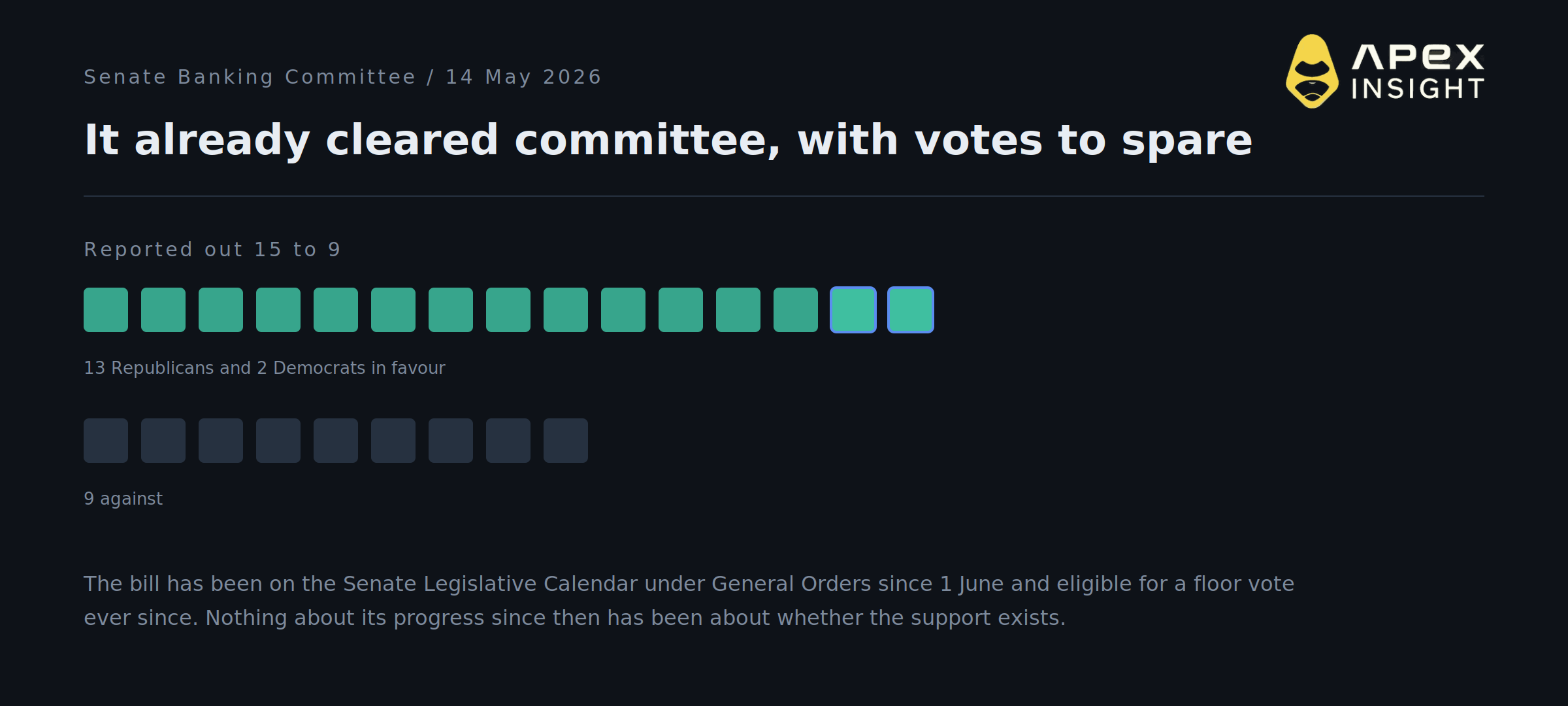
On 14 May the Senate Banking Committee reported the CLARITY Act out 15 to 9. All 13 Republicans voted yes, joined by two Democrats, though both signalled that a committee vote did not guarantee floor support without movement on outstanding issues.
Since 1 June the bill has been on the calendar and eligible for a vote. Nothing that has happened in the ten weeks since has been about whether the votes exist. It has been about floor time, sequencing against other legislation, and three unresolved disputes: government ethics and conflict-of-interest provisions, law enforcement language, and the treatment of DeFi.
3. The calendar is the binding constraint
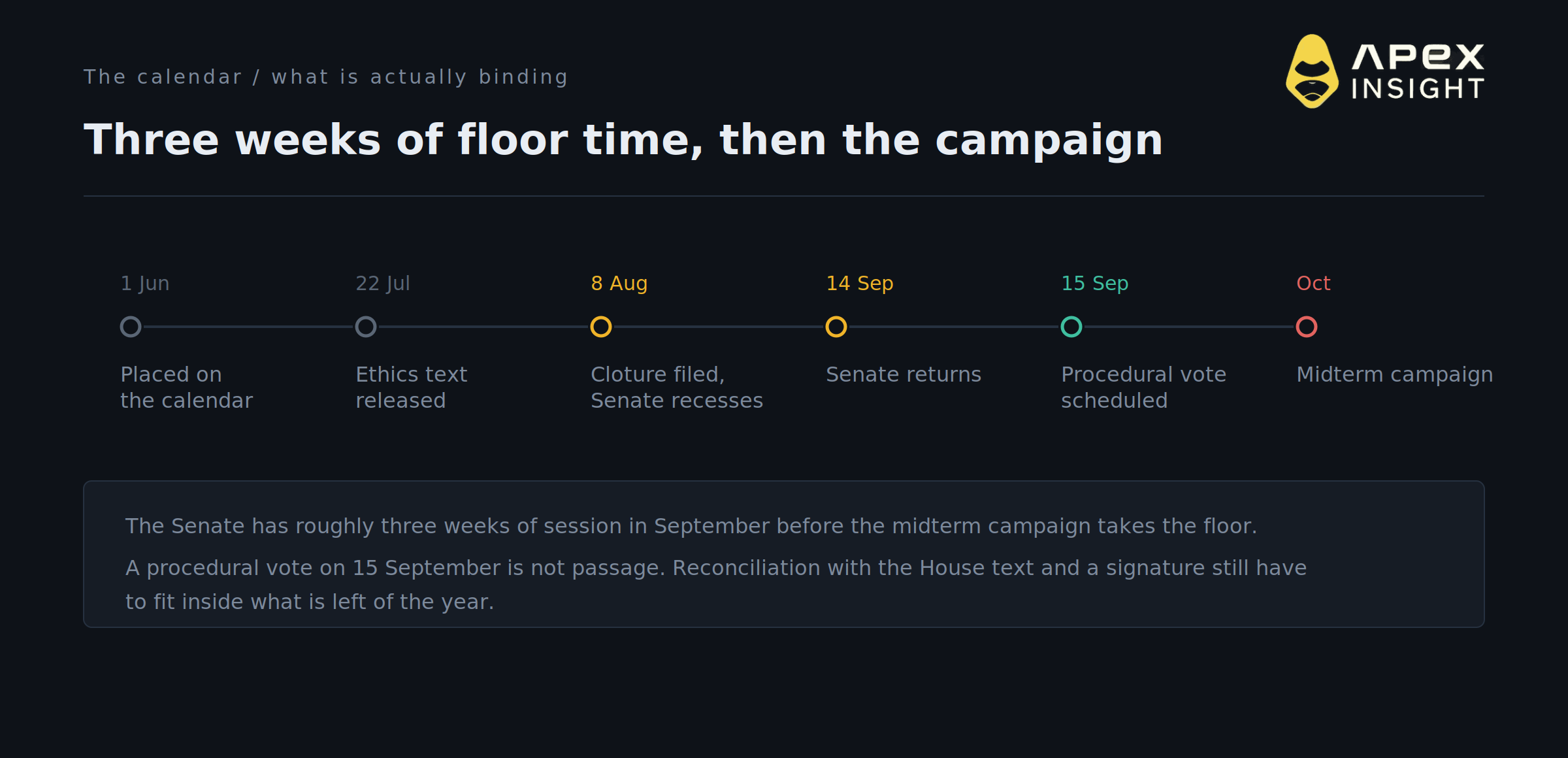
The sequence is now fixed enough to read directly. Thune said on 3 August a floor vote would happen before recess. It did not. On 8 August he filed cloture on the motion to proceed and the Senate recessed. It returns on 14 September with a procedural vote scheduled for the 15th, and has roughly three weeks of session before the midterm campaign consumes the calendar.
A cloture motion on a motion to proceed is two procedural steps below passage. From there the bill needs a successful vote, reconciliation across two Senate committee texts and the House version, and a presidential signature.
Lobbyists have floated attaching CLARITY to must-pass year-end legislation if September fails, though no senator has confirmed it. That path is not separately priced anywhere, which means the 20 percent is carrying it implicitly.
4. No individual Senator prices above 40 percent
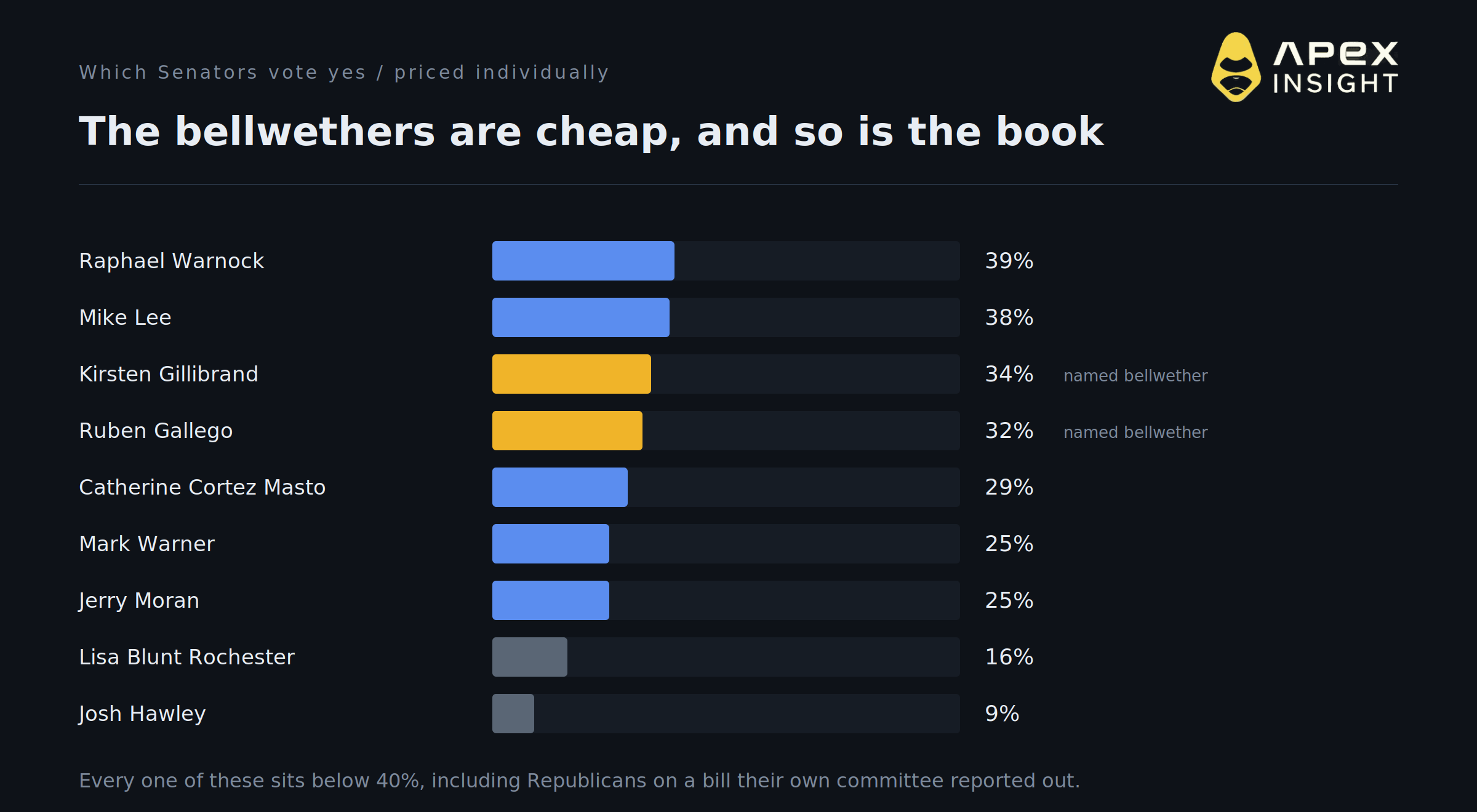
Individual Senator contracts price Raphael Warnock at 39 percent, Mike Lee at 38, Kirsten Gillibrand at 34, Ruben Gallego at 32, Catherine Cortez Masto at 29, Mark Warner and Jerry Moran at 25 each, Lisa Blunt Rochester at 16 and Josh Hawley at 9.
Gillibrand and Gallego are worth watching specifically, since both have been identified as bellwethers for how Democrats respond to the July ethics language. Their prices are the closest thing available to a live read on whether that dispute is closing.
Note the shape rather than the levels: not one contract, Republican or Democrat, prices above 40 percent on a bill their own committee reported out three months ago. That is consistent with a market pricing the vote never happening rather than the vote failing.
5. The vote-count ladder is too thin to read as a forecast
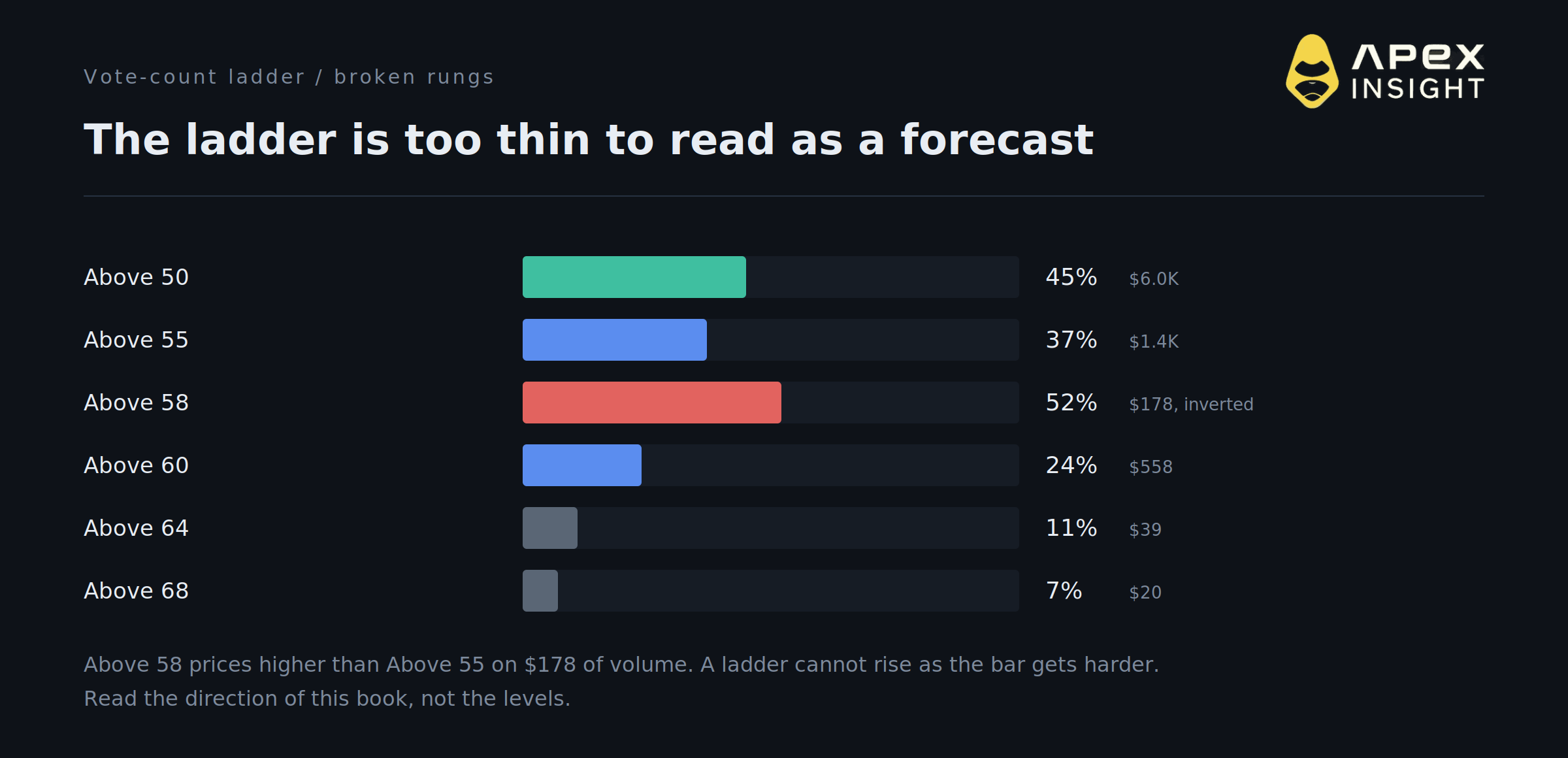
More than 50 Senators prices at 45 percent on $6.0K. More than 55 prices at 37 percent on $1.4K. More than 58 prices at 52 percent on $178.
That last one cannot be right. A ladder cannot rise as the bar gets harder, and a contract on 58 Senators should never price above one on 55. On $178 of volume, this is a stale quote rather than a view.
The broader point applies to this entire section of the board. The headline CLARITY market carries $7.02M. Every sub-market attached to it carries four figures or less. Use the sub-markets for direction and structure, and the headline market for anything you would act on.
6. Two independent books land on the same number
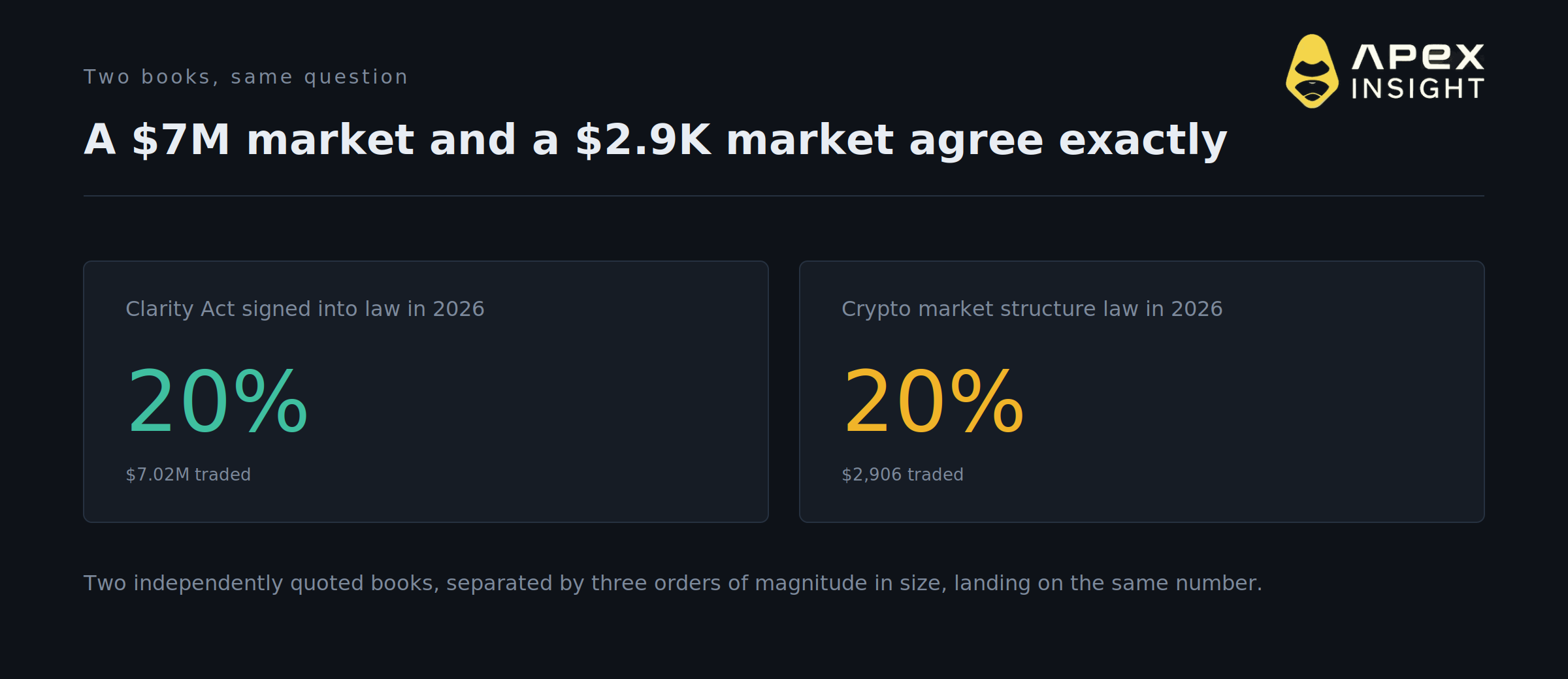
The CLARITY Act being signed into law in 2026 prices at 20 percent on $7.02M. A separate, much smaller market on crypto market structure legislation becoming law in 2026 prices at 20 percent on $2,906.
Two books quoted independently, separated by three orders of magnitude in size, arriving at the same figure. That is the strongest available evidence the headline number is not an artefact of one crowd, and it is a useful check to run whenever a single market is carrying an entire narrative.
7. The policy wish list prices in single digits
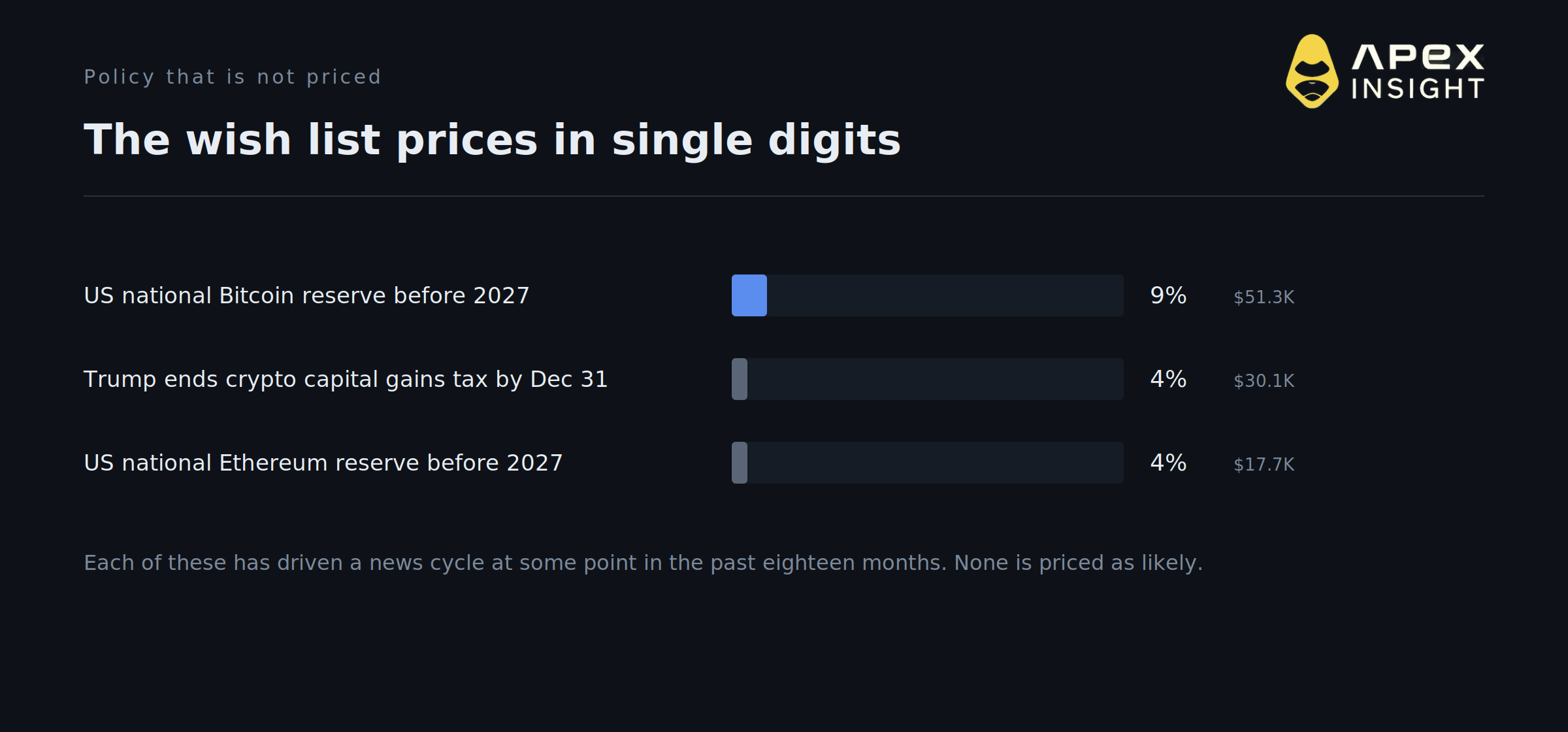
A US national Bitcoin reserve before 2027 prices at 9 percent on $51.3K. Trump eliminating capital gains tax on crypto by 31 December prices at 4 percent. A national Ethereum reserve prices at 4 percent.
Each of these has driven a news cycle in the past eighteen months. None is priced as more than a tail. The distinction worth carrying is that market structure legislation is a calendar problem with real machinery behind it, while these are policy aspirations with no comparable process underway.
8. A settled question can still be an expensive one
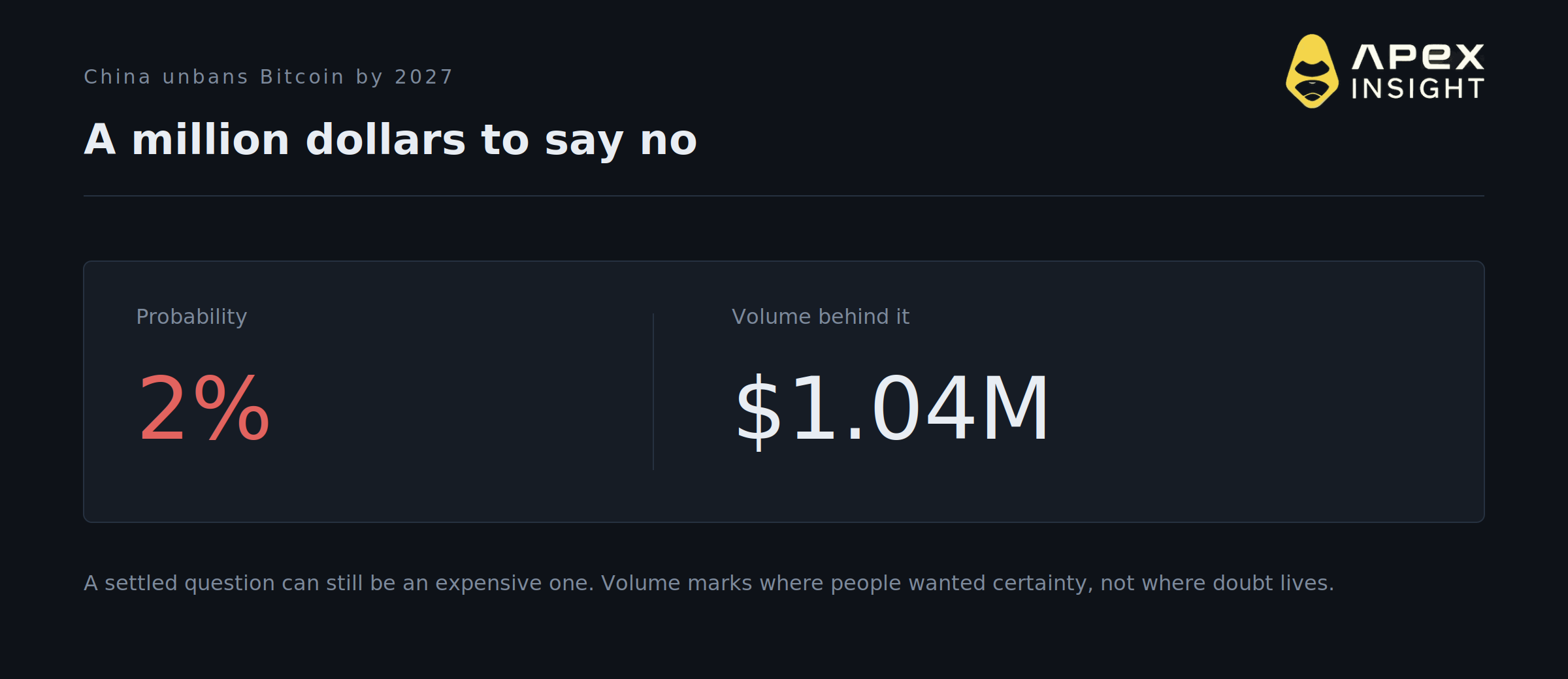
China unbanning Bitcoin by 2027 prices at 2 percent and carries $1.04M in volume.
A million dollars has traded a question the market considers effectively closed. That is not irrational. Volume accumulates where people want certainty or protection, not only where the outcome is uncertain, and this contract has served as a cheap hedge against a genuinely regime-changing event.
It is also a caution against ranking markets by volume to find the interesting ones. On this board, the deepest contract outside CLARITY is also the one with the least remaining uncertainty.
9. Attention and probability are different currencies
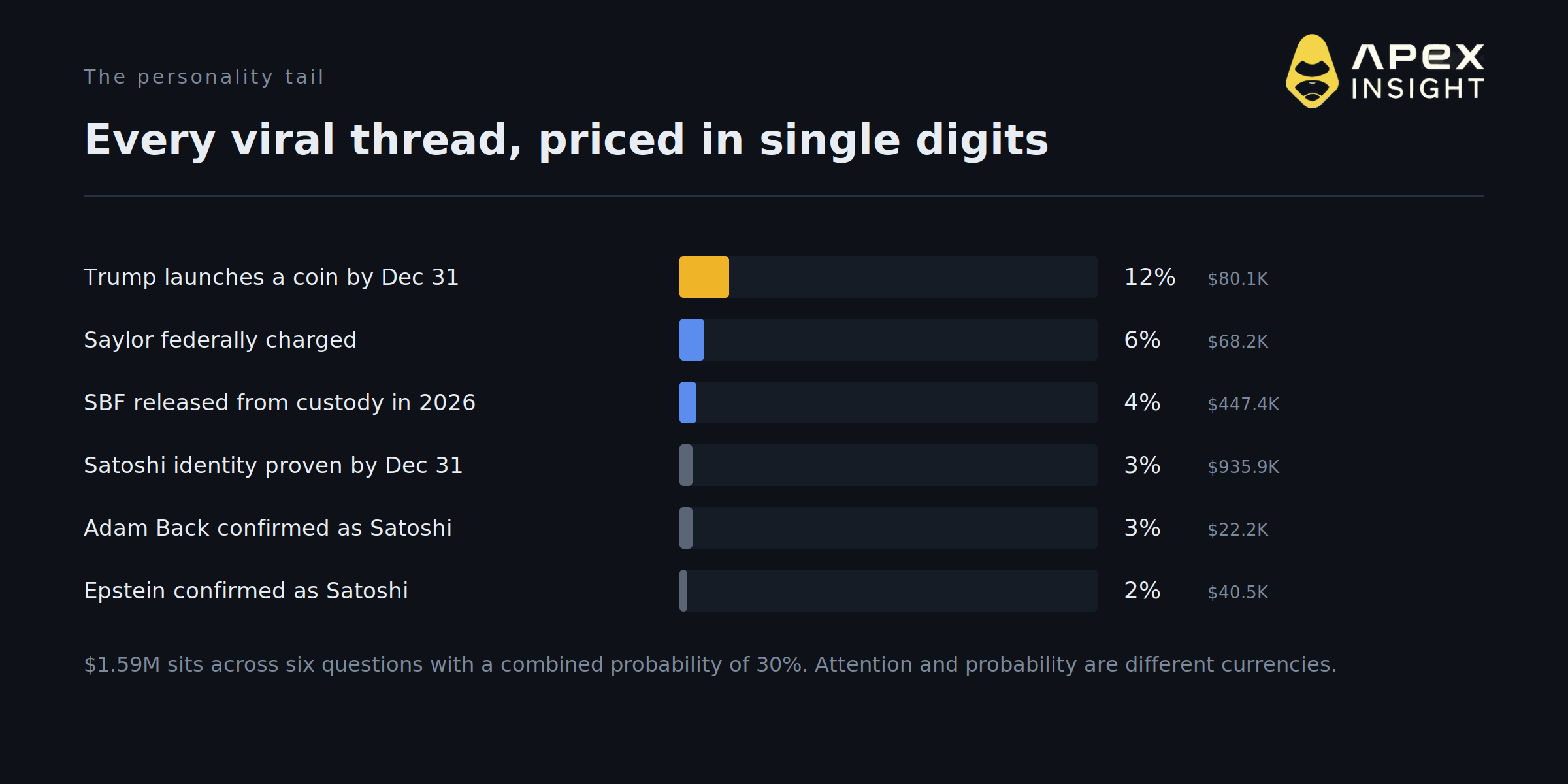
Trump launching a coin by 31 December prices at 12 percent. Michael Saylor being federally charged prices at 6 percent. SBF being released from custody in 2026 prices at 4 percent on $447.4K. Satoshi's identity being proven prices at 3 percent on $935.9K, with Adam Back at 3 percent and Epstein at 2 percent.
Roughly $1.59M sits across six questions with a combined probability around 30 percent. Every one of them has produced a viral thread at some point this year.
None of that makes the prices wrong. Low-probability events resolve at their stated rate, and a 4 percent contract that comes in was never mispriced. But if a thesis needs two of these to land, the joint probability is a fraction of a percent, not the sum of the parts.
10. The genuinely live policy market is in California
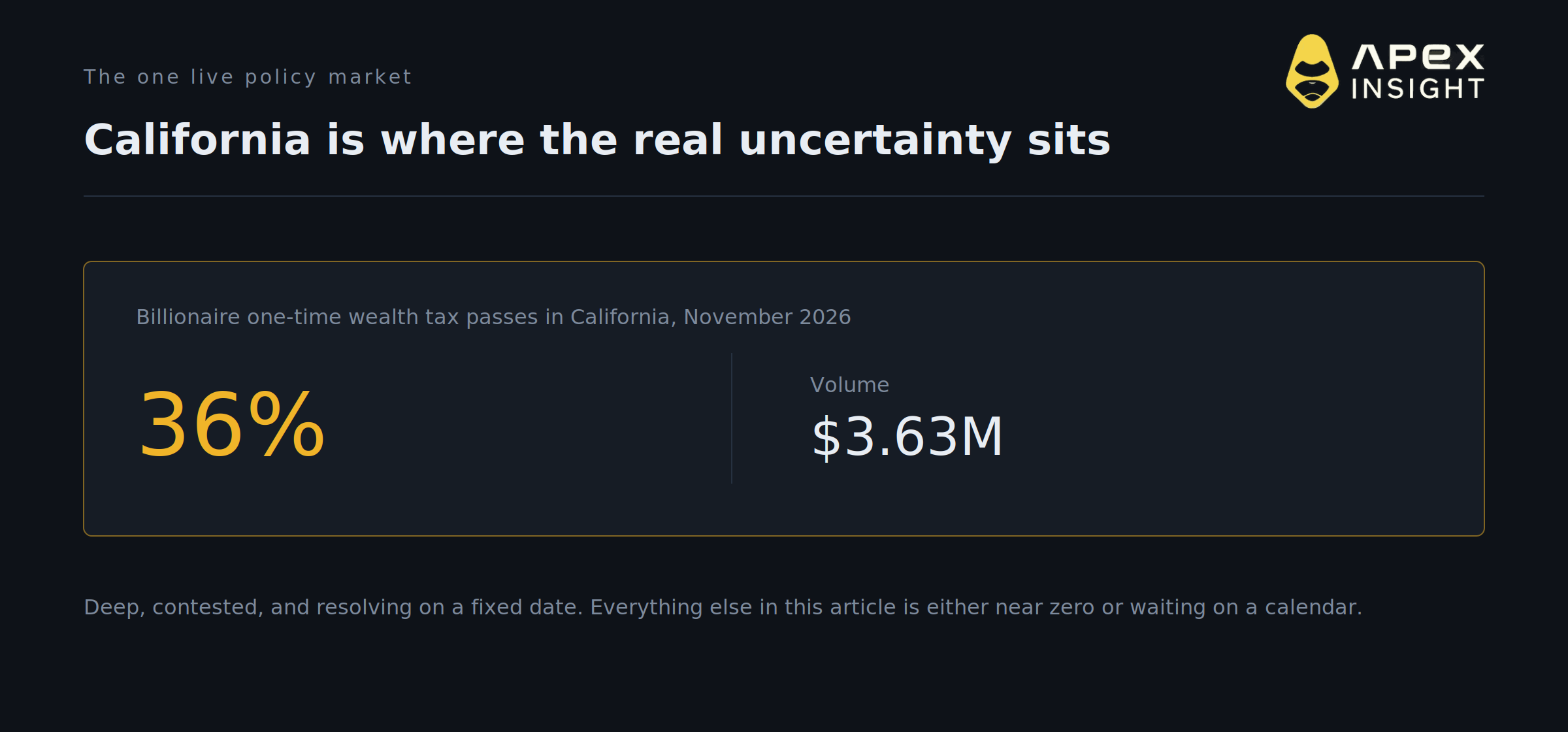
The billionaire one-time wealth tax on the California ballot in November prices at 36 percent on $3.63M.
That is the only policy market in this article that is simultaneously deep, genuinely contested, and resolving on a fixed date that cannot slip. Everything else here is either priced near zero or waiting on a legislative calendar that has already moved several times.
For anyone tracking policy risk to crypto holdings, the state ballot is the near-term event with a hard deadline, and the federal file is the one where the date keeps moving. Most coverage has that ordering reversed.
What this adds up to
The CLARITY Act is not stalled for lack of support. It cleared committee with bipartisan votes, has been eligible for a floor vote since June, and has a procedural vote scheduled for 15 September. What it lacks is runway: three weeks of session, three unresolved disputes, a reconciliation across three versions of the text, and a midterm campaign closing the window behind it.
That is why the vote prices at 45 percent and the law at 20. Anyone reading the second number as scepticism about crypto legislation is reading a calendar as a headcount.
Two things to watch. Whether the 15 September procedural vote converts into an actual floor vote, since that is the step the 20 percent is most sensitive to. And whether Gillibrand and Gallego reprice, because those two contracts are the cheapest available read on whether the ethics dispute is closing.
Where to watch it
Every market in this article is live on ApeX Omni, where Polymarket's order books are integrated directly: the same liquidity and the same settlement source, minus the KYC. The board carries the headline legislation contract alongside the vote-count ladder and the individual Senator markets, with the volume behind each one visible, so you can tell in a glance which numbers are deep enough to act on and which are a single stale quote.
We appreciate your continued support.
Published by ApeX. For informational and educational purposes only. Not investment advice, and not a forecast or endorsement of any political or policy outcome. Trading involves risk, including total loss.