




Note: All market prices are as of 19 August 2026 and reported events as of that date. This is a live book with a December expiry, so the numbers below will move.
1. It is the biggest question on the board that nobody is answering
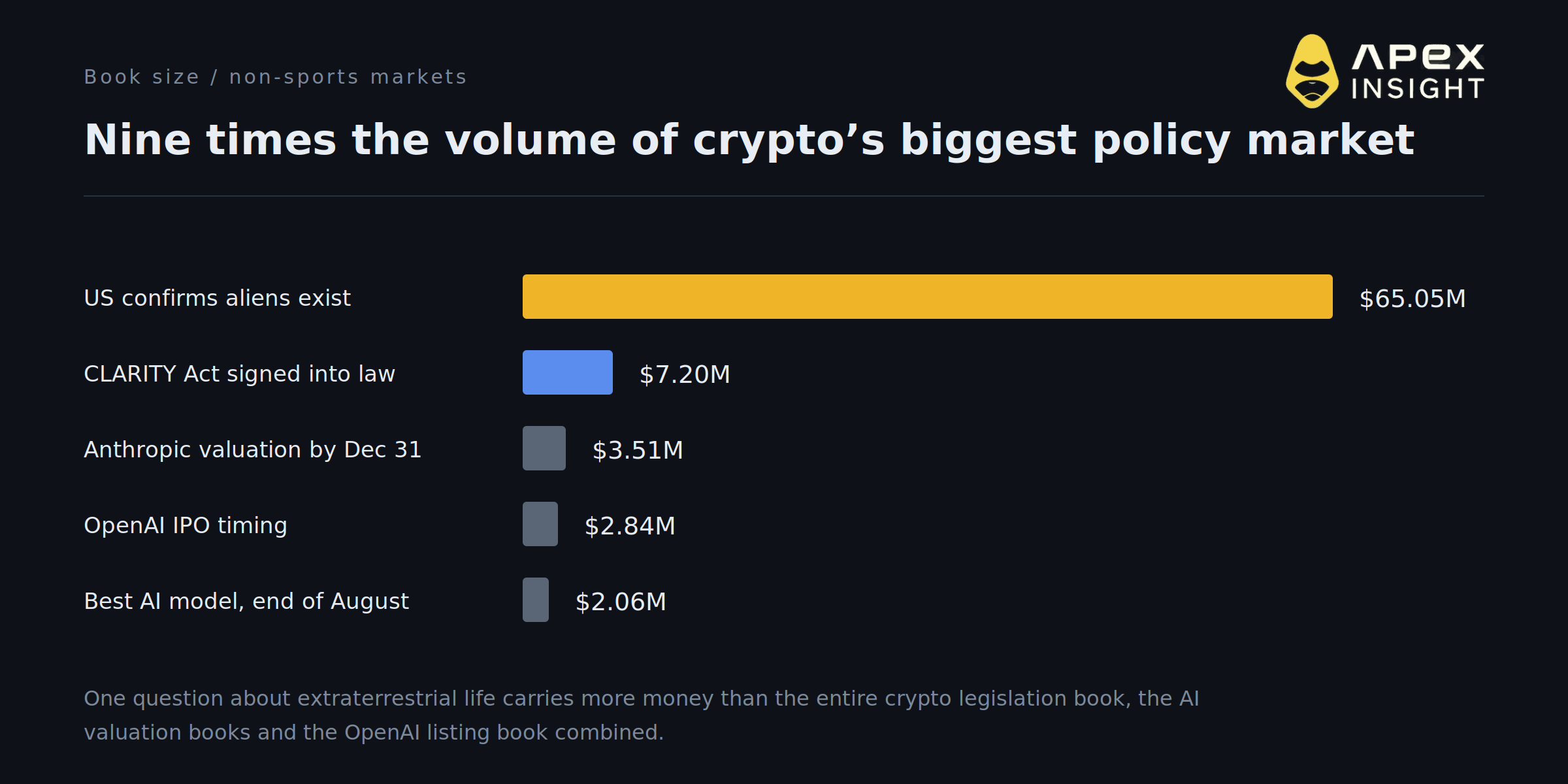
The alien confirmation book carries $65.05M. For comparison, the CLARITY Act carries $7.20M, the Anthropic valuation ladder $3.51M, the OpenAI listing book $2.84M and the best-AI-model market $2.06M.
One question about extraterrestrial life carries more capital than crypto's most consequential legislation and the entire AI complex put together. Whatever else is true, this is not a novelty corner of the platform.
2. The bar is a named official, not a headline
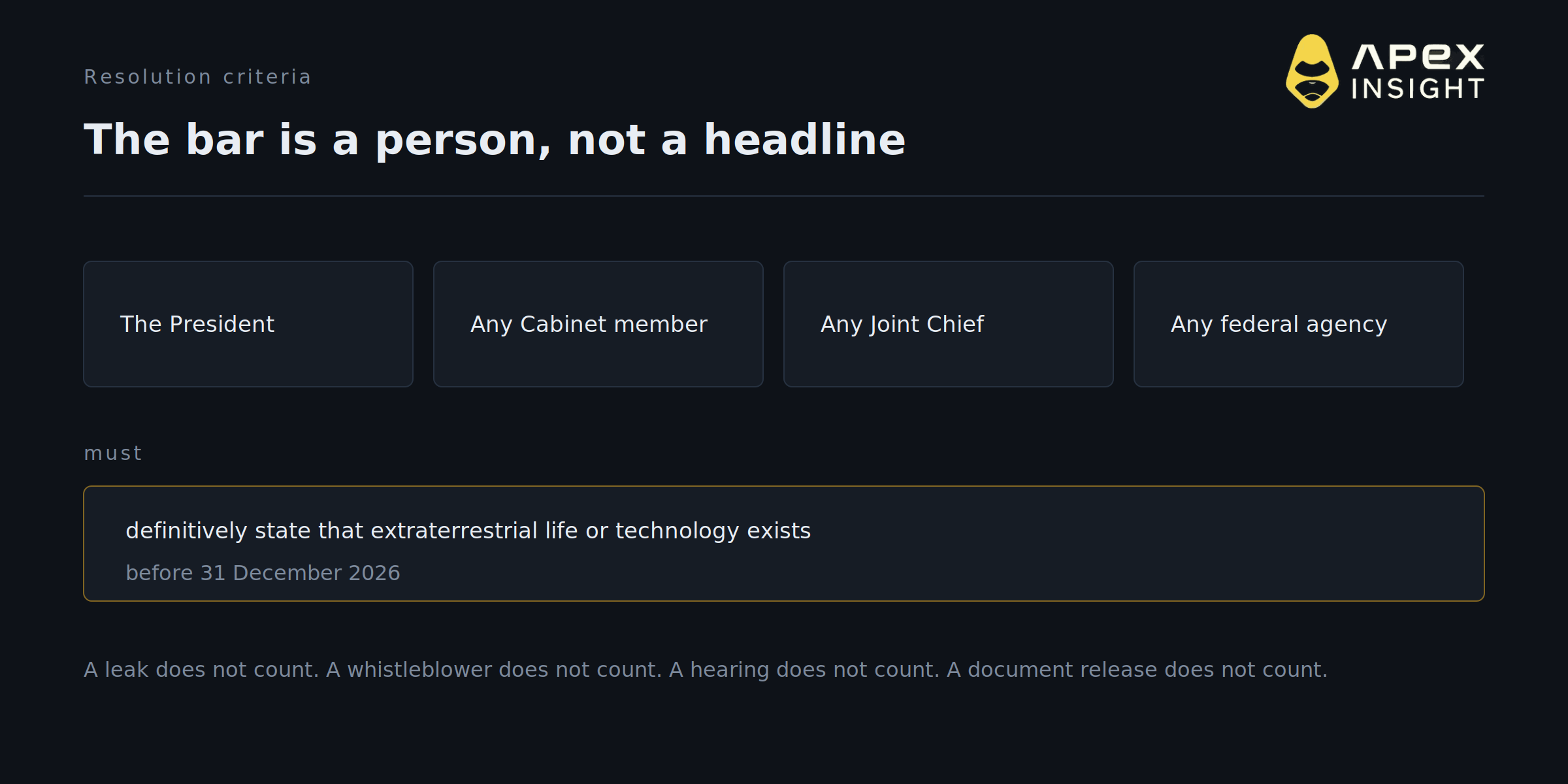
The resolution text is narrow and worth reading in full before forming any view. The contract resolves yes only if the President, any member of the Cabinet, any member of the Joint Chiefs of Staff, or any US federal agency definitively states that extraterrestrial life or technology exists.
That excludes a great deal. A whistleblower's testimony does not count. A congressional hearing does not count. A leaked document does not count. A retired official speaking on a podcast does not count. Even a full document release does not count unless someone in that specific set says the words.
Nearly every headline that has moved this topic in the past two years falls outside the resolution criteria. That is not the market being pedantic, it is the market pricing a much harder question than the one most coverage is answering.
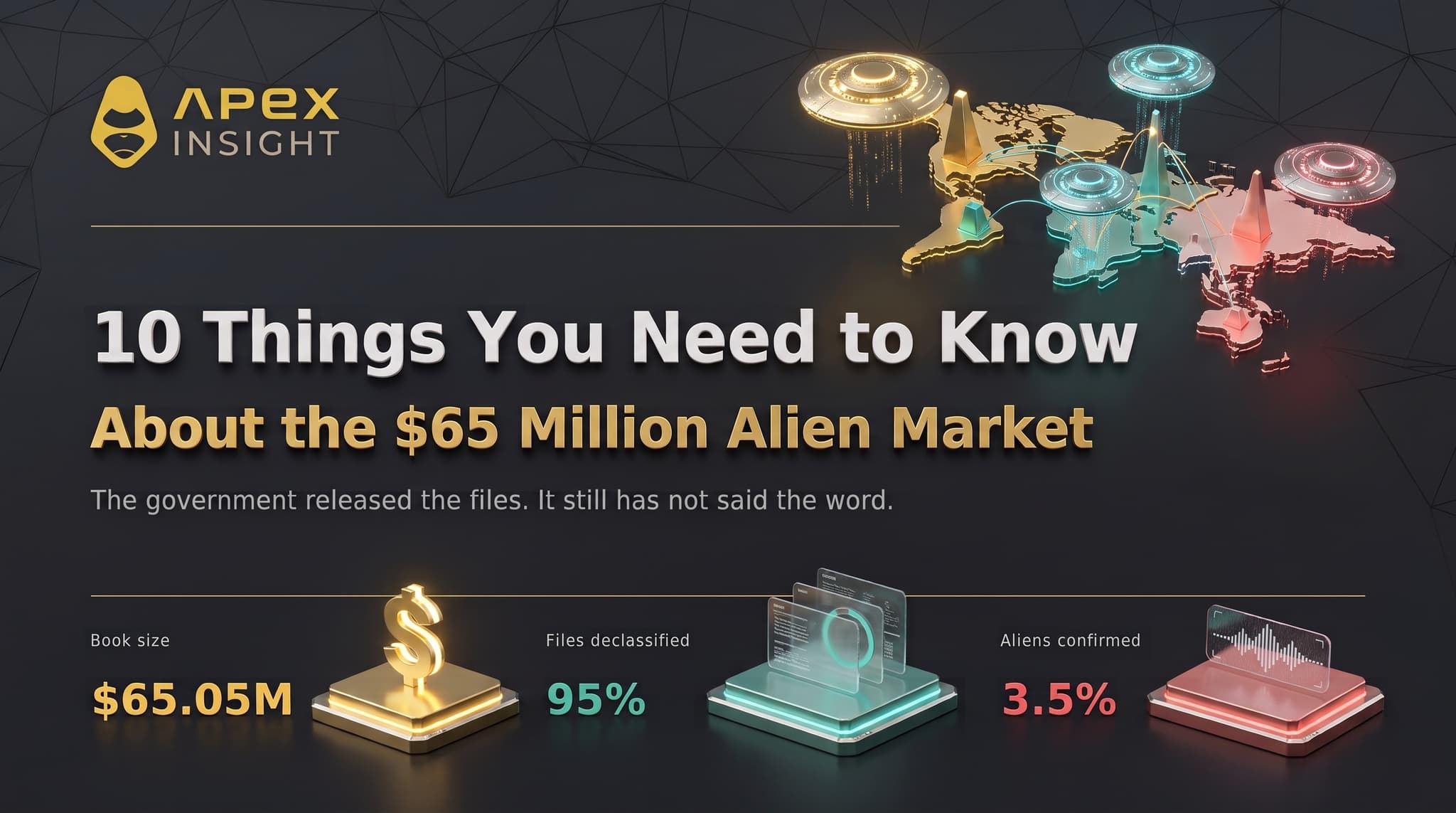
3. Disclosure prices at 95 percent, confirmation at 3.5
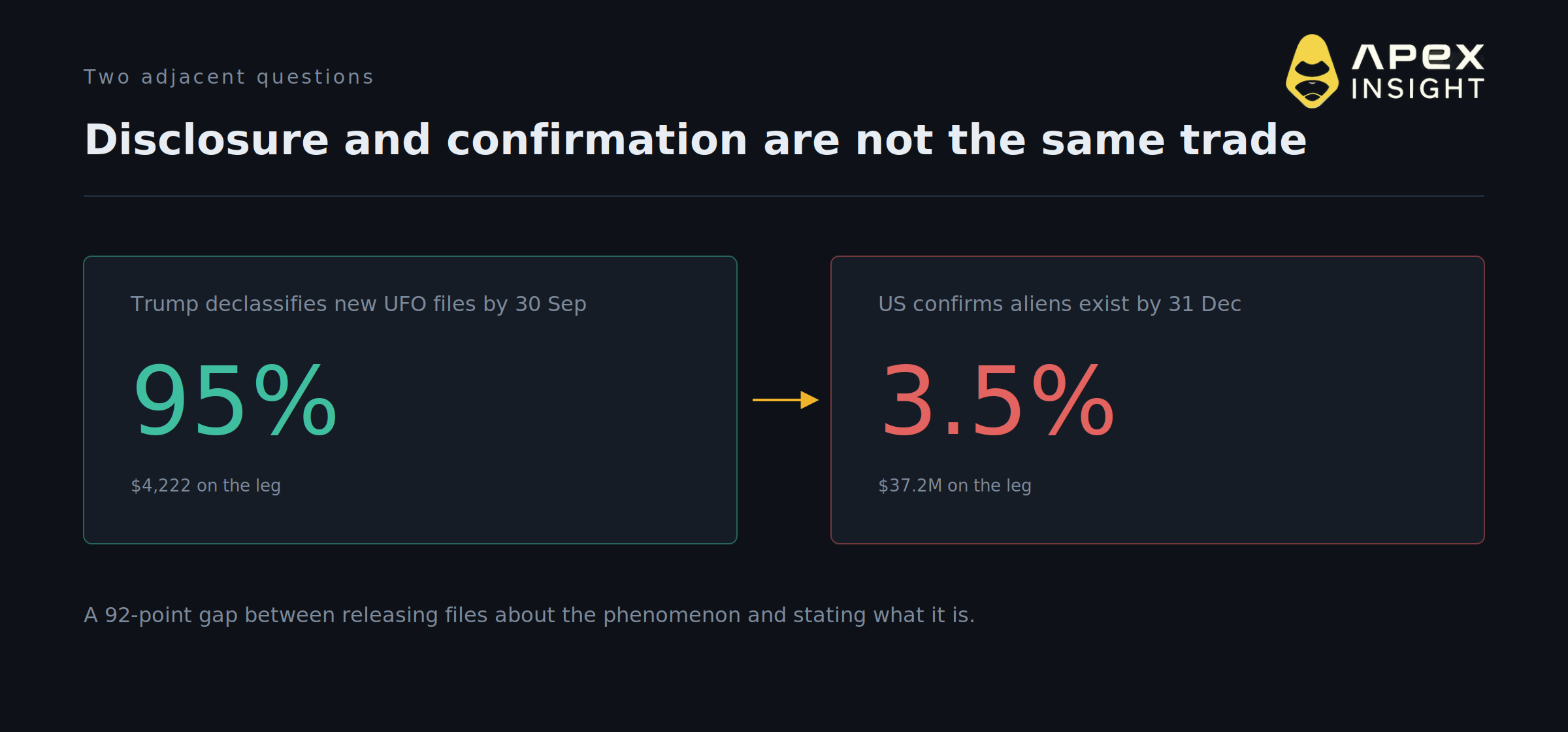
The Trump administration declassifying new UFO files by 30 September prices at 95 percent. The United States confirming aliens exist by 31 December prices at 3.5 percent.
A 92-point gap between releasing files about the phenomenon and stating what the phenomenon is.
This is the same structural error that recurs across the board in other forms: an airdrop is not a token launch, a committee vote is not a law, and a document release is not a confirmation. Each pair looks adjacent and resolves on completely different conditions. Anyone treating the disclosure trend as evidence for the confirmation contract is trading the wrong instrument.
4. The disclosure already happened, and the price did not move
This is the part that makes the 3.5 percent interesting rather than dismissive.
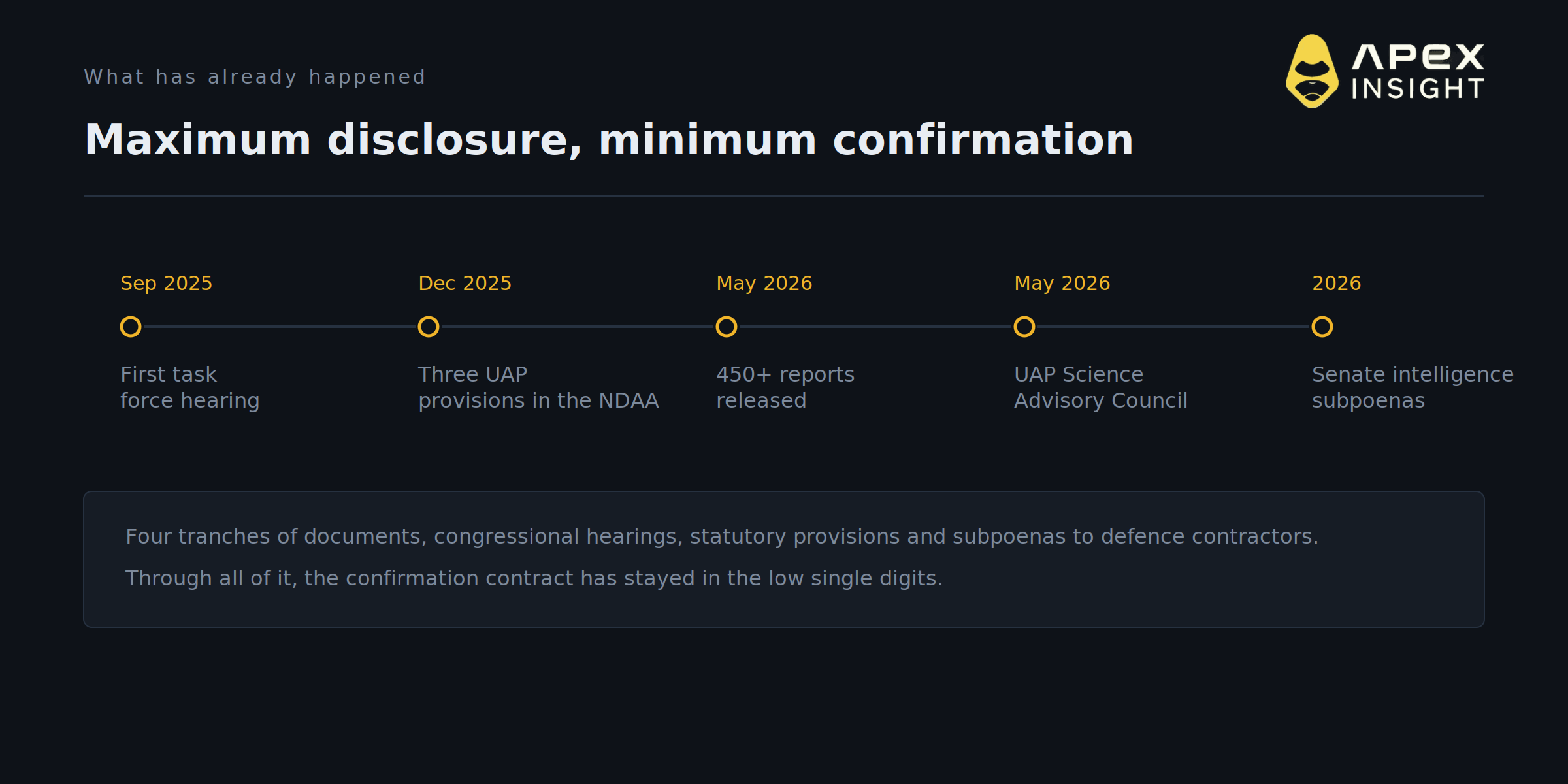
In September 2025 the House Task Force on the Declassification of Federal Secrets held its first hearing dedicated to UAP transparency and whistleblower protection. Three UAP provisions went into the FY26 defence authorisation. On 8 May 2026 the administration began a serial release of four tranches totalling more than 450 official reports, posted publicly on a Department of Defense site. A UAP Science Advisory Council was formed. The Senate Select Committee on Intelligence issued subpoenas to private defence contractors believed to hold legacy programmes outside normal oversight.
By any reasonable measure, 2026 has been the most active year of official UAP disclosure on record. Through all of it, the confirmation contract has stayed in the low single digits.
A market that does not move on the biggest news flow in a file's history is telling you something specific: it never thought that news flow was the relevant variable.
5. Five deadlines have passed and all resolved no
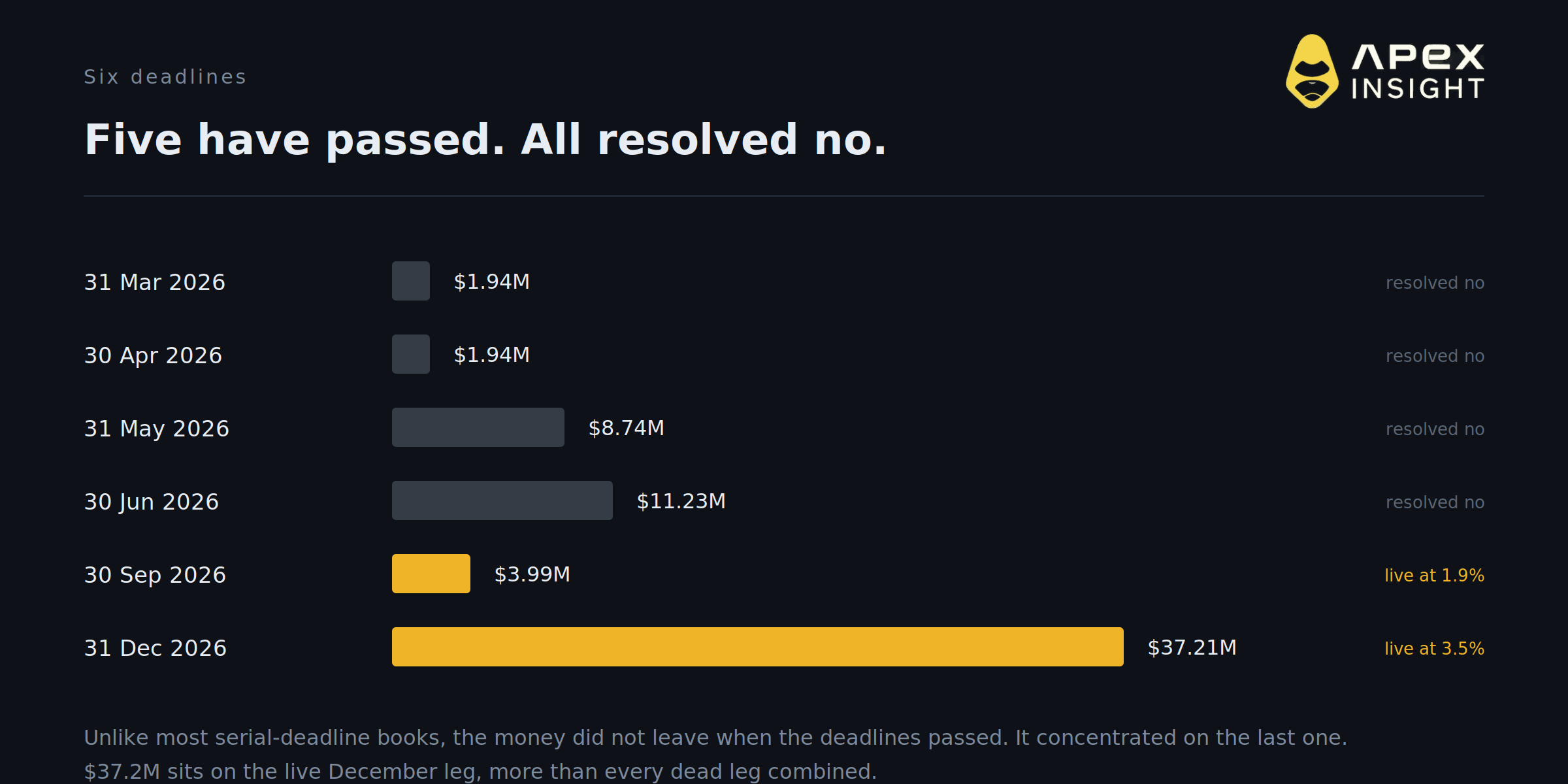
The book has run through six expiries. March, April, May and June 2026 all resolved no. September sits live at 1.9 percent and December at 3.5 percent.
The volume distribution is unusual. The June leg took $11.23M, May took $8.74M, April and March around $1.94M each. Every one of those resolved no.
6. The money consolidated instead of leaving
That last point deserves separating out, because it inverts a pattern that shows up everywhere else.
In most serial-deadline books, capital trades heavily on an early expiry, loses, and never rolls forward. The live leg ends up thinner than the dead ones, and a low price on it reflects a small number of remaining participants rather than a considered view.
Here the opposite happened. The live December leg carries $37.21M, more than every expired leg combined. Participants did not abandon the question when the deadlines passed, they re-entered further out.
That makes the 3.5 percent one of the better-tested low probabilities available. It is not a stale quote on an empty book. It is a heavily traded, repeatedly refreshed view.
7. Japan prices higher than the United States
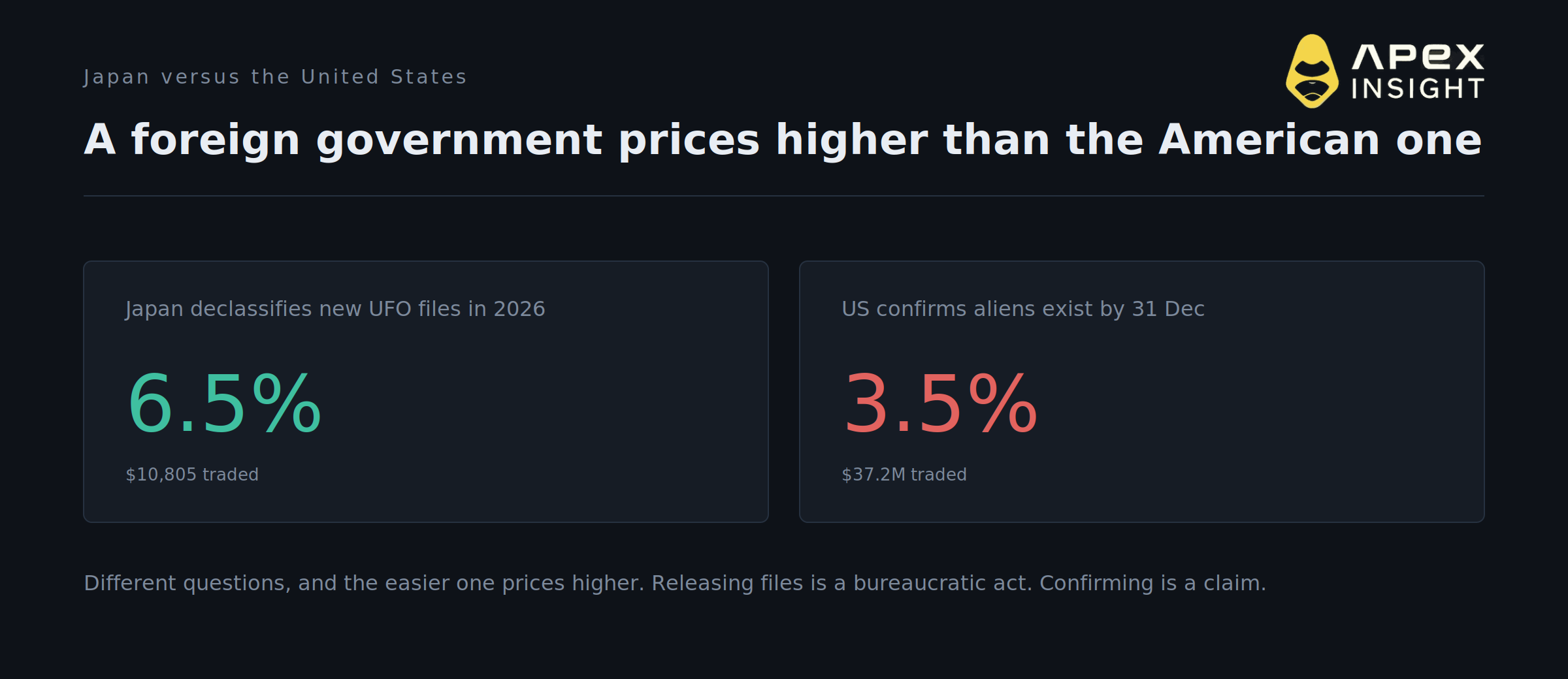
A separate contract on Japan declassifying new UFO files in 2026 prices at 6.5 percent on $10,805 of volume, nearly double the US confirmation price.
These are different questions, and the easier one prices higher, which is the correct ordering. Releasing previously classified material is a bureaucratic act with precedent in several countries. Confirming extraterrestrial life is a claim about reality that no government has ever made.
The comparison is useful mostly as a sanity check. When two related contracts price in the wrong order relative to their difficulty, something is broken. Here they price in the right order, which is a small piece of evidence that this corner of the board is functioning.
8. The 95 percent is thin, so read it as direction
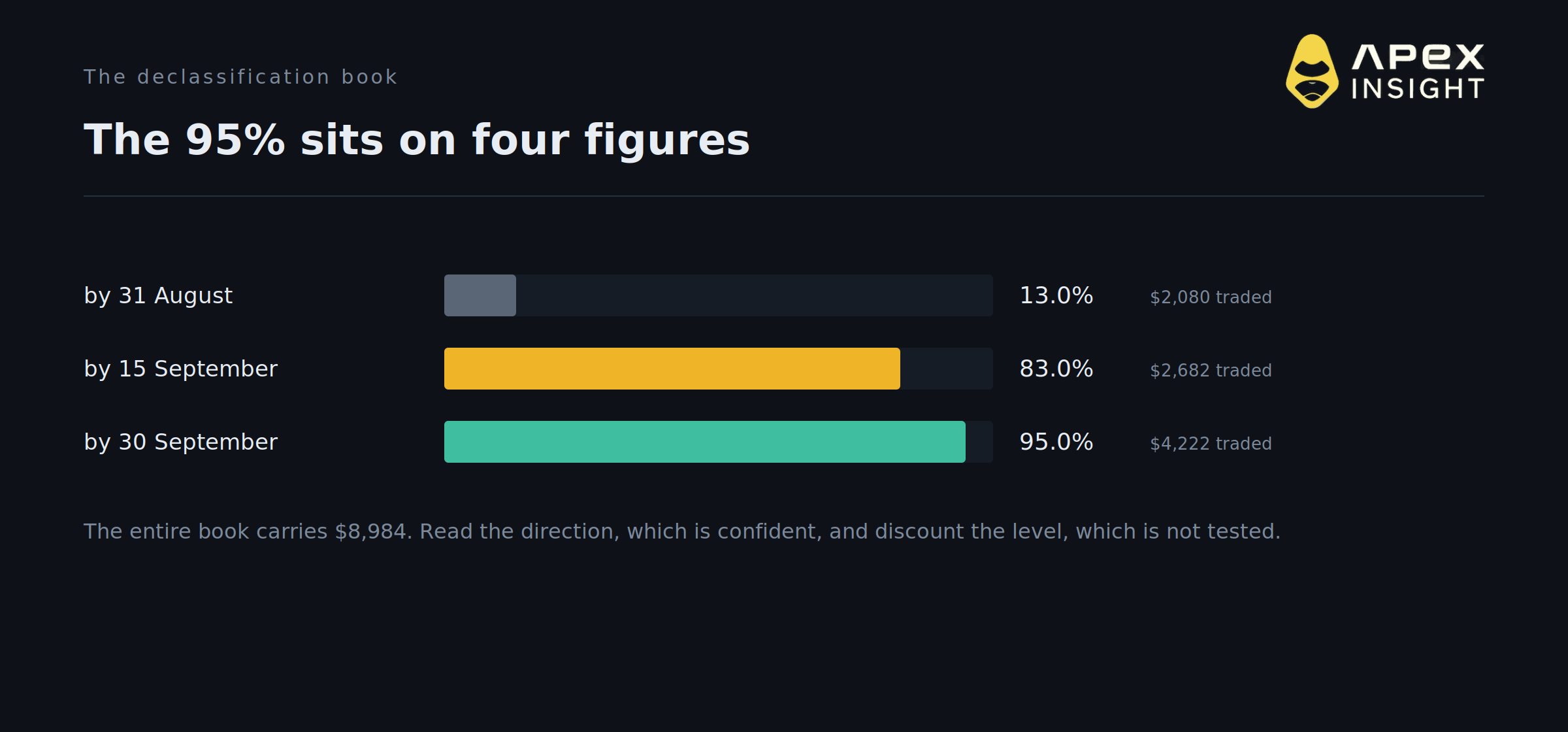
The declassification market prices 13 percent by 31 August, 83 percent by 15 September and 95 percent by 30 September. The entire book carries $8,984 across all three legs.
That is four figures against $65M on the confirmation side. The shape is credible and consistent with a serial release already in progress, but the specific levels have not been tested by anyone risking meaningful capital.
Use it to establish that the market expects continued disclosure, a view that has firmed in the past week. Do not quote 95 percent as though it carries the same weight as the number next to it.
9. Three and a half percent is small, not zero
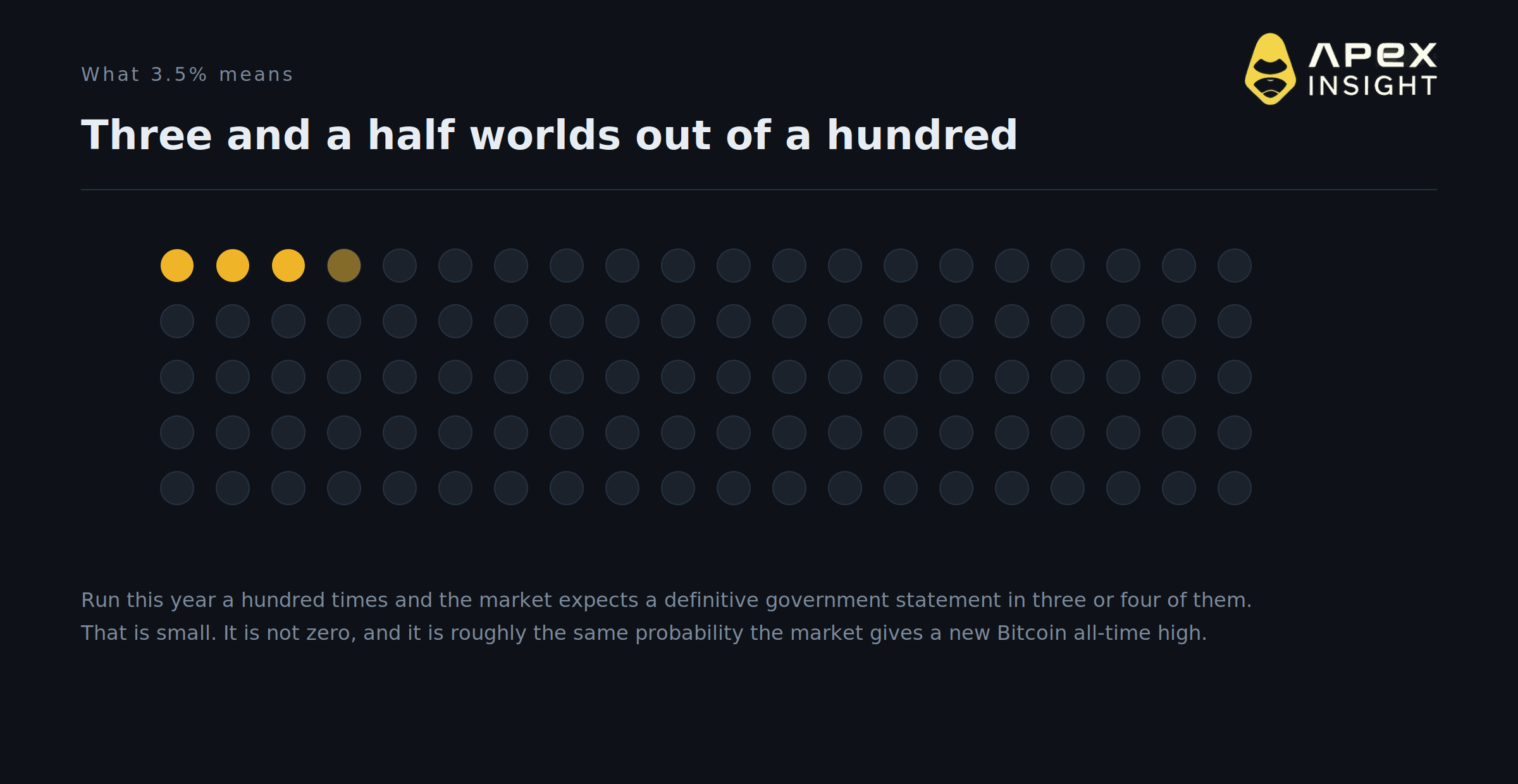
Run 2026 a hundred times and the market expects a definitive government statement in three or four of them.
That is a low number and it is not a dismissal. Low-probability events resolve at their stated rate, and a contract that comes in at 3.5 percent was never wrong for having been cheap.
For scale, the same probability band contains some familiar company.
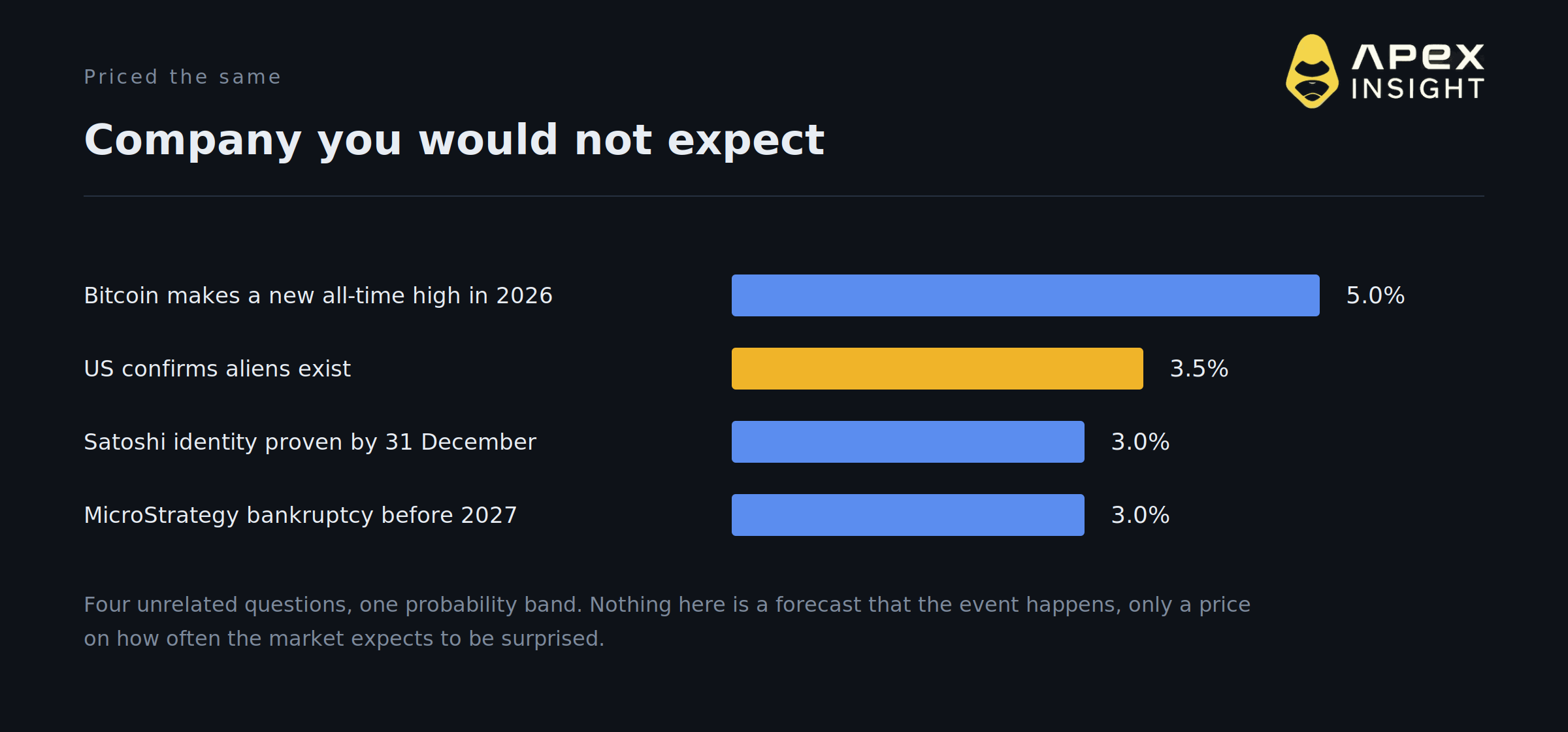
A new Bitcoin all-time high in 2026 prices at 5 percent. Satoshi's identity being proven by 31 December prices at 3 percent. MicroStrategy filing for bankruptcy before 2027 prices at 3 percent. Alien confirmation sits between them.
Four unrelated questions, one probability band. None is a forecast that the event happens. Each is a price on how often the market expects to be surprised.
10. What would actually move the number
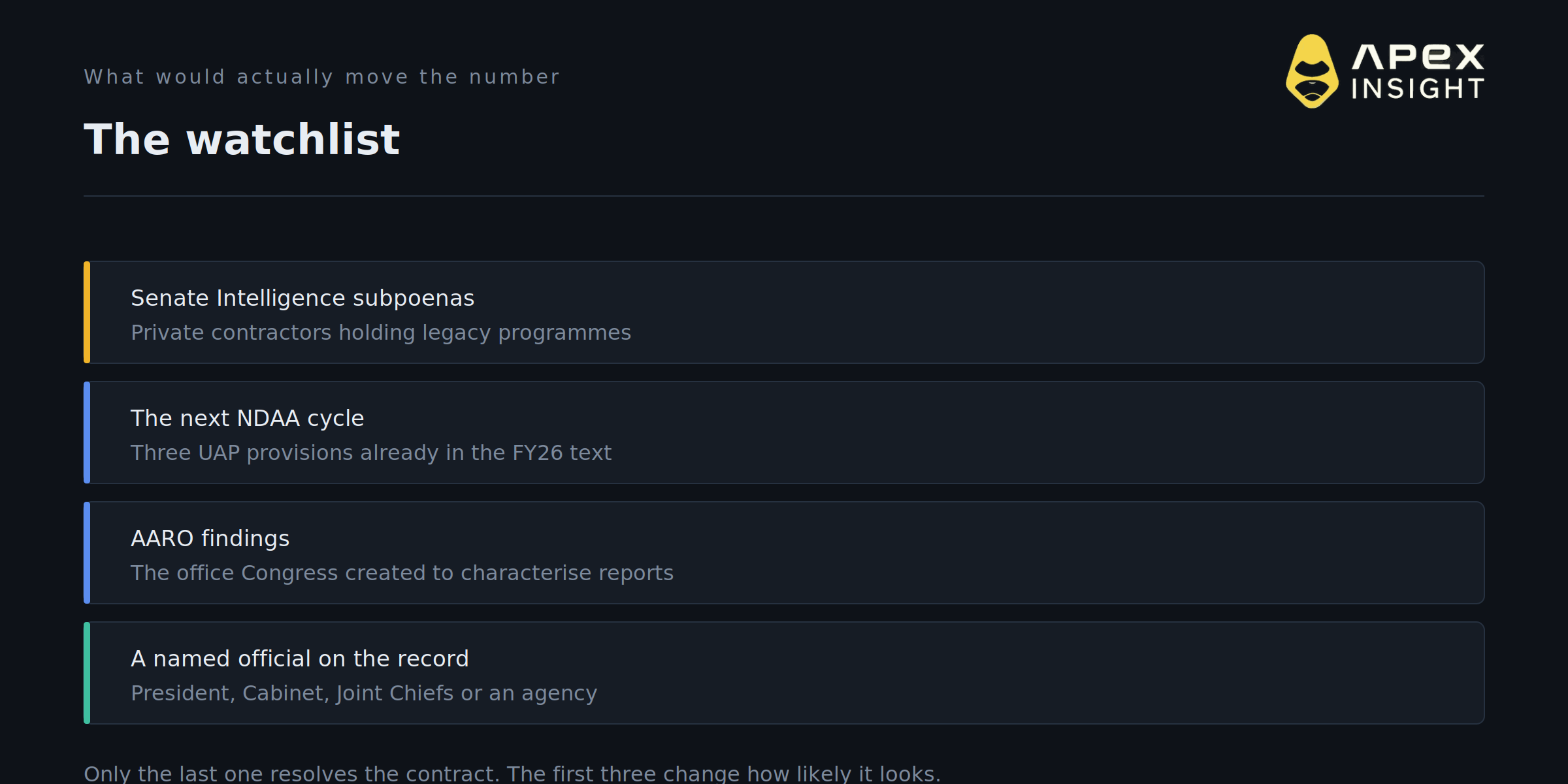
Three things could change how likely confirmation looks without resolving anything: the Senate Intelligence subpoenas to private contractors, the next defence authorisation cycle building on the three UAP provisions already in the FY26 text, and any substantive finding from the All-Domain Anomaly Resolution Office.
One thing resolves it: a named official inside the resolution set saying that extraterrestrial life or technology exists.
If you are watching this market, watch for the second category and treat the first as noise that changes sentiment rather than outcome. The past year is the evidence: an enormous amount of the first happened, and the price barely moved.
What this adds up to
The alien market is the clearest demonstration on the board of why resolution criteria matter more than narrative. A year of unprecedented disclosure, hearings, subpoenas and document releases has produced almost no movement in a contract about confirmation, because disclosure was never what the contract was asking about.
It is also a useful correction to the assumption that volume follows uncertainty. $65M has accumulated on a question the market considers roughly 96 percent settled, which says more about how much people want exposure to a world-changing surprise than about how likely that surprise is.
The two habits worth carrying: read the resolution text before the price, and check whether the news you are reacting to would actually satisfy it. On this file, almost none of it would.
Where to watch it
Every market in this article is live on ApeX Omni, where Polymarket's order books are integrated directly: the same liquidity and the same settlement source, minus the KYC. The board shows the full expiry structure and the volume behind each leg, so you can see which deadlines have already passed, where the money actually sits, and how a question with $65M behind it can still be priced as a tail.
We appreciate your continued support.
Published by ApeX. For informational and educational purposes only. Not investment advice, and not a forecast or endorsement of any outcome. Trading involves risk, including total loss.