

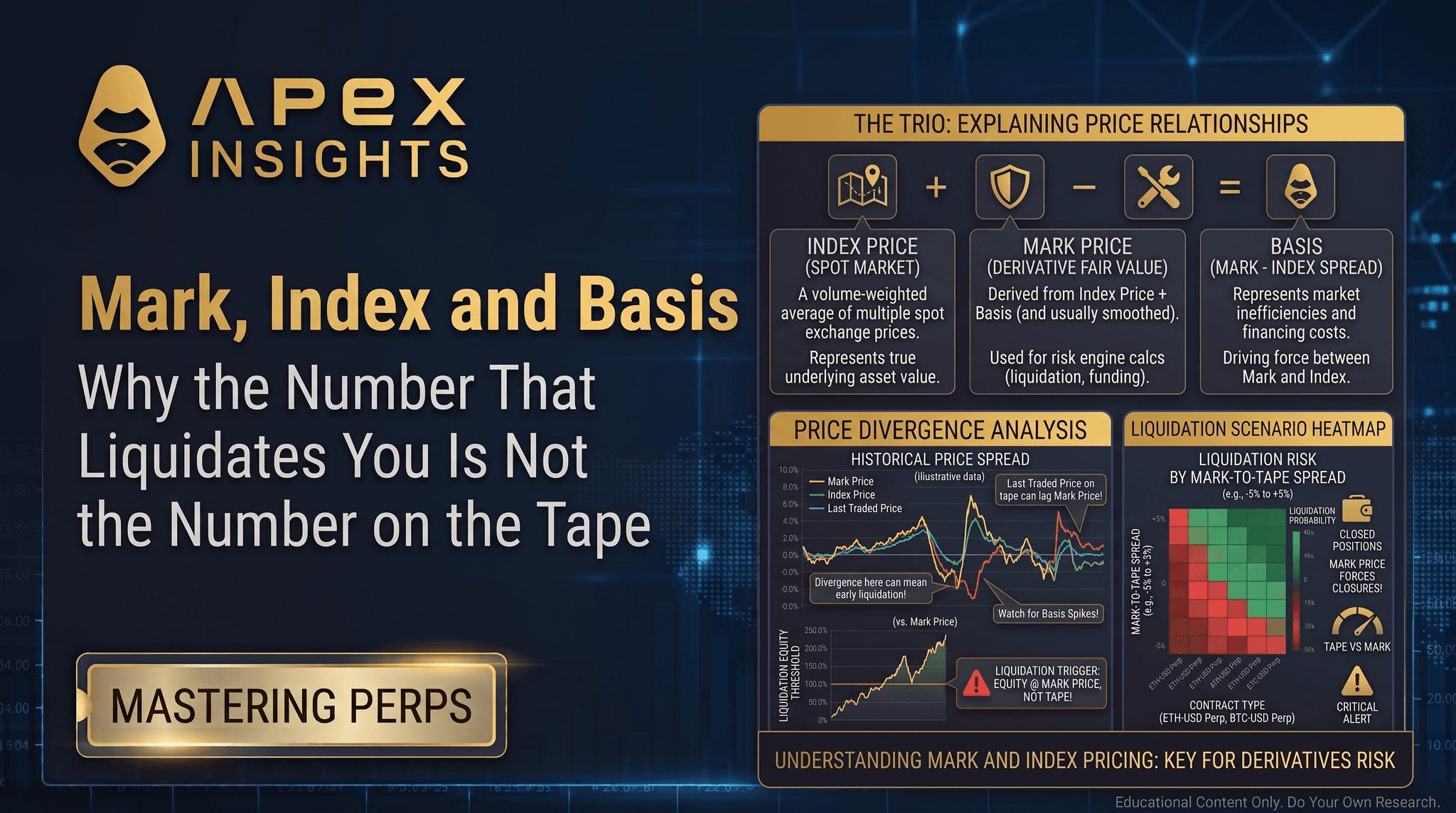


The three prices a perp actually has
On ApeX Omni, and on any serious perps venue, three distinct prices run side by side (ApeX docs).
Last price is the most recent traded price on the exchange's own order book. It updates with every matched trade, it is what your charts and technical analysis are built on, and it is what fills your orders. It is also the most volatile of the three, prone to short-lived spikes and wicks when a large order or a thin book briefly dislocates it.
Index price is a weighted average of the asset's spot price across several major exchanges. Because it aggregates independent venues, no single exchange's wick or manipulation moves it much. It is the objective anchor to the real spot market, and it is the input that drives the funding rate from the previous part.
Mark price is a smoothed fair value of the contract, and it is the important one for risk. Your unrealised profit and loss, your margin requirement, and your liquidation price are all calculated on the mark price, never on the last price.
The single most useful table in this whole topic is which price governs what:
Function | Price used |
Order execution and charts | Last price |
Funding fees | Index price |
Unrealised PnL, margin, liquidation | Mark price |
Stop-loss and take-profit triggers | Your choice: last, mark, or index |
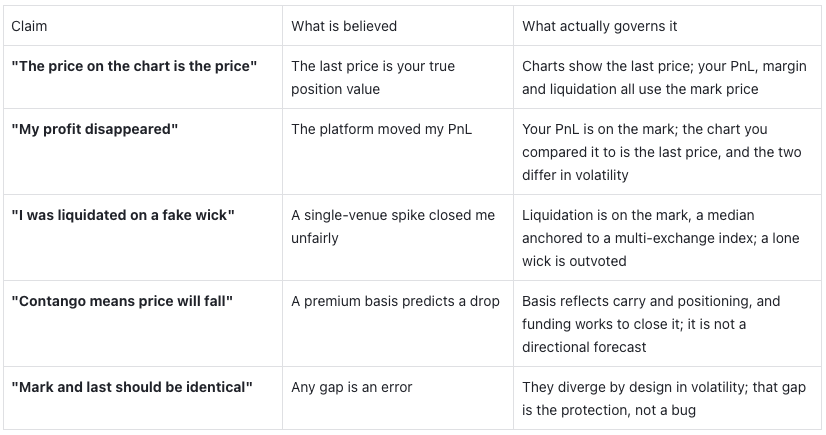
Read that and two common panics dissolve. Your PnL looks different from the chart because the chart is the last price and your PnL is the mark price. And your position survived a stab through your liquidation level because liquidation watches the mark, not the tape.
Watch the three prices diverge
Numbers make it concrete. Say the index price of BTC, the cross-exchange fair value, is sitting at $65,000, and your leveraged long has a liquidation price of $63,500. Now a large market sell hits ApeX's own order book and, for a few seconds of thin liquidity, the last price wicks down to $63,000.
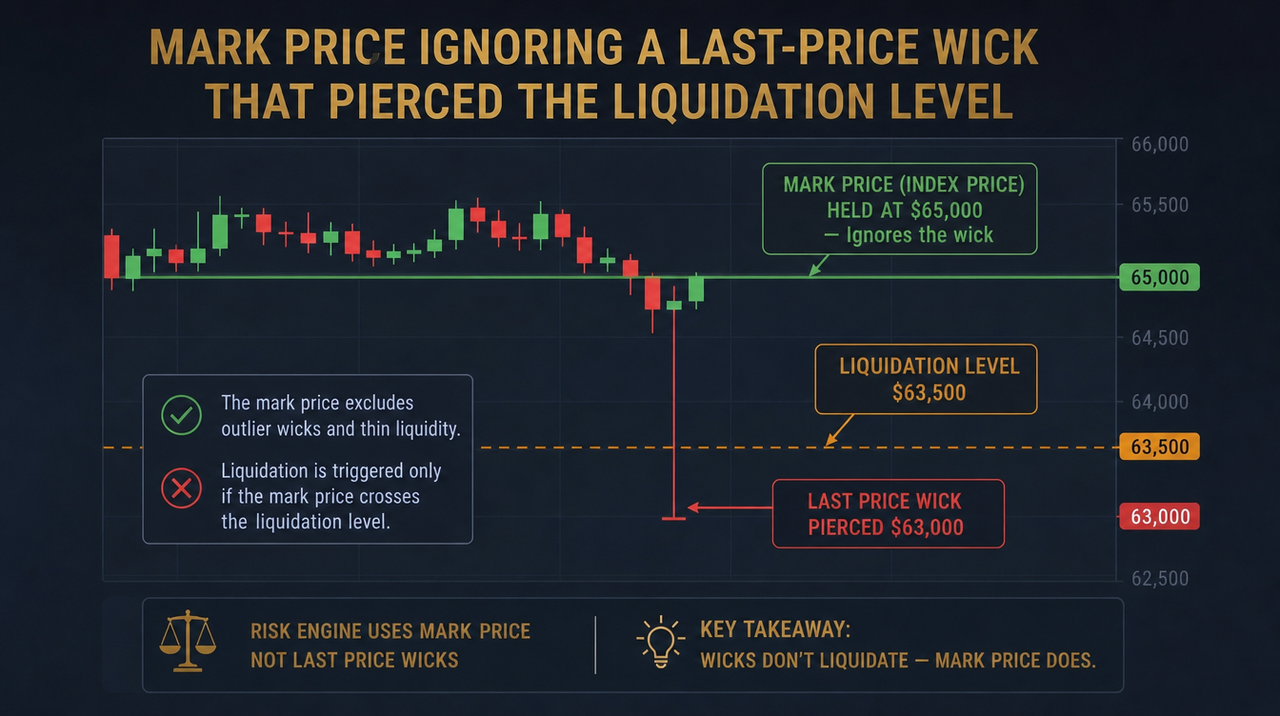
That is the mechanism doing its job. The mark price is the median of three fair-value estimates, and two of them are anchored to the multi-exchange index, so a single-venue wick is one vote out of three and the median throws it out. During those same seconds your chart, drawn on the last price, flashed a stomach-dropping loss, while your actual unrealised PnL, computed on the mark, barely flinched. The chart scared you; the mark told the truth.
The flip side is worth stating too: when the mark price genuinely reaches your liquidation level, the cross-exchange fair value really did move there. That is not a wick and not a hunt. It is the market, and no amount of "but the candle recovered" changes it.
What the basis is, and why it is just funding wearing a different hat
The gap between the perpetual's price and spot has a name: the basis. When the perp trades above spot, the basis is positive, the state traditional futures call contango; when it trades below, the basis is negative, or backwardation. In conventional markets, contango is the normal condition, reflecting the cost of carrying a position over time - financing and storage (CME Group).
A dated future closes its basis automatically at expiry. A perpetual has no expiry, so, as the last part explained, funding does the job instead: a positive basis produces positive funding, longs pay shorts, and the pressure drags the perp back toward spot. This is the connection worth holding onto: the basis and the funding rate are two views of the same gap. The basis is the distance between perp and spot; the funding is the payment that distance generates. When you read one, you are reading the other.
The basis is also a real, tradable quantity, not just a diagnostic. The institutional Bitcoin cash-and-carry from the previous part is a basis trade by another name: buy spot, short the future or perp, and harvest the premium as the basis converges. In bullish periods that premium has run into the double digits annualised on Bitcoin, which is precisely why the trade attracts size (CF Benchmarks). A wide, persistent basis is the market paying you to close it, with all the risk the last part catalogued.
Why the mark price is built the way it is
The mark price looks over-engineered until you see what it is defending against. Its construction has three deliberate layers of protection.
It leans on the index, not the tape. Two of the mark's three inputs are derived from the cross-exchange index price, which is itself a weighted average of several venues. To move the mark, you have to move the real spot price across multiple exchanges at once, which is expensive and hard, rather than just wicking one order book.
It smooths the basis. One input adds a five-minute moving-average basis, so a sudden, momentary premium or discount is averaged away instead of instantly repricing your risk.
It takes the median. With three inputs, the median simply ignores whichever one is the outlier. A single dislocated price cannot drag the mark; it gets outvoted.
The result is the property the whole system exists for: liquidations and margin run on a number that is genuinely hard to manipulate, so a flash crash or a spoofed wick on one venue does not close positions that the real market never threatened. ApeX Omni's own documentation puts the trade-off honestly: during volatile periods the gap between last and mark can widen, and that is not a glitch, it is the design working.
Reputation versus evidence
Reading the three prices in practice
Track your liquidation on the mark price, not the chart. The candle can pierce your level and leave you untouched, or the mark can reach it while the candle looks fine. Watch the number that actually decides.
Set stop-losses and take-profits on the mark price for protection. ApeX Omni lets you trigger conditional orders on last, mark, or index. Triggering on the mark means a manipulative wick will not fire your stop, at the cost of a slightly slower trigger; triggering on the last is faster but wick-exposed. Choose deliberately.
Use the index price to read funding. The basis you see between the perp and the index is the funding you are about to pay or receive. They are the same information.
Expect divergence in volatility, and do not panic at it. A widening gap between last and mark during a violent candle is the system protecting you, not breaking.
Common mistakes
Judging your liquidation distance off the chart - the chart is the last price; your liquidation is on the mark, which can sit meaningfully apart in fast markets.
Believing your PnL changed unfairly - it is marked to the mark price, which is smoother than the last price you were watching.
Crying manipulation on a mark-price liquidation - if the mark hit your level, the cross-exchange fair value did too.
Reading contango as a sell signal - a premium basis is carry and crowding, closed by funding, not a directional prediction.
Setting a tight stop on the last price in a wicky market - a momentary spike can trigger it; the mark-price trigger exists for exactly this.
Price markers on ApeX Omni
Because ApeX Omni is a perpetuals DEX, all three prices are live on the interface, and knowing which is which is a practical edge. Order execution and your charts use the last price; funding is charged on the index price, so the perp-to-index basis is your funding read; and unrealised PnL, margin, and liquidation are all computed on the mark price, a median of two index-anchored fair values and the last price that resists single-venue wicks. You can even choose whether your stop-loss and take-profit trigger on last, mark, or index. The honest way to use it is to watch the mark for your risk, read the index for your funding, and treat the last price as what it is: the fast, noisy tape. Read the full Price Markers guide, then check your mark price and liquidation on ApeX Omni.
The bottom line
A perpetual's "price" is really three numbers with three jobs. The last price is the fast, manipulable tape you trade against. The index price is the honest cross-exchange spot value that sets your funding. The mark price is the smoothed, median, manipulation-resistant number that decides your profit, your margin, and your liquidation, which is exactly why it, and not the candle on your screen, is the one to watch. The gap between the perp and spot is the basis, and it is the same thing as the funding you learned to respect. Read the three prices for the different things they are, and the market stops seeming to lie to you: your PnL was always honest, your wick liquidation was usually fair, and the number that ends your trade was never the one on the tape.
Frequently asked questions
What is the difference between mark price and last price? The last price is the most recent trade on the exchange's order book and drives execution and charts. The mark price is a smoothed fair value used for unrealised PnL, margin, and liquidation. They can differ, especially in fast markets, because the mark is deliberately resistant to wicks.
Why is my unrealised PnL different from the chart? The chart shows the last price, but your PnL is calculated on the mark price. In volatile moments the two diverge, so the profit or loss you feel from the candle is not the number your account uses.
What is the index price used for? The index price is a cross-exchange average of spot, and it is the input for the funding rate. The gap between the perpetual and the index is the basis, which is what funding works to close.
What is basis in crypto trading? The basis is the difference between the perpetual (or futures) price and the spot price. A positive basis (perp above spot) is contango; a negative basis is backwardation. On a perpetual, funding is the mechanism that keeps the basis from running away.
Can the mark price be manipulated? It is far more resistant than the last price because it leans on a multi-exchange index and a smoothed basis, and it takes the median of its inputs so a single outlier is ignored. Manipulating it would require moving spot across several venues at once.
Which price triggers my stop-loss? On ApeX Omni you choose: last, mark, or index. A mark-price trigger protects you from a manipulative wick firing your stop, while a last-price trigger is faster but exposed to spikes.
Explore more from this series: Part 8: Putting It All Together | Part 9: Leverage and Liquidation | Part 10: Funding Rates | Part 12: Order Types
This article is for educational and informational purposes only and is not financial, investment, or legal advice. Do your own research before making any trading decision.