


Published 19 November 2026
Everyone knows what a rate rise does to bitcoin. Higher rates make cash pay, risk assets get sold, crypto gets sold hardest. It is the first thing anyone learns about macro and crypto, and 2022 appeared to prove it.
In 2026 the Fed actually raised rates. Bitcoin gained 10.72% in the week that followed.
Then, six weeks later, the committee met again and did nothing at all. Bitcoin is 21.62% lower since that meeting. The policy rate has been 3.75% to 4.00% throughout both of those moves.
A December rise is now all but fully priced, with every one of the 101 economists in a Reuters poll expecting a quarter point. So that pair of facts is worth more than any forecast, because it tells you which event you are actually trading, and the answer is not the one on 9 December.
Two meetings, opposite outcomes, one unchanged rate
On 16 September 2026 the Federal Open Market Committee voted 12 to 0 to raise its target range a quarter point to 3.75% to 4.00%, the first increase since 26 July 2023 and the end of a stretch of more than three years without one.
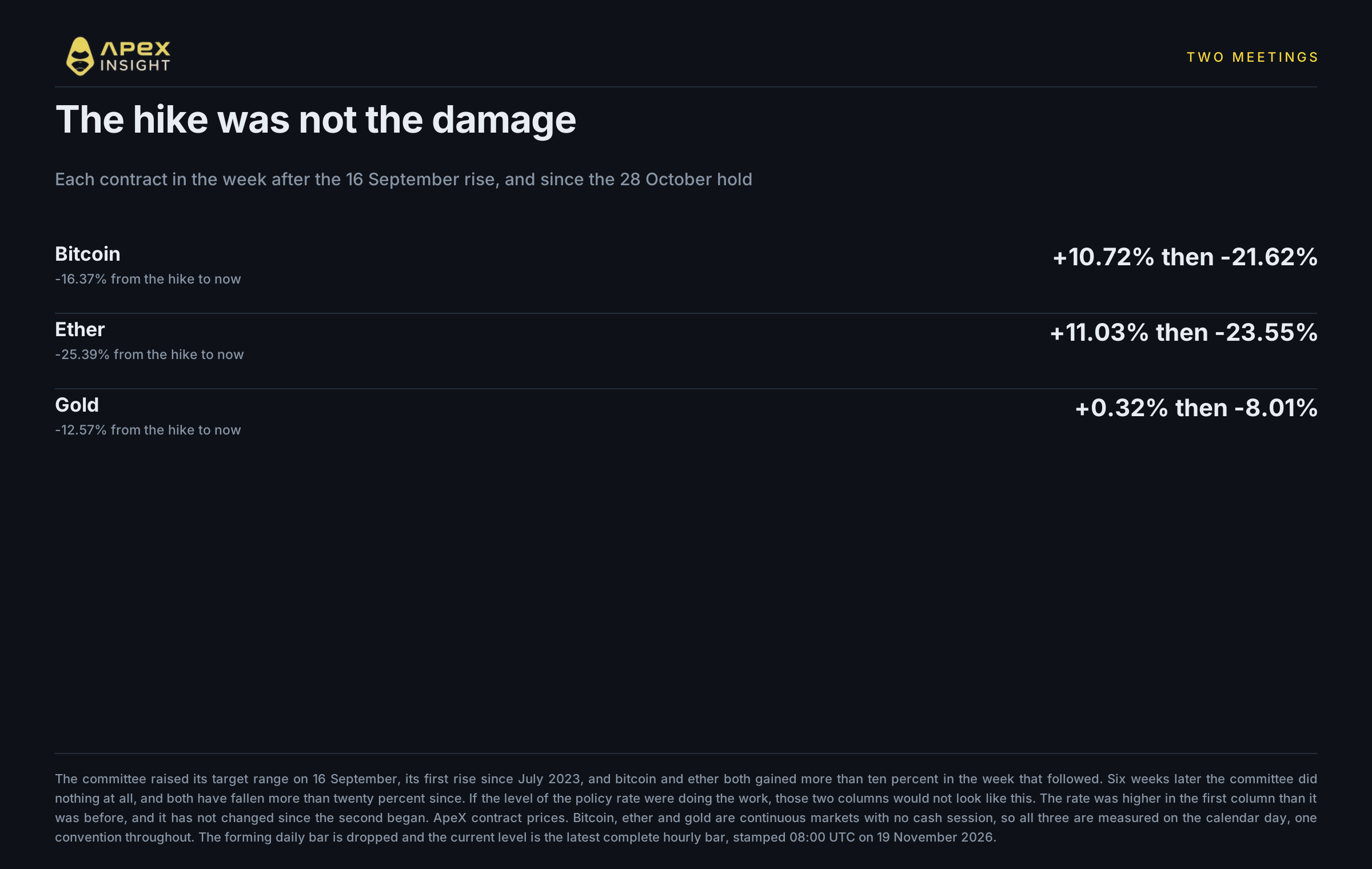
In the week after that decision, measured on the ApeX contracts: bitcoin +10.72%, ether +11.03%, gold +0.32%.
On 28 October the same committee held the range where it was, by ten votes to two. Since that meeting: bitcoin −21.62%, ether −23.55%, gold −8.01%.
Read those two sets together and the conventional story stops working. The rate was higher during the first set than it had been for three years, and it has not moved at all during the second. If the level of the policy rate were doing the damage, the columns would not look like this.
The rally was in the first week, and it faded before the hold
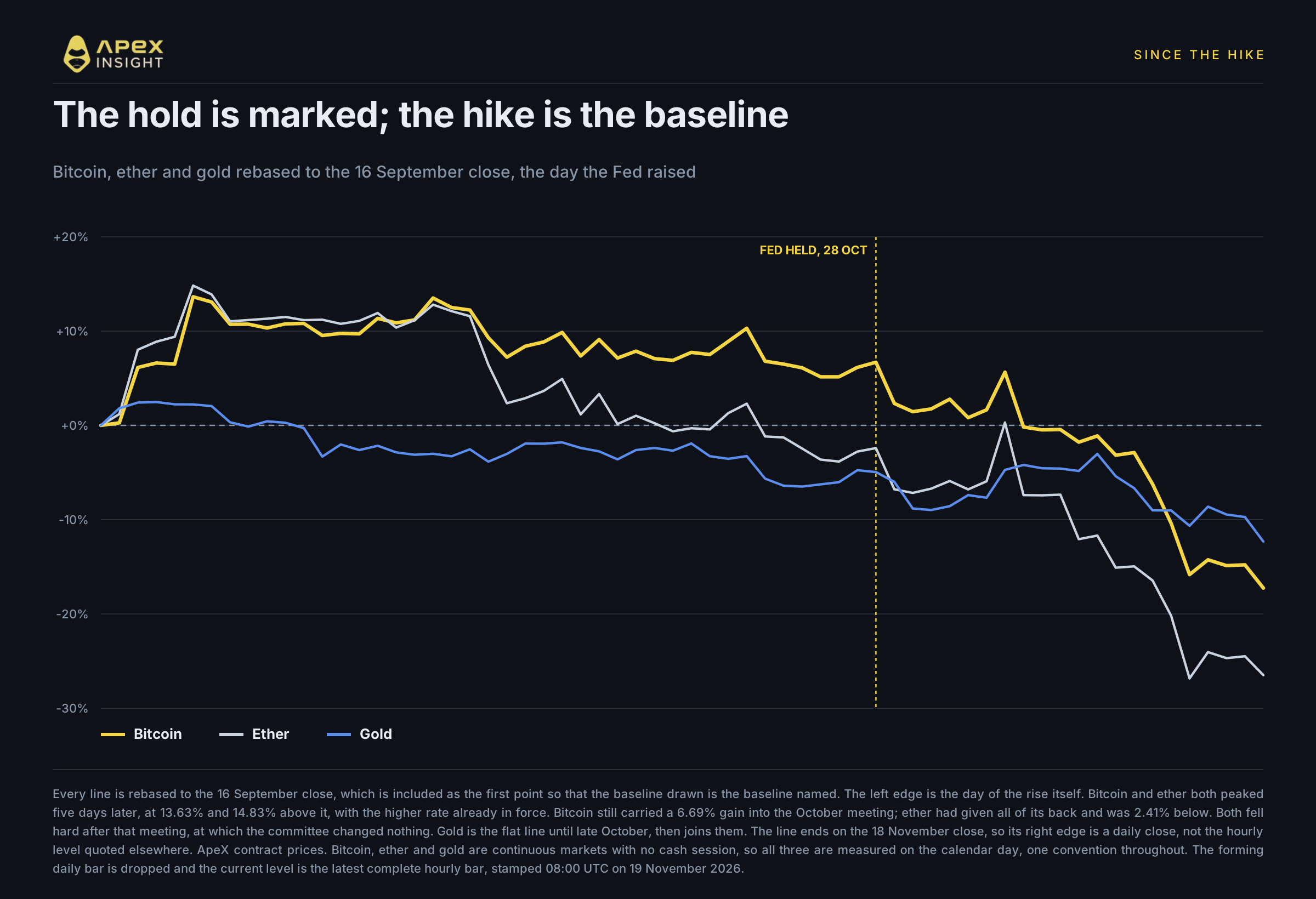
The daily path matters here, because "bitcoin rose after the hike" is true and lazy.
Bitcoin and ether both peaked five days after the decision, at 13.63% and 14.83% above the 16 September close. From there they drifted. Bitcoin still carried a 6.69% gain into the October meeting. Ether had already given all of its back and was 2.41% below where it started.
So the honest version is not that a rate rise is good for crypto. It is that the rise itself was absorbed almost immediately, produced a sharp relief rally, and then stopped being the thing that mattered. The decline that followed began around a meeting at which nothing was decided.
Both had also given back part of that rally in early October, before any of the events listed below, so the expected path is not the only thing in these numbers. Crypto-specific flows, a wave of liquidations and the wider risk-asset drawdown are in them too. The claim here is that the path is the largest identifiable factor across the two windows, not that it is the only one.
This is the same shape this series found yesterday in a much shorter window. Gold fell 2.76% in the nineteen hours before the October minutes were published and 0.11% in the eleven hours after. The scheduled event was not where the move happened. The event only confirmed what had already been traded.
What changed between the meetings was not the rate
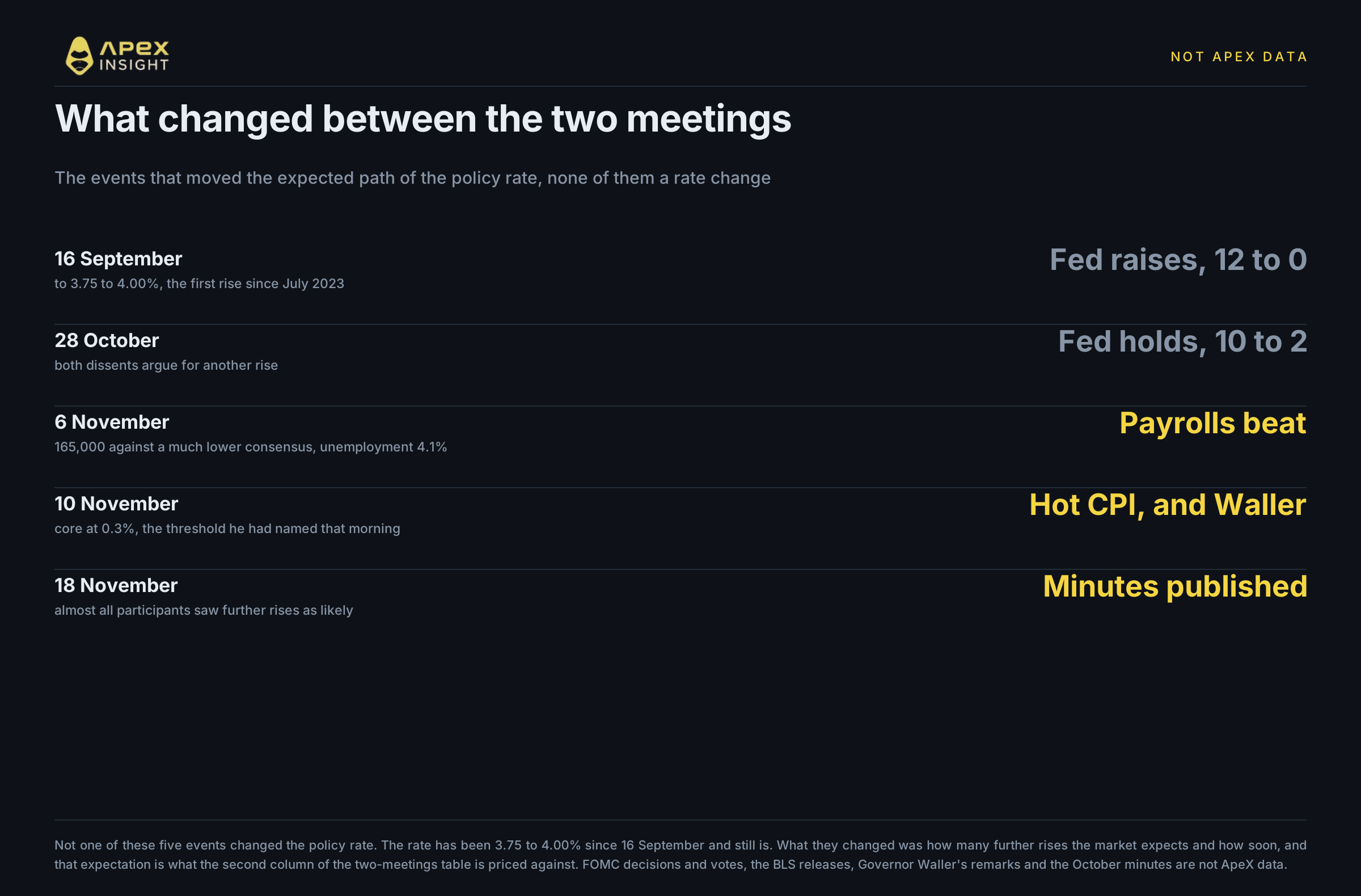
Five things happened between those two columns, and not one of them was a change in interest rates.
The committee held on 28 October, but both dissenting votes argued for a rise, which is a different signal from a unanimous pause. On 6 November payrolls came in at 165,000, far above expectations, with unemployment at 4.1%. On 10 November core CPI printed at 0.3%, the threshold Governor Christopher Waller had named that same morning as the level at which a half-point rise "should be considered". On 18 November the October minutes showed almost all participants judging further increases likely appropriate.
The rate stayed at 3.75% to 4.00% through every one of those. What moved was the expected path: how many more rises, and how soon.
That is the variable crypto has been trading. Not the level of rates, but the first derivative of expectations about them. A rise that is delivered and understood is a fact the market can absorb in days. A rise that might be followed by two or three more, with the number still unsettled, is a discount rate that has to be re-applied to every asset every time the estimate changes.
The reason that distinction bites hardest in crypto is duration. Bitcoin has no coupon and no earnings to discount, so essentially all of its value sits in expectations about a distant future. That makes it behave in some ways like a very long-duration asset: small changes in the rate used to value a distant future produce large changes in what that future is worth today. A stock with cash flows next quarter has something to cushion it. Bitcoin has no cash flows at all, so the comparison is an analogy rather than a model that literally applies, and it is one reason bitcoin may move early and hard on changes in the expected path and then go quiet once the path settles.
It also explains why the September rise was survivable. One delivered quarter point, with the committee signalling patience, did not change the long-run discount rate much. What has happened since 10 November is different in kind: the market has gone from pricing one more rise to pricing a sequence of them, with the terminal level unsettled. That is a shift in the whole curve rather than a single step on it.
The 2022 cycle, which is the one usually cited as proof that hikes kill crypto, says the same thing on a longer timescale. The Fed raised eleven times between March 2022 and July 2023, from near zero to 5.25% to 5.50%. Bitcoin's low came in November 2022, around $15,500, with eight months and several more rises still ahead of it. It then rose through the rest of the hiking cycle. The bottom arrived when the market stopped revising its estimate upward, not when the Fed stopped raising. That episode had crypto-specific disasters tangled in it, Terra and FTX among them, so it is supporting evidence rather than a clean experiment. It points the same way regardless.
A hike is settled, its size is not
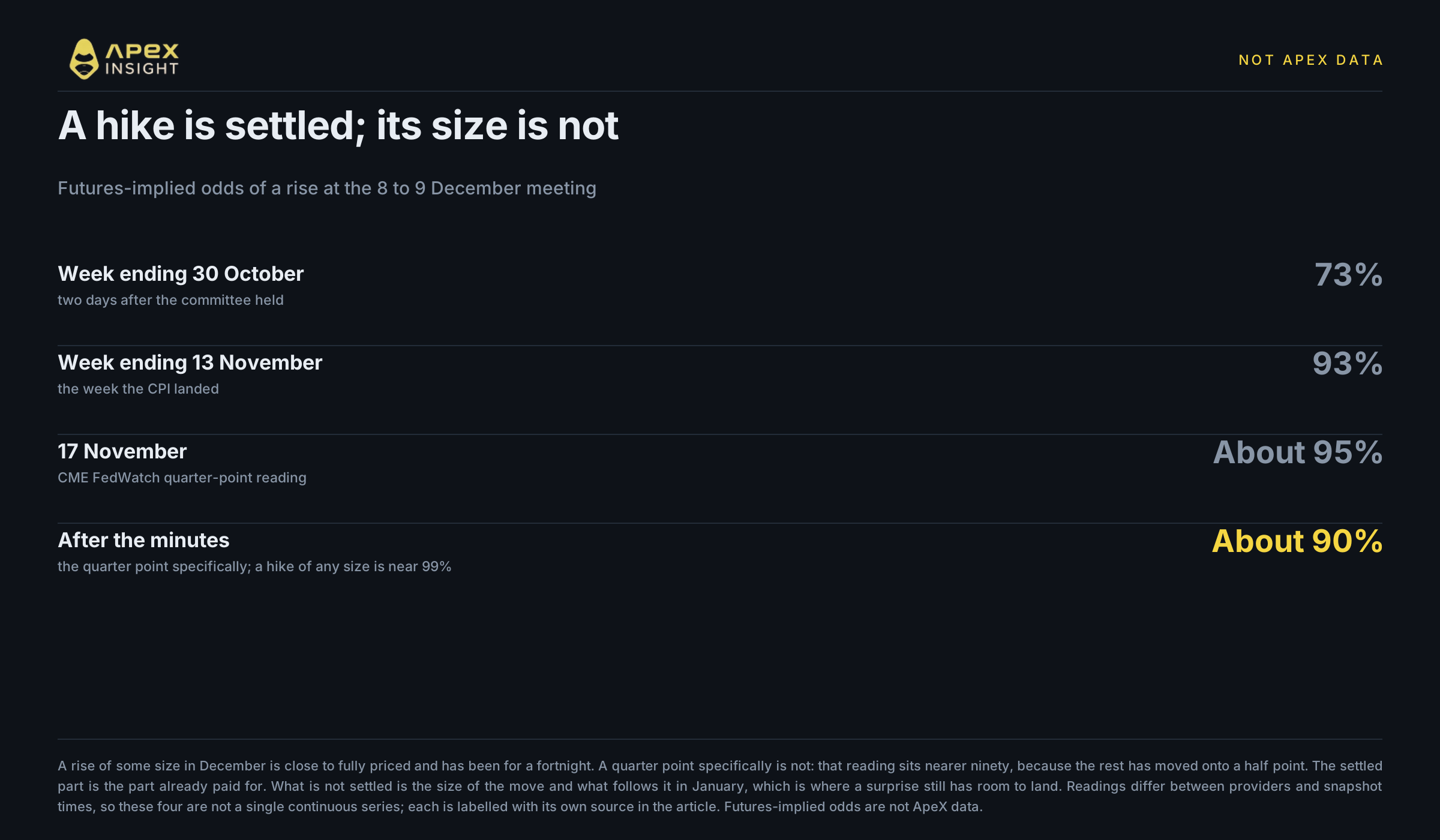
The repricing is visible in the odds, and for the near date it is finished. A quarter-point rise was fully discounted in money markets within hours of the 10 November CPI, and a hike of some size now prices at close to 99%.
Odds of a quarter-point December rise ran at 73% in the week to 30 October and 93% in the week the CPI landed. By 17 November CME FedWatch had the quarter point at about 95%. After the minutes it sat at about 90%, with a half point at roughly 10%, which is about double where the half point had been.
Note what that means, because the headline number hides it. A hike of some size is close to certain. A hike of exactly a quarter point is not: it sits nearer 90%, because the rest has moved onto a half point. The quarter-point reading did not rise on hawkish news; it slipped, while the larger move took the difference. The argument has already moved on from whether to how much, and the part everyone is quoting as settled is the only part that is.
These four readings come from different providers and snapshot times, so they are not one continuous series and each is labelled with its source. What they agree on is the shape: the December date is crowded and the uncertainty has moved behind it.
What would actually be new
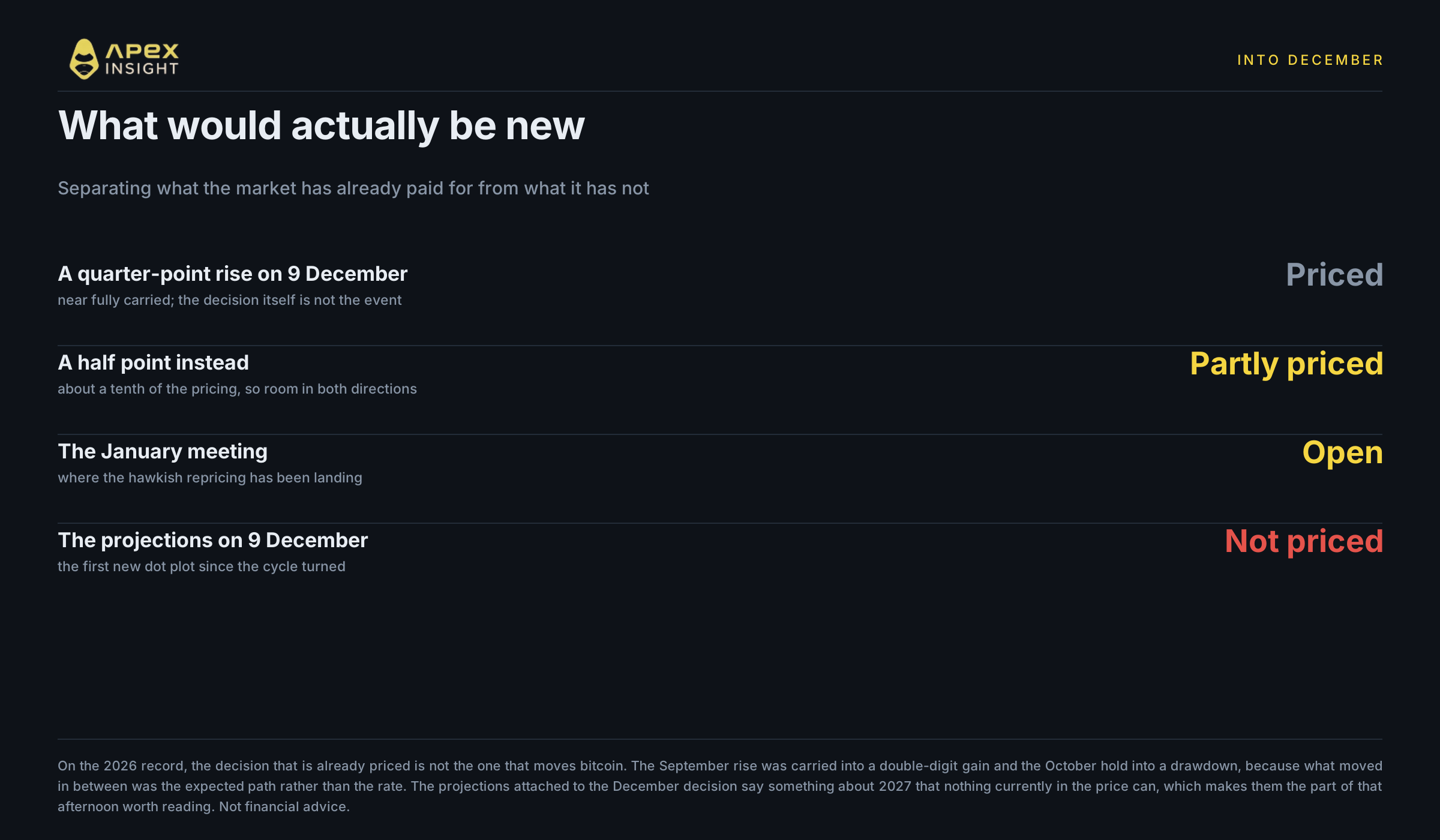
The decision lands on 9 December, with fresh projections attached.
On the 2026 record, the quarter point itself is not the event. It is carried. A market that has spent three weeks moving from 73% to roughly 90% has already paid for it, and the September precedent is that a delivered, understood rise can be followed by a rally rather than a sell-off.
What is not carried is the size, where about a tenth of the pricing sits on a half point and there is therefore room in both directions. Nor is January, which is where the hawkish repricing has actually been landing: Kalshi's January contract moved from 52% to 60% over the seven days to 18 November. Nor, most of all, are the projections. This will be the first set published since the cycle turned, and they speak to 2027 in a way that nothing currently in the price does.
The committee also goes into that meeting with less information than usual: the November CPI is not published until 10 December, the day after it ends. The October print, the one that crossed Waller's threshold, is the last inflation reading it will see before deciding.
It is worth saying plainly what this does and does not imply. None of the above forecasts a rally. The September episode is one observation, the 2022 parallel is confounded by crypto's own failures, and a market that has priced something can always reprice it further. What the record supports is narrower: the part of the December meeting that is already paid for is the part everyone is watching, and the part that is not is the part nobody is quoting.
What to watch
Everything below trades 24/7 on ApeX, which matters for a 9 December decision in the plainest possible way: the repricing will not wait for a cash session.
The one with the clearest record. BTC-USDT gained 10.72% in the week after the Fed actually raised and has lost 21.62% since the Fed declined to. It is 16.37% below where it stood on the day of the rise. If the pattern holds, what moves it in December is not the quarter point but whatever the projections say about the meetings after it.
The one that amplifies it. ETH-USDT gained slightly more than bitcoin in that first week, 11.03%, and had fallen further since the hold as at 08:00 UTC on 19 November, 23.55% against bitcoin's 21.62%. Ether gave back its post-hike gain before the October meeting while bitcoin was still holding one, which is the behaviour to expect from the higher-beta of the two in both directions.
The one that answers to rates most directly. XAU-USDT barely moved on the rise, 0.32% in that week, and is 8.01% lower since the hold. Gold has no yield to defend it against a rising real rate. It moved far less than bitcoin in both windows, which is the point: gold is the smaller mover but the cleaner read, because it carries none of crypto's own flows on top of the rate story.
Trade the move on ApeX
Crypto perpetuals up to 100x and TradFi up to 50x, trading 24/7 including overnight.
Trading carries a high risk of loss, and leverage increases both gains and losses. None of the above says a December rise will be followed by a rally. It says that the rise is already in the price and the surprise is somewhere else, which is a statement about where risk sits rather than which way it breaks. Positioning for the headline when the headline is already priced is one of the more expensive ways to be right about the news. This is not financial advice and none of it is a recommendation to buy or sell anything. Do your own research and size positions you can afford to lose.
If you need any help, feel free to reach out to our team on Discord.
Website: https://www.apex.exchange
Twitter: https://twitter.com/OfficialApeXdex
Telegram: https://t.me/ApeXdex
Methodology. Contract figures are from the ApeX Omni v3 API, built on 19 November 2026. Bitcoin, ether and gold are all continuous markets with no cash session, so all three are measured on the calendar day, which is one convention throughout this article and means no cash-close or daylight-saving adjustment applies to any figure in it. The three anchors are the 16 September 2026 FOMC decision to raise, the 28 October decision to hold, and the latest complete bar; the first two are scheduled central bank dates and neither was chosen from how any contract behaved, and the third is simply the latest complete bar. The week after the rise is measured from the 16 September close to the 23 September close. The forming daily bar is always excluded, because a figure measured into an open bar changes on every read and cannot be reproduced afterwards. Current levels are taken from the latest complete hourly bar rather than a daily close, and that bar is stamped 08:00 UTC on 19 November 2026. The rebased chart includes the 16 September close as its first point so that the baseline drawn is the baseline named. The FOMC decisions and votes, the BLS releases, Governor Waller's remarks, the October minutes, the futures-implied odds, the 2022 to 2023 hiking cycle and the December meeting and CPI dates are not ApeX data and are hyperlinked at each claim; the odds readings come from different providers and snapshot times and are not a continuous series. Nothing here is financial advice.
