






What Unitree Actually Sells
Unitree makes legged robots and the parts inside them. That second half matters more than the first.
The company builds its own high-torque motors, actuators, reducers, controllers and sensors. In a field where most competitors assemble bought components, vertical integration is what lets Unitree set prices nobody else can match. The product line splits three ways: quadrupeds like the Go2, B2 and A2, humanoids like the G1, H1, R1 and H2, and the components themselves.
In 2025, humanoid robots generated roughly 868 million yuan, or 51.78% of main-business revenue. The robot dogs that built the company are now the smaller half of it.
From a 200-Yuan Student Project to the Shanghai Stock Exchange
The origin story is unusually literal. Wang Xingxing built a 14-degree-of-freedom biped as an undergraduate at Zhejiang Sci-Tech University for a little over 200 yuan. During his master's at Shanghai University he built XDog, a low-cost electrically driven quadruped, for a total machine cost of about 20,000 yuan. It won a prize at the Shanghai Robot Competition. He joined DJI after graduating in 2016, left after two months, and registered Unitree in a 50 square metre office in Hangzhou.
Fundraising was hard for years. Wang was not a PhD from a prestigious university, had no overseas background and no big-company resume, and at one point paid salaries out of his own pocket. He once travelled ten hours by sleeper train to Beijing because the robot's battery exceeded the limits for high-speed rail and flights.
Everything changed with price.
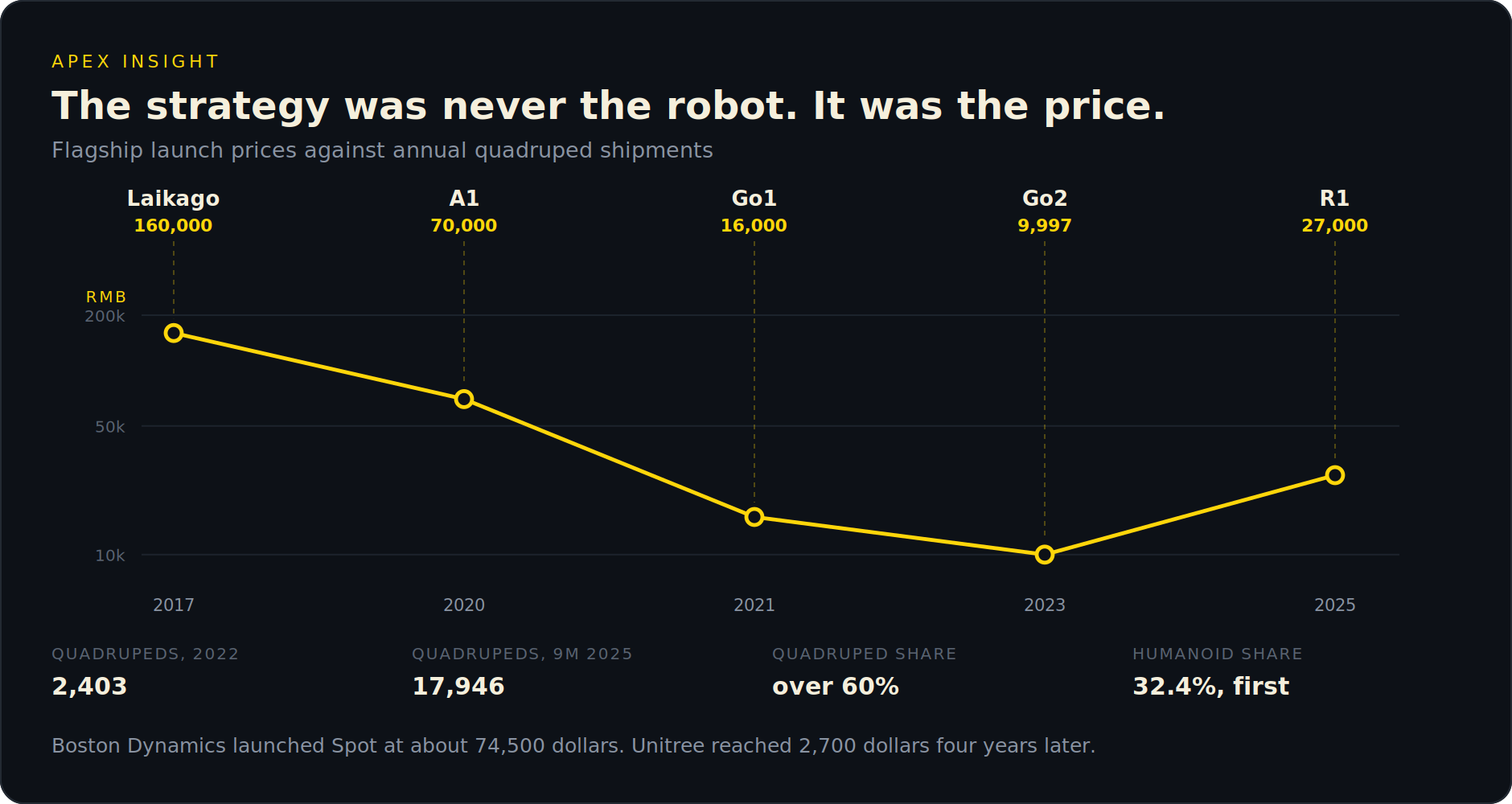
Laikago arrived in 2017 as the first commercially retailed high-performance quadruped in China. The A1 pushed price into consumer range in 2020. The Go1 landed at 16,000 yuan in 2021 and appeared on the CCTV Spring Festival Gala the same year. The Go2 broke 10,000 yuan in 2023 at 9,997.
For scale, Boston Dynamics launched Spot at about 74,500 dollars, more than double Laikago's highest asking price, and by 2021 Unitree was selling quadrupeds at 2,700 dollars. Unit sales followed: 2,403 quadrupeds in 2022 rising to 17,946 in the first nine months of 2025.
That is the whole strategy, and it transfers. Wang has said the joint motors, mechanical structure and sensors in a quadruped and a humanoid are largely the same. Six years of cost discipline on robot dogs produced the cheapest humanoid joint motor in the world as a byproduct.
The Cash Engine Is Real, and It Is Being Spent on Purpose
Here is where most coverage goes wrong. Unitree's profitability is treated as proof the valuation is sane. The numbers say something more interesting.
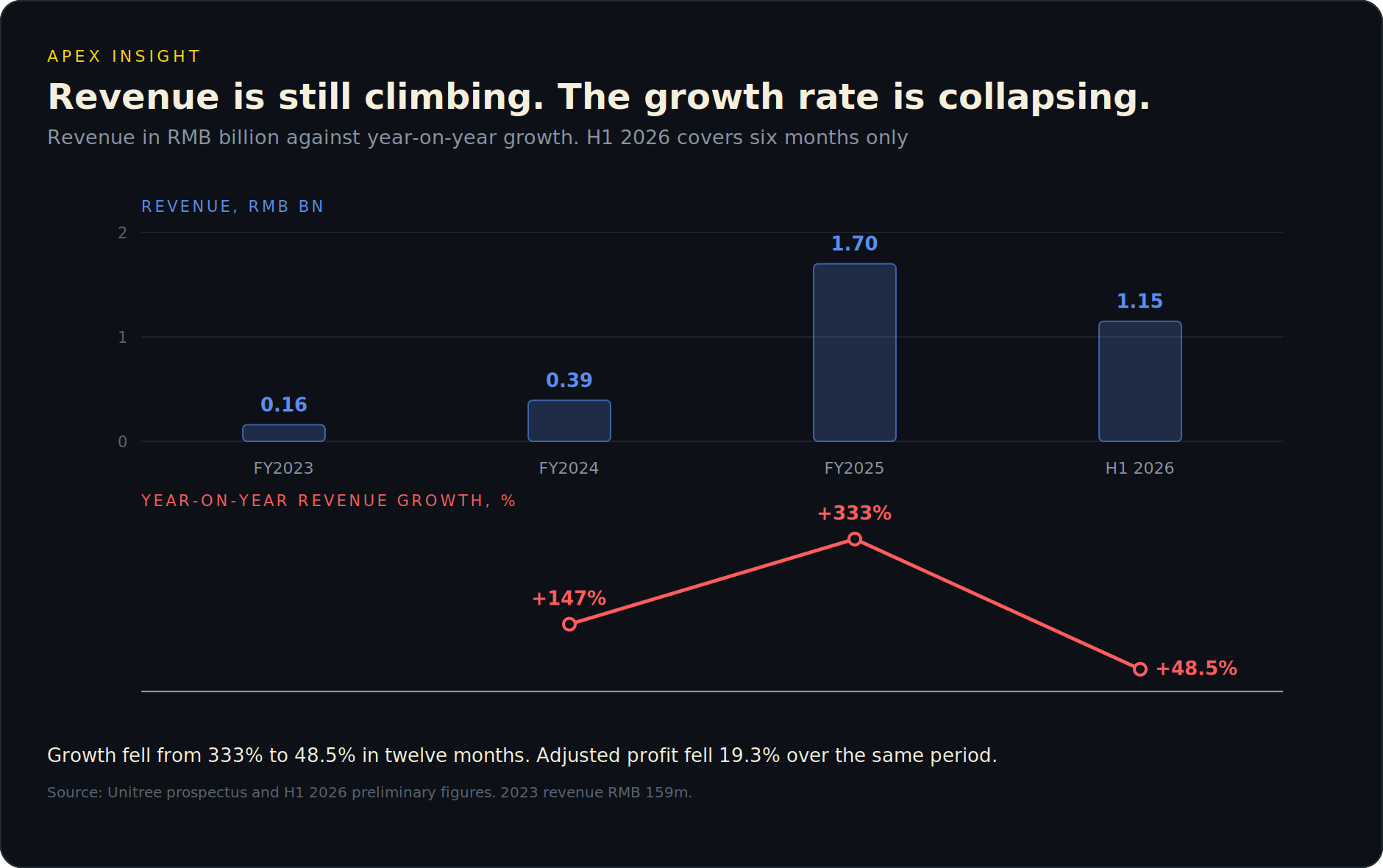
Period | Revenue, RMB | Growth | Net profit, RMB |
|---|---|---|---|
FY2023 | 159m | loss | |
FY2024 | 393m | +147% | loss |
FY2025 | 1,700m | +333% | 278m reported, 591m adjusted |
H1 2026 | 1,150m | +48.5% | adjusted profit down 19.3% |
Main-business gross margin was 60.13% in 2025 and overseas sales were 43.65% of main-business revenue. In the first quarter of 2026 revenue rose 68.49% while adjusted profit fell 52.55%, driven by higher research and selling costs.
Read that carefully. Unitree is deliberately converting quadruped profits into humanoid research and distribution. That is the correct decision for a company trying to win a market that does not exist yet. It also means trailing earnings are not a measure of anything, and any multiple built on them is theatre.
The deceleration is the number that matters. Growth went from 333% to 48.5% in twelve months, in the same period the market repriced the equity more than fivefold.
Why Did the Stock Jump 629% and Then Fall 18%?
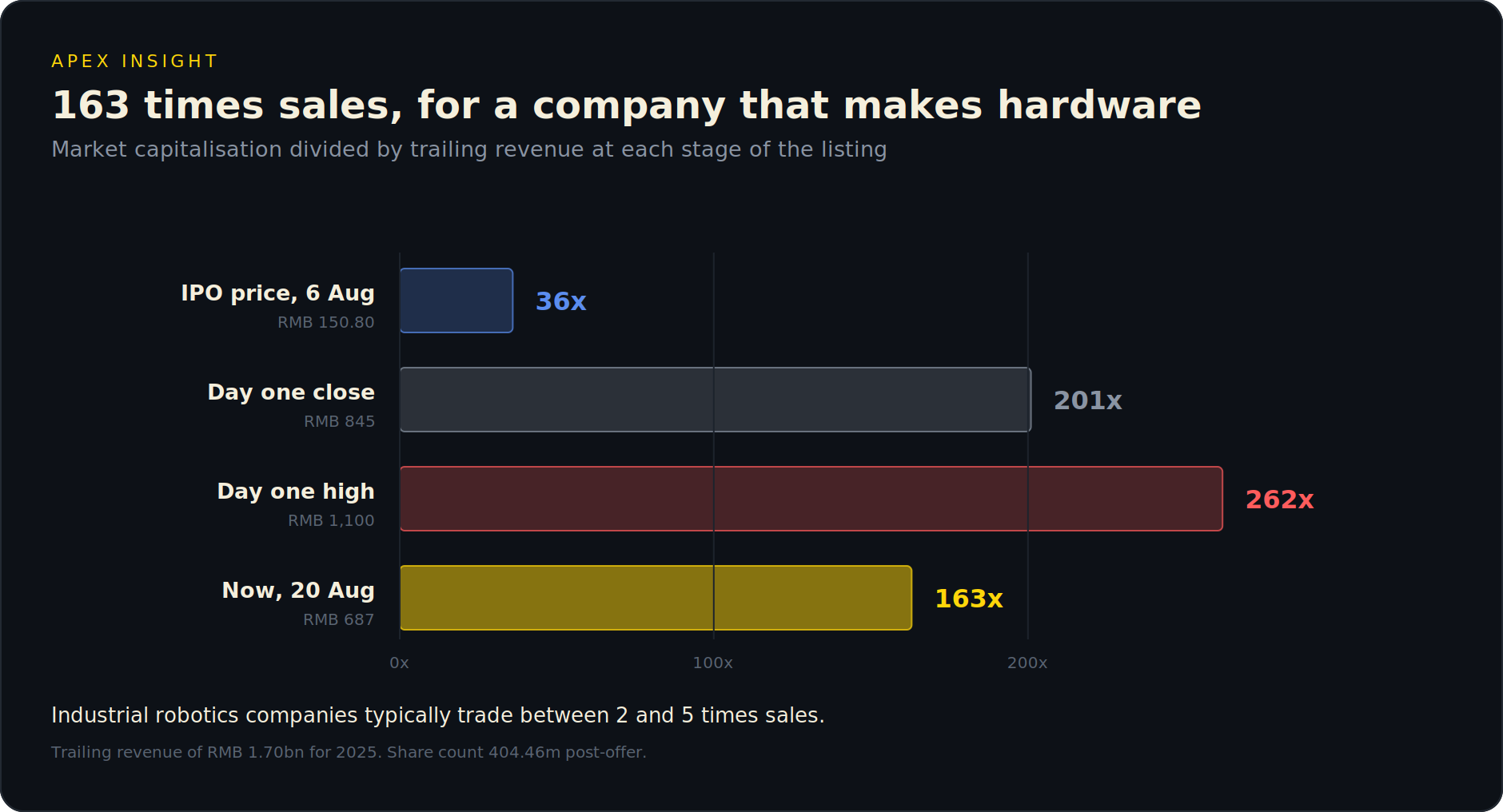
The IPO priced at 150.80 yuan on August 6, valuing Unitree at about 61 billion yuan, or roughly 219 times 2025 earnings and 36 times 2025 sales, with a 10% float. Retail demand exceeded the allocation by more than 8,000 times, a record for the STAR Market.
Then the same mechanism that hit CXMT last month took over. A tiny float met enormous demand. Shares opened at 1,100 yuan, up as much as 629%, before paring to close at 845 for a market value of 342 billion yuan. On the second session the stock fell more than 18%.
Nothing about the business changed in either direction during those two days. The float did the work on the way up and the absence of buyers did it on the way down.
What Are You Actually Paying For?
At 687 yuan across 404.46 million shares, the market capitalisation is about 277.9 billion yuan, or 41.2 billion dollars.
Multiple | Calculation | Result |
|---|---|---|
Price to 2025 sales | 277.9 / 1.70 | 163x |
Price to annualised H1 2026 sales | 277.9 / 2.30 | 121x |
Price to 2025 reported earnings | 277.9 / 0.278 | 999x |
Price to 2025 adjusted earnings | 277.9 / 0.591 | 470x |
Reuters Breakingviews put the day one close near 857 times projected 2026 earnings, against a STAR Market average multiple around 130. Industrial robotics companies typically change hands between 2 and 5 times sales.
Run it backwards, which is the more useful exercise. To justify today's market capitalisation on a 10 times sales multiple in 2030, Unitree needs 27.8 billion yuan of revenue, 16 times the 2025 figure, a 75% compound growth rate sustained for five years. That is the bet. It is not impossible. It is simply what the price already assumes.
Price Targets and the Math Behind Them
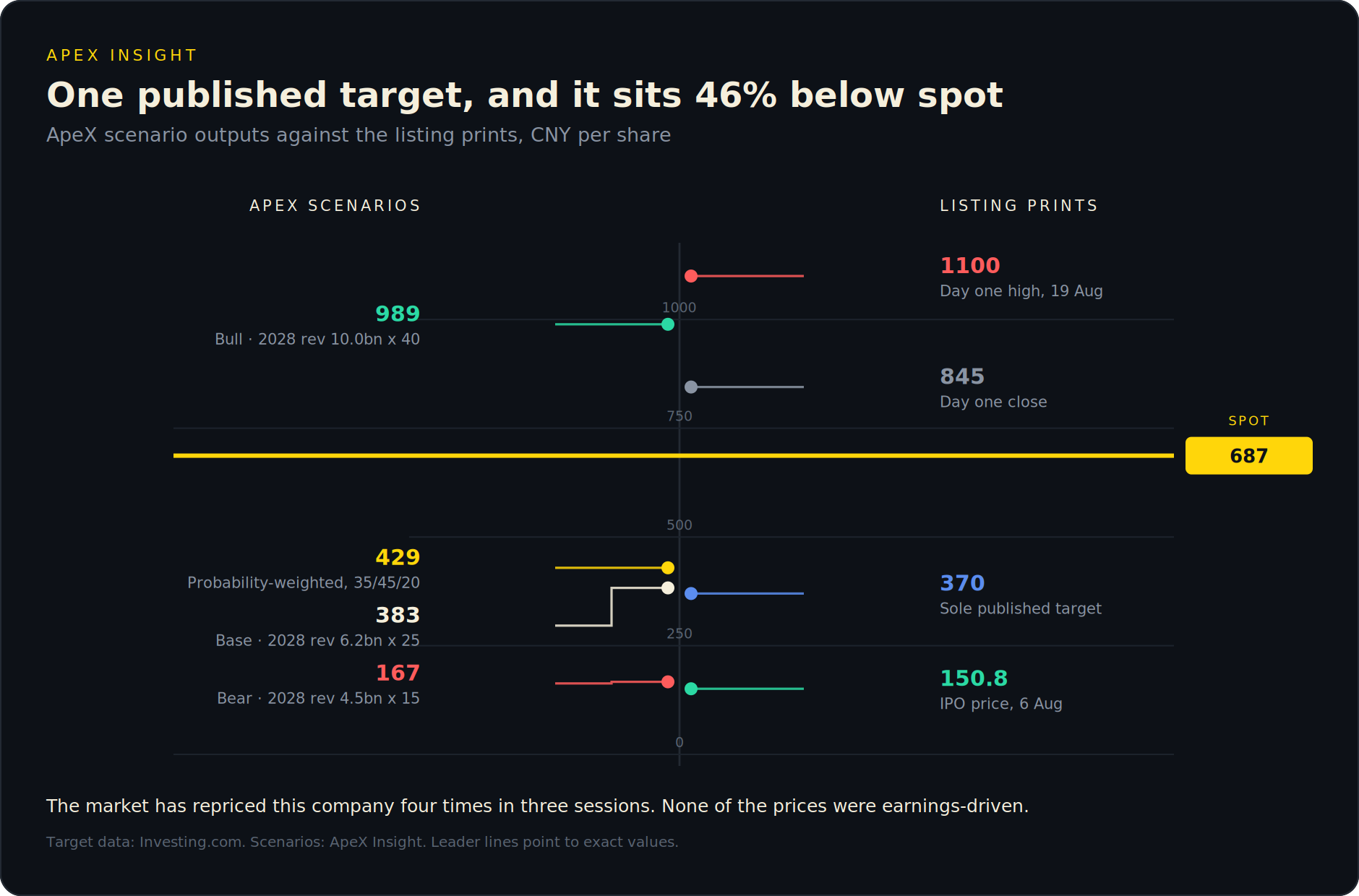
Earnings multiples are useless here, so each scenario is anchored to 2028 revenue and a price to sales multiple.
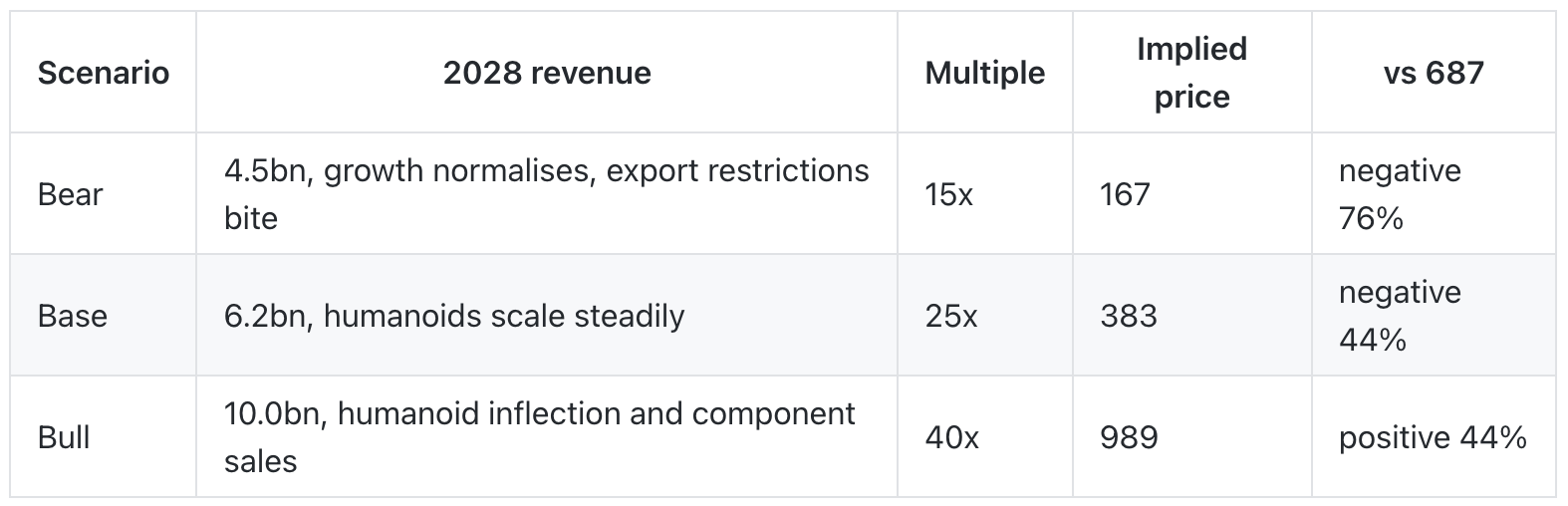
Bear reasoning: 4.5 billion yuan in 2028 still means revenue nearly tripling from 2025, and 15 times sales would be a rich multiple for any other hardware manufacturer on earth. This is a conservative case built on generous inputs.
Base reasoning: 25 times sales on 6.2 billion yuan assumes humanoid shipments scale roughly fourfold from 2025 and that Unitree keeps its lead. It lands near the sole published target of 370 yuan, which is a useful independent check.
Bull reasoning: 10 billion yuan by 2028 requires an 80% compound rate and a genuine humanoid inflection, not just research and education units. At 40 times sales it produces 989 yuan, above spot but below the day one high.
Probability-weighting at 35% bear, 45% base and 20% bull gives 429 yuan, roughly 38% below spot. The gap is not a view on Unitree's technology. It is arithmetic about what the current price already requires.
Is Unitree Expected to Grow?
Yes, and it has the best position in its industry to do it. Three things decide whether shareholders capture it.
Humanoid utility. Quadrupeds sell because inspection, education and research are real jobs. Humanoids are still mostly bought for research and demonstration. The bull case needs a working commercial use case.
Cost leadership holding. Morgan Stanley analysis cited by SCMP estimated that building Tesla's Optimus Gen 2 without Chinese suppliers would raise the bill of materials from roughly 46,000 to 131,000 dollars. That gap is Unitree's moat, and it is a supply-chain moat, not a software one.
Access to overseas demand. The FCC added foreign-made humanoid and quadruped robots to its Covered List in late July, citing national security, and China's commerce ministry threatened countermeasures. Overseas sales are 43.65% of main-business revenue.
Key Risks
Export restrictions against roughly 44% of revenue, with the United States alone at 13.3%.
A 10% float, with lock-up expiries arriving in 2027 into a market that has never priced the other 90%.
Margin compression that is deliberate now but hard to reverse if humanoid demand disappoints.
Competition from Figure, 1X, Apptronik, UBTech and a long queue of Chinese peers preparing Hong Kong listings.
A valuation with no precedent in hardware, which leaves no room for an ordinary disappointment.
What to Watch Next
Full first-half results against the preliminary 1.15 billion yuan figure, and whether the profit decline continues.
Any conversion of trials into volume orders. Japan Airlines has been trialling G1 units at Haneda for luggage handling, with the trial running toward 2028.
The FCC Covered List process and any Chinese countermeasures.
Stock Connect eligibility, which requires index inclusion or an A plus H structure and would change the float dynamic.
Peer listings in Hong Kong, which will test whether Unitree's multiple is a sector rating or a scarcity rating.
How to Trade the First Public Humanoid Stock
Unitree trades in Shanghai as 688836, quoted in yuan, and sits outside Northbound Stock Connect at listing. For most investors outside the mainland there is no direct route in, in either direction.
That is the gap. The most important robotics listing in years is one the majority of global investors can only read about.
You can take either side on ApeX Omni with the UNITREE-USDT RWA perpetual, with up to 50x leverage, long or short, no KYC, full self-custody and 24/7 trading hours. That last detail matters more than usual here. Shanghai trades four hours a day, and this stock has already moved 629% and negative 18% in consecutive sessions. The gaps are where the risk lives, and a 24/7 market is the only way to manage a position through them.
A 10% float, decelerating growth and a 163 times sales multiple. Size accordingly, because leverage magnifies losses as fast as gains.
This article is for educational and informational purposes only and does not constitute financial, investment, or legal advice. Traditional finance (TradFi) markets and financial products involve risk, and past performance does not guarantee future results. Market conditions, valuations, and other financial information referenced are accurate to the dates and sources cited but may change without notice. Always conduct your own research and consult a licensed financial professional before making any investment decisions. Figures are current as of August 21, 2026, with conversions at approximately 6.75 yuan per dollar. Do your own research.
We appreciate your continued support.