



Pearl is a copy of Bitcoin with one line changed, and that line has produced one of the loudest price charts in crypto this quarter.
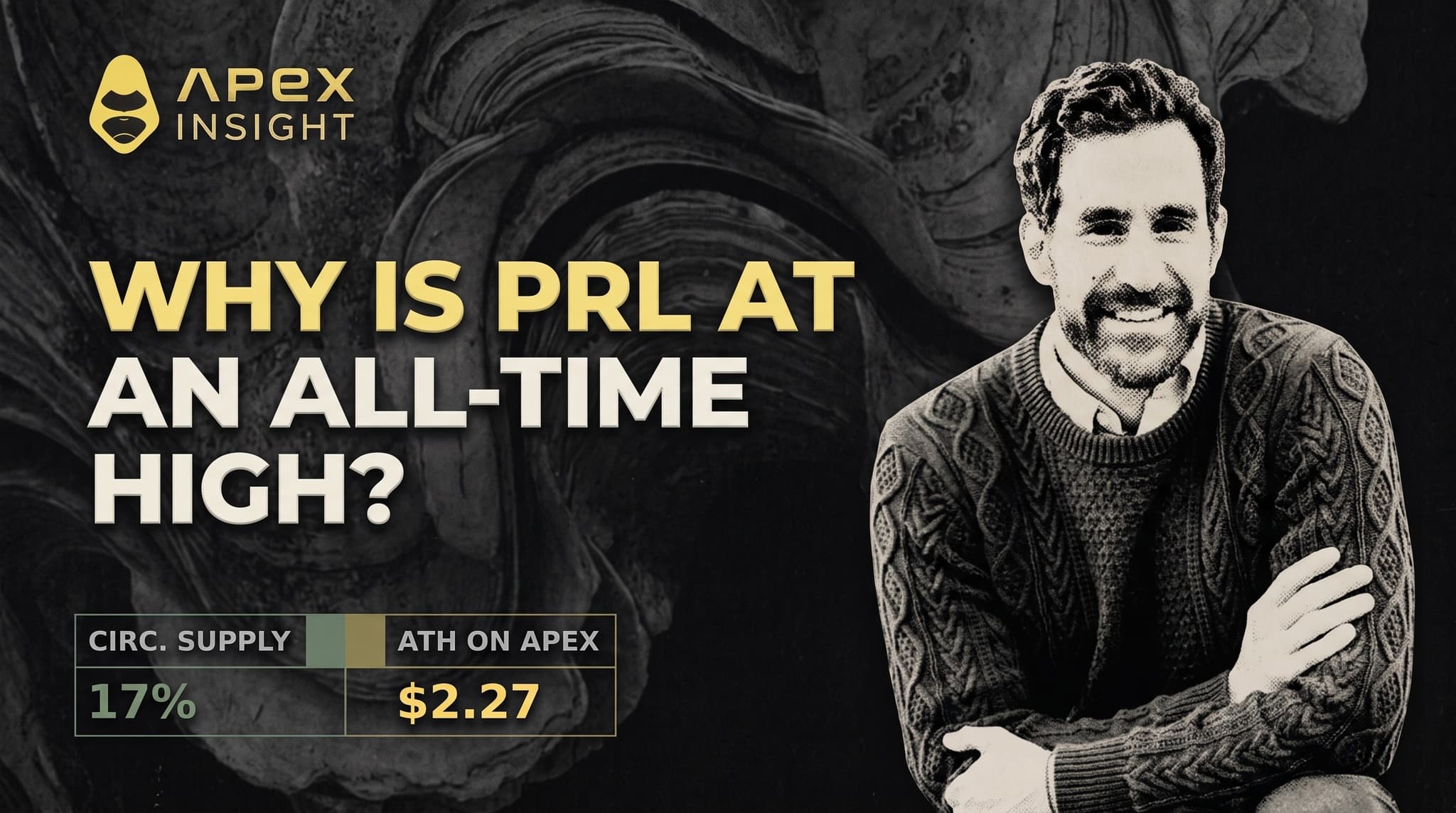
PRL is trading at or very near its record, depending on which price source you open. CoinMarketCap puts the high at $2.22 on 20 October; the ApeX contract printed $2.2746 that same day and sits around $2.22 this morning, up more than 13% in a day. Two months ago it was trading in cents.
The PRL contract's price history on ApeX begins on 14 October, and it has since become one of the most actively traded altcoin contracts on the board, ninth of 129 crypto perpetuals by 24-hour turnover.
So what is actually behind the move? Five things, and the fourth is the one most price charts leave out.
1. The mining is the product, not a side effect
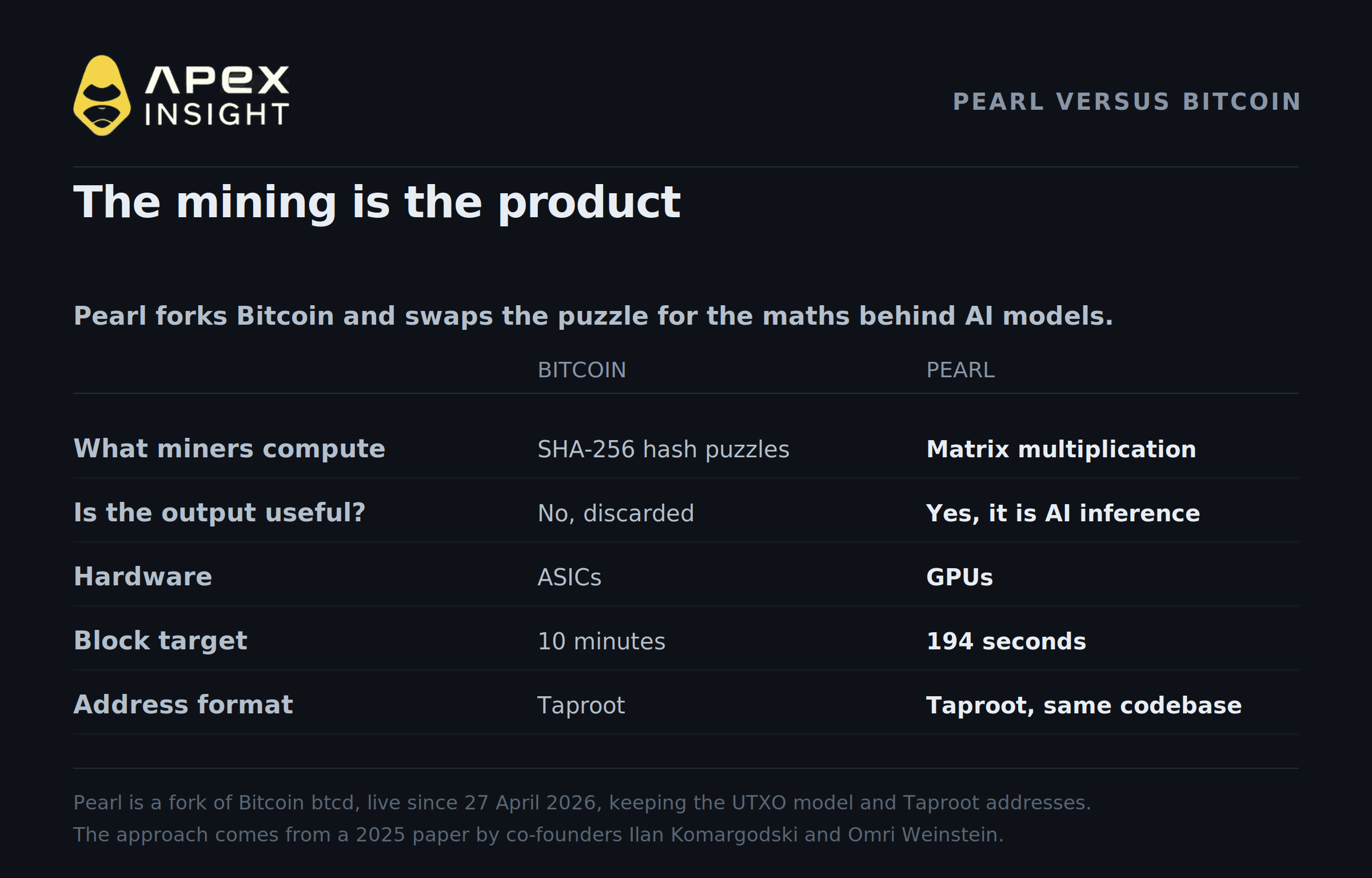
Bitcoin miners solve SHA-256 hash puzzles. The answers are worthless. They exist only to prove that electricity was burned.
Pearl miners do matrix multiplication instead. That is the same arithmetic a GPU performs when it runs an AI model, which means the work that secures the chain can also be the work that answers an AI request. Pearl calls this Proof of Useful Work, and it comes from a 2025 paper by co-founders Ilan Komargodski and Omri Weinstein.
Everything else is familiar. Pearl is a fork of Bitcoin's btcd codebase that went live on 27 April 2026. It keeps the UTXO model and Taproot addresses. Only the puzzle changed, and blocks target 194 seconds rather than ten minutes.
The commercial proof point arrived on 15 May, when Together AI launched a Pearl-linked inference endpoint priced more than 25% below its usual rate, with the discount offset by the expected future value of PRL emissions. If mining pays part of the compute bill, inference gets cheaper. That is the pitch in one sentence.
Worth noting: as of 17 October that endpoint was still listed on Together's model page but marked unavailable on its serverless API.
2. Nobody was handed a coin
This is the part that gives the story its moral energy.
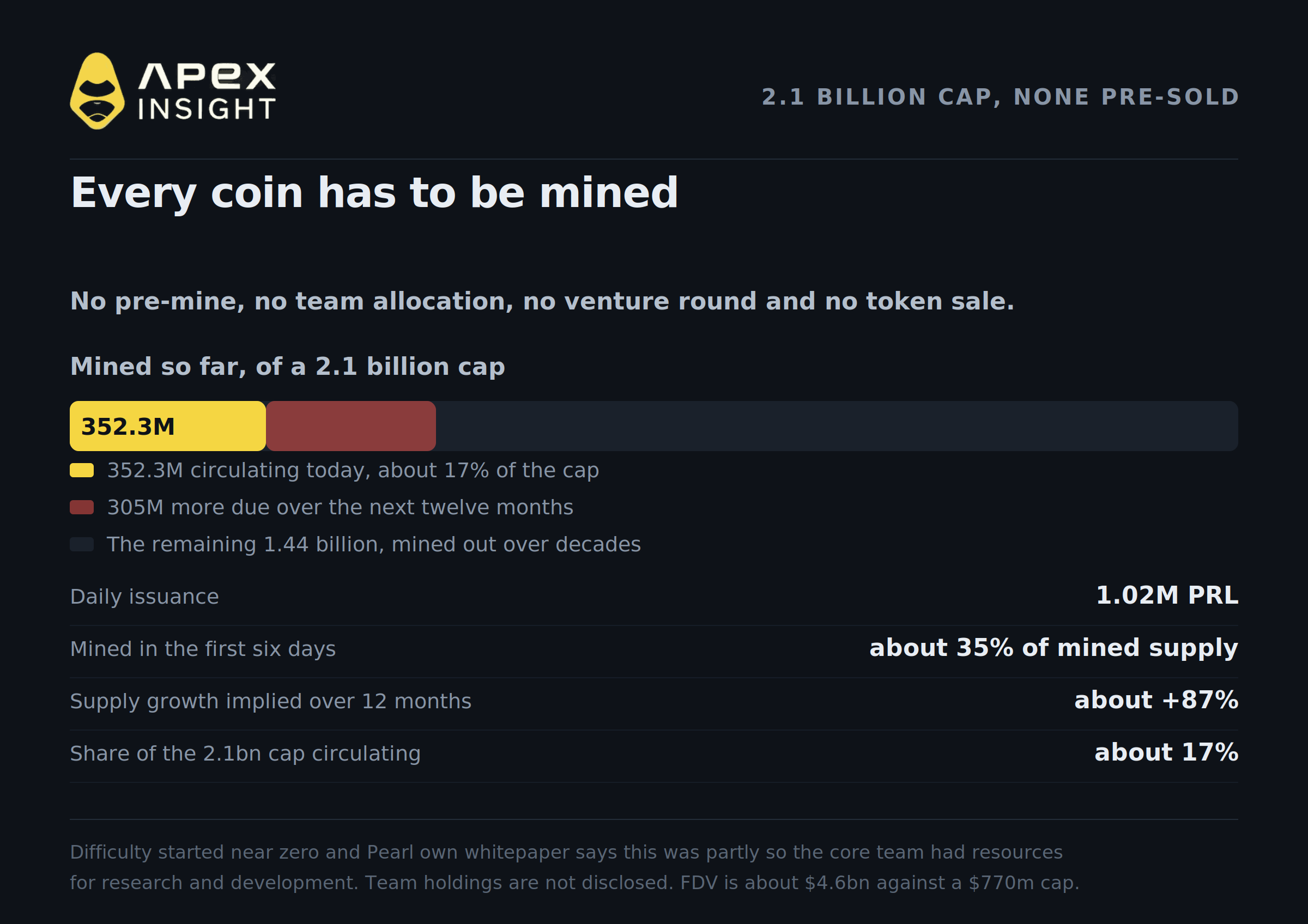
No token sale, venture round or team allocation is written into the code. There was no contract address to buy at launch. The supply cap is 2.1 billion, a deliberate echo of Bitcoin's 21 million, and every coin in existence entered circulation through mining.
That is unusual, and it explains much of the goodwill around the project. It is also not the whole story.
Mining difficulty started near zero, and Pearl's own whitepaper says this was partly so the core team "had resources for research and development". Roughly 35% of mined supply was produced in the first six days, and the team's holdings have never been disclosed. There is no pre-mine in the code, but there is a launch window that functioned a lot like one.
"Fair launch" describes the rules here, not the outcome.
3. The run is real, and so is the disagreement about it
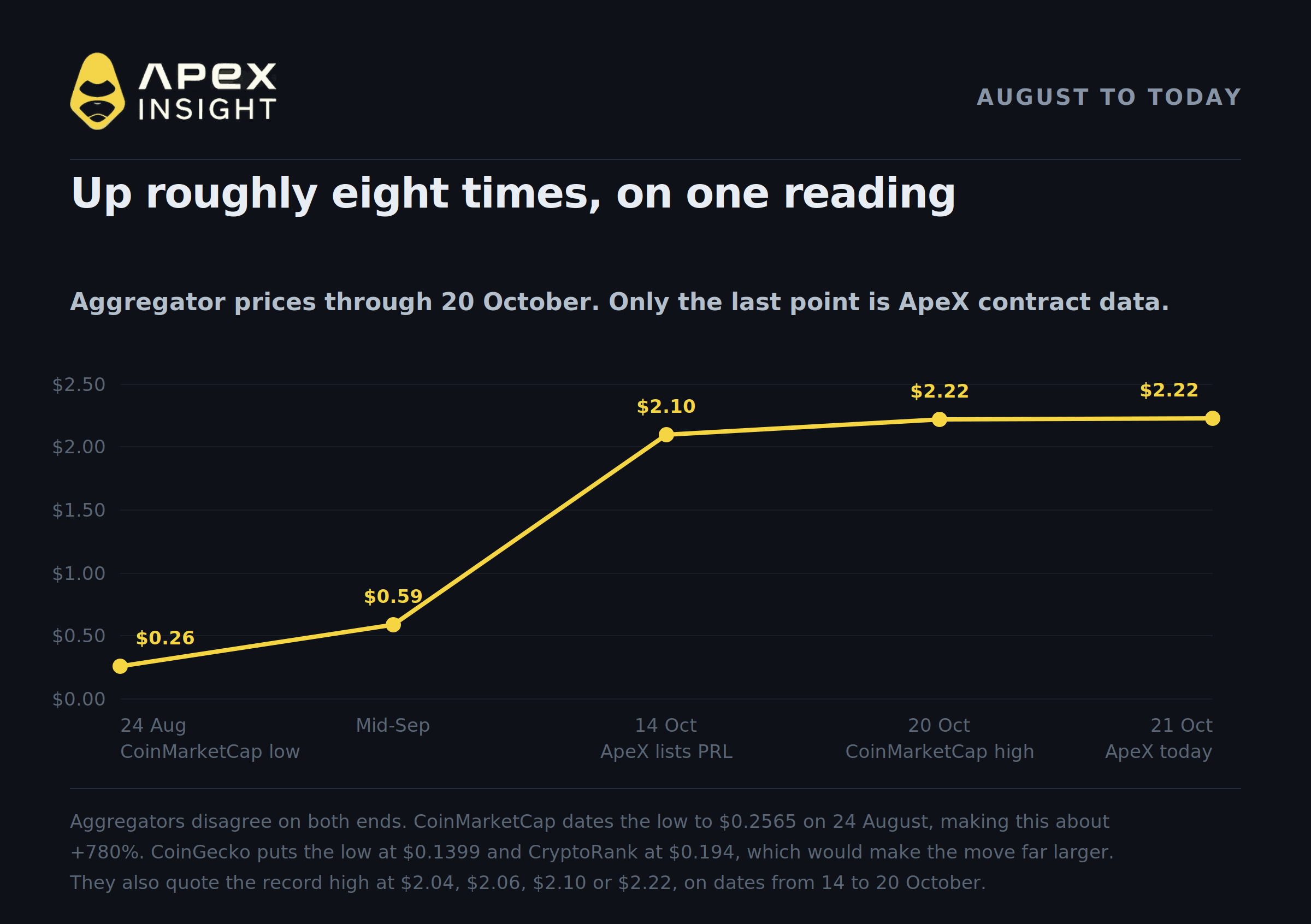
How big the run has been depends entirely on which low you accept. CoinMarketCap dates the record low to $0.2565 on 24 August, which makes the move about 780%. CoinGecko puts the low at $0.1399 and CryptoRank at $0.194, either of which would make it very much larger.
Taking CoinMarketCap's figures throughout:
Date | Price | Source |
|---|---|---|
24 Aug | $0.26 | Aggregator |
Mid-Sep | $0.59 | Aggregator |
14 Oct | $2.10 | Aggregator |
20 Oct | $2.22 | Aggregator |
Today | $2.22 | ApeX contract |
Two cautions before anyone quotes those numbers.
First, the aggregators do not agree with each other, at either end. In the last 24 hours they have quoted PRL anywhere between $1.70 and $2.21, and they date the record high to 14, 19 or 20 October at $2.04, $2.06, $2.10 or $2.22. The reason is simple: they track different venues. Blockspot sees only SafeTrade, CoinGecko leads with Ourbit, and their reported daily volumes range from under $1m to about $10m for the same asset on the same day.
Second, several unrelated tokens use the PRL ticker, including a Perle token trading near 9 cents and an unreviewed Base token that calls itself "Pearl Research (PRL)" and trades at a tiny fraction of a cent. CoinMarketCap lists the real asset under the ticker PEARL, not PRL. Check the chain and the project, not the symbol.
4. A researcher mined the AI chain using random numbers
Here is the problem that belongs in every PRL conversation and appears in almost none of them.
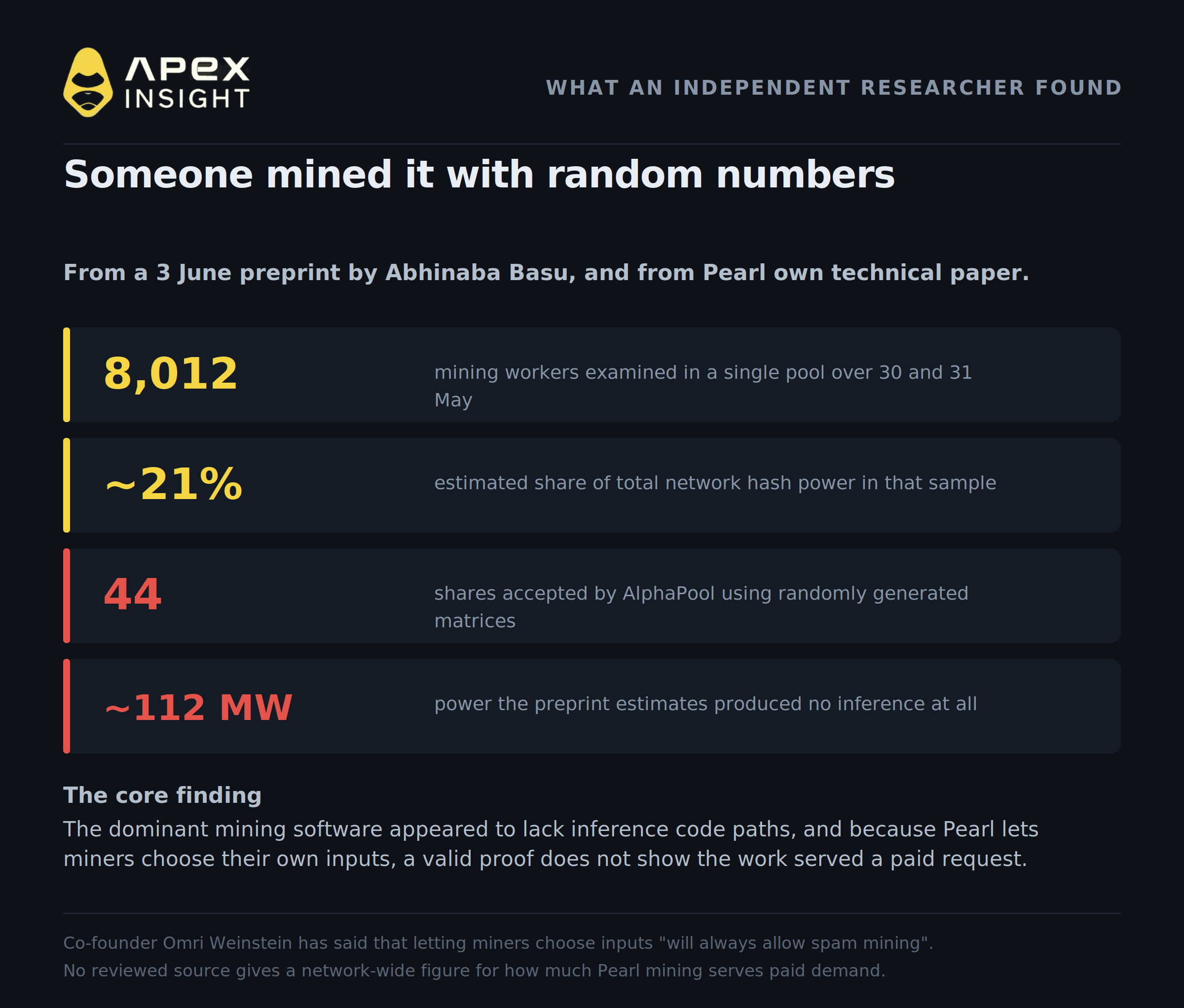
In a preprint published on 3 June, researcher Abhinaba Basu examined 8,012 mining workers in AlphaPool over 30 and 31 May, an estimated 21% of network hash power at the time. Every one of those workers had inference-capable hardware. The dominant mining software contained no inference code at all. Basu then ran his own open-source miner, submitted randomly generated matrices, and had 44 shares accepted.
The paper's scale estimate is the part that should stop you: roughly 24 exahashes per second, about 320,000 GPU-equivalents, and around 112 megawatts of power, producing output nobody asked for.
In other words, the chain accepted work that did no AI at all.
This is not a bug so much as a design consequence. Pearl's own technical paper allows miners to choose their own inputs, so a valid proof demonstrates that a matrix multiplication happened, not that anyone wanted the answer. Weinstein has acknowledged that this "will always allow spam mining."
Two things are fair to say alongside it. Running real inference carries a measured performance overhead of 10% to 15%, which an FP8 testnet upgrade reportedly cuts to between 0% and 3%, though that upgrade has no mainnet date. And no reviewed source has published a network-wide figure for how much Pearl mining currently serves paid demand. The honest position is that nobody outside the project knows the number.
That uncertainty is the actual trade here. PRL is priced as an AI compute network. Whether it is one yet is an open question.
5. An active tape sitting on an almost empty book
This is the part that matters most if you are sizing a position, and it is the simplest explanation for the whole chart.
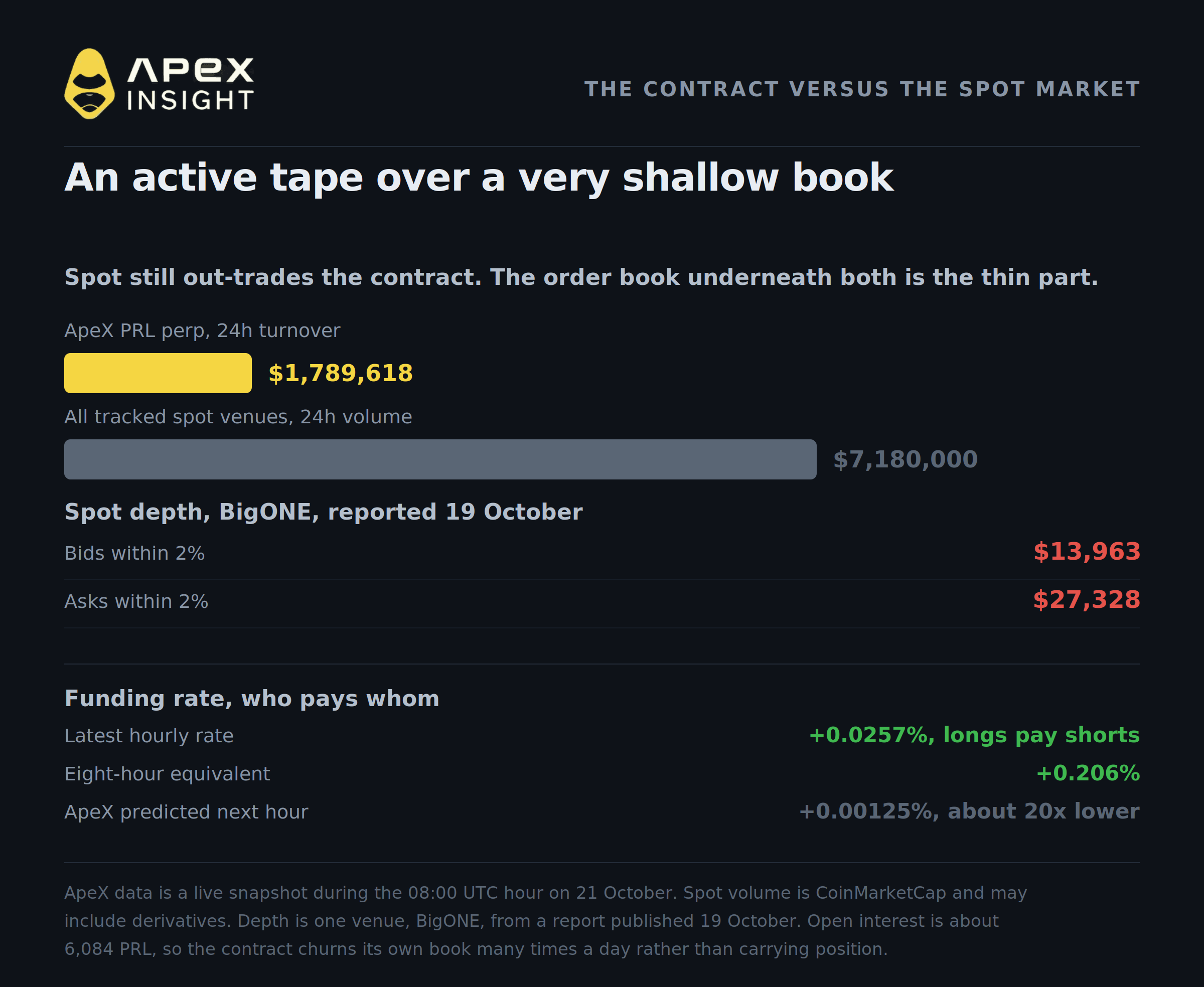
In a report published on 19 October, the spot order book on BigONE held roughly $13,963 of bids and $27,328 of asks within 2% of the price. That is a market where a single mid-sized order moves the print.
Volume looks healthier than that depth suggests. The ApeX PRL contract turned over $1,789,618 over 24 hours, against roughly $7.2m across all tracked spot venues on CoinMarketCap, a figure that may include derivatives. So spot still out-trades the contract by about four to one. The thin part is not the volume, it is the book underneath it.
Put the pieces together and you get a mechanical explanation that needs no narrative at all. Only about 17% of the 2.1 billion cap is circulating. The book is a few tens of thousands of dollars deep. Derivatives listings arrived only this month. A float that small against a book that shallow produces eight-times moves on its own.
Funding is the other thing to watch. The latest hourly rate is +0.0257%, so longs are paying shorts, and eight hours of that is about +0.206%. Annualise it and you get roughly 225%, but do not take that as a run rate: ApeX's own predicted next hourly rate is about twenty times lower, and the exchange caps hourly funding at 0.05% in either direction. Treat it as a snapshot of crowding right now, not an annuity.
One more number worth knowing. Open interest is only around 6,084 PRL. Against $1.79m of daily turnover, that is a contract being churned by fast money rather than one carrying a large positioned crowd.
What would actually change the story
Three markers, in order of how much they would matter:
A published figure for paid inference. Any credible measure of how much Pearl mining serves real demand would settle the central question in either direction.
The Together AI endpoint returning to service. It is the flagship commercial integration and it was listed as unavailable on 17 October.
The supply schedule biting. Around 1.02 million PRL enter circulation daily. Roughly 305 million more are due over the next twelve months against about 352 million circulating today, which implies supply growth near 87%. The two figures reconcile because Pearl's block subsidy declines on a smooth curve with no halvings, so the twelve-month total comes in below today's run rate. Fully diluted valuation is about $4.6bn against a market capitalisation near $770m. New issuance has been absorbed easily during a melt-up. It usually is, right up until it is not.
Trade PRL on ApeX
PRLUSDT is live on ApeX Omni, settled in USDT, with no KYC. You can go long or short, which on a contract where longs are currently paying funding every hour is not an academic distinction.
If you want the majors alongside it, BTCUSDT and ETHUSDT sit in the same account on the same margin balance.
Trade PRL on ApeX Omni
Long or short PRL with USDT collateral. No KYC, no gas fees.
Trading perpetual contracts carries a high level of risk and can result in the loss of your entire position. Leverage increases both gains and losses. Prices quoted here move constantly, and thinly traded assets such as PRL can gap sharply. Nothing in this article is financial advice. Do your own research and never risk more than you can afford to lose.
If you need any help, feel free to reach out to our team on Discord.
Website: https://www.apex.exchange
Twitter: https://twitter.com/OfficialApeXdex
Telegram: https://t.me/ApeXdex
ApeX contract data is a live snapshot taken during the 08:00 UTC hour on 21 October 2026. Some Pearl protocol details, including the block time and the first-six-days mining figure, come from ApeX's own earlier analysis of the project. Spot prices, market capitalisation, circulating supply and record high figures are from third-party aggregators, which disagree with one another on this asset, and are labelled where quoted. Pearl's design, supply rules and partnership claims are the project's own statements. The 3 June research preprint is the work of its author and has not been peer reviewed. Funding rates change every hour.