




Why did SpaceX fall 9% after its $193bn unlock?
Lock-up expiries are supposed to be boring. A date passes, insiders can sell, the stock takes its medicine, everyone moves on.
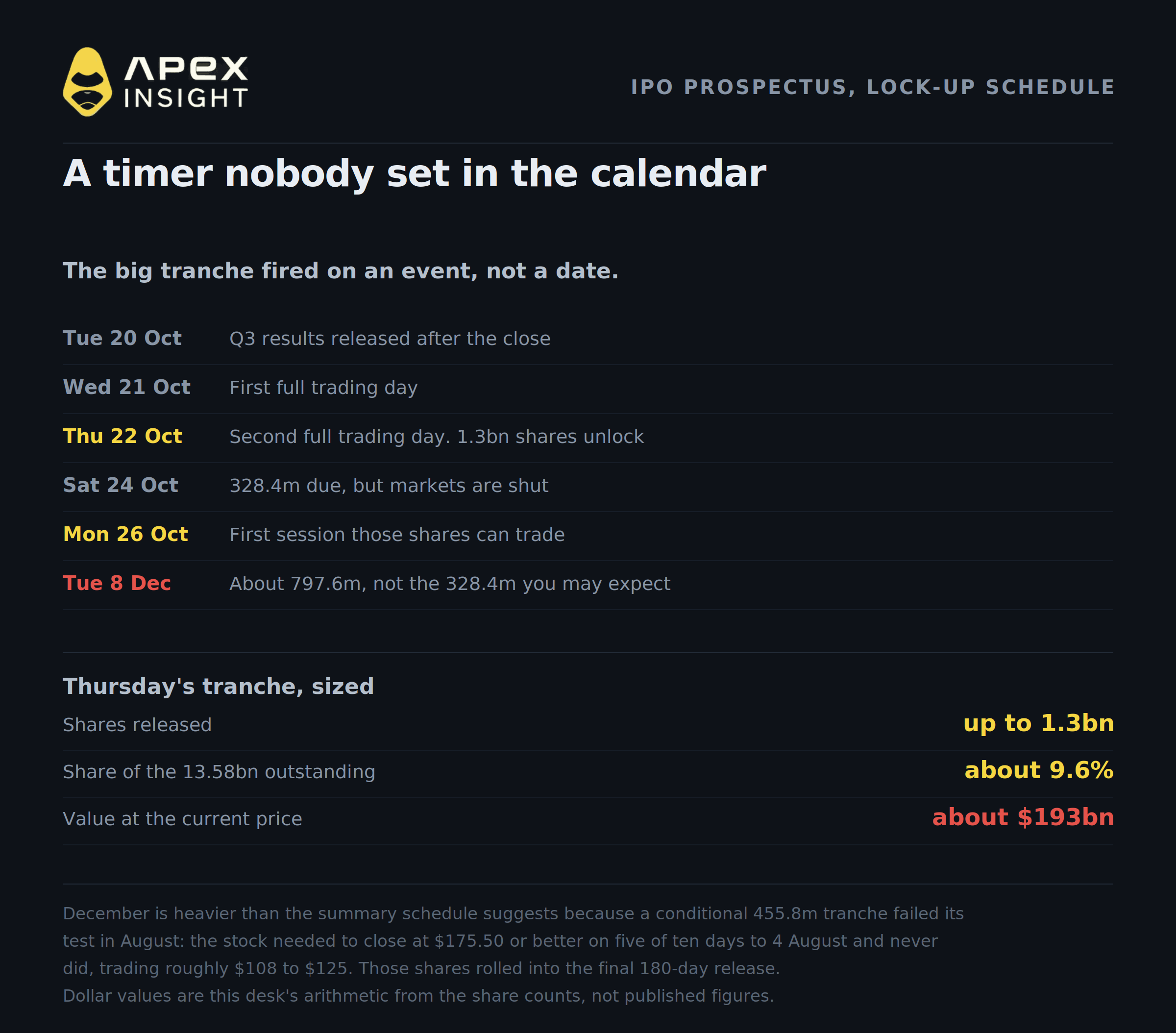
This one was not boring, and not only because of the size. On Thursday 22 October, up to 1.3 billion SpaceX shares became eligible for sale, which is about 9.6% of the 13.58 billion shares outstanding. At the price going into unlock day that was roughly $193bn of stock; at Thursday's closing price it is nearer $188bn. Another 328.4 million becomes tradable on Monday 26 October.
It landed on a stock that had just jumped 7.8% on a Q3 beat and a merger proposal nobody was expecting. SpaceX then fell 9.1% on unlock day, closing at $144.75, below where it stood before anyone had seen the quarter. It has steadied since, trading around $147 in the following session.
So why did it fall? The honest answer is that three things hit the tape at once and no single one of them owns the move. Here are six things that explain why, and why anyone claiming a cleaner answer is guessing.
1. The unlock did not happen on a date, it happened on an event
This is the detail that catches people out, and it is written into the prospectus rather than any calendar.
The 1.3 billion tranche was never scheduled for 22 October. It was scheduled for "the second full trading day on Nasdaq immediately following the public release of our quarterly financial results" for the September quarter. SpaceX released Q3 after the close on Tuesday 20 October. Wednesday was the first full trading day. Thursday was the second. That is the whole mechanism.
It is also worth knowing that Thursday was not the first release. The same schedule had already freed roughly 2.26 billion shares across six earlier tranches between August and 9 October. The market has been absorbing this for ten weeks, which matters for how you read the price action later in this article.
The schedule runs on, and the next tranche is a trap for the careless. The prospectus lists 328.4 million shares at day 135, which falls on Saturday 24 October. Markets are shut. The first session in which those shares can actually trade is Monday 26 October.
Then there is the piece almost nobody has written about.
The prospectus contained a conditional tranche of 455.8 million extra shares, which would have been released early in August if the stock closed at least 30% above the $135 IPO price, meaning $175.50 or better, on at least five of the ten consecutive trading days ending on the first earnings release date of 4 August. It did not come close. Across those ten sessions the closes ran from $108.37 to $125.33. Not one day qualified.
Those shares did not vanish. They rolled into the final tranche of the 180-day pool, which means the release due on 8 December is around 797.6 million shares rather than the 328.4 million a reader of the summary schedule might assume. That 797.6 million is the prospectus's own figure for this exact scenario, not our arithmetic, which is why it does not tally neatly with 328.4 plus 455.8: the percentage tranches in the schedule are rounded. December is roughly two and a half times heavier than it looks.
2. Musk is not in this unlock at all
If you have seen a post suggesting Musk can cash out into this unlock, it is wrong, and the filing is unambiguous.
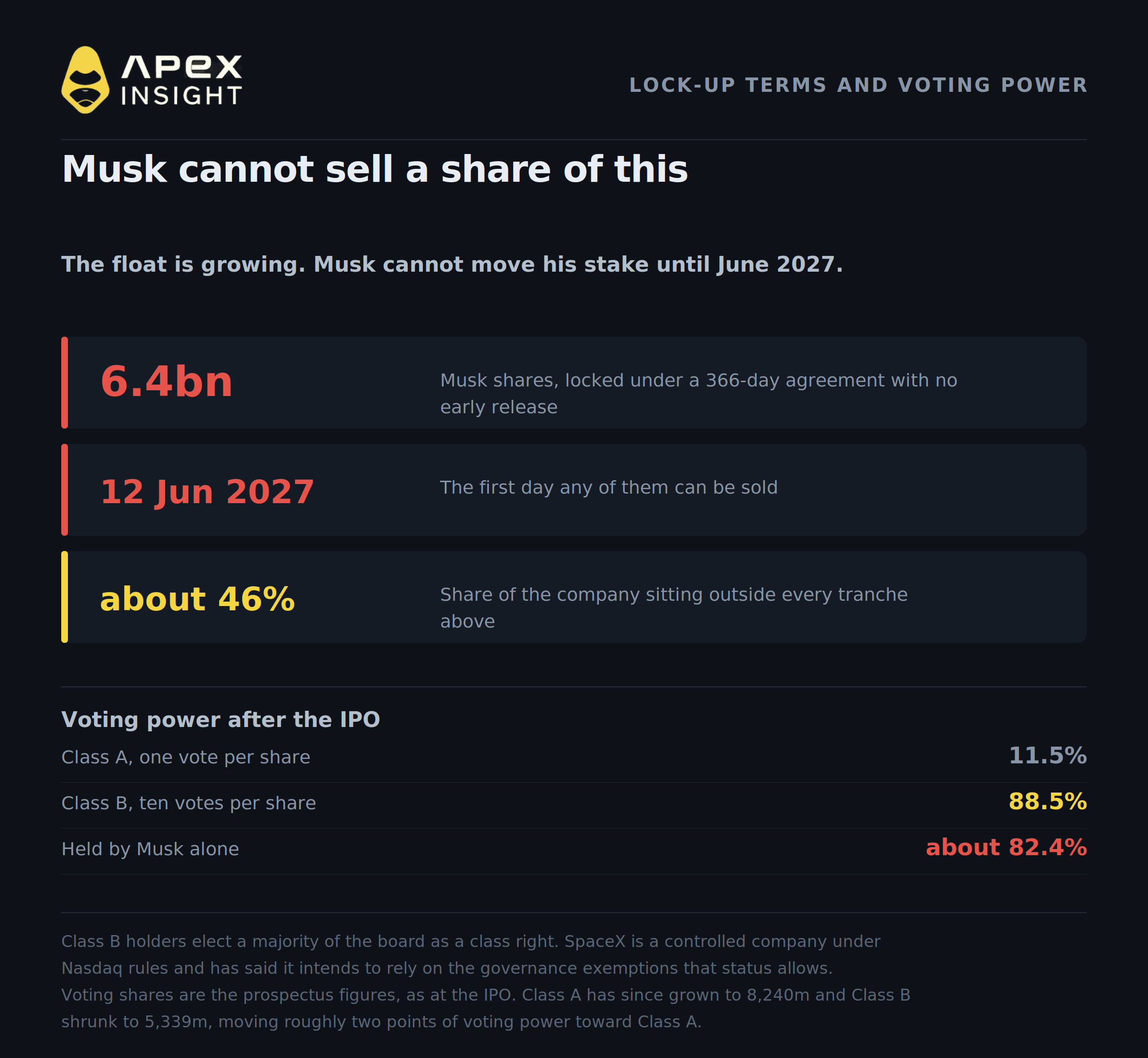
Musk signed a 366-day lock-up with no early release provisions. His holding, up to 6.4 billion shares including 350 million Class B shares underlying options, stays locked until 12 June 2027. Against the 13.58 billion shares outstanding at the end of September that is roughly 46% to 47% of the company, sitting entirely outside every tranche discussed above.
What he does have is control. SpaceX runs a dual class structure in which Class A carries one vote and Class B carries ten. After the IPO, Class A holders held 11.5% of the voting power and Class B held 88.5%, with Musk holding roughly 82.4% of total voting power on his own. Class B holders elect a majority of the board as a class right.
The company is a controlled company under Nasdaq rules and has said it intends to rely on the exemptions that status allows from certain corporate governance requirements. The bylaws also impose mandatory arbitration and venue restrictions on shareholder claims. None of this is hidden. All of it is in the company's own risk summary.
So the ownership question and the selling question point in opposite directions. The float is getting larger, and the voting split has drifted slightly with it: Class A has grown to 8,240m shares and Class B shrunk to 5,339m since the IPO, which moves roughly two points of voting power toward Class A. But Musk's own stake cannot move before next June, whatever the float does.
Insiders below Musk are a different matter. President and COO Gwynne Shotwell sold 342,170 shares on 22 September at weighted average prices between $151.15 and $154.72, for about $52.5m, alongside same-day option exercises at strikes of $8.40, $11.20 and $19.40. Those sales were made under a 10b5-1 plan adopted in June, so they were scheduled rather than opportunistic. They are still a reminder of the cost basis insiders are selling against.
3. The bigger news was not the unlock, it was the merger
Buried under the lock-up headlines, Musk used the same earnings call to confirm something far larger.
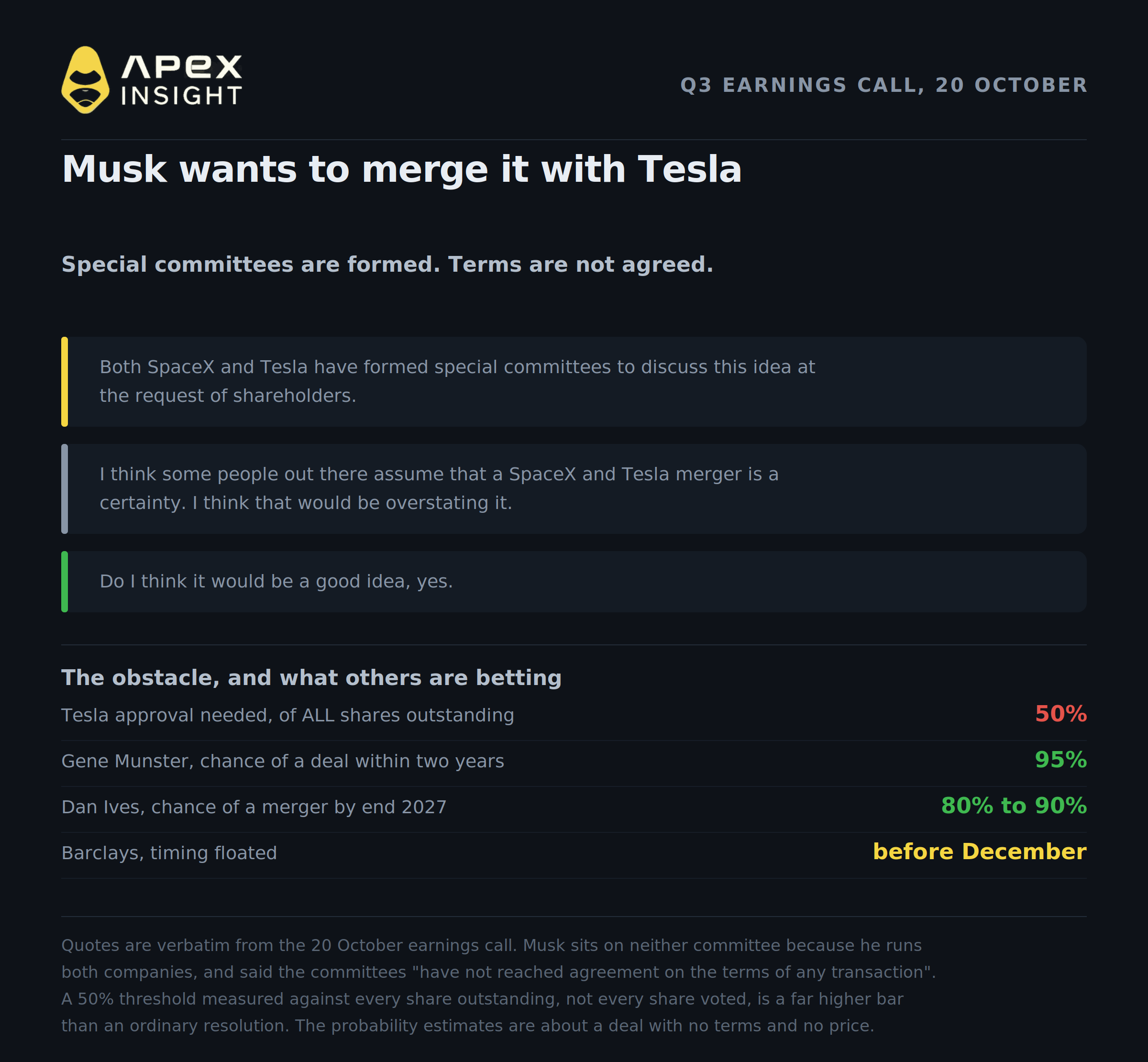
"Both SpaceX and Tesla have formed special committees to discuss this idea at the request of shareholders," he said. The committees are made of independent directors. Musk is not in their discussions: as he put it, "because I'm a conflicted party, I can't actually be in the discussions of the special committees." He described the arrangement as "an odd kabuki dance where two groups of people are talking, and I can't be in the conversation," and said at one point that he felt like he was "tap dancing through a mine field."
He was careful not to oversell it. "I think some people out there assume that a SpaceX and Tesla merger is a certainty," he said. "I think that would be overstating it." The committees "have not reached agreement on the terms of any transaction," and "obviously, there's no guarantee that they will."
He was equally clear about his own view. In the same answer he said "Do I think it would be a good idea, yes," and separately that "there's a lot of merit to combining the companies as we are pretty much in the super intelligence singularity."
The obstacle he named is procedural and it is substantial. On the Tesla side, he said, "we will need a 50% vote of all shares, not just those who vote, but of all shareholders," which he called "quite a high hurdle to try to achieve." A threshold measured against every share outstanding, rather than every share voted, is much harder to clear than a normal resolution.
There is also a detail in the filings that complicates the picture of Musk standing outside the process. The third quarter 10-Q, filed on 22 October, says a combination would be subject to approval by the special committee, the board and the controlling shareholder. Musk cannot sit in the committee discussions, but nothing happens without him either.
The Street is already pricing something. Gene Munster has put the chance of a combination within two years at 95%, Barclays has suggested a deal could be announced before December, and Dan Ives at Yorkville Ives has written that "We believe there is an 80%-90% chance that Tesla and SpaceX merge by the end of 2027." Those are estimates about a transaction with no terms, no price and no agreement, so treat them as sentiment rather than analysis.
4. What the price actually did, and why you cannot pin it on one thing
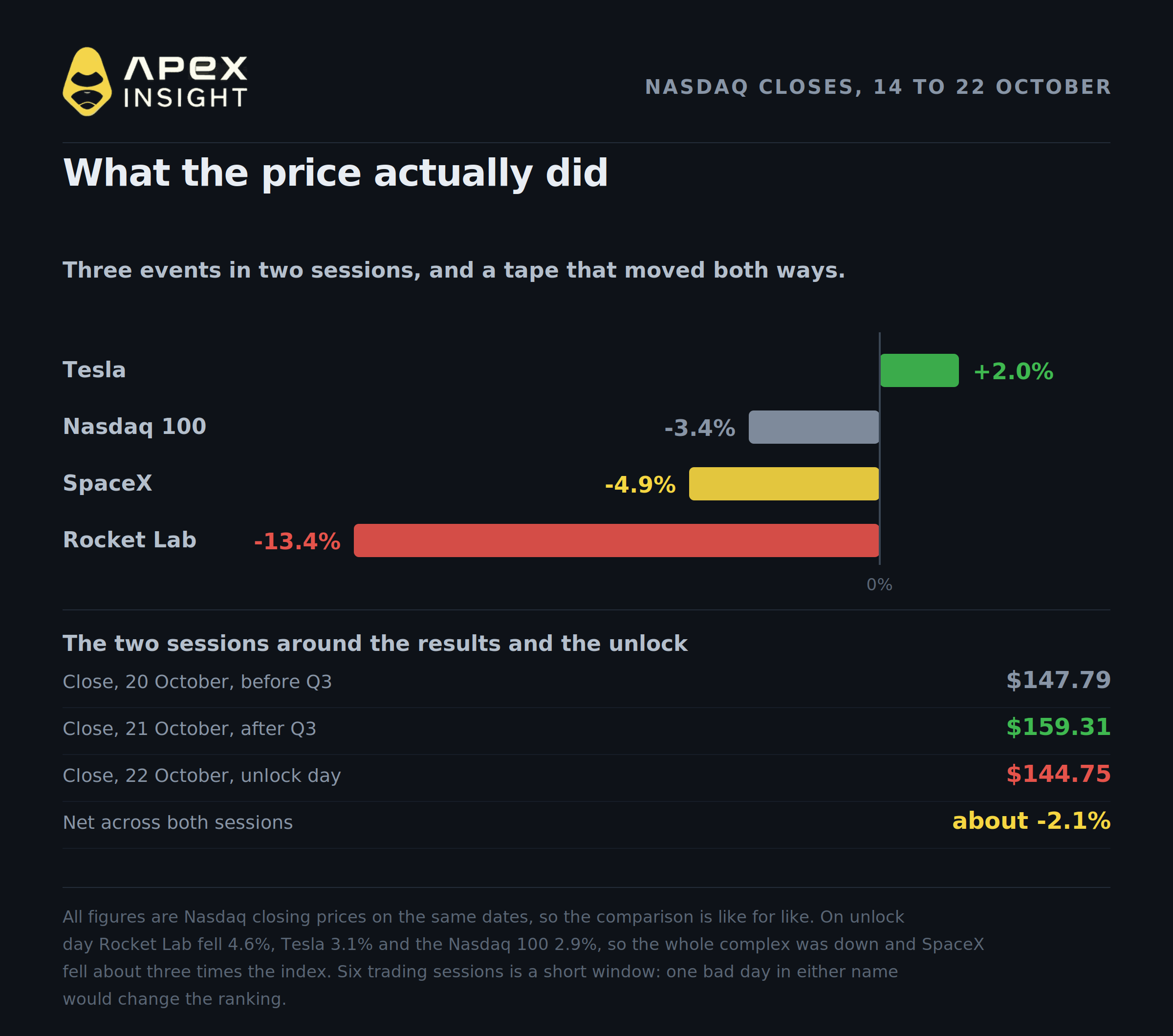
Three events, two sessions, and a tape that moved hard in both directions.
SpaceX closed at $147.79 on 20 October, before the Q3 release. It jumped 7.79% to $159.31 on Wednesday, a session in which the results drew a wave of price target increases and the merger proposal was absorbed at the same time. Then on unlock day it fell 9.1%, closing at $144.75. Net across the two sessions: down about 2.1%.
That is a hard day by any measure. But a single stock's move means little without a comparison, and the comparison does not support a one-cause story. Over the same session Rocket Lab fell 4.6%, Tesla fell 3.1% and the Nasdaq 100 fell 2.9%. Thursday was a down day across the board, and SpaceX fell about three times as hard as the index.
Widen the window and the ranking changes again. Measured on closes from 14 to 22 October, SpaceX is down 4.9%, worse than the Nasdaq 100's 3.4% but far better than Rocket Lab's 13.5%.
Closing change, 14 to 22 October | Change |
|---|---|
Tesla | +2.0% |
Nasdaq 100 | -3.4% |
SpaceX | -4.9% |
Rocket Lab | -13.5% |
The honest reading is that all three events were in the price at once. The unlock added supply, the capital intensity in the results gave people a reason to worry about dilution, and a merger proposal with no terms attached is hard for anyone to value. Coverage of the fall put it down to capital intensity, dilution risk and the merger proposal, without mentioning the lock-up at all. Anyone telling you precisely how much of a 9% move belongs to the unlock is guessing, and that includes anyone writing in its favour.
For longer context: the stock is about 15.8% below its 6 October close of $171.92, about 28.3% below its record close of $201.80 on 16 June, and still about 7.2% above the $135 IPO price from June.
5. You are not buying a rocket company
This is the fact that reframes everything above, and it comes straight from the Q3 release.
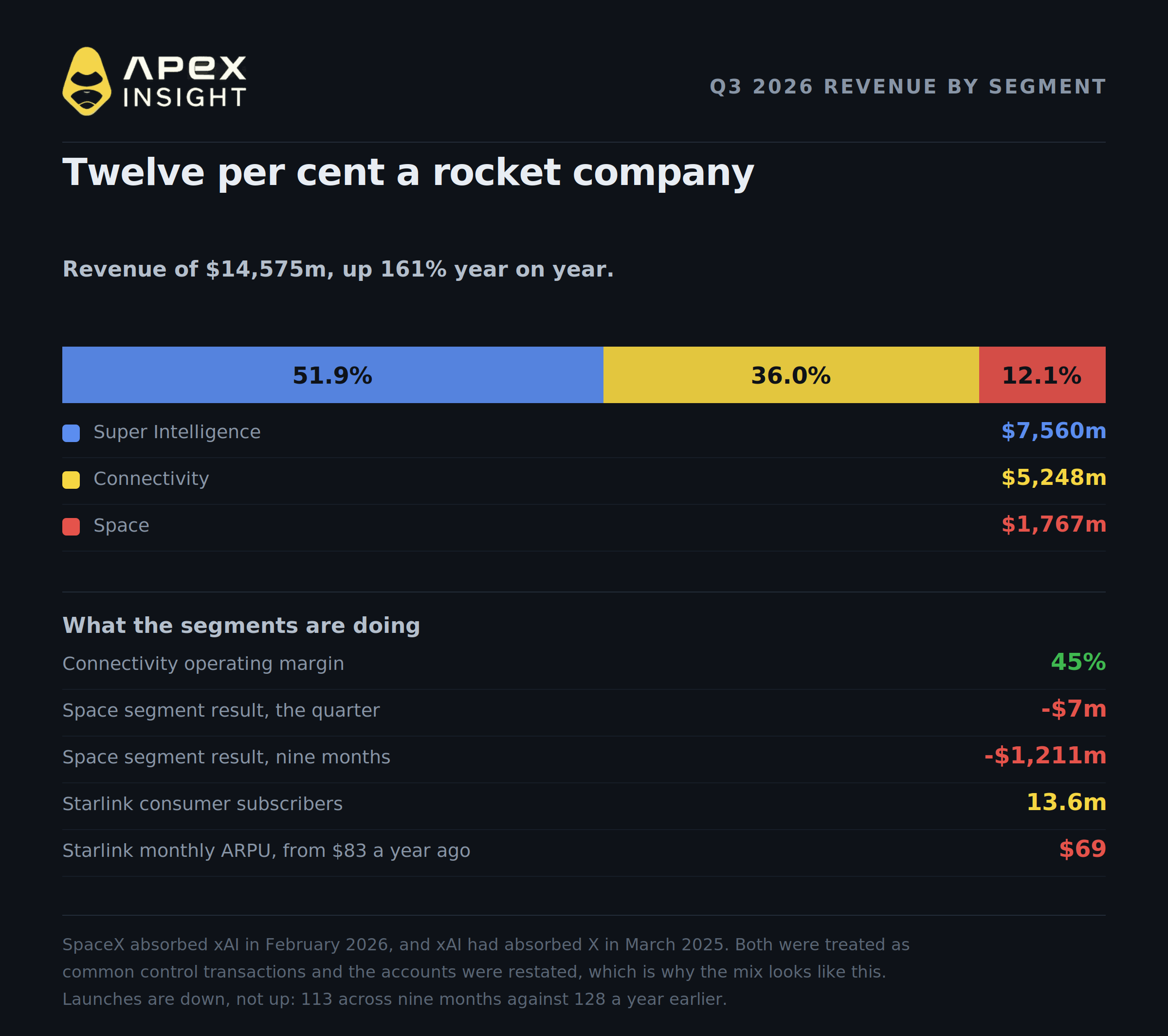
SpaceX reported revenue of $14,575m for the September quarter, up 161% year on year. Split it by segment and the company most people think they are buying is a minority of it:
Segment | Q3 revenue | Share |
|---|---|---|
Super Intelligence | $7,560m | 51.9% |
Connectivity | $5,248m | 36.0% |
Space | $1,767m | 12.1% |
The Space segment lost $7m in the quarter and has lost $1,211m over nine months.
The reason is corporate history rather than strategy drift. SpaceX absorbed xAI effective February 2026, and xAI had already absorbed X, formerly Twitter, in March 2025. Both were accounted for as common control transactions and the financials were restated accordingly. In August the company closed a merger with Cursor's parent Anysphere, issuing about 389.3 million new Class A shares at a $60.0bn implied equity value.
That last point matters for anyone focused on the unlock. The dilution that actually changed the share count this year came from acquisitions, not lock-up expiries. Weighted average basic shares went from 2,941m in Q3 2025 to 11,942m in Q3 2026.
The connectivity business, meanwhile, is the one quietly doing the work. Starlink reached 13.6 million consumer subscribers at the end of September, adding 1.6 million in the quarter and up from 7.2 million a year earlier, and the segment earned $2,367m of operating income on $5,248m of revenue. That is a 45% operating margin.
It is not uniformly good. Average revenue per user is $69 a month against $83 a year earlier, although it rose 5% sequentially in the quarter and the company attributes the quarter's additions to growth in developed markets. So the annual trend is down and the quarterly one has turned. And launches are down, not up: 113 across nine months against 128 in the same period last year.
As for the rockets themselves, Starship flew its first orbital mission on 28 September, deploying 26 Starlink V3 satellites. A Raptor engine shut down during ascent, the vehicle compensated and completed its burn, and the ship later splashed down in the Pacific several hours earlier than planned following a post-orbit checkpoint assessment.
The next flight is the one to watch, because it will attempt to catch both the booster and the ship for the first time. Musk's own framing on the earnings call was carefully balanced: "So success is not guaranteed on these first flights, but I'd say it's more likely than not that this succeeds next flight."
6. The number to worry about is capital spending, not the unlock
An unlock changes who owns the shares. Capital spending changes whether the company needs to sell more of them.
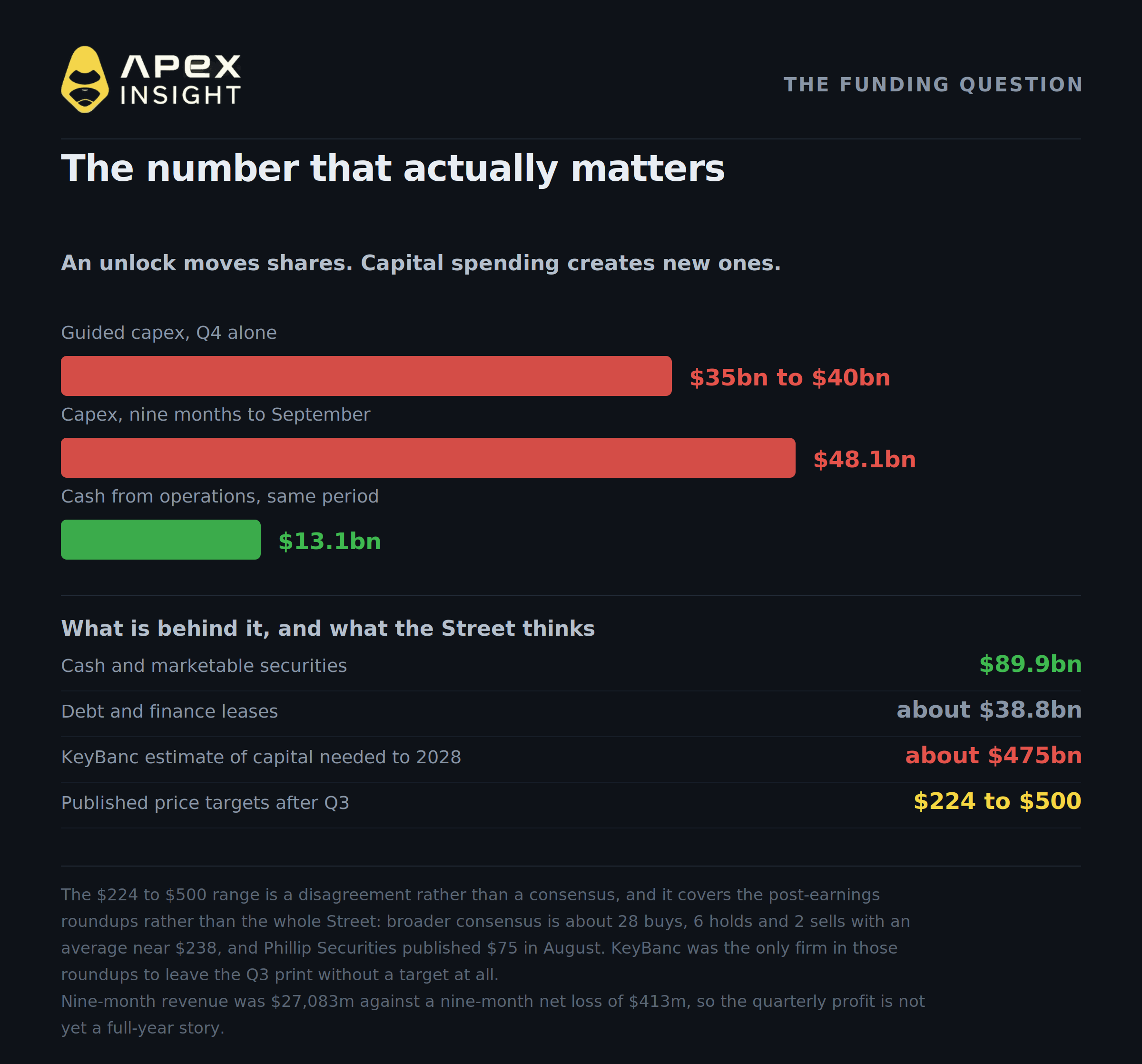
SpaceX spent $19,593m on capital expenditure in the third quarter alone, and $48,069m across nine months, against $13.1bn of cash generated from operations in the same period. Chief financial officer Bret Johnsen told the earnings call that "we expect fourth quarter capital expenditures to now be in the range of $35 billion to $40 billion."
Put that next to last year. The guided spend for this single quarter is two and a half to three times the company's entire capital expenditure across the first nine months of 2025, which was $13,846m.
There is a backlog behind it too. The third quarter 10-Q puts it at $62,959m at the end of September, with roughly $42bn expected to be recognised within a year. The balance sheet can absorb a lot as well: SpaceX holds about $89.9bn in cash and marketable securities, against roughly $38.8bn of debt and finance leases, and it raised $25bn of senior notes in June at coupons from 5.350% to 6.650%. A lot is not forever. Michael Leshock at KeyBanc models roughly $475bn of additional capital needed through 2028, and was the only firm in the post-earnings roundups to come out without a price target at all, writing that he wants more before moving: "Until we achieve greater visibility on Starship's progress to validate its growth initiatives."
Most of the rest moved higher. Across the dozen or so firms that published after Q3, targets ran from $224 at TD Cowen to $500 at JPMorgan, with Goldman Sachs at $245, Barclays at $300, Cantor Fitzgerald at $345, and Morgan Stanley holding rather than raising at $300.
Two things to hold alongside that. A $224 to $500 spread on the same stock after the same results is not a consensus, it is a disagreement with error bars the width of a mid-cap company. And the post-earnings roundups are not the whole Street: the broader consensus compiled by TipRanks is roughly 28 buy ratings against 6 holds and 2 sells, with an average target near $238, and at least one published target sits far below the current price, Phillip Securities having put $75 on the stock in August. The bullish cluster is real, but it is a cluster, not unanimity.
Two more things a buyer should hold in view. Nine month revenue was $27,083m but the nine month result was a net loss of $413m, so the $4,404m of third quarter net income is not yet a full year story. And customer concentration is high and getting higher. One unnamed customer was 20.9% of 2025 revenue. In the third quarter 10-Q, filed on unlock day, Customer A is 16.6% of quarterly revenue and Customer B is 34.5%, so two customers account for just over half the quarter between them. A single customer is also 27.7% of accounts receivable.
What would actually settle this
Four markers, in order of how much they would move the stock:
Whether the special committees produce terms. A merger with an exchange ratio attached is a completely different security to the one trading today. Until then it is a proposal, and the Tesla side needs 50% of all shares outstanding to pass.
Whether the 8 December tranche gets absorbed. It is around 797.6 million shares, not the 328.4 million the headline schedule implies, for the reason given in section one. That is the real test of appetite, not the tranche just past.
Starship cadence. Musk told the call "We expect Starship to fly weekly at some point in the first half next year." Weekly flights would change the launch economics. Anything slower leaves KeyBanc's objection standing.
Whether capex guidance comes down. A quarter guided at $35bn to $40bn is a bet. If the next guide is lower, the funding question softens. If it is higher, the equity question comes back.
One honest gap worth stating. Musk spoke at length about the merger, but across the Q3 release, the earnings call and every filing checked for this piece, no SpaceX executive said anything at all about the lock-up, the unlock or the share price. On the thing that moved the stock hardest that week, there is no company view on the record.
Trade the markets in this article
Everything discussed here is tradeable on ApeX Omni as a TradFi perpetual, settled in USDT, up to 50x, long or short, with no KYC.
Trade SpaceX on ApeX Omni
Long or short SPCX with USDT collateral. Up to 50x, no KYC, no gas fees.
The stock at the centre of it, and the peer that makes its move meaningful:
If the view is about Musk rather than about rockets:
TSLAUSDT, Tesla
And if you want the index to trade the move against:
QQQUSDT, the Nasdaq 100
TradFi contracts settle against an index rather than the underlying asset, and ApeX lists them separately from its crypto perpetuals in its own contract data. Check promotion terms before trading one to qualify for a volume campaign.
Race to the Top 50 is live
ApeX is running a trading competition with a prize pool of up to 10,000 USDT, split across the Top 50 on the leaderboard.
Full rules, the campaign period, how points are scored and the complete prize table are in the Race to the Top 50 announcement.
Trading perpetual contracts carries a high level of risk and can result in the loss of your entire position. Leverage increases both gains and losses. Share prices move on filings and news that arrive without warning, and a stock in a lock-up expiry window can gap in either direction. Nothing in this article is financial advice. Do your own research and never risk more than you can afford to lose.
If you need any help, feel free to reach out to our team on Discord.
Website: https://www.apex.exchange
Twitter: https://twitter.com/OfficialApeXdex
Telegram: https://t.me/ApeXdex
Share prices described as closes are Nasdaq consolidated prices, cross-checked against market data rather than taken from any single linked article; the links on those sentences point to coverage of the event, not to the price itself. All relative performance between SpaceX, Rocket Lab, Tesla and the Nasdaq 100 is computed from Nasdaq closing prices on the same dates, so every comparison in the piece is like for like. ApeX contract data was used to monitor the contracts intraday while writing and tracked the Nasdaq price closely, but no ApeX figure is quoted in the body. All three sessions quoted, on 20, 21 and 22 October, are complete and their closes are final. The reference to the stock steadying around $147 is an intraday level during the 23 October session, which had not closed at the time of writing, and is the only unfinished figure in the piece. Merger quotes are verbatim from the 20 October earnings call transcript, which is machine-assisted and was cross-checked against secondary reporting of the same remarks. The 14 to 22 October window is six trading sessions, short enough to be sensitive to a single day in either name. Unlock share counts, lock-up terms, voting power and the conditional tranche test come from the IPO prospectus; quarterly figures from the 20 October results release; the Cursor share issuance and the Shotwell sale from the filings linked. The third quarter 10-Q was filed on 22 October and the backlog, customer concentration and merger approval disclosures are taken from it. Market capitalisation and the dollar value of each unlock tranche are this desk's arithmetic from the share counts and the current price, not published figures.