




Note: All market prices and spot figures are as of 11 September 2026, the week described here. The Bitcoin contracts referenced run to 31 December and do not settle on the Fed decision.
1. The rally stopped
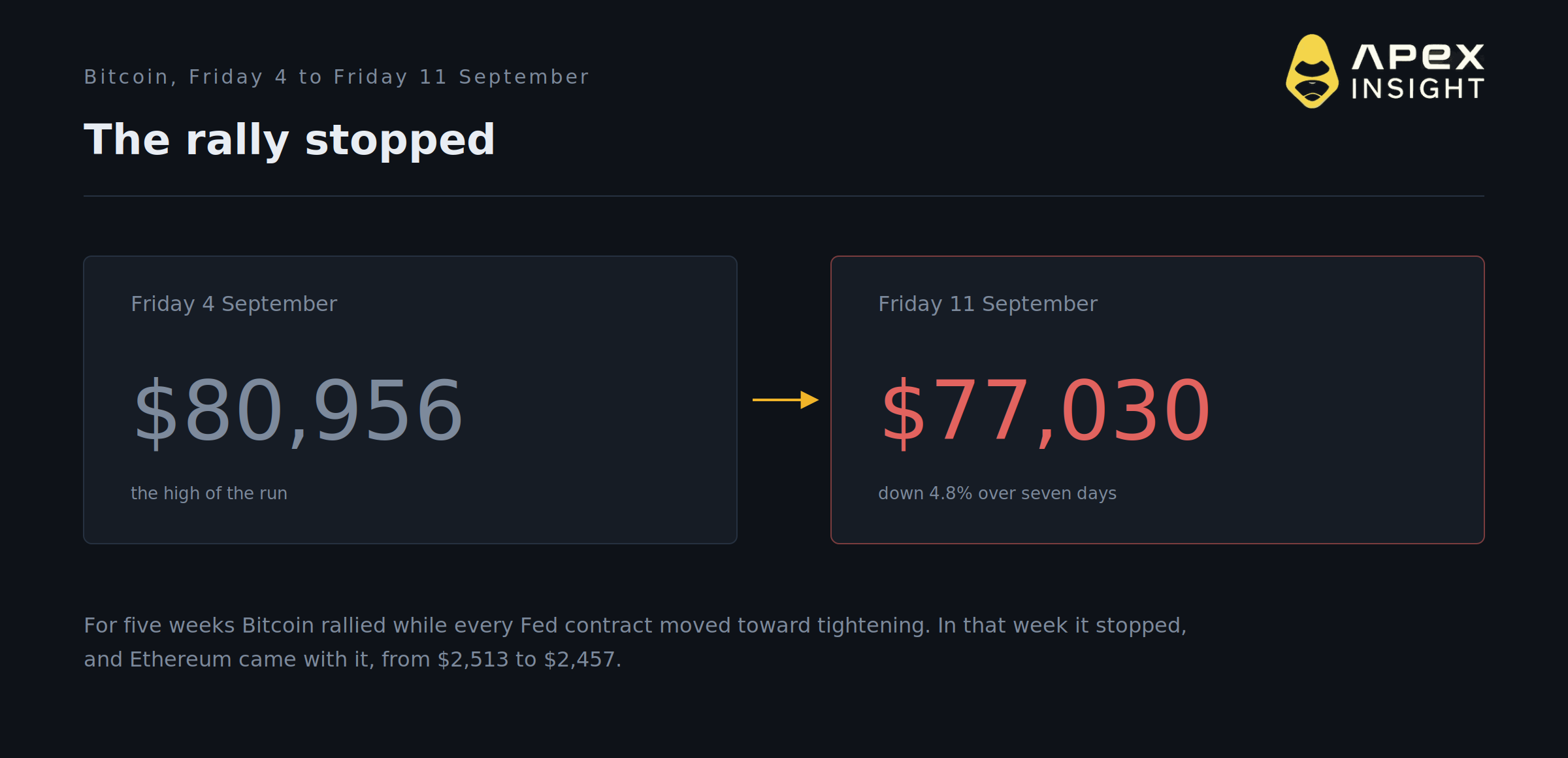
Bitcoin printed $80,956 on Friday 4 September, the high of a run that began in early August. By Friday 11 September it was $77,030, down 4.8 percent over those seven days.
Ethereum came with it, from $2,513 to $2,457 across the same window.
That is not a collapse and it does not undo the August move. But it is the first week since the start of that run in which crypto has gone down while the Fed contracts went up, and the direction of that relationship is the whole point of this piece.
2. The upside ladder lost twenty-two points
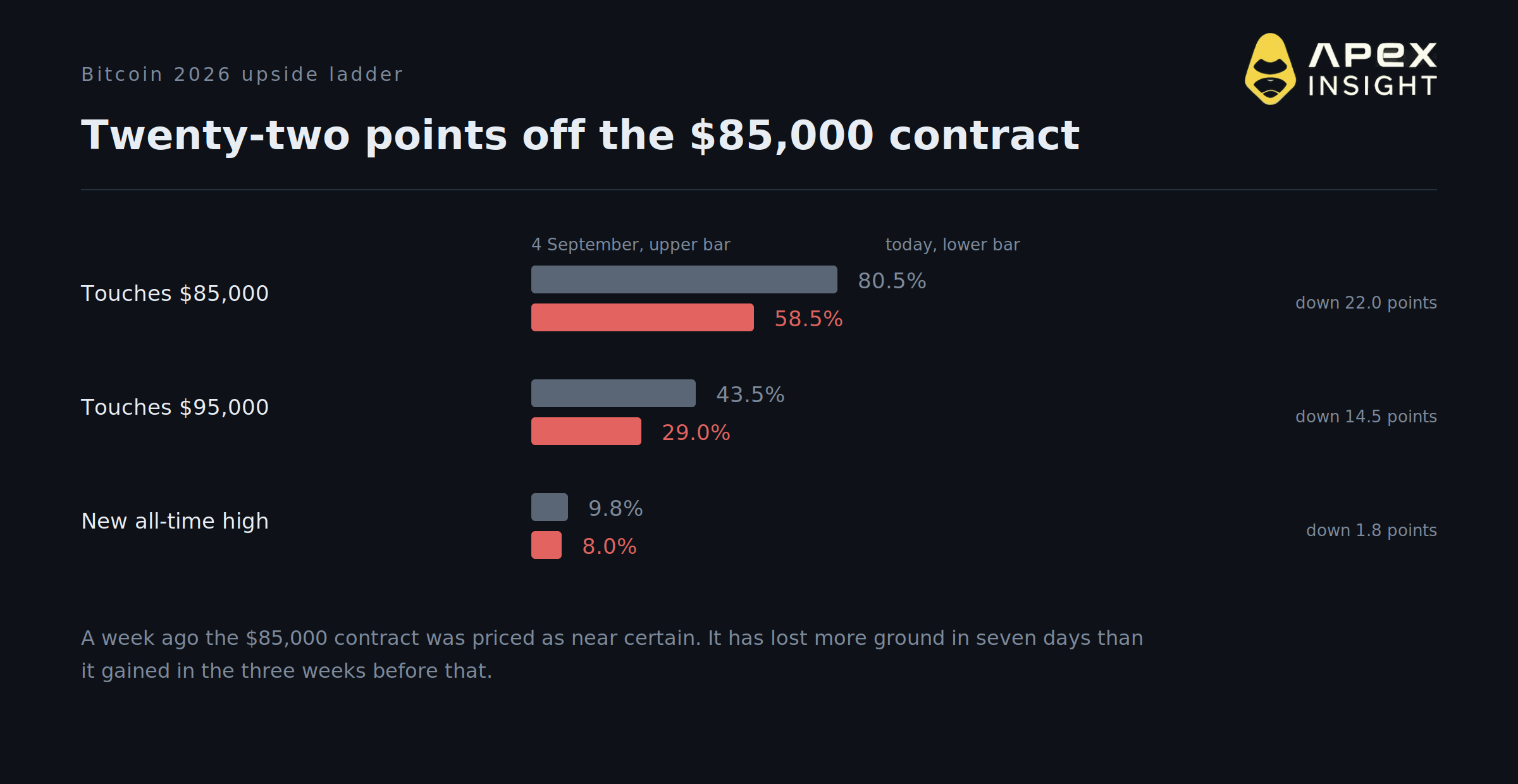
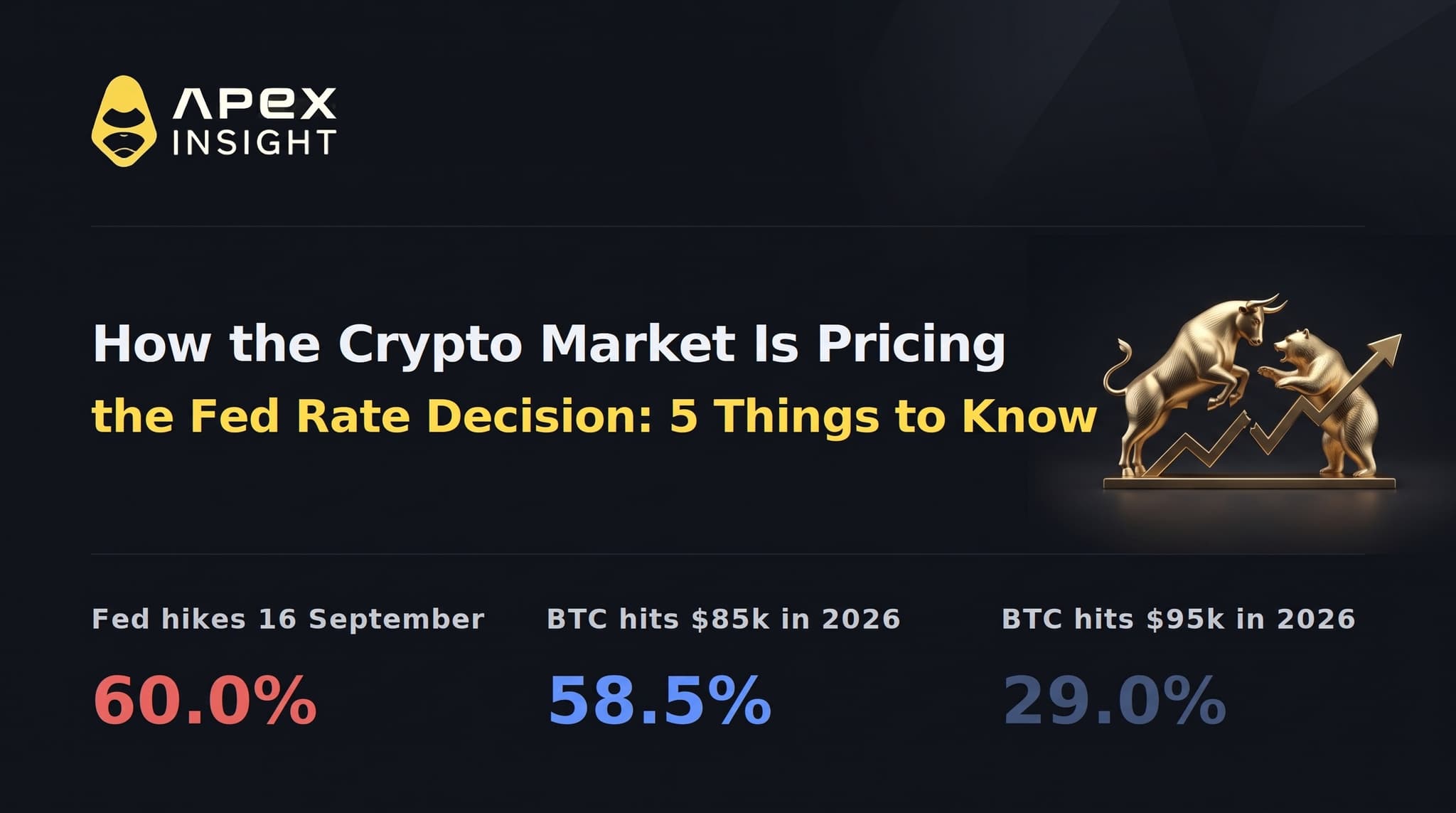
A week ago Bitcoin touching $85,000 before year end priced at 80.5 percent. It now prices at 58.5 percent.
Touching $95,000 has fallen from 43.5 percent to 29.0 percent. A new all-time high by 31 December has fallen from 9.8 percent to 8.0 percent.
The $85,000 contract has lost more ground in seven days than it gained in the three weeks before it. That is a faster repricing than the spot move alone would imply, which is what happens when a market stops extrapolating a trend.
3. The downside has come back
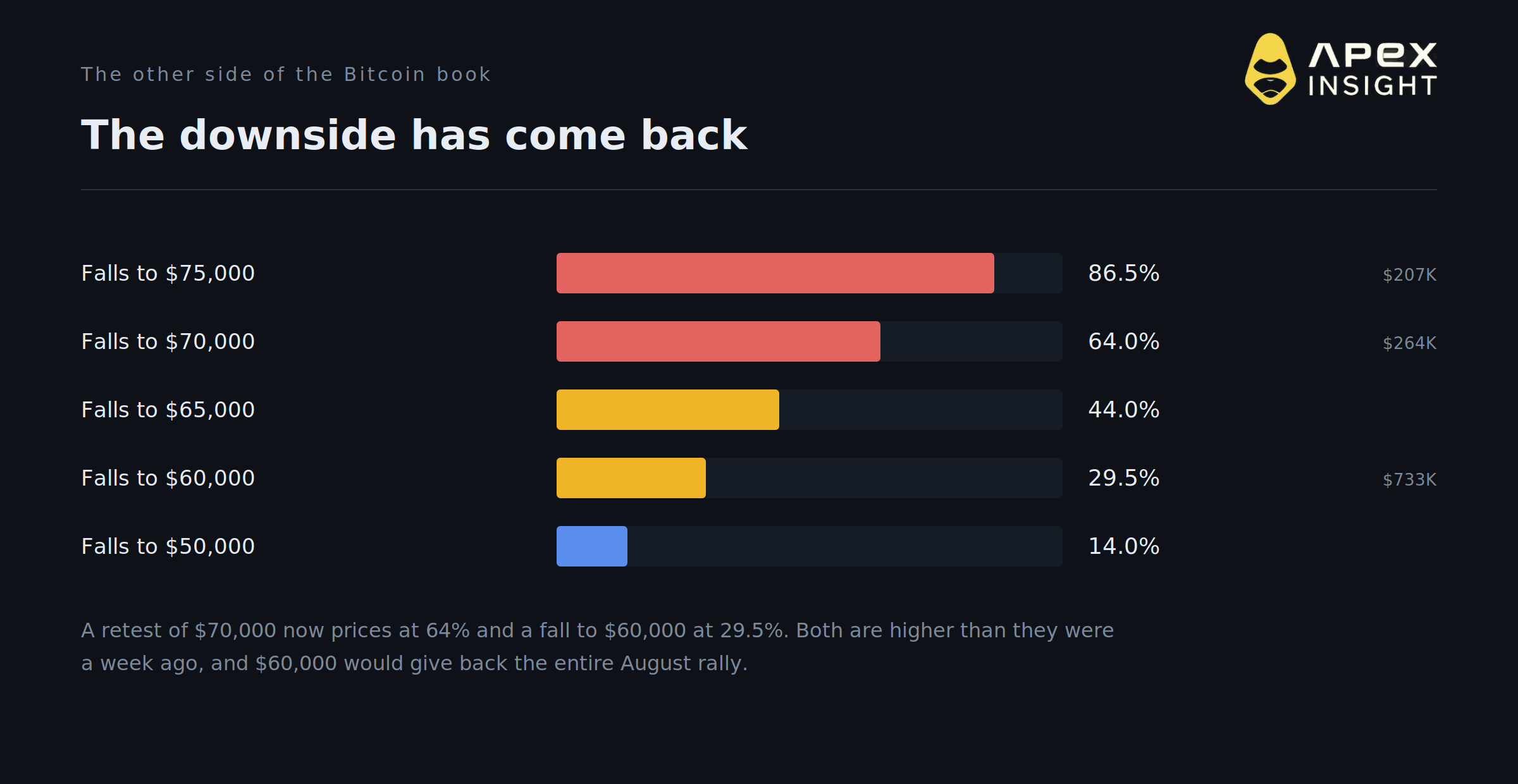
Falling to $75,000 prices at 86.5 percent, $70,000 at 64.0 percent, $65,000 at 44.0 percent and $60,000 at 29.5 percent.
All of those are higher than a week ago. A return to $60,000 would give back the entire August rally, and it now prices at close to one in three on a $733K leg.
Note that these are touch contracts running to 31 December, so a 64 percent chance of tagging $70,000 is not a forecast that Bitcoin ends the year there. It is a statement about how much room the market now expects price to cover in both directions.
4. The two series converged
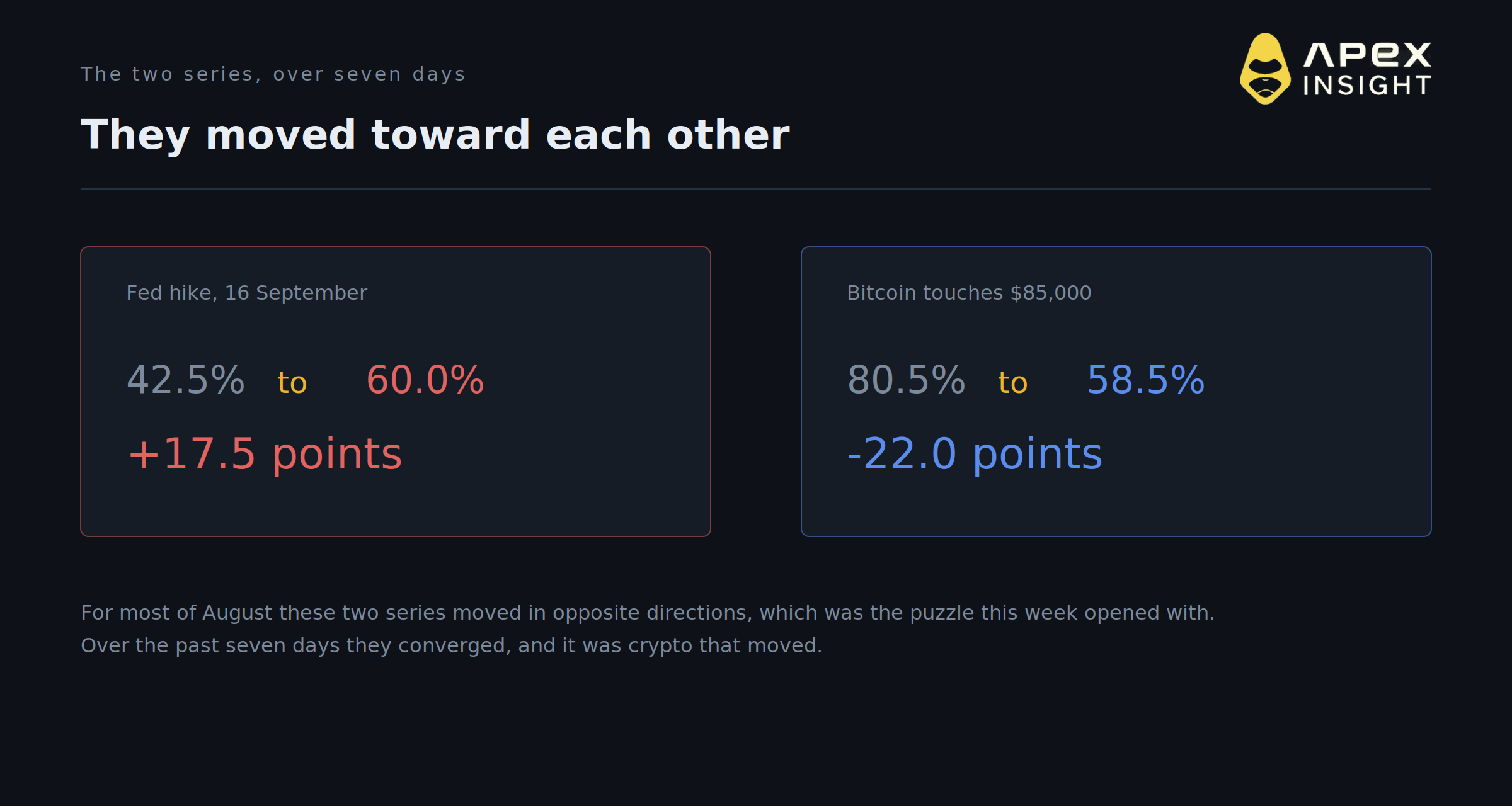
Over seven days the September hike contract rose from 42.5 percent to 60.0 percent. Over the same seven days, Bitcoin touching $85,000 fell from 80.5 percent to 58.5 percent.
Seventeen and a half points one way, twenty-two points the other.
For most of August these two moved apart, which is what made the divergence worth writing about in the first place. They then moved toward each other, and the adjustment came almost entirely from the crypto side. The Fed contracts did not soften to meet crypto. Crypto repriced to meet the Fed.
5. The whole board in one week
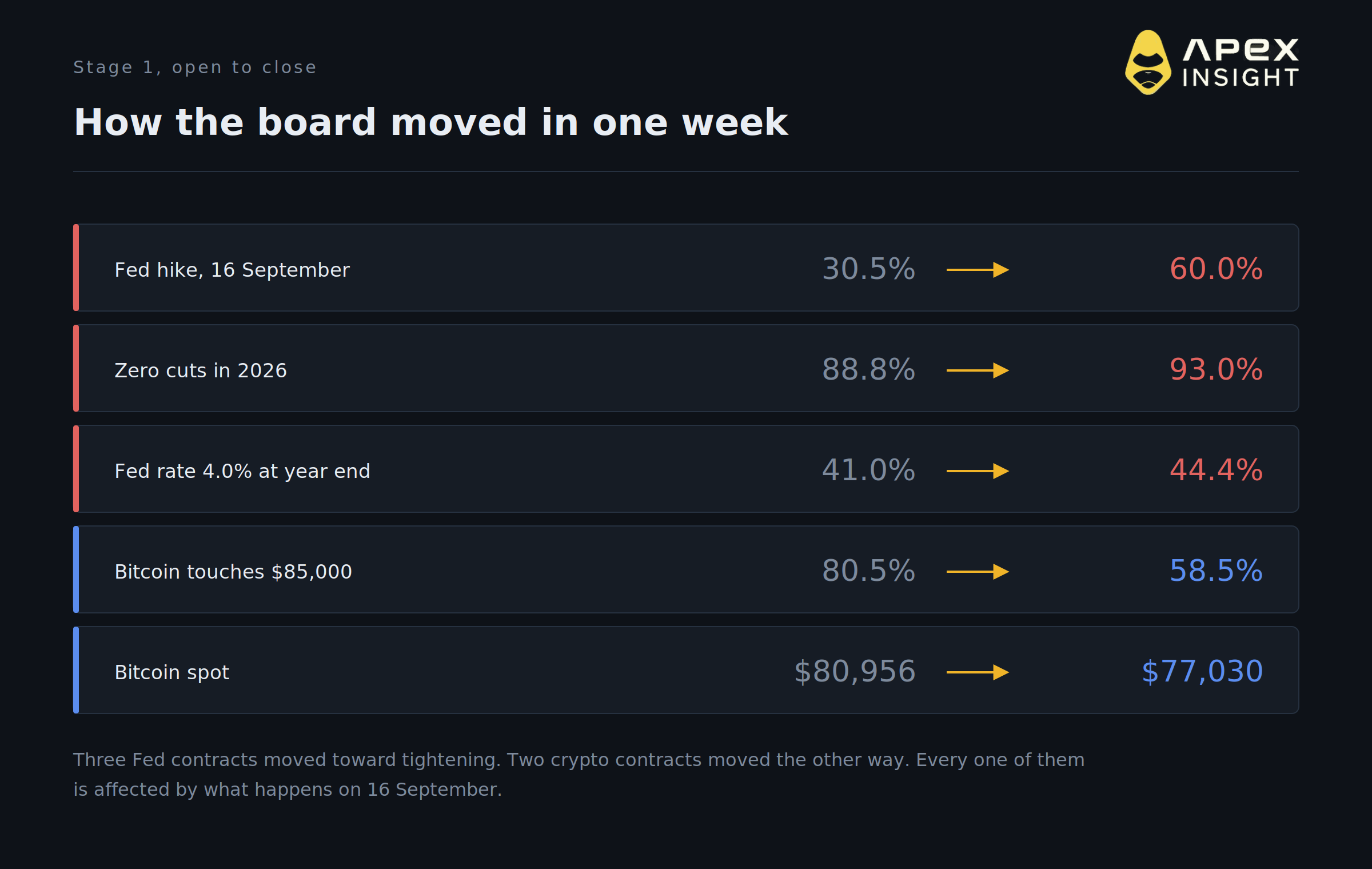
Across that week and the days either side of it:
The September hike went from 30.5 percent to 60.0 percent. Zero cuts in 2026 went from 88.8 percent to 93.0 percent. The year-end rate at 4.0 percent went from 41.0 percent to 44.4 percent. Bitcoin touching $85,000 went from 80.5 percent to 58.5 percent. Bitcoin spot went from $80,956 to $77,030.
Three Fed contracts moved toward tightening. Two crypto contracts moved the other way. Every one of them is affected by the same decision.
What actually resolves, and what does not
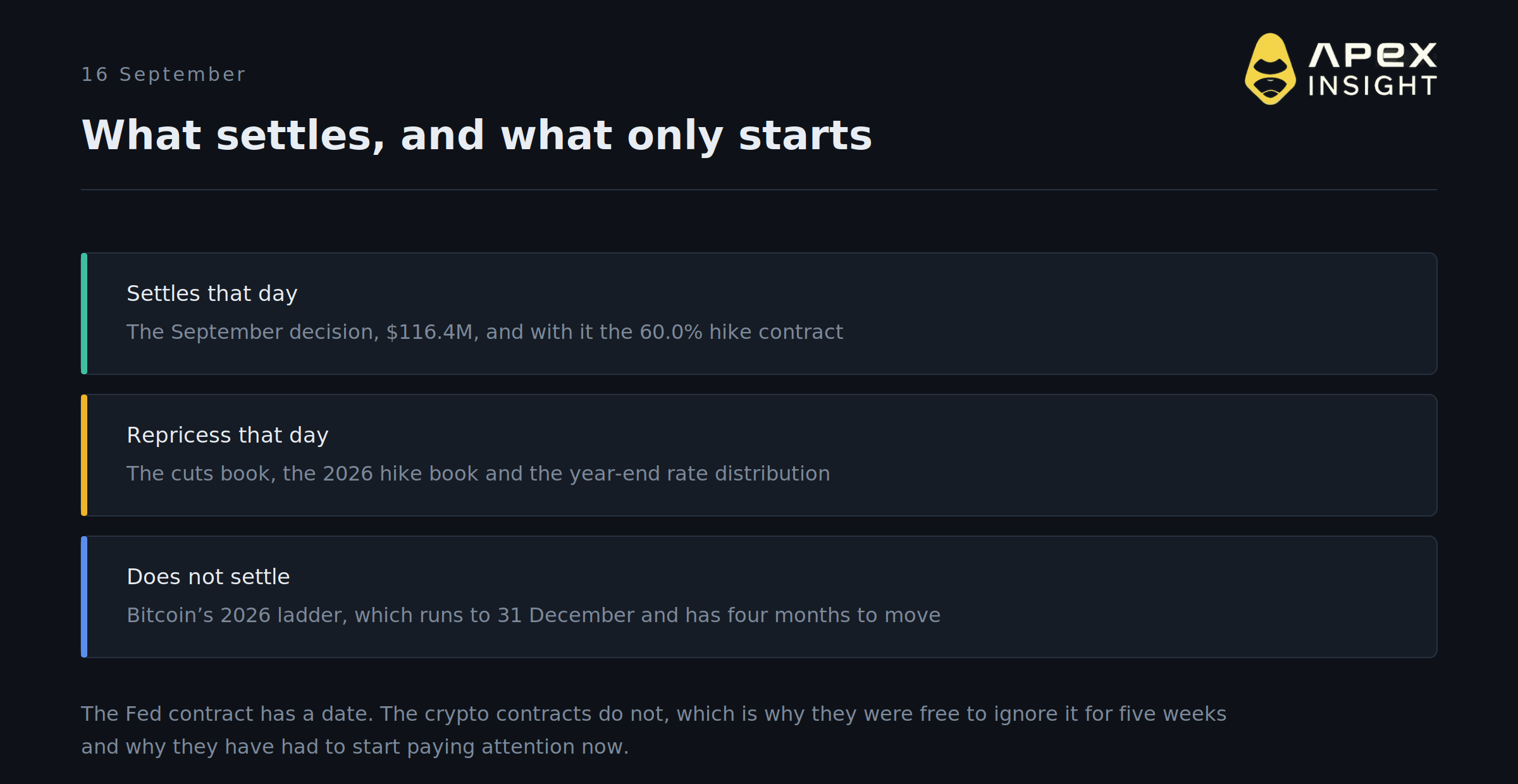
The September decision settles on the day, and with it the $116.4M book and the 60.0 percent hike contract. The cuts book, the 2026 hike book and the year-end rate distribution do not settle, but all three reprice immediately.
Bitcoin's ladder does not settle at all. It runs to 31 December and has three and a half months left to move.
That asymmetry explains the whole five weeks. The Fed contract has a fixed date and had to converge toward an answer. The crypto contracts have no date, which is exactly why they were free to ignore the Fed for a month, and why the adjustment when it came was abrupt.
The thing to watch after any decision like this is whether the ladder keeps repricing or snaps back. A hike that is already 60 percent priced can pass without incident, and a market that has just taken twenty-two points off its upside contract has room to take them back.
What the week taught
Five contracts, five days, and one lesson that transfers to any market on the board.
A contract with a fixed resolution date has to converge toward an answer. A contract without one does not, and can drift from the evidence for weeks before it catches up. The Fed decision had a date. Bitcoin's 2026 ladder does not, and that asymmetry explains both the five weeks of divergence and the abruptness of the correction when it came.
The practical version: when two markets describe the same world and disagree, check which one settles first. That is usually the one doing the honest work, and the other is the one with room to be wrong for longer.
Trade it
Political Markets Season is live on ApeX Omni. Four stages, four political markets, a 6,000 USDT prize pool. Stage 1 covered the Fed Decision in September. Stage 2 is next, so keep an eye on the board.
Spot prediction trading on Polymarket order books. No leverage, no liquidation, no KYC. Trade the odds, not the outcome.
We appreciate your continued support.
Published by ApeX. For informational and educational purposes only. Not investment advice, and not a forecast or endorsement of any policy outcome. Trading involves risk, including total loss.