

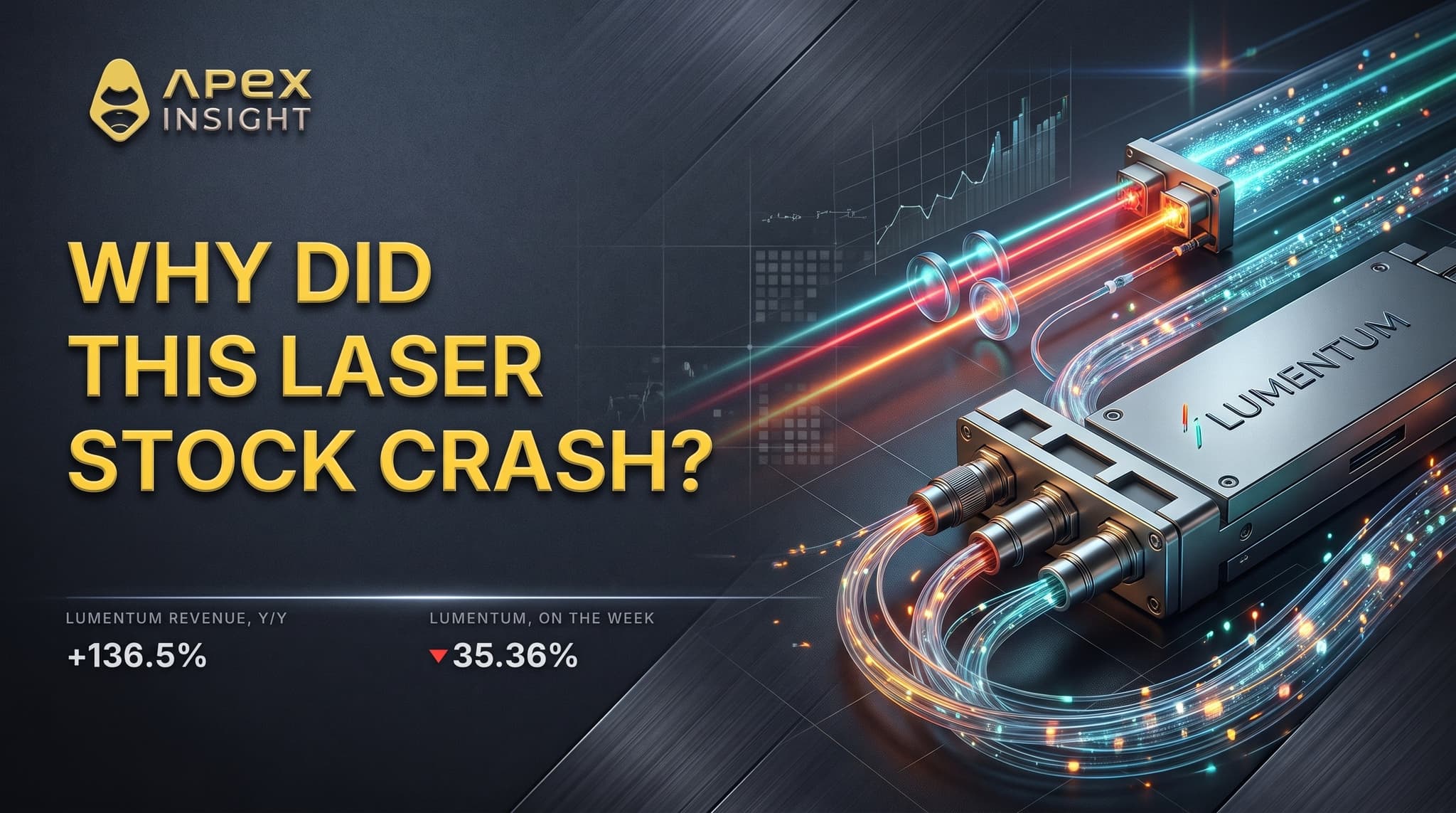


Lumentum grew revenue 136.5% year on year. It guided the next quarter up another $350 million or so. It won a second major design slot backed by purchase commitments over $5 billion. It agreed to be bought by Marvell. Its contract on ApeX is down 35.36% on the week.
That is not a company having a bad quarter. That is a company having the best quarter in its history while its price collapses.
Yesterday was the worst day on Wall Street since April 2025. The Nasdaq Composite fell 5.52% into correction, the Philadelphia Semiconductor Index fell more than 12%, and the SOXL contract on ApeX fell 38.56% in a single session. Then, with the US cash market shut overnight, part of it started coming back.
The ApeX prices here are perpetual contract prices, not share prices. US cash markets closed yesterday at 21:00 UTC and have not reopened, so every figure measured after that point is a contract price with no cash market behind it. That is also the most interesting part of the day, and section 5 is about it.
Here are six things the tape shows.
1. The worst day since April 2025
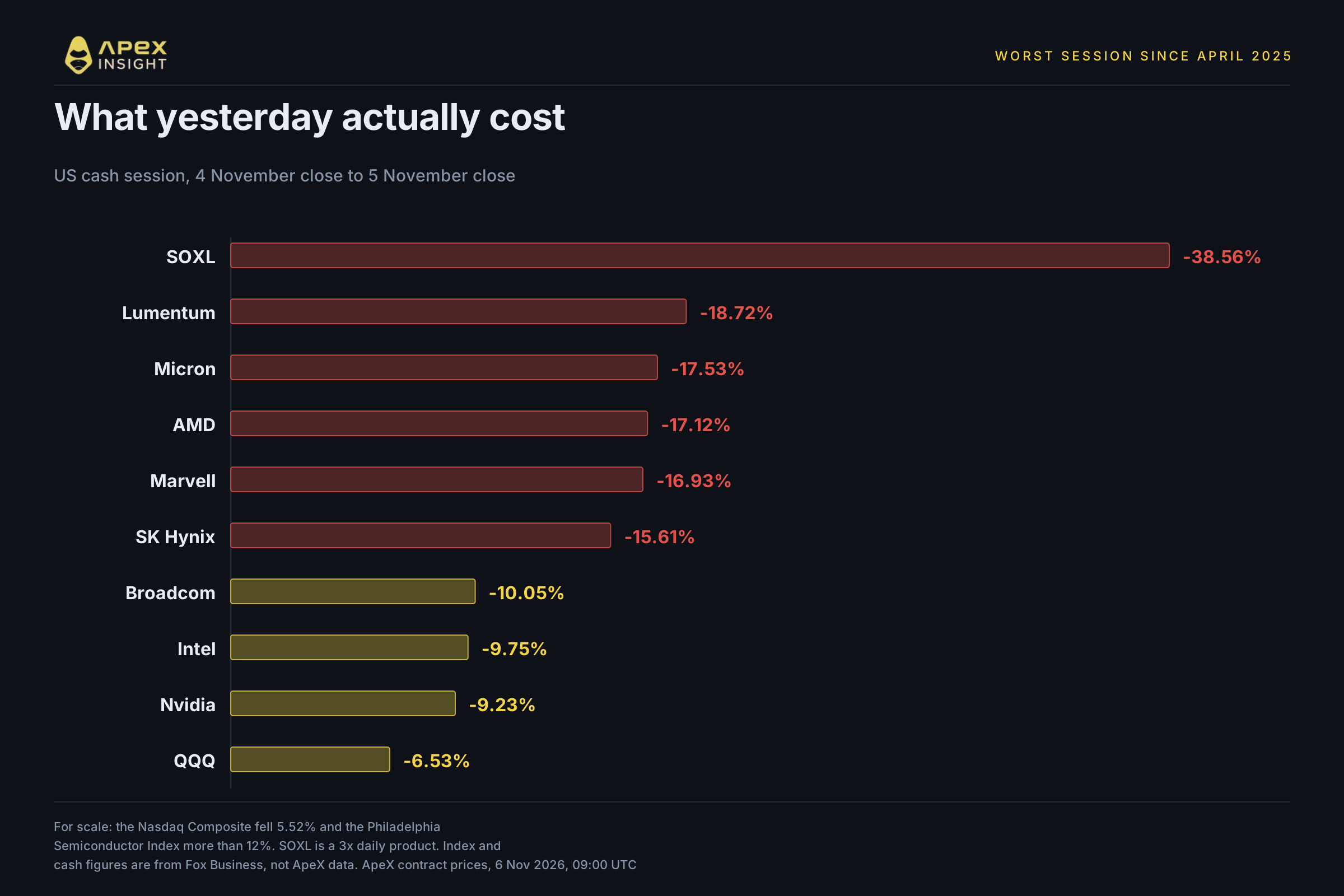
Start with the size of it.
The Nasdaq Composite fell 5.52%, or 1,421.52 points, to 24,314.997, its worst session since April 2025, closing more than 10% below its 6 October record and so into correction territory. The S&P 500 fell 4.36% to 7,353.73. The Dow fell 1,833.06 points, or 3.44%. The Philadelphia Semiconductor Index fell more than 12%, roughly three times the S&P.
On ApeX the same session reads as a column of outsized losses. SOXL fell 38.56%, Lumentum 18.72%, Micron 17.53%, AMD 17.12%, Marvell 16.93%, SK Hynix 15.61% and Broadcom 10.05%, all of them double digit. Intel fell 9.75% and Nvidia 9.23%.
Two of those are worth pausing on as a check on the contracts themselves. Nvidia's contract fell 9.23% against 9.26% in the shares, and the SOXL contract fell 38.56% against 38.71% in the SOXL ETF itself. Through US hours the US listed contracts tracked their underlyings closely. Section 5 is where that stops being true.
The explanation on offer is the one this series has been following all week. eToro's Jakub Rochlitz said "The obvious catalyst for the sharp selloff is that markets are pricing in the midterm results", and that "The market's interpretation is that the AI infrastructure buildout will become slower and more expensive".
2. Lumentum grew revenue 136.5% and lost a third of its value
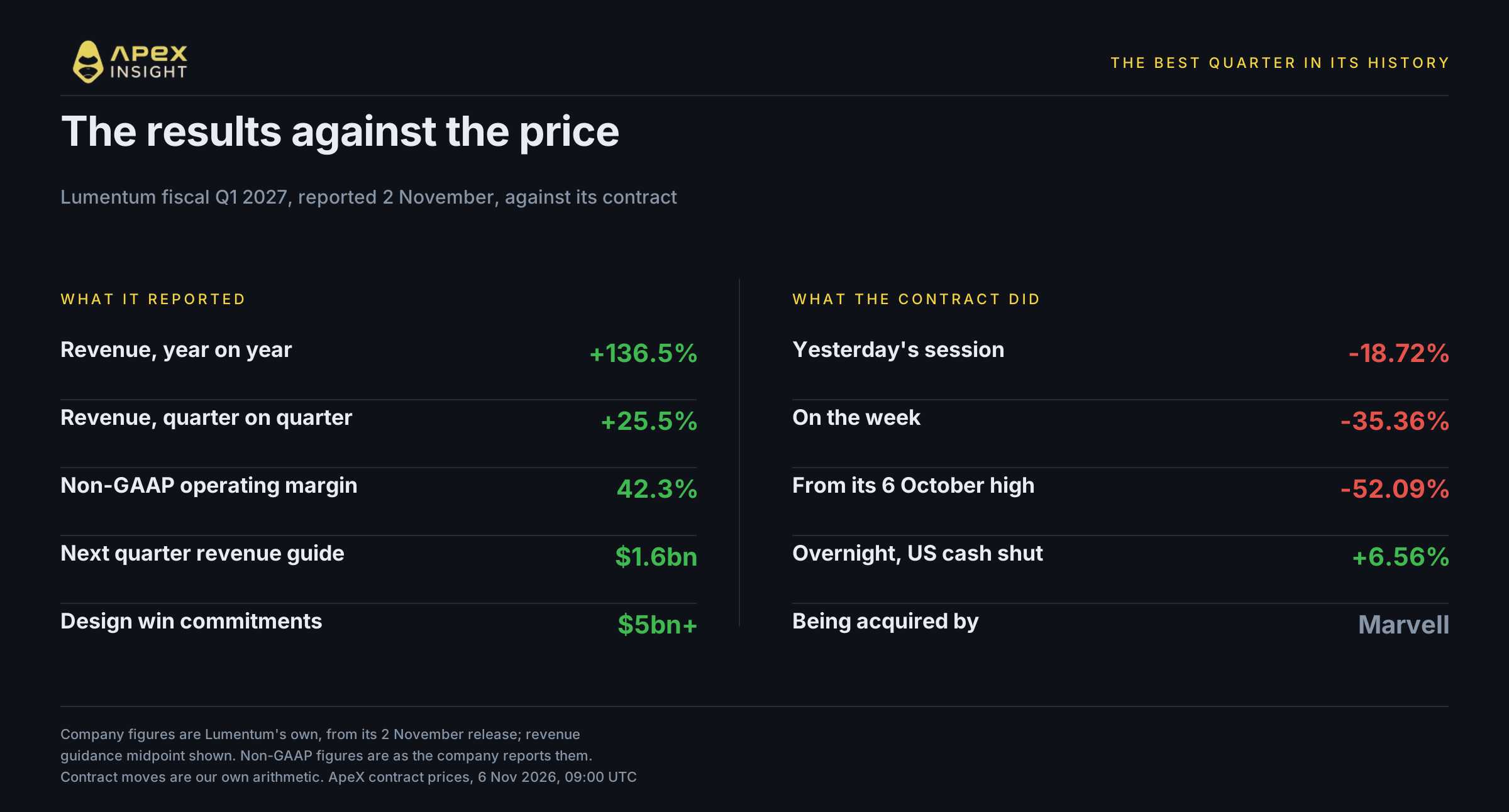
Now the single clearest example of what this market is doing.
Lumentum makes the lasers and optical modules that move data inside AI data centres. On 2 November it reported its fiscal first quarter: net revenue of $1,262.6 million, up 25.5% on the quarter and 136.5% on the year, non-GAAP diluted earnings of $4.57 a share, a non-GAAP gross margin of 53.2% and a non-GAAP operating margin of 42.3%.
The guidance was stronger than the quarter. Lumentum guided fiscal second quarter revenue to between $1.575 billion and $1.625 billion and non-GAAP earnings to between $5.90 and $6.20 a share. Chief executive Michael Hurlston said the company had "secured our second major NPO/CPO win, backed by purchase commitments exceeding $5 billion", and that it anticipates "adding approximately $350 million in sequential growth in our second quarter".
Against that, the contract. Lumentum is down 18.72% in yesterday's session alone, 35.36% on the week, and 52.09% from its 6 October high.
A company does not usually halve while doubling. The most coherent explanation is that the market is no longer paying for AI infrastructure results at all, and is instead repricing how long the spending behind them lasts. Whether that is right is unknowable today. What is measurable is that the repricing is not happening because the numbers disappointed.
3. It did not matter what they reported
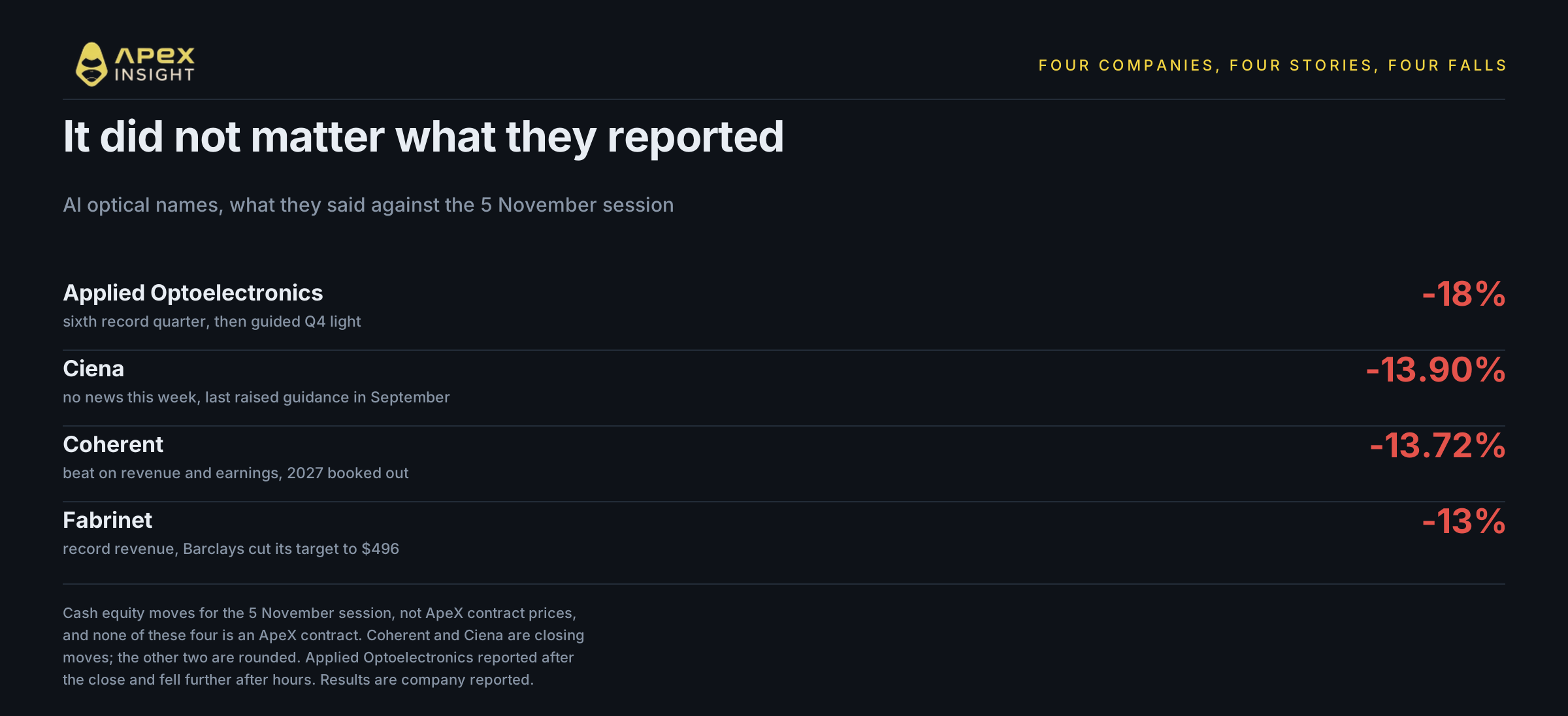
If Lumentum were alone, it would be a Lumentum story. It is not, and the detail is more telling than a clean sweep would be.
Coherent reported fiscal first quarter revenue of $2.37 billion against a $2.31 billion consensus and adjusted earnings of $2.09 a share against $1.97 expected, guided the next quarter to between $2.55 billion and $2.75 billion, and chief executive Jim Anderson told the call that "calendar 2027, is basically booked out, and the customers are booking out calendar 2028 now". The stock rose about 5% on the release and then reversed, closing yesterday down 13.72%.
Fabrinet reported record quarterly revenue of $1,474.5 million on 2 November, up 50.7% year on year and above its own guidance. It fell about 13%, and Barclays cut its price target from $739 to $496 the same week while keeping an Overweight rating.
Applied Optoelectronics is the one that complicates the picture, and it is worth being exact about. It fell around 18% during the session, and only then reported, after the close: revenue of $269.9 million, up about 127% year on year and a sixth consecutive record quarter, but fourth quarter revenue guidance of $385 million to $420 million whose midpoint sits below where analysts were. The shares fell again after hours.
Ciena did not report in this window at all. Its most recent update was a fiscal 2026 guidance raise back in September. It fell about 13.9%.
So the four did not fall for one reason. Two beat cleanly, one printed a record and guided light, and one had no news in the window at all. What they share is an end market, not a result.
The counter-argument is worth stating plainly, because it is the strongest one against this whole piece. These are not independent observations. Optical components for AI data centres is one supply chain with one customer base, so those four plus Lumentum falling together is one fact about one trade, not five facts about the market. Argent Capital's Jed Ellerbroek put the bullish version of it directly: "This feels like the capitulation phase for the data center capex beneficiary stocks, especially the semiconductors", adding "But I think the magnitude of the moves is outsized".
4. The deal has a fixed ratio, and the gap to it is widening
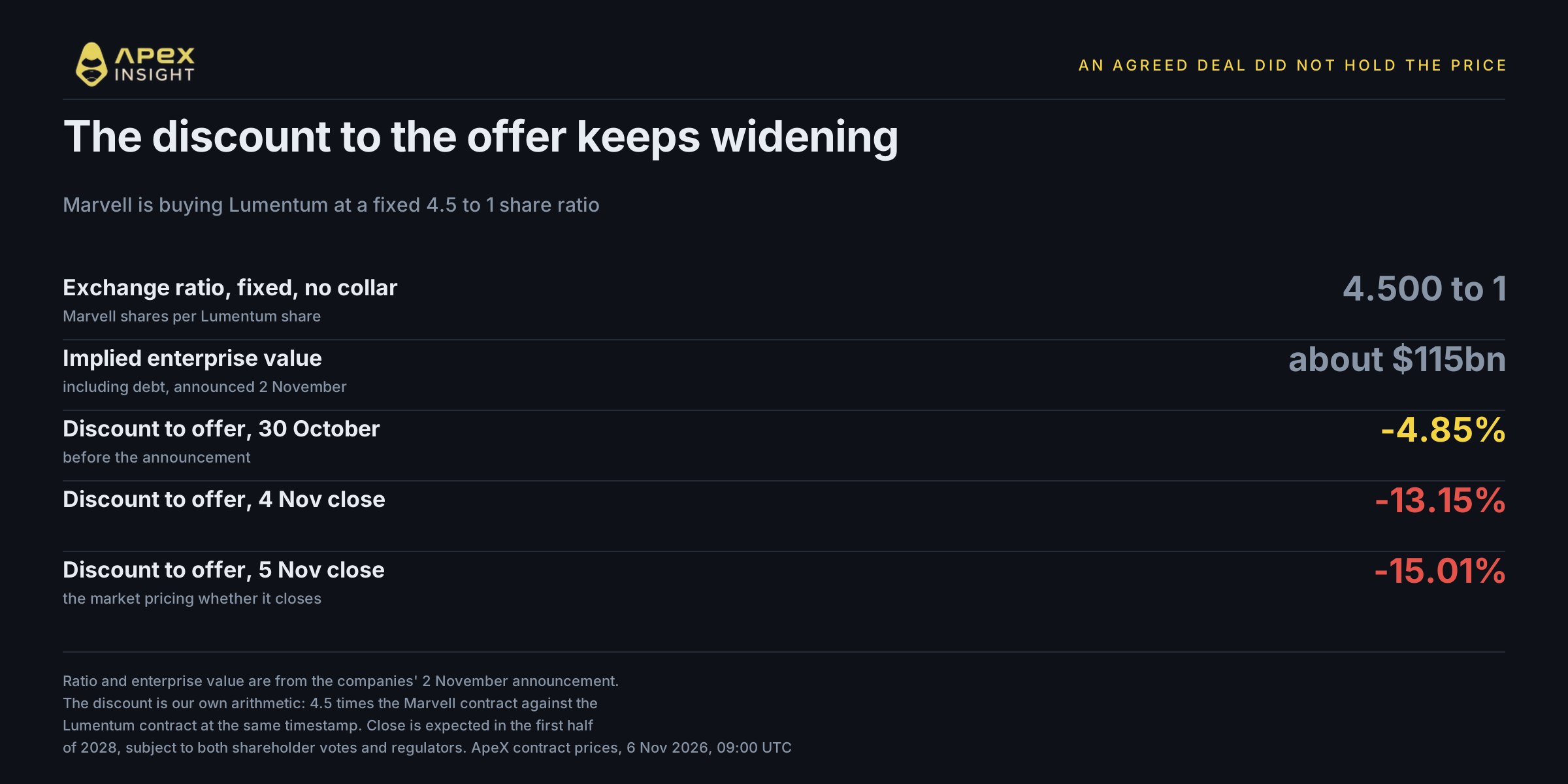
Here is the part that should have put a floor under one of these names, and the one number in this piece you can work out yourself.
On 2 November Marvell announced an all-stock acquisition of Lumentum at a fixed ratio of 4.500 Marvell shares for each Lumentum share, with no collar, at an implied enterprise value of about $115 billion including debt. It is expected to close in the first half of calendar 2028, subject to both shareholder votes and regulatory approval. Nvidia is a large holder of both companies, having put $2 billion into each in March.
The industrial logic is clear enough. BNP Paribas analyst Karl Ackerman noted that Broadcom is currently the only supplier combining compute and switch silicon with its own lasers, and that Lumentum would close that gap for Marvell.
A fixed ratio with no collar means the offer is worth exactly 4.5 times whatever Marvell is worth, so the target's price should track the acquirer's. The gap between the two is the market pricing whether the deal actually closes.
That gap is widening fast. On 30 October, before the announcement, Lumentum traded 4.85% below 4.5 times Marvell. By the 4 November close the discount was 13.15%. By last night's close it was 15.01%, and at 09:00 UTC this morning 14.92%.
So Lumentum has not simply fallen with the sector. It has fallen further than the acquirer whose shares now define what it is worth, which is a statement about the deal rather than about optics. With no close expected before 2028, two shareholder votes and antitrust review in between, a widening discount is what doubt looks like in a price.
5. The contracts rose while every open cash market fell
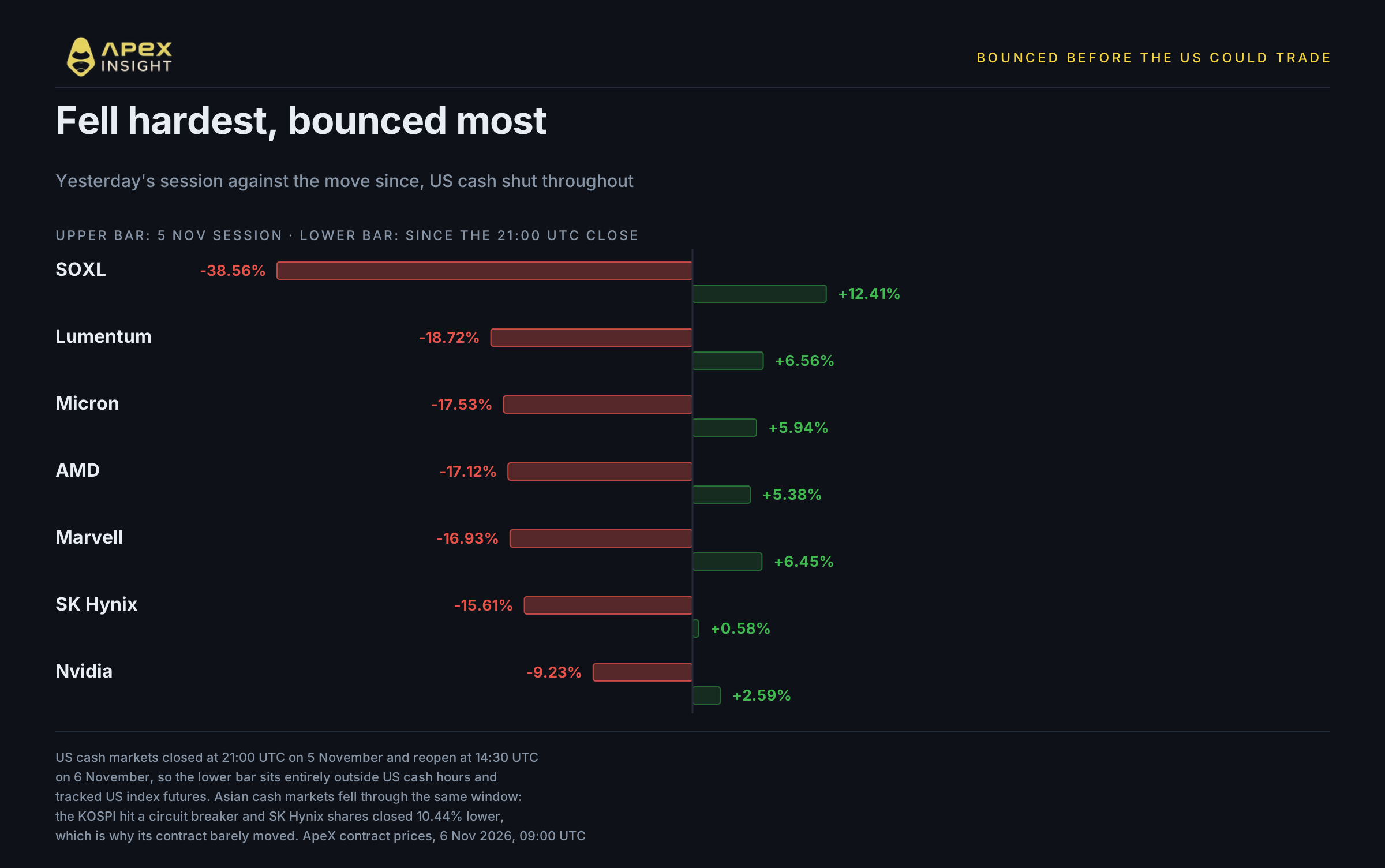
This is the part only a 24/5 contract shows you, and it is not the simple story.
US cash markets closed yesterday at 21:00 UTC and do not reopen until 14:30 UTC today. Across that window, as at 09:00 UTC, the ApeX contracts have been climbing: SOXL is up 12.41%, Lumentum 6.56%, Marvell 6.45%, Micron 5.94%, AMD 5.38%, Intel 4.38%, Broadcom 4.13% and Nvidia 2.59%.
In the cash markets that were actually open, the crash carried on. The KOSPI fell more than 8% intraday, broke below 5,000 and triggered a market wide circuit breaker before closing down 6.02%. SK Hynix shares closed 10.44% lower and Samsung 6.35%. The Nikkei 225 fell 5.96%, with SoftBank down 10.83% and Kioxia 8.72%.
So the contracts were not following Asia. They were following US index futures, which were higher through the European morning. The two tapes said opposite things for nine hours, and that is worth being precise about rather than calling it a recovery.
Read the fall and the bounce together and the ordering is almost exactly repeated rather than reshuffled: the contracts that fell hardest yesterday are the ones that have bounced most. SOXL fell furthest and has bounced furthest.
SK Hynix is the exception, and the most instructive name here. Its contract is up 0.58% while its own listed shares fell 10.44% in Seoul, an eleven point divergence in a single window. That is the clearest illustration in this piece that a dollar quoted, index settled contract is not the same instrument as the share behind it.
None of this is a prediction. A bounce after a 38% session is what thin books do, and the US open at 14:30 UTC is where it gets tested by real volume. The point is narrower: an investor in the cash market could not act on any of it, and a holder of the contract spent the whole move in the position.
6. Nothing in the numbers changed, only the price
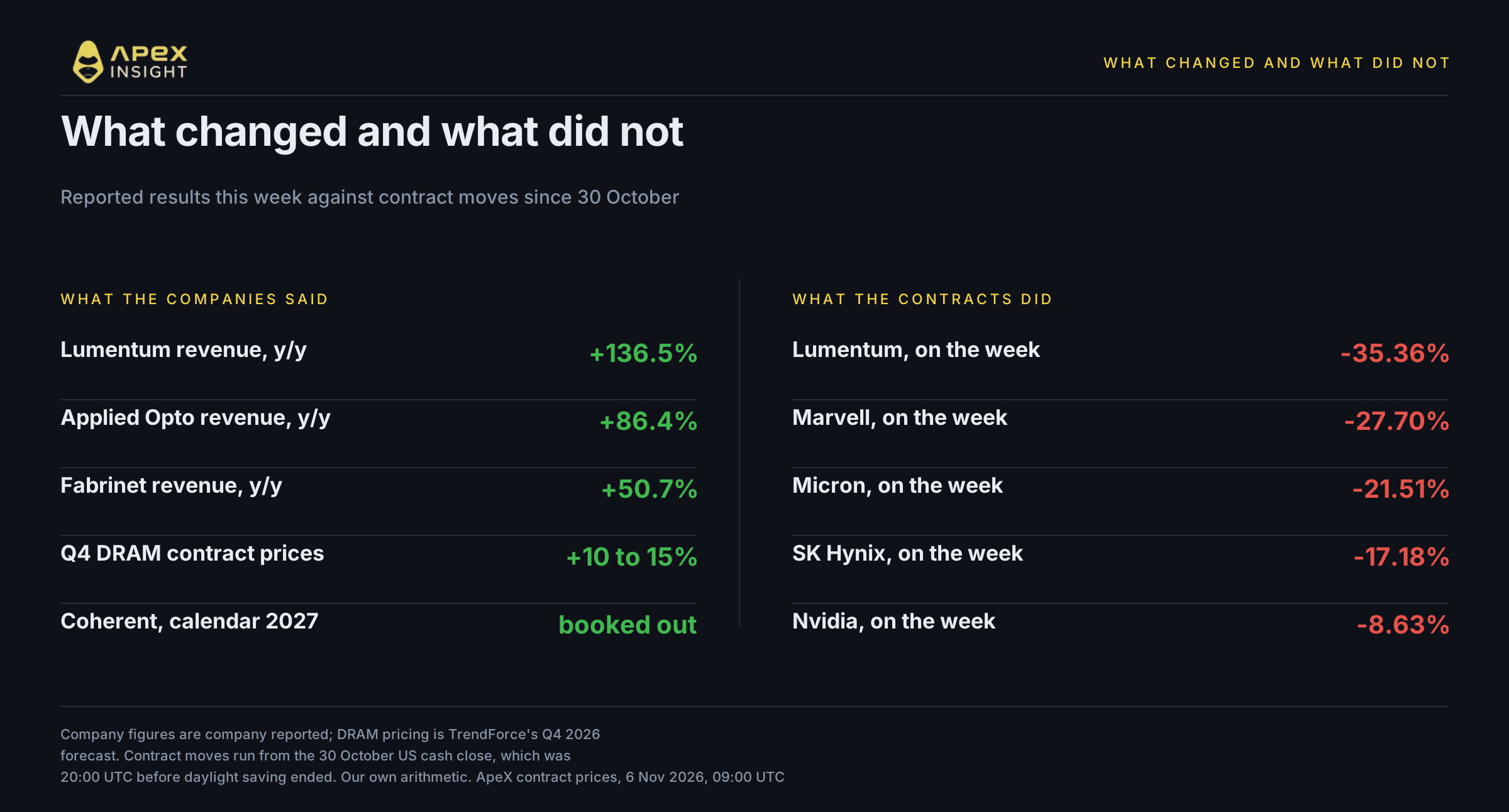
Put the week end to end.
DRAM contract prices are rising 10% to 15% this quarter, and NAND flash 15% to 20%. Apple told investors memory pricing is "unprecedented" and guided its margin down to absorb it. Lumentum grew 136.5% and guided up. Coherent is booked out through 2027. Applied Optoelectronics cannot build fast enough until mid 2027. Fabrinet grew 50.7%.
Against that, since the 30 October close, Lumentum is down 35.36%, Marvell 27.70%, Micron 21.51%, SK Hynix 17.18%, Intel 16.30%, AMD 15.55% and Nvidia 8.63%.
Only one of those declines followed anything a company said, and that was Applied Optoelectronics guiding light after the close. The rest followed an election result that changed expectations about how quickly data centres get approved. No approval timeline has actually changed yet.
That is a coherent thing for a market to do. Demand for optical modules in 2028 depends on data centres that have not been permitted yet, and a buildout that slows down is worth less than one that does not, whatever this quarter printed. It is also the kind of repricing that is impossible to verify for years, which is exactly why the price moves first and the arguing comes later.
Gold, for the third piece running, did something quieter. Measured on the calendar day, which is the convention here for a market that never closes, it rose 0.55%. Measured over the same 21:00 to 21:00 window as the equity contracts it rose 0.99%, the only one of them that was up.
Trade the market
Go long or short Lumentum with up to 50x leverage, around the clock, five days a week.
The optical pair. One is buying the other, and both fell.
The leveraged expression. A 3x daily product, so it magnifies both the session and the bounce. Over longer runs compounding pushes the result away from three times the cumulative move, usually against the holder.
The memory names, for continuity. The subject of Tuesday's and Thursday's pieces, and still falling.
The large caps. Less exposed to data centre capex than the names above, and down less.
The quiet one. Up on the day and up on the week.
Every ApeX price in this piece is a perpetual contract price. TradFi contracts settle against an index rather than the underlying asset, and ApeX lists them separately from its crypto perpetuals in its own contract data.
Trading perpetual futures carries a high risk of loss and leverage magnifies losses as fast as gains. Nothing here is financial advice.
If you need any help, feel free to reach out to our team on Discord.
Website: https://www.apex.exchange
Twitter: https://twitter.com/OfficialApeXdex
Telegram: https://t.me/ApeXdex
Methodology: all moves are computed from ApeX klines. Hourly bars are start-stamped, so the price at hour H is the close of the bar stamped H minus one; spot figures are the close of the bar stamped 08:00 on 6 November, which is the price at 09:00 UTC. "Yesterday's session" runs from the 4 November US cash close to the 5 November close, both at 21:00 UTC. "On the week" runs from the 30 October US cash close to 09:00 UTC on 6 November; the US close was 20:00 UTC on 30 October and became 21:00 UTC when daylight saving ended on 1 November, so the two ends of that window use different clock times. Distance from a high uses each contract's highest weekday close in its ApeX history, which begins between April and July 2026 for these contracts, so it is a high since listing and not a calendar year high. SOXL is excluded from any distance-from-high figure because its ApeX history starts on 10 July 2026, after the sector had already peaked. Weekend closes are excluded throughout because weekend prints in equity contracts are thin. Contract moves are our own arithmetic on ApeX prices; index levels, cash equity moves and all company results are from the linked sources and are not ApeX data. Cash equity percentages for Coherent, Fabrinet, Applied Optoelectronics and Ciena are closing moves where a close was available and are rounded. Gold trades continuously, so its headline figure uses the calendar day rather than the US cash window, and both measures are given in the text. Lumentum, Coherent, Applied Optoelectronics, Fabrinet and Ciena results are company reported. The Marvell and Lumentum exchange ratio and enterprise value are from the companies' 2 November announcement; the discount to the offer is our own arithmetic, 4.5 times the Marvell contract against the Lumentum contract at the same timestamp. Figures as at 6 November 2026, 09:00 UTC.