




Apple's new chief executive told investors on Monday that what the company is seeing in memory pricing is "unprecedented". He meant it as a complaint. Apple's gross margin guidance dropped to 45% to 46% from 47.9% and its purchase obligations rose by $33 billion, all because memory costs too much.
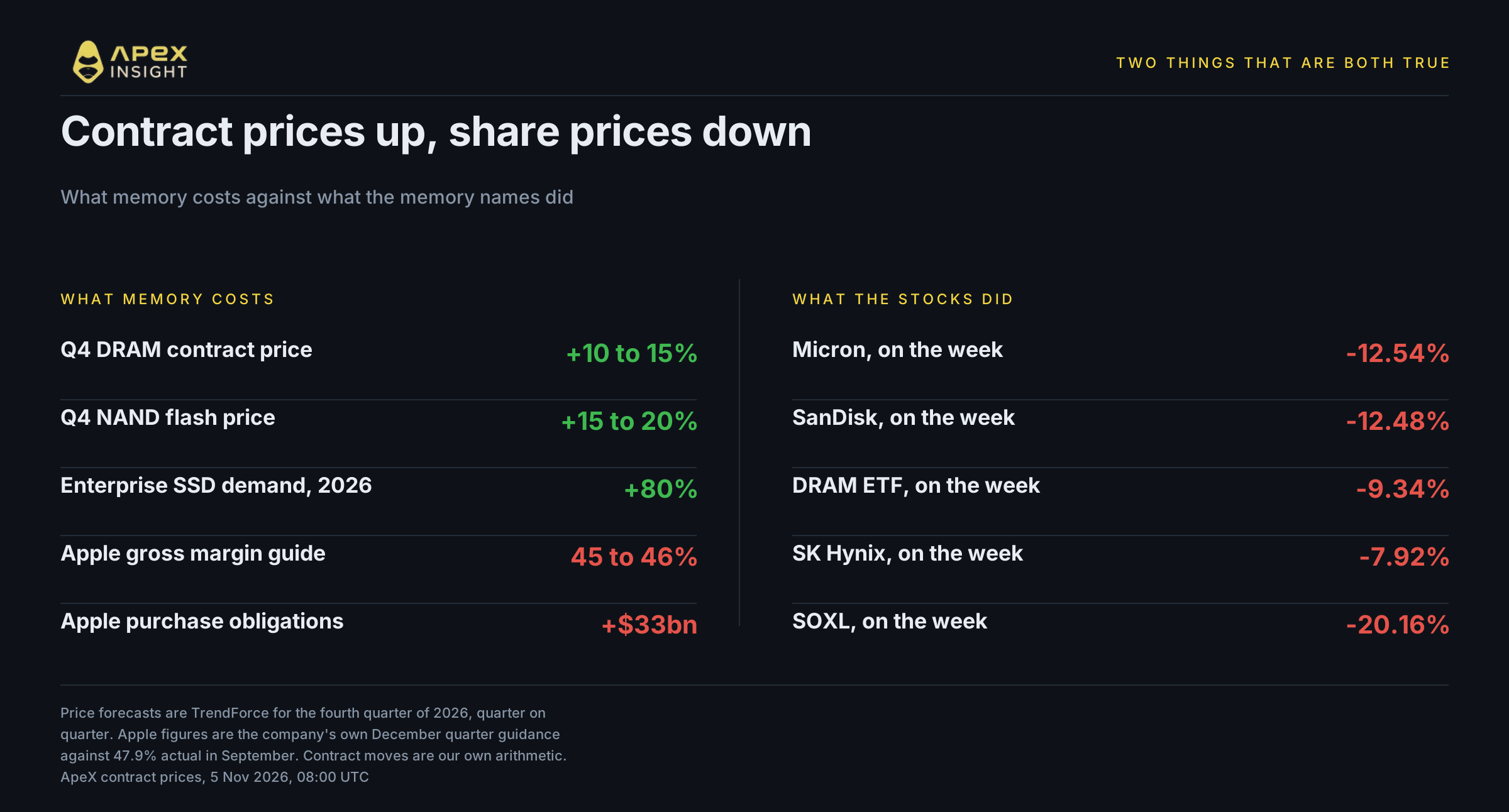
Three days later, the memory trade is being taken apart. Micron is down 12.54% this week on ApeX, SanDisk 12.48%, and SOXL 20.16%. Korea's benchmark index fell 5.28% in a single session this morning.
So memory has never been more expensive, and the companies that sell it have never been cheaper relative to the summer. Both of those statements are true at the same time, and the gap between them is the trade.
One note on the prices before the numbers. Every ApeX figure here is a perpetual contract price rather than a share price at a close, and US cash markets have not opened since Wednesday, so nothing measured after that close has a US cash market behind it. Cash prices do appear in three places. Apple's are in section 3, and the KOSPI index level is in section 1. Samsung's and SK Hynix's, also in section 1, matter more than usual today, because the Korea Exchange was open from 00:00 to 06:30 UTC this morning, which is where most of the move happened.
Here are six things the tape shows.
1. Korea's market fell 5.28% and its chipmakers fell more
Start with the only cash market that was open.
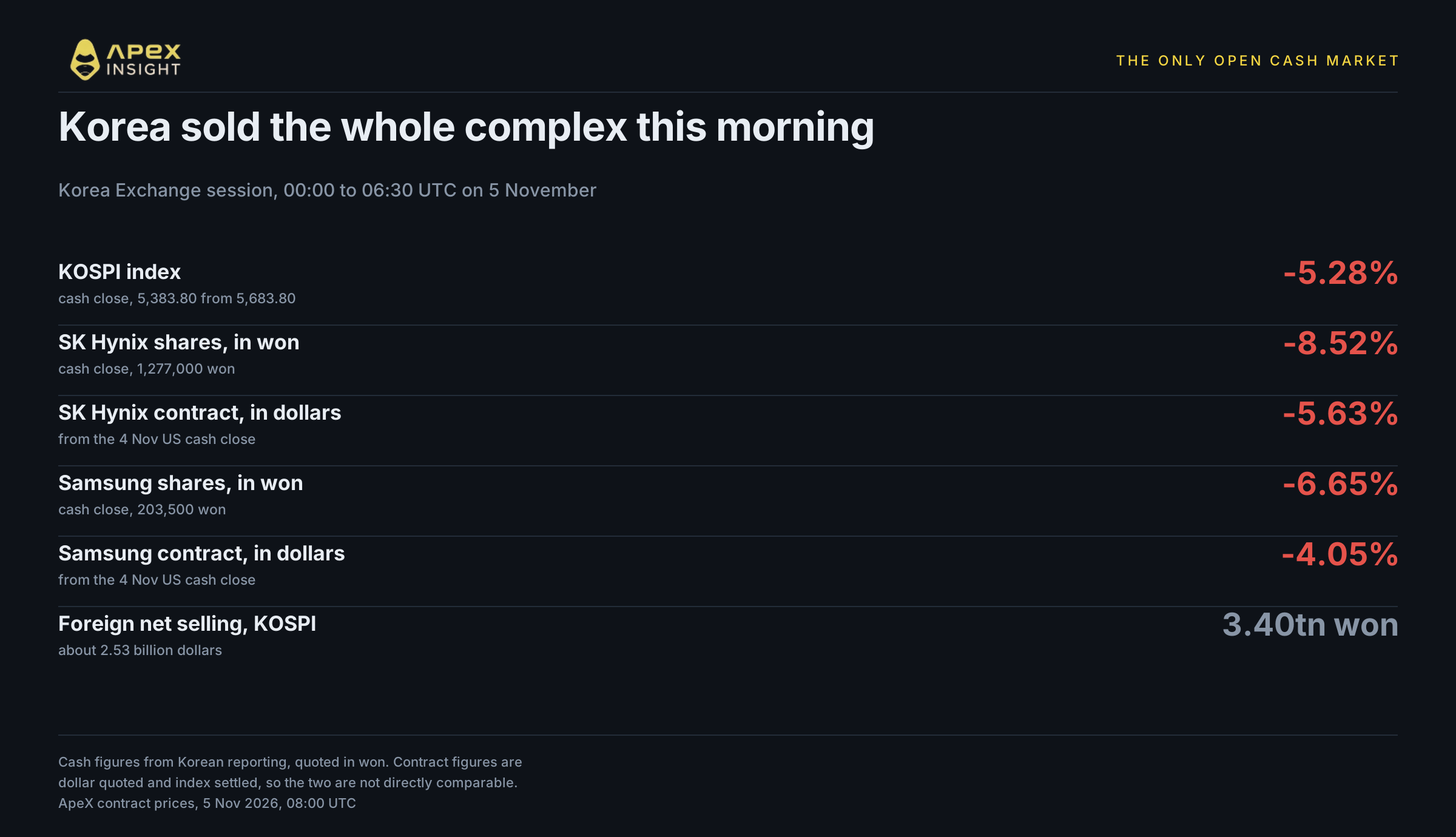
The KOSPI closed down 5.28% at 5,383.80 this morning, from 5,683.80 the day before. SK Hynix shares fell 8.52% to 1,277,000 won. Samsung Electronics fell 6.65% to 203,500 won. Foreign investors sold a net 3.40 trillion won, about 2.53 billion dollars, while retail investors bought 2.28 trillion won of what they were selling.
On ApeX the same two names fell less. The SK Hynix contract lost 5.63% from Wednesday's US cash close to 08:00 UTC, and Samsung 4.05%. Both are smaller than the move in the underlying shares.
That gap is worth understanding rather than glossing over, and section 6 takes it apart. Three things feed into it: the contracts are quoted in dollars against shares priced in won, they settle against an index rather than against the shares themselves, and they kept trading after Korea shut.
2. Why a midterm sweep became a memory problem
Here is the part that connects to Tuesday's vote.
Korean reporting puts the selling down to the Democratic sweep and what it might mean for AI data centre regulation. Texas is the sharpest version of that, because there the policy is already named.
Texas elected Gina Hinojosa as governor. During the campaign she promised a statewide moratorium on data centre approvals until the Legislature passes what she calls "real protections so Texans can have a seat at the table". Her stated priorities include union labour requirements, water supply protections and a ban on the nondisclosure agreements that keep project details from the public.
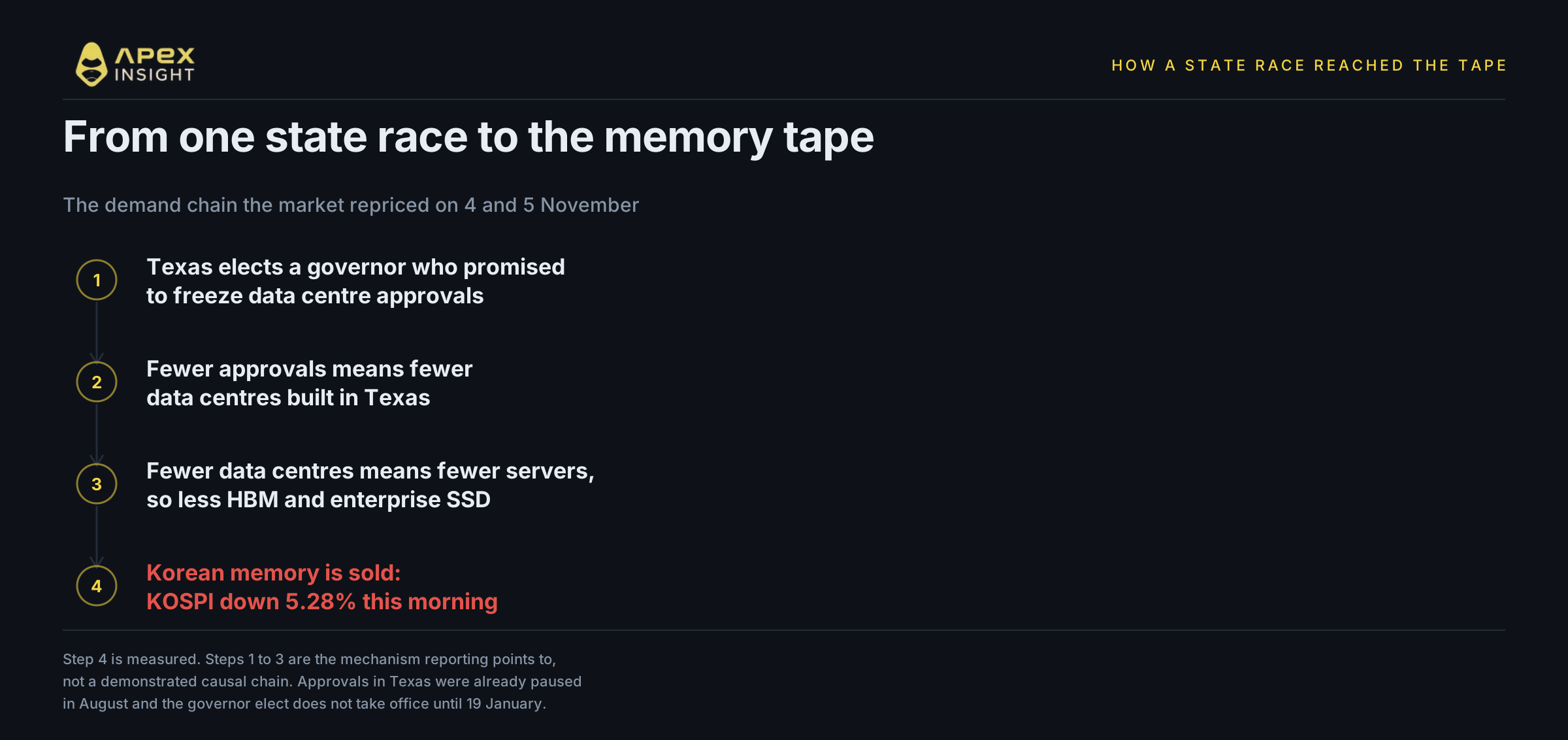
Texas holds about a third of all US data centre capacity under construction, more than any other state. Memory is what fills it. The chain from a state race to the Micron tape is short: fewer data centres means fewer servers, fewer servers means less high bandwidth memory and fewer enterprise drives.
The Korean reporting made that link explicitly, attributing the sell-off to fears that tighter regulation of AI data centres would slow investment and weaken demand for Korean memory and equipment.
Three caveats, because this is the part most likely to be overstated.
Approvals in Texas were already paused. Greg Abbott froze them at the state grid in August and then at the environmental permitting agency, pending an audit expected to finish this year. Hinojosa does not take office until 19 January 2027, and some county officials have said they lack the authority to regulate data centres under current state law anyway.
It is also not only Texas. Data Center Watch found that 43% of 74 gubernatorial candidates across 36 states backed a moratorium or a ban, so this is a national shift in posture rather than one state's result.
And a promise is not a statute. The most coherent explanation for this morning's move is that the market repriced the probability of a slower US build-out, not that any build-out has actually slowed.
3. Memory prices are going the other way
Now the contradiction.
TrendForce expects conventional DRAM contract prices to rise 10% to 15% in the fourth quarter, and NAND flash 15% to 20%. It describes the DRAM market as undersupplied, with server DRAM staying that way on constraints in component supply, packaging and testing. Enterprise SSD demand is projected to grow more than 80% year on year in 2026.
Apple is the cleanest evidence that those numbers are real, because Apple is the one paying them. On Monday's earnings call, chief executive John Ternus said "What we're seeing with memory pricing right now is unprecedented" and that the company sees pricing "continuing to increase" beyond the December quarter. Apple guided December quarter gross margin to 45% to 46%, down from 47.9% in September, and said its manufacturing purchase obligations have risen by $33 billion as it works to secure supply. Mac and iPad supply stays constrained, mainly on memory.
Apple shares opened about 4% lower the next day and closed down 1.9%.
So the buyer of memory is being punished for how expensive memory is, and the sellers of memory are being punished at the same time. Those two things cannot both be about current pricing. The most coherent reading is that Apple's stock is pricing today's cost and the memory stocks are pricing tomorrow's demand.
4. The memory names are a third to over half below June
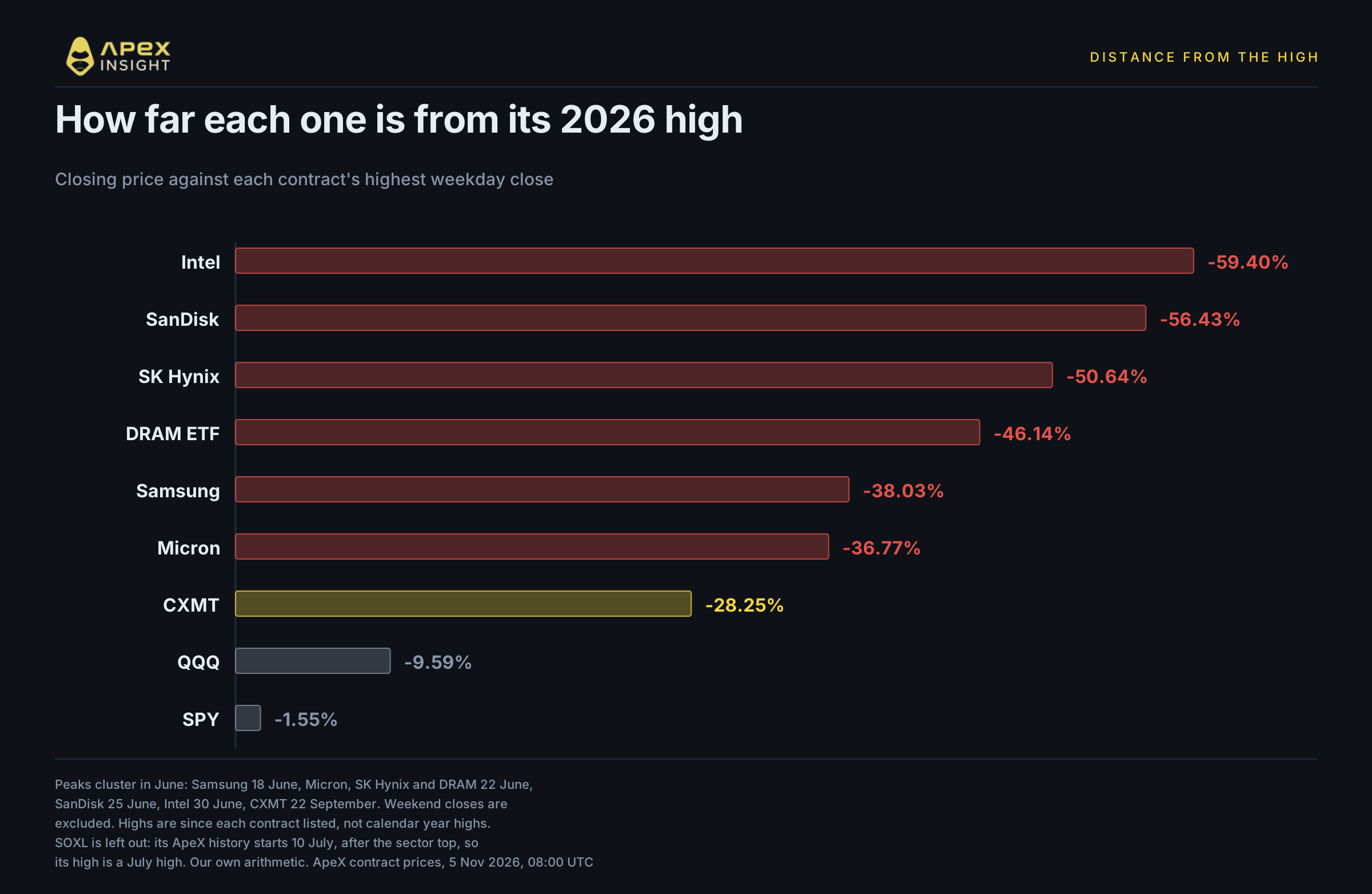
This is not a one week story, and the single number that makes that clearest is the distance from each contract's own high.
Measured on ApeX closing prices, the memory names are between a third and well over half below their peaks: SanDisk 56.43%, SK Hynix 50.64%, the Roundhill memory ETF contract 46.14%, Samsung 38.03% and Micron 36.77%. Intel sits lower still at 59.40%, and it is not a memory maker: it sold its NAND business to SK Hynix in a deal finalised in March 2025.
Look at the dates rather than the sizes. Samsung peaked on 18 June, Micron, SK Hynix and DRAM all on 22 June, SanDisk on 25 June and Intel on 30 June. Every one of them topped inside a fortnight in the second half of June and has been falling since. It has not been a steady slide: most of the damage came in two discrete shocks, one in July and this week's.
Set that against the index. SPY sits 1.55% off its own high and QQQ 9.59%. On the week SPY is up 1.14% and QQQ is 0.77% lower.
That is the strongest single argument that this is a sector unwind and not a market event. A market that was worried about growth would not leave the S&P contract within 2% of its record while taking half the value out of memory.
The counter-argument deserves stating. These six names are not six independent observations. Memory is one supply chain with one end market, so a cluster of correlated instruments falling together is one data point about one trade, not six about the market. SOXL is missing from that list for a reason worth being open about: its ApeX history only starts on 10 July, after the sector had already topped, so its highest price here is a July high and is not comparable with the rest.
5. One memory contract went up, and it is the Chinese one
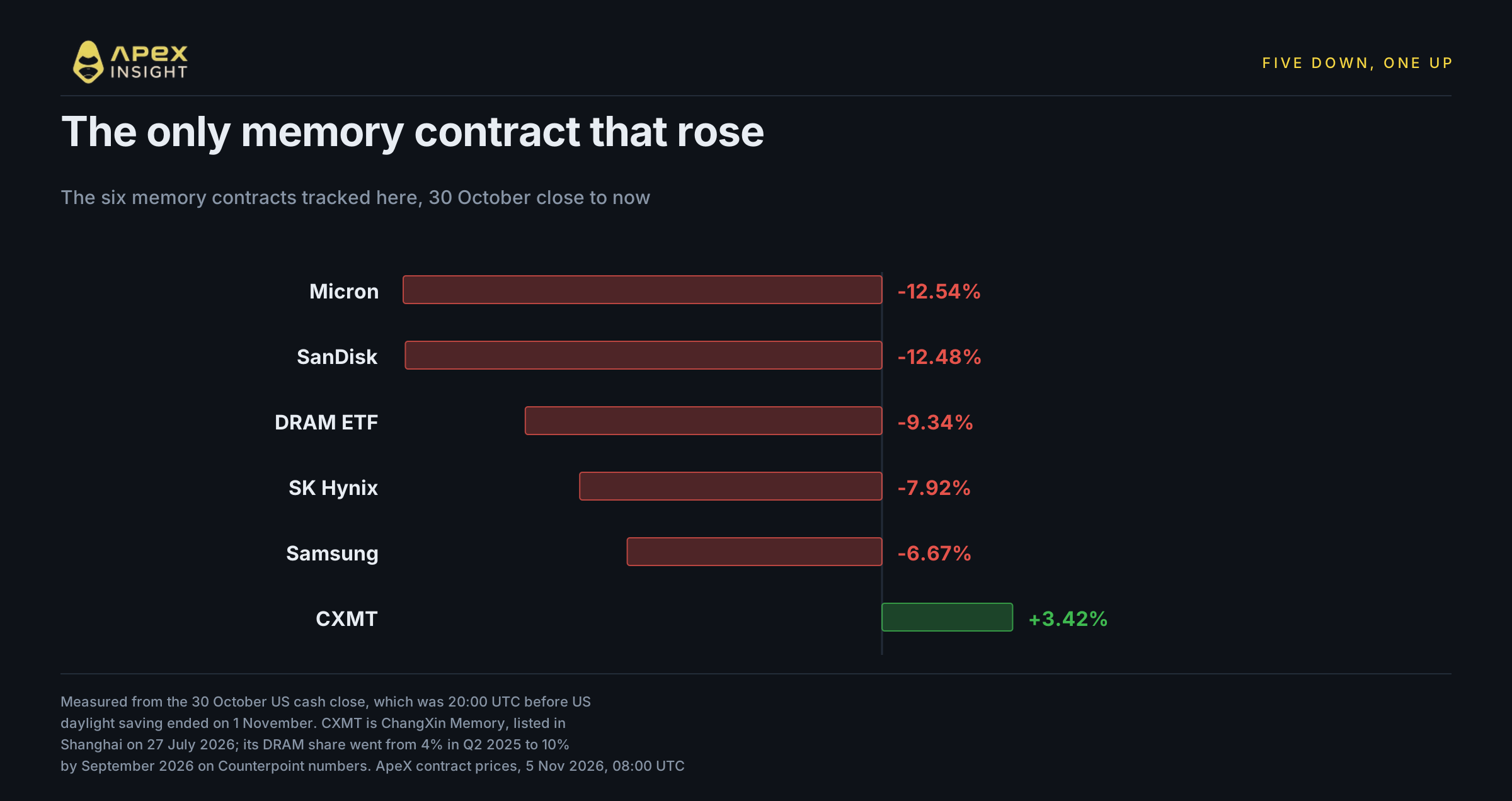
Here is the fact that reframes the other five sections.
Of the six memory contracts tracked here, five fell this week. CXMT rose 3.42%, and it gained 6.05% in Wednesday's session alone, the session that took 7.02% out of Micron.
CXMT is ChangXin Memory Technologies, China's largest DRAM maker. It listed on the Shanghai STAR Market on 27 July 2026 at 8.66 yuan a share and opened at 49.50, a debut gain near 470%. Its share of the global DRAM market went from 4% in the second quarter of 2025 to 10% in the second quarter of 2026 on Counterpoint Research's numbers. Over the same quarter Samsung, SK Hynix and Micron held 87% between them, down from comfortably above 90% a year earlier.
Capacity is the reason it keeps appearing in notes about the other three. Counterpoint and TrendForce expect CXMT to go from about 320,000 DRAM wafers a month to roughly 420,000 within a year and up to 600,000 by 2028. It had begun risk production of HBM3E by the end of August.
Read those two facts together and the divergence makes sense in a way that is worth sitting with. A US data centre slowdown is a demand shock to companies that sell into US hyperscalers. CXMT sells mostly into Chinese demand, and in the oversupply story it is the cause rather than the casualty. So the single contract that benefits from the fear driving the other five is the one that went up.
Two things keep this from being tidy. CXMT is itself 28.25% below its own September peak, so it is not immune, just out of phase. And the oversupply framing may be wrong on its own terms: CXMT reportedly quoted Apple prices similar to or above what Samsung charges, which is not what a company trying to flood a market does.
6. The low came before Korea closed, the bounce came after
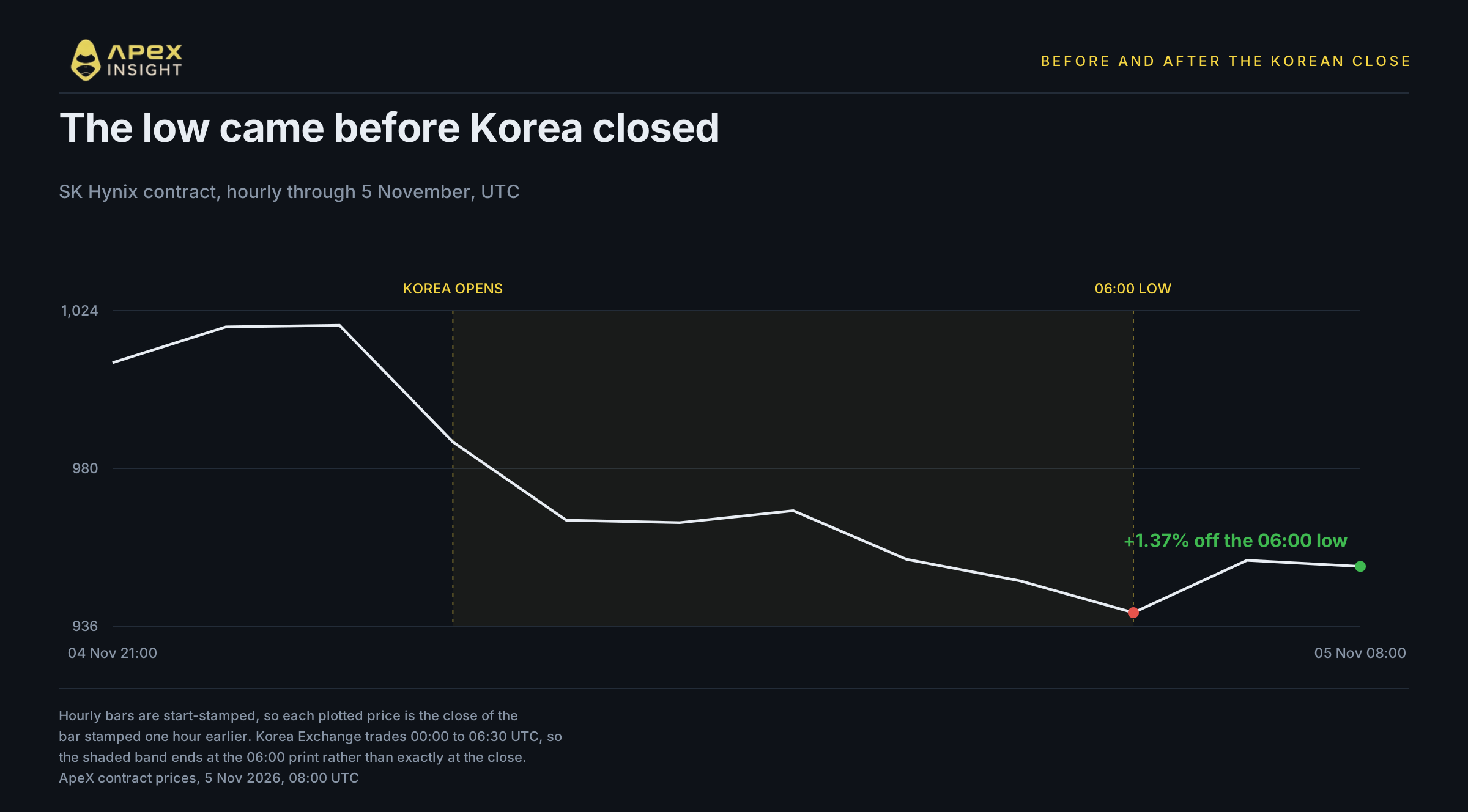
Here is why the window you measure in decides what you see.
The Korea Exchange trades 09:00 to 15:30 local time, which is 00:00 to 06:30 UTC. Inside that window the SK Hynix contract fell from 987.32 at the open to 939.73 by 06:00, a drop of 4.82%. Samsung fell 5.27% over the same hours. Those 06:00 prints are the lows of the night for both.
Both contracts turned half an hour before the Korean close. By 08:00 UTC the SK Hynix contract was back to 952.61 and Samsung to 152.25, gains of 1.37% and 1.66% off the 06:00 low. That is a two hour recovery, and only the last ninety minutes of it ran with the Korean cash market shut.
This is also most of the answer to the gap in section 1. SK Hynix shares fell 8.52% in won; the contract fell 5.63% in dollars. Part of that is the currency, part is that a TradFi contract settles against an index rather than against the shares, and part is simply that the contract was still trading after the shares stopped, and spent that time recovering.
Be careful with the recovery, though. It is two hours long, only ninety minutes of which are after the close, it is small next to a 5% session, and it is the kind of move that reverses on the US open. What it is not is unavailable: the window after a foreign cash close is exactly the window a 24/5 contract exists to cover.
Trade the markets
The two memory names that fell hardest. Both are US listed memory names. Micron sells into the hyperscalers directly; SanDisk's data centre business is a smaller share of a mostly consumer and edge revenue base.
The Korean pair. Quoted in dollars against shares priced in won, so a position here carries the currency as well as the stock.
The other side of the same story. The supply threat rather than the demand victim, plus the basket.
The leveraged expression. A 3x daily product. It targets three times the index move each day, and over longer runs compounding and volatility decay push the result away from three times the cumulative move, usually against the holder.
Every ApeX price in this piece is a perpetual contract price. TradFi contracts settle against an index rather than the underlying asset, and ApeX lists them separately from its crypto perpetuals in its own contract data. If you are trading to qualify for a volume campaign, check the promotion terms first, because not every contract is eligible.
Race to the Top 50
Trade to climb the leaderboard and share a pool of up to 10,000 USDT. Ends 6 November, 10:00 UTC.
The current trading competition runs until 6 November, 10:00 UTC, which is 18:00 Singapore time tomorrow. The prize pool is up to 10,000 USDT shared by the top 50, and it stays locked until campaign volume reaches 30,000,000 USDT, with only the highest unlocked tier applying.
Score combines trading volume, P&L percentage, net deposits and referrals. Qualifying needs registration through the campaign page, at least 100 USDT in the perpetual futures account, at least 10,000 USDT of eligible volume, and a top 50 finish. Full rules and the prize table are on the campaign page.
Trading perpetual futures carries a high risk of loss and leverage magnifies losses as fast as gains. Nothing here is financial advice.
If you need any help, feel free to reach out to our team on Discord.
Website: https://www.apex.exchange
Twitter: https://twitter.com/OfficialApeXdex
Telegram: https://t.me/ApeXdex
Methodology: all moves are computed from ApeX klines. Hourly bars are start-stamped, so the price at hour H is the close of the bar stamped H minus one; spot figures are the close of the bar stamped 07:00 on 5 November, which is the price at 08:00 UTC. "The week" means one window throughout, the 30 October US cash close to 5 November at 08:00 UTC. The US cash close moved from 20:00 to 21:00 UTC when daylight saving ended on 1 November, so the 30 October anchor is the 20:00 print and every close from 2 November is the 21:00 print. Figures described as a single session run from one 21:00 close to the next. Weekend closes are excluded from the peak calculations because weekend prints in equity contracts are thin. Distance from peak uses each contract's highest weekday close in its ApeX history, which begins between May and July 2026 for these contracts and on 31 July 2026 for CXMT, so a "2026 high" is the high since listing and not a calendar year high. Drawdown and week figures are our own arithmetic on ApeX contract prices, not company or exchange figures. The week window contains the 2, 3 and 4 November US cash sessions, so the contracts traded alongside their underlying shares for those hours. No US cash session has taken place since the 4 November close, so everything measured from there to 08:00 UTC on 5 November is a contract price with no US cash market open behind it. Samsung and SK Hynix are the exception in that leg, with the Korea Exchange open from 00:00 to 06:30 UTC. KOSPI, Samsung and SK Hynix cash figures are from Korean reporting and are quoted in won, so they are not directly comparable with the dollar quoted contracts. DRAM is the Roundhill memory ETF contract and SOXL is a 3x leveraged semiconductor product. Figures as at 5 November 2026, 08:00 UTC.