
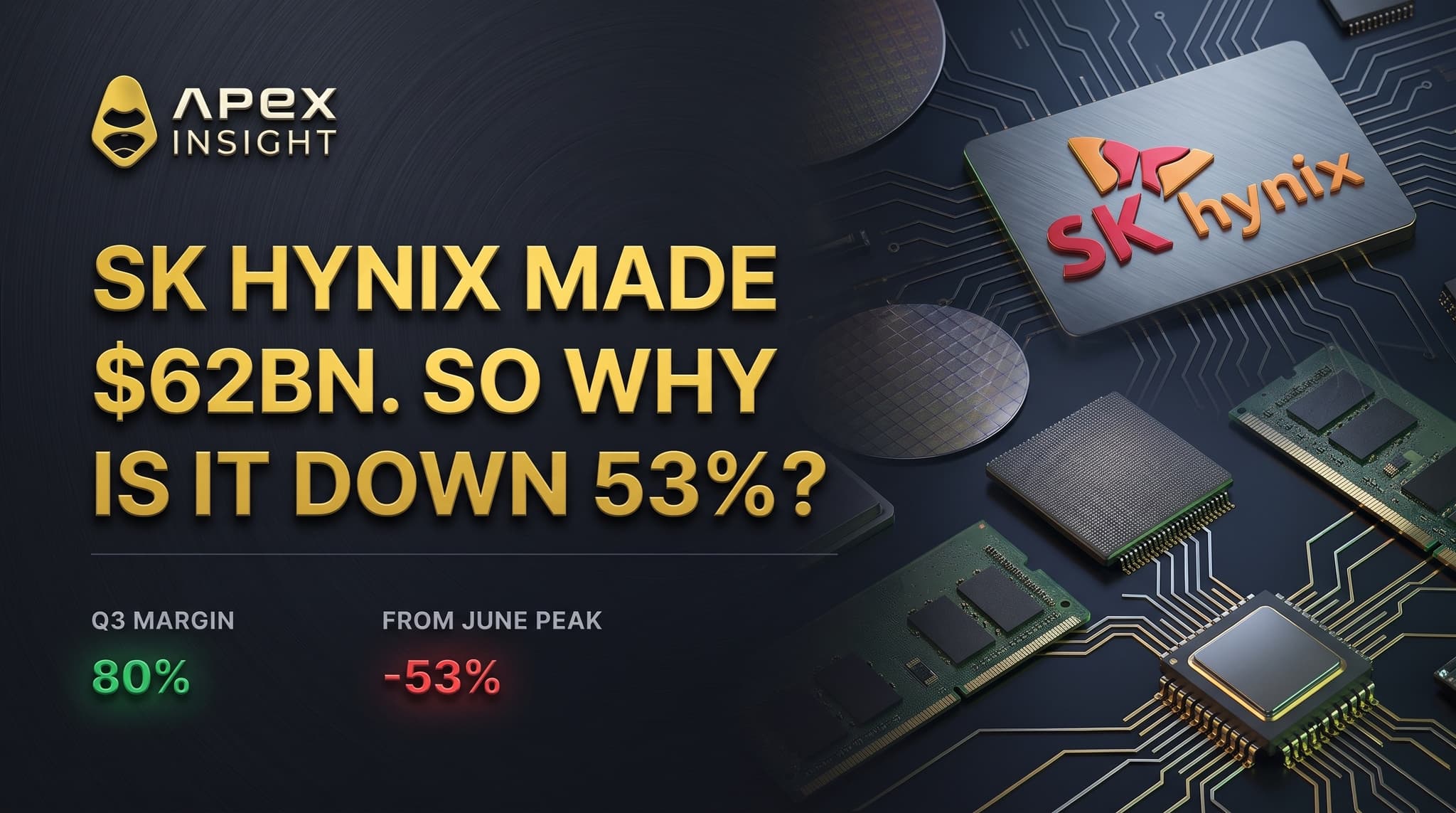



On Wednesday, SK Hynix reported the best quarter in its history.
Revenue of 104.6 trillion won, the first time the company has passed 100 trillion in a single quarter. Operating profit of 83.3 trillion won. An operating margin of 80%, which is a number you almost never see in manufacturing of any kind. In dollars, roughly $78bn of revenue and $62bn of operating profit in three months.
Two days later the shares fell 7% and closed at 1,418,000 won, which is about 53% below the intraday high it set in late June.
That gap is the story. The market is not arguing about whether SK Hynix is making money. It is arguing about how long the money lasts.
This piece walks through what the company reported, what has happened to the share price, and the three things the market is worried about. There is a bull case too, and it is stronger than the chart suggests.
1. What SK Hynix actually reported
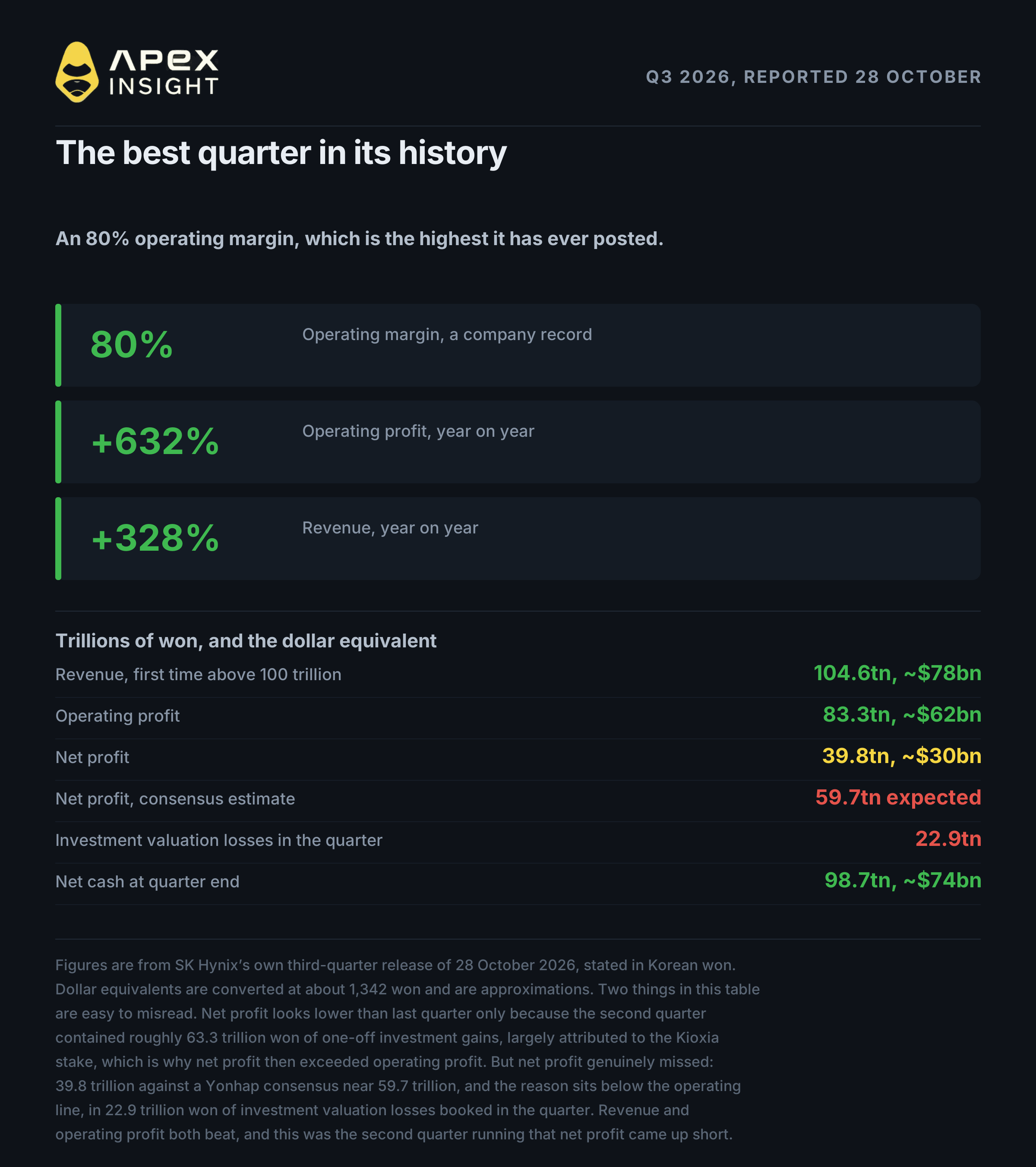
The numbers from the company's own results release, in trillions of won:
Item | Q3 2026 | Q2 2026 | Q3 2025 |
|---|---|---|---|
Revenue | 104.6 | 79.3 | 24.4 |
Operating profit | 83.3 | 60.5 | 11.4 |
Operating margin | 80% | 76% | 47% |
Net profit | 39.8 | 93.9 | 12.6 |
Revenue is up 328% year on year. Operating profit is up 632%. Both set company records, and the 80% margin is the highest SK Hynix has ever reported.
Two things in that table need explaining before anyone draws the wrong conclusion from them.
Net profit looks like it collapsed. It did not. The second quarter included about 63.3 trillion won of one-off gains from selling and revaluing investments, largely attributed to the company's Kioxia stake, which is why net profit that quarter was larger than operating profit. Comparing the two quarters on net profit is comparing a normal quarter against one with a windfall in it.
Net profit still missed, and the reason is below the operating line. At 39.8 trillion won it came in well under the roughly 59.7 trillion won analysts expected, according to Yonhap's consensus as reported by AFP. The quarter carried 22.9 trillion won of investment valuation losses, which accounts for most of that shortfall. Revenue and operating profit both beat. So the headline was a record and the bottom line was a miss, in the same release.
What drove it: DRAM average selling prices rose by a high-20s percentage from the previous quarter on about 10% more bits shipped, and server DDR5 shipments grew more than 40%. The company also finished the quarter with 98.7 trillion won of net cash, around $74bn, which makes it effectively debt free.
On the day of the results the market liked it. SK Hynix rose 10.89% and the KOSPI gained 6.63%, closing back above 6,000 for the first time in ten sessions.
That lasted two days.
2. The share price tells a different story
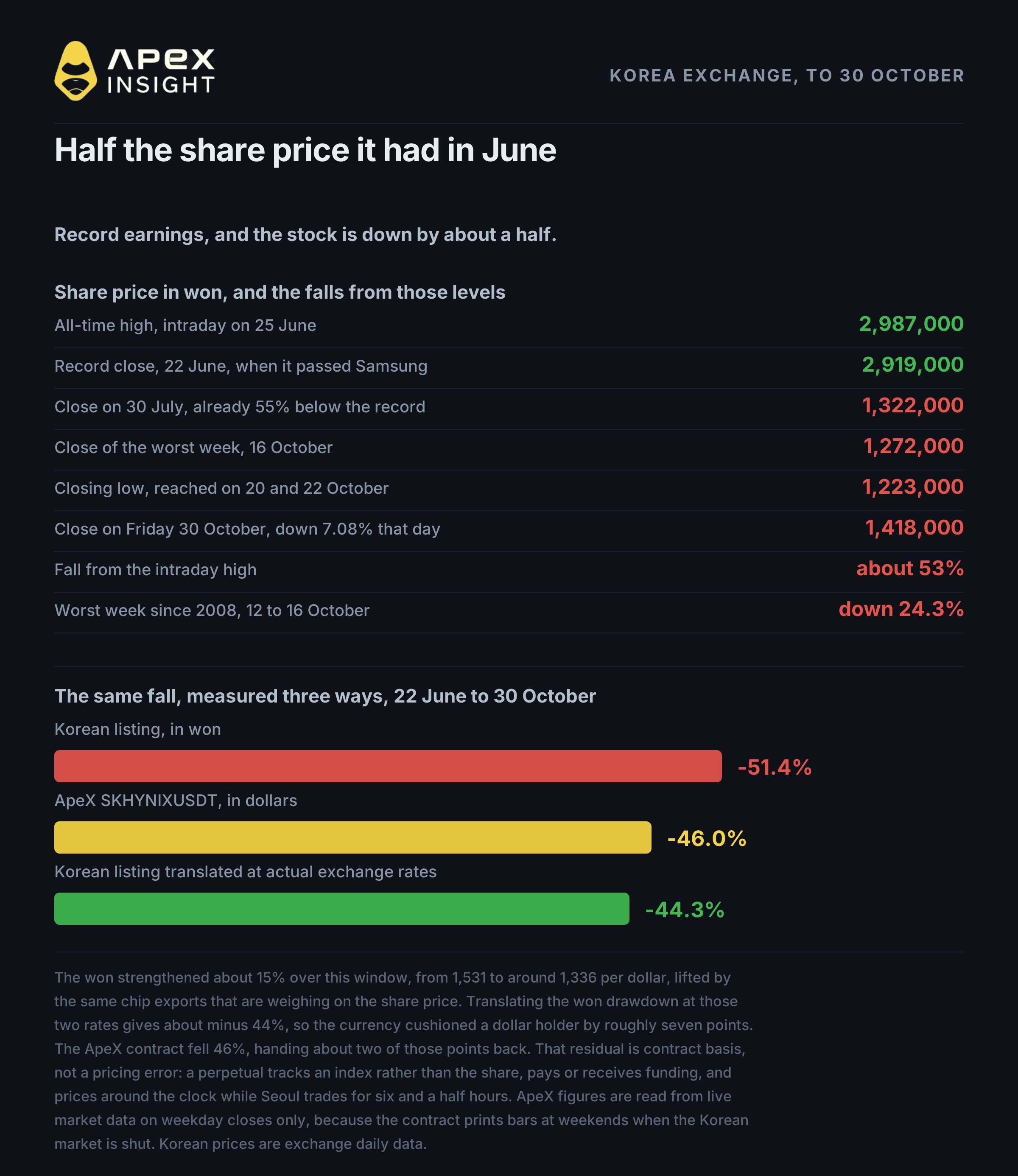
SK Hynix touched an all-time high of 2,987,000 won intraday on 25 June. Its record close was 2,919,000 on 22 June, the day it briefly overtook Samsung Electronics to become the most valuable company on the KOSPI for the first time, ending Samsung's roughly 25-year run at the top.
On Friday it closed at 1,418,000 won. From the intraday record that is a fall of about 53%.
Most of that fall had already happened by the end of July. The shares closed at 1,322,000 on 30 July, around the second-quarter results, which was already about 55% below the 22 June record close. October did not create this drawdown. It re-tested one that was essentially complete three months earlier.
October was still violent. The week of 12 to 16 October was down 24.3%, the worst week since 2008, ending at 1,272,000 won. The closing low came the following week, 1,223,000 on both 20 and 22 October, with an intraday low of 1,171,000 on 23 October. Then two strong sessions into the results, up 5.2% on 27 October and 10.9% on the day itself. And then Friday, when the shares fell 7.08% and the KOSPI fell 3.48%.
Friday's fall was not about SK Hynix. Alphabet had reported the night before, fell 12.64% in its worst day on record, and took the whole AI complex with it. In Seoul, foreign investors sold a net 1.62 trillion won of Korean shares. Daishin Securities' Lee Kyoung-min put it plainly: investor sentiment towards AI and semiconductors has weakened.
One thing worth saying clearly, because the two events happened within hours of each other: the Binance hack did not cause this. The theft began at 20:05 UTC on 29 October, five minutes after the US market closed, so Alphabet's fall was complete before any of it started. Crypto liquidations were far too small to move equities. Korean coverage of Friday's session does mention the hack, but the reasons it gives for the fall are AI profitability worries and the foreign selling. The shared cause is a market pricing roughly an 86% chance of a December Fed hike, which pressures long-duration assets of every kind.
The same stock, three different numbers
Here is something that only shows up if you trade the contract rather than the listing.
On ApeX, the same fall measures 46%.
The ApeX SKHYNIXUSDT contract closed Friday at 1,041.80, against a weekday-close peak of 1,929.99 on 22 June. That is a fall of 46.0%. The Korean listing, between those same two dates, fell 51.4% in won.
Most of the gap is the currency. The contract is priced in dollars and the underlying is priced in won, so holding it is a position in the Korean won as well as in the stock. The won has strengthened about 15% against the dollar since 22 June, from 1,531 to around 1,336, lifted by exactly the thing that is hurting the share price: semiconductor exports in the first 20 days of October were up 222.5% year on year, and the won closed at a one-year high of 1,325.2 on 21 October.
Translate the won drawdown at those two rates and you get about minus 44%. The contract fell 46%. So the currency cushioned the dollar holder by roughly seven percentage points, and the contract handed about two of them back.
Those two points are the part worth knowing. A perpetual on a foreign listing is not a clean currency-translated copy of the share. It tracks an index rather than the stock, it pays or receives funding, and it prices around the clock while Seoul trades for six and a half hours. The rally into the results shows the same thing in miniature: from 22 to 30 October the Korean listing rose 15.94% in won and the contract rose 14.93% in dollars.
3. Worry one: the price rises are decelerating
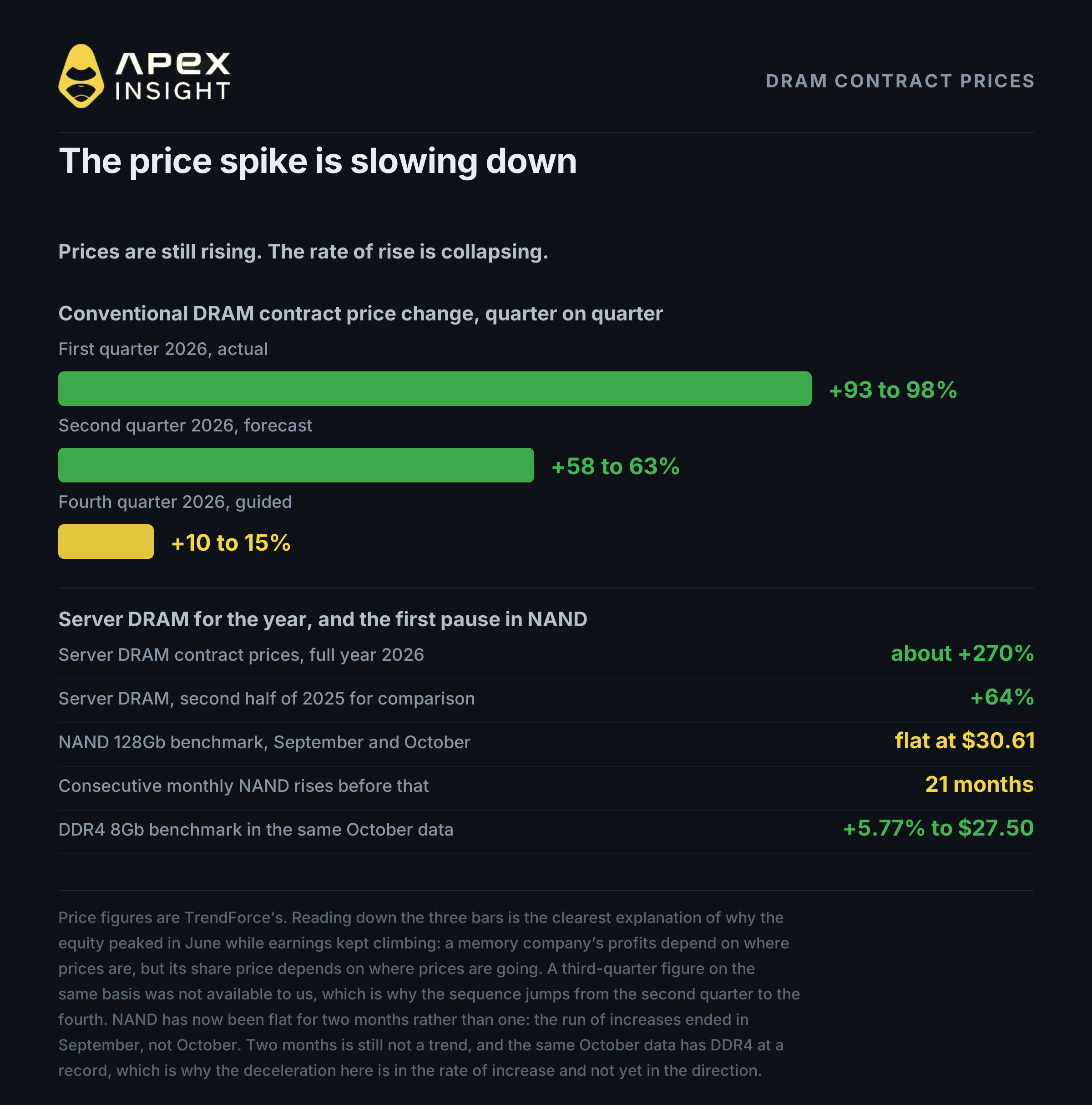
Memory is a price story, and the prices are still going up. They are just going up much more slowly.
Quarter | Conventional DRAM contract price change |
|---|---|
Q1 2026 | +93% to +98% |
Q2 2026 | +58% to +63% (forecast) |
Q4 2026 | +10% to +15% (guided) |
Those are TrendForce figures, from its releases of 1 June and 30 September. A third-quarter figure on the same basis was not available to us, which is why the table jumps from the second quarter to the fourth. Server DRAM contract prices are on track for roughly +270% across 2026 as a whole, after +64% in the second half of 2025, on TrendForce's August numbers.
Read down that column and you can see why the equity peaked in June. The rate of change peaked long before the price did. A memory company's earnings depend on where prices are; a memory share price depends on where prices are going.
There is a first hint of a top in NAND as well. The 128Gb benchmark was flat at $30.61 in October, the second flat month running, after a run of 21 consecutive monthly increases that ended in September. Two months is still not a trend, but it is the first pause in nearly two years.
The same October data cuts the other way for DRAM, and it belongs here for honesty: the DDR4 8Gb benchmark rose 5.77% to a record $27.50 in the same month. The deceleration is in the rate of increase, not yet in the direction.
4. Worry two: the lead is narrowing
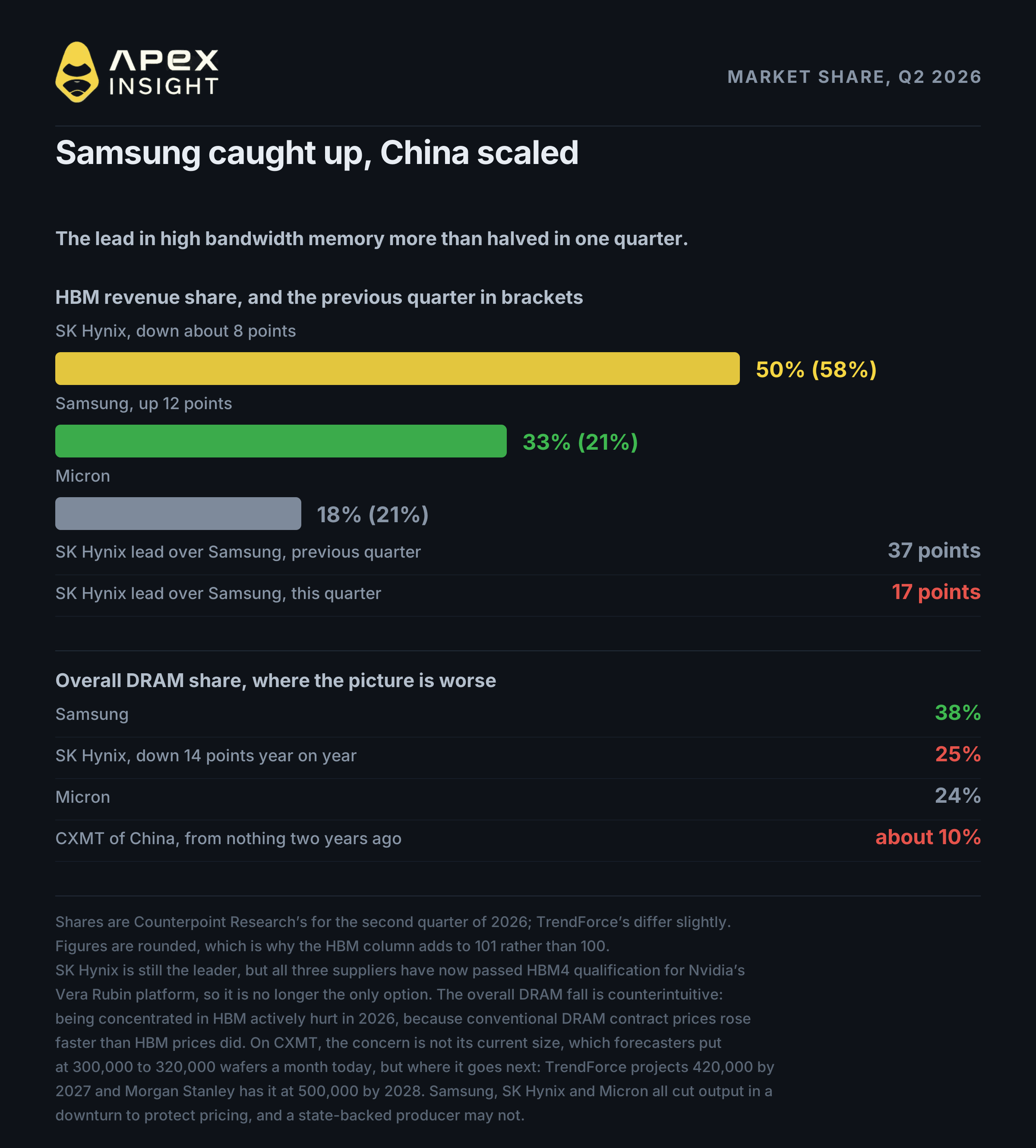
For two years the simple version of this trade was that SK Hynix owned high bandwidth memory and everyone else was catching up. That is no longer accurate.
Counterpoint Research's HBM revenue share for the second quarter, published in September:
Q2 2026 | Previous quarter | |
|---|---|---|
SK Hynix | 50% | about 58% |
Samsung | 33% | 21% |
Micron | 18% | about 21% |
Figures are rounded, which is why the current column sums to 101.
Samsung closed the gap from 37 points to 17 points in a single quarter. It began HBM4 mass production in February, ahead of both rivals, and in June Jensen Huang confirmed publicly that all three memory makers had passed HBM4 qualification for Nvidia's Vera Rubin platform. SK Hynix is still the leader. It is no longer the only option.
In overall DRAM, Counterpoint has Samsung at 38% and SK Hynix at 25%, down 14 points year on year. Our reading of why is counterintuitive, and Counterpoint does not say it: SK Hynix's HBM weighting probably hurt it in 2026, because conventional DRAM prices rose faster than HBM contract prices, which are set in long-term agreements and lag the spot market. Being concentrated in the premium product was the wrong place to be during a commodity spike.
Then there is China. CXMT now holds about 10% of the DRAM market, up from nothing of consequence two years ago, and completed a roughly 16nm-class process in the second quarter with yields above 90%. Estimates of its current scale cluster around 300,000 to 320,000 wafers a month, and the forecasts of where it goes next are the uncomfortable part: TrendForce projects 420,000 by 2027, and Morgan Stanley has it reaching 500,000 by 2028.
The structural point about CXMT is not its size. It is that Samsung, SK Hynix and Micron all cut output in a downturn to protect pricing, and a company operating under state objectives may not.
5. Worry three: who pays for all this
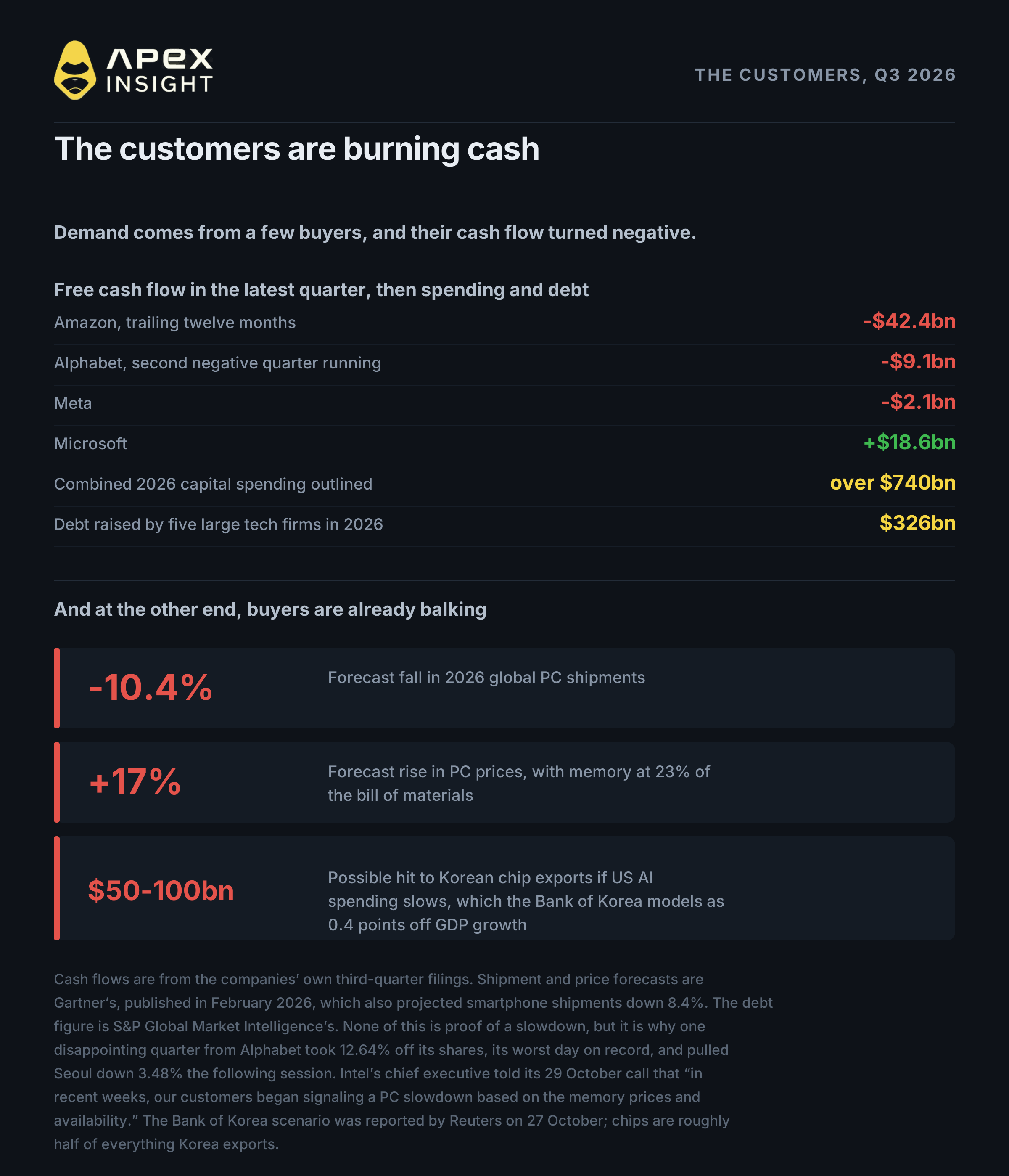
SK Hynix's demand comes from a handful of very large customers, and in the last two weeks those customers published their cash flows.
Free cash flow | Capex | |
|---|---|---|
Alphabet | minus $9.1bn in Q3, second negative quarter running | $51.4bn in Q3, up to $205bn for 2026 |
Amazon | minus $42.4bn over twelve months | $220bn planned |
Meta | minus $2.1bn in Q3 | guided up to $145bn |
Microsoft | plus $18.6bn | $45.2bn, below expectations |
Across the large technology companies, more than $740bn of capital spending is outlined for this year. The four above are most of it, though the table gives Microsoft's spending for the quarter rather than the year, so those rows do not add to that total on their own. Five large technology companies raised a combined $326bn of debt in 2026, roughly three times the previous year, according to S&P Global Market Intelligence as reported by TechCrunch.
None of that is proof of a slowdown. It is the reason a single disappointing quarter from Alphabet took 12.64% off its share price and dragged Seoul down with it.
There is harder evidence at the consumer end. Intel's chief executive told the company's 29 October earnings call that "in recent weeks, our customers began signaling a PC slowdown based on the memory prices and availability." Gartner forecast in February that memory costs would cut 2026 PC shipments by 10.4% and smartphone shipments by 8.4%, push PC prices up 17%, and take memory to a peak of 23% of a PC's bill of materials, from 16% in 2025. On Friday Dell fell 11%, HP 9%.
The most striking version of this risk is sovereign. Bank of Korea analysis reported by Reuters on 27 October modelled a scenario in which US technology firms slow AI spending: Korean semiconductor exports fall $50bn to $100bn against earlier forecasts, and GDP growth drops about 0.4 percentage points. Chips are roughly half of everything Korea exports.
6. What the bull case still rests on
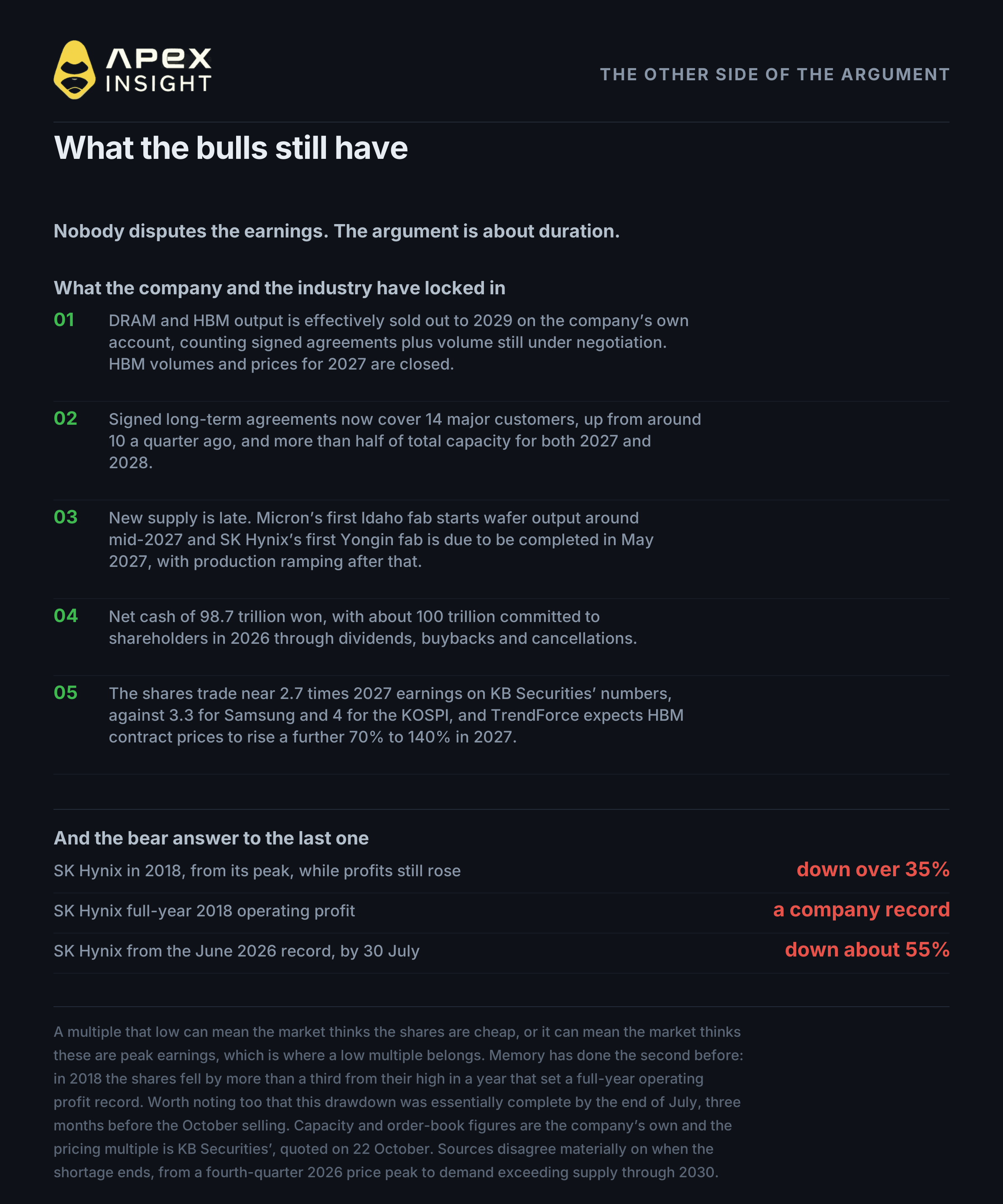
All of the above is why the stock halved. Here is what has not changed.
The order book is full. SK Hynix told its results call that DRAM and HBM output is effectively sold out to 2029, though the qualifier matters: that is signed long-term agreement volume plus volume still under negotiation, not contracted backlog alone. The signed part is agreements with 14 major customers, up from around 10 a quarter earlier, covering more than half of total production capacity for both 2027 and 2028. HBM volumes and prices for 2027 are already negotiated and closed.
New supply is late. Micron's first Idaho fab starts wafer output around mid-2027 and its second in late 2028. SK Hynix's own Yongin first fab is due to be completed in May 2027, with production ramping after that, since completing a building is not the same as qualifying equipment. An advanced DRAM fab takes years to build and tens of billions of dollars. Whatever happens to demand, meaningful new global capacity does not arrive before late 2027.
The balance sheet is extraordinary. Net cash of 98.7 trillion won, and a commitment to return about 100 trillion won to shareholders in 2026, around $75bn. The company states floors rather than a split: at least 30 trillion in dividends and at least 60 trillion in buybacks and cancellations.
Prices are still forecast to rise. TrendForce expects HBM contract prices to climb a further 70% to 140% in 2027, which is not the shape of a market anyone expects to break next year.
The multiple is low. KB Securities' head of research put SK Hynix at 2.7 times 2027 earnings on 22 October, against 3.3 for Samsung and 4 for the KOSPI, calling it an undervaluation comparable to past financial crises.
And the bears' answer to that last point, which you should hear too: a multiple that low can simply mean the market believes these are peak earnings. Returns on equity across the memory industry this year are far above anything it has sustained through a normal cycle, and a cyclical peak is exactly where a low multiple belongs. Memory has done this before. In 2018 SK Hynix fell more than 35% from its high while profits were still rising, and went on to set a full-year operating profit record in the same year.
Jensen Huang, asked about oversupply at Nvidia's Berlin event in late October, said he does not expect it until some time after 2029: "One of the things that's really great about memory is that you can always use more of it."
What to watch next
Tuesday 3 November, the US midterm elections. KB Securities flags in the same note that a Democratic Congress could mean tighter regulation and investment oversight of AI data centres.
December's Fed decision. Markets put roughly an 86% chance on a hike, and two governors already dissented in favour of one at the October meeting. Long-duration assets, which is what a memory stock is now, carry that directly.
Whether the Rubin Ultra report is true. TrendForce reported on 27 October that Nvidia may use 8-high HBM4 rather than 12-high HBM4E in Rubin Ultra, which would mean less memory content per GPU. It is single-sourced, unconfirmed by Nvidia, and SK Hynix's finance chief pushed back on it directly. If it is confirmed, it matters.
Fourth-quarter DRAM pricing. Guided at 10% to 15%. If it lands below that, the deceleration argument gets a lot stronger.
The honest summary is that nobody in this debate disputes the earnings. The argument is entirely about duration, and the share price has already taken a view.
Trade the markets in this article
All three are tradeable on ApeX Omni as USDT-settled perpetuals, long or short, with no KYC:
SKHYNIXUSDT, SK Hynix, up to 50x
SAMSUNGUSDT, Samsung, up to 50x
MUUSDT, Micron, up to 50x
Four things to know before trading a Korean listing as a dollar contract. You are also taking a currency position: the underlying trades in won and the contract settles in USDT, which is why the drawdown differs from the one Korean shareholders experienced. The trading day does not line up: the Korean session runs 00:00 to 06:30 UTC, so the contract's daily close falls around the next Korean open rather than the same day's close. The contract prints a bar every calendar day including weekends, when Seoul is shut, so weekend moves are the contract's own order flow rather than the stock. And the contract is not the only dollar route into this name: SK Hynix raised $26.5bn in a Nasdaq listing on 10 July, the largest US listing by a foreign company on record, so a dollar-denominated share exists if you want the exposure without leverage or funding.
Funding on these contracts is capped at 2%, and leverage is 50x, which on a name that fell 24% in a week is worth sizing for.
Race to the Top 50 is live
Trade your way up the leaderboard. A prize pool of up to 10,000 USDT, paid down to 50th place.
ApeX is running a trading competition until 5 November, 10:00 UTC, with a prize pool of up to 10,000 USDT paid down to 50th place on the leaderboard.
The pool unlocks in tiers on total campaign volume, so it stays locked below 30,000,000 USDT and reaches the full 10,000 USDT at 100,000,000 USDT. Your score is the sum of four parts: trading volume, realised profit percentage, net deposits and referrals. Qualifying requires registration through the campaign page, at least 100 USDT in your perpetual futures account, at least 10,000 USDT of eligible volume, and a Top 50 finish.
Full rules and the prize table are in the Race to the Top 50 announcement.
Trading perpetual contracts carries a high level of risk and can result in the loss of your entire position. Leverage increases both gains and losses. Nothing in this article is financial advice. Do your own research and never risk more than you can afford to lose.
If you need any help, feel free to reach out to our team on Discord.
Website: https://www.apex.exchange
Twitter: https://twitter.com/OfficialApeXdex
Telegram: https://t.me/ApeXdex
Company results are from SK Hynix's own third-quarter release of 28 October 2026, stated in Korean won. Dollar equivalents are converted at about 1,342 won and are approximations. Korean share prices are Korea Exchange daily data. The all-time high of 2,987,000 won is an intraday high on 25 June; the record close is 2,919,000 on 22 June, and percentage falls state which of the two they are measured from. One widely circulated Korean report gives a 3,002,000 high on 23 June, which the exchange data does not support. The October closing low is 1,223,000, reached on both 20 and 22 October; 1,272,000 on 16 October is the close of the worst week, not the low. ApeX contract figures are read from live market data and are measured on weekday closes only, because the contract prints bars at weekends when the Korean market is shut. The ApeX contract is quoted in dollars against a won-denominated underlying, so its performance includes currency and will not match a won chart, and the residual after translating for currency is contract basis rather than a pricing error. Market share figures are Counterpoint Research's for the second quarter of 2026; TrendForce's differ slightly. Price forecasts and capacity projections are third-party estimates, and sources disagree materially on CXMT's current scale and on when the shortage ends, with published views ranging from a fourth-quarter 2026 price peak to demand exceeding supply through 2030. The Rubin Ultra report is single-sourced and unconfirmed.