


On 26 October, Anthropic filed a registration statement on Form S-1 with the US Securities and Exchange Commission. It has applied to list its Class A common stock on the Nasdaq Global Select Market under the symbol ANT, with Goldman Sachs and Morgan Stanley running the offering. The registration is not yet effective, and no price range has been set.
Three days later, an ANT perpetual is live on ApeX.
The filing produced one number that travelled further than any other: a net loss of $80.7bn for the first half of 2026. It is a real figure, taken straight from the filing, and it is close to meaningless as a description of how the business performed.
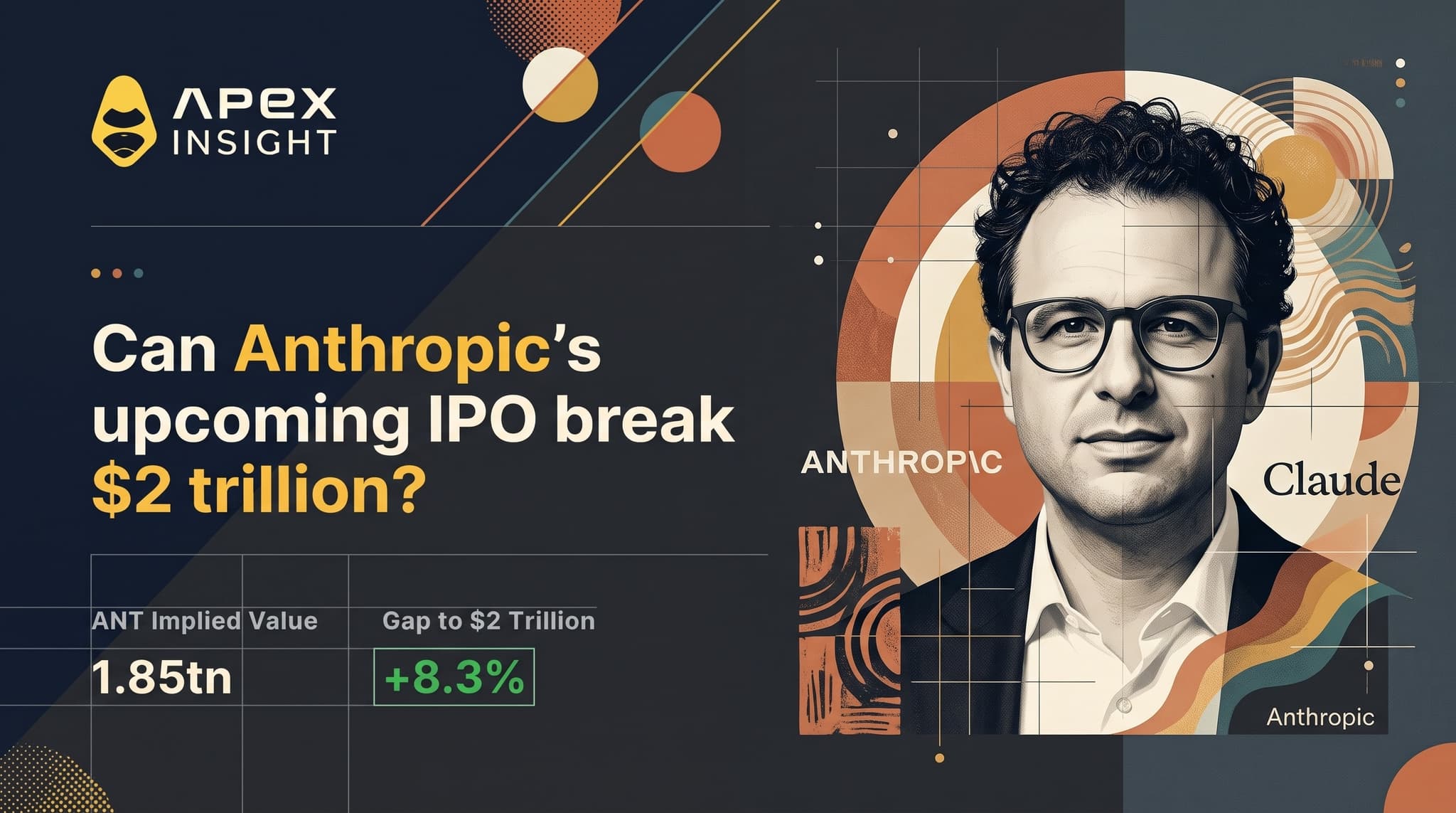
There is also a level worth having in your head before you read any further. The contract puts Anthropic at about $1.85 trillion. Two trillion is 8.3% up the screen from there, and other venues were within a percent of it two months ago.
Six sections, then, on what the filing says, what the contract does with it, and what stands between $1.85tn and $2tn.
1. What Anthropic actually filed
Start with the document, because the summaries have been doing the work for most readers.
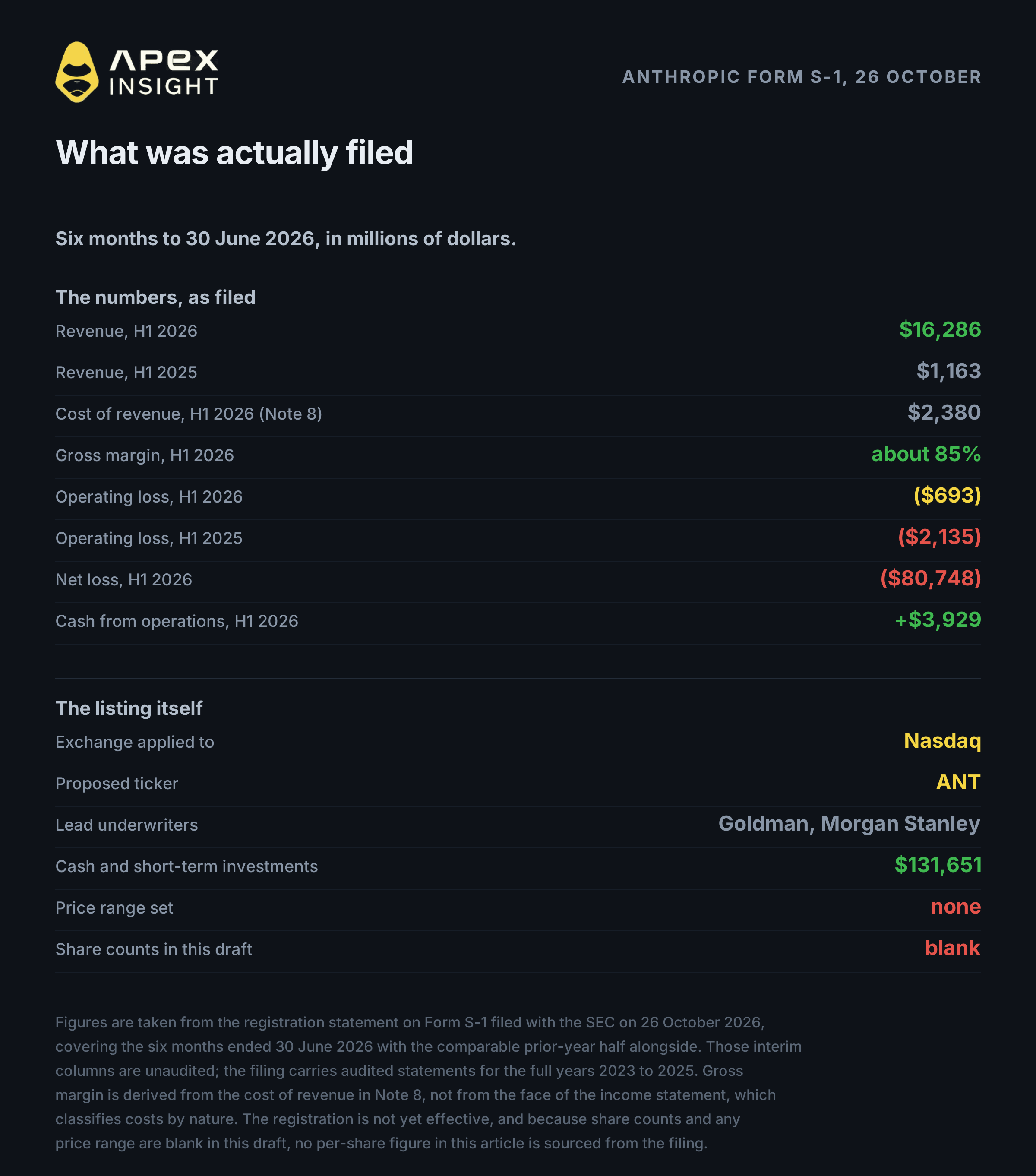
The S-1 is public and on EDGAR. It covers the six months ended 30 June 2026, with the prior-year half as a comparative. The headline items, taken directly from the filing, in millions of dollars:
Item | H1 2026 | H1 2025 |
|---|---|---|
Revenue | 16,286 | 1,163 |
Cost of revenue (Note 8) | 2,380 | 1,019 |
Operating loss | (693) | (2,135) |
Net loss | (80,748) | (12,969) |
Change in fair value of convertible notes, derivative liabilities and SAFEs | (72,388) | (10,942) |
Cash and short-term investments stood at $131.7bn at the end of June, being $112.4bn of cash and equivalents plus $19.3bn of short-term investments. Net cash provided by operating activities was $3,929m, against $1,513m used in operating activities a year earlier.
One caveat on all of it: the H1 2026 columns are unaudited. The S-1 carries audited statements for the full years 2023 to 2025 and presents the interim half as unaudited interim financial information, which is normal for a filing of this kind but worth knowing before you lean on a single line.
Three things in that table are worth sitting with before moving on. Revenue grew fourteen-fold year on year. The operating loss shrank, from $2,135m to $693m, while that was happening. And the cost of revenue line gives a gross margin of about 85% for the half, against about 12% a year earlier.
What the filing does not contain is just as relevant for anyone pricing the contract. The share counts for Class A and Class N are blank in this filing. There is no price range. There is no stated valuation. Anything you read this week putting a number on what Anthropic is worth is working from private rounds or from inference, not from the prospectus.
2. The $80.7bn loss is mostly an accounting reflex
This is the part that matters, and it is the part most of the coverage has handled badly.
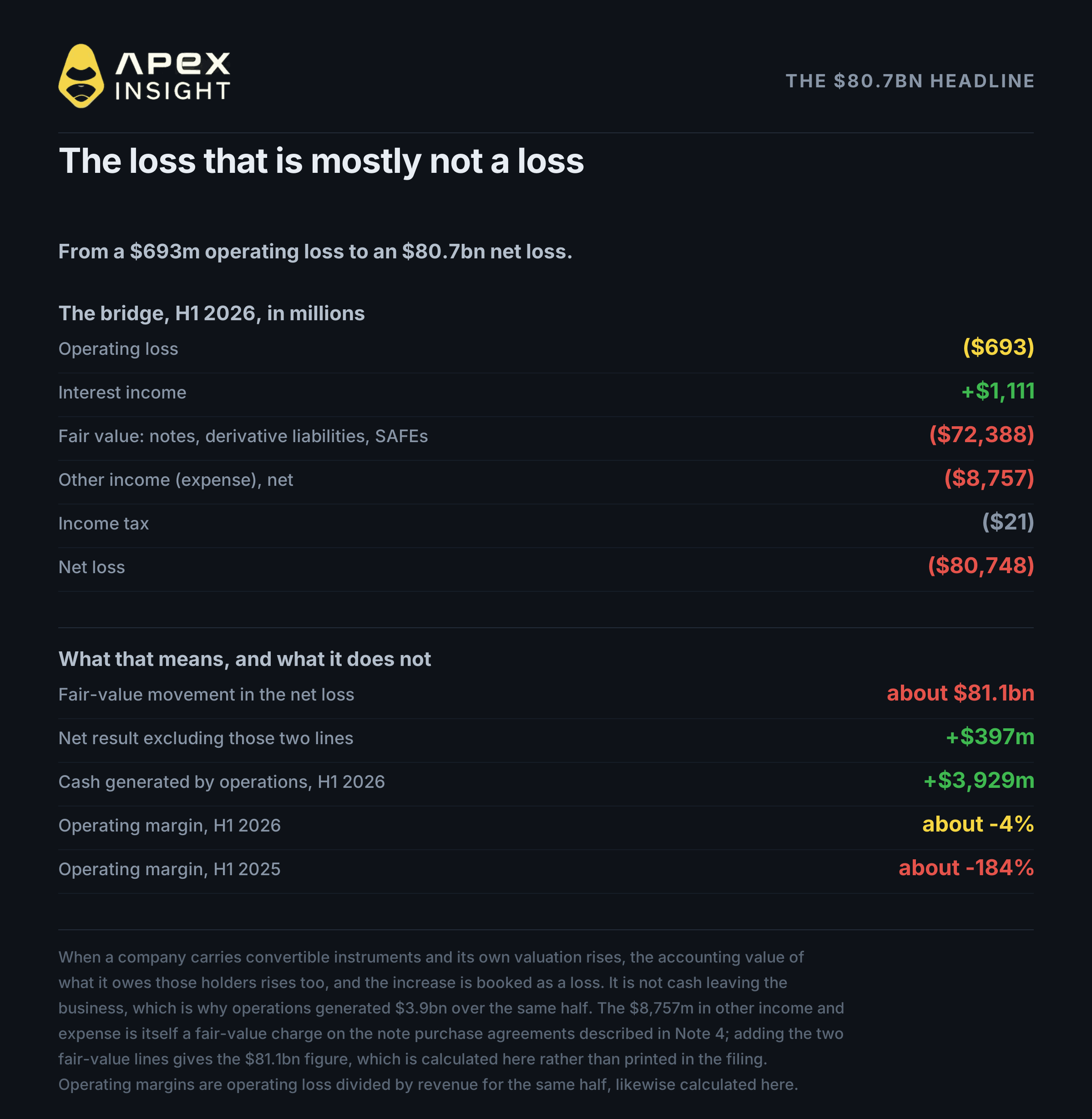
Of the $80,748m net loss, $72,388m is a single line: the change in fair value of convertible notes, derivative liabilities and SAFEs. That is a non-cash remeasurement. When a company has convertible instruments outstanding and its own valuation rises, the accounting value of what it owes those holders rises with it, and the increase runs through the income statement as a loss.
It is not the only one. Here is the whole bridge from the operating loss to the net loss, in millions:
Line | H1 2026 |
|---|---|
Operating loss | (693) |
Interest income | 1,111 |
Change in fair value of convertible notes, derivative liabilities and SAFEs | (72,388) |
Other income (expense), net | (8,757) |
Income tax | (21) |
Net loss | (80,748) |
That $8,757m is itself a fair-value charge, on the note purchase agreements described in Note 4. Add the two together and $81.1bn of fair-value movement sits between a $693m operating loss and an $80.7bn net loss.
Take both lines out and the arithmetic flips. The operating loss of $693m, plus $1,111m of interest income, less $21m of tax, leaves net income of $397m for the half. That is not a number the filing prints, and it is not a GAAP result — but it is the one that describes what the business did.
Put plainly: almost the whole of that $80.7bn is the accounting consequence of Anthropic becoming more valuable. It is not money that left the business — and the cash flow statement says as much, with $3.9bn generated by operations over the same half.
The pattern is not new, which is the clearest evidence that it is structural rather than a one-off. In the first half of 2025 the convertible-notes line alone was $10,942m against a $12,969m net loss. In both periods the remeasurement accounts for the overwhelming majority of the reported loss: about 84% last year and about 90% this year on that line by itself.
Strip the fair-value movement out and the operating picture is the $693m operating loss, on $16.3bn of revenue. That is a margin of roughly minus 4%, against minus 184% in the same half last year.
3. What the ANT contract is actually quoting
Here is where a lot of traders will get into trouble, because the number on the screen is not what it looks like.
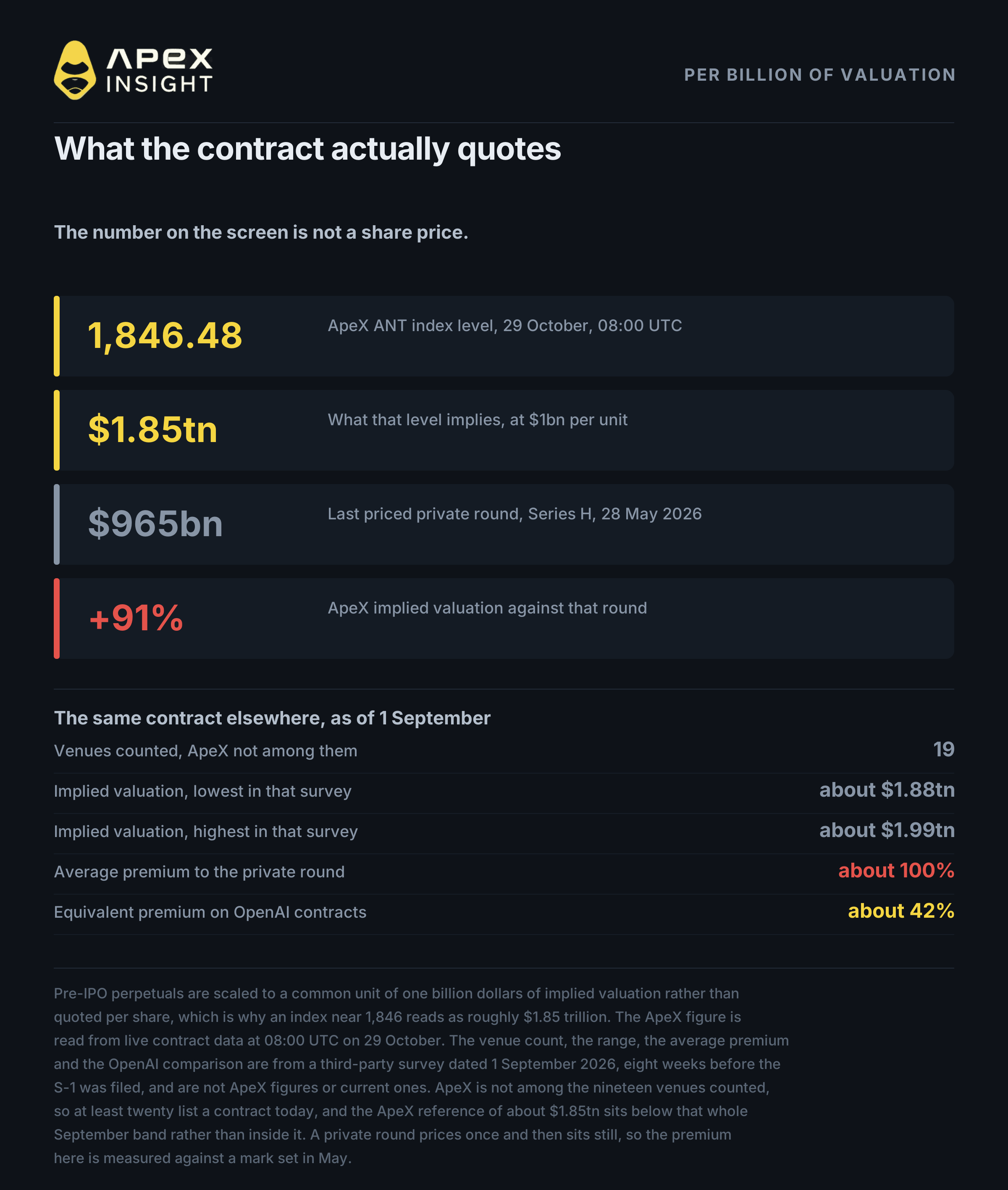
A pre-IPO perpetual does not quote a share price. These contracts are scaled to a common unit of one billion dollars of implied valuation. The quote is the company's implied worth, in billions.
So the ApeX ANT index at 1,846.48 is not $1,846 a share. It is an implied valuation of about $1.85 trillion.
That distinction changes how you read every other number. Anthropic's last priced private round was Series H at $965bn, on 28 May 2026. Against that, the ApeX index sits about 91% higher.
It is also worth knowing where that sits against the rest of the market, because this is not an exclusive listing. The best cross-venue snapshot we could find is dated 1 September 2026, eight weeks before the S-1 was filed, and it counted nineteen venues carrying an Anthropic contract — not including ApeX, so the current number is at least twenty. On that date implied valuations ran from about $1.88tn to $1.99tn, an average premium near 100% over the private mark.
Two things follow, and the date matters for both. ApeX's reference of about $1.85tn is below that entire September band, not at the cheap end of it. And nobody should treat a September snapshot as today's spread, because the filing landed in between. If you want a current comparison, you will have to read the other venues' screens yourself.
For a sense of whether premiums this size are normal for the product: on that same September snapshot, the equivalent premium on OpenAI contracts was nearer 42%, across eighteen venues.
Which puts a round number in view, and on this contract the round number is unusually literal. Because the quote is scaled per billion, $2 trillion of implied valuation is an index of exactly 2,000.00 on the screen. From 1,846.48 that is 8.3% away. The venues in the September survey were already printing up to $1.99tn, within a percent of it, before ApeX listed its contract at all.
So the level is close, and it has been approached elsewhere. Whether it breaks is a question nothing in this article can answer, and you should be suspicious of anyone who says otherwise: there is no price range in the S-1, no analyst coverage of an unlisted stock, and on ApeX there is not yet a tape. What the rest of this piece can do is tell you what sits between here and there.
4. A listing is not yet a market
This is the most practical thing in the article, and it is a fact about the tape rather than about the company.
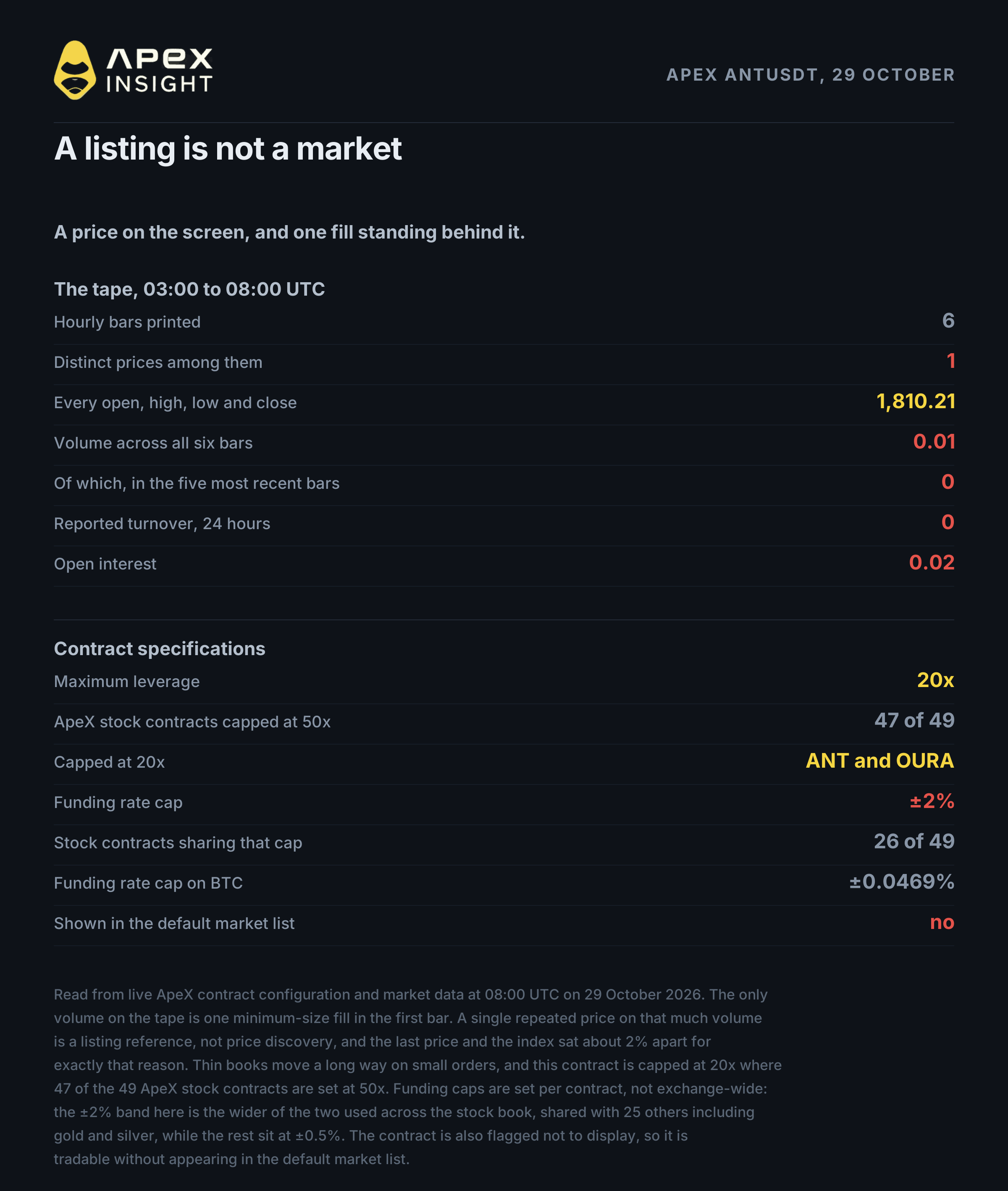
As of 08:00 UTC on 29 October, the ApeX ANT contract had printed six hourly bars, every one of them flat at 1,810.21. Total volume across all six was 0.01 contract, a single minimum-size fill in the first bar; the five bars since have printed zero. Reported turnover over twenty-four hours was zero. Open interest was 0.02 contracts. The last price and the index were about 2% apart, which is what happens when almost nothing trades to pull the mark toward the reference.
So there is a contract, and there is a reference price, and there is essentially no price discovery. Anyone quoting ANT's "price" today is quoting a listing reference, not a market.
That matters for execution rather than for the thesis. A book with no depth moves a long way on a small order, and a 20x contract on an empty book is a fast way to find that out. The sensible read is to let the first sessions build a tape before treating any level as information.
Contract specifications worth knowing, from the live contract data. Maximum leverage is 20x. That is unusual: of ApeX's 49 stock contracts, 47 are set at 50x, and only ANT and OURA are capped at 20x. The funding rate cap is ±2%, the wider of the two bands ApeX uses across its stock book — 26 of the 49 sit there, including gold and silver, and the other 23, Nvidia among them, sit at ±0.5%. For scale, BTC is capped at ±0.0469%. Tick size is 0.01.
One more detail from the configuration: ANT-USDT is currently flagged not to display, meaning it is tradeable but does not appear in the default market list. If section four's heading seemed strong, that is the exchange's own data agreeing with it.
5. What a pre-IPO perpetual is not
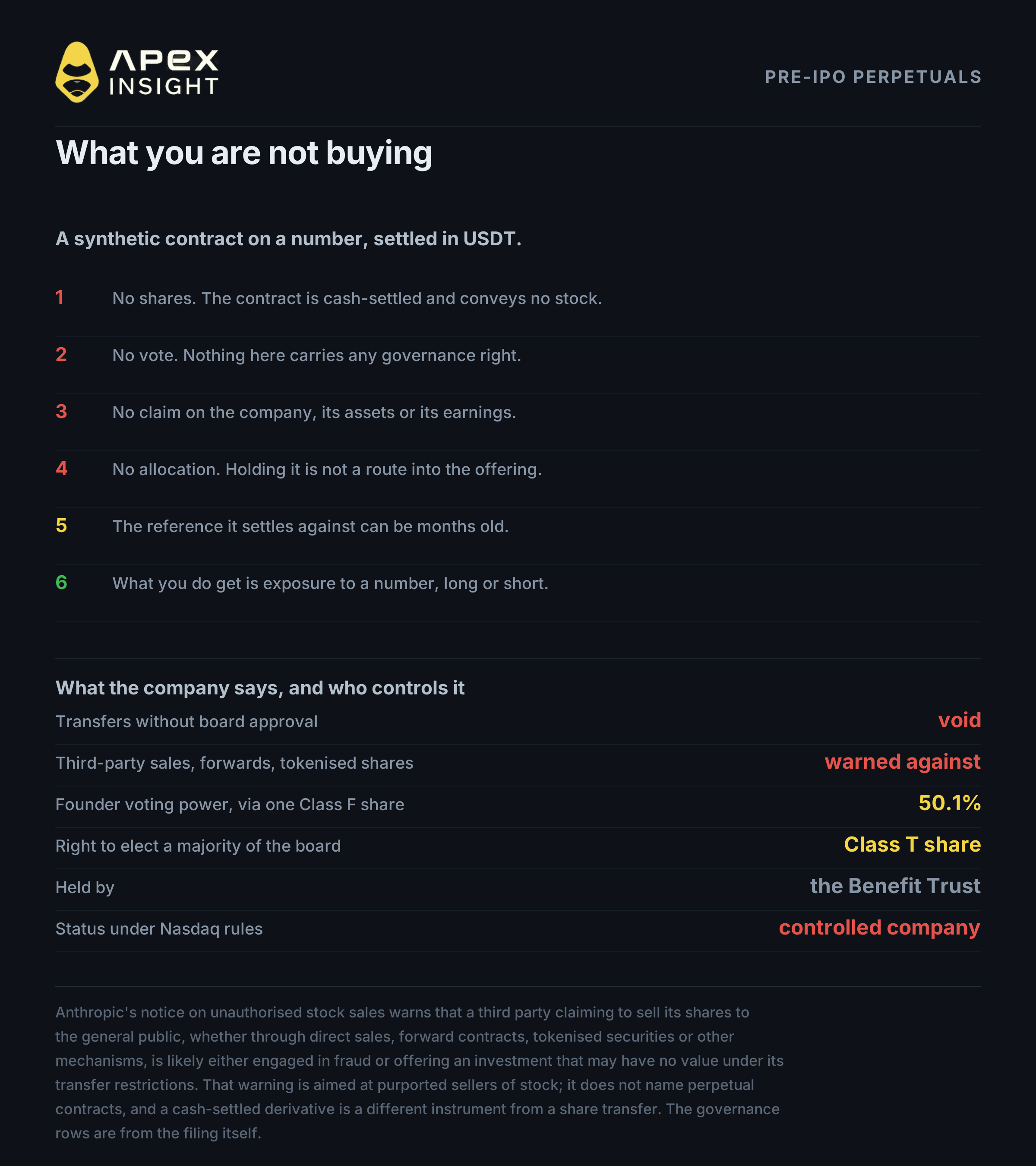
Six words, and they are the most important in the article: you are not buying any equity.
A pre-IPO perpetual is a synthetic, cash-settled contract. It conveys no shares, no voting rights and no claim of any kind on the company. It is a bet on a number that an exchange derives from private valuation data.
Anthropic itself has been pointed about the broader category. In a notice on unauthorised stock sales, the company warns that a third party claiming to sell its shares to the general public, whether through direct sales, "forward contracts," tokenised securities, or other mechanisms, is "likely either engaged in fraud or offering an investment that may have no value due to our transfer restrictions." It has separately said that purported transfers made without board approval are void under those restrictions.
Read it precisely. That warning is aimed at people purporting to sell you Anthropic stock; it does not name perpetual contracts, and a cash-settled derivative is a different instrument from a share transfer. But a trader should know that the company whose valuation they are trading has taken a public position on the products next door.
Two further structural points, and both are in the filing. Anthropic's seven co-founders hold a single Class F share — no economic rights — carrying votes equal to 50.1% of total voting power, through a Founder LLC. Separately, a Class T share held by the Long-Term Benefit Trust carries the right to elect a majority of the board. The filing's own risk factor says the structure may effectively eliminate the ability of Class A holders to influence important decisions, including a change of control. Anthropic will list as a controlled company under Nasdaq rules.
One last point, about the instrument rather than the company: the reference prices these contracts are built on can be months stale, because a private round prices once and then sits there while the market moves.
6. What the company says the risks are
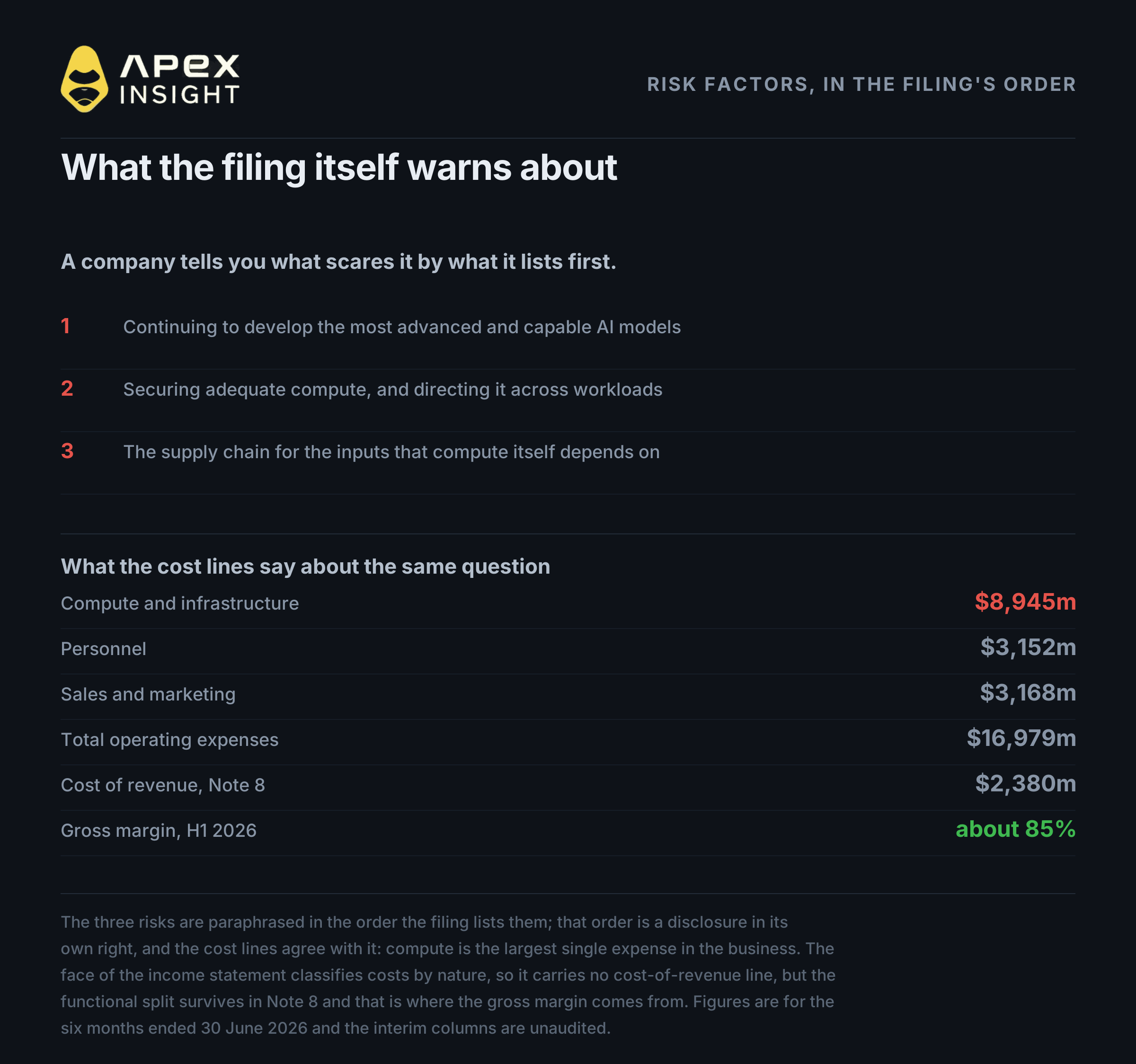
A useful discipline with any S-1 is to read the risk factors in the order the company chose, because that order is a disclosure in itself.
Anthropic's first three, in the filing's own sequence, are all versions of the same problem. The first is that success depends on continuing to develop the most advanced and capable AI models, which requires compute, talent, revenue growth and access to capital. The second is securing adequate compute and directing it across workloads, including competition for it and dependence on cloud providers. The third is the supply chain inputs that compute itself depends on.
The company is telling you that its central risk is access to chips and the capital to buy them, and its own cost lines agree. Compute and infrastructure is the largest single expense in the filing at $8,945m of $16,979m in total operating expenses, well ahead of sales and marketing at $3,168m and personnel at $3,152m.
There is a presentation quirk worth knowing if you go looking for a gross margin. The face of the income statement classifies costs by nature, so there is no cost-of-revenue line on it; Anthropic changed to that presentation during 2025. The functional split survives in Note 8, which gives cost of revenue of $2,380m — substantially all of it compute serving customer workloads — and that is where the 85% gross margin in section one comes from.
So the bull case and the bear case use the same facts. Revenue grew fourteen-fold in a year, the operating loss narrowed sharply, and the gross margin is high. Whether that continues depends on a compute supply chain the company itself lists as its first three risks.
None of which tells you whether $1.85tn is the right number. It tells you what you are actually taking a view on when you trade the contract: not Anthropic's product, but the gap between a private mark set in May and whatever the public market decides in the coming weeks.
Trade the markets in this article
Everything discussed here is tradeable on ApeX Omni as a TradFi perpetual, settled in USDT, long or short, with no KYC.
The contract at the centre of it:
ANTUSDT, Anthropic, up to 20x
The closest comparison on the book, another private company trading as a perpetual before its listing:
SPCXUSDT, SpaceX, up to 50x
And the listed company whose fortunes are most tied to the compute constraint in section six:
NVDAUSDT, Nvidia, up to 50x
TradFi contracts on ApeX settle against an index rather than the underlying asset, and ApeX lists them separately from its crypto perpetuals in its own contract data. Specifications differ by contract, so check them before you size a position: ANT is capped at 20x where SpaceX and Nvidia both offer up to 50x, and funding caps vary the same way.
ANT is now live on ApeX
ANTUSDT is listed and open for trading, long or short, with up to 20x leverage and settlement in USDT. No KYC.
Everything in section four applies before you place an order. The book is new, the tape is one fill long, and the contract does not yet appear in the default market list — so trade it from the link rather than by browsing, size the position for a market with no depth, and remember that the 20x cap on this contract is there for a reason.
ANT is now live on ApeX
Trade Anthropic's pre-IPO perpetual long or short, with up to 20x leverage. Settled in USDT, no KYC.
Trading perpetual contracts carries a high level of risk and can result in the loss of your entire position. Leverage increases both gains and losses. A newly listed contract with little or no trading history carries additional risk: order books are thin, spreads are wide, and small orders can move the price a long way. Nothing in this article is financial advice. Do your own research and never risk more than you can afford to lose.
If you need any help, feel free to reach out to our team on Discord.
Website: https://www.apex.exchange
Twitter: https://twitter.com/OfficialApeXdex
Telegram: https://t.me/ApeXdex
Disclosure: this article was drafted with Claude, a product of Anthropic, the company it analyses. It was fact-checked against primary sources and the conclusions are the desk's own, but readers should weigh that relationship when reading it.
The financial figures in sections one, two and six are taken from Anthropic's Form S-1 as filed with the SEC on 26 October 2026, stated in millions of dollars for the six months ended 30 June 2026 with the comparable prior-year half alongside. Those interim columns are unaudited; the filing's audited statements cover the full years 2023 to 2025. Gross margin is derived from the cost of revenue disclosed in Note 8 rather than from the face of the income statement, which classifies costs by nature. The governance arrangements in section five, including the Class F and Class T shares, are from the filing. Share counts and any price range are blank in the registration statement as filed, so no per-share figure in this article is filing-sourced. ApeX contract data, including the index level, last price, hourly bars, leverage cap, funding caps and display flag, was read from the live contract configuration and market data at 08:00 UTC on 29 October 2026. The ANT contract is quoted per billion dollars of implied valuation rather than per share, and every valuation figure here follows that convention. The cross-venue implied valuations, venue counts, average premiums and the OpenAI comparison are from a third-party survey dated 1 September 2026, eight weeks before the S-1 was filed — and are labelled with that date in the text; they are not ApeX figures and should not be read as current. The Series H private mark is likewise third-party. A pre-IPO perpetual is a cash-settled derivative that conveys no equity; nothing in this article should be read as a route to owning Anthropic stock.