




What Pons Is and What It Solves
Creating a token normally means writing a contract, deploying it, seeding liquidity, locking that liquidity so buyers trust it, and finding a venue. Pons compresses all of it into a single transaction.
The creator sets a name, symbol, image and fee wallet. The protocol handles the rest, and the liquidity is locked automatically. No code, no KYC. The interface never holds funds, so every action is a transaction the user's own wallet approves.
Robinhood Chain is a genuine Ethereum Layer 2 on the Arbitrum stack, live since July 1 and built for tokenized real-world assets. Pons is not a Robinhood product. It is a third party operated by Pons Labs, LLC, created by a pseudonymous developer known onchain as MEADGod.
How the Two Generations Differ
Pons runs two live generations, and both matter for understanding the business.
v1 | v2 | |
|---|---|---|
Launch | Straight to pool | Bonding curve |
Venue | Uniswap V3 | Uniswap V4 |
Pairing | WETH only | Approved assets |
In v1 a launch opens directly as a locked Uniswap V3 position paired against WETH, with a fixed one billion supply and graduation once 4.2 ETH is paired. In v2 the full supply mints to a bonding curve first, and the pool is created only at graduation, seeded from what the curve collected. Both factories are verified on chain and both generations are published as source.
Two v2 features matter for the outlook. Launches can be paired against approved assets rather than only ETH, including tokenized stocks, which is how a chain built for tokenized equities ended up with a quarter of its launchpad volume priced in them. And every launch opens with a decaying tax on buys that starts near 99% and falls to nothing within five seconds, which makes the opening moments unprofitable to snipe.
Why a Launchpad Out-Earned Ethereum
On August 30, applications on Robinhood Chain generated 2.66 million dollars in 24-hour revenue, briefly ahead of Ethereum, Hyperliquid and Base. Pons contributed more than 930,000 dollars, roughly 35%, and crossed one million dollars of daily revenue for the first time.
Two competitors made that possible. When rival launchpad Noxa stopped accepting launches in July, Pons absorbed the displaced activity within days. When Uniswap Labs opened a competing venue in August, it failed to take share. Being the default venue on the fastest-growing new chain of 2026 is the whole business.
The scale is real but the quality is thin. Reported launch counts vary by source and rise daily, from roughly 124,000 to more than 500,000. On the paired figures, roughly 1% of launches reach graduation, and graduation only confirms a liquidity threshold was cleared. It is not a quality signal, as the documentation says plainly.
Where the Money Actually Goes
This is the most useful thing to understand about the token.
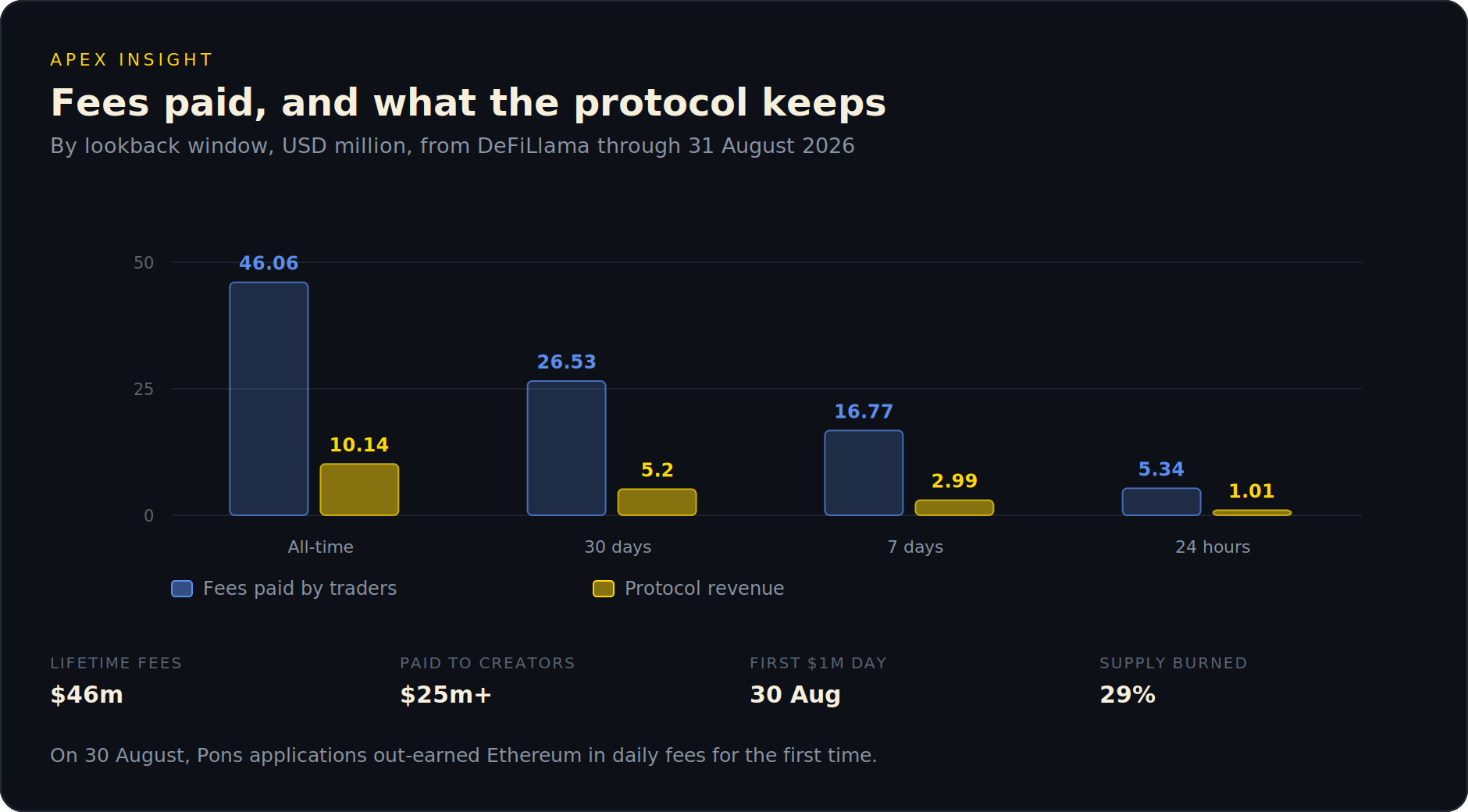
Over the seven days to August 30, traders paid 16.77 million dollars in fees. The protocol kept 2.99 million, about 18%. The remaining 82% went to token creators and to Uniswap.
That is not a flaw. Paying creators is the product, and more than 25 million dollars has gone out to them since launch, which is exactly why builders keep choosing Pons over the competition. But it means turnover is the wrong number to value the token against. Only the 18% is the protocol's.
The Tokenomics
Maximum supply is one billion. Roughly 291 million sit at the dead address, leaving about 707 million circulating. There is no vesting and no unlock cliff, so nothing is waiting to hit the market on a schedule. For a token this young that is a genuine structural positive.
Under v1, protocol buybacks use protocol funds to purchase PONS on the open market and send it to the burn address. The documentation states the buyback runs at 80% of protocol fees through an automated TWAP, with 20% toward infrastructure and team, and is explicit that the arrangement is not immutable yet.
One measurement note. Several trackers quote a market capitalisation of 470 to 481 million dollars by applying the price to the full one billion maximum supply, which counts the burned tokens. The Pons documentation itself defines burn-adjusted market cap as price multiplied by total supply minus burned supply. On that basis the figure is about 328 million dollars, and every multiple below uses it.
What Is PONS Worth Against Its Peer?
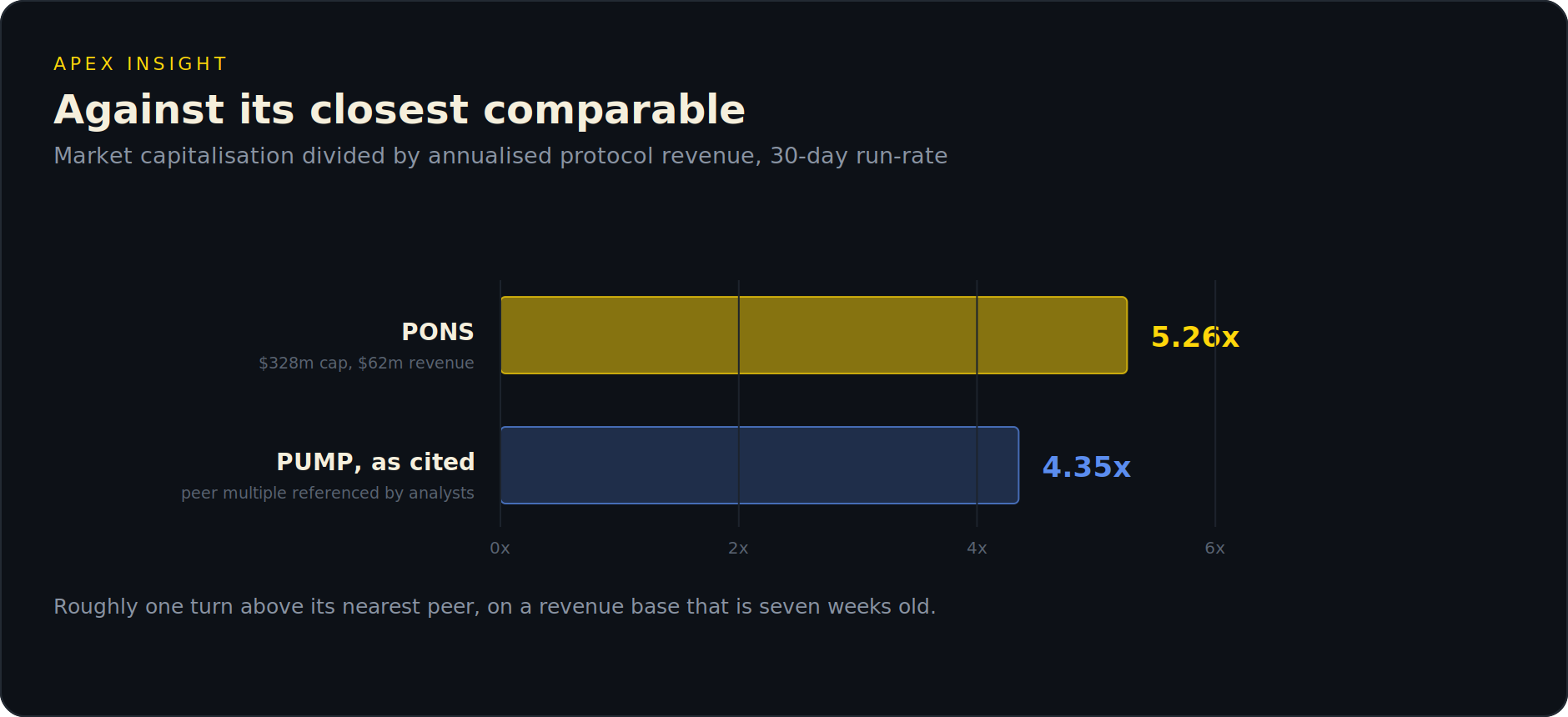
Annualising the 30-day window gives roughly 318 million dollars of fees and 62 million of protocol revenue.
Base | Annualised | Multiple |
|---|---|---|
Turnover, all fees | $318m | 1.03x |
Protocol revenue | $62m | 5.26x |
The multiple that matters is the second one. At 5.3 times annualised protocol revenue, PONS sits roughly one turn above the 4.35 times that analysts have cited for Pump.fun's token, its closest comparable. That is a premium rather than a discount, and it is being paid on a revenue base seven weeks old.
Where This Could Go
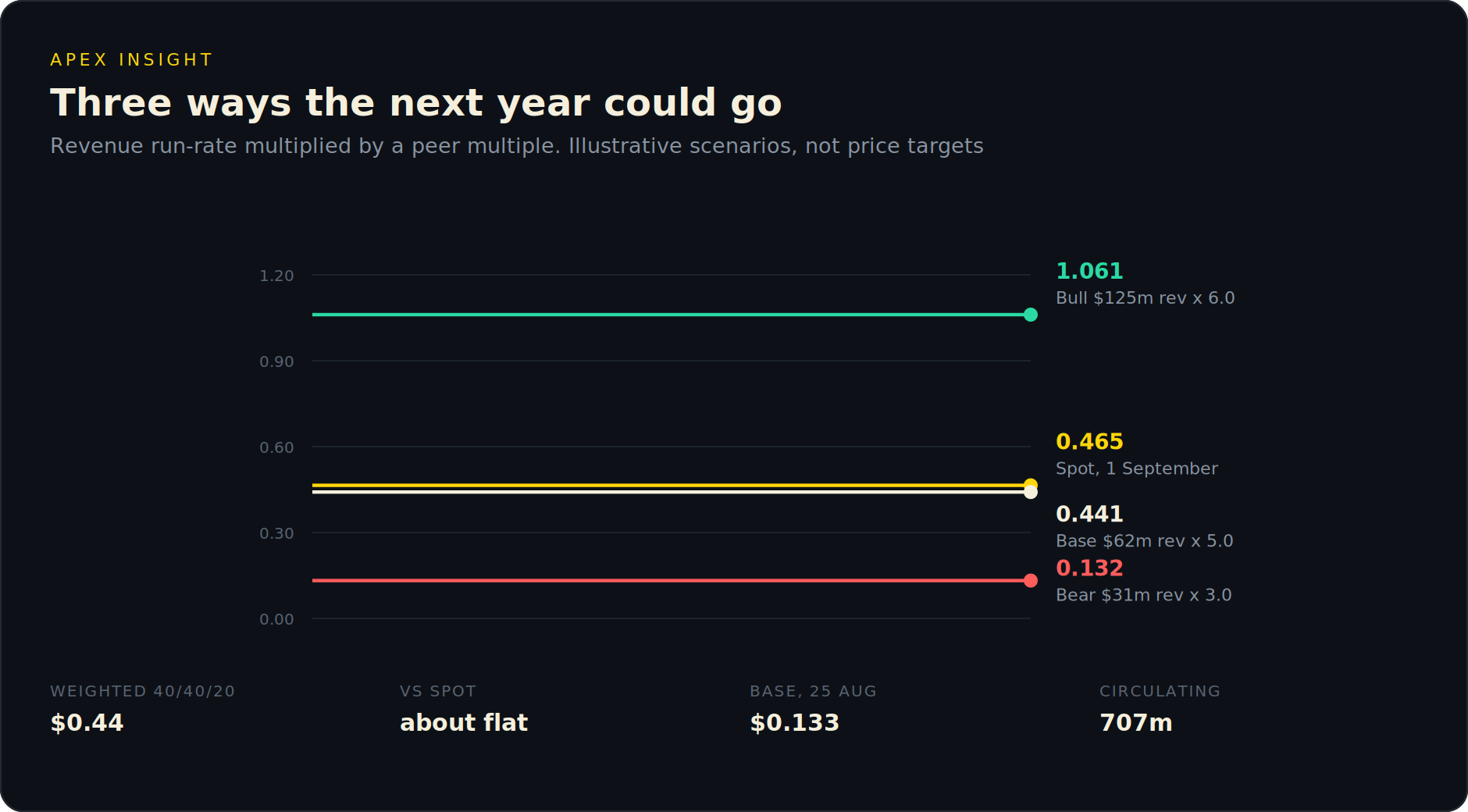
Earnings multiples do not apply to a protocol this young, so each scenario is a revenue run-rate multiplied by a peer multiple. These are illustrations of what different worlds imply, not price targets.
Scenario | Working | Implied |
|---|---|---|
Bear | $31m rev x 3.0 | $0.13 |
Base | $62m rev x 5.0 | $0.44 |
Bull | $125m rev x 6.0 | $1.06 |
Bear assumes launch activity halves as the novelty of a new chain fades, and the multiple compresses toward the low end for cyclical fee businesses. Base assumes the current run-rate holds and the market pays roughly its peer's multiple. Bull assumes revenue doubles as Robinhood Chain adds users and the multiple expands modestly.
Weighting those at 40, 40 and 20 gives about 44 cents, which is close to where the token already trades. That is the honest conclusion: on the current run-rate the price is neither obviously cheap nor obviously stretched, and almost everything depends on the direction of launch volume.
What Would Change the Picture
Several things could move the revenue base rather than just the multiple.
Tokenized stock pairings. If launches priced against equities become a durable category rather than a novelty, Pons captures a flow no other launchpad has.
Distribution. Spot listings on Gate and KuCoin, Binance Wallet support and a perpetual on Aster all arrived recently, and new venues against a fixed float have historically moved price.
cbBTC pairing through Chainlink CCIP, which extends launches beyond ETH-denominated pairs.
Robinhood itself. The chain's headline application being a memecoin launchpad is not obviously what Robinhood planned, and how the company responds is a genuine unknown.
Competition. Uniswap already tried and failed to take share, but the barrier to launching a rival on the same chain is low.
Key Risks
Revenue is a direct function of launch mania on a two-month-old chain, and that is the most cyclical revenue there is.
Around 1% of launches graduate, so the customer base is structurally loss-making.
v2 is under review by three security firms with no report closed. The documentation says to treat it as unaudited.
Public v2 launches remain gated to whitelisted addresses.
The developer is pseudonymous, and the v1 buyback arrangement is documented as not yet immutable.
Version-level revenue attribution is not broken out publicly, so external estimates of where fees flow vary.
What to Watch Next
Daily launch counts, the leading indicator for every other number in this piece.
Publication of the three v2 audits.
Whether tokenized-stock pairings grow as a share of volume.
Any disclosure of revenue split by version, which would settle several open questions.
Whether the chain retains users once launch activity normalises.
What This Means for Traders
Pons is a real business. The launch volume is real, creator payouts are real, the locked liquidity on graduated pools is real, and the fee numbers are large enough to have been noticed by every analyst on the chain.
What it is not is a stable one. A launchpad's revenue is the most cyclical line in crypto, and this one is seven weeks old on a chain that is two months old. The token is priced at a premium to its closest peer on a run-rate that has never been tested through a downturn.
Trade the launch-volume cycle on Robinhood Chain, and size for the possibility that a young, permissionless, pseudonymously operated protocol reprices as quickly on the way down as it did on the way up.
How to Trade It Either Way
Most of the ways to hold PONS are long-only. Buying spot on a decentralised exchange, or on Gate or KuCoin, gives you one direction and no way to express the other.
You can take either side with the PONS-USDT perpetual on ApeX Omni, with up to 5x leverage, long or short, no KYC and full self-custody. Note the leverage cap. Five is a fraction of what the same venue offers on large-cap markets, and that is the right read on an asset that moved from 13 cents to 46 cents in seven sessions.
A seven-week revenue base, a premium to its closest peer, and a price that has already run four times in a week. Size accordingly, because leverage magnifies losses as fast as gains.
This article is market commentary for informational purposes only. It is not investment advice, and nothing here is a recommendation to buy or sell any token. Scenarios are illustrative, not price targets. Figures are as of September 1, 2026, from DeFiLlama, CoinMarketCap and the Pons documentation, and move quickly. Do your own research.
We appreciate your continued support.