




Note: All chain and token figures are as of 2 September 2026, sourced from public onchain data. Prices and market capitalisations move continuously, so the figures below will have shifted by the time you read them.
1. Zero to $750M in nine weeks
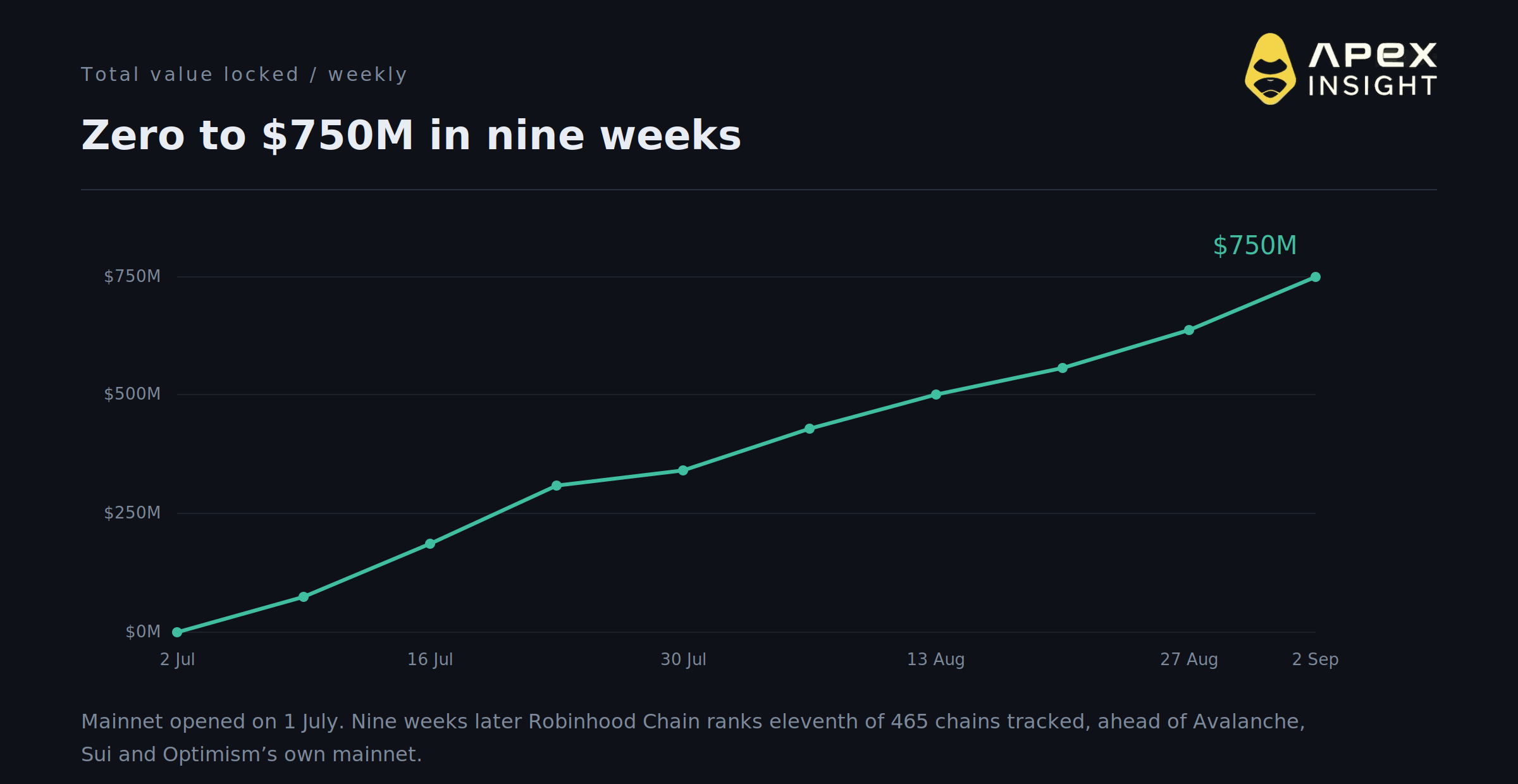
Mainnet opened on 1 July at a keynote in London. TVL reached $74M in the first week, $188M by 16 July, $430M by 6 August and $750M by 2 September.
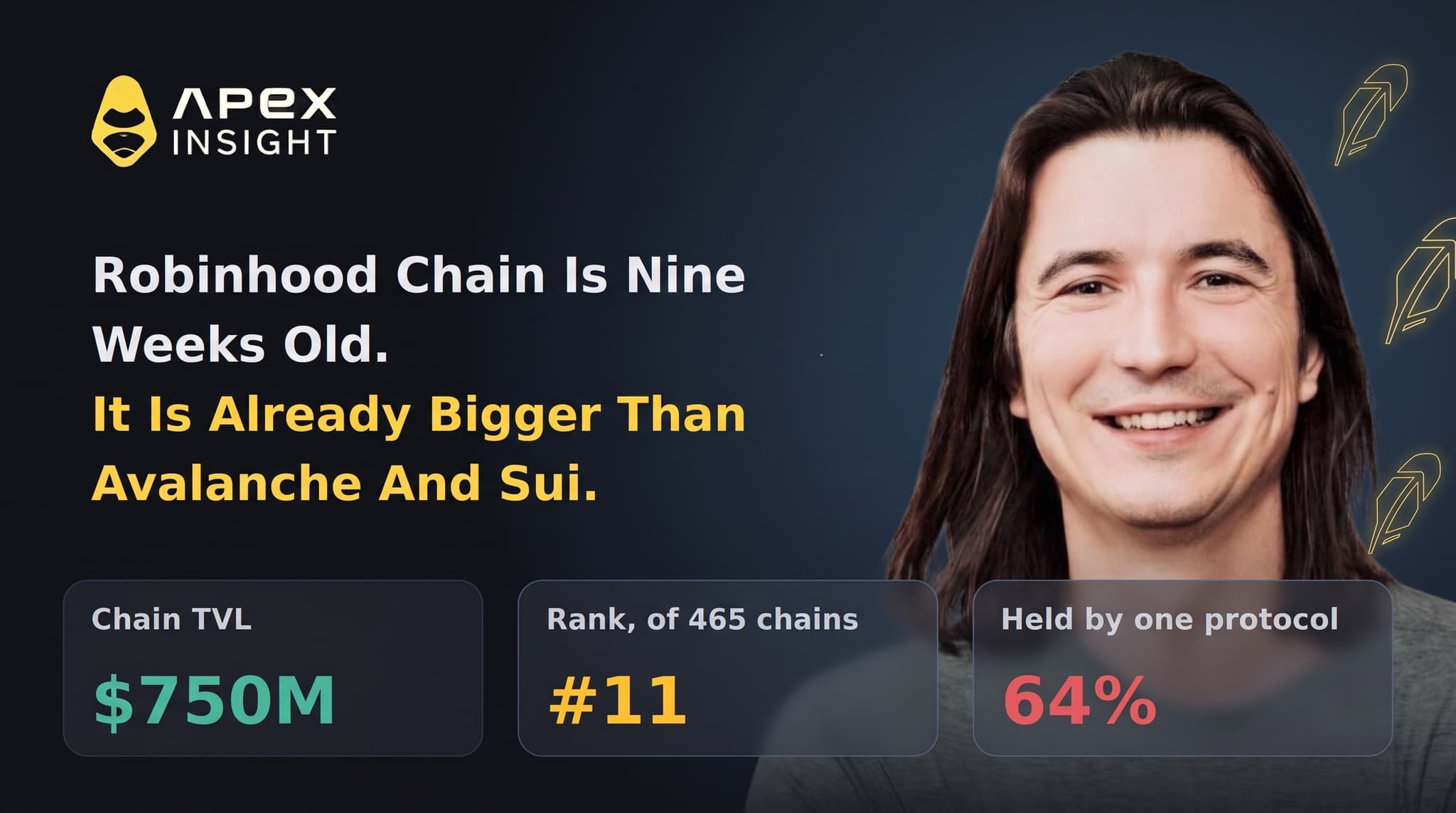
That ranks it eleventh of the 465 chains tracked, above Avalanche at $470M, Sui at $450M and OP Mainnet at $427M. Two months ago it did not exist.
2. Only two chains have ever started faster
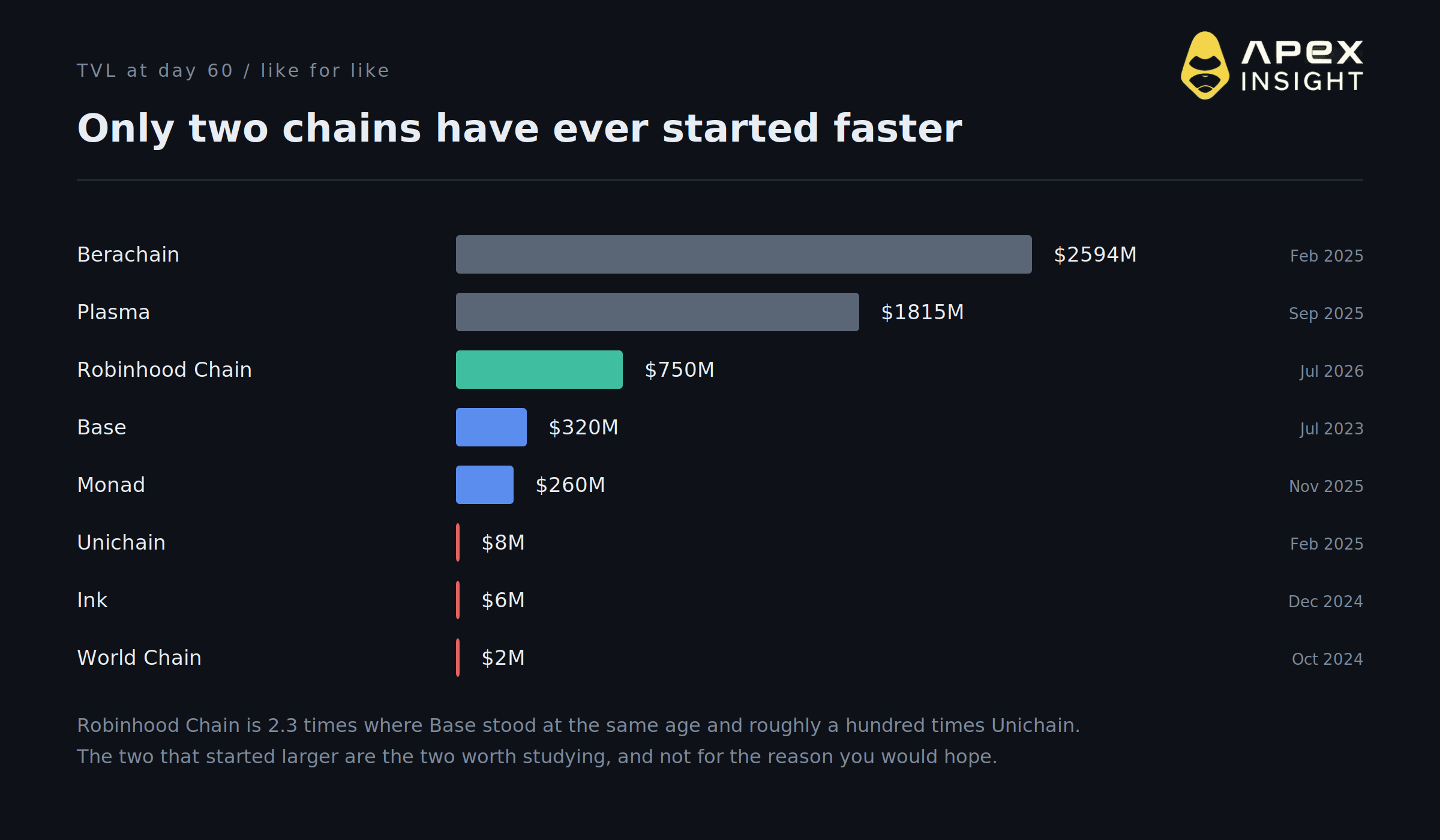
Comparing chains at the same age removes the advantage of a head start. At day sixty, Robinhood Chain sits at $750M. Base stood at $320M, Monad at $260M, Unichain at $8M, Ink at $6M and World Chain at $2M.
So it is 2.3 times Base at the same point and roughly a hundred times Unichain, the chain Uniswap built for itself.
Only Berachain at $2,594M and Plasma at $1,815M started larger.
3. Both of the chains that started bigger collapsed
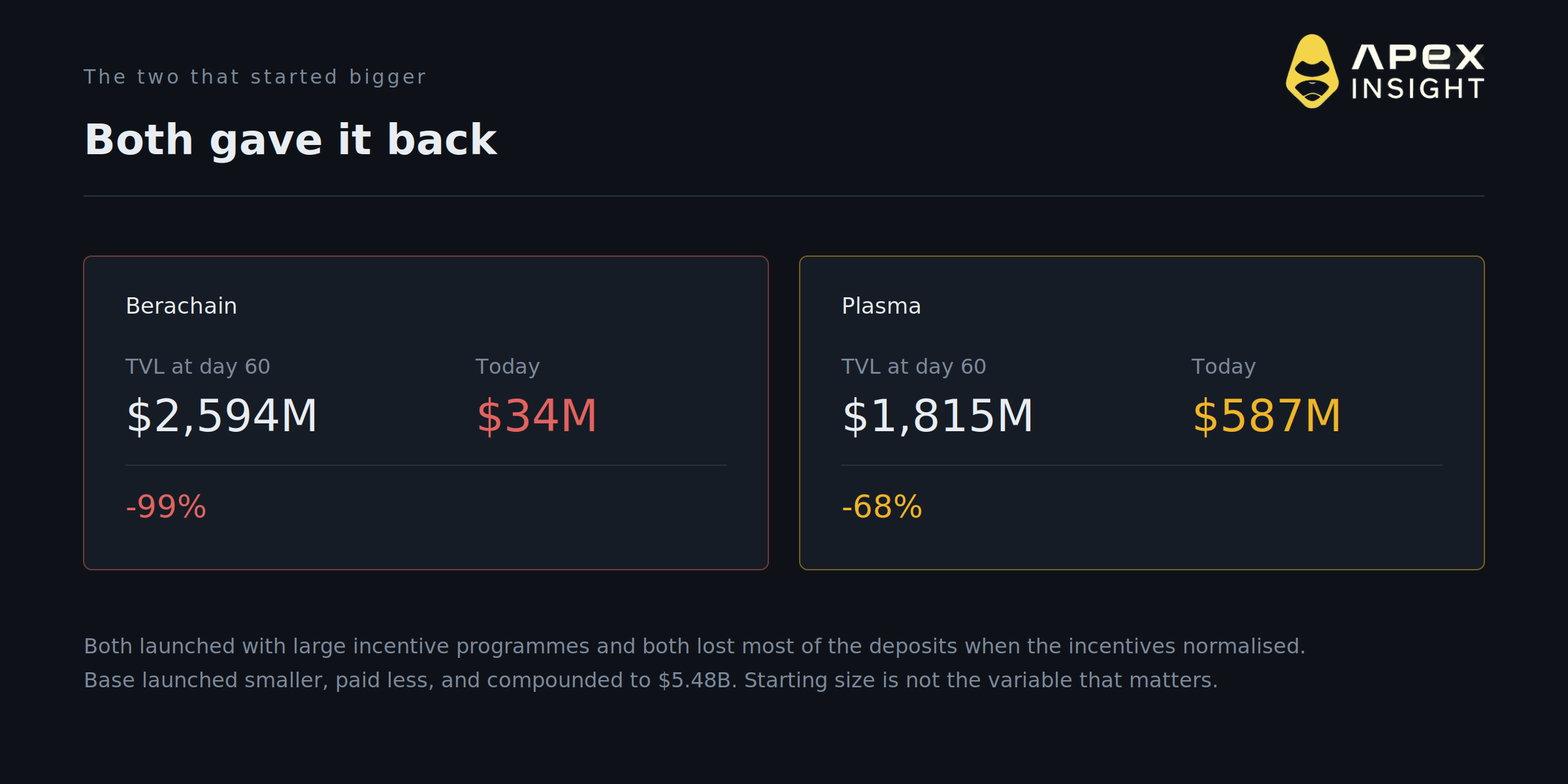
Berachain held $2,594M at day sixty in early 2025. It holds $34M today, a fall of 99 percent. Plasma held $1,815M and now holds $587M, down 68 percent.
Both launched with large incentive programmes, and both lost the deposits when the incentives normalised. Base launched at a fraction of their size, paid out far less, and compounded to $5.48B.
Starting size is not the variable that determines what a chain becomes. What matters is whether the deposits are there for a reason that survives the subsidy ending, and that question does not resolve for another two or three quarters.
4. What is deployed, and how concentrated it is
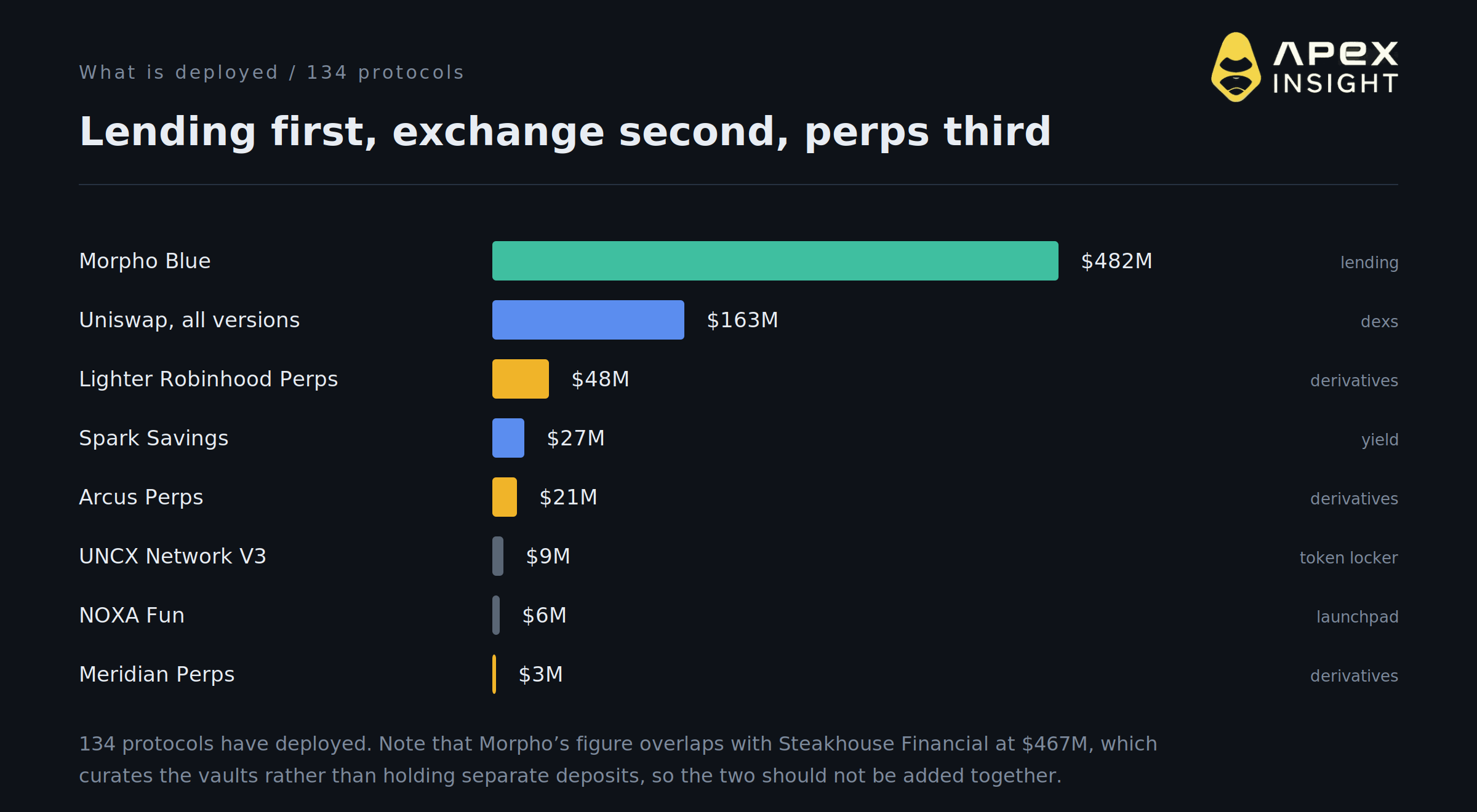
134 protocols have deployed. Morpho Blue leads at $482M, followed by Uniswap across three versions at a combined $163M, Lighter's perps venue at $48M, Spark Savings at $27M and Arcus Perps at $21M.
One accounting note that matters if you check the numbers yourself. Steakhouse Financial appears at $467M, but it curates Morpho vaults rather than holding separate deposits, so the two overlap and should not be added together. The listed protocol figures sum to more than the chain total for exactly this reason.
Launch partners included Uniswap, Chainlink for price feeds, Alchemy for developer infrastructure, BitGo for custody, Paxos for the USDG stablecoin, LayerZero for bridging and TRM Labs for compliance.
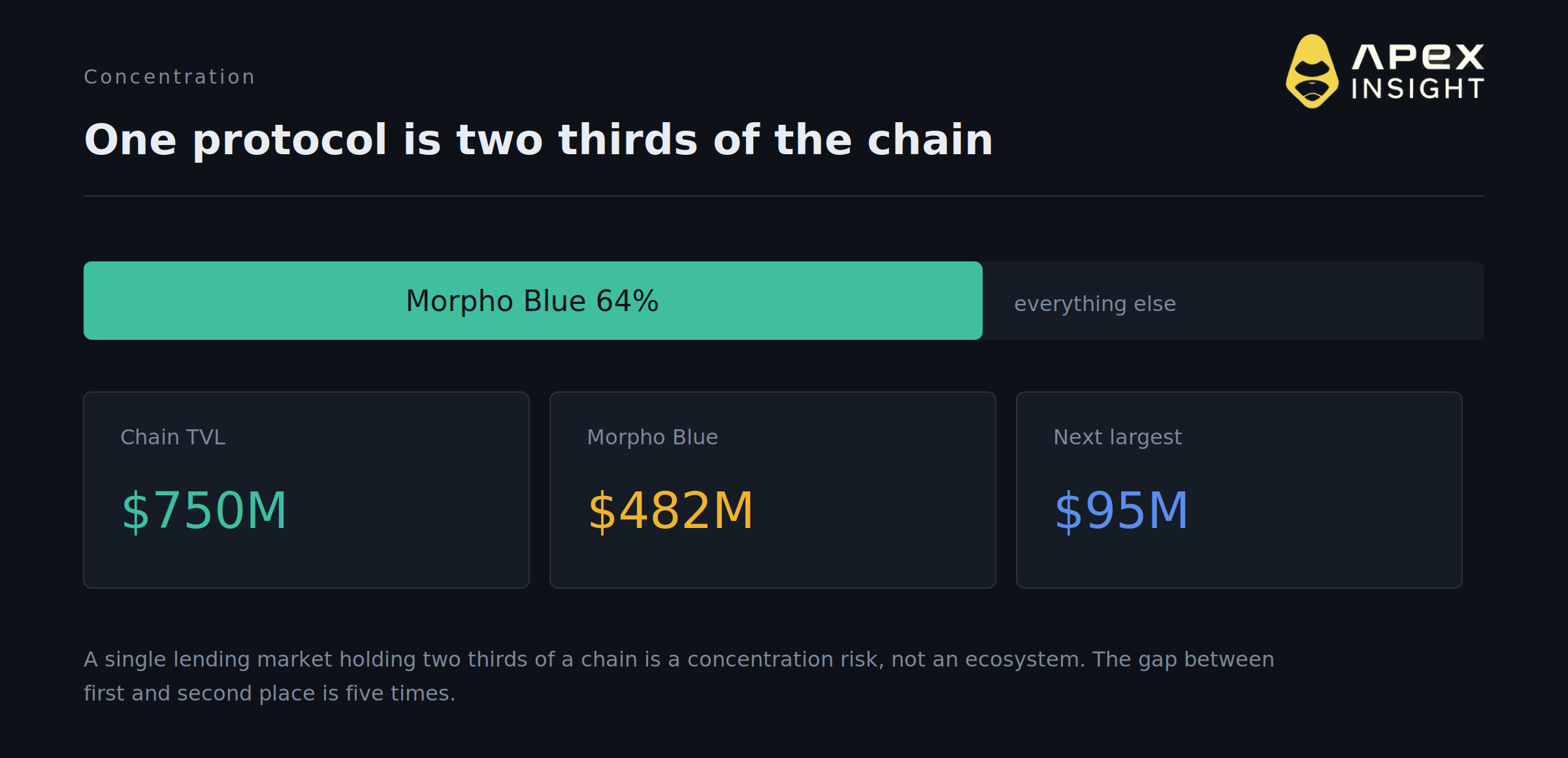
Morpho Blue's $482M is roughly 64 percent of everything on Robinhood Chain. The second largest position, Uniswap V4, is $95M. The gap between first and second is five times.
A single lending market holding two thirds of a network is a concentration risk rather than an ecosystem. It also means the headline TVL figure is substantially a statement about one protocol's deposits and the yield being paid on them.
Robinhood Earn offers roughly 7 percent annual yield on USDG through onchain lending. Whether the deposits stay when that number moves is the same test Berachain and Plasma failed.
5. Three perps venues have already shipped
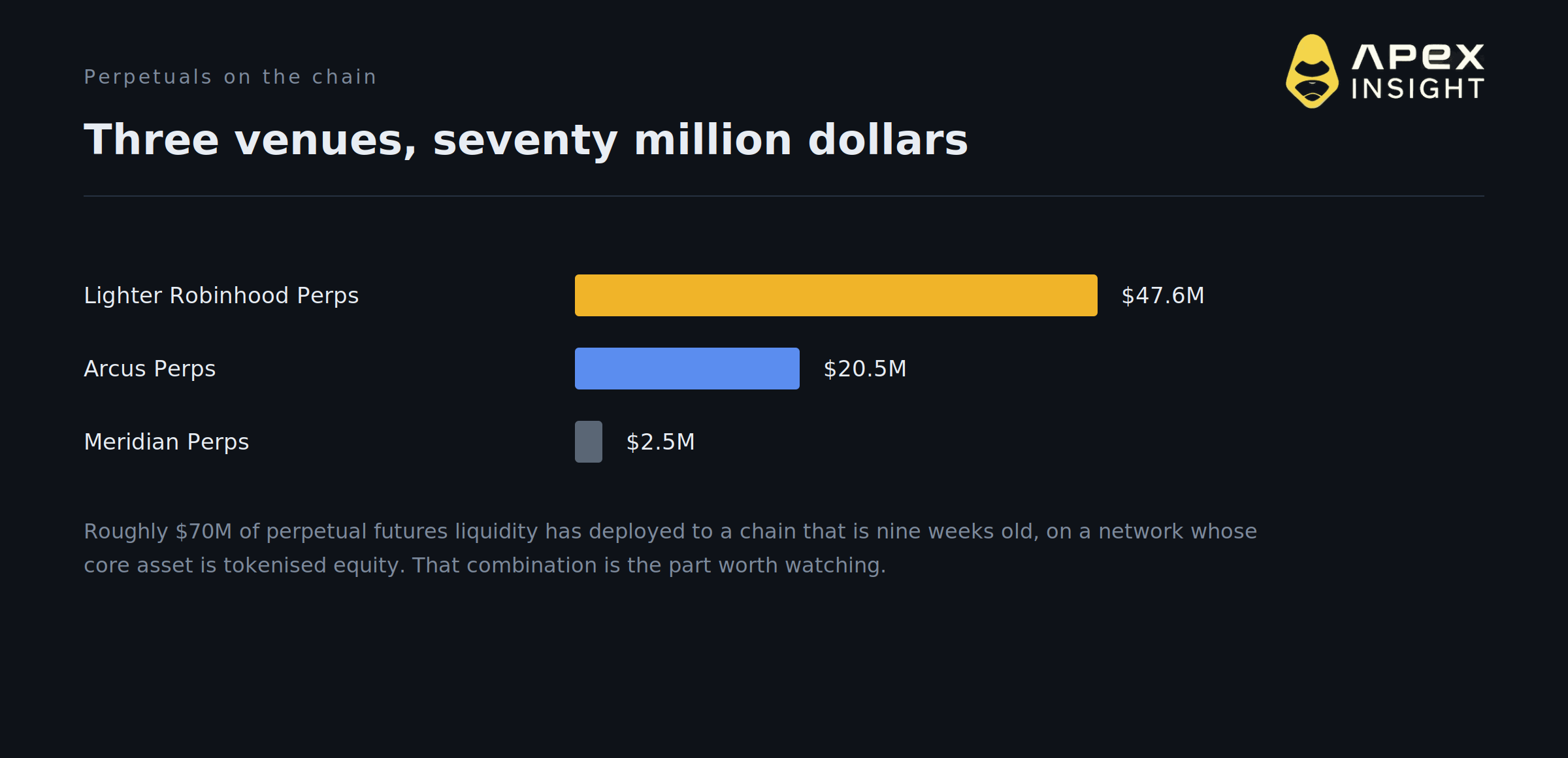
Lighter's Robinhood Perps holds $47.6M, Arcus Perps $20.5M and Meridian Perps $2.5M. That is roughly $70M of perpetual futures liquidity on a chain that is nine weeks old.
The combination is the interesting part. A network whose flagship asset is tokenised equity is also attracting derivatives venues, which points at the actual thesis: collateral that is a stock rather than a stablecoin, used inside DeFi.
6. What the chain is for
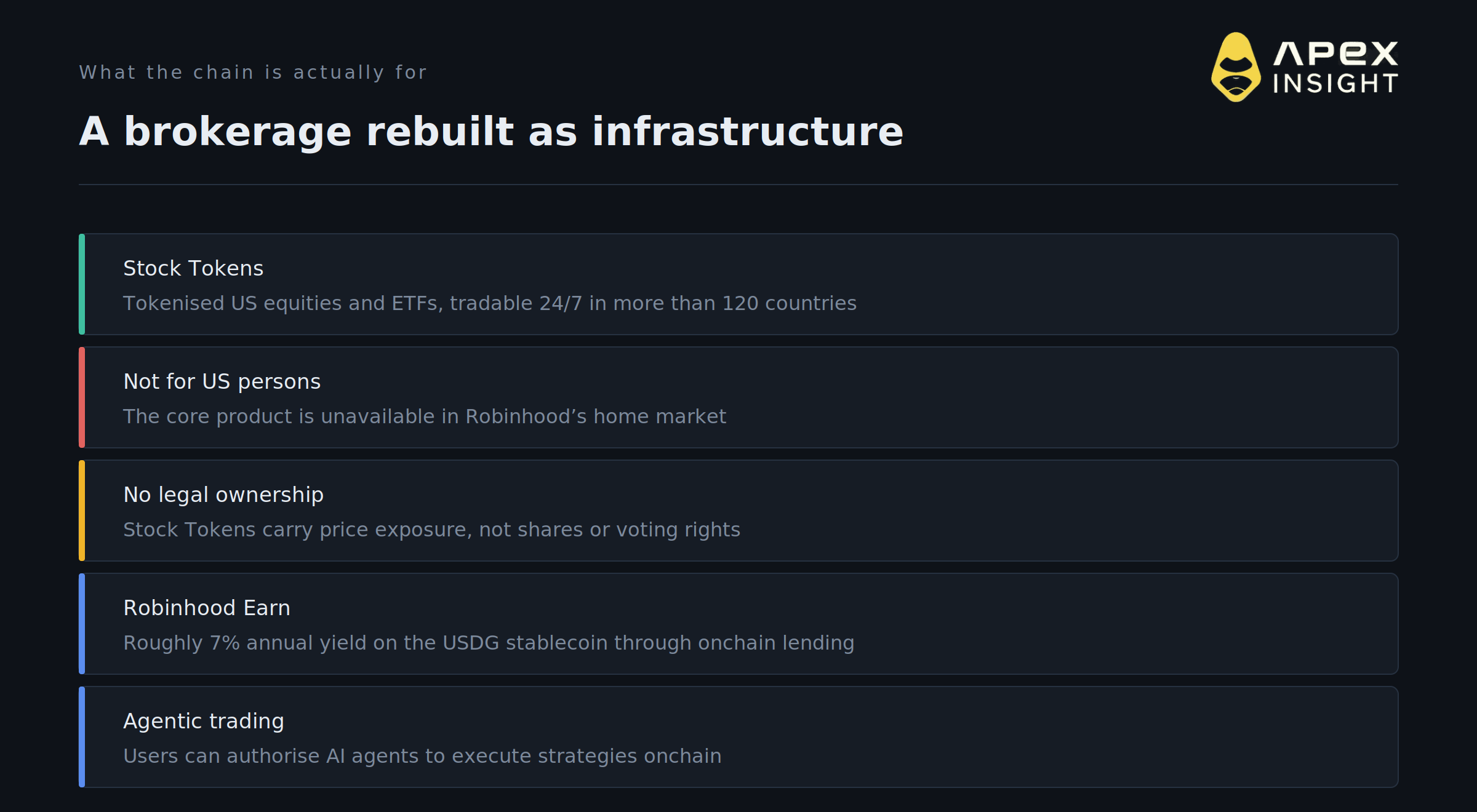
The core product is Stock Tokens, tokenised US equities and ETFs tradable around the clock in more than 120 countries through Robinhood Wallet. They carry price exposure, not legal share ownership or voting rights.
Notably, they are not available to US persons. Robinhood built a chain whose flagship product cannot be sold in its home market.
Alongside it sits Robinhood Earn, paying roughly 7 percent on USDG, and an agentic trading feature that lets users authorise AI agents to execute strategies onchain.
This is not a general purpose L2 looking for a use case. It is a brokerage putting itself onchain and inviting others to build against it, which is a narrower and more defensible plan than most chain launches start with.
7. Fast, permissionless, and centrally sequenced
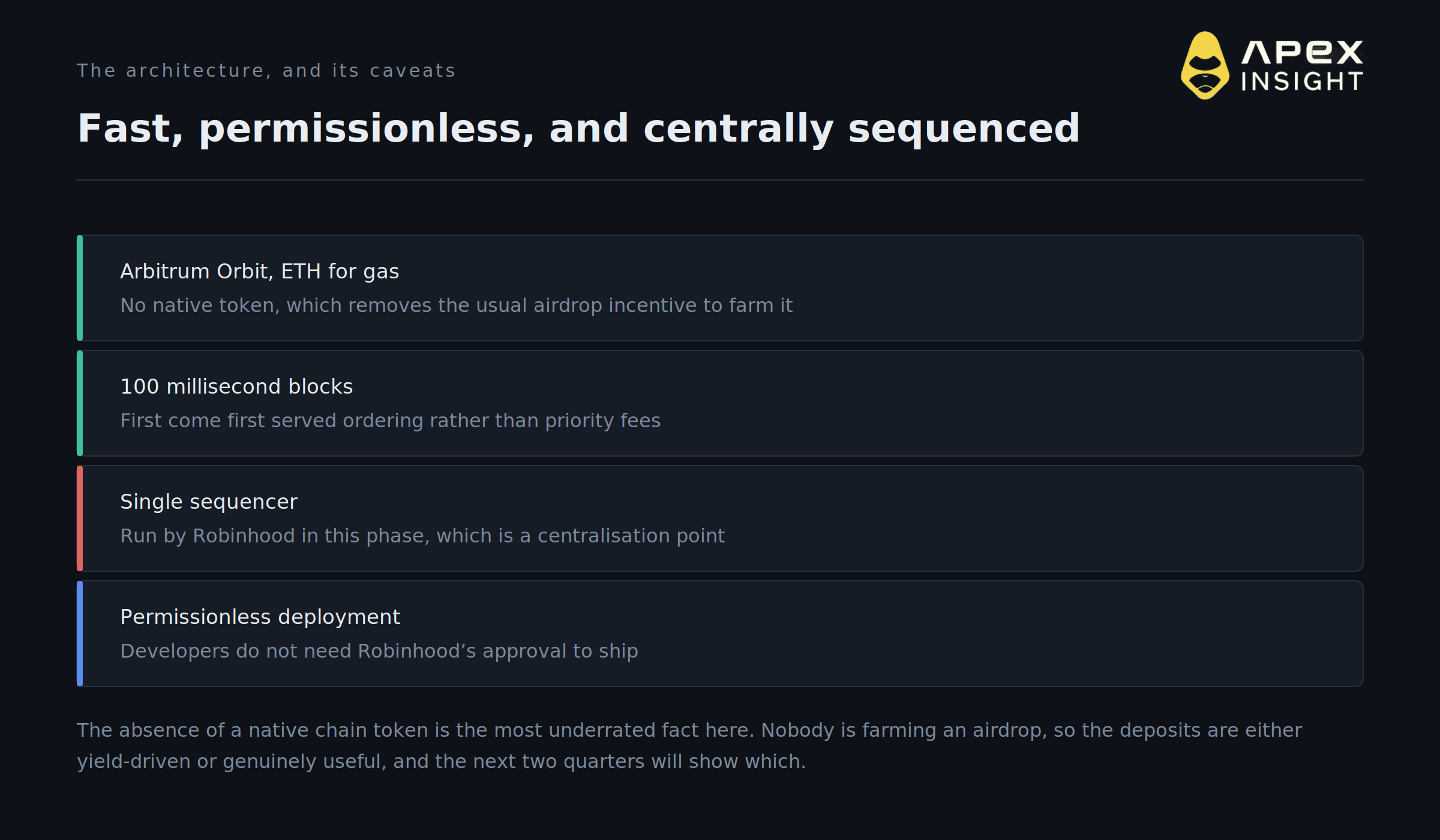
The chain runs on Arbitrum Orbit as an optimistic rollup settling to Ethereum, uses ETH for gas, and produces blocks in roughly 100 milliseconds with first come first served ordering rather than priority fees. Deployment is permissionless.
The sequencer is run by Robinhood alone in this phase, which is the standard early tradeoff and the standard early criticism.
The most underrated fact is the absence of a native token. There is no airdrop to farm, which means the $750M is either chasing yield or genuinely useful. On most new chains you cannot separate those two, and here you eventually will be able to.
For context on the pace: Robinhood announced the chain in June 2025, opened a public testnet on 10 February 2026 that processed roughly 4 million transactions in its first week, and shipped mainnet on 1 July ahead of schedule. It also committed $1M to the Arbitrum Open House programme to seed builders and completed a $180M acquisition of WonderFi to push into Canada over the same period.
8. Two tokens have carried the retail story
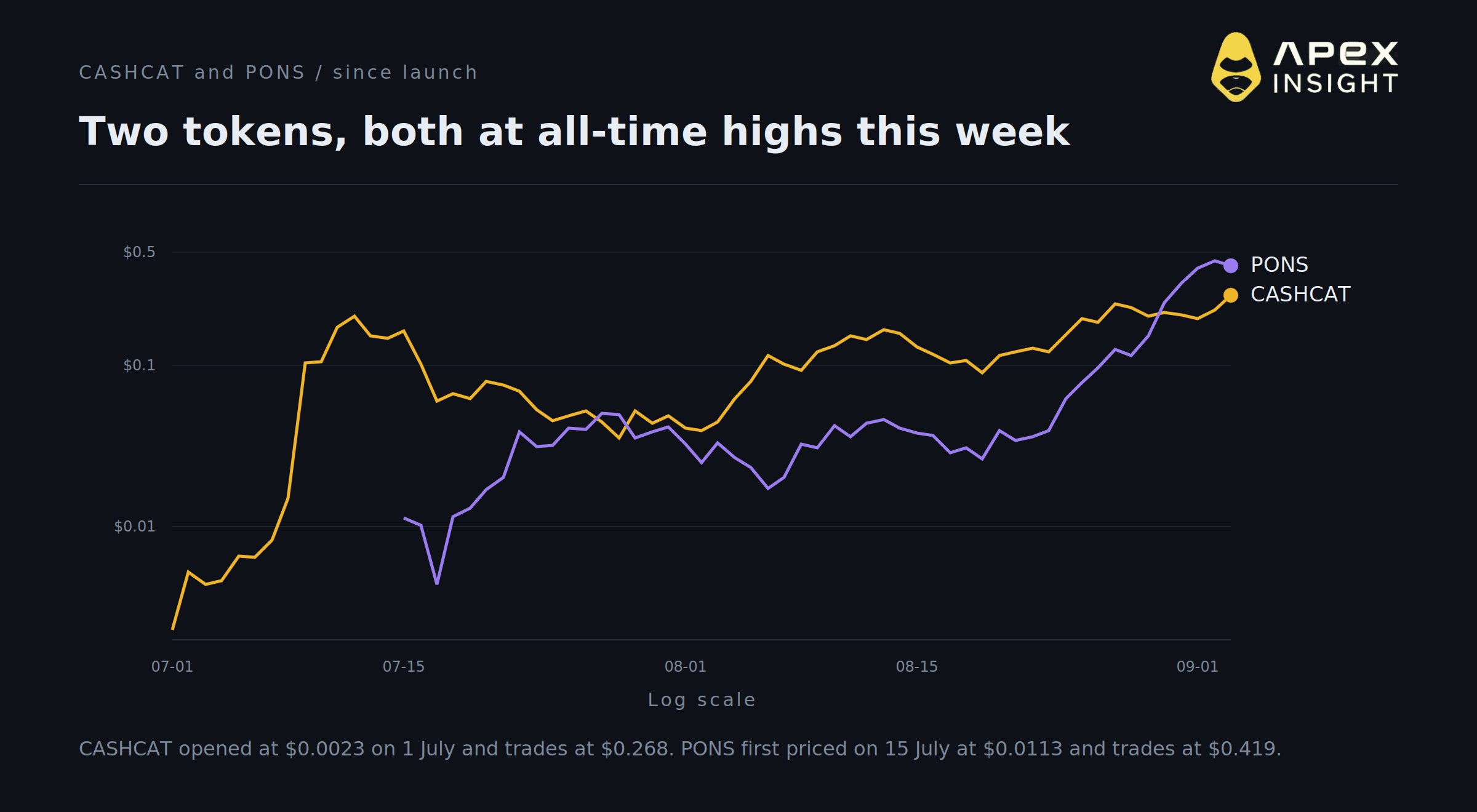
The chain has no token of its own, but two built on it have done the work.
CASHCAT is the community memecoin named after Robinhood's original name, the one Vlad Tenev and Baiju Bhatt chose before settling on Robinhood. It opened at $0.0023 on 1 July, ran more than 1,400 percent in a single day that month, and now trades at $0.268. Robinhood listed it in its own app on 6 August, which widened the audience considerably, and Tenev followed the token's account.
PONS is a different animal. It first priced on 15 July at $0.0113 and trades at $0.419, up 226 percent in the past week alone.
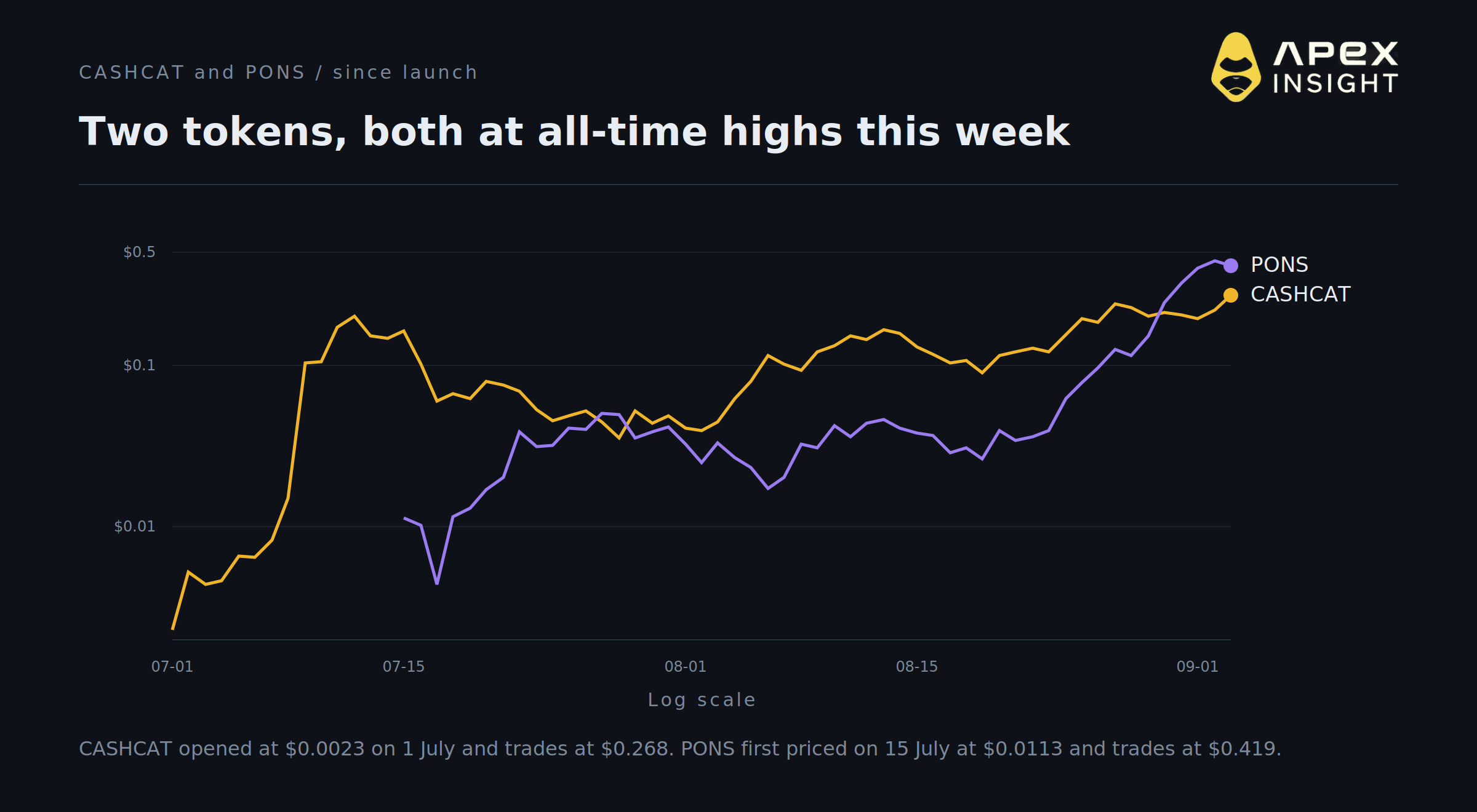
CASHCAT carries a $264.6M market cap at rank 143, up 536 percent in thirty days, with $83.0M of daily volume. PONS carries $297.9M at rank 137, up 1,348 percent in thirty days, with $92.9M of daily volume. Both set all-time highs on 1 and 2 September.
Put those returns against the rest of the market over the same thirty days. Bitcoin is up 23.5 percent, Ethereum 30.2 percent, Solana 37.3 percent and Zcash, the best performing large asset of the year, 75.4 percent. PONS has outrun Bitcoin by roughly 57 to 1 and CASHCAT by 23 to 1.
Between them that is $562M of market capitalisation and $176M of daily volume on a chain that did not exist ten weeks ago.
9. One of them actually earns money
The distinction between the two matters more than the price charts suggest.
CASHCAT has no cash flow. It is a memecoin, and its value is a leveraged expression of belief in the chain and in meme momentum. It once carried a $150M valuation on roughly $6.6M of actual liquidity, which is the kind of ratio that produces both the upside and the drawdowns.
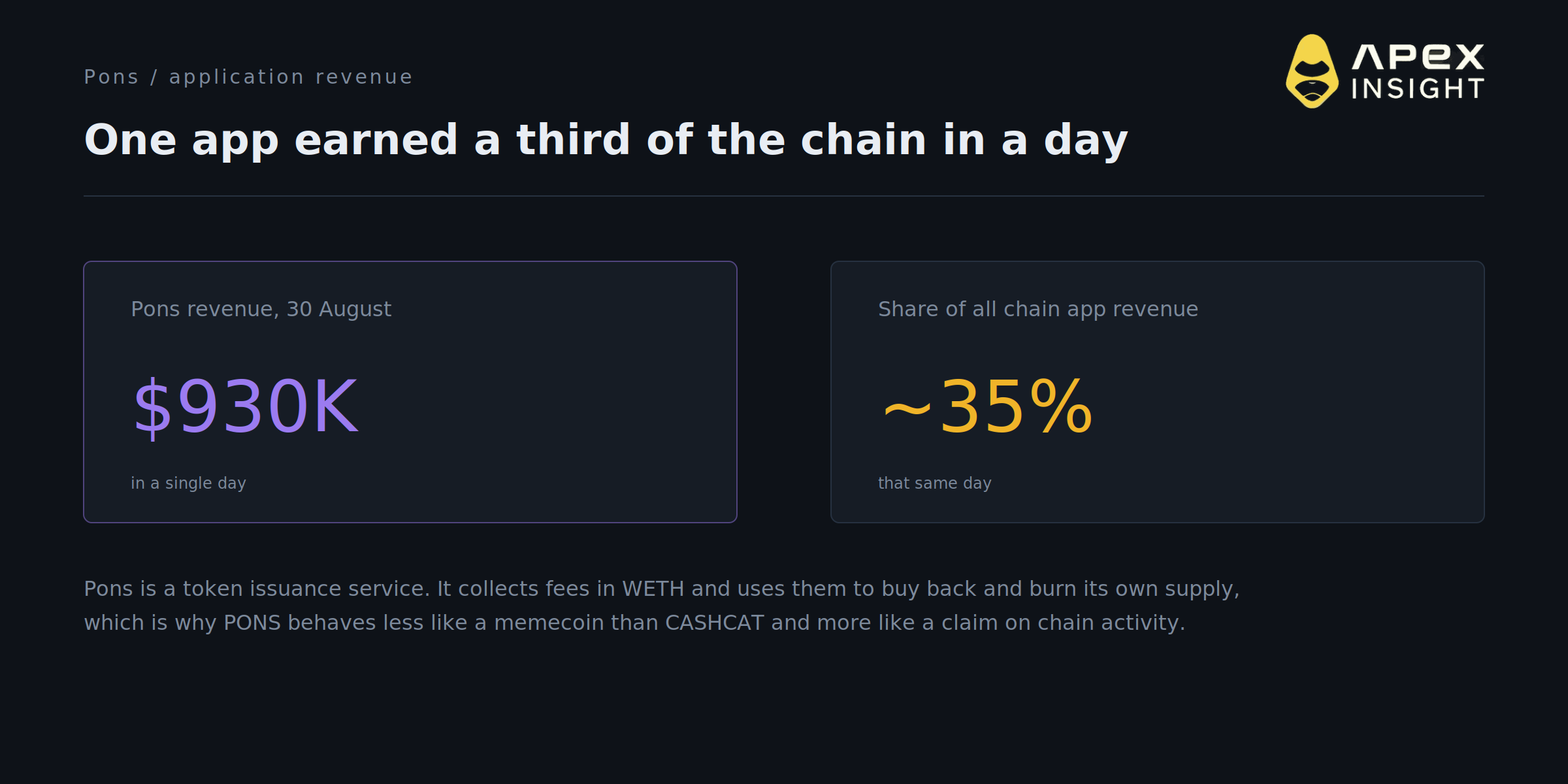
Pons is a token issuance service, and PONS is its platform token. It collects fees in WETH and uses them to buy back and burn supply. On 30 August alone it generated more than $930,000 in application revenue, roughly 35 percent of everything the entire Robinhood Chain ecosystem earned that day.
So one is a bet on attention and the other is closer to a claim on chain activity. They have moved together so far. They will not always.
One trade illustrates the risk in both. Onchain trackers followed a single address, 0x7e3ba, which put $106.5K into CASHCAT and sold it in full for $672.6K, then spent $113.7K on PONS and still holds roughly $4.2M of it. About $220K became more than $4.7M, most of it unrealised.
That is what happens when market capitalisation runs far ahead of actual depth, and it cuts both ways. The same thinness that produced a twenty-fold return produces the drawdown when it comes. CASHCAT is already 6 percent below the high it set today, and PONS 15 percent below the one it set yesterday.
10. What to watch, and what nobody is pricing
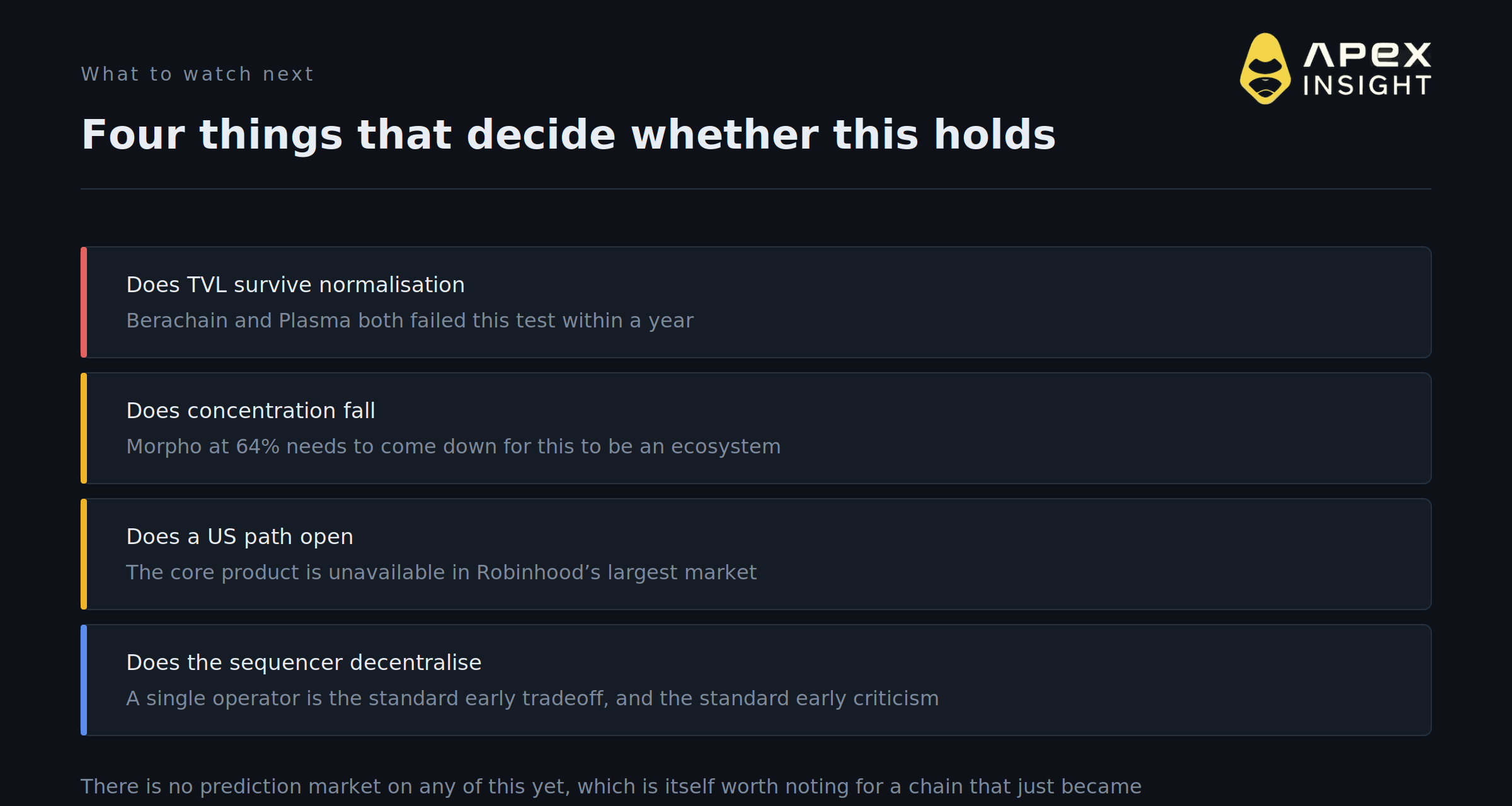
Four questions decide whether this holds. Whether TVL survives the normalisation of incentives, which Berachain and Plasma both failed inside a year. Whether Morpho's 64 percent share falls, because an ecosystem needs more than one protocol. Whether a US path opens, since the flagship product is currently unavailable in Robinhood's largest market. And whether the sequencer decentralises.
There is one more thing worth saying, and it is the reason this article looks different from the rest of this series. There is no prediction market on any of it. No contract on Robinhood Chain's TVL, no market on tokenised equity adoption, nothing on whether Stock Tokens reach US users.
For a chain that became the eleventh largest in crypto in nine weeks, that is a strange gap. Every other question in this series has a price attached to it. This one has to be argued from the data alone.
What this adds up to
Robinhood Chain has had the strongest first sixty days of any chain except two, and both of those two are now cautionary tales. It has a real product, real partners, no token to farm, and a concentration problem that will either resolve or define it.
The bull case is that a brokerage with tens of millions of users has put its own order flow onchain, that tokenised equity as DeFi collateral is a genuinely new primitive, and that at least one application on the chain is already earning real revenue and burning supply with it. The bear case is that $482M of the TVL sits in one lending market paying 7 percent, that $562M of the retail interest sits in two tokens that are ten and seven weeks old, and that we have seen what happens when both of those normalise.
Both cases resolve on the same evidence over the next two quarters: whether the deposits are still there when the yield is not, and whether Pons is still earning when the launchpad cycle cools.
Where to trade it
There is no prediction market on Robinhood Chain itself, but both of the tokens in this article are live on ApeX Omni with leverage: CASHCAT up to 50x and PONS up to 5x.
The difference in those limits is worth reading as information rather than as a menu. CASHCAT is a memecoin that has already traded at a $150M valuation on $6.6M of liquidity, and PONS has moved 226 percent in a week. Higher leverage on a thinner, more volatile asset compounds both directions, and on assets that move like this it compounds fast.
If you want the chain exposure without the single-token risk, the crypto board also carries the Ethereum ladders that Robinhood Chain settles to, and the token launch markets covering the wider category.
We appreciate your continued support.
Published by ApeX. For informational and educational purposes only. Not investment advice, and not a forecast or endorsement of any outcome. Trading involves risk, including total loss.