



Note: All market prices, spot levels and price history are as of 28 August 2026. Upgrade timelines are as publicly reported and have slipped before. Nothing here is a recommendation.
1. What a Solana year actually looks like
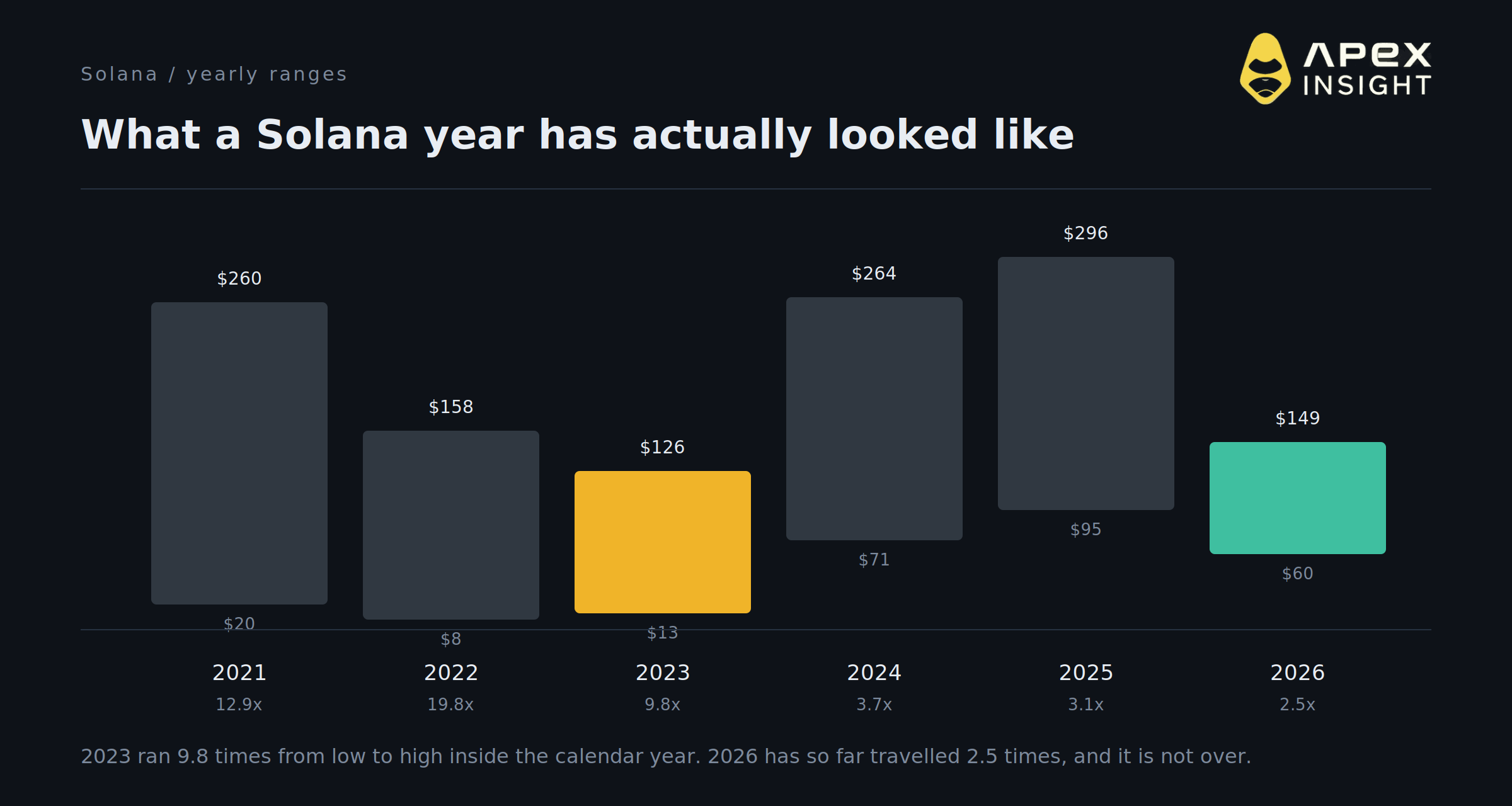
Solana's history is a series of violent years. 2021 ran 12.9 times from low to high. 2022 fell from $157.70 to $7.95. 2023 ran 9.8 times, from $12.86 in January to $126.13 in December. 2024 managed 3.7 times, 2025 managed 3.1.
2026 has so far travelled 2.5 times, from $60.12 in June to January's $148.66, and there are four months left.
The point of this table is not that a big year is due. It is that Solana's normal range of outcomes is far wider than most assets, and any forecast that ignores that is understating both tails.
2. The setup rhymes with the start of a recovery
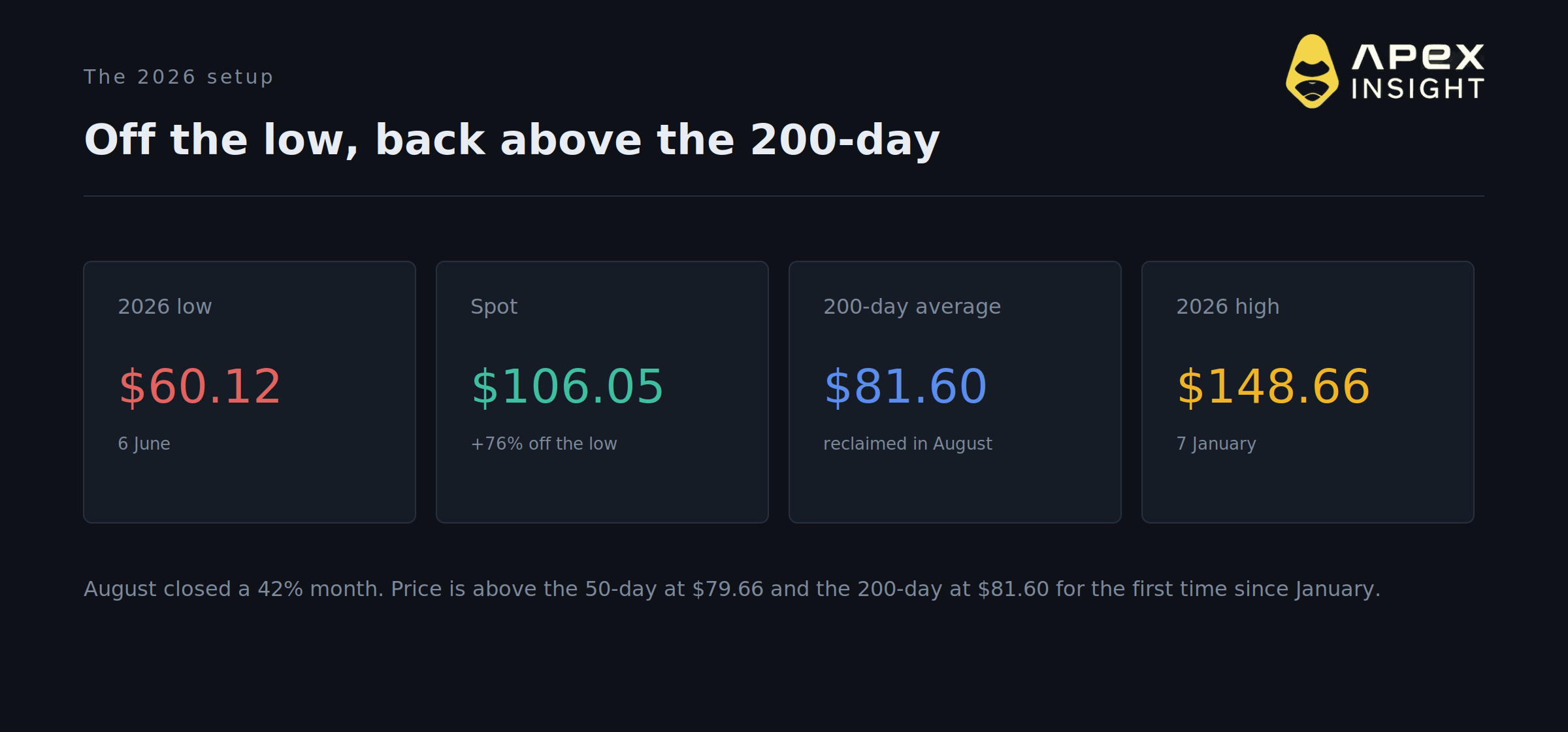
Spot sits at $106.05. The 50-day average is $79.66 and the 200-day is $81.60, both now well below price. Solana spent five months pinned between roughly $70 and $85 before August broke it out.
That is the structure people mean when they talk about a base. It is also the structure that precedes plenty of failed rallies, so it is worth being precise: reclaiming a long-term average is a necessary condition for a trend change, not a sufficient one.
3. A repeat of 2023 puts SOL near $590
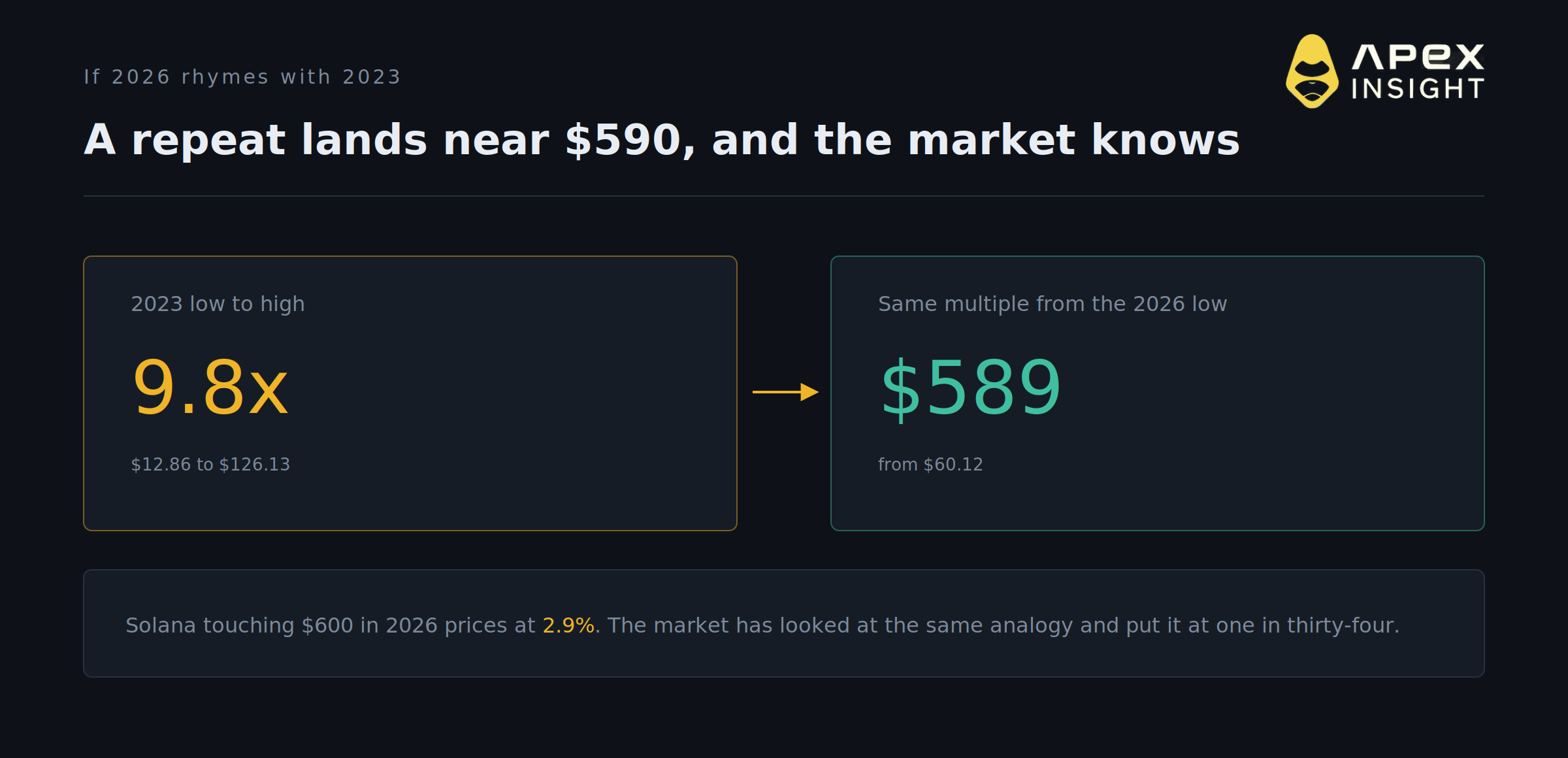
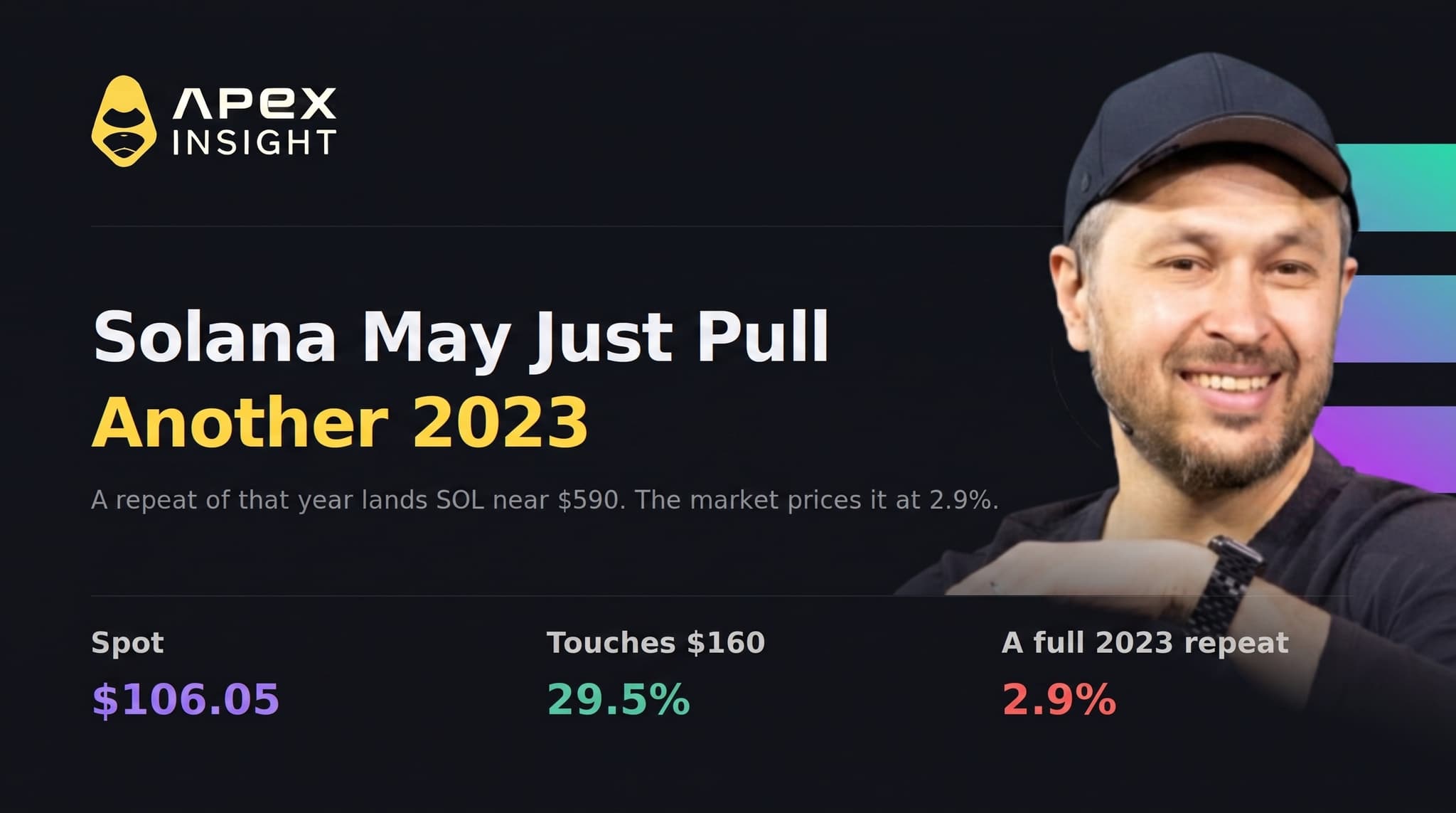
Take the 9.8 times that 2023 delivered and apply it to the June low of $60.12. That gives $589.
Now look at what that costs. Solana touching $600 in 2026 prices at 2.9 percent. The market has effectively run the same arithmetic and put a full repeat at roughly one in thirty-four.
That is not a dismissal. A 2.9 percent contract that resolves yes was never wrong for being cheap, and Solana has delivered multiples like this twice in five years. But anyone writing the "SOL to $500" thread is taking the other side of a live market at long odds, and should know it.
4. The ladder the market is actually trading
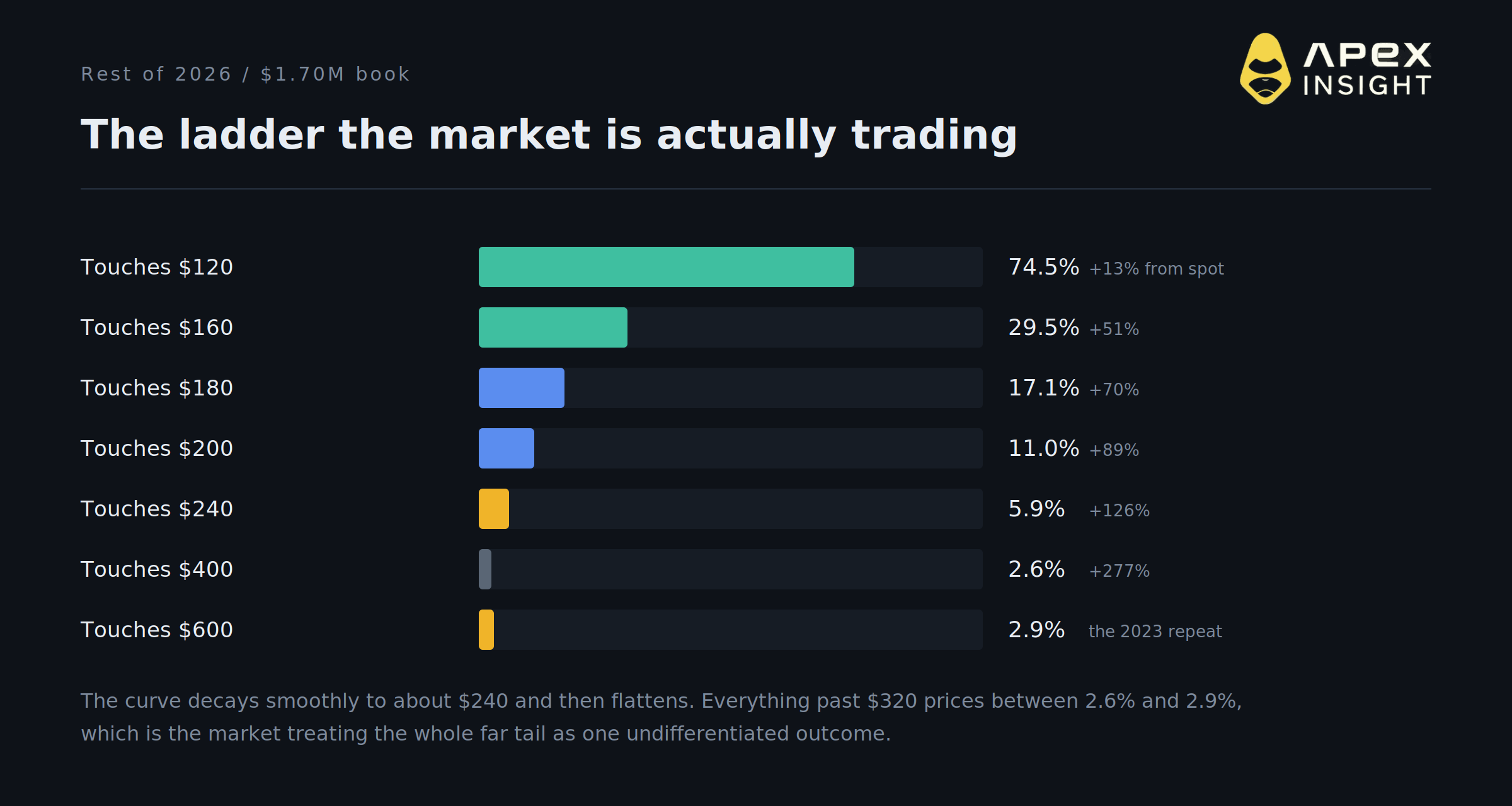
Touching $120 prices at 74.5 percent, a 13 percent move. $160 prices at 29.5 percent. $180 at 17.1 percent, $200 at 11 percent, $240 at 5.9 percent.
Then the curve flattens. $320 prices at 2.8 percent, $400 at 2.6 percent and $600 at 2.9 percent. Past a certain point the market stops differentiating and treats the entire far tail as one outcome, which is a signal in itself: nobody is doing careful work above $320.
The tradeable disagreement sits between $120 and $240. Everything above that is a lottery ticket the market has not bothered to price precisely.
5. Standard Chartered says $250. The board says 5.9 percent.
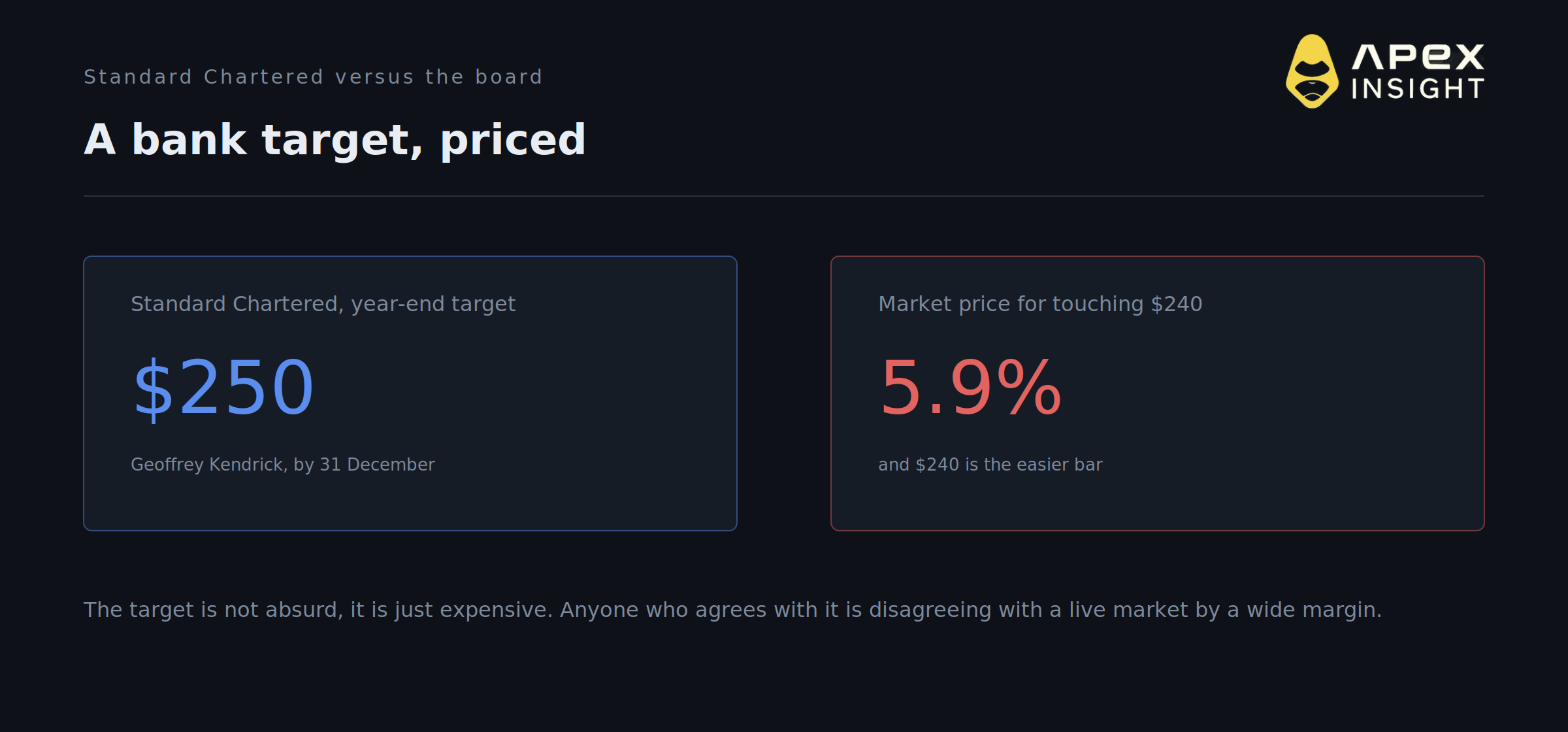
Geoffrey Kendrick at Standard Chartered has a $250 year-end target for Solana, and several independent forecasts cluster in the $250 to $350 range for a bullish scenario.
The market prices touching $240, a slightly easier bar, at 5.9 percent.
Both can be defensible. A bank target is a central estimate under a set of assumptions, and a market price is what it costs to disagree with the crowd today. But the gap is large enough to be worth stating plainly: the consensus sell-side number sits at roughly one in seventeen on the board.
6. The upgrade calendar is real, and one piece has already landed
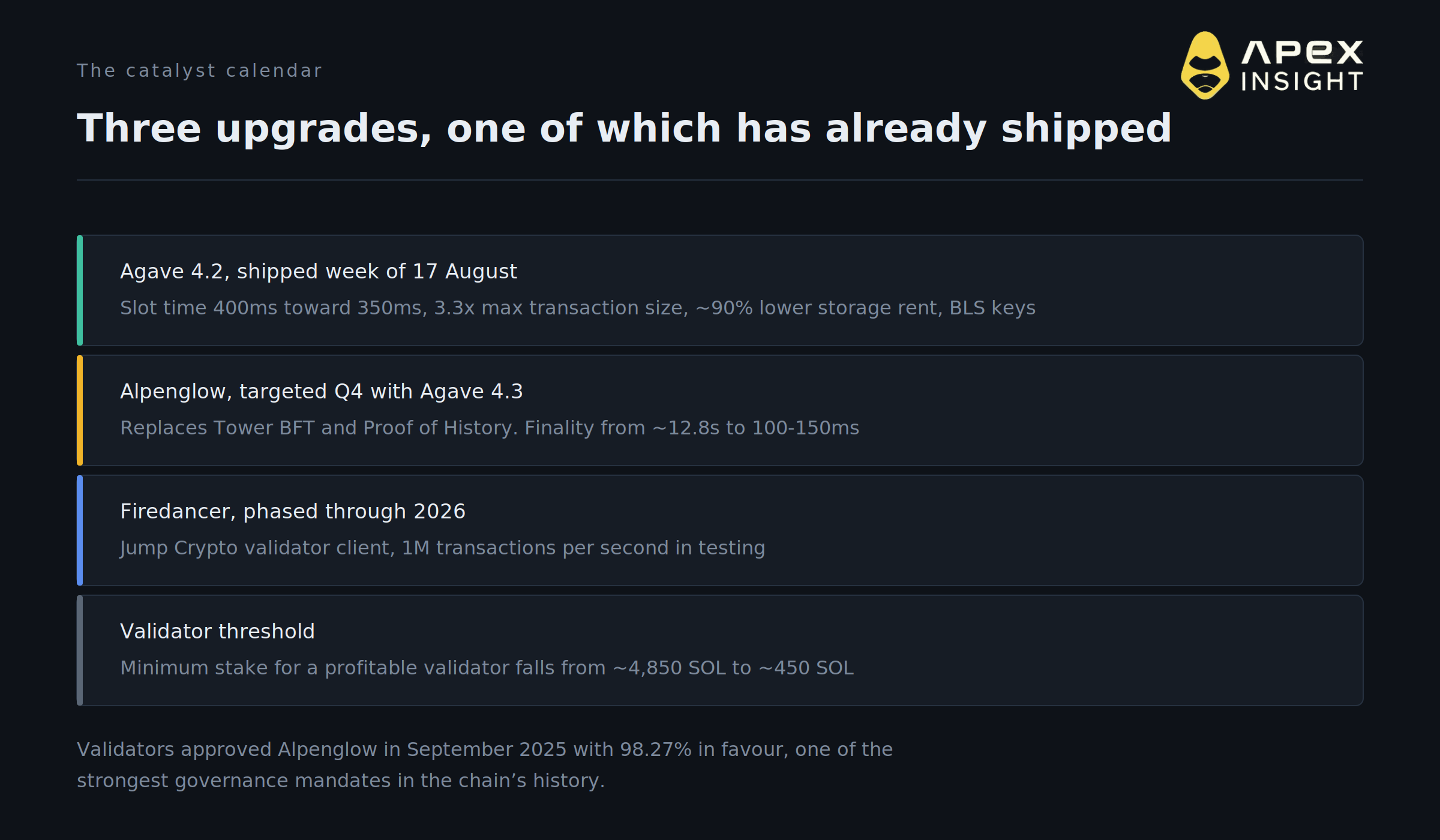
Agave 4.2 activated on mainnet the week of 17 August. It delivers the first step of a slot-time reduction from 400 milliseconds toward 350 and eventually 200, a 3.3 times increase in maximum transaction size, roughly a 90 percent cut in on-chain storage rent, and BLS key support, which is the technical prerequisite for what comes next.
Alpenglow is the larger change and it has not shipped. It replaces both Tower BFT and Proof of History, the two mechanisms Solana has run on since launch, and targets finality of 100 to 150 milliseconds against roughly 12.8 seconds today. Validators approved it in September 2025 with 98.27 percent in favour. Anatoly Yakovenko said in May that third-quarter activation was possible if testing went cleanly; current reporting points to the fourth quarter with Agave 4.3.
Firedancer, the Jump Crypto validator client that handled a million transactions per second in testing, continues its phased rollout through the year. Alongside it, the minimum stake for a profitable validator falls from roughly 4,850 SOL to around 450.
One honest caveat. Solana's 2023 run was not driven by an upgrade. It was a recovery from a solvency scare and a rerating of the whole ecosystem. Treating a technical roadmap as the cause of a repeat is a substitution of one story for another.
7. The June low is still a live question
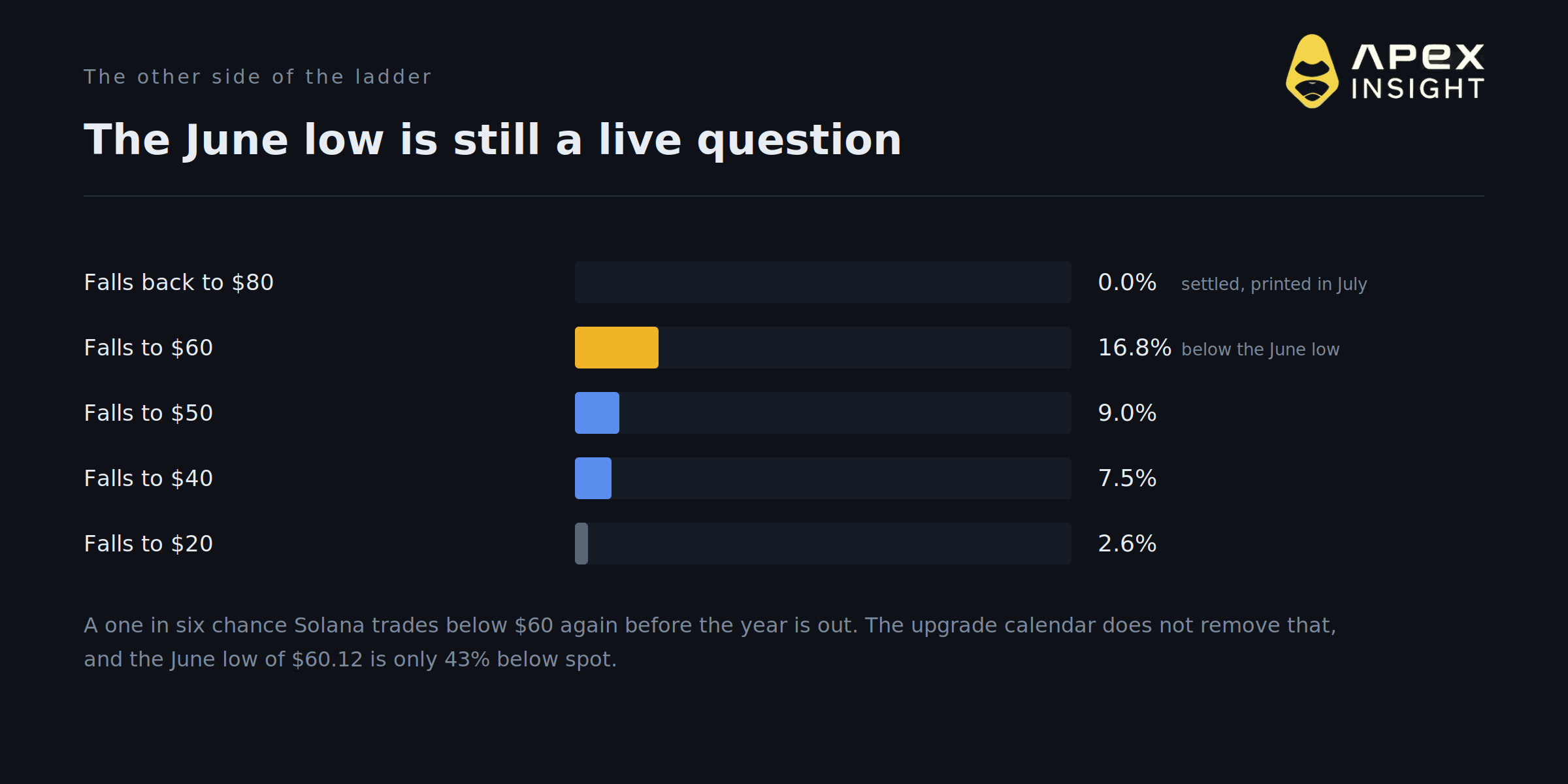
Falling back to $60 prices at 16.8 percent. $50 prices at 9 percent, $40 at 7.5 percent and $20 at 2.6 percent.
A one in six chance of revisiting the June low before the year is out, after a 76 percent rally, is the market declining to call a bottom. The upgrade calendar does not remove that, and the level is only 43 percent below spot, which for this asset is not a large move.
8. Against Bitcoin, the recovery has barely started
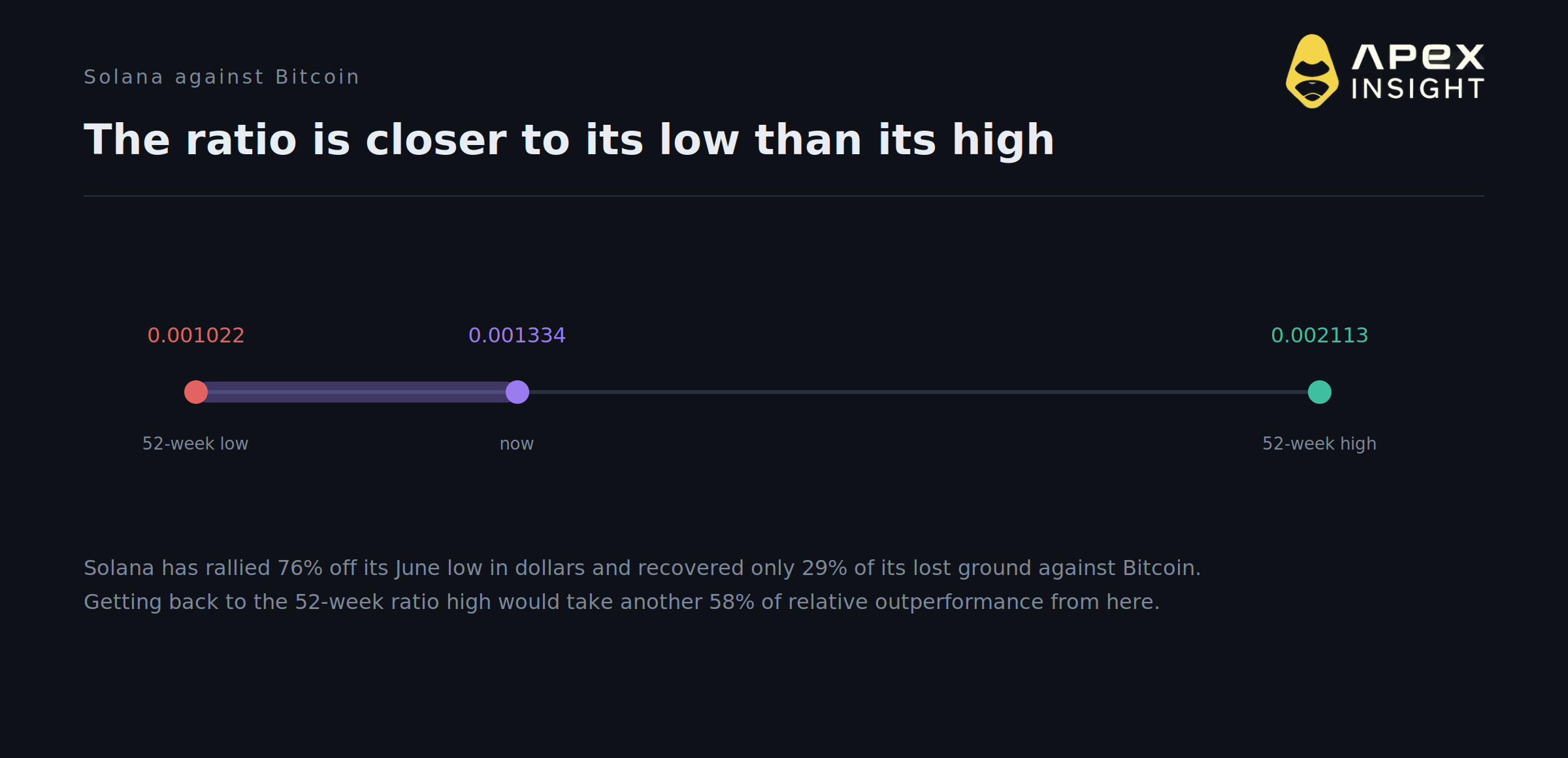
Solana against Bitcoin sits at 0.001334. The 52-week low is 0.001022 and the high is 0.002113.
So a 76 percent dollar rally has recovered only about 29 percent of the ground Solana lost against Bitcoin. Getting back to the 52-week ratio high would require another 58 percent of relative outperformance from here.
That gap matters for anyone framing this as an altseason. In dollar terms Solana looks like it is running. Measured against the asset it competes with for capital, it has done far less than the headline number suggests.
9. The record is a long way off
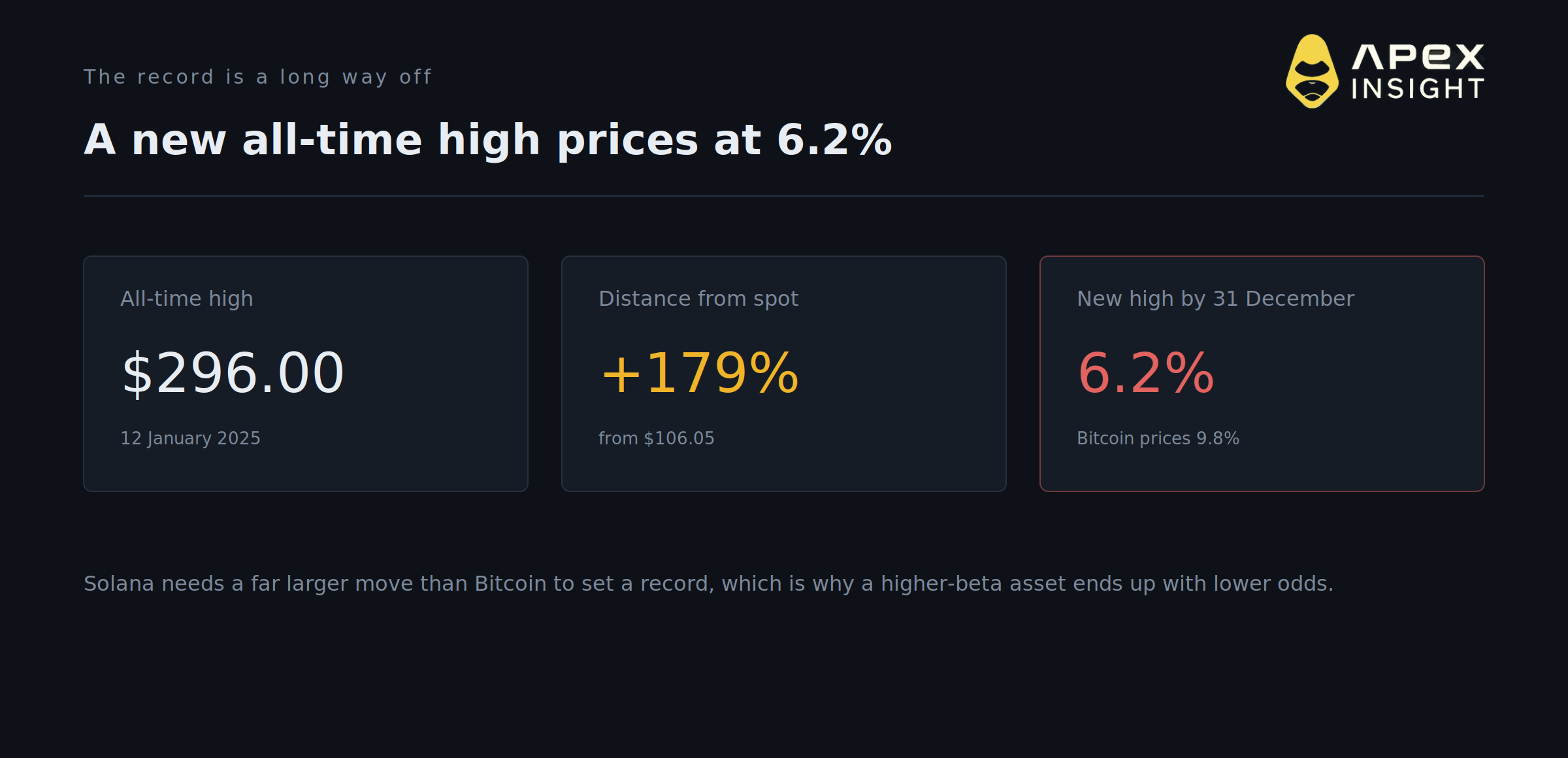
Solana's all-time high is $296.00, set on 12 January 2025. That is 179 percent above spot. A new record by 31 December prices at 6.2 percent.
Compare that to Bitcoin at 9.8 percent for the same question. The higher-beta asset carries the lower probability, because it needs a far bigger percentage move to get there. That is a useful corrective to the assumption that the more volatile asset always prices better odds on a record.
10. Three scenarios, and what each costs
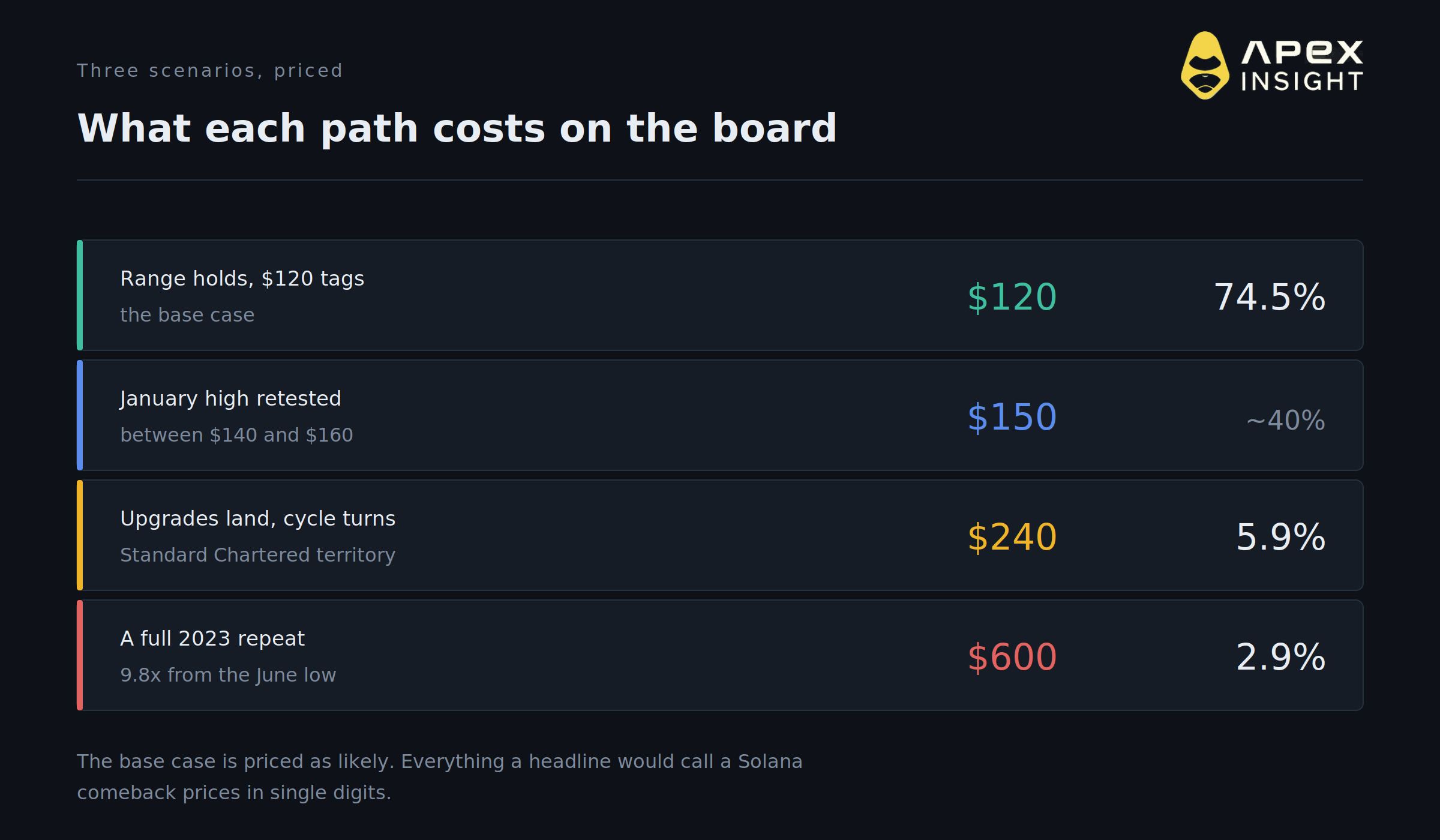
The base case is a tag of $120, priced at 74.5 percent, which needs a 13 percent move. Retesting January's $148.66 sits between the $140 and $160 rungs, so roughly 40 percent. The upgrade-driven bull case that reaches Standard Chartered territory at $240 prices at 5.9 percent. A full 2023 repeat at $600 prices at 2.9 percent.
Read as a set, that says the market expects further upside and does not expect a transformation. Everything a headline would describe as a Solana comeback sits in single digits.
11. Where the levels sit
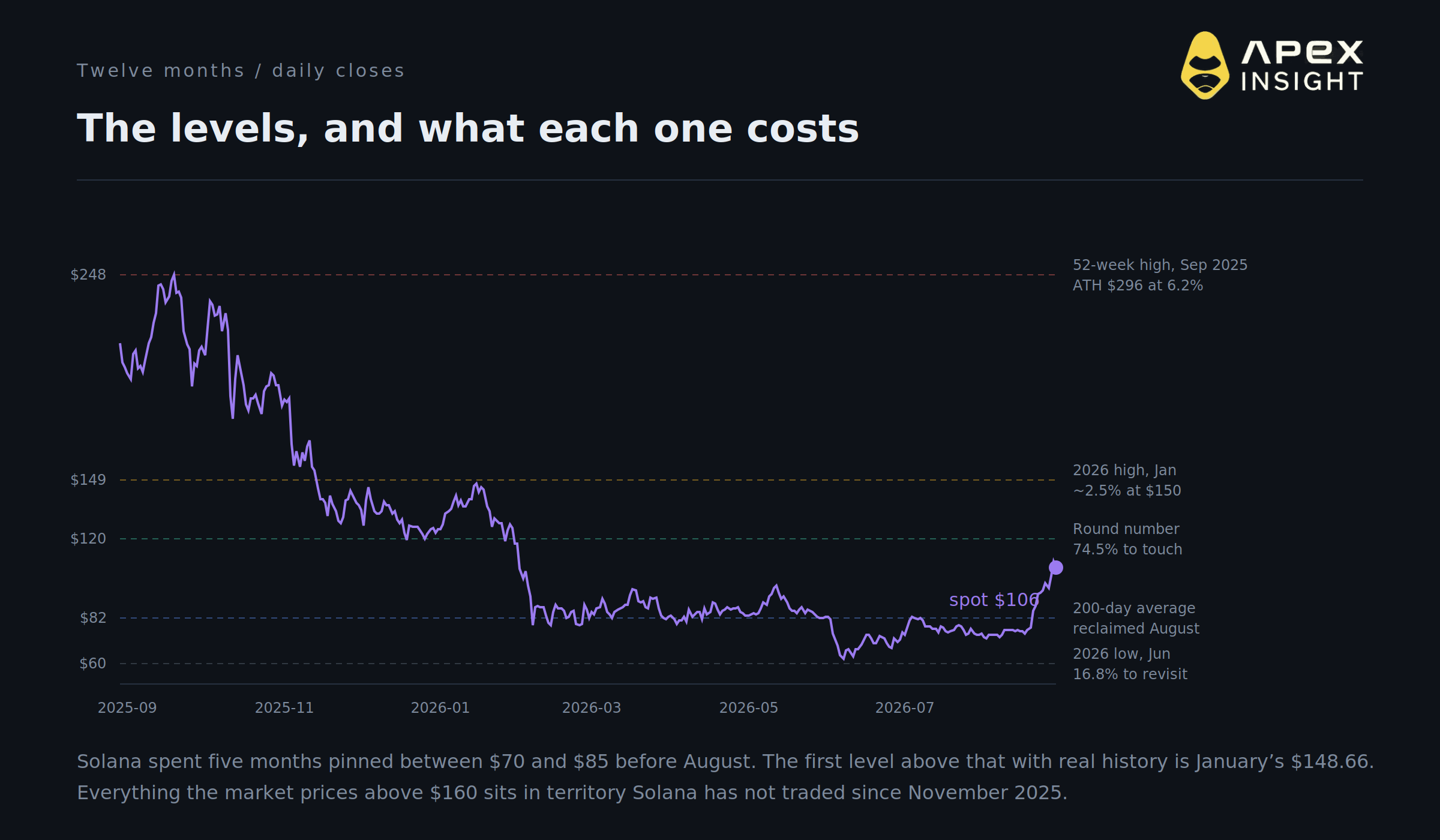
Solana traded between roughly $70 and $85 for five months before August. Above spot, the first level with real history behind it is January's $148.66. The 52-week high of $247.60 dates from September 2025.
Below, the 200-day at $81.60 is the level that matters, because losing it would undo the entire technical case built in August. The June low at $60.12 sits beneath that.
The useful thing about putting market prices on a chart is what it shows about the space between levels. Everything the board prices above $160 sits in territory Solana has not traded since November 2025, which is why the probabilities fall away so quickly past that point.
What this adds up to
Solana has done the first part of a recovery: a base, a 76 percent rally and a reclaim of its long-term average, with a genuine upgrade calendar arriving into it. The market has repriced accordingly, and a tag of $120 is now the base case.
What it has not done is price a repeat of 2023. $240 sits at 5.9 percent, $400 at 2.6 percent and $600 at 2.9 percent, and the ratio against Bitcoin says the relative recovery has barely begun. The bull case is available and it is cheap, which is exactly what a low probability on a liquid book means.
Two things to watch. Whether Alpenglow actually activates in the fourth quarter, since a slip would remove the clearest scheduled catalyst in the calendar. And whether the SOL/BTC ratio follows the dollar price, because until it does, this is a Bitcoin rally that Solana is participating in rather than a rotation into Solana.
Where to watch it
Every market in this article is live on ApeX Omni, where Polymarket's order books are integrated directly: the same liquidity and the same settlement source, minus the KYC. The board carries the full Solana strike ladder alongside the monthly and all-time-high contracts, with the volume behind each leg visible, so you can see exactly what any given price target costs rather than reading it as a headline.
We appreciate your continued support.
Published by ApeX. For informational and educational purposes only. Not investment advice, and not a forecast or endorsement of any outcome. Trading involves risk, including total loss.