




Note: All market prices, spot levels and price history are as of 29 August 2026. Analyst targets are as publicly reported. Upgrade timelines have slipped before. Nothing here is a recommendation.
1. The $12,000 call, priced
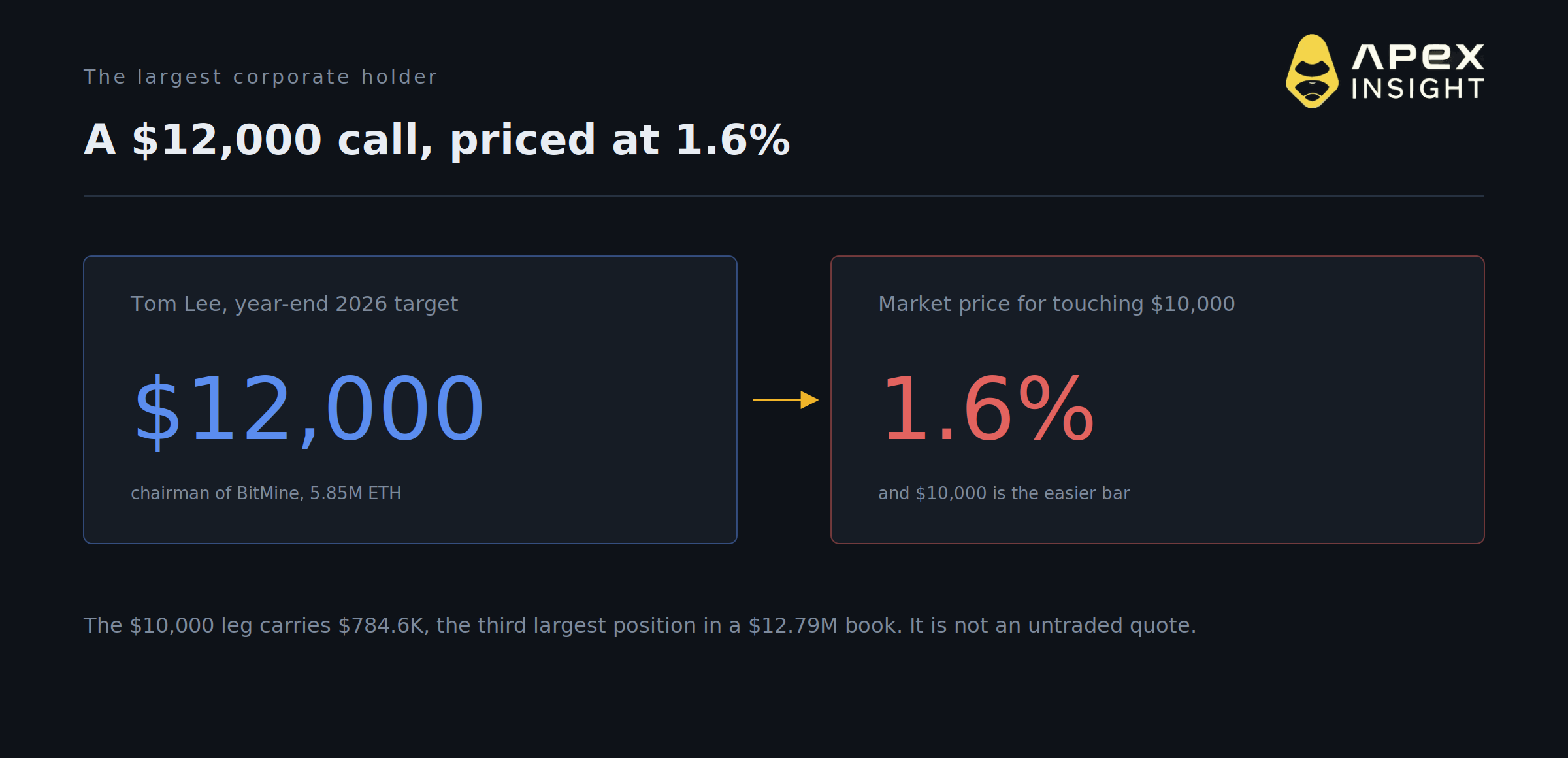
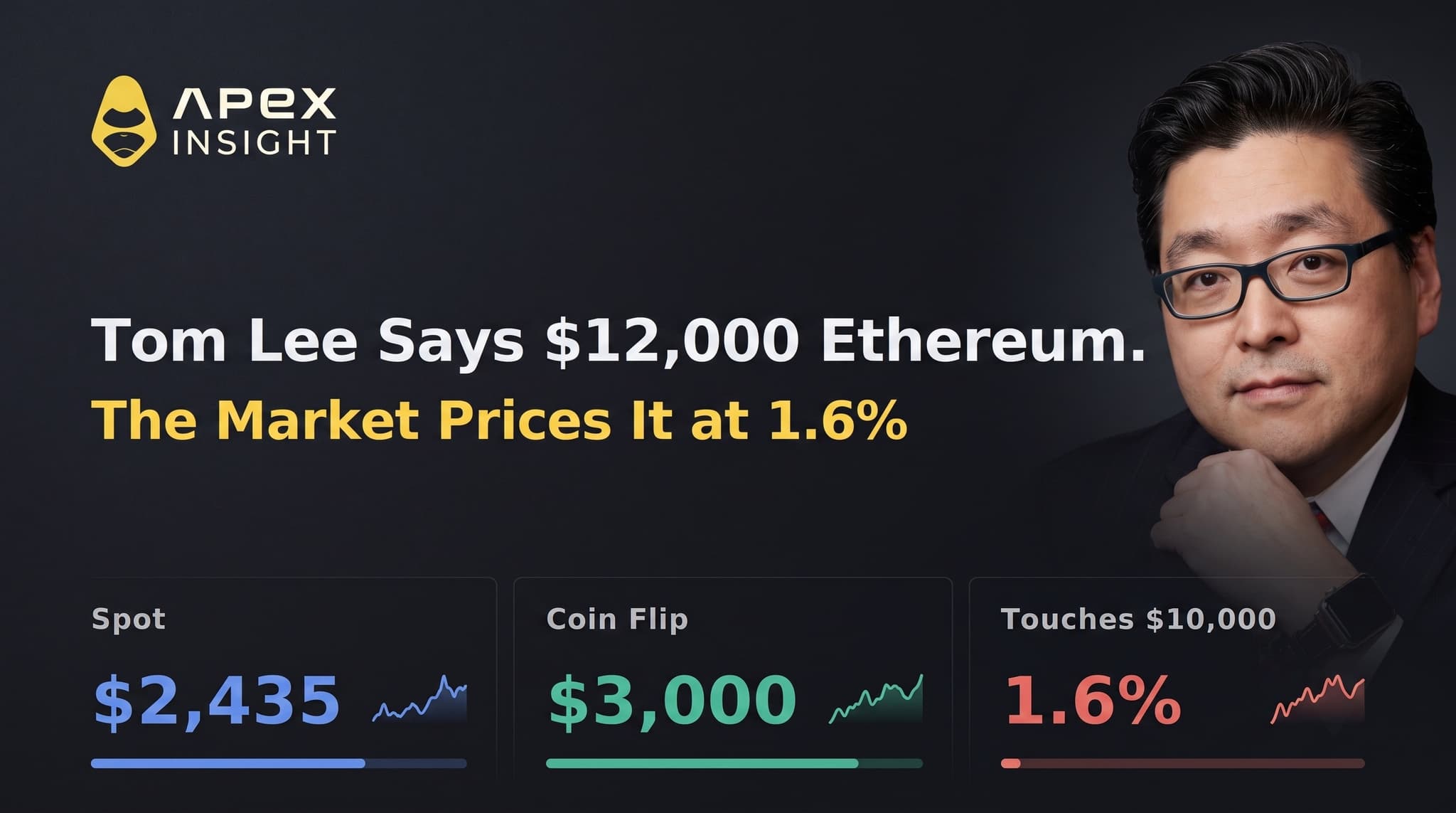
Tom Lee's published year-end target for Ethereum is $12,000. He chairs BitMine Immersion, which announced a treasury of 5.85 million ETH on 24 August, worth roughly $14.3 billion and representing about 4.66 percent of circulating supply.
The market prices Ethereum touching $10,000 at any point in 2026 at 1.6 percent. That is a lower bar than $12,000 and it is a touch contract rather than a year-end close, so it is easier again.
The $10,000 leg carries $784.6K, making it the third largest position in the book. This is not a stale quote nobody has looked at. It is a level with real money on both sides, priced at roughly one in sixty.
None of that makes Lee wrong. He is running a multi-billion dollar position on the same view, which is a far stronger form of commitment than a price target. But anyone repeating the number should know what it costs to agree.
2. Ethereum's coin flip is $3,000
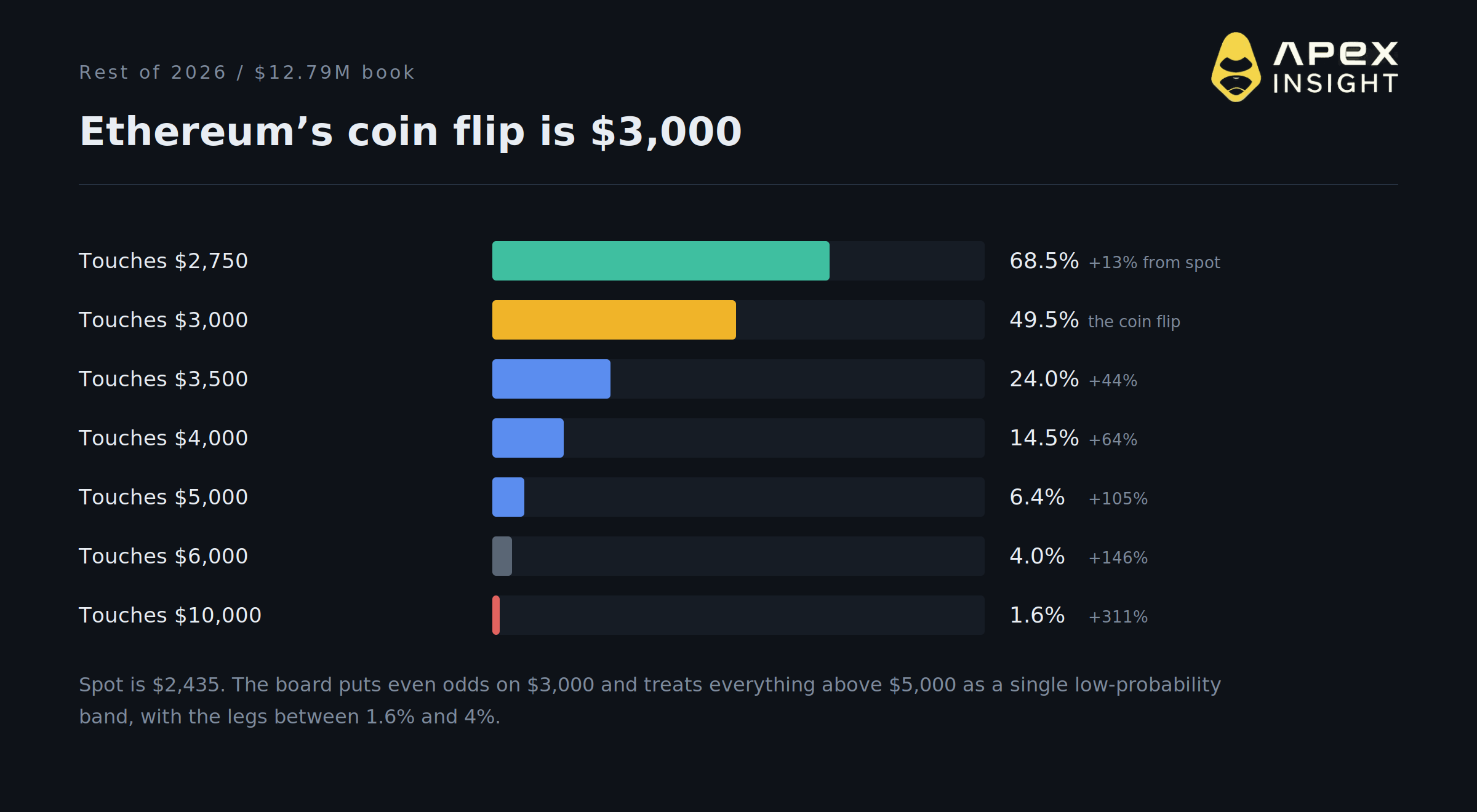
The 2026 ladder carries $12.79M. Touching $2,750 prices at 68.5 percent, $3,000 at 49.5 percent, $3,500 at 24 percent, $4,000 at 14.5 percent and $5,000 at 6.4 percent.
Then it flattens. $5,500 prices at 2.9 percent, $6,000 at 4 percent, $7,000 at 2.4 percent and $10,000 at 1.6 percent. Past $5,000 the market stops differentiating and treats the whole upper range as one low-probability band.
The tradeable disagreement sits between $2,750 and $4,000. Everything above that is priced as a tail.
3. Three targets, three very different prices
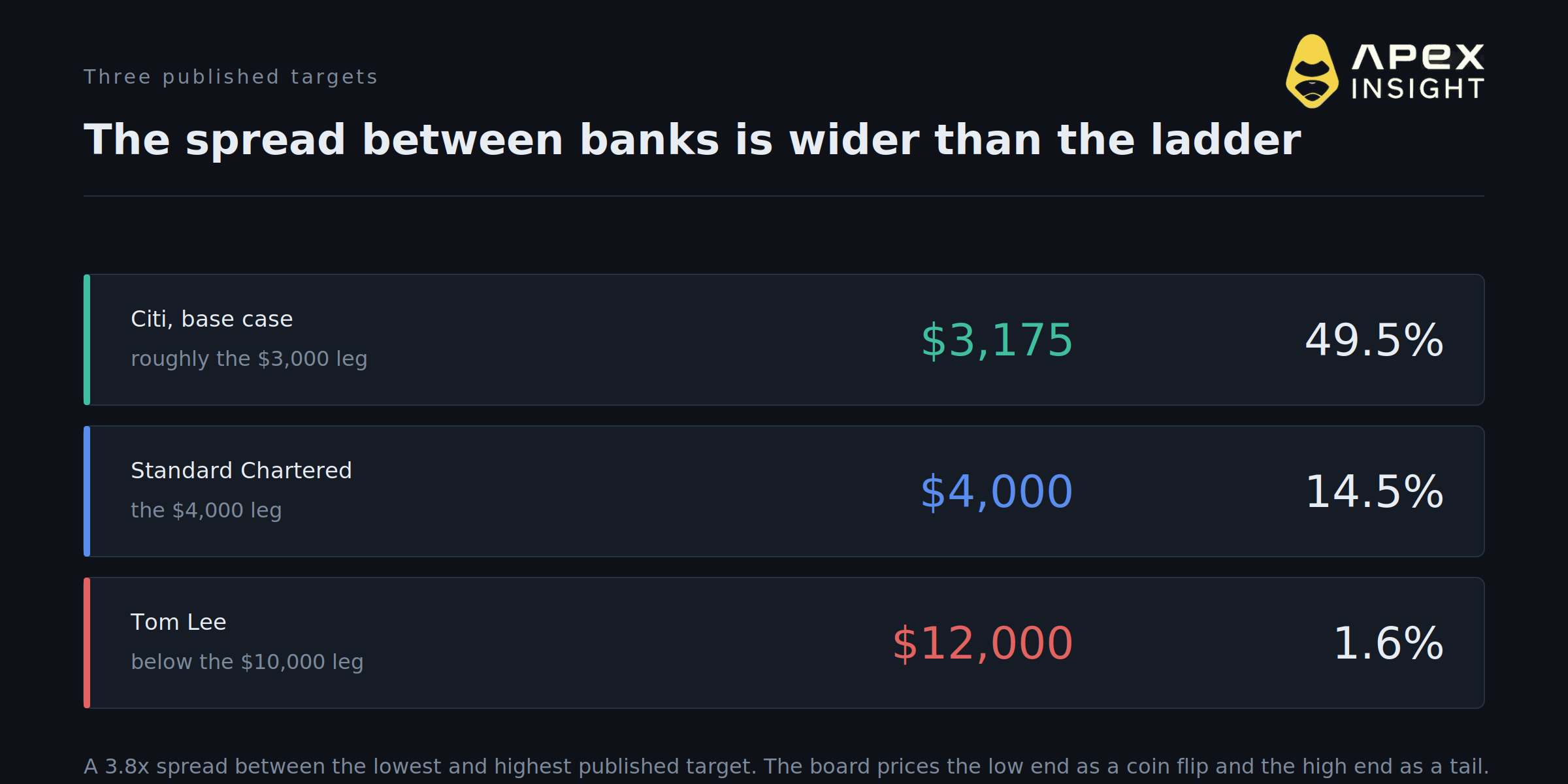
Citi's base case is $3,175, which maps to roughly the $3,000 leg at 49.5 percent. Standard Chartered projects $4,000, which is the 14.5 percent leg. Tom Lee's $12,000 sits above the 1.6 percent leg.
A 3.8 times spread between the lowest and highest published target on the same asset over the same horizon is unusual, and it is worth noticing what the board does with it. It prices the low end as a coin flip, the middle as a one in seven, and the high end as a tail.
If you want a single sentence for how to use sell-side targets, this is it: they are scenario markers, and the market will tell you what each scenario costs.
4. The setup is real
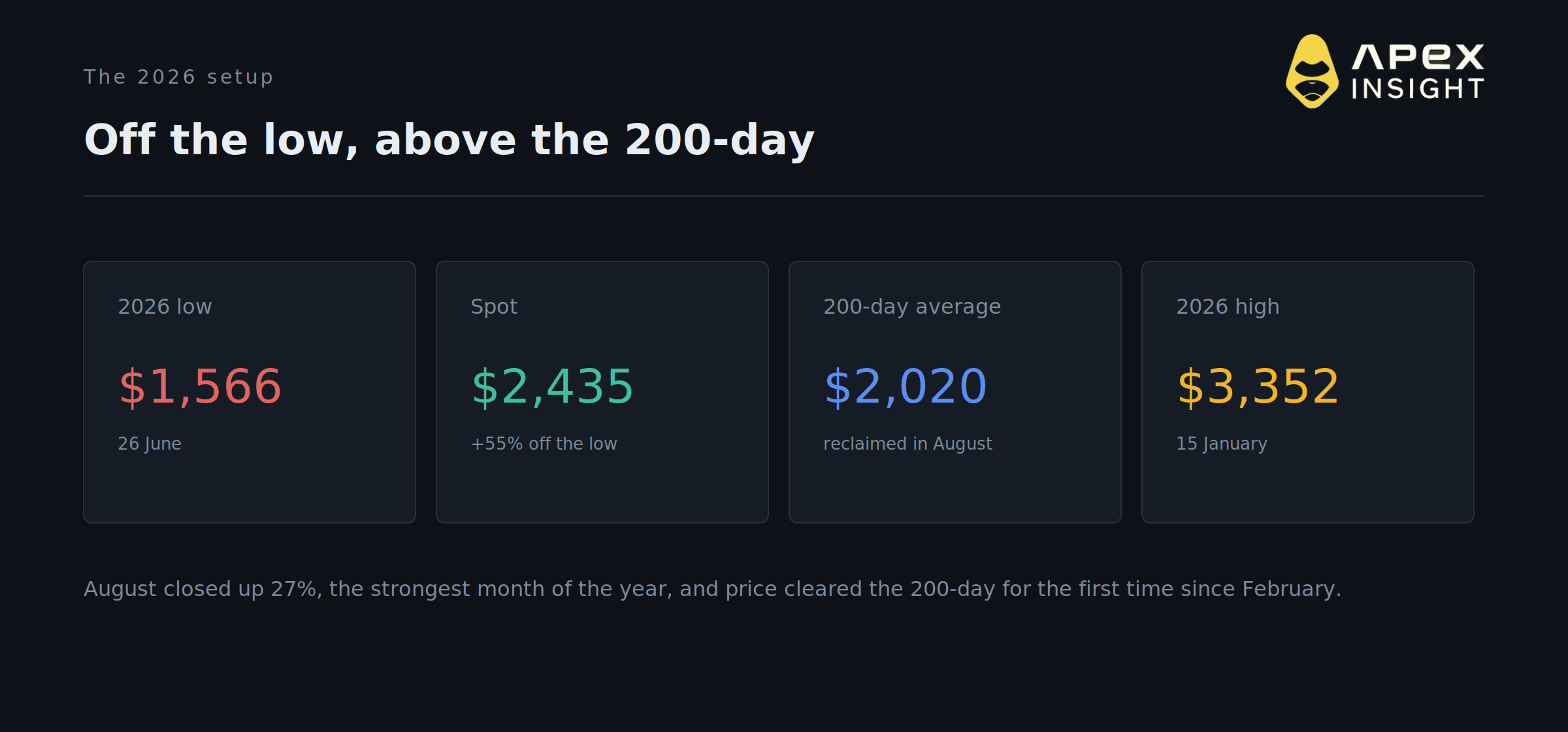
Ethereum bottomed at $1,566 on 26 June. It trades at $2,435. The 200-day average sits at $2,020 and the 50-day at $2,004, both now below price, and ETH cleared its 200-day exponential average at $2,139 during the August move.
August closed up 27 percent, the strongest month of the year, and the structure flipped from a downtrend to a confirmed uptrend for the first time since February.
That is a genuine change. It is also, as section 9 covers, being carried by an unusual amount of leverage.
5. One company holds 4.66 percent of all Ethereum
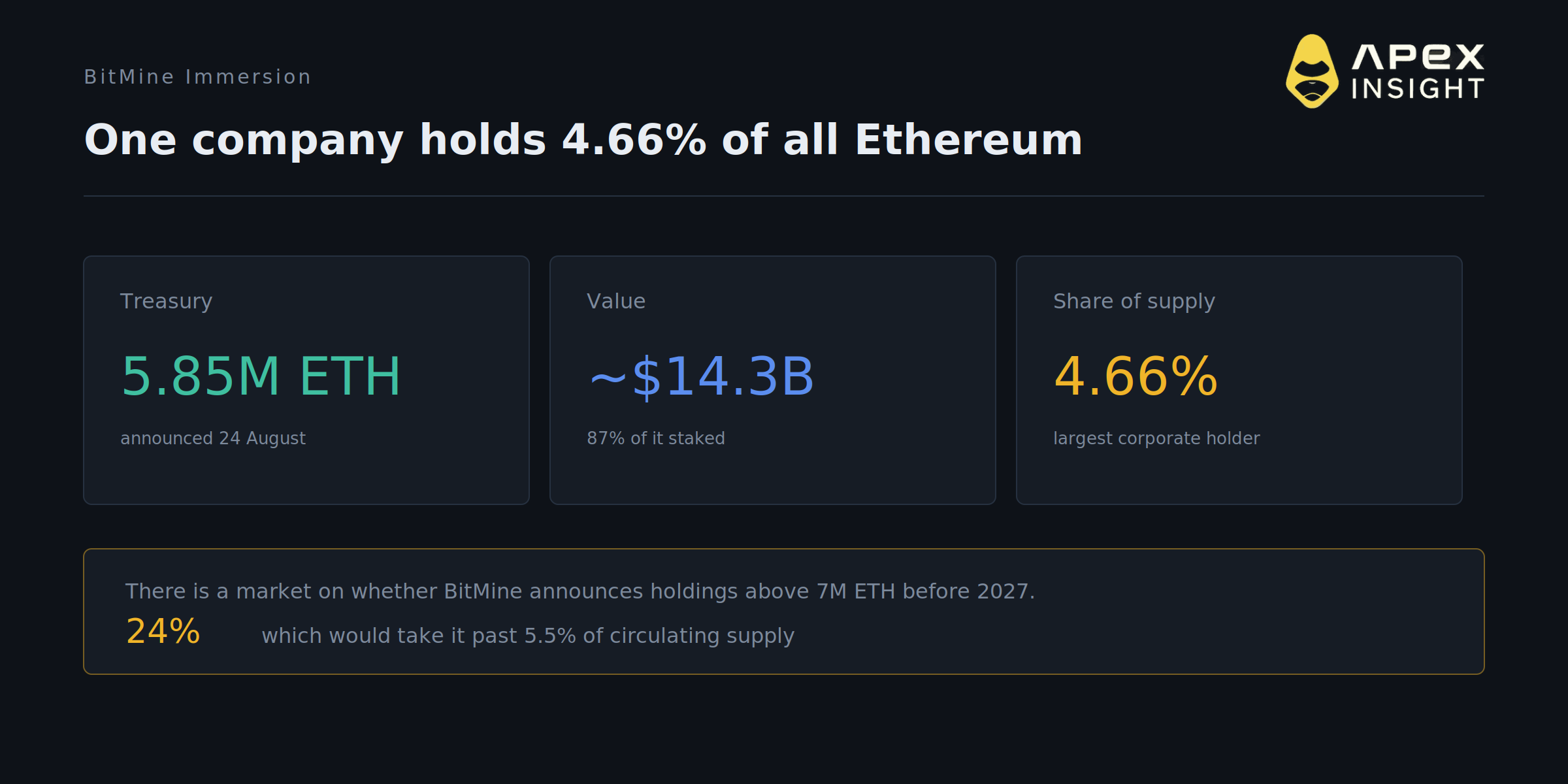
BitMine Immersion announced holdings of 5.85 million ETH on 24 August, worth about $14.3 billion, with 87 percent of it staked. That is roughly 4.66 percent of every Ethereum in existence held by one listed company.
There is a market on whether BitMine announces holdings above 7 million ETH before 2027. It prices at 24 percent, which would take the company past 5.5 percent of circulating supply.
Concentration of this kind cuts two ways and it is worth being explicit about both. Staked coins in a corporate treasury are the least likely supply to hit the market, which supports price. They are also a single balance sheet with a single set of incentives, and treasury companies have historically been forced sellers at exactly the wrong moment.
6. One issuer is most of the demand
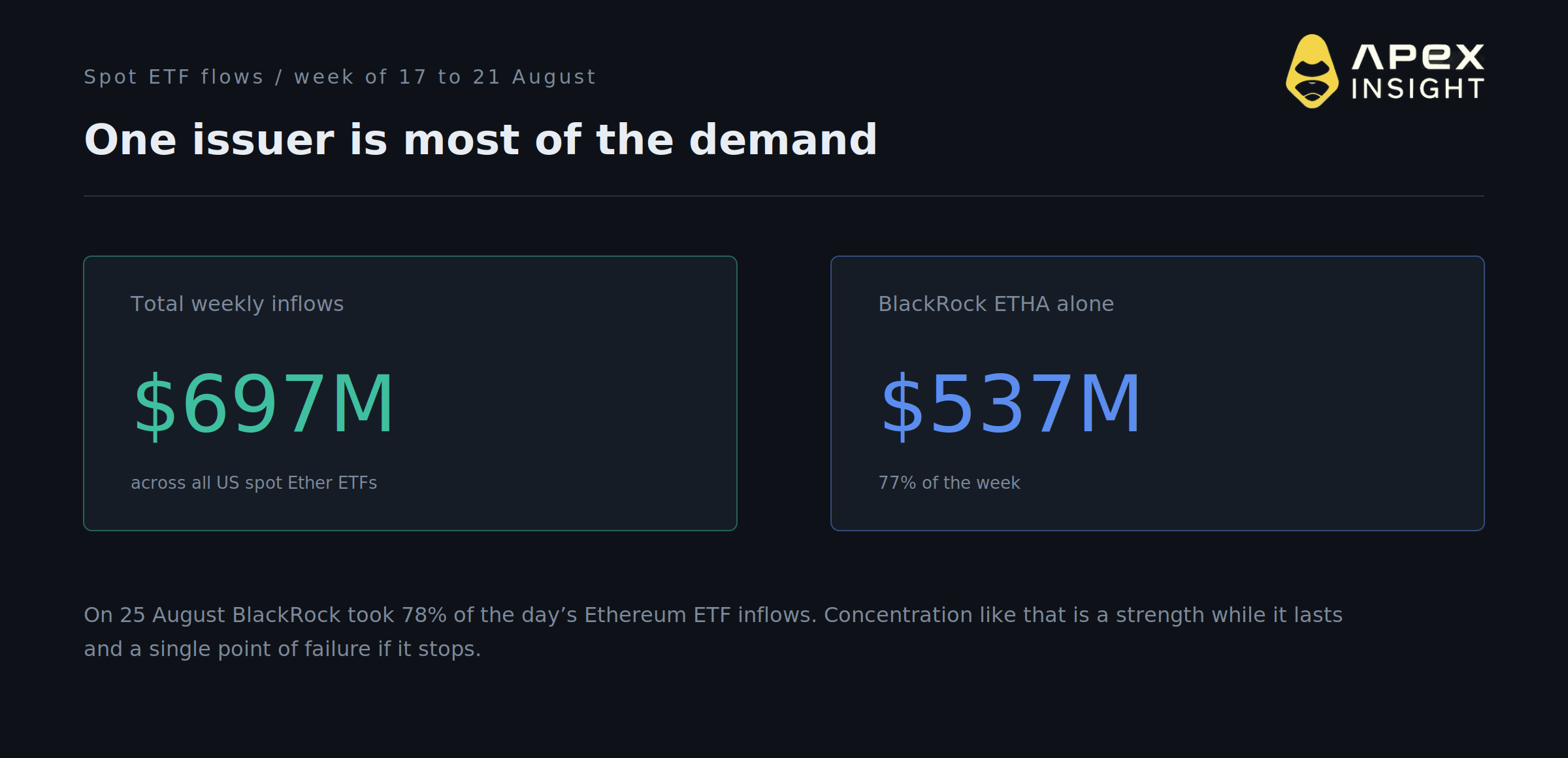
US spot Ether ETFs took $697M in the week of 17 to 21 August. BlackRock's ETHA accounted for $537M of that, roughly 77 percent. On 25 August BlackRock took 78 percent of the day's Ethereum ETF inflows on its own.
Thirty-day inflows reached $524.3M, and $71.47M arrived on 18 August alone with ETHA taking $64.68M of it.
Read that carefully before treating flows as broad institutional adoption. What the data shows is one issuer supplying the overwhelming majority of demand. While it continues it is a powerful bid. If it pauses, there is not much underneath it.
7. The supply side has genuinely tightened
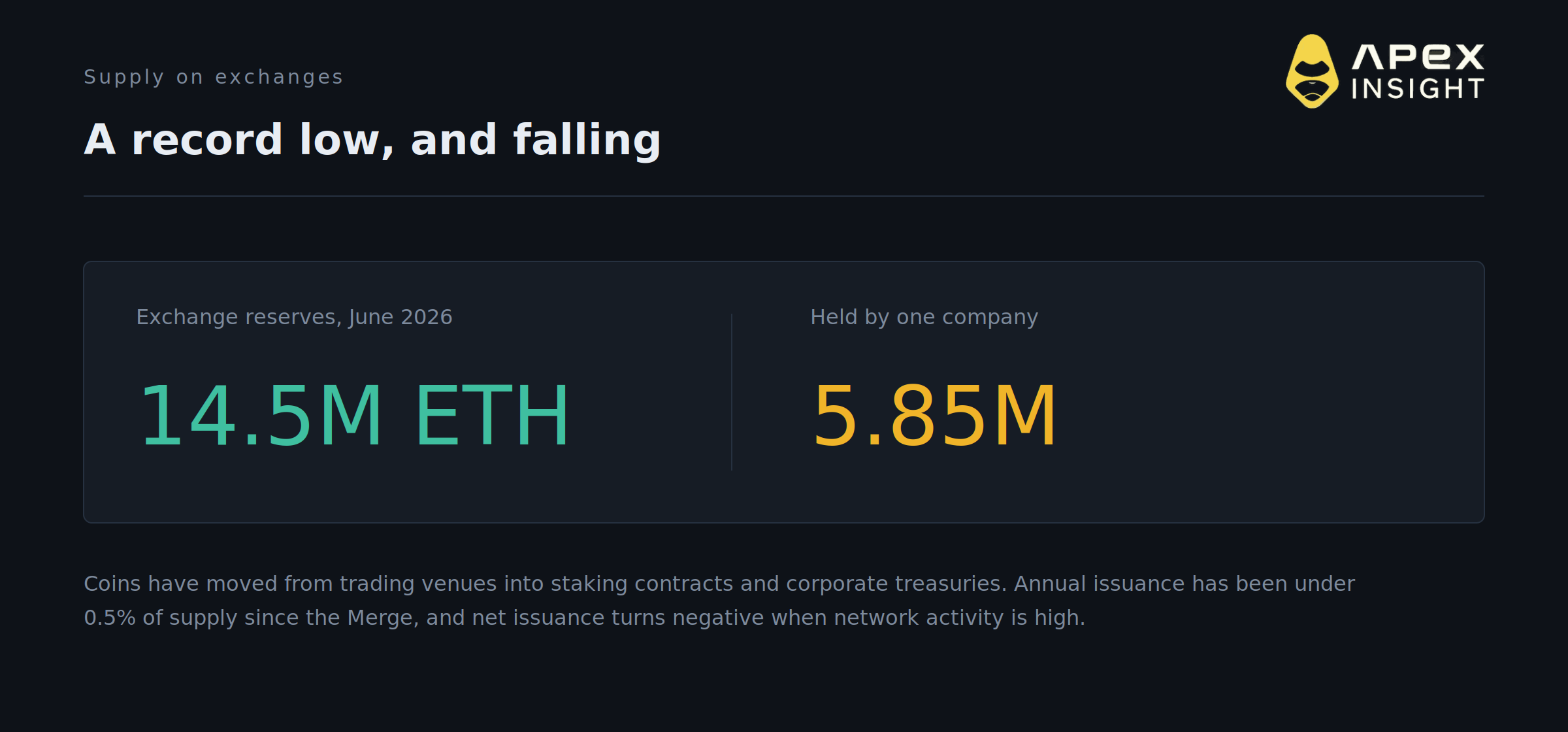
Exchange reserves hit a record low of 14.5 million ETH in June 2026 as coins moved from trading venues into staking contracts and corporate treasuries.
For scale, BitMine's treasury alone is 5.85 million ETH, roughly 40 percent of everything still sitting on exchanges.
Since the Merge, annual issuance has run below 0.5 percent of supply, and net issuance turns negative in periods of high network activity when fee burn exceeds validator rewards. This is the part of the Ethereum thesis that has actually delivered, and it is structural rather than narrative.
8. Glamsterdam is staged but not shipped
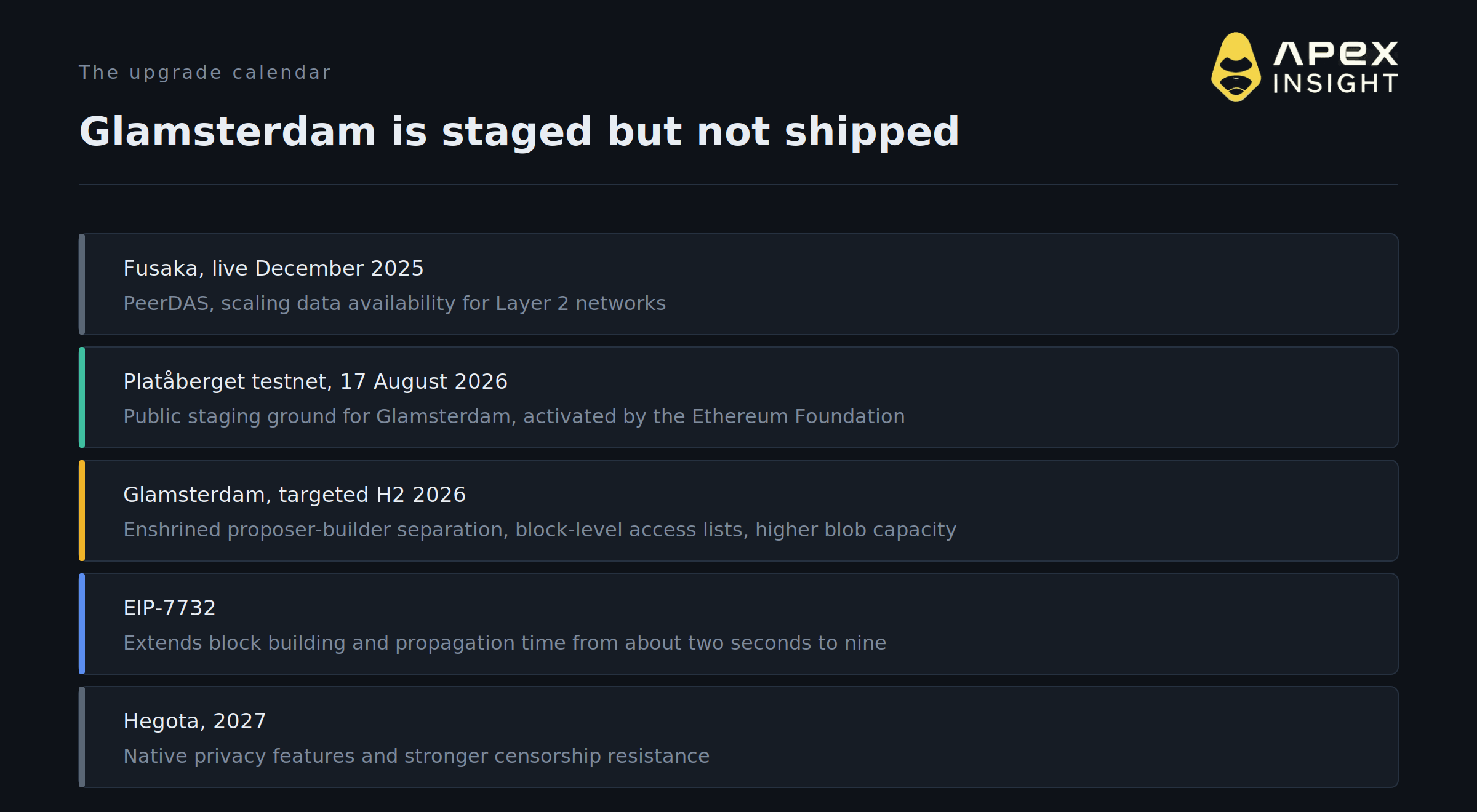
Fusaka went live in December 2025, bringing PeerDAS and a large increase in data availability for Layer 2 networks. The Ethereum Foundation activated the Platåberget public testnet on 17 August as the staging ground for Glamsterdam, which is targeted for the second half of 2026.
Glamsterdam is an infrastructure upgrade rather than a user-facing one. It brings enshrined proposer-builder separation to decentralise block production, block-level access lists for parallel execution, and higher gas and blob capacity. EIP-7732 extends the window for building and propagating a block from about two seconds to nine. Hegota follows in 2027 with native privacy features.
One development worth flagging that gets less coverage than the roadmap. The Ethereum Foundation is stepping back from core client development, and EthLabs launched to fill the gap, founded by five former Foundation researchers and backed by Joe Lubin, BitMine and SharpLink among more than fifty partners. Whether EthLabs and Protocol Guild can jointly cover the estimated $30 million a year of core client work is an open question, and it is a genuine risk that sits outside the price chart.
9. The rally is carrying a lot of borrowed conviction
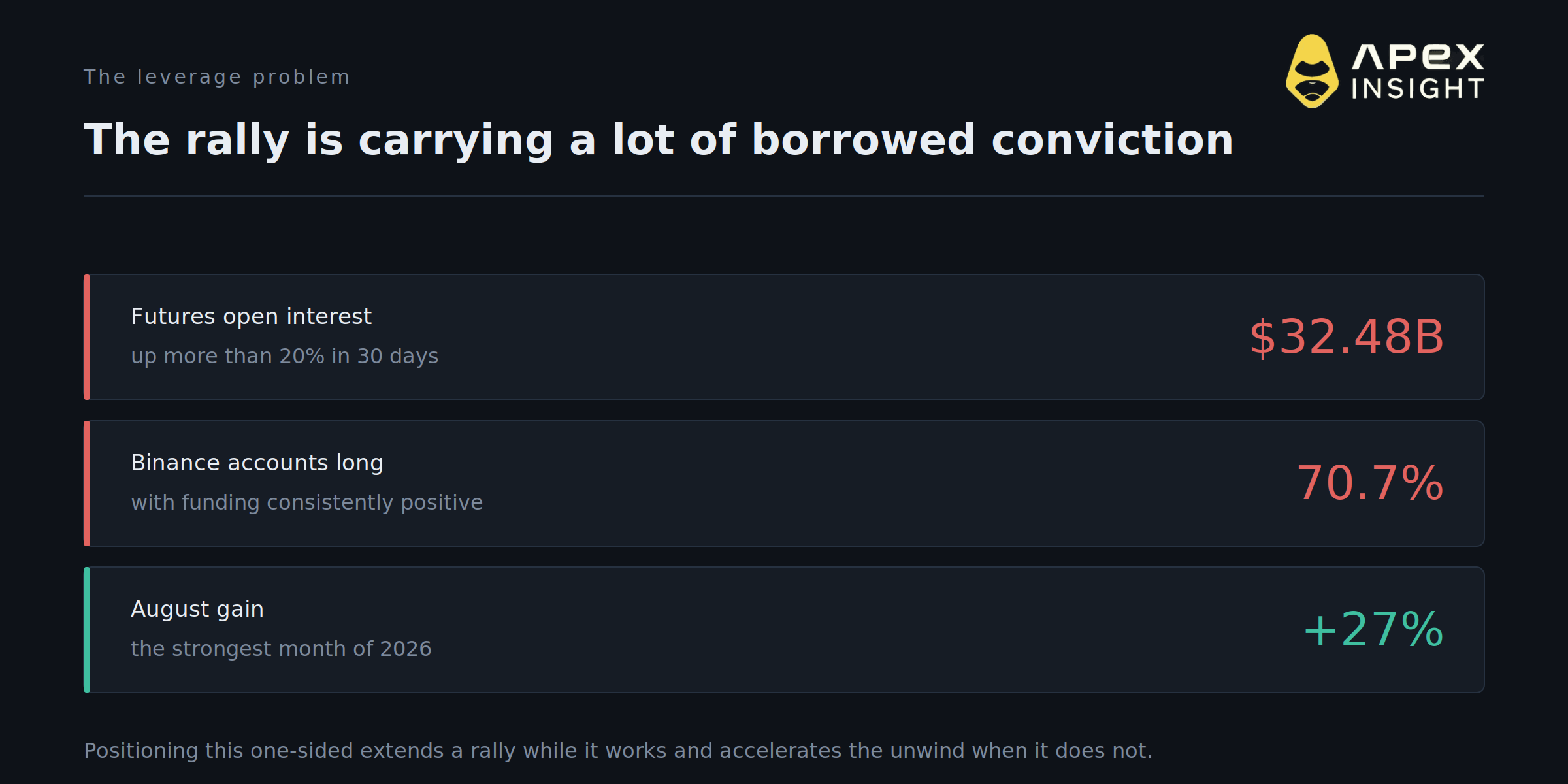
Futures open interest has reached $32.48 billion, up more than 20 percent in thirty days. Funding is consistently positive and roughly 70.7 percent of Binance accounts are positioned long. Sentiment readings have moved into greed.
That is one-sided positioning into a 27 percent month. It extends a rally while it works and it accelerates the unwind when it does not, which is the mechanical reason a move like this can retrace faster than it arrived.
The levels traders are watching are $2,500 to $2,550 above and roughly $2,355 below.
10. The biggest position in the book is bearish
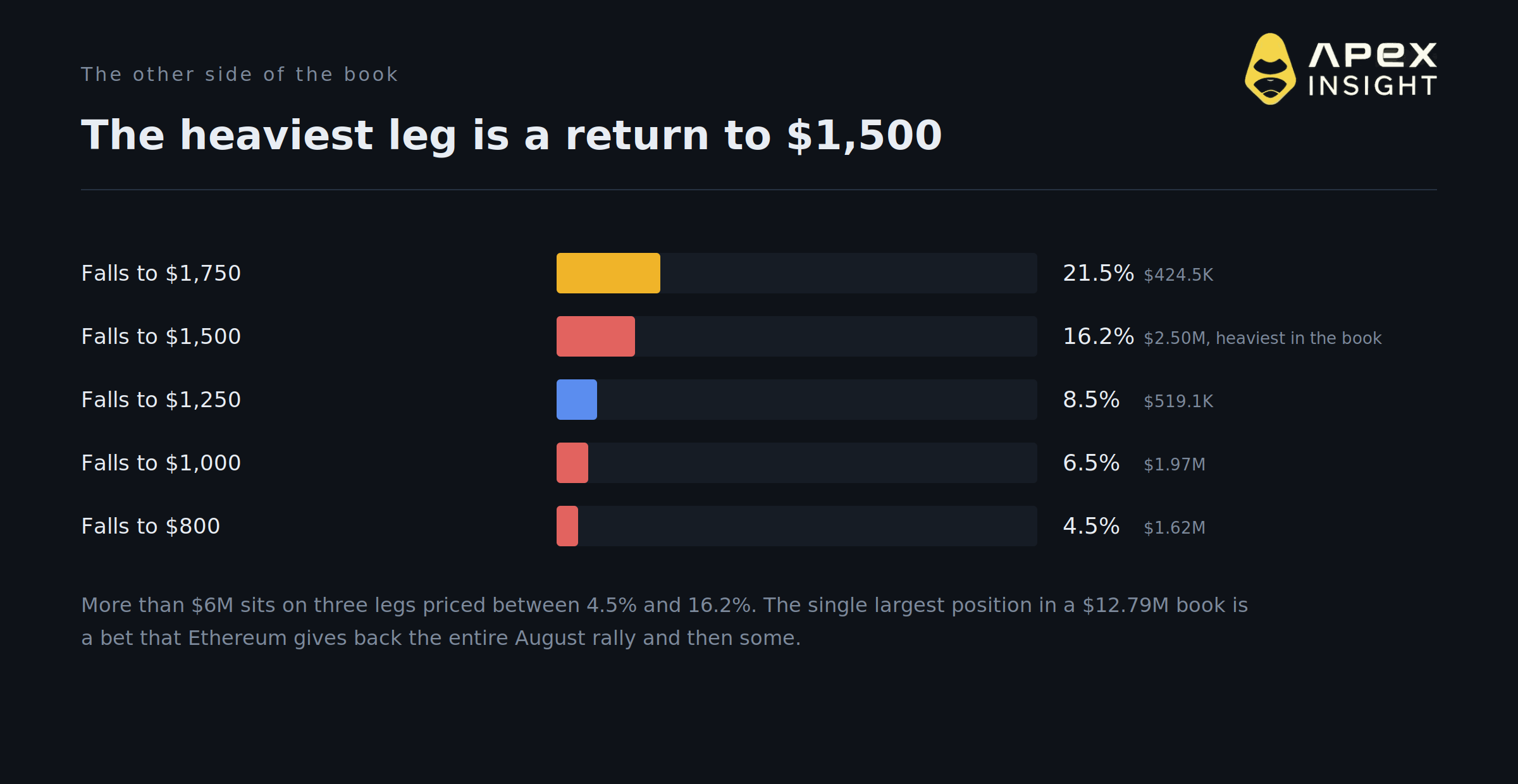
Falling back to $1,750 prices at 21.5 percent. $1,500 prices at 16.2 percent, $1,250 at 8.5 percent, $1,000 at 6.5 percent and $800 at 4.5 percent.
The $1,500 leg carries $2.50M, the single largest position anywhere in the $12.79M book. Below it, $1,000 carries $1.97M and $800 carries $1.61M. More than $6 million sits on three legs that all require Ethereum to give back the entire August rally and then some.
That is worth holding alongside section 1. The loudest published call is $12,000 and the heaviest position on the board is a return to $1,500.
11. Where the levels sit
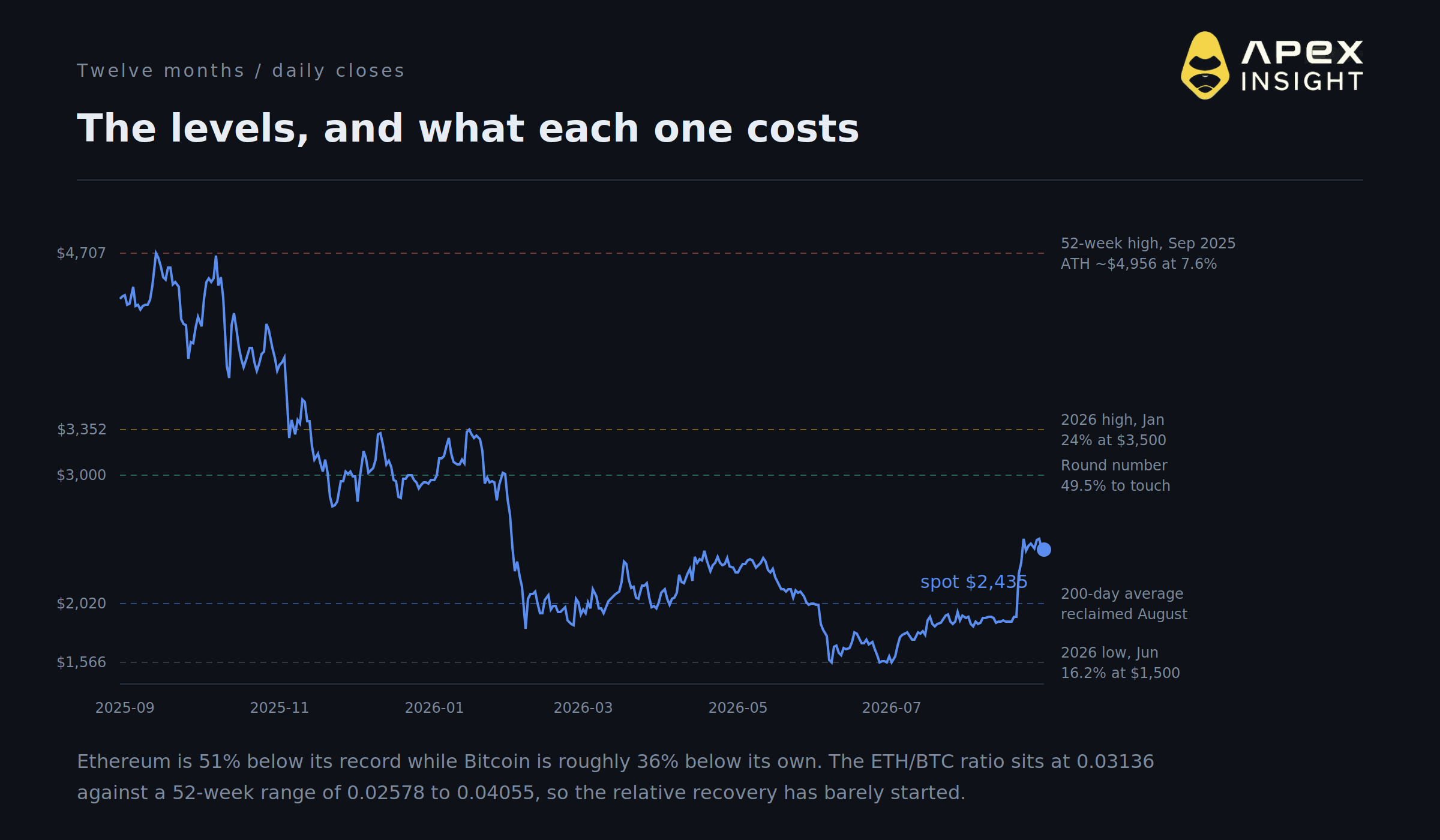
Above spot, the first level with history behind it is January's $3,352, which sits between the $3,000 and $3,500 rungs. The 52-week high of $4,707 dates from 13 September 2025. Ethereum's record of roughly $4,956 prices at 7.6 percent for a new high by 31 December.
Below, the 200-day at $2,020 is the level that matters, because losing it would undo the technical case built in August. The June low of $1,566 sits beneath it.
One comparison worth carrying. Ethereum is about 51 percent below its record while Bitcoin is roughly 36 percent below its own. The ETH/BTC ratio sits at 0.03136 against a 52-week range of 0.02578 to 0.04055, so a 55 percent dollar rally has recovered only a fraction of the ground lost against Bitcoin.
What this adds up to
Ethereum's fundamental picture is the best it has been in a year. Supply on exchanges is at a record low, one company has locked up 4.66 percent of it, ETF demand is real, and the upgrade calendar has a live testnet behind it.
The market has repriced accordingly and stopped well short of the headlines. $3,000 is a coin flip, $4,000 is one in seven, and $10,000 is one in sixty. The heaviest single position on the board is a return to $1,500, and the rally is being carried by open interest up 20 percent in a month with 70 percent of accounts on one side.
Two things to watch from here. Whether BlackRock's share of ETF inflows normalises, because a bid that concentrated is a strength and a fragility at the same time. And whether Glamsterdam ships in the second half, since a slip would remove the only scheduled catalyst in the calendar and leave the rally resting entirely on flows and leverage.
Where to watch it
Every market in this article is live on ApeX Omni, where Polymarket's order books are integrated directly: the same liquidity and the same settlement source, minus the KYC. The board carries the full Ethereum strike ladder alongside the all-time-high contract and the BitMine treasury market, with the volume behind each leg visible, so you can see exactly what any published price target costs rather than reading it as a headline.
We appreciate your continued support.
Published by ApeX. For informational and educational purposes only. Not investment advice, and not a forecast or endorsement of any outcome. Trading involves risk, including total loss.