





Published 27 November 2026
On a day when almost nothing in crypto moved, Zcash lost 11.60%. The obvious explanation was sitting right there: Monero, the other large privacy coin, had been told by an exchange it was being dropped, and Monero fell 11.53% on the same day. Two coins, the same sector, the same size of fall, one piece of bad news between them. It looks closed. One outlet ran the question in a headline that evening: Monero plunges after KuCoin delisting announcement: is Zcash next?
Put the two on the same clock and it falls apart. Zcash was already down 5.69% before Monero moved at all.
This piece is about what the tape actually says, which is more interesting than the tidy version, and about a second thing: how easy it is to read two numbers that end up in the same place and assume they travelled together.
Thanksgiving was quiet, and Zcash was not
The US cash market was shut all of 26 November. Crypto was not, and crypto did very little.
Zcash was alone at the bottom
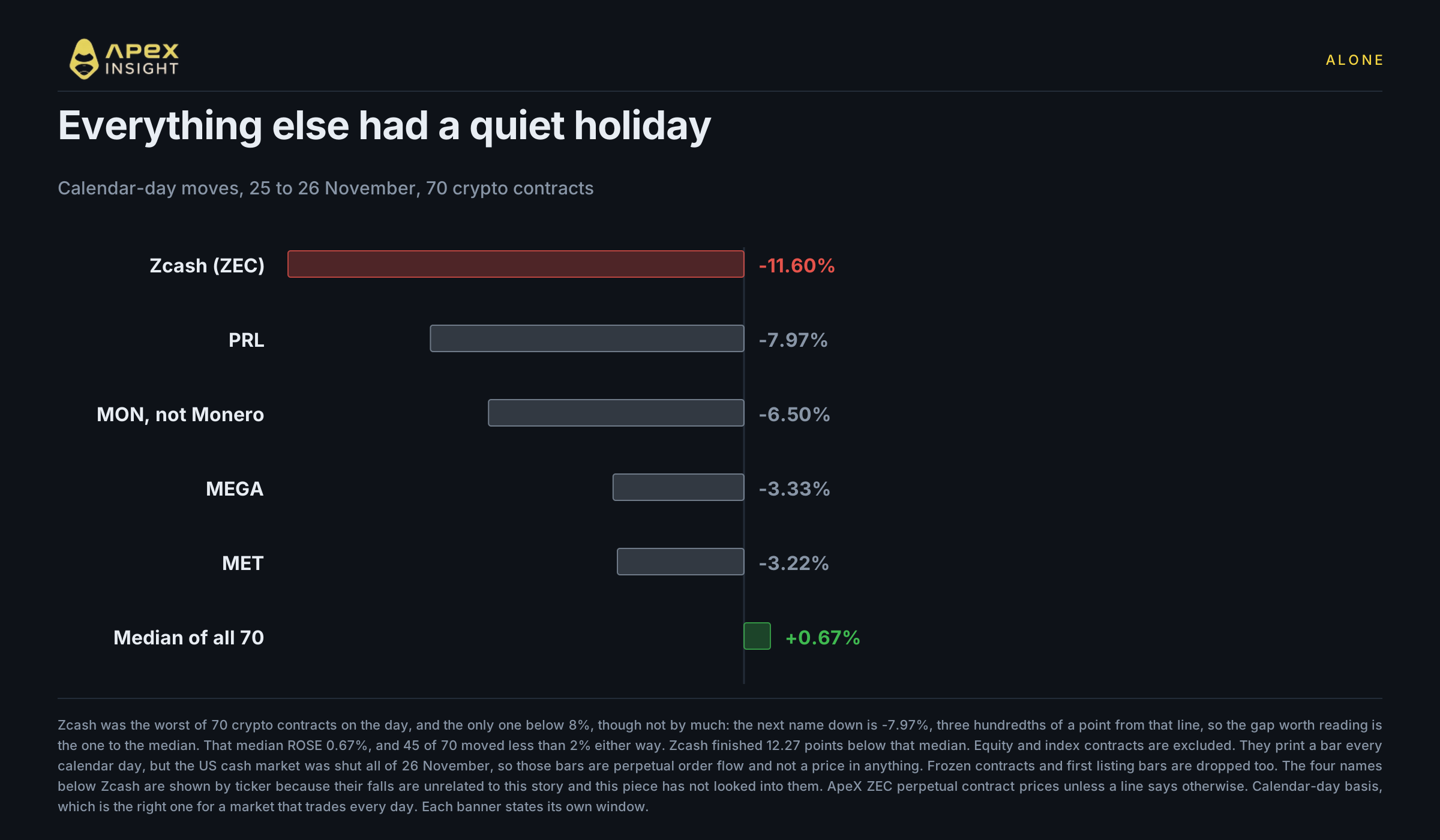
Across 70 crypto contracts on ApeX, the median move was +0.67%. Not a flat market, a slightly positive one. Forty-five of the 70 moved less than 2% in either direction, which is about as still as a holiday session gets.
Zcash finished −11.60%, the worst of the 70, and 12.27 points below that median. The next worst was PRL at −7.97%, and after the top three nothing else was below −3.33%. So this was not a risk-off day that caught one name harder than the rest. It was one name.
A note on what is not in that ranking. Equity and index contracts print a bar every calendar day, but with the US cash market shut on 26 November those bars are perpetual order flow and not a price in any share, so they are excluded. Ranking a shut market beside a trading one produces a league table of nothing.
The shape of the day
Eleven and a half percent can arrive in a lot of different ways, and the way matters.
One bad hour, a recovery, and a worse finish
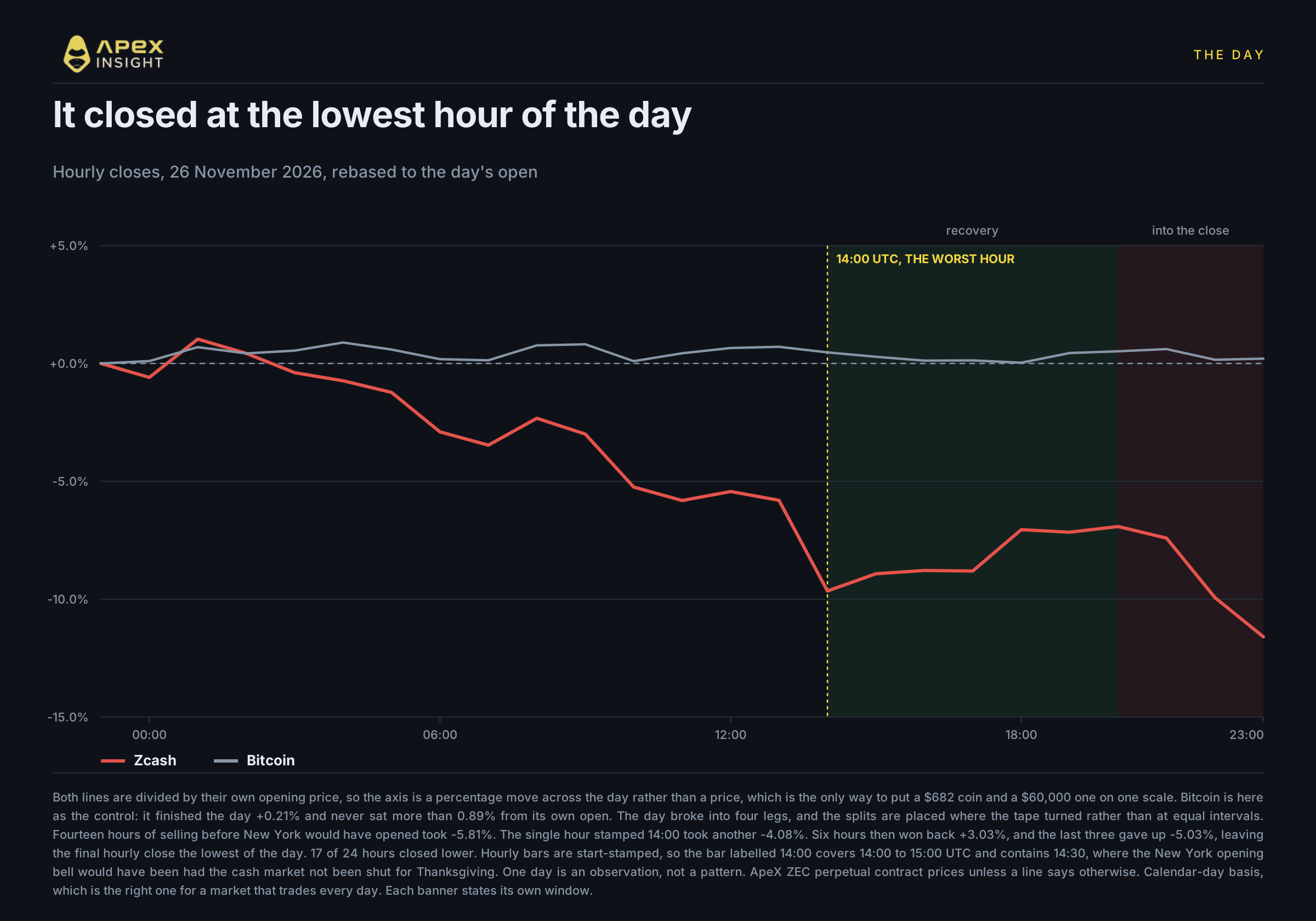
The day broke into four legs, cut where the tape turned rather than at equal intervals:
00:00 to 13:00, fourteen hours: −5.81%. The day actually opened higher, peaking +0.83% at 01:00, then turned over in the 02:00 hour and bled steadily from there.
The 14:00 hour alone: −4.08%. The single worst hour of the day.
15:00 to 20:00, six hours: +3.03%. It got about a quarter of the damage back.
21:00 to 23:00, three hours: −5.03%. It gave all of that back and more.
Seventeen of 24 hours closed lower, and the final hourly close was the lowest of the day. That last detail is the one worth holding onto. A market that sells off hard and then stabilises has found a buyer. A market that recovers and then makes its low in the last three hours has not.
Bitcoin is on that chart as a control and it did nothing: +0.21% on the day, never sitting more than 0.89% from its own open. Whatever moved Zcash was not moving crypto.
One reading note, because it matters twice later. Hourly bars are start-stamped, so the bar labelled 14:00 covers 14:00 to 15:00 UTC and contains 14:30, where the New York opening bell would have been had the market not been shut.
The delisting belonged to a different coin
The news everyone pointed to on 26 November was not about Zcash at all.
KuCoin published a notice that it will delist Monero, removing the XMR/USDT, XMR/USDC, XMR/ETH and XMR/BTC spot pairs at 08:00 UTC on 30 November and closing withdrawals on 31 December. The stated reason was "platform policies" and nothing more. It goes well beyond spot: the notice also removes XMR from KuCoin's Convert, Earn, trading bots and loan collateral. That is under four days of notice, and it mattered more than a single venue usually would, though exactly how much is less certain than the round number suggests. CoinMarketCap put KuCoin's XMR/USDT at 47% of reported Monero spot volume, about $73.8 million, over the 24 hours around the notice; CoinGecko put the same pair at $62.6 million. Both are single-provider snapshots of a window the news itself distorted, and reported volume is not the same thing as liquidity. The safe version is that a venue carrying a large minority of Monero's spot turnover was switching it off at under four days' notice.
No equivalent notice landed on Zcash that day, and KuCoin still trades ZEC against USDT and BTC. Nothing about where Zcash can be bought or sold changed on 26 November.
Zcash is not delisting-free, though. Kraken completed one for clients in the UAE during 2026, alongside Monero and Dash, and did the same in India; Euronext Paris suspended the CoinShares Zcash ETP on its debut day in October. None of that was new on 26 November, which is what matters here. But Zcash sits in the same regulatory weather as Monero, at some of the same venues, and has all year.
There was Zcash-specific news, and it is easy to wave away. It should not be.
At 01:40 UTC, Zakura, a Zcash infrastructure team, proposed a network upgrade to disable payments into the older Sapling shielded pool and urged holders to migrate out of it. The destination is Ironwood, the pool Zcash activated in July 2026, not Orchard. About 400,000 ZEC sits in Sapling, roughly 2% of supply and about $291 million at the time.
The motive is precautionary, and worth stating precisely because the headlines were not. Zakura points to speculation about mathematical advances at AI labs and a reported proof of the Riemann hypothesis, then says explicitly that none of it shows pairing-based cryptography can be broken in practice, calling a practical break "highly speculative". Move the funds early, not the pool is unsafe today.
The timing is where it gets awkward for any tidy account of the day, this one included.
Zcash was up 0.83% at 01:00. It turned over during the 02:00 hour and did not stop: down 0.46% by 03:00, 1.37% by 05:00, 2.74% by 06:00. The slide that carried most of the day's damage began within roughly an hour of that post. Then The Block published its write-up at 13:21 UTC, thirty-nine minutes before the 14:00 bar, which is the worst hour of the day.
So the 14:00 hour has two candidate explanations rather than one. Monero broke in it, and a Zcash-specific story reached a large audience just before it. A single day cannot separate them, and this piece is not going to pick the one that makes its own argument cleaner.
The sequence, which is where the tidy story dies
If Monero's delisting dragged Zcash down with it, Monero should have moved first. It did the opposite.
Zcash was falling long before Monero was
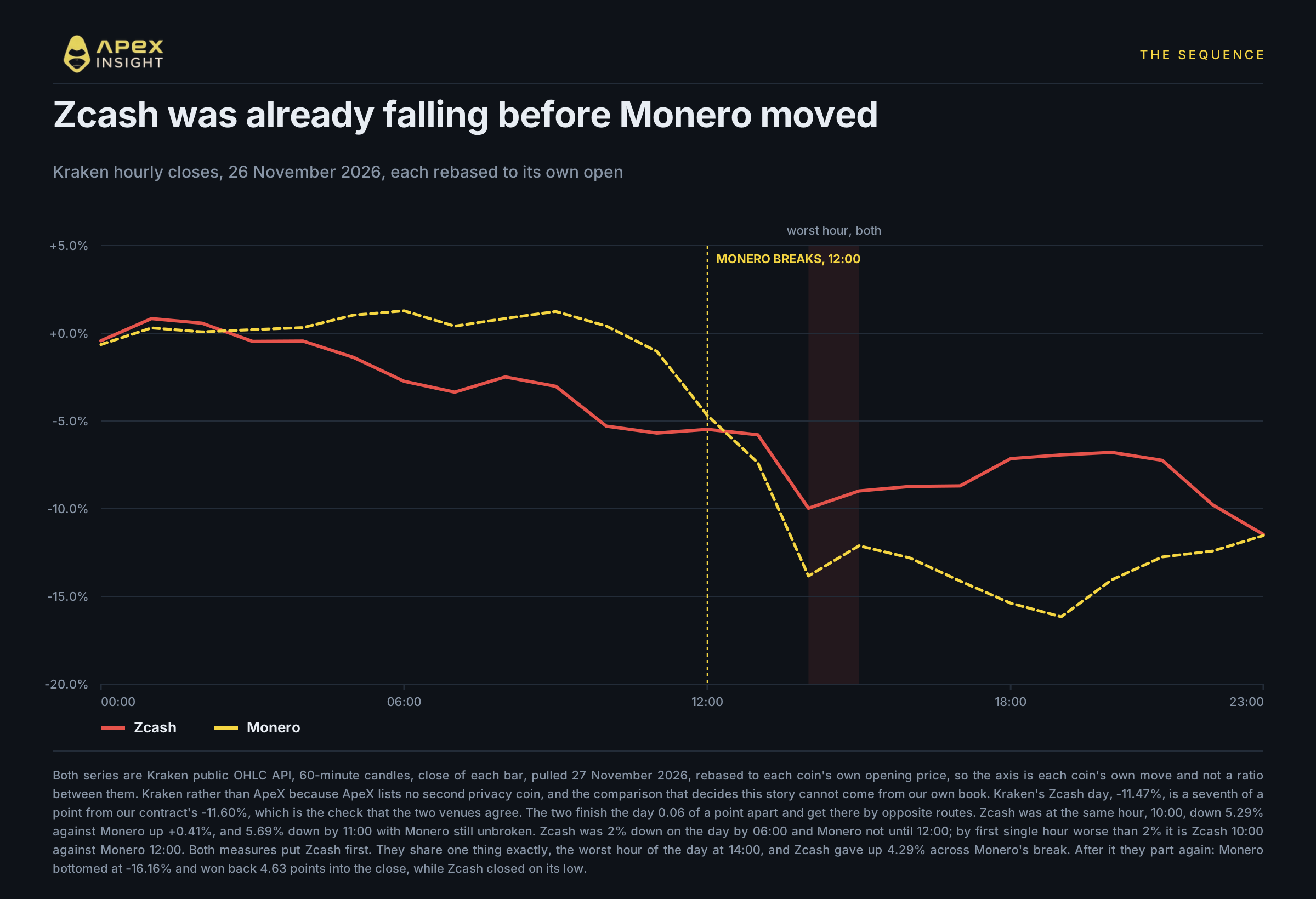
Both coins on Kraken, both rebased to their own opening price, both on the same clock:
Zcash was already 2% down on the day by 06:00. Monero did not get there until 12:00, six hours later.
Counted a different way, by the first single hour that fell more than 2%: Zcash 10:00, Monero 12:00. Both measures put Zcash first.
At 10:00, Zcash was down 5.29%. Monero was up 0.41%.
By 11:00, Zcash was down 5.69% and Monero still had not broken.
Monero then fell hard: −3.69% at 12:00, −2.84% at 13:00, −6.96% at 14:00.
Zcash's worst hour was also 14:00, at −4.45%.
Monero bottomed at −16.16% around 19:00 and won back 4.63 points into the close. Zcash closed on its low.
The two finish 0.06 of a point apart and get there by routes that barely resemble each other. The reporting corroborates the shape: Monero held between roughly $515 and $528 through the earlier part of the day before breaking, and the first wire stories on the delisting are timestamped around 14:20 UTC, inside the hour both coins fell hardest.
So the honest accounting of Zcash's 11.47% on Kraken looks like this. Roughly 5.7 points went before Monero had moved at all. Roughly 4.3 points went during Monero's break, from 11:00 to 14:00. The remaining 1.5 points went afterwards, in a stretch where Monero was recovering and Zcash was not.
The answer to the question in the title, then, is: about a third of it at the very most, and only for a three-hour window in the middle of the day. The rest was Zcash's own, and even that middle window is contested, for reasons the previous section gives.
That one shared hour is worth taking seriously. Both coins printing their worst hour of the day in the same sixty minutes is unlikely to be chance, and the most coherent explanation is that Monero's break pulled capital out of anything that looked adjacent to it. It is not the only explanation available, since a Zcash-specific story landed thirty-nine minutes earlier. But a shared hour is a shared hour either way. It is not a shared day.
A caveat on the comparison. ApeX lists no second privacy coin, so the Monero figures are Kraken spot; the check that the venues agree is Zcash itself, at −11.47% on Kraken against our −11.60%. Dash, the third name usually grouped with these two, finished −0.07%, so "privacy coins fell" does not survive contact with the third one. Dash is small and thinly traded, which makes that weak evidence, but it points against the category reading rather than for it.
It does not look like a liquidation cascade
The other ready-made explanation for a fast 11% is forced selling, and the positioning data does not support it either.
Open interest measured in coins rose about 9.6% on the day, from roughly 1.97 million ZEC to 2.16 million. The unit matters: because the price fell 11.6% at the same time, open interest measured in dollars was roughly flat to slightly lower. Whichever unit you prefer, more contracts were open at the end of the day than at the start, and a cascade closes positions rather than opening them.
The liquidations point the same way, with a caveat about how they are counted. TokenPost recorded long liquidations of about $910,000 in the hour to 14:51 UTC and $1.15 million in the hour to 22:57 UTC, across Binance, Bybit and OKX. For scale, CoinGlass put Zcash long liquidations at roughly $35.81 million for the whole of 20 November, six days earlier.
Those are not measured the same way: hourly and three venues against daily and all venues. The gap is partly an artefact of the comparison, so read it as an order of magnitude and not a ratio. Nor were these necessarily the day's heaviest hours. They are the two that cleared a provider's reporting threshold.
What that leaves is ordinary selling: people deciding to be smaller, over a full day, and still deciding it in the last hour.
The two months behind the one day
A single day only means something against a baseline, and Zcash's baseline has been deteriorating for two months.
This is the tail end of a much larger move
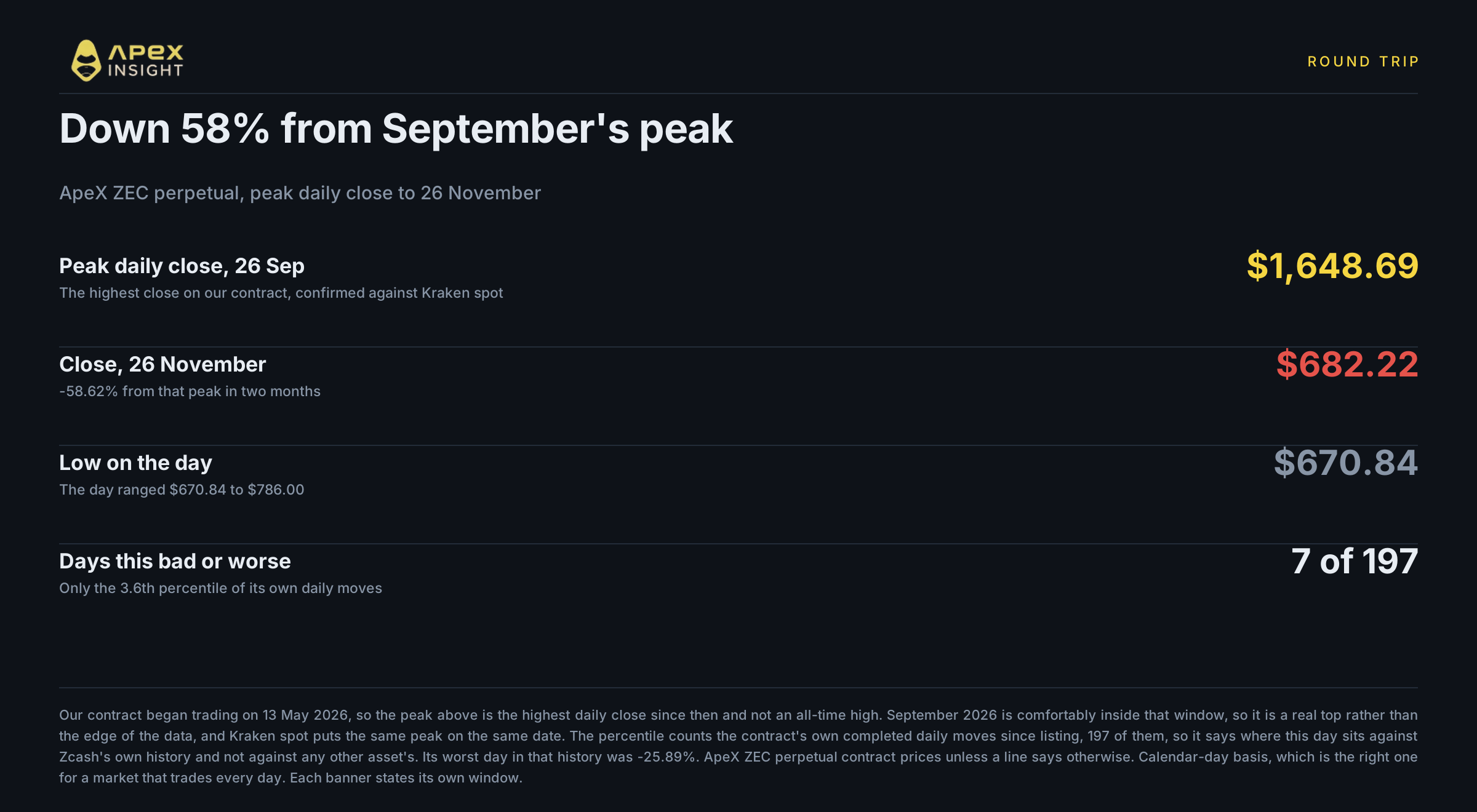
Our contract's highest daily close was $1,648.69 on 26 September 2026. The close on 26 November was $682.22, which is −58.62% from that peak in two months to the day. The day's range was $670.84 to $786.00.
Against Zcash's own history the day was severe but not unprecedented: only 7 of 197 completed days since our contract listed were this bad or worse, putting it at the 3.6th percentile. Its worst single day in that history was −25.89%.
The contract began trading on 13 May 2026, so that peak is the highest daily close since then and not an all-time high. September sits comfortably inside the window rather than at its edge, which is what makes it a real top rather than an artefact of where the data starts. Kraken spot puts the same peak on the same date.
This is also where the week and month comparisons matter. Both sides of them are Kraken spot, so the comparison is like for like: over seven days Zcash is down 23.70% against Monero's 8.04%, and over thirty days 47.90% against 24.57%. On our own contract the same two windows read 23.73% and 47.95%, which is the venues agreeing again. On every window longer than a day, Zcash is roughly two to three times worse. Whatever was happening on 26 November, it was happening on top of something that had been running for two months and had nothing to do with Monero.
The buyer that could not show up
One more feature of 26 November is specific to the date rather than the asset.
The fund was shut while spot fell 11%
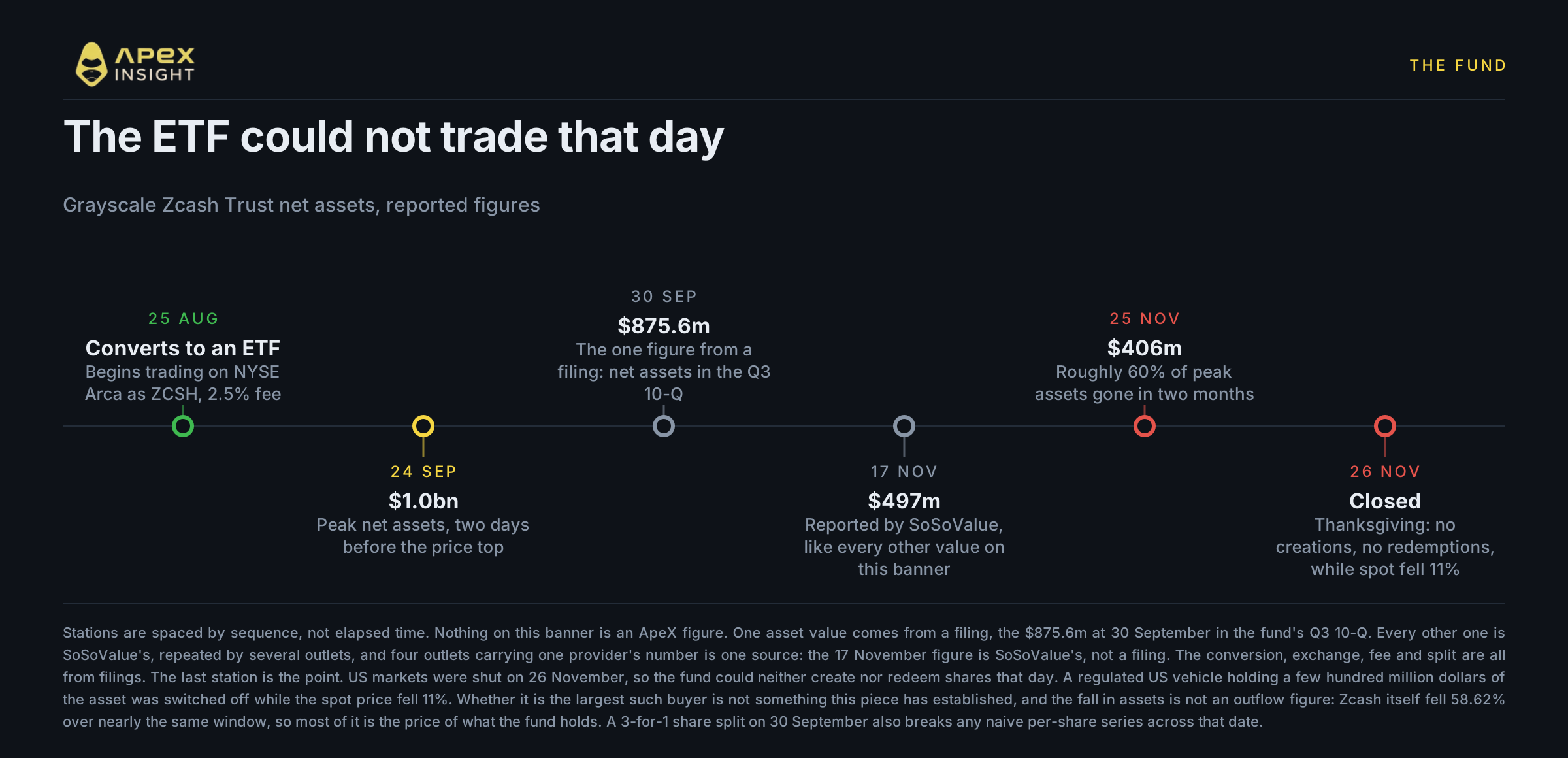
Grayscale's Zcash vehicle converted to an ETF on 25 August 2026 and trades on NYSE Arca as ZCSH at a 2.5% fee, all three confirmed in the fund's own filings. Its net assets reportedly peaked around $1.0 billion on 24 September, and the one figure that comes from a filing rather than a data feed is $875.6 million at 30 September, in the Q3 10-Q. By 17 November the reported figure was $496.79 million and by 25 November roughly $406 million: about 60% of the peak gone in two months.
One thing that number does not mean. Zcash itself fell 58.62% over almost exactly that window, so most of the decline in the fund's assets is the price of what it holds, not investors leaving. Treat it as a measure of how much smaller the vehicle got, not as an outflow figure.
On 26 November the fund could do nothing at all. US markets were shut for Thanksgiving, so there were no creations and no redemptions while spot fell 11.6%. A regulated US vehicle holding a few hundred million dollars of the asset was switched off for the day.
That cuts both ways. A shut ETF cannot sell into a falling market, but it cannot buy a dip either, and the arbitrage that normally ties the fund to spot was not running. One of the channels through which this asset usually trades was closed, which thins a market, and a thin market moves further on the same flow.
Every asset value above except the 30 September one traces to SoSoValue, a single data provider repeated by several outlets, and four outlets repeating one provider is still one source. The registrant filed nothing on or near 17 November; its filings carry net assets only at quarter-end, which is why 30 September is the one figure here with a filing behind it. A 3-for-1 share split on 30 September also breaks any naive per-share series across that date.
What the European rule actually says
Hanging over all of this is a regulatory story that is routinely reported one notch stronger than the text supports, and it is worth correcting because it shapes how people read every privacy-coin delisting.
The regulation bans accounts, not coins
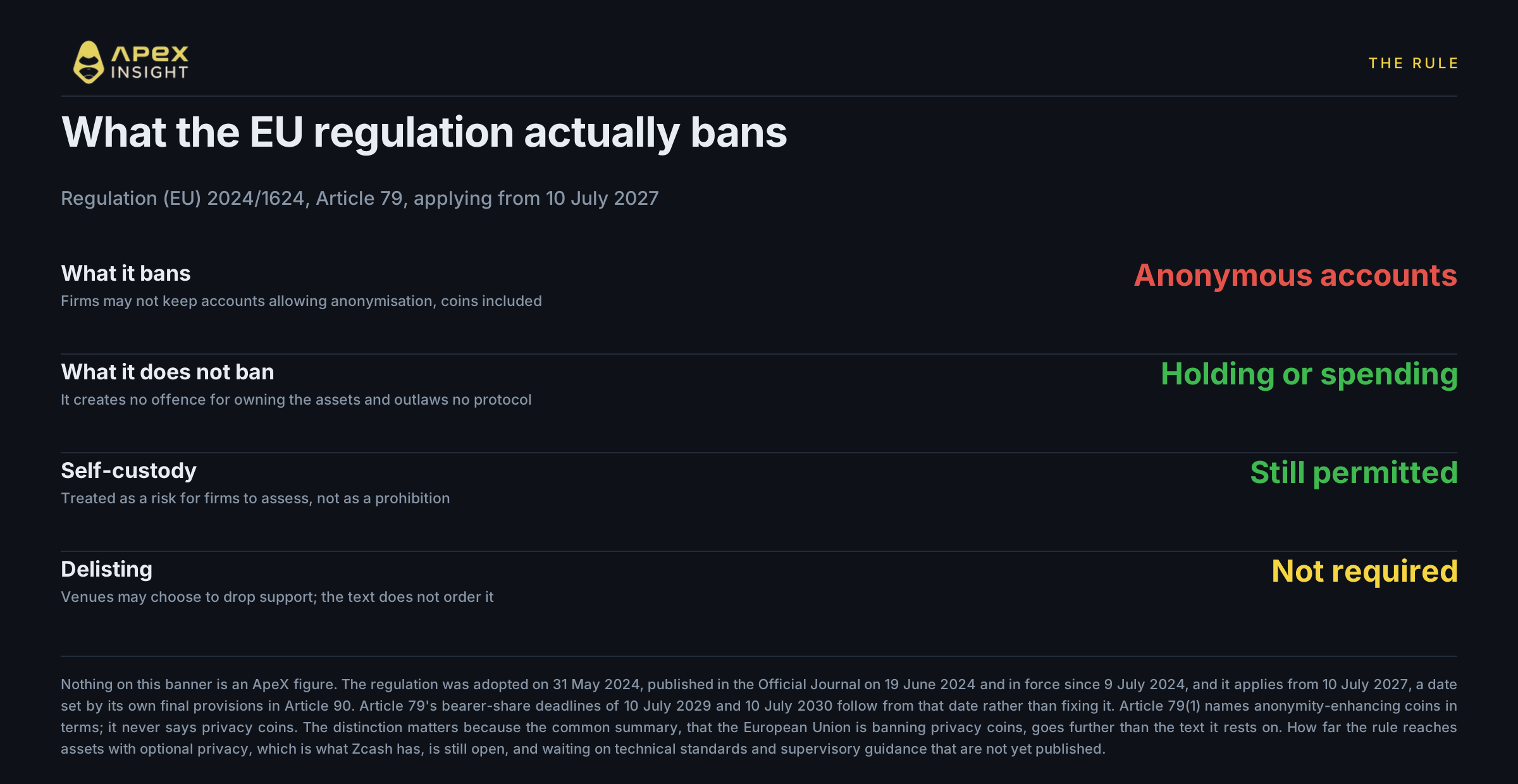
Regulation (EU) 2024/1624, the European Union's anti-money-laundering regulation, was adopted on 31 May 2024, published in the Official Journal on 19 June 2024, and applies from 2027. Its Article 79 prohibits credit institutions, financial institutions and crypto-asset service providers from keeping anonymous accounts, and the text does name the asset class: it covers accounts allowing the anonymisation or increased obfuscation of transactions, "including through anonymity-enhancing coins". It never uses the phrase "privacy coins".
What it does not do: it creates no offence for owning or spending these assets, outlaws no protocol, treats self-custody as a risk for firms to assess rather than a prohibition, and orders no venue to delist anything. Exchanges that have dropped support made a commercial decision about compliance cost, which is real and has real price consequences, and is the most natural reading of Monero's day. But "the EU is banning privacy coins" is a stronger claim than the text it rests on, and how far the rule reaches assets with optional privacy, which is what Zcash has, is still open and waiting on technical standards that have not been published.
The application date is 10 July 2027, set by the regulation's own final provisions in Article 90. Article 79's bearer-share deadlines of 10 July 2029 and 10 July 2030 follow from that date rather than fixing it.
So what was it?
Putting it together.
Zcash fell 11.60% on a day the median crypto contract rose 0.67% and Bitcoin moved 0.21%. What the day does not support is the explanation almost everyone reached for: Monero's delisting cannot account for a slide already five points deep before Monero ticked down, and it cannot account for a close Monero did not share.
What is left is less tidy, and the honest version says so:
The morning belongs to Zcash. The one Zcash-specific item of the day, Zakura's Sapling proposal, went up at 01:40 and the slide began in the 02:00 hour. That is suggestive and nothing more; one day cannot separate a market reading a proposal from a market that was going to sell anyway.
The 14:00 hour has two candidates and this piece cannot choose between them. Monero broke in it, which is real and is why both coins printed their worst hour together. A Zcash-specific story also reached a large audience thirty-nine minutes before it.
The close is Zcash alone, and it is the part nobody has an explanation for. The last three hours took 5.03% and finished on the low of the day while Monero was climbing off its own.
The positioning data does not look like a liquidation cascade: open interest in coins rose rather than fell, and the liquidations that were reported are a fraction of a bad day a week earlier. A privacy-coin sector repricing does not fit either, though that rests on a weak control, since the third name usually grouped with these two was flat and is small and thinly traded.
The least dramatic description is probably the right one. Zcash is two months into unwinding a very large move, down 58.62% from its September peak, and was having another bad day in a long run of them, in a holiday-thinned market with the ETF channel shut and two separate pieces of news landing on it. Monero's was the loudest and the easiest to point at.
Two assets finishing six hundredths of a point apart made it look like one story. It was more than one, and they overlapped for an hour.
Trade ZEC on ApeX
Zcash perpetual contracts, open every hour of the holiday.
The holiday shut the fund and the cash market. It did not shut the contract.
The subject of this piece:
ZEC, which traded every one of the 24 hours described above
The control that did nothing:
BTC, +0.21% on the day and never more than 0.89% from its open
The majors that topped in the same month Zcash did:
Trading perpetual futures and other leveraged products carries a high risk of loss, and you can lose some or all of your funds. Nothing here is financial advice.
If you need any help, feel free to reach out to our team on Discord.
Website: https://www.apex.exchange
Twitter: https://twitter.com/OfficialApeXdex
Telegram: https://t.me/ApeXdex
Methodology. Zcash and Bitcoin prices are ApeX perpetual contract closes, not spot and not the underlying asset, and the two differ. Monero and Dash are Kraken spot, computed from their public OHLC API, because ApeX lists no second privacy coin and the comparison this piece turns on cannot come from our own book; so are the seven-day and thirty-day figures for both coins in section 6, which are quoted Kraken-to-Kraken so the two sides are like for like, with our contract's own readings given alongside. Every banner and figure drawn from Kraken says so on its face. The two venues are reconciled on the one asset they share: Kraken has Zcash at -11.47% on the day against our contract's -11.60%. Both ApeX and Kraken bars are start-stamped, so the bar labelled 14:00 covers 14:00 to 15:00 UTC, and a day's open is the previous day's 23:00 close; the day chart is rebased to that open rather than to the 00:00 bar's close, which would have ended the series at -11.08% and disagreed with every other figure here by half a point. The forming bar is dropped. The four legs in section 2 are cut where the cumulative path changes sign, not at equal intervals: an earlier draft bucketed 14:00 with 15:00 and reported -3.31% for the pair when 14:00 alone was -4.08% and 15:00 rebounded, which averages a fall with its own recovery and understates both. The cross-section ranks 70 crypto contracts on calendar-day closes; equity and index contracts are excluded because the US cash market was shut all of 26 November, which makes those bars perpetual order flow rather than a price in any share, and frozen contracts and first listing bars are dropped. The peak and drawdown are measured on our contract's completed daily closes since it listed on 13 May 2026, so the peak is the highest close in that window and not an all-time high; September 2026 sits well inside the window rather than at its edge, and Kraken spot puts the same peak on the same date. The percentile counts the contract's own 197 completed daily moves. Open interest is denominated in ZEC and not in dollars, and the distinction reverses the sign of the change, so it is stated in the text. Liquidation figures are third-party and not ApeX data, and they are not mutually commensurable: the two hourly figures are TokenPost's across Binance, Bybit and OKX, while the 20 November comparison is CoinGlass's across all venues for a full day, so the gap between them is partly an artefact of the comparison. Grayscale asset values are reported figures from SoSoValue, one data provider repeated by several outlets, with the single exception of 30 September 2026, which is the net asset figure in the fund's own Q3 10-Q; the conversion date, exchange, fee and share split are all from the fund's filings. A 3-for-1 share split on 30 September breaks any naive per-share series across that date. The claim that Monero moved after Zcash is derived by putting both series on one clock and reading across, not taken from any summary; an earlier draft had it the other way round on the strength of a summary, and the build script carries an assertion that fails if the data ever stops supporting it. Where this piece offers an explanation for a price move it says that is what it is doing, and where two explanations fit it says so rather than choosing.