





Why did Indonesia cut the gas to Singapore?
Indonesia started cutting pipeline gas exports to Singapore today.
The official answer is procedural. Indonesia's upstream regulator says it is redirecting the gas to power stations at home, and cites the domestic-supply-priority provision of the country's oil and gas law. The subtext some readers will reach for is a noisy week in Jakarta, in which the energy minister twice raised ending export contracts and the president told a cabinet session that Indonesia does not want to be insulted all the time. Section two lays that week out, dated and quoted, and leaves the reading to you.
Then there is the question the market answered, which has a cleaner answer. If you trade energy on headlines, a supply cut sounds like a reason to be long gas. It was the opposite. US gas spent that week falling out of its range: the front-month contract settled at $3.058 on Monday 19 October, $2.963 on Tuesday, slid 4.5% on Wednesday, and on Friday, the day SKK Migas announced the cut, lost the $3 handle entirely and closed near $2.64, down about 6% on the session and roughly a fifth on the month. Asian spot LNG was above $31 at the same time.
Read the American market commentary from that week and Indonesia does not appear in it. What appears is mild weather, a warm November outlook and storage still building. One report published two days before the cut put it in five words: "The selling reflects weather, not supply."
Here are six things that make sense of it.
1. What Indonesia actually cut
The facts are narrow and well documented, which is more than can be said for most of the coverage.
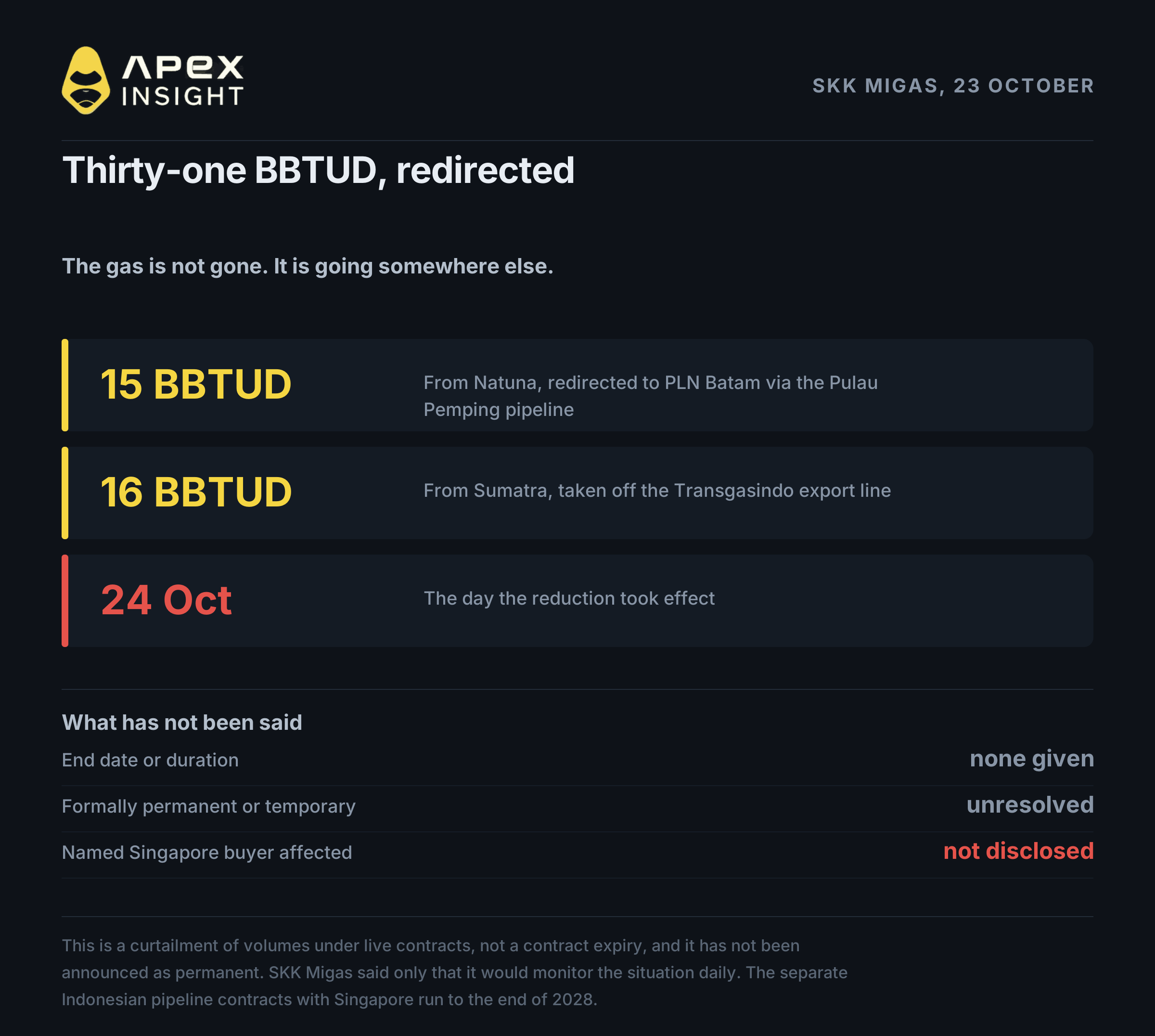
Indonesia's upstream regulator, SKK Migas, announced on 23 October that exports to Singapore would fall by 31 BBTUD, or billion British thermal units per day, starting the following morning. The cut splits into two pieces: 15 BBTUD from the Natuna fields and 16 BBTUD from Sumatra, the latter from the Jambi Merang field.
Djoko Siswanto, who heads SKK Migas, put it plainly in Jakarta, in the English rendering carried by The Star: "Starting tomorrow, we will reduce gas exports to Singapore by 15 BBTUD from Natuna and 16 BBTUD from Sumatra." The same report identifies the Sumatran volumes as coming from Jambi Merang.
A note on units, since the Indonesian and English coverage do not use the same one. English-language reports give the cut as 31 BBTUD, billion British thermal units per day. CNN Indonesia gives it as 31 MMscfd, million standard cubic feet per day. Those are different units that happen to land on almost the same number for this gas, which is why both say 31.
The gas is not disappearing, it is being redirected. CNN Indonesia reported that the Natuna volumes go to PLN Batam through the Pulau Pemping pipeline, and the Sumatran volumes come off the Transgasindo export line to serve power demand in Batam, Bintan and Sumatra. Djoko's stated legal basis is the domestic-supply-priority provision of Indonesia's 2001 oil and gas law. Separately, energy minister Bahlil Lahadalia has tied the wider review of export policy to a directive from President Prabowo Subianto, but that is a different statement about a different thing, and no official has presented the Singapore cut as executing a presidential instruction.
Three things are worth noting about what has not been said. No Singapore buyer has been named. No end date, review date or duration has been given, and Djoko said only that his agency would monitor the situation daily. And this is a curtailment of volumes under live contracts, not a contract expiry and not announced as permanent. Anyone describing it as either is filling in a blank.
2. The week before the cut, in order
The cut came at the end of a week in which senior Indonesian officials said a number of things in public about energy exports. Here is that week, dated, quoted, and with the occasion each remark was made on. What you make of it is your business.
Before the sequence, the thing that argues against reading too much into it: this is not the first trim. Indonesia ran a multiparty gas swap in 2025 that redirected 27 BBTUD of West Natuna volumes to the domestic market, physically supplied by South Sumatra producers, after Medco agreements in May 2025 diverted gas originally destined for Singapore. And in 2022 Indonesia agreed to supply Singapore until 2028 at lower volumes than before. A standing policy of putting domestic supply first, applied repeatedly since 2022, sits behind this week.
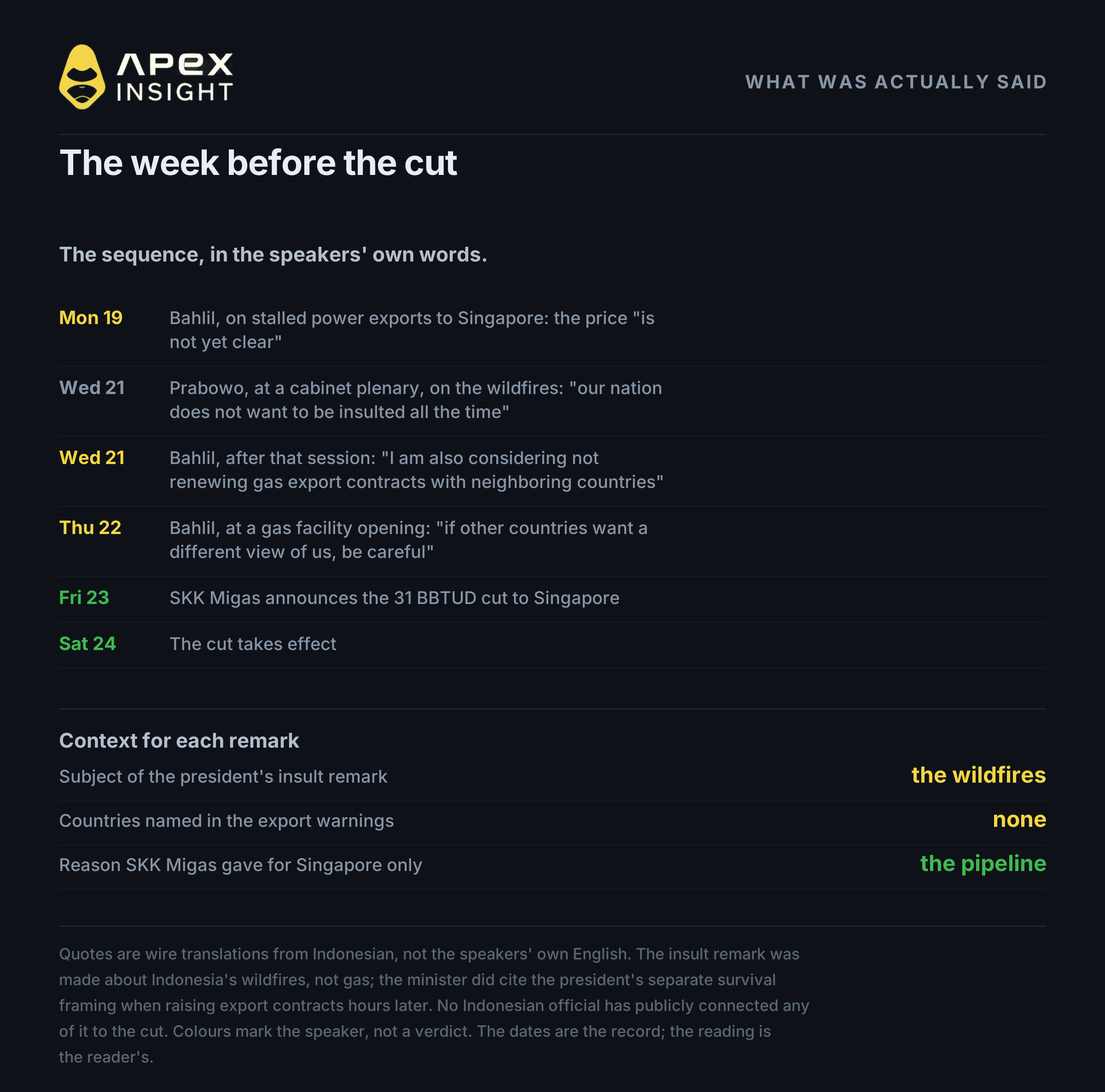
Monday 19 October, Sanur. Energy minister Bahlil Lahadalia, who since 1 October has also served as Coordinating Minister for Downstreaming and Energy Transition, is asked about Indonesian electricity exports to Singapore, which have stalled. He says: "we have not reached a deal because the price is not yet clear," and "Once the price is clear, I will send the electricity." Singapore has granted conditional licences to seven Indonesian companies for roughly 3.4 gigawatts.
Wednesday 21 October, Merdeka Palace, Jakarta. A plenary cabinet session marking two years of the Prabowo administration. It covers several subjects. On the smuggling of natural resources, President Prabowo Subianto says: "We are now in a condition where we must survive. We must save our wealth, our natural resources," and "They are like our blood. If our blood keeps leaking, our body cannot survive." On Indonesia's wildfires, which he calls environmental terrorism, he turns on the country's critics: "Indonesia is a polite and patient nation. Our country is often insulted, but believe me, our nation does not want to be insulted all the time." He names no country.
Wednesday 21 October, after that session. Bahlil tells reporters in Jakarta that officials "must translate everything President Prabowo has said into concrete programs," and that he is considering not renewing gas export contracts with neighbouring countries: "I am also considering not renewing gas export contracts with neighboring countries." His stated reason is the survival framing from the meeting, that Indonesia has to meet domestic needs first. He names no country.
Thursday 22 October, at the inauguration of a gas facility. Bahlil says, in the wire translation: "So, if other countries want a different view of us, be careful. I might also consider not renewing gas exports to neighboring countries." English headlines rendered a related line as refusing to hesitate over stopping exports to countries that do not respect Indonesia. He does not appear to name any country.
Friday 23 October. SKK Migas announces the 31 BBTUD reduction to Singapore, effective the next morning. Asked why Singapore alone, Djoko points at the plumbing: the pipelines only go there.
Saturday 24 October. The cut takes effect.
That is the record. The president's remarks on being insulted were made about the wildfires, not gas. His survival and natural-resources remarks were about smuggling, though Bahlil expressly cited that framing when he raised export contracts hours later. No Indonesian official has publicly tied any of it to the Singapore cut, and at the time of writing no Singapore government or power producer had responded to the cut at all. Worth holding alongside all of it: the volume involved is around 2.5% of Singapore's gas supply, which is a thin instrument of coercion. Readers can weigh the sequence for themselves.
3. How small 31 BBTUD actually is
Scale is what turns a frightening headline into a tradeable fact, and this one shrinks under inspection.
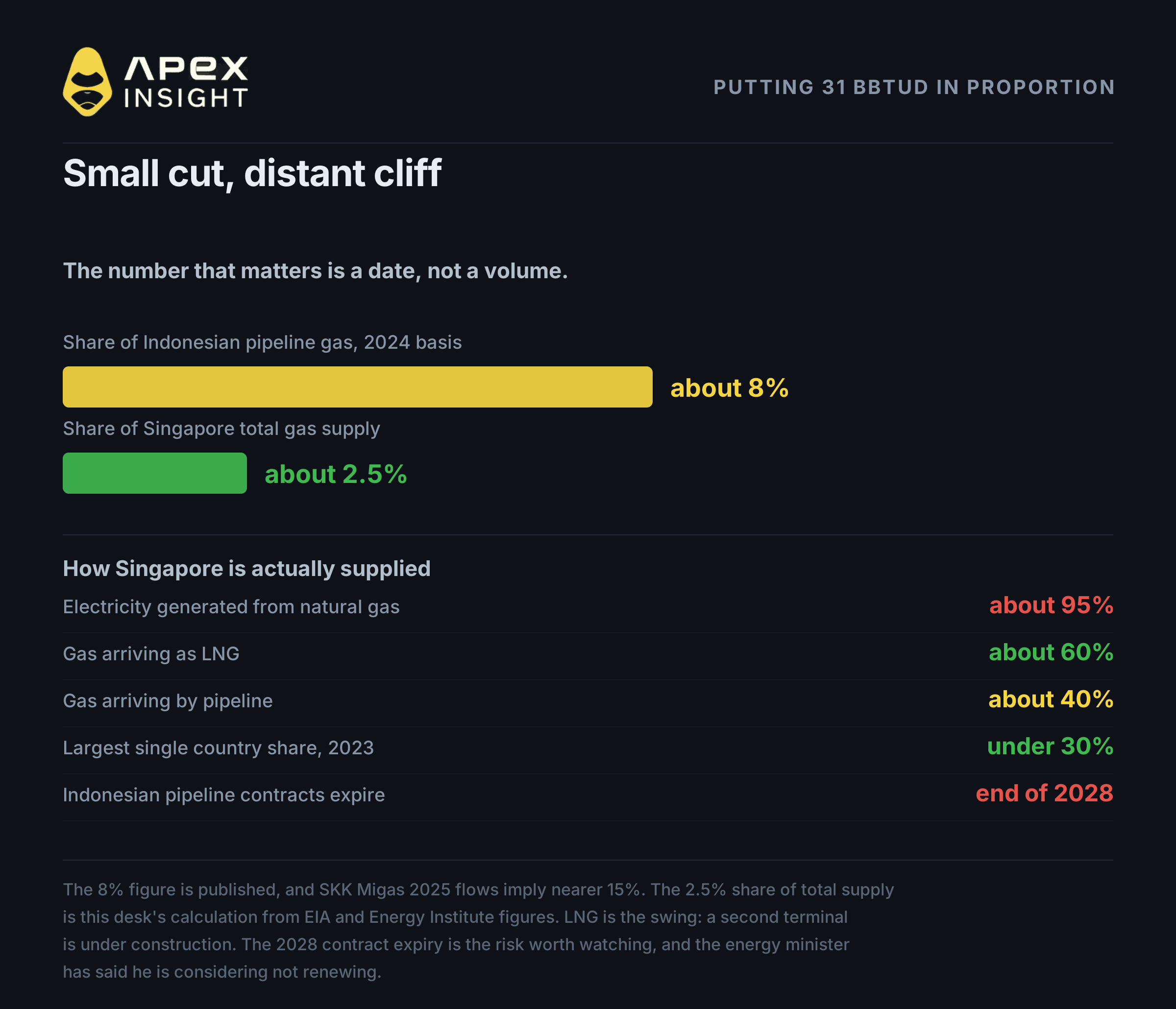
Two published figures bracket it, and they disagree, so here are both. Indonesia piped about 4.11 billion cubic metres of gas to Singapore in 2024 on EIA data, which makes the cut about 8% of that flow. But SKK Migas put 2025 pipeline exports to Singapore nearer 200 million cubic feet a day, against which 31 is about 15%. The gap is a year of declining flows, and the honest answer is that the cut is somewhere between 8% and 15% of what Indonesia currently pipes south. Against Singapore's total gas consumption, our own arithmetic puts it at roughly 2.5% either way.
Singapore is unusually exposed to gas in general: about 95% of its electricity comes from it. But its supply is deliberately diversified. Roughly 40% arrives by pipeline from Indonesia and Malaysia and the balance as LNG. Gan Kim Yong, now Deputy Prime Minister and Minister for Trade and Industry, said in September 2023 that no single country accounted for more than 30% of Singapore's gas imports. That figure is three years old and we found no more recent official restatement, which is worth saying plainly because it does not sit easily beside the arithmetic above. LNG is the swing, and onshore work has begun on a second LNG terminal.
The genuine risk is not 31 BBTUD. It is the calendar. Singapore's pipeline contracts with Indonesia expire at the end of 2028, and Bahlil has openly said he is considering not renewing. That is the question worth watching, and it is just over two years away rather than today.
One mechanical note for anyone expecting Singapore power bills to jump. Household tariffs are set from gas prices over the first two and a half months of the preceding quarter, so a cut on 24 October cannot reach a bill before the first quarter of 2027. At 2.5% of supply, the effect would be small in any case.
4. There is no such thing as "the gas price"
This is the part that explains why the price on your screen ignored the news, and then went the other way.
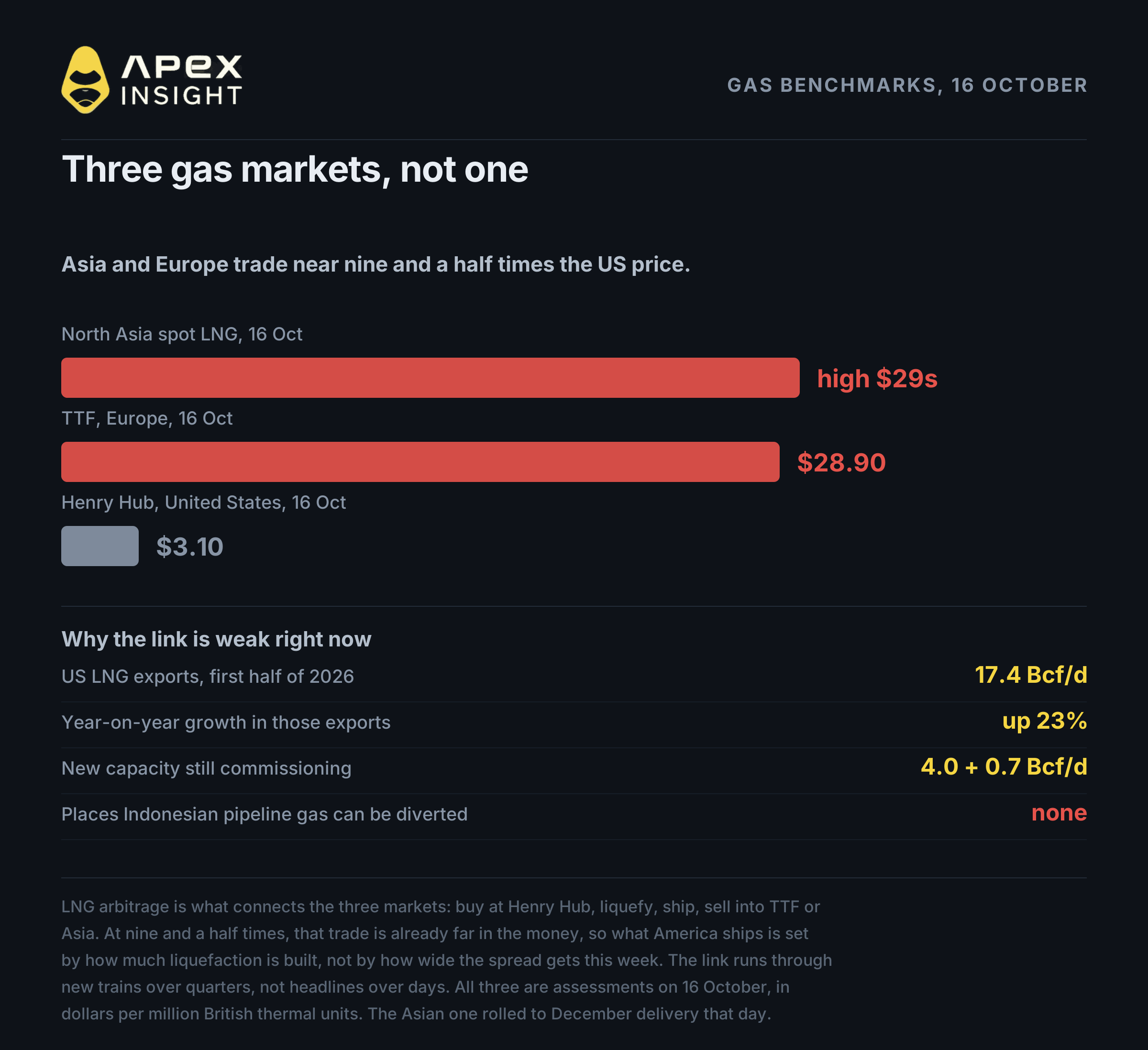
Natural gas is not one global market. It is three regional ones that happen to share a name, and they were trading like this last week:
Taking all three from one weekly assessment series on the same day, 16 October:
Benchmark | Region | Assessment, 16 October |
|---|---|---|
Henry Hub | United States | about $3.10 |
TTF | Europe | about $28.90 |
North Asia spot LNG | Asia | high $29s |
On those dates Asia and Europe were trading at roughly nine and a half times the American price, and by Friday's US close the gap was nearer twelve times. That spread is itself the proof that these are separate markets.
One caveat on the Asian figure, because it is the sort of thing that trips people up. That assessment rolled its delivery month from November to December on 16 October, which is part of why it jumped from the low $26s a week earlier. Some of that move is the roll, not the market.
The thing that connects the three is LNG arbitrage. An American exporter buys gas at Henry Hub, pays to liquefy and ship it, and sells it into Europe or Asia. When the spread is wider than that cost, cargoes sail and the markets pull on each other.
Here is why that link transmits so weakly on a given day. The spread is not marginally profitable, it is enormously profitable, and has been for months. At roughly ten times Henry Hub on the dates above, and nearer twelve times at Friday's prices, every cargo that can physically be liquefied is already contracted and already sailing. US LNG exports averaged 17.4 billion cubic feet a day in the first half of 2026, up 23% year on year. When the arbitrage is already this far in the money, what America ships is set by how much liquefaction has been built and commissioned on spreads expected years ago, not by how wide the spread gets this week. Widening an already-saturated arbitrage moves no additional molecules in the short run.
That is a claim about speed, not about disconnection. The link is real and it is tightening: the same EIA note has Plaquemines exporting at full capacity, Golden Pass still ramping, and Corpus Christi Stage 3 nearing completion, which Cheniere confirmed on 28 August when the last of its seven trains was handed over. The EIA puts the combined nominal capacity from Plaquemines and Corpus Christi Stage 3 at 4.0 billion cubic feet a day, with Golden Pass Train 1 adding another 0.7. The EIA expects exports to reach 18.7 billion cubic feet a day in the first half of 2027. Global prices do reach Louisiana, but they arrive through new trains commissioning over quarters, not through a Friday headline.
The honest counter-example, and it is a good one, is June 2022. When a fire shut the Freeport LNG terminal, Henry Hub fell double digits in a single session, because roughly two billion cubic feet a day of export demand vanished overnight. That is the same mechanism running in reverse and at speed. It is a capacity event, not a spread event, which is the point: it is the pipes that transmit, not the price signal.
Indonesian pipeline gas has even less optionality. It cannot be diverted anywhere, because, as Djoko said, the pipeline only goes to Singapore. It is not competing for cargoes with anyone.
Separately, Société Générale analysts Michael Haigh and Jeremy Sellem argue the gap stays wide for years yet. In a note reported by FXStreet and carried by Mitrade, they write that "the war has pushed global gas-price convergence back by more than two years," with convergence "pushed back to the end of 2028." Their reasoning is different from the capacity argument above and worth noting as such: they point to damaged Qatari liquefaction, disrupted Hormuz flows, and Qatari exports not returning to pre-war levels until the end of 2027. Their original baseline was US to European convergence, which is a narrower comparison than the one this section makes.
5. The precedent that makes the case
If the argument above still feels theoretical, July ran a much bigger version of the same test.
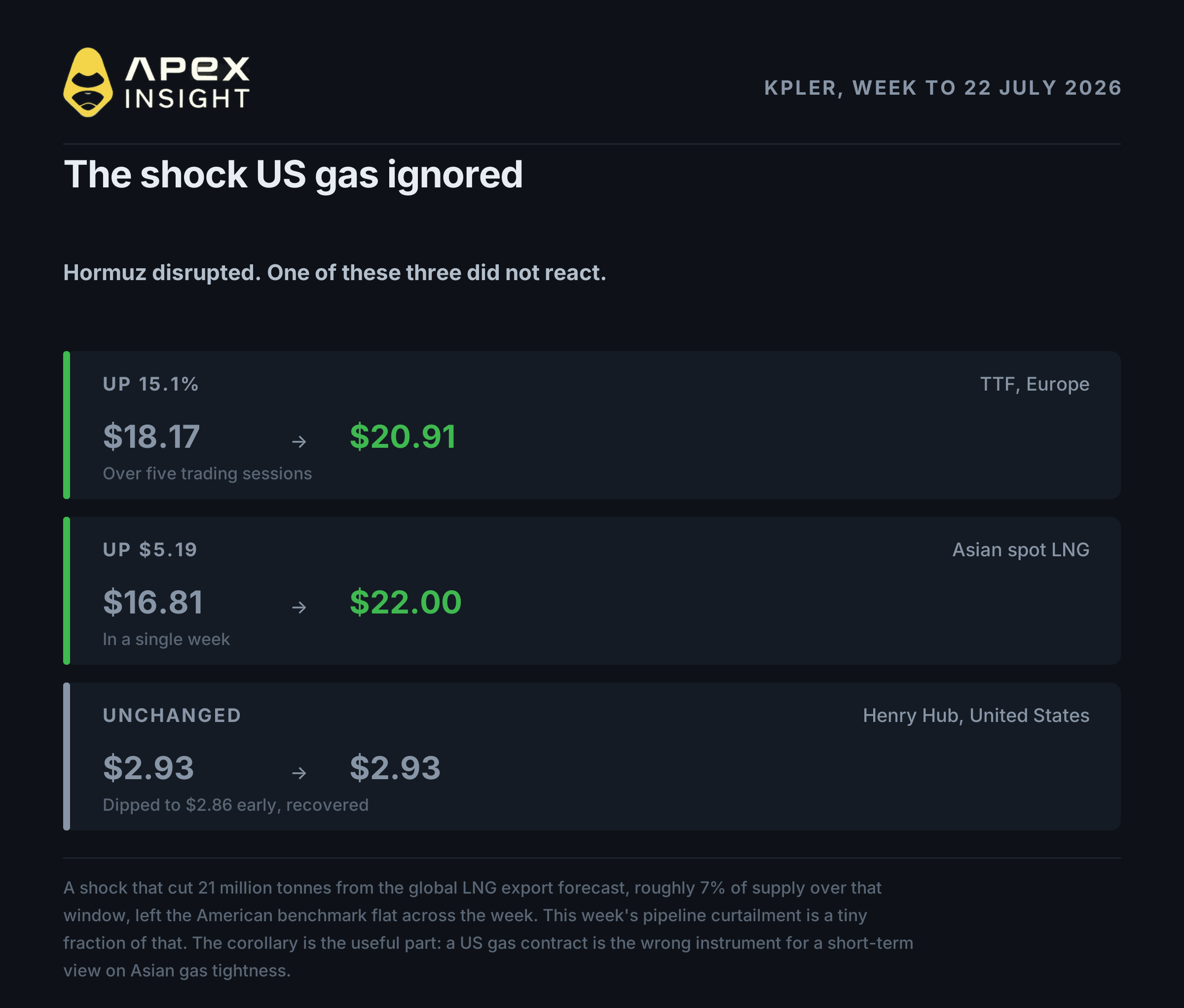
When hostilities between the United States and Iran resumed and the Strait of Hormuz was disrupted, a large slice of global LNG supply came under threat. Kpler cut its global LNG export forecast by 21 million tonnes across July 2026 to March 2027 on the back of it, with Qatar's 77-million-tonne-a-year Ras Laffan complex and the UAE's Das Island among the facilities slowed or stopped. Here is what that did to each benchmark:
Benchmark | Week to 22 July 2026 |
|---|---|
TTF | $18.17 to $20.91, up 15.1% |
Asian spot LNG | $16.81 to $22.00 |
Henry Hub | $2.93, unchanged on the week |
Europe rose 15.1% over the five trading sessions in that window. Asia rose more than five dollars. The American benchmark finished where it started, having dipped to $2.86 early in the window and recovered.
Hold that next to this week. A shock that took 21 million tonnes out of the global LNG forecast, roughly 7% of supply over that window, left Henry Hub flat across the week. A 31 BBTUD pipeline curtailment in Southeast Asia is a tiny fraction of that. The most coherent reading is that a cut this size was never going to register on an American contract.
The corollary matters too, and it cuts the other way. If you want short-term exposure to Asian gas tightness, a US gas contract is the wrong instrument. On the two occasions this year when Asian prices spiked, it did not follow.
6. What actually drives US gas, and where it goes next
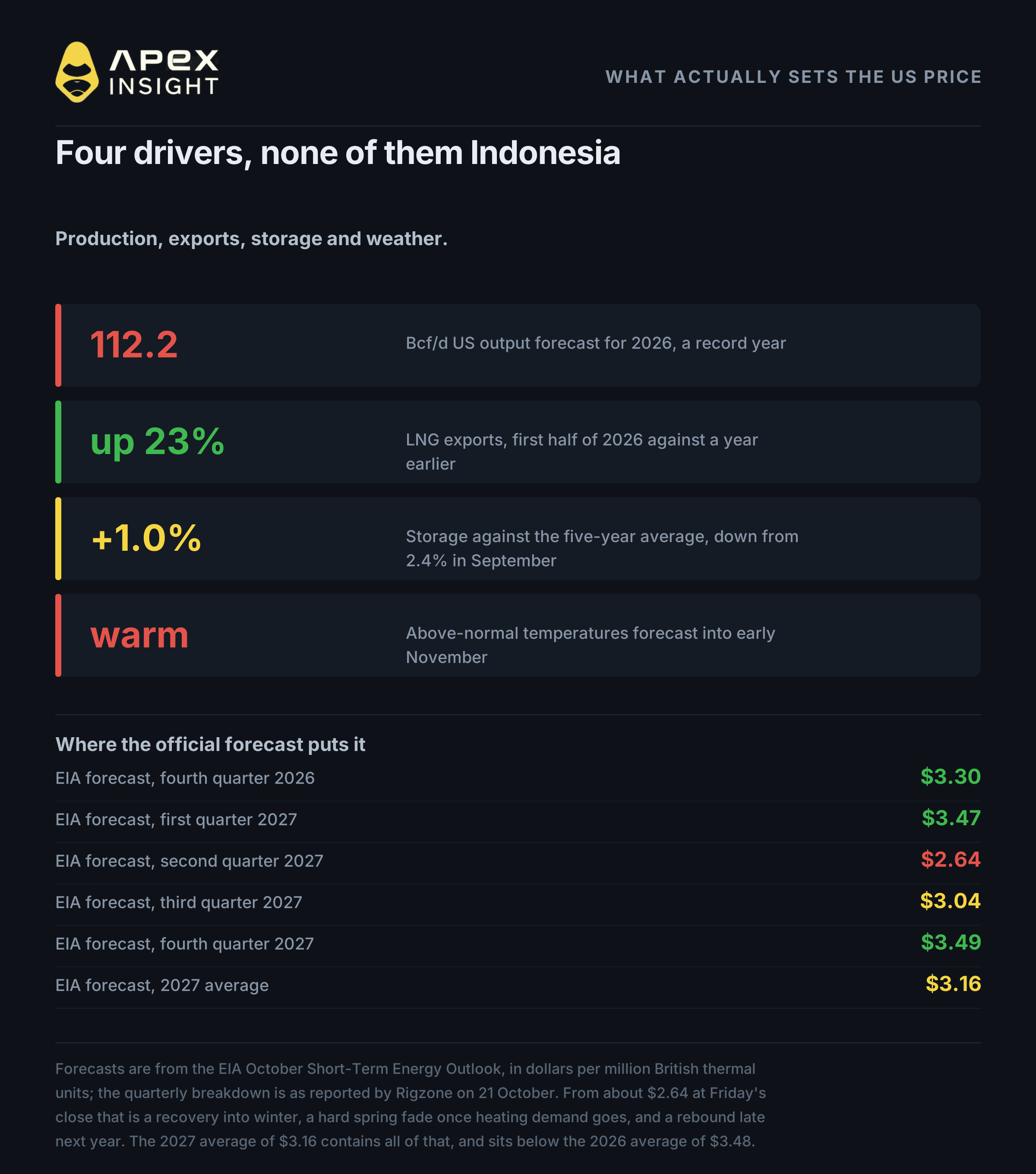
So if not Indonesia, what? Four things, and over the coming weeks weather is the one doing the most work.
Production, which is the bearish anchor. US output is on track for a record year, running about 4% above 2025, with the EIA forecasting 112.2 billion cubic feet a day for 2026 and 116.1 for 2027. Record supply is why $3 has behaved like a ceiling as much as a floor.
LNG exports, which are the bullish counterweight. This is the mechanism from section four seen from the other end. The Asian spot price does not move Henry Hub on the day, but the capacity being built to chase that price absolutely moves it over quarters. Golden Pass began exporting in April and is still ramping, Corpus Christi Stage 3 reached substantial completion in August, and Plaquemines is now exporting at full capacity. Exports averaged 17.4 billion cubic feet a day in the first half of this year and the EIA expects 18.7 in the first half of next. Note what that implies, because the article should not oversell it: 7.5% growth against the 23% just recorded, so the bullish force is real but decelerating sharply. It is still the thing slowly eating the storage cushion.
Storage, which is comfortable but tightening. Inventories rose 77 billion cubic feet in the week to 16 October, taking working gas to about 3,644 billion cubic feet, roughly 1% above the five-year average. The number to watch is not the level but the direction: that surplus has narrowed from about 2.4% in late September to 1% now.
Weather, which right now is setting the price. Forecasts of above-normal temperatures across the Midwest and East into early November are suppressing heating demand at exactly the moment the market would normally start pricing winter. This is what drove the week's slide, and it is why the front-month lost the $3 handle while a supply cut was being announced on the other side of the world.
As for where it goes, the EIA's October Short-Term Energy Outlook has Henry Hub averaging $3.16 across 2027, below 2026's $3.48. The quarterly path underneath that annual number is the interesting part, and Rigzone's breakdown of the same forecast gives it: $3.30 in the fourth quarter of 2026, rising to $3.47 in the first quarter of 2027, then collapsing to $2.64 in the second quarter, with monthly lows of $2.60 in April and May, before recovering through $3.04 and back to $3.49 by the fourth quarter of 2027.
So from roughly $3 today the official forecast is modest upside into winter, a hard spring fade once heating demand goes, and a recovery late next year. Not a spike, and not a collapse either.
An EBW Analytics Group report sent to Rigzone and published in that same 21 October piece projected that the market may test support and recover over the following seven to ten days, before turning what EBW's Eli Rubin called "structurally soft" over the following 30 to 45 days.
Those two are not saying the same thing about direction. The EIA has the fourth quarter averaging above where the market now sits; EBW sees softness into December. What they do agree on is the subject matter. Every driver in both views is American: production, export terminals, storage and weather. None of them is in Indonesia.
Trade the markets in this article
Everything discussed here is tradeable on ApeX Omni as a TradFi perpetual, settled in USDT, up to 50x, long or short, with no KYC.
The contract at the centre of it:
NATGASUSDT, natural gas
Trade natural gas on ApeX Omni
Long or short gas with USDT collateral. Up to 50x, no KYC, no gas fees.
One thing to understand before you trade it, because the numbers in this article will not match your screen. The ApeX contract was around $3.06 on 24 October, down about 1.9% over 24 hours, while the NYMEX front-month discussed above closed near $2.64 on Friday, down about 6%. Both are correct. They reference different contract months, so the levels sit apart and the percentage moves differ, and a TradFi perpetual keeps trading through a weekend when the underlying futures market is shut, on thin volume. Do not difference one series against the other, and treat any weekend move on a TradFi contract as the thin print it is.
If the view is about energy more broadly, note that oil has been trading on an entirely separate story this month, driven by the Middle East rather than anything in Southeast Asia:
And the instrument that usually moves with geopolitical risk rather than against it:
XAUUSDT, gold
TradFi contracts on ApeX settle against an index rather than the underlying asset, and ApeX lists them separately from its crypto perpetuals in its own contract data. Check promotion terms before trading one to qualify for a volume campaign.
Race to the Top 50 is live
ApeX is running a trading competition with a prize pool of up to 10,000 USDT, split across the Top 50 on the leaderboard.
Full rules, the campaign period, how points are scored and the complete prize table are in the Race to the Top 50 announcement.
Trading perpetual contracts carries a high level of risk and can result in the loss of your entire position. Leverage increases both gains and losses. Commodity prices move on weather, policy and military events that arrive without warning, and natural gas is among the most volatile contracts on any exchange. Nothing in this article is financial advice. Do your own research and never risk more than you can afford to lose.
If you need any help, feel free to reach out to our team on Discord.
Website: https://www.apex.exchange
Twitter: https://twitter.com/OfficialApeXdex
Telegram: https://t.me/ApeXdex
Benchmark prices in this article are published figures with the dates given, and they are not all the same kind of number. The three levels in section four are front-month assessments taken from a single weekly series on 16 October, with the Asian one on December delivery after that day's roll and the other two on November. The daily settlements in the introduction and section six are NYMEX front-month Henry Hub. The July figures in section five are front-month settlements as reported by Kpler. None of them are ApeX contract prices. The ApeX natural gas contract settles against its own index and traded in a $3.03 to $3.12 range on 24 October and was quoted at $3.06, well above the NYMEX front-month, because the two reference different contract months; its series should not be differenced against published front-month futures changes, and percentage moves over any period spanning a roll are not comparable. Unless stated otherwise, moves in true 24-hour markets are measured on calendar-day closes. The share of Singapore's total gas supply represented by the cut is this desk's calculation from EIA pipeline-flow data and Energy Institute consumption figures for 2024, and is labelled as such; the 8% and 15% shares of Indonesian pipeline flows are published figures for different years. Indonesian officials' remarks are wire translations from Indonesian, not the speakers' own English, and are reproduced with the occasion each was made on. The wildfire area figure is a satellite estimate from Nusantara Atlas that the Indonesian government says it cannot confirm. No Singapore government or power producer response to the cut had been published at the time of writing. Storage figures are from the EIA weekly series for the week ending 16 October. No Indonesian official has publicly connected the export cut to the remarks in section two, and this article draws no conclusion either way.