




Note: All market prices, spot levels and price history are as of 30 August 2026. This is a $405K book carrying a $14.2 billion story, and several legs are thinly traded. Section 10 covers which ones to trust.
1. Forty dollars to eight hundred
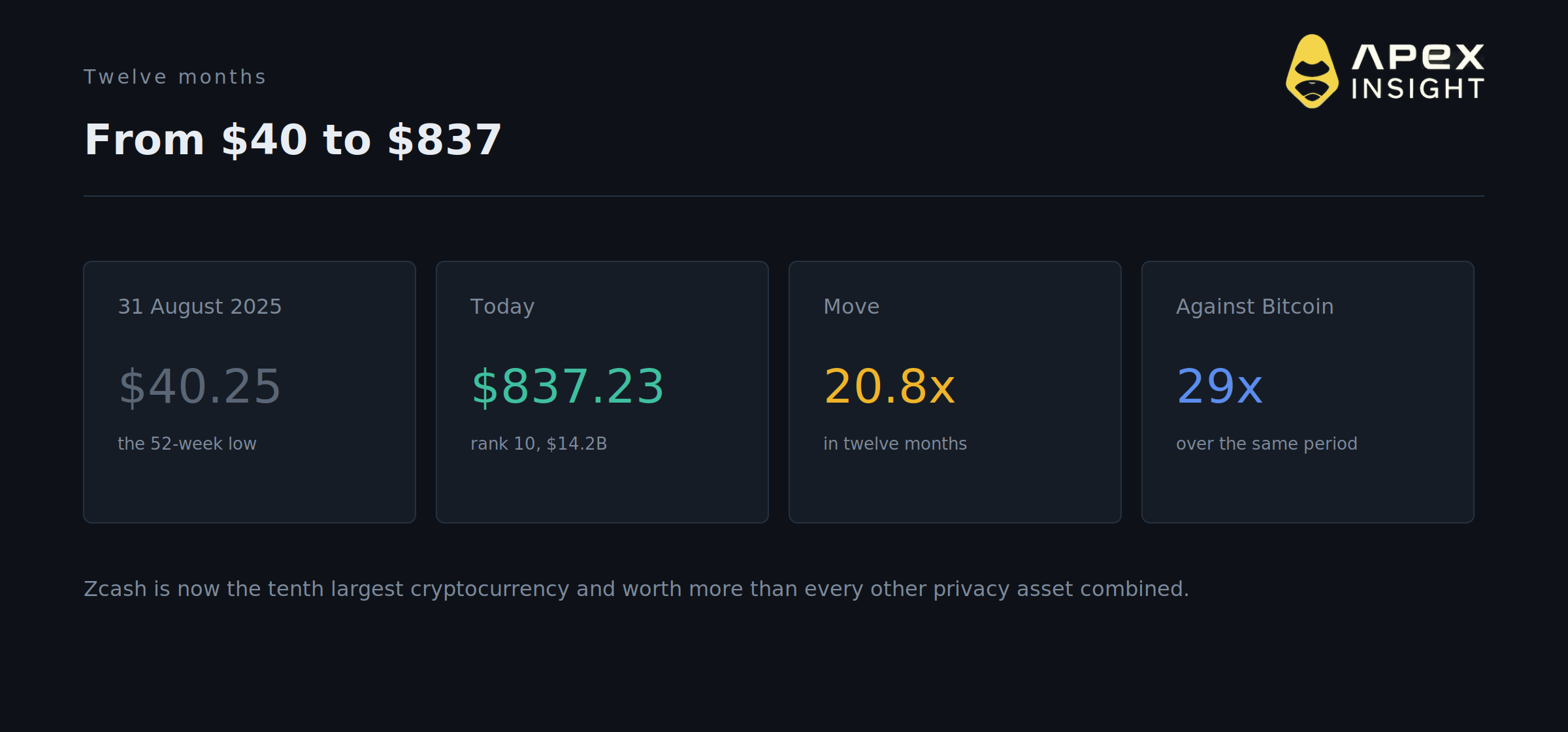
Zcash bottomed at $40.25 on 31 August 2025 and printed a 52-week high of $852.82 on 24 August 2026. That is 20.8 times in twelve months, and roughly 29 times measured against Bitcoin.
It now ranks tenth by market capitalisation at $14.2 billion, ahead of every other privacy-focused token, with 16.9 million of a 21 million hard cap in circulation.
2. Four things happened in five weeks
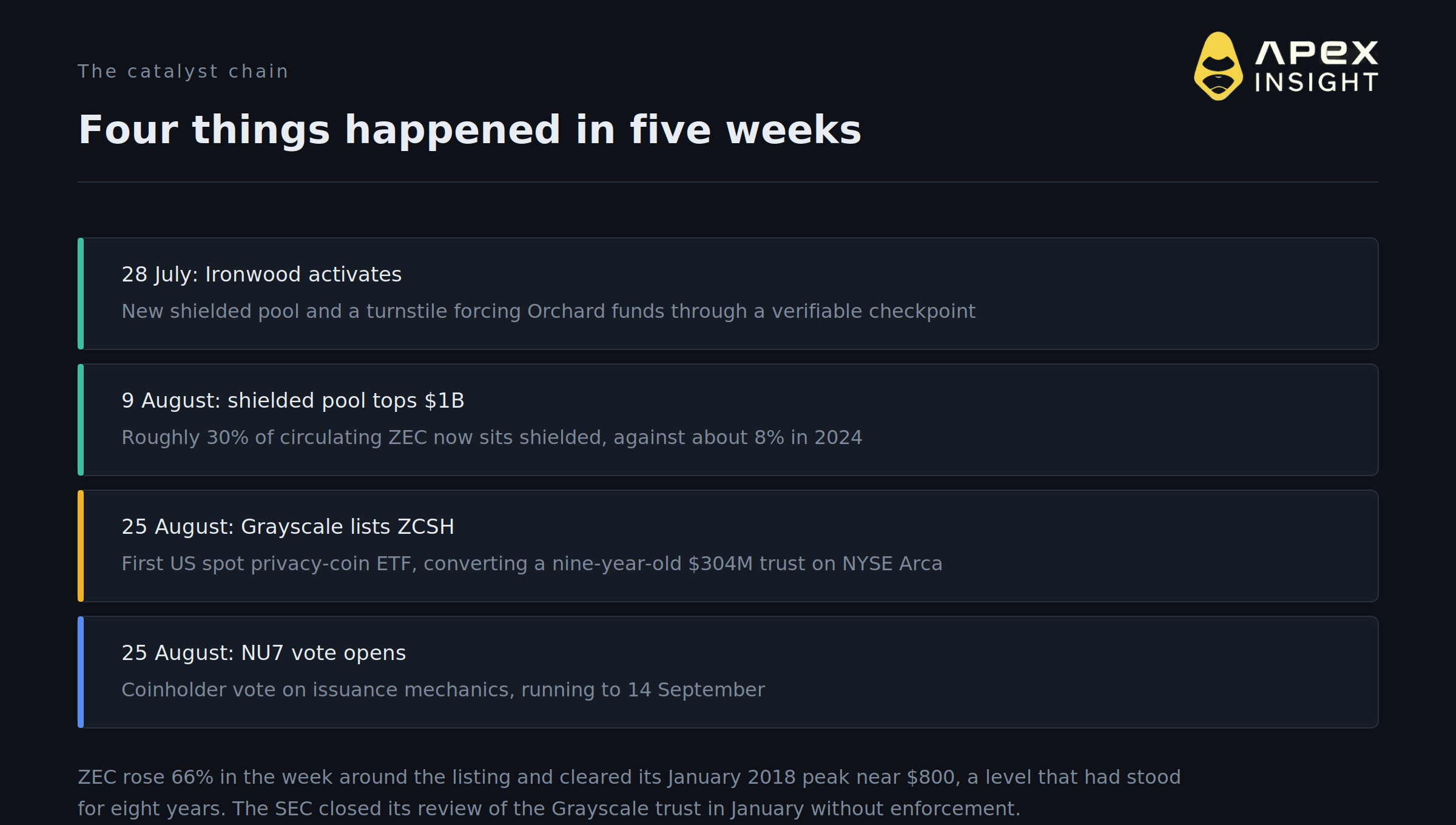
Ironwood activated on 28 July, introducing a new shielded pool and a turnstile mechanism that forces funds migrating out of the old Orchard pool through a verifiable checkpoint. Node operators moved to Zebra 6.0.0.
The shielded pool passed $1 billion around 9 August. Roughly 30 percent of circulating ZEC now sits shielded, against about 8 percent in 2024.
On 25 August Grayscale listed ZCSH on NYSE Arca, converting a nine-year-old trust holding roughly $304 million into the first US-listed spot privacy-coin ETF, with Coinbase Custody holding the underlying. The SEC had closed its review of that trust in January without enforcement, an inquiry that began in late 2024 over whether ZEC qualifies as a security.
The same day, a coinholder vote on NU7 issuance mechanics opened, running to 14 September.
ZEC rose 66 percent in the week around the listing and cleared its January 2018 peak near $800, a level that had stood for eight years.
3. The market wants $1,000 and stops there
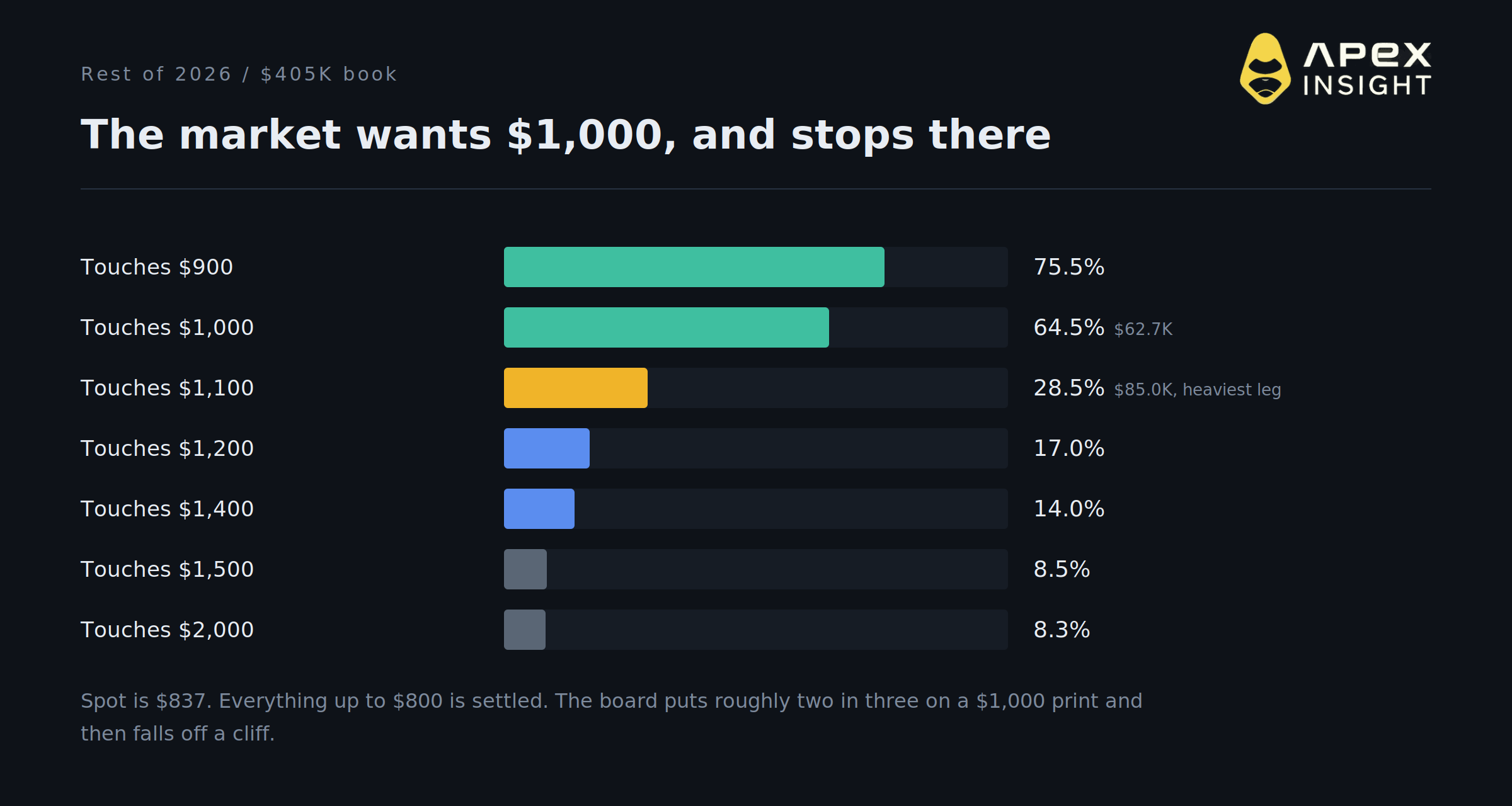
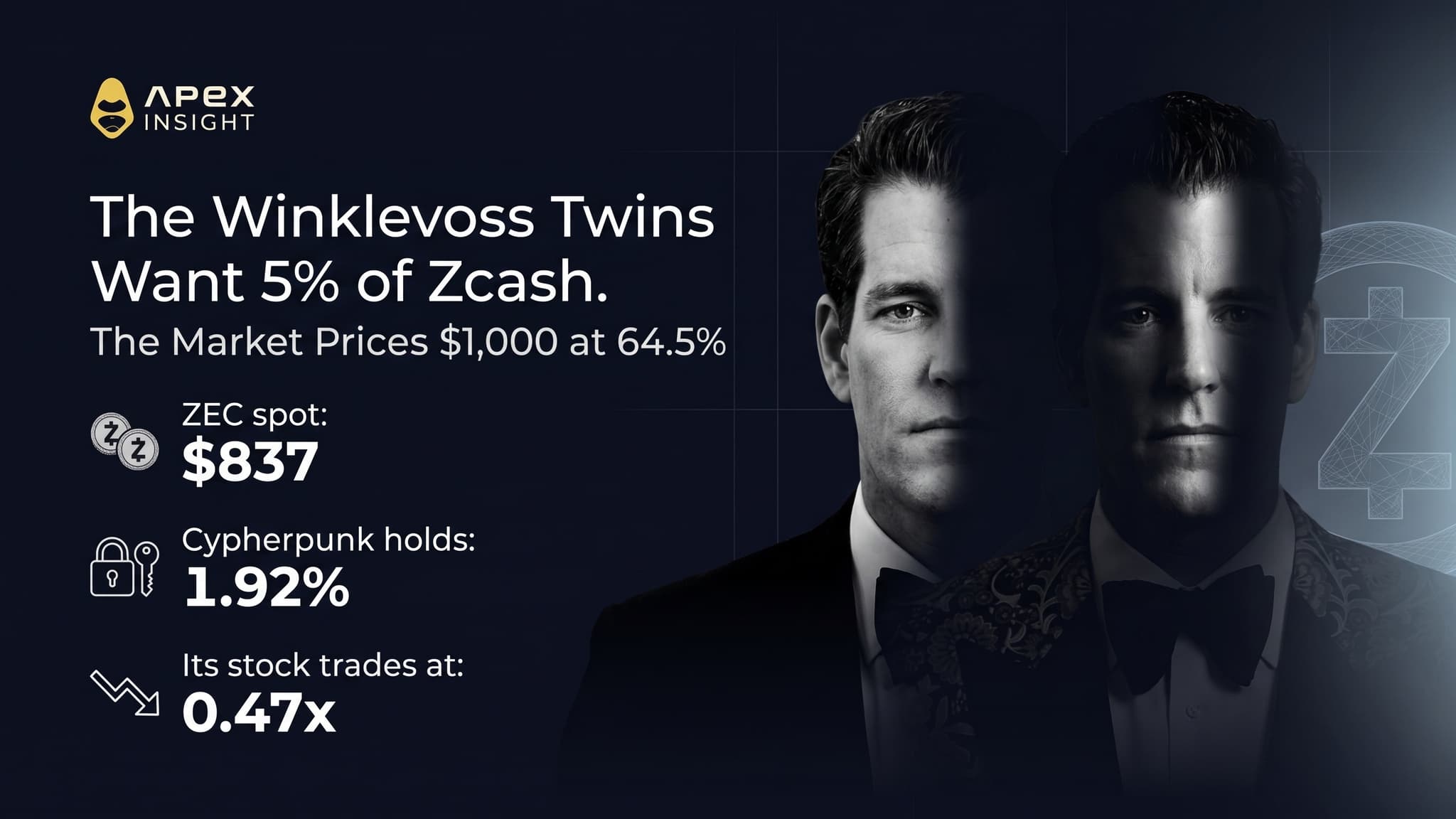
Everything up to $800 is settled. Touching $900 prices at 75.5 percent, $1,000 at 64.5 percent, $1,100 at 28.5 percent, $1,200 at 17 percent, $1,400 at 14 percent and $2,000 at 8.3 percent.
For context on how fast this has moved: two weeks ago, with ZEC near $495, the same board priced $700 at 36 percent and $1,000 at 10 percent. The $1,000 contract has gone from a tail to a base case inside a fortnight.
4. The cliff between $1,000 and $1,100
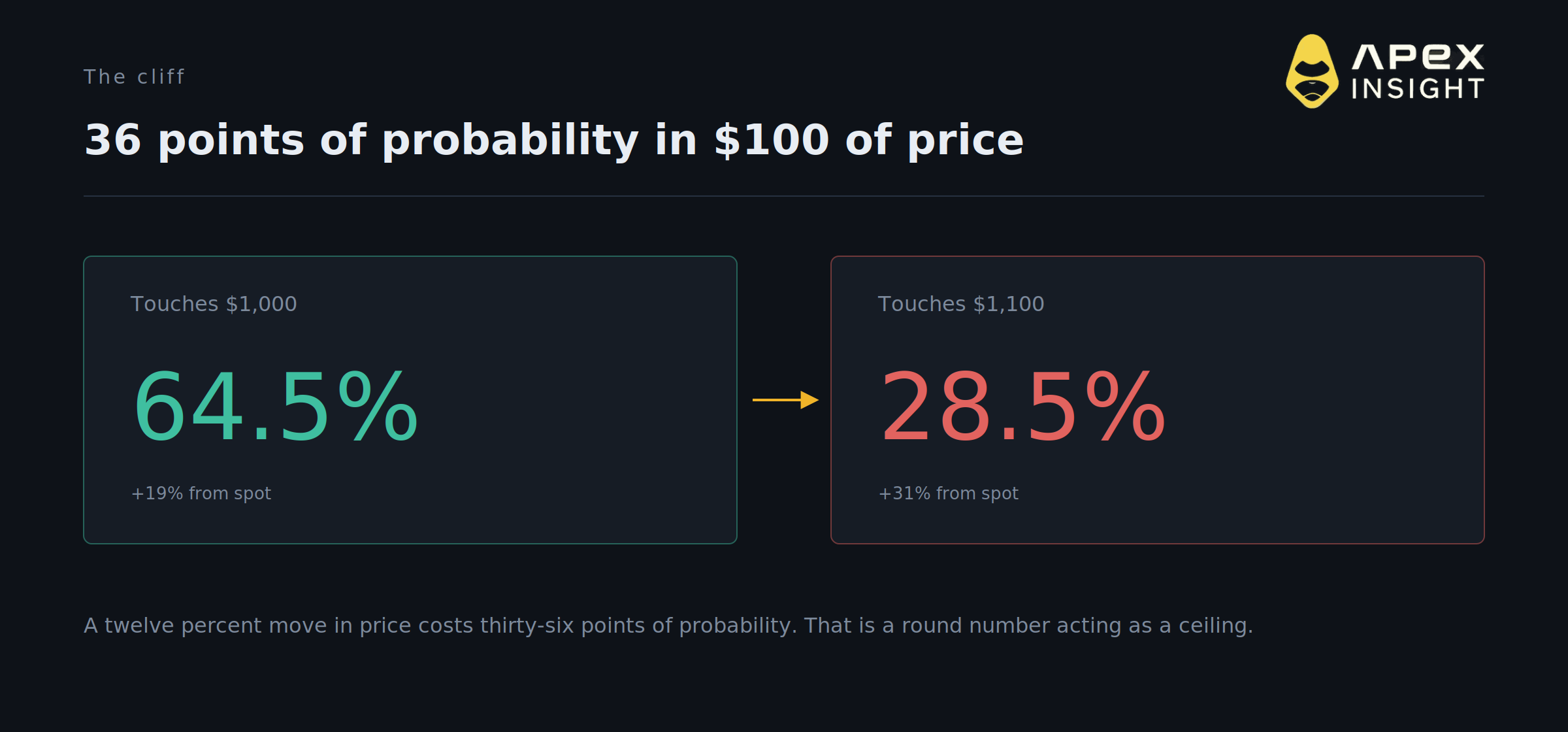
A twelve percent move in price, from $1,000 to $1,100, costs thirty-six points of probability.
That is not a smooth decay, it is a ceiling. Round numbers do this in every market, and it tells you where the crowd expects the move to run out of buyers. If ZEC clears $1,100 with volume, the ladder above it is priced cheaply relative to what has just happened below it.
Worth holding lightly, though. This is exactly the sort of shape that thin books produce, and section 10 covers what sits behind each leg.
5. It fell 57 percent in a single day this year
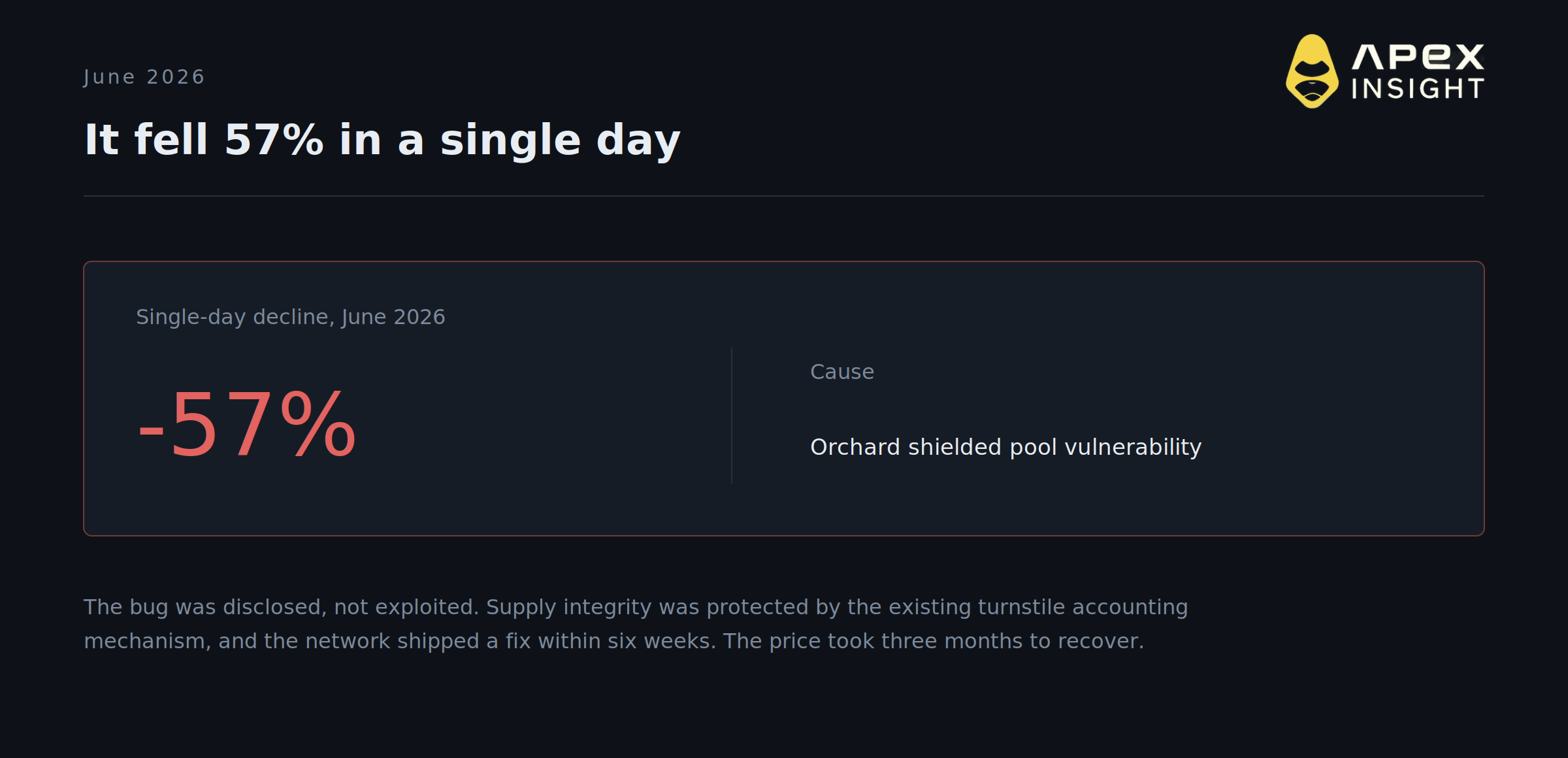
In June, a vulnerability was disclosed in Zcash's Orchard shielded pool, the part of the network holding private transactions. The token fell 57 percent in one day.
Two things matter about that. The bug was disclosed rather than exploited, and total supply was protected throughout by the existing turnstile accounting mechanism, so no counterfeit coins entered circulation. The team shipped a fix within six weeks.
But the price took three months to recover, and that is the honest read on what this asset does when something goes wrong. A 20x year and a 57 percent day are the same volatility profile viewed from different ends.
6. There is a live market on whether the pool was exploited
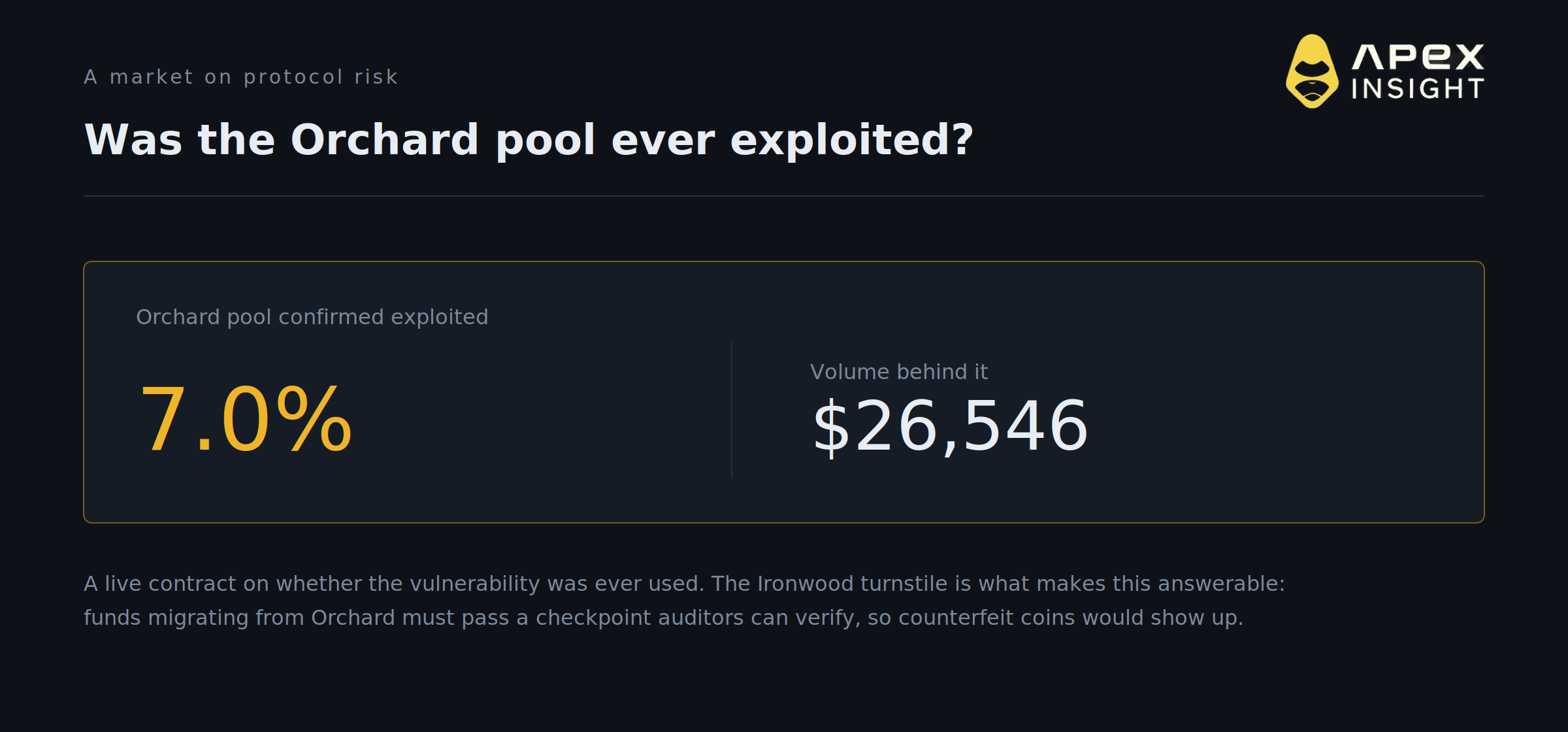
A separate contract asks whether the Orchard pool is ever confirmed as having been exploited. It prices at 7 percent on $26,546.
This is a rare thing: a tradeable price on protocol risk rather than on price. It is answerable precisely because of Ironwood's design, since funds leaving Orchard must pass a checkpoint that independent auditors can verify, so counterfeit supply would surface rather than stay hidden.
Seven percent is the market saying the containment story is probably right and not certainly right.
7. The metric that actually changed
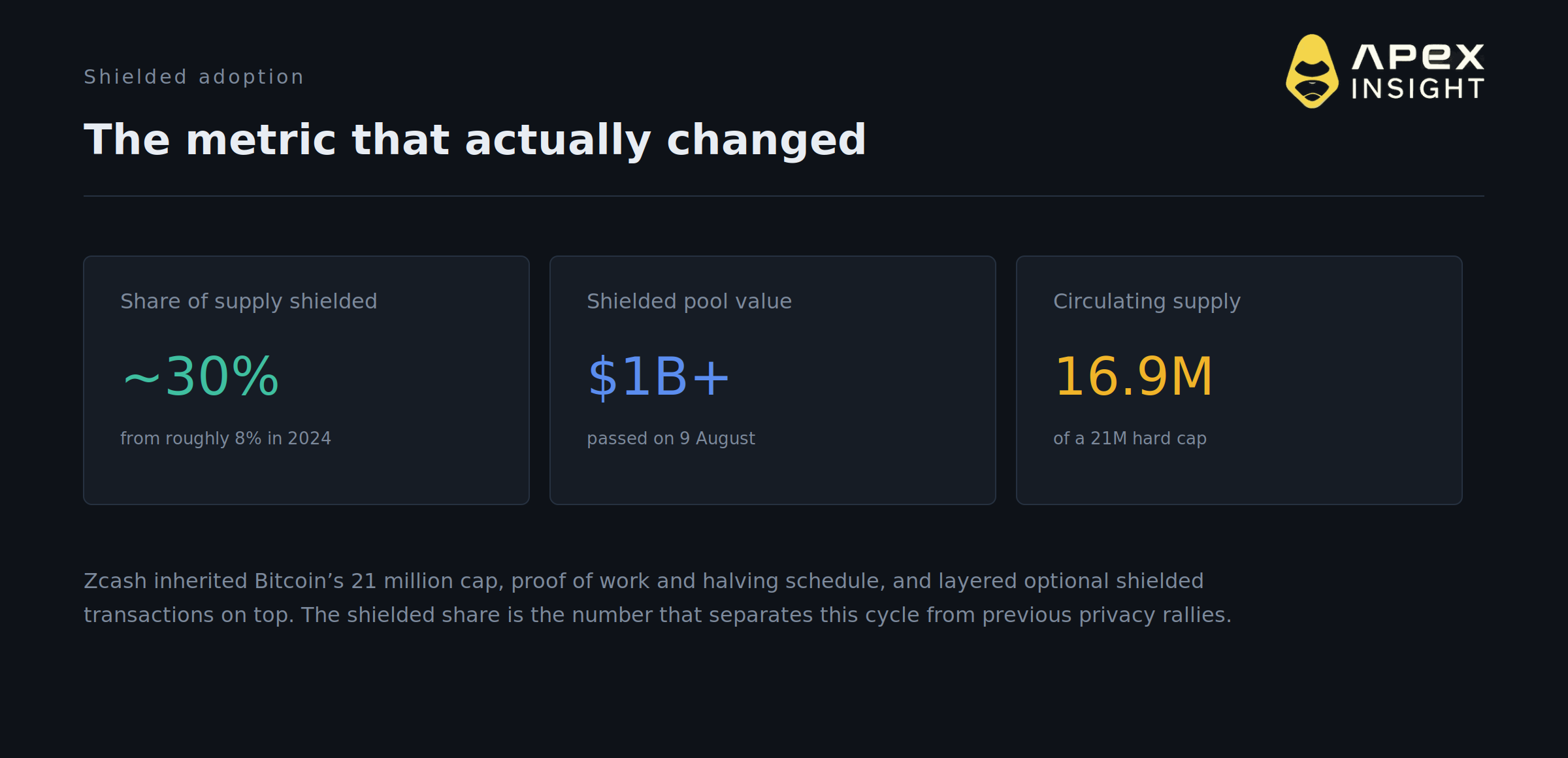
Zcash inherited Bitcoin's 21 million cap, proof of work and halving schedule, then layered optional shielded transactions on top. The optionality is why an ETF was possible at all: transparent addresses exist alongside private ones.
The number that separates this cycle from previous privacy rallies is the shielded share. Roughly 30 percent of circulating ZEC now sits in shielded pools against about 8 percent in 2024, and the pool passed $1 billion in August.
That is adoption of the actual feature rather than speculation on the ticker, and it is the strongest part of the fundamental case.
8. The Winklevoss twins are trying to corner it
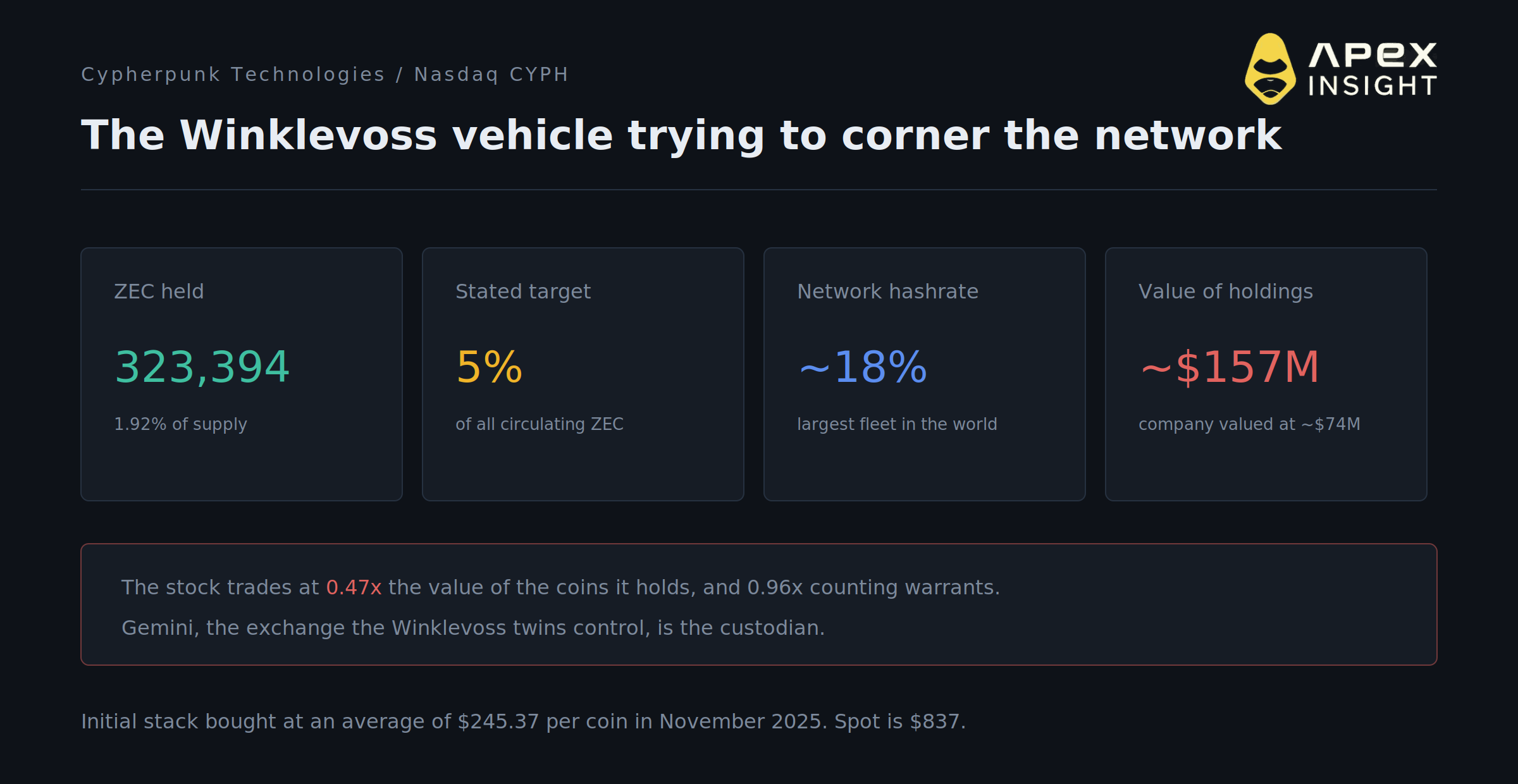
Cypherpunk Technologies, listed on Nasdaq as CYPH and formerly the biotech Leap Therapeutics, is the largest of only two known Zcash treasury companies. It is backed by Winklevoss Capital, the family office of Cameron and Tyler Winklevoss, and its coins are custodied at Gemini, the exchange the twins control.
It holds 323,394 ZEC, about 1.92 percent of circulating supply, bought from a starting stack of 203,775 coins at an average of $245.37 in November 2025. Spot is now $837. The stated goal is 5 percent of the entire network.
On 18 August it went further, launching Cypherpunk Mining through a $33.33 million equity deal with Winklevoss Capital. The fleet runs roughly 4.2 GSol/s of Equihash hashrate, about 18 percent of the whole Zcash network, which the company says makes it the largest active fleet in the world.
Then the part that complicates the story. The holdings are worth roughly $157 million and the market values the entire company at about $74 million, a multiple of 0.47 times net asset value, or 0.96 times counting pre-funded warrants. The company lost $37.8 million in the first half of 2026, the stock is down 40 percent this year, and it has announced a pivot in focus toward a cancer drug candidate that missed its primary endpoint in a Phase 2 trial.
So the most committed buyer of Zcash is a company the equity market is unwilling to value at the price of its own coins. That is the same distinction the market draws with other treasury vehicles: a discount on the wrapper is not a verdict on the asset inside it.
9. Who is on each side, by name
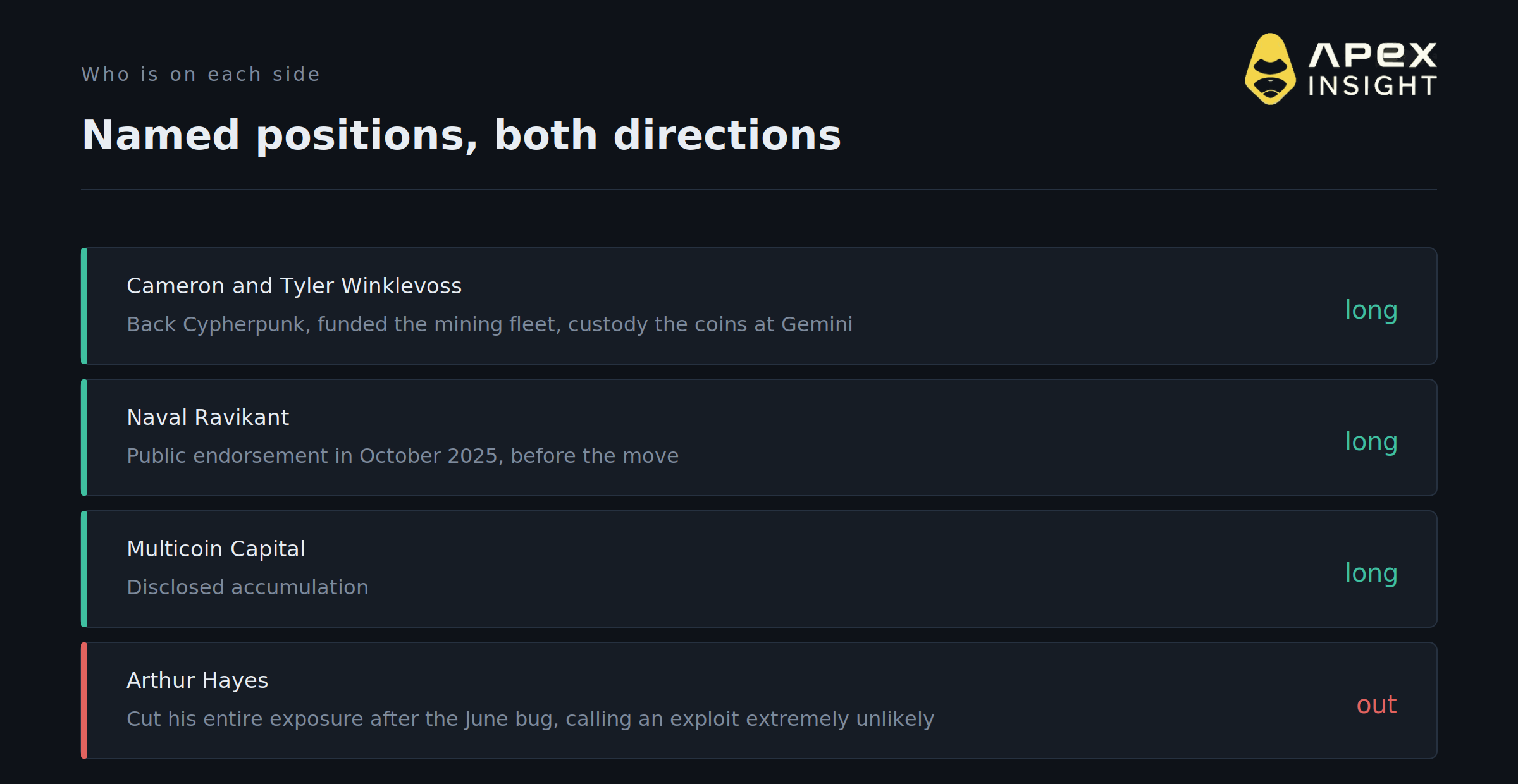
The Winklevoss twins are the anchor. Cameron has argued publicly that formal verification is the way to secure software and that Zcash is leading on it, describing encrypted money with provable correctness as unstoppable. They funded the treasury, funded the mining fleet, and hold the custody.
Naval Ravikant endorsed Zcash publicly in October 2025, before most of this move. Multicoin Capital has disclosed accumulation. Cypherpunk also put $5 million into Zcash Open Development Labs alongside a16z crypto, Coinbase and Paradigm.
On the other side, BitMEX co-founder Arthur Hayes cut his entire exposure after the June bug. His stated reason is the interesting part: he judged an exploit extremely unlikely, but noted that the network's own privacy makes it impossible to verify either way.
That is worth sitting with, because it is the same position the market expresses as a number. The Orchard contract at 7 percent says an exploit is probably not there and cannot be ruled out. Hayes reached the identical conclusion and decided the uncertainty alone was reason enough to leave.
10. One rule could undo the access story
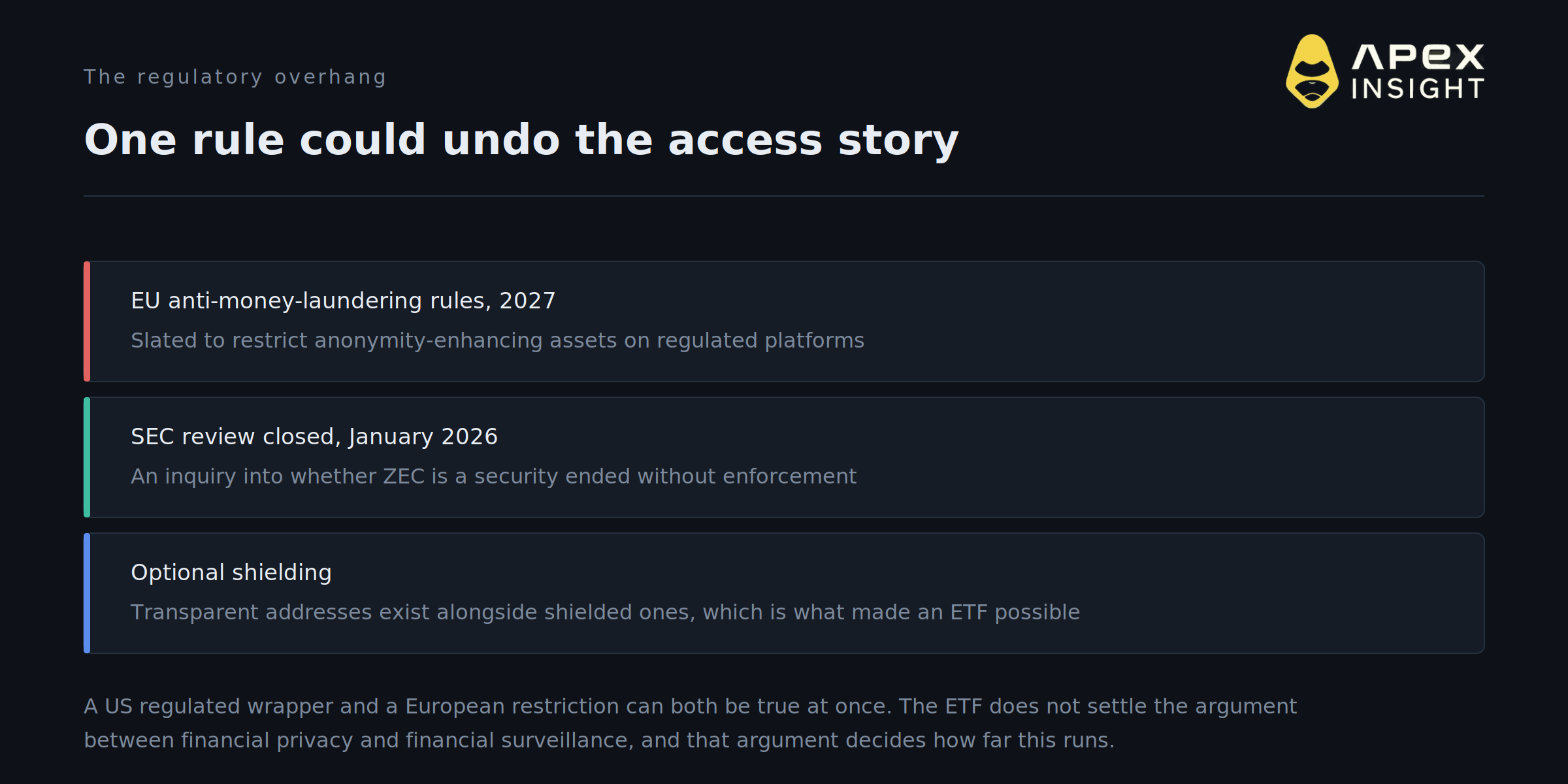
European anti-money-laundering rules slated for 2027 would restrict anonymity-enhancing assets on regulated platforms. That sits directly against the ETF thesis, and it has not gone away because a US regulated wrapper now exists.
The SEC closing its review in January without enforcement was the clearance that made the NYSE Arca listing possible. It was not an endorsement.
Both things can be true at once: a US ETF and a European restriction. The argument between financial privacy and financial surveillance is unresolved, and it decides how far this rally can run more than any chart level does.
11. The only major that actually outperformed
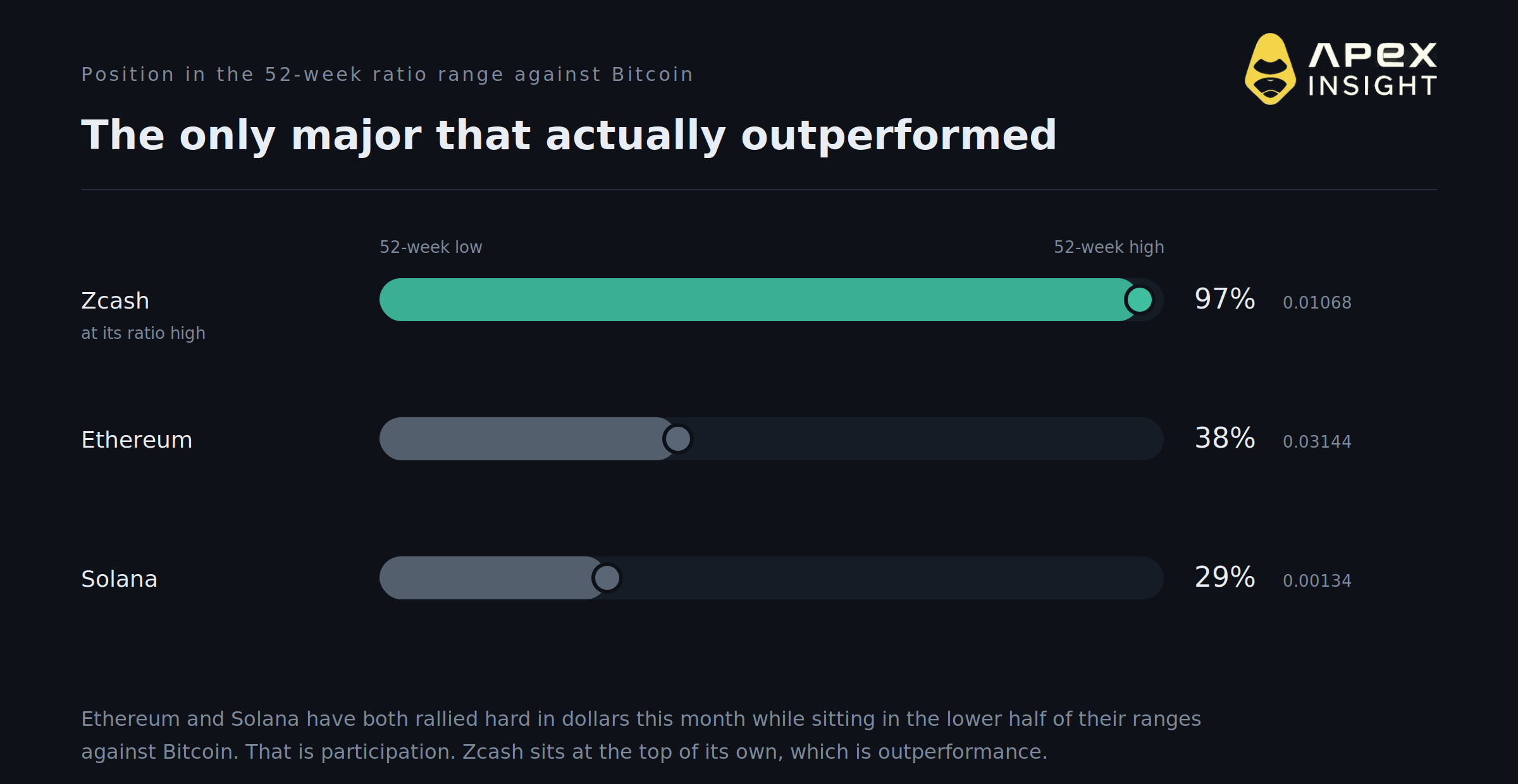
Zcash against Bitcoin sits at 0.01068, against a 52-week range of 0.00037 to 0.01097. That puts it at 97 percent of its own range, effectively at the high.
Run the same calculation on the other two majors that have rallied this month and the picture separates. Ethereum sits at 38 percent of its ratio range and Solana at 29 percent. Both have moved hard in dollars while remaining in the lower half of their ranges against Bitcoin, which means they are participating in a Bitcoin move rather than leading one.
Whatever you think of the asset, that is the difference between outperformance and a rising tide.
12. Read the book before the price
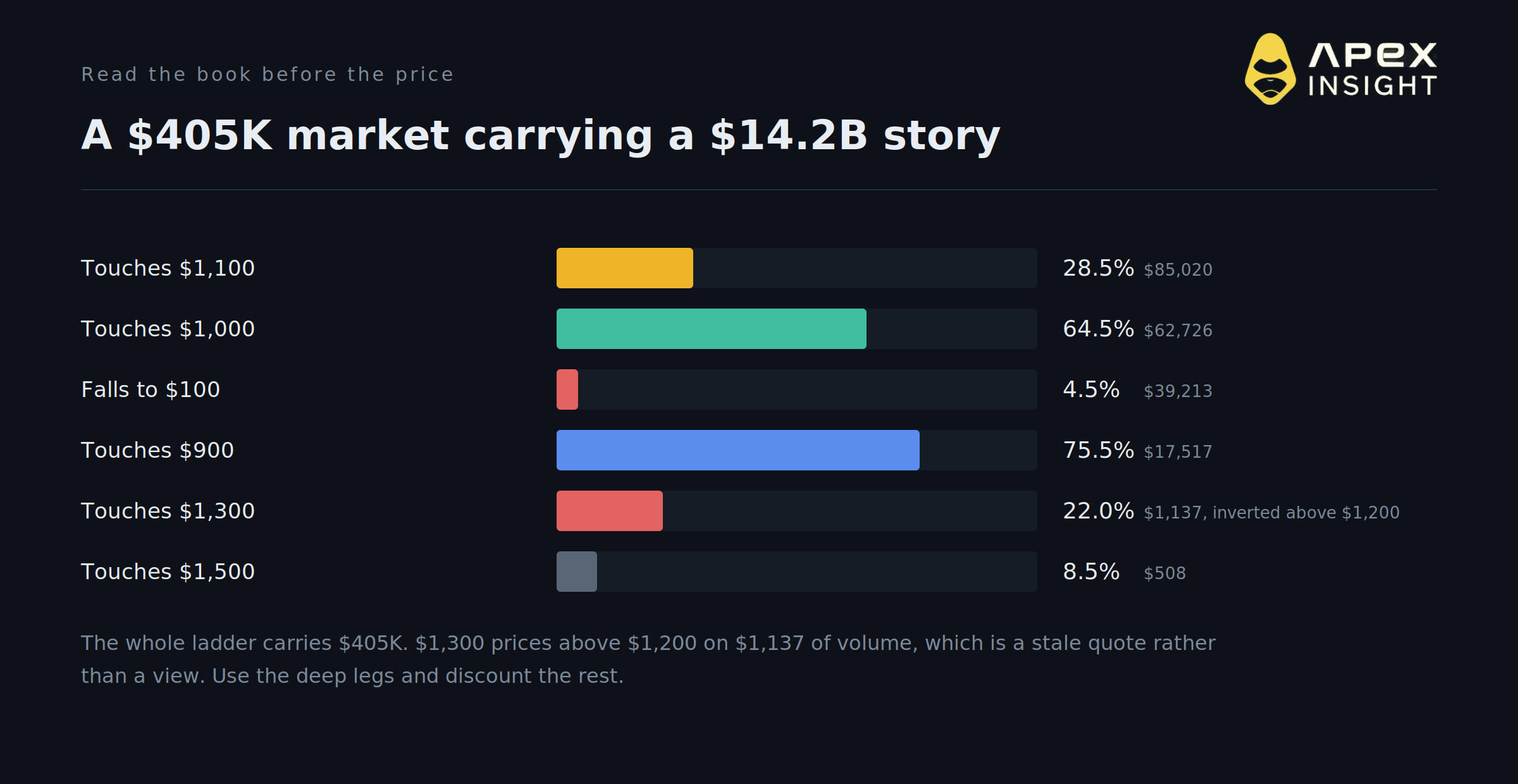
The entire 2026 ladder carries $405K. The $1,100 leg is the heaviest at $85,020, followed by $1,000 at $62,726 and the downside $100 leg at $39,213.
Below that it thins out fast. The $1,300 contract prices at 22 percent while $1,200 prices at 17 percent, which cannot both be right on the same date. The $1,300 leg carries $1,137 and the $1,200 leg carries $523, so this is a stale quote rather than a considered view.
Use the four legs carrying five figures or more. Treat the rest as indicative. A $405K book pricing a $14.2 billion asset is informative, not authoritative.
13. Where the levels sit
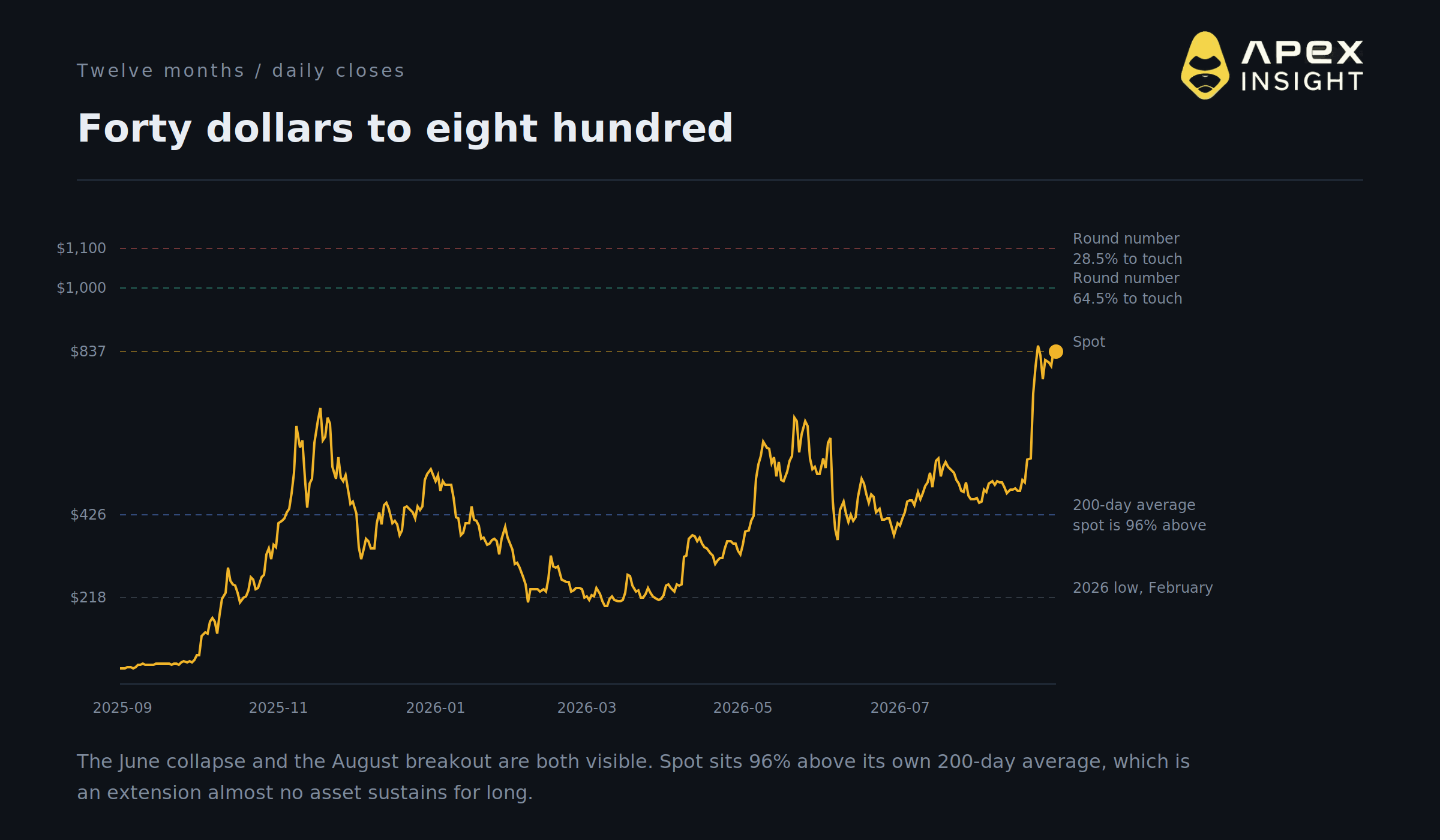
The chart shows both halves of this year: the June collapse and the August breakout.
Spot sits 96 percent above its own 200-day average of $425.88. That is an extension almost no asset sustains for long, and it is the single strongest argument for caution regardless of what the fundamentals say. The 2026 low of roughly $218 came in February.
One number to treat carefully. Zcash's nominal all-time high dates from its launch week in October 2016, when the token printed in the thousands on almost no liquidity in the first hours of trading. It is not a meaningful target and no serious analysis should use it as one. The relevant record is the January 2018 peak near $800, which ZEC has now cleared.
What this adds up to
Zcash has had the best fundamental year of any large crypto asset. A shielded pool that grew from 8 percent to 30 percent of supply, a vulnerability found, contained and fixed inside six weeks, and the first US spot ETF ever granted to a privacy coin.
The market has priced most of it. $1,000 is a base case at 64.5 percent, and then a wall at $1,100. The book is small, the price sits 96 percent above its 200-day average, and this is an asset that fell 57 percent in a single session ten weeks ago.
Three things to watch. Whether ZCSH sees real inflows now the novelty has passed, since a $304 million converted trust is a starting point rather than evidence of demand. The NU7 vote closing on 14 September, the only scheduled event on the calendar. And whether Cypherpunk keeps buying toward 5 percent while its own equity trades at half the value of its coins, because a forced seller at that size would be the largest single risk to the float.
Where to watch it
Every market in this article is live on ApeX Omni, where Polymarket's order books are integrated directly: the same liquidity and the same settlement source, minus the KYC. The board carries the full Zcash strike ladder alongside the Orchard exploit contract and the Monero comparison, with the volume behind each leg visible, which is what lets you tell a tested price from a stale quote in a book this size.
We appreciate your continued support.
Published by ApeX. For informational and educational purposes only. Not investment advice, and not a forecast or endorsement of any outcome. Trading involves risk, including total loss.