



Note: All market prices are as of 16 September 2026. This is a live and fast-moving file, and several of the sub-markets below are thinly traded, which is flagged where it matters.
1. Sixty-six million dollars on a single question
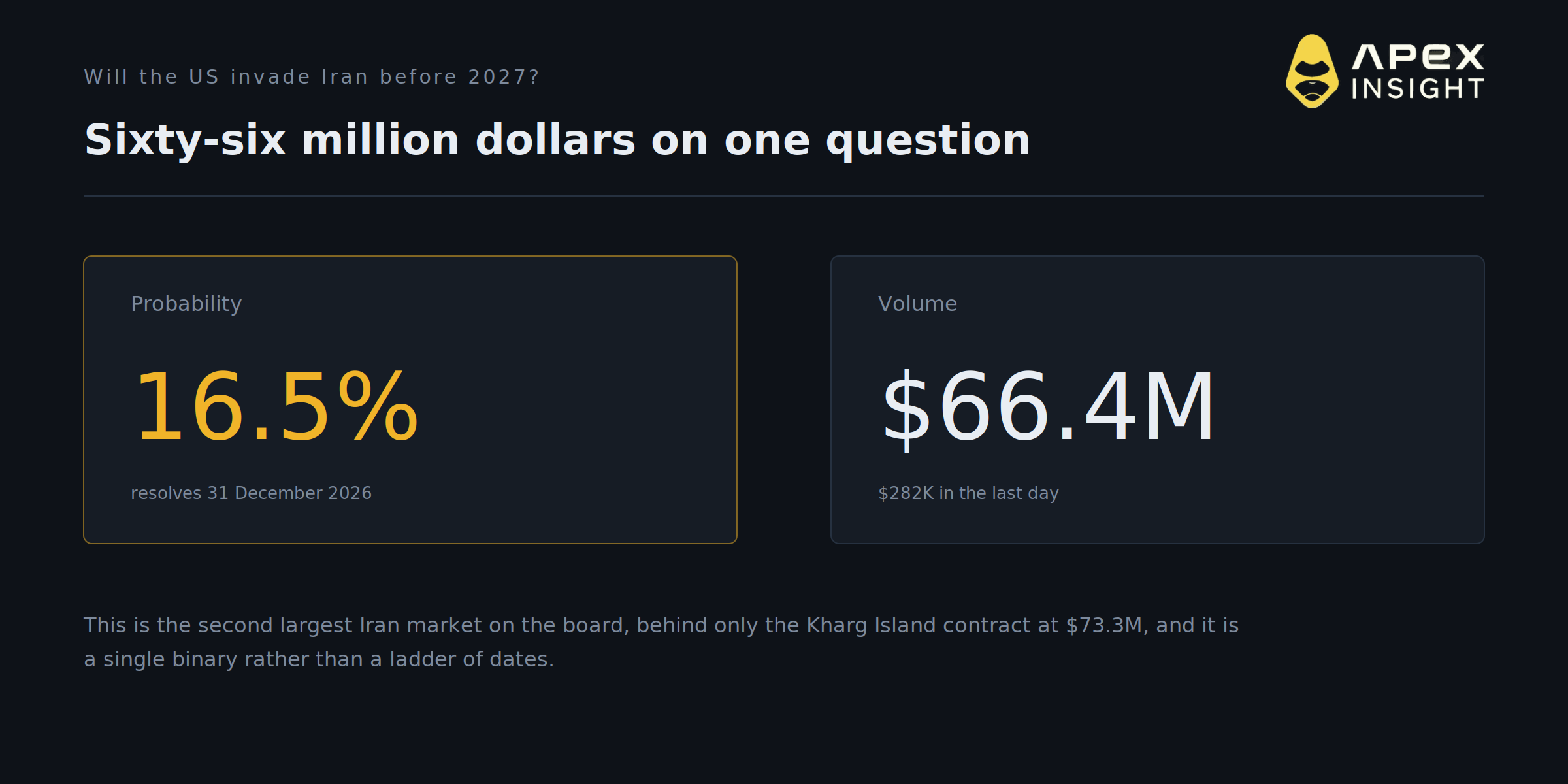
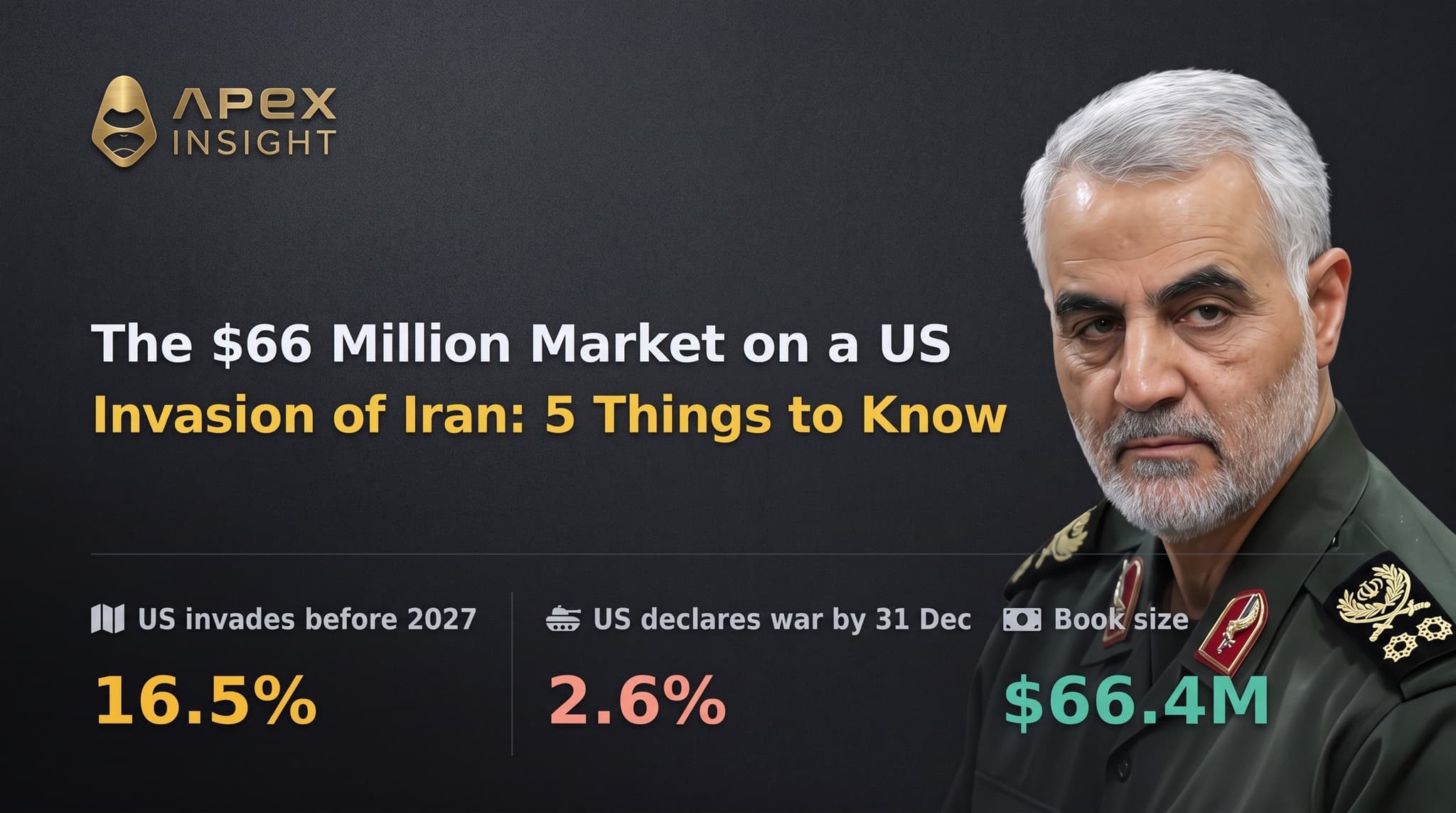
The contract prices at 16.5 percent with $66.4M of cumulative volume and $282K traded in the last day.
Only the Kharg Island market is larger at $73.3M, and that one is a ladder spread across ten separate dates. This is one binary with one resolution date.
For scale against the rest of the board: the Iranian regime falling before 2027 carries $25.9M, the blockade ending $28.6M, and the entire US-Iran nuclear deal market $17.6M. This single question carries more than any of them.
2. The bar is territory, not firepower
This is the part that explains everything else, and it is where most commentary on the market goes wrong.
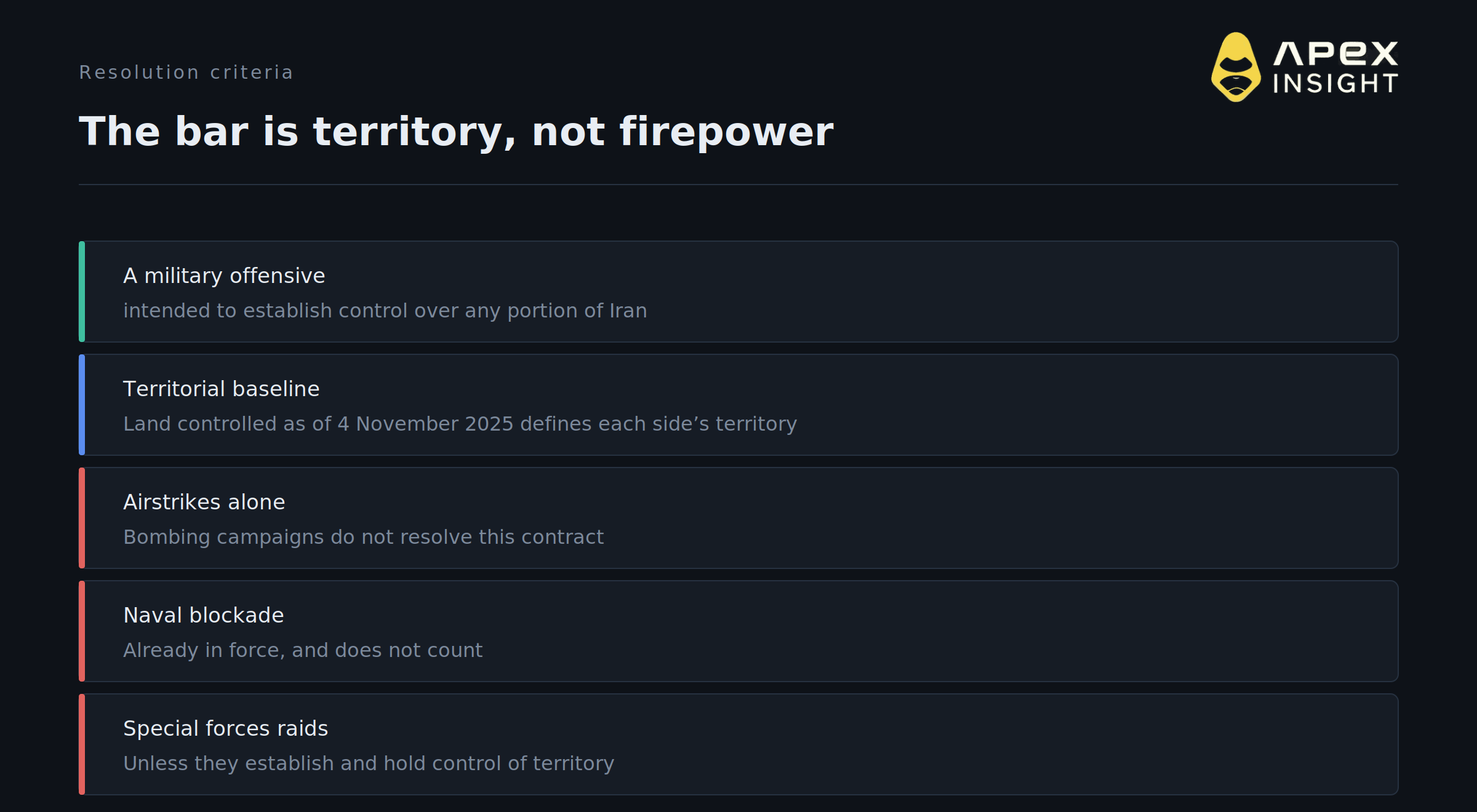
The contract resolves yes if the United States commences a military offensive intended to establish control over any portion of Iran. Land controlled by either side as of 4 November 2025 defines the baseline territory.
Airstrikes do not count, however sustained. The naval blockade does not count, and it has been in force since April. Special forces raids do not count unless they establish and hold ground.
So seven months of bombing, a blockade, and the death of a head of state have left this contract unresolved, because none of it involved taking territory. When you see 16.5 percent, that is the price of boots on Iranian soil, not the price of continued conflict.
3. A ceasefire is in force and the number held
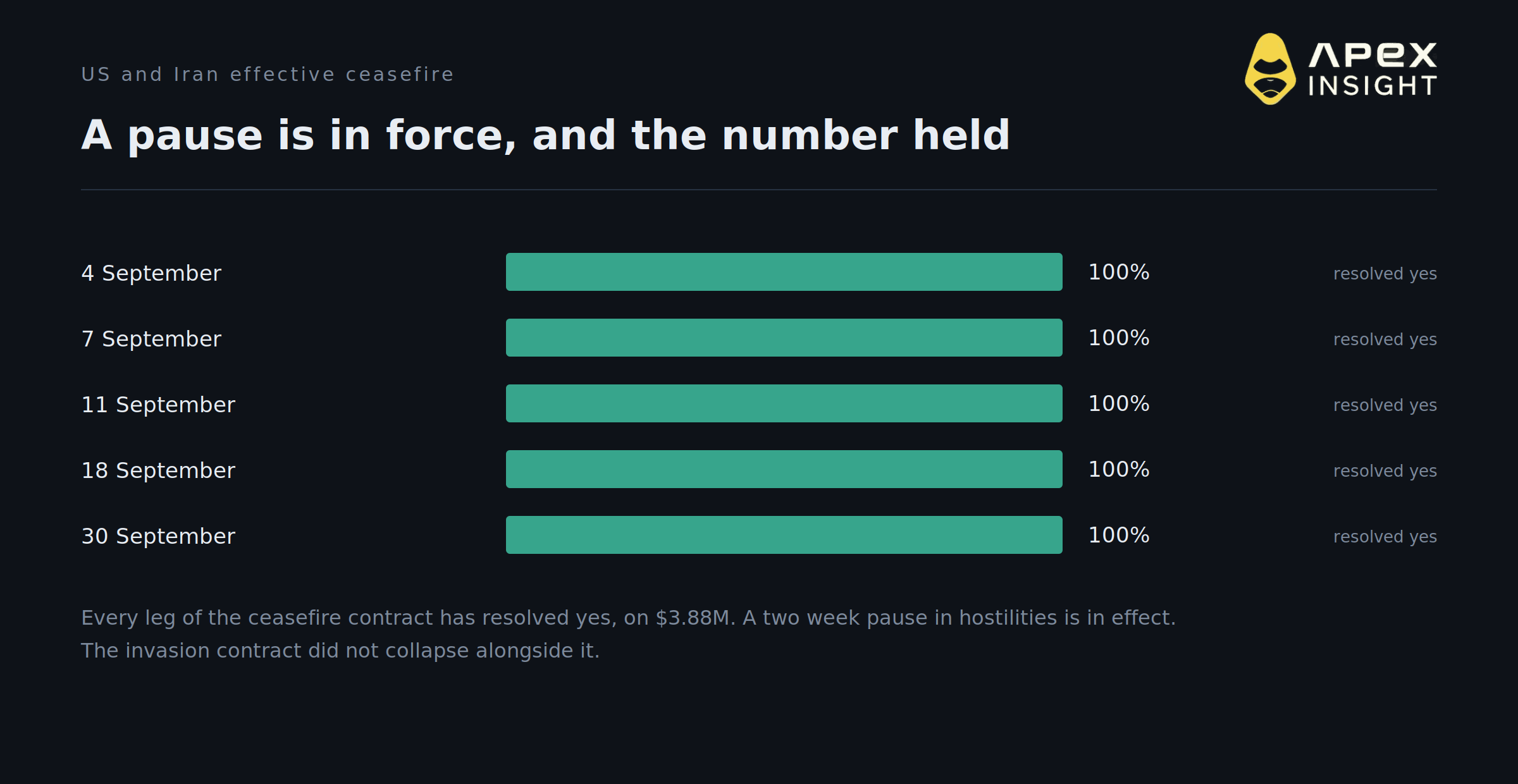
The US and Iran effective ceasefire contract, defined as a two week pause in hostilities, has resolved yes at every leg: 4, 7, 11, 18 and 30 September, on $3.88M.
A pause is in effect right now.
The invasion contract did not fall to low single digits alongside it. That tells you the market reads the current calm as a pause rather than a settlement, which is a reasonable reading given the record. A Pakistan-brokered two week ceasefire was agreed on 8 April, extended indefinitely on 21 April, formalised in the Islamabad Memorandum in June, and fighting resumed on 8 July.
This would be the third pause of the year. The two before it both ended.
4. An invasion without a declaration of war
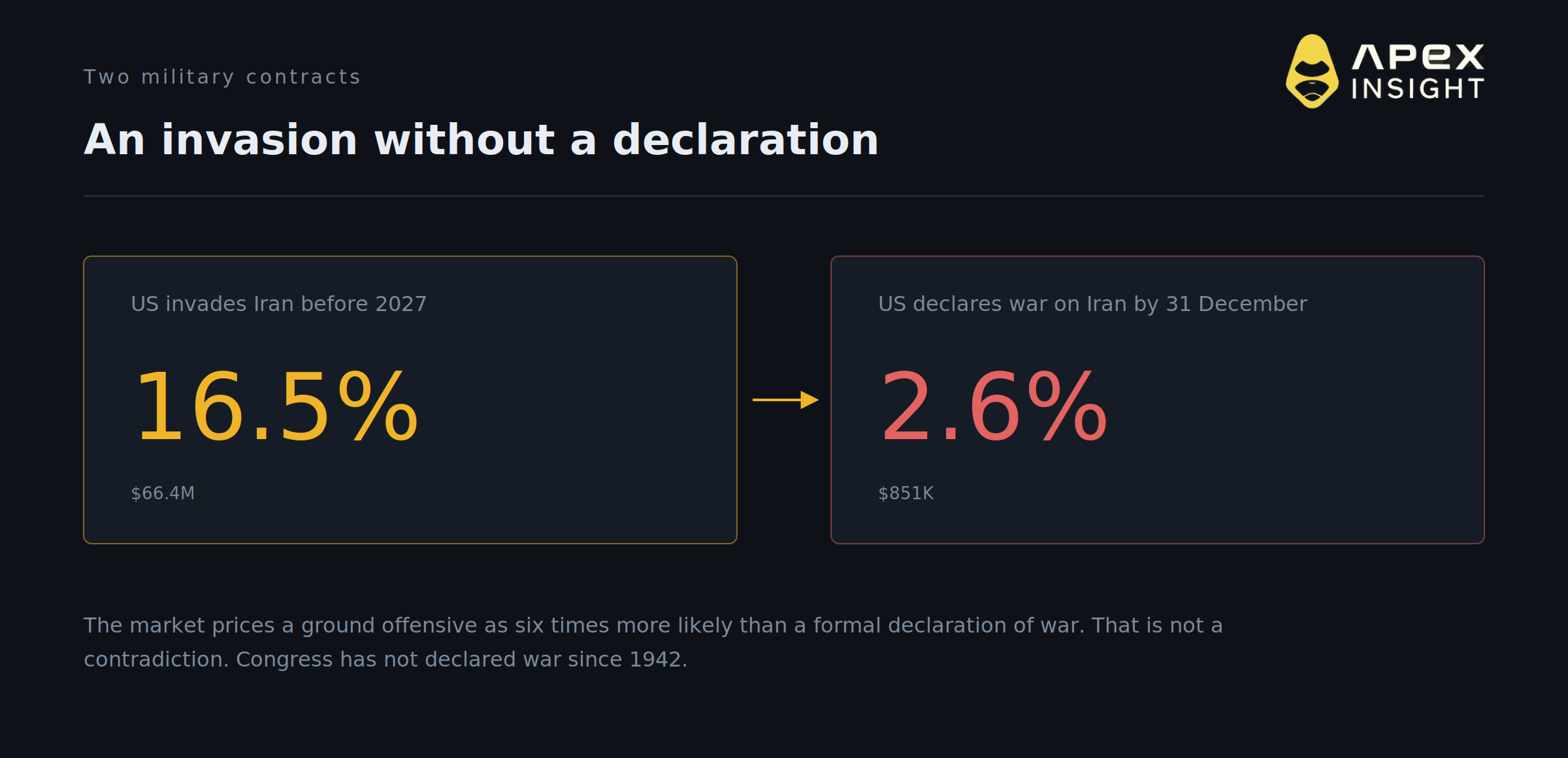
A US invasion prices at 16.5 percent. The United States formally declaring war on Iran by 31 December prices at 2.6 percent.
A ground offensive is priced as roughly six times more likely than a declaration of war.
That looks contradictory for about a second and then stops being one. Congress has not formally declared war since 1942, and every American military action since has proceeded without one. The market is not saying the war would be illegitimate or covert. It is saying the legal instrument is obsolete and the operational question is separate.
It is a useful reminder for reading any of these contracts: the resolution text is the whole market, and two questions that sound like the same event can be thirteen points apart.
5. Where invasion sits on the escalation board
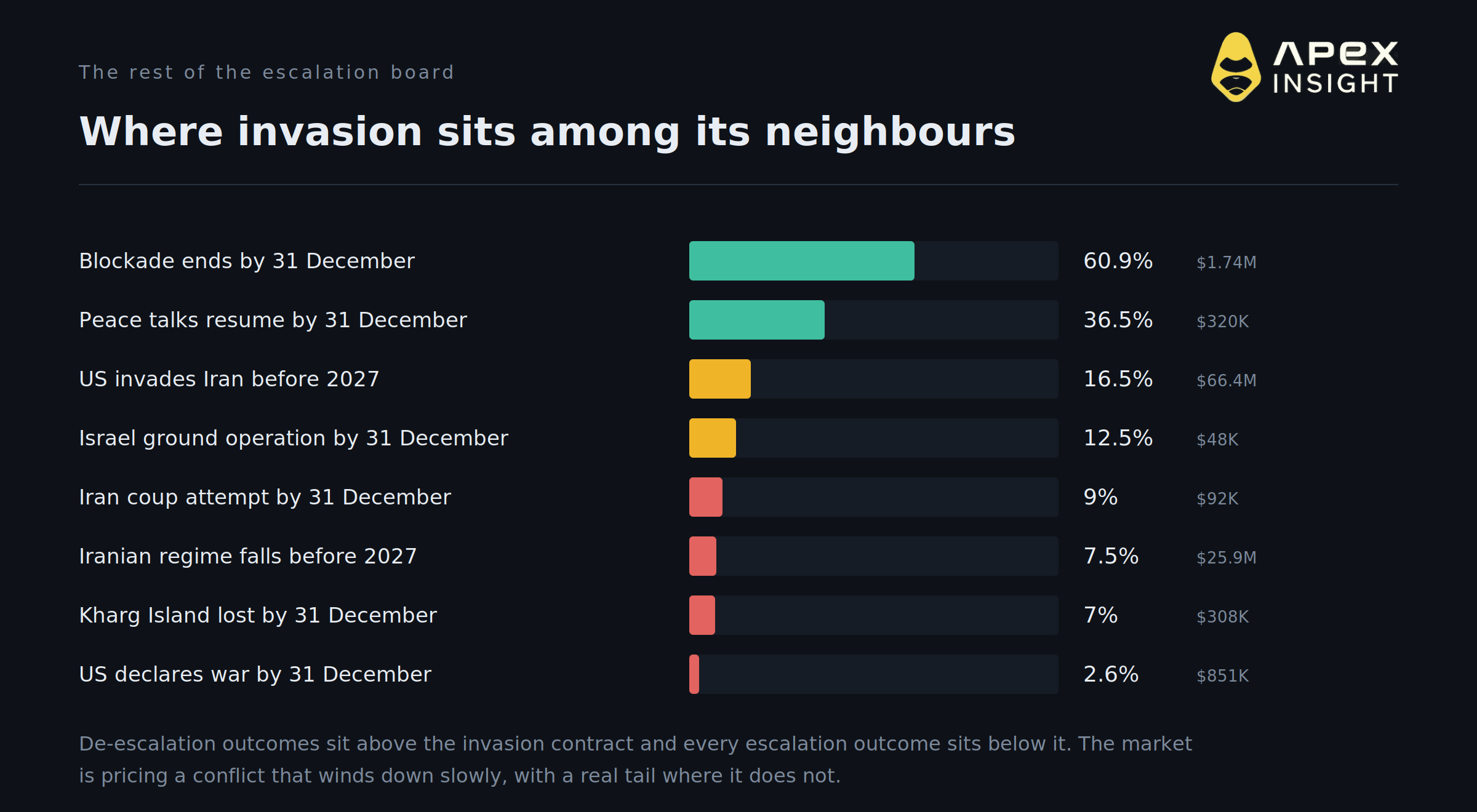
Ranked by probability: the blockade ending by 31 December at 60.9 percent, peace talks resuming at 36.5 percent, a US invasion at 16.5 percent, an Israeli ground operation at 12.5 percent, an Iranian coup attempt at 9 percent, the regime falling at 7.5 percent, Kharg Island falling at 7 percent and a declaration of war at 2.6 percent.
Read as a set, every de-escalation outcome sits above the invasion contract and every escalation outcome sits below it.
That is a market pricing a conflict that winds down slowly, with a real but secondary tail where it does not. And the invasion contract sits exactly at the hinge between those two stories, which is why it carries more money than either side of it.
The context any 16.5 percent has to be read against
One more thing before this series goes further into the detail.
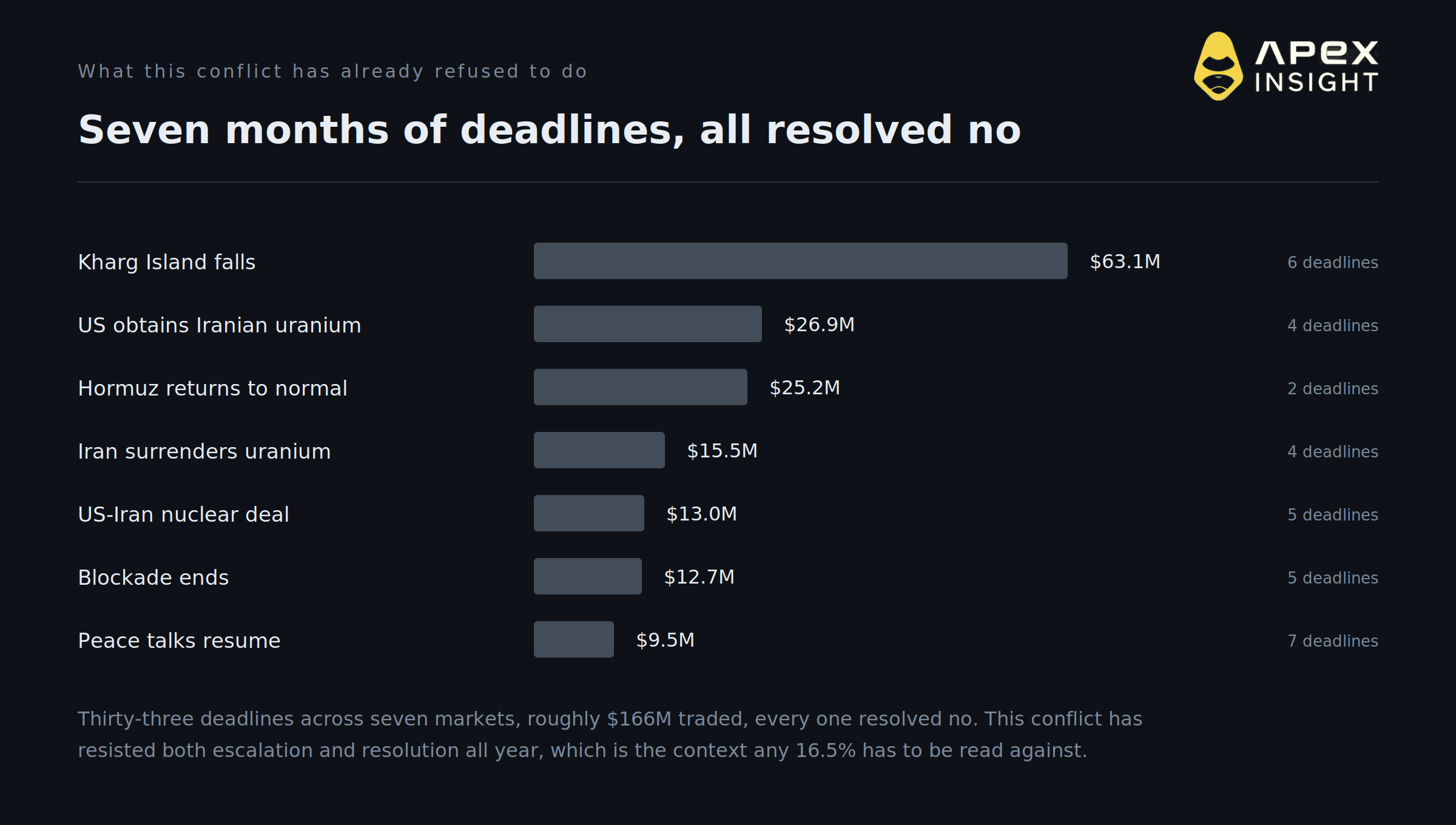
Across seven Iran markets there have been roughly thirty-three deadlines this year asking whether something would change: Kharg Island falling, the US obtaining Iranian uranium, Hormuz reopening, Iran surrendering its stockpile, a nuclear deal, the blockade ending, peace talks resuming. Around $166M traded across them.
Every single one resolved no.
This conflict has spent 2026 resisting escalation and resolution in equal measure. Nothing has fallen, nothing has been surrendered, no deal has been signed and no offensive has taken ground. A 16.5 percent on the most consequential escalation question is a market that has watched that pattern for seven months and priced accordingly.
The next four pieces in this series take the contract apart: what an invasion would actually require, who the market thinks would be at the table instead, what Iran's leadership succession does to the odds, and how the oil and shipping markets underneath it are priced.
Trade it
Political Markets Season is live on ApeX Omni. Four stages, four political markets, a 6,000 USDT prize pool. Stage 2 is the US invasion of Iran before 2027.
Spot prediction trading on Polymarket order books. No leverage, no liquidation, no KYC. Trade the odds, not the outcome.
We appreciate your continued support.
Published by ApeX. For informational and educational purposes only. Not investment advice, and not a forecast or endorsement of any political or military outcome. Trading involves risk, including total loss.