



Note: All market prices are as of 17 September 2026. Several sub-markets here carry six figures or less, which is flagged where it matters.
1. The blockade lifts and the deal does not
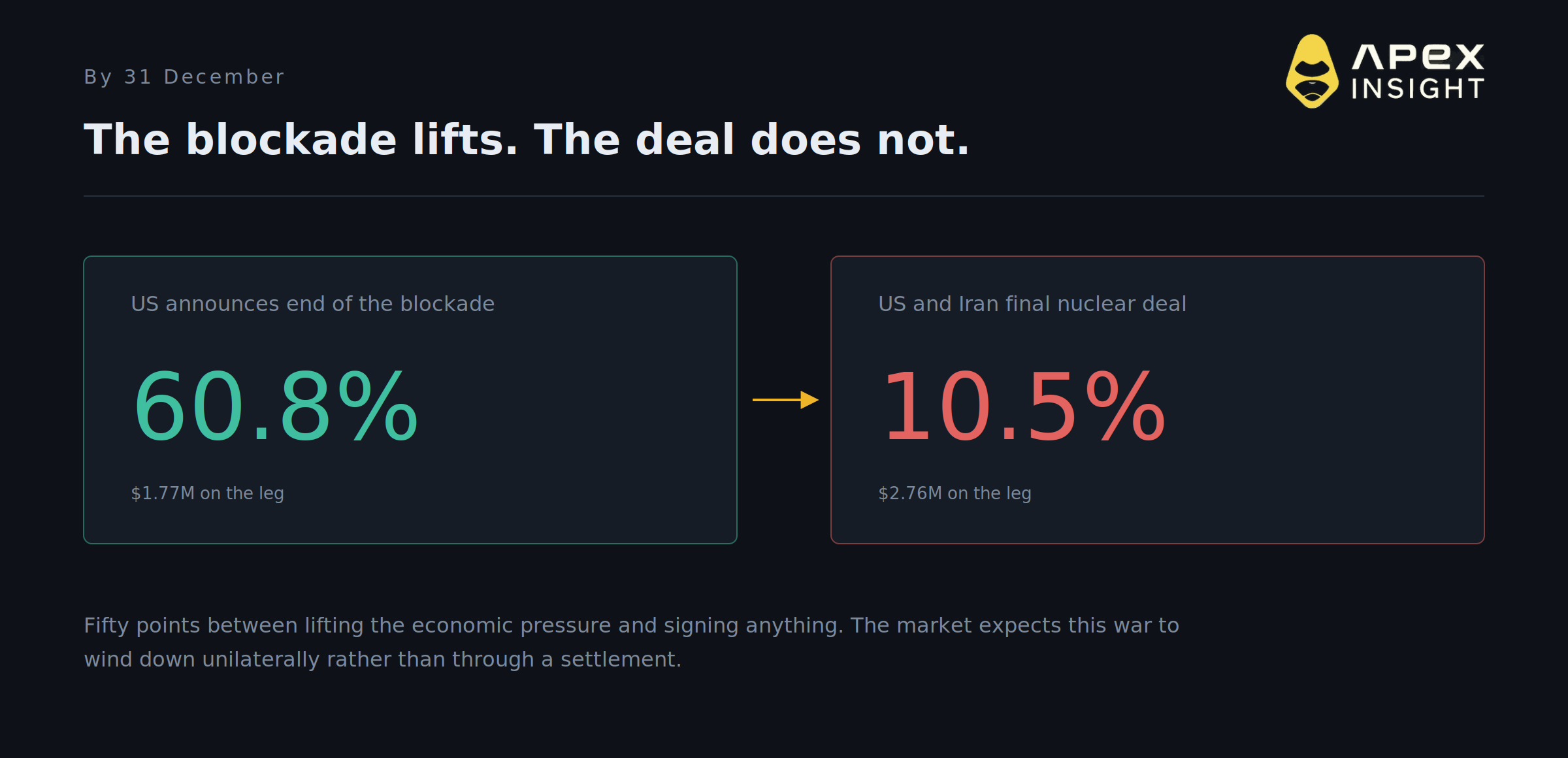
An announced end to the blockade by 31 December prices at 60.8 percent on a $28.8M book. A final nuclear deal by the same date prices at 10.5 percent on a $17.7M book.
Both are deep markets. Both resolve on the same day. They are fifty points apart.
That gap describes a specific ending: the United States stops squeezing without Iran conceding anything in writing. Not a peace, not a victory, just pressure being withdrawn because maintaining it costs more than it returns.
2. Seven deadlines, all resolved no
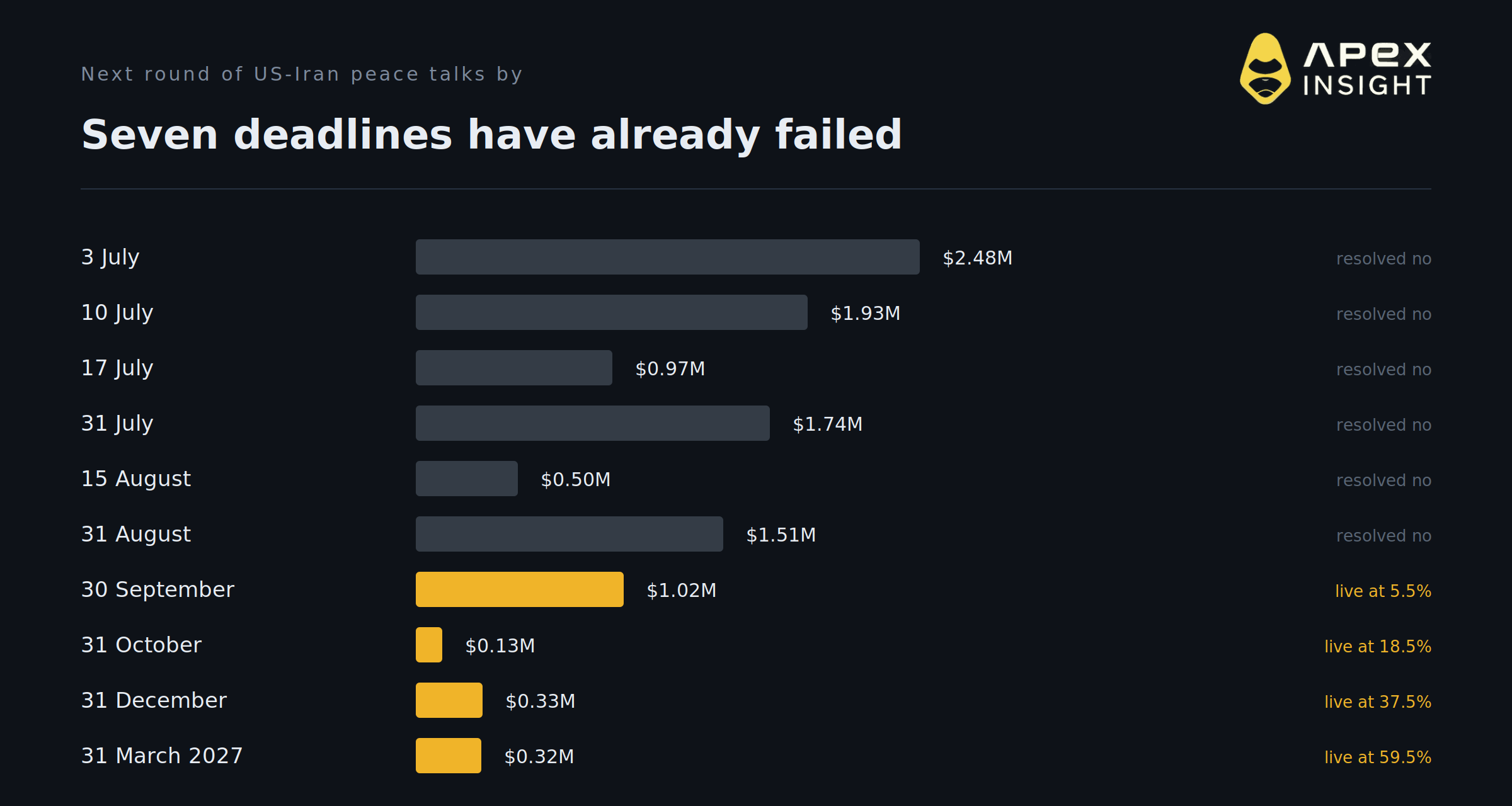
The market on the next round of US-Iran peace talks has run through seven deadlines: 3, 10, 17 and 31 July, 15 and 31 August, and more. All resolved no, on $9.13M.
What remains prices 30 September at 5.5 percent, 31 October at 18.5 percent, 31 December at 37.5 percent and 31 March 2027 at 59.5 percent.
The first date where a resumption is more likely than not sits three months past the expiry of the invasion contract this series is about. On the market's own timeline, the question of whether the US invades resolves before the question of whether the two sides talk again.
3. The leading venue is nowhere
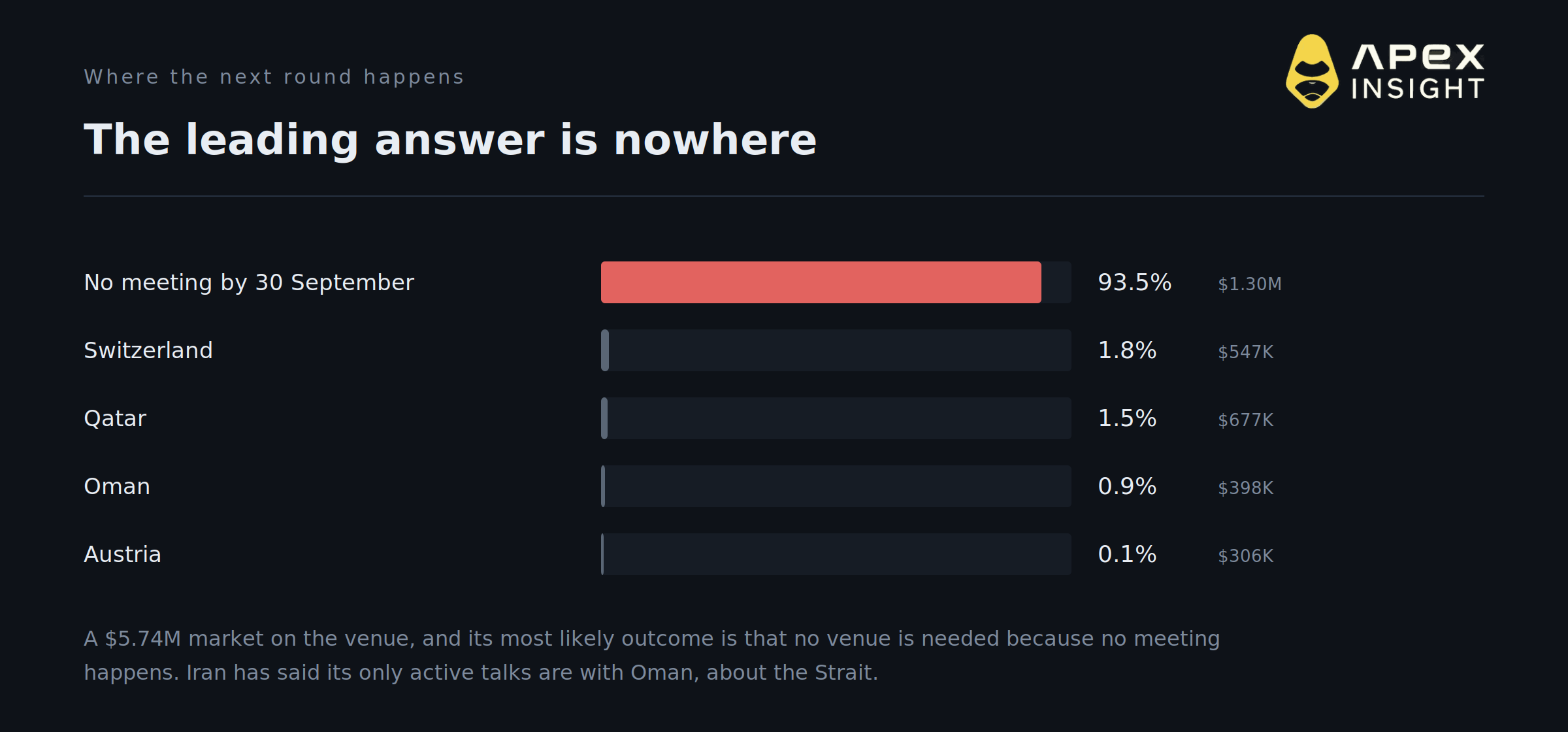
There is a $5.74M market on where the next round of talks will be held. Its leading outcome, at 93.5 percent, is that no meeting happens by 30 September.
Switzerland prices at 1.8 percent, Qatar at 1.5 percent, Oman at 0.9 percent and Austria at 0.1 percent.
Iran's foreign ministry has said its only active negotiations are with Oman, and those concern the future of the Strait rather than the nuclear file. The venue market agrees: a shipping arrangement is being discussed, a settlement is not.
4. The names in the room are envoys
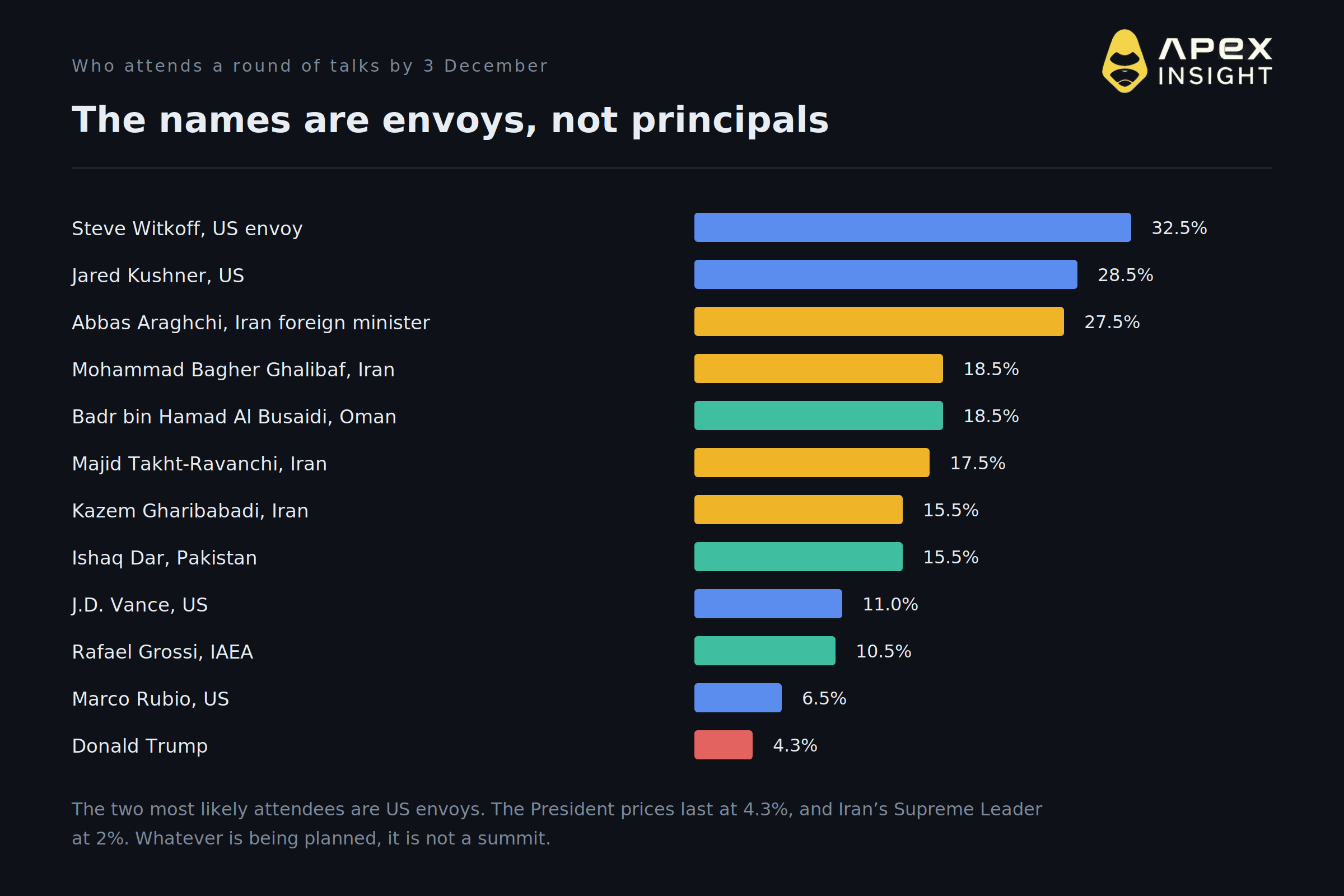
A $664K market prices who attends a round of talks by 3 December. Steve Witkoff leads at 32.5 percent, Jared Kushner at 28.5 percent, Iranian foreign minister Abbas Araghchi at 27.5 percent and Mohammad Bagher Ghalibaf at 18.5 percent.
Oman's Badr bin Hamad Al Busaidi and Pakistan's Ishaq Dar both appear, at 18.5 and 15.5 percent, which fits the mediation pattern of the past year. IAEA director Rafael Grossi prices at 10.5 percent.
Then the two that matter for interpretation. President Trump prices at 4.3 percent. Iran's Supreme Leader Mojtaba Khamenei prices at 2.0 percent.
Whatever the market thinks is being prepared, it is not a summit. It is working-level contact through intermediaries, which is what produces shipping arrangements rather than nuclear agreements.
This book is thin, so read the ordering rather than the levels.
5. Nothing would be in the deal anyway
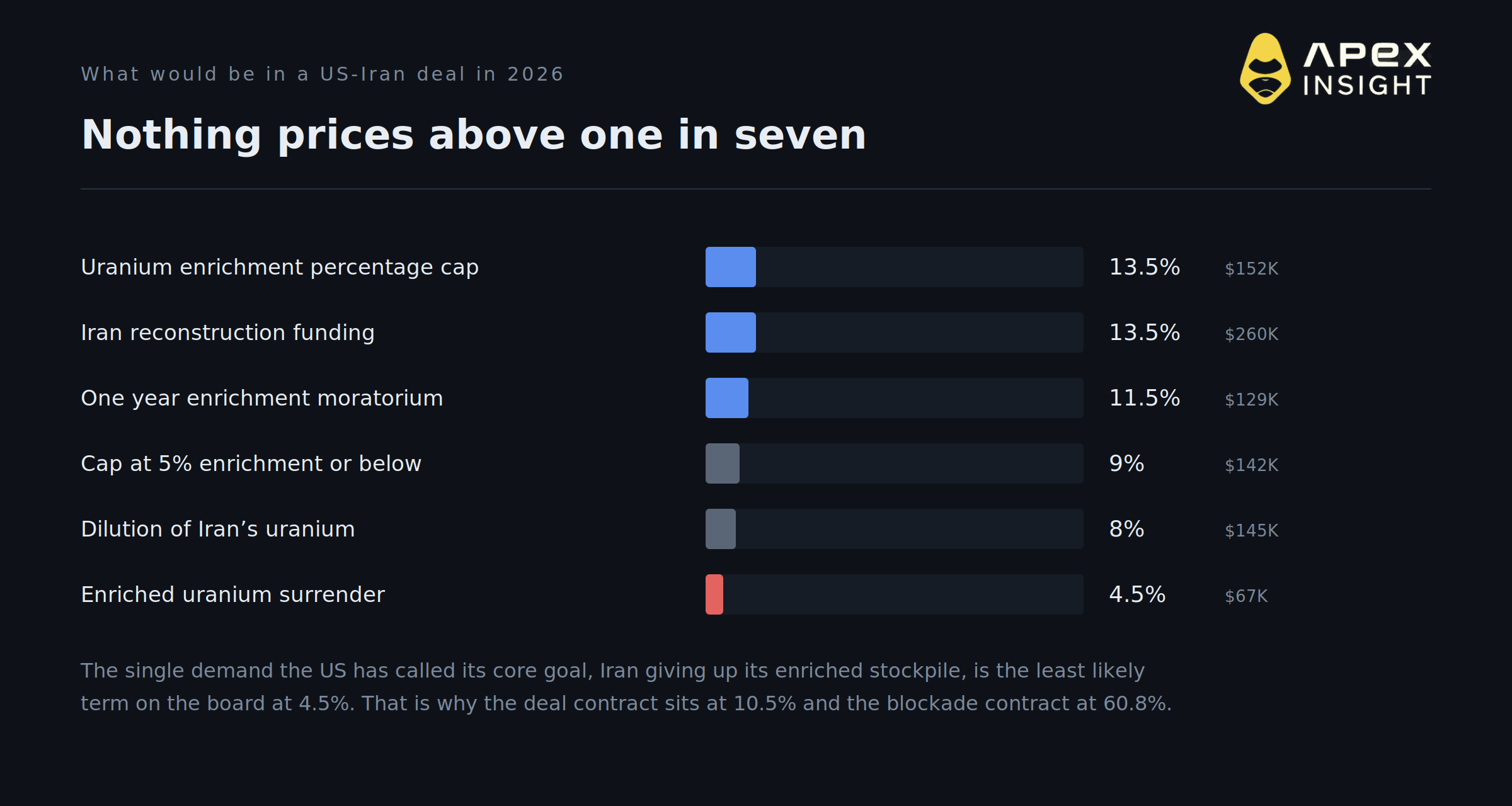
There is a market on what a 2026 US-Iran deal would actually contain. No term prices above 13.5 percent.
A uranium enrichment percentage cap prices at 13.5 percent, Iranian reconstruction funding at 13.5 percent, a one year enrichment moratorium at 11.5 percent, a cap at five percent enrichment or below at 9 percent, and dilution of Iran's stockpile at 8 percent.
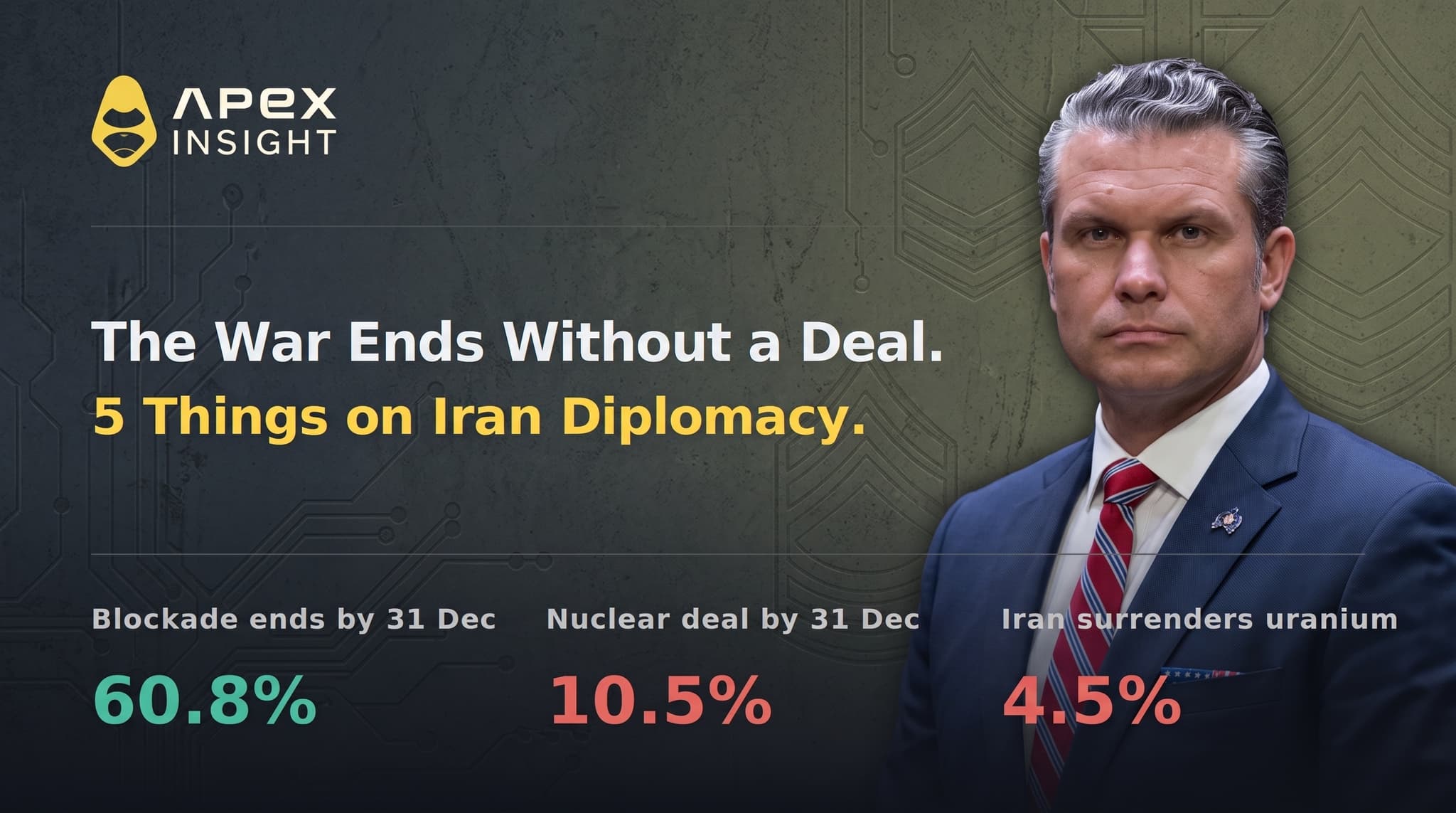
Last on the list, at 4.5 percent, is Iran surrendering its enriched uranium. That is the demand the United States has repeatedly described as its core objective, and it is the least likely term on the board.
A standalone contract asking the same question directly prices at 7.5 percent by 31 December.
Read sections one and five together and the 10.5 percent deal price stops being surprising. There is no version of an agreement where the central American demand is met, so the market prices the agreement accordingly and prices the blockade lifting anyway.
The shape of the ending
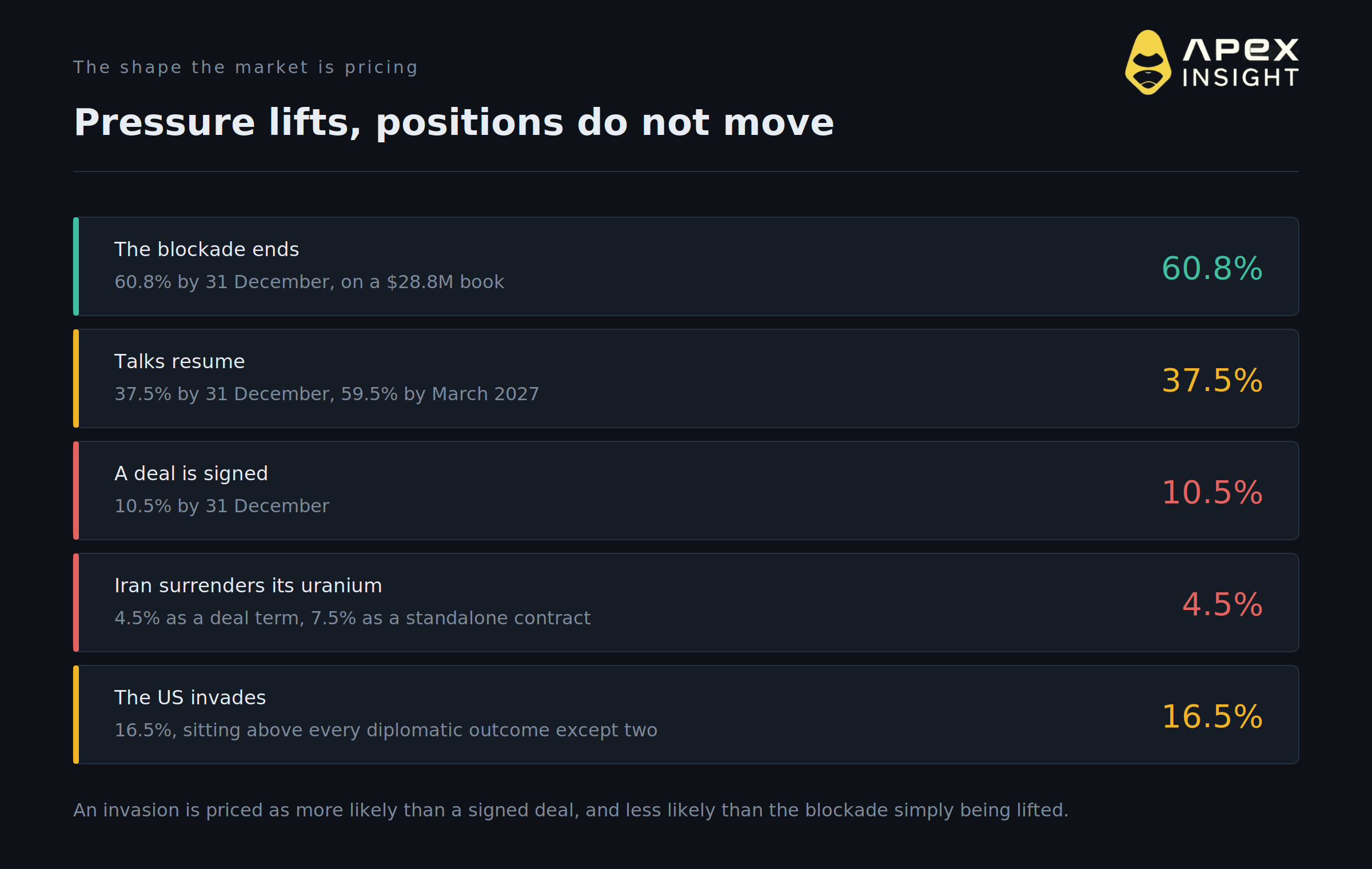
Put the whole diplomatic board in order and the shape is clear.
The blockade ends at 60.8 percent. Talks resume at 37.5 percent by year end. A US invasion prices at 16.5 percent. A deal is signed at 10.5 percent. Iran surrenders its uranium at 4.5 percent as a deal term.
An invasion is priced as more likely than a signed agreement, and less likely than the economic pressure simply being withdrawn.
That is a market describing a frozen conflict thawing at the edges without resolving at the centre. The ships move again, the enrichment continues, nobody signs anything, and the possibility of a ground offensive sits underneath all of it at one in six.
The next piece in this series looks at the succession question, and what Iran's leadership market does to the invasion price.
Trade it
Political Markets Season is live on ApeX Omni. Four stages, four political markets, a 6,000 USDT prize pool. Stage 2 is the US invasion of Iran before 2027.
Spot prediction trading on Polymarket order books. No leverage, no liquidation, no KYC. Trade the odds, not the outcome.
We appreciate your continued support.
Published by ApeX. For informational and educational purposes only. Not investment advice, and not a forecast or endorsement of any political or military outcome. Trading involves risk, including total loss.