



Note: All market prices are as of 19 September 2026. Price history is taken from the market's own order book.
1. Ten months in one line
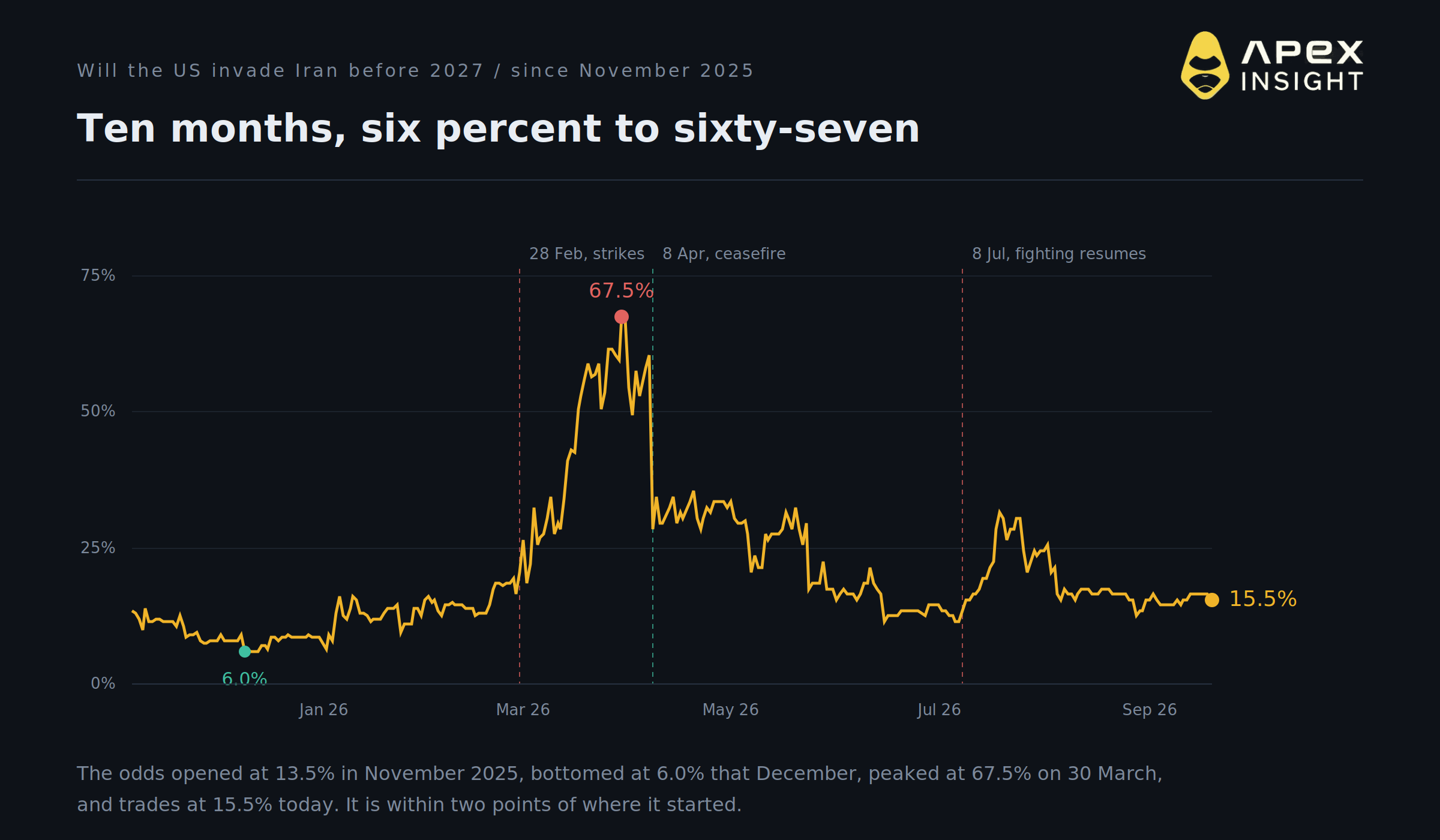
The market has been trading since November 2025, four months before the war began.
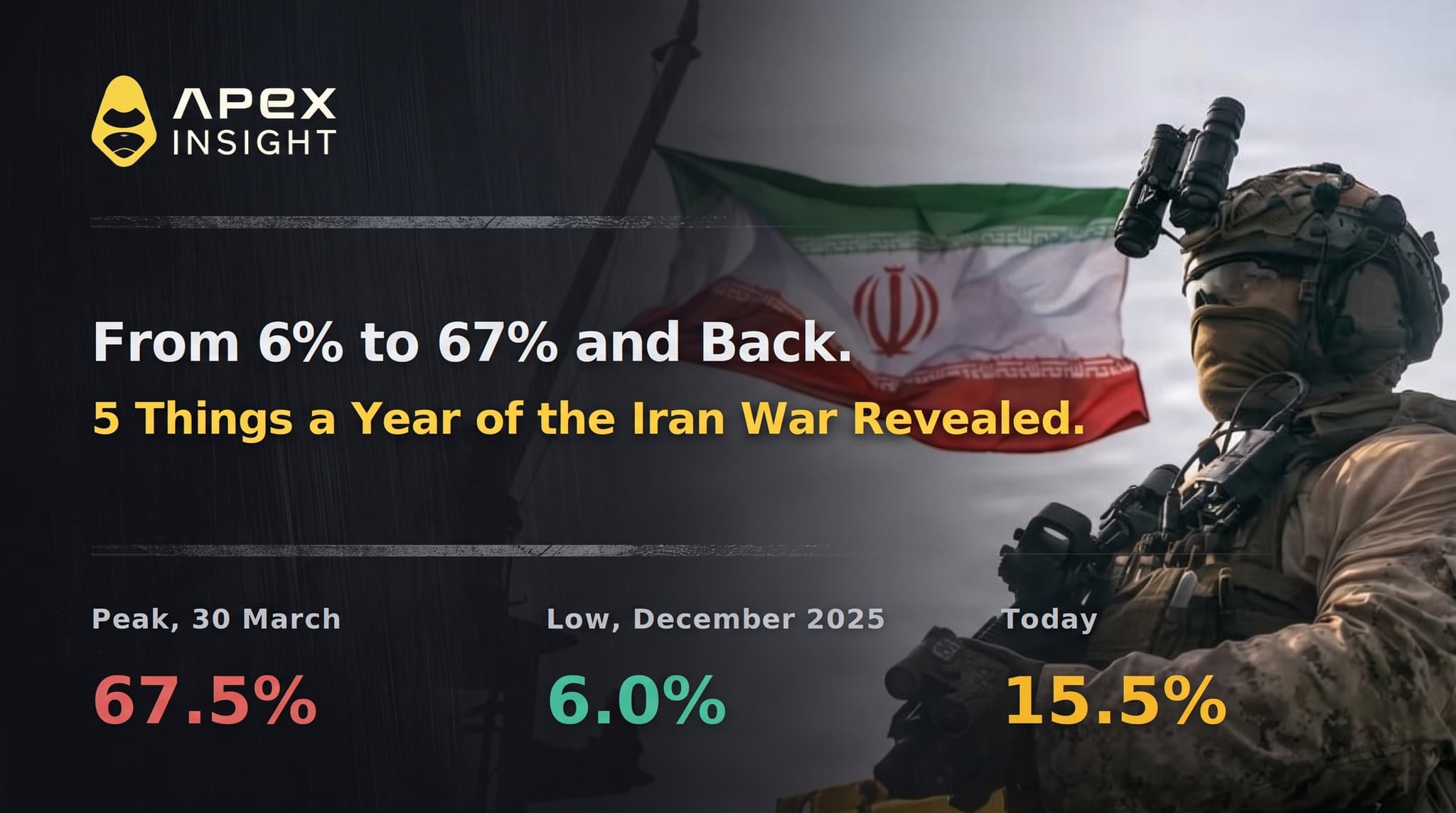
It spent that winter between 6 and 14 percent. It began climbing in February, spiked violently through March, collapsed in April, drifted down through early summer, spiked again in July, and settled back into the mid teens.
The range is 6.0 percent to 67.5 percent. That is not a market that ignores news. It is a market that has responded to every development of this war and arrived back near its starting point.
2. The week the market thought it was coming
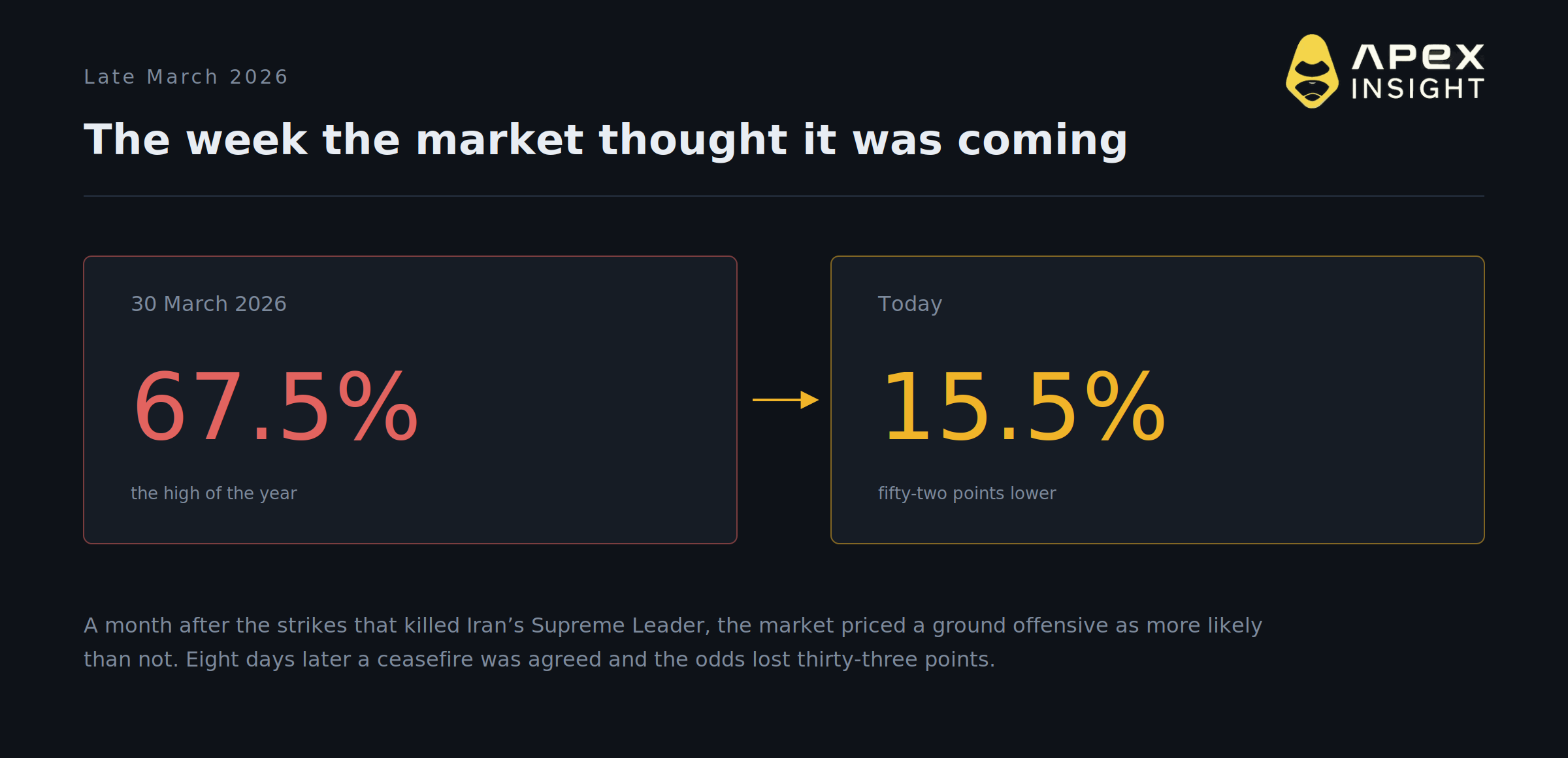
On 30 March 2026 the odds reached 67.5 percent.
A month earlier, US and Israeli strikes had killed Iran's Supreme Leader and Iran had closed the Strait of Hormuz. Talks had not yet begun, a naval blockade was being prepared, and the market priced a ground offensive as the likeliest outcome.
Eight days later, Pakistan brokered a two week ceasefire. By 9 April they had fallen to 34.5 percent. It lost thirty-three points in nine days.
That is worth holding onto when reading any number in this complex. A market that can move thirty-three points in nine days is not expressing a settled view. It is expressing a current one.
3. Every move maps to an event
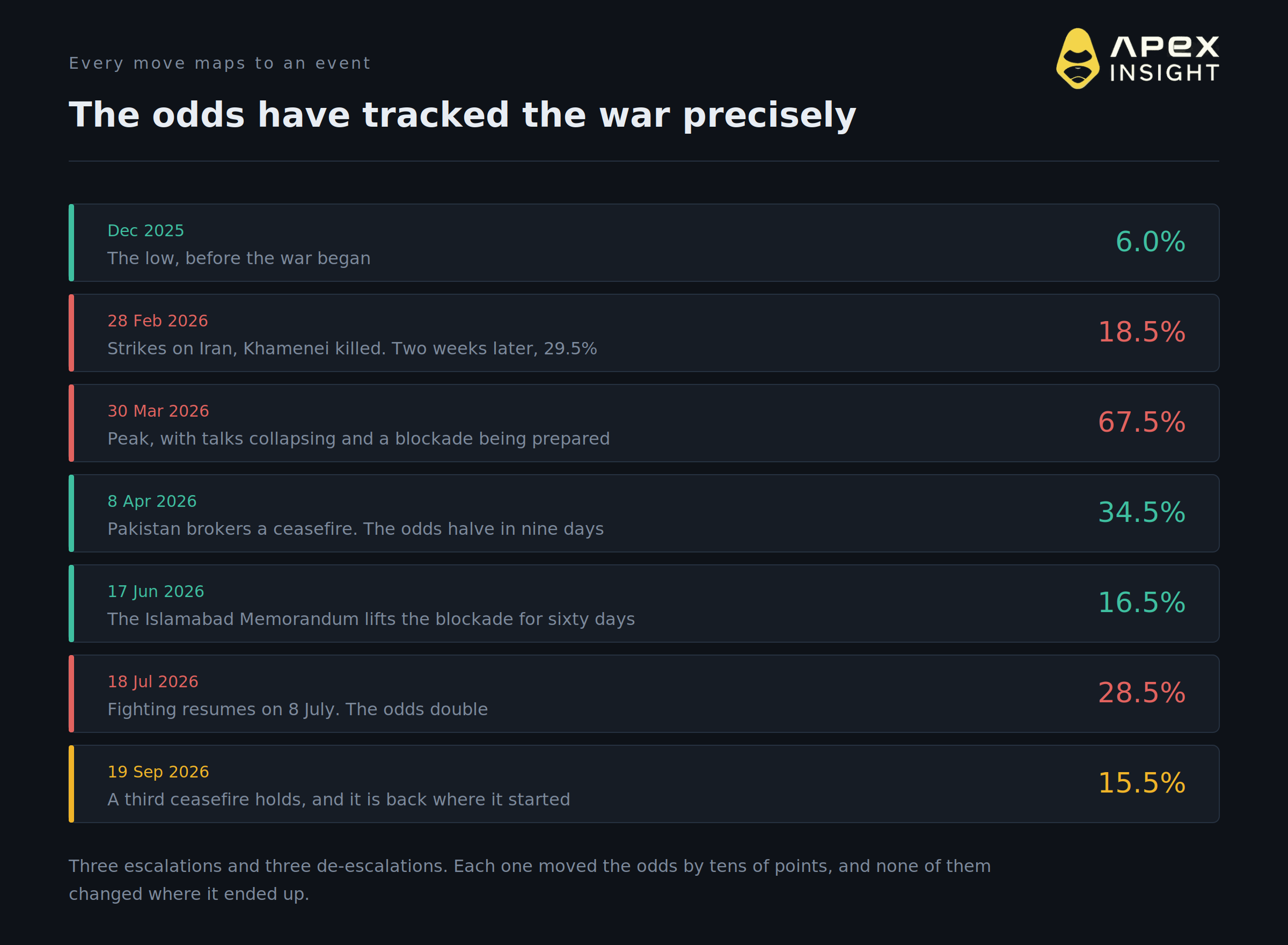
December 2025, 6.0 percent, before the war. 28 February, 18.5 percent on the day of the strikes, rising to 29.5 percent within two weeks. 30 March, 67.5 percent at the peak. 8 April, 34.5 percent as the ceasefire lands. 17 June, 16.5 percent as the Islamabad Memorandum lifts the blockade for sixty days. 18 July, 28.5 percent after fighting resumes on the 8th. Today, 15.5 percent with a third ceasefire holding.
Three escalations and three de-escalations, each moving the odds by tens of points.
What this shows is that the 15.5 percent is not apathy or thin trading. They are an actively managed price that has been tested repeatedly, and the current level is the market's considered answer after ten months of evidence.
4. Every escalation route is a tail
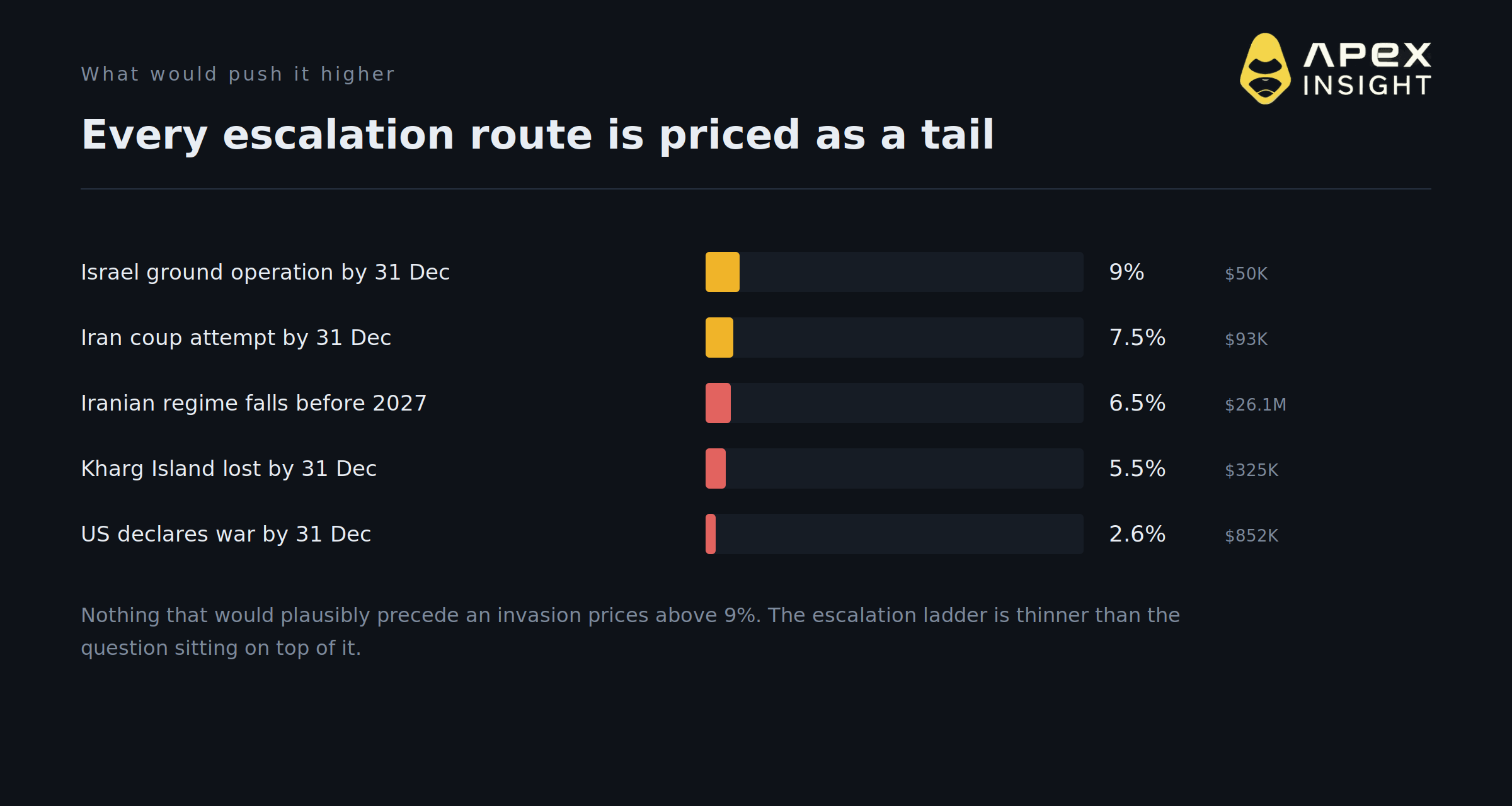
For the odds to climb back toward their March level, something would have to precede it. Here is what those things cost.
An Israeli ground operation in Iran by 31 December prices at 9 percent. An Iranian coup attempt prices at 7.5 percent. The regime falling before 2027 prices at 6.5 percent on a $26.1M book. Kharg Island falling out of Iranian control prices at 5.5 percent. A formal declaration of war prices at 2.6 percent.
Nothing that would plausibly come first prices above 9 percent.
That is an unusual shape. The escalation ladder is thinner than the question sitting on top of it, which means the market is pricing an invasion that arrives without the intermediate steps, or not at all.
5. Every de-escalation route is partial
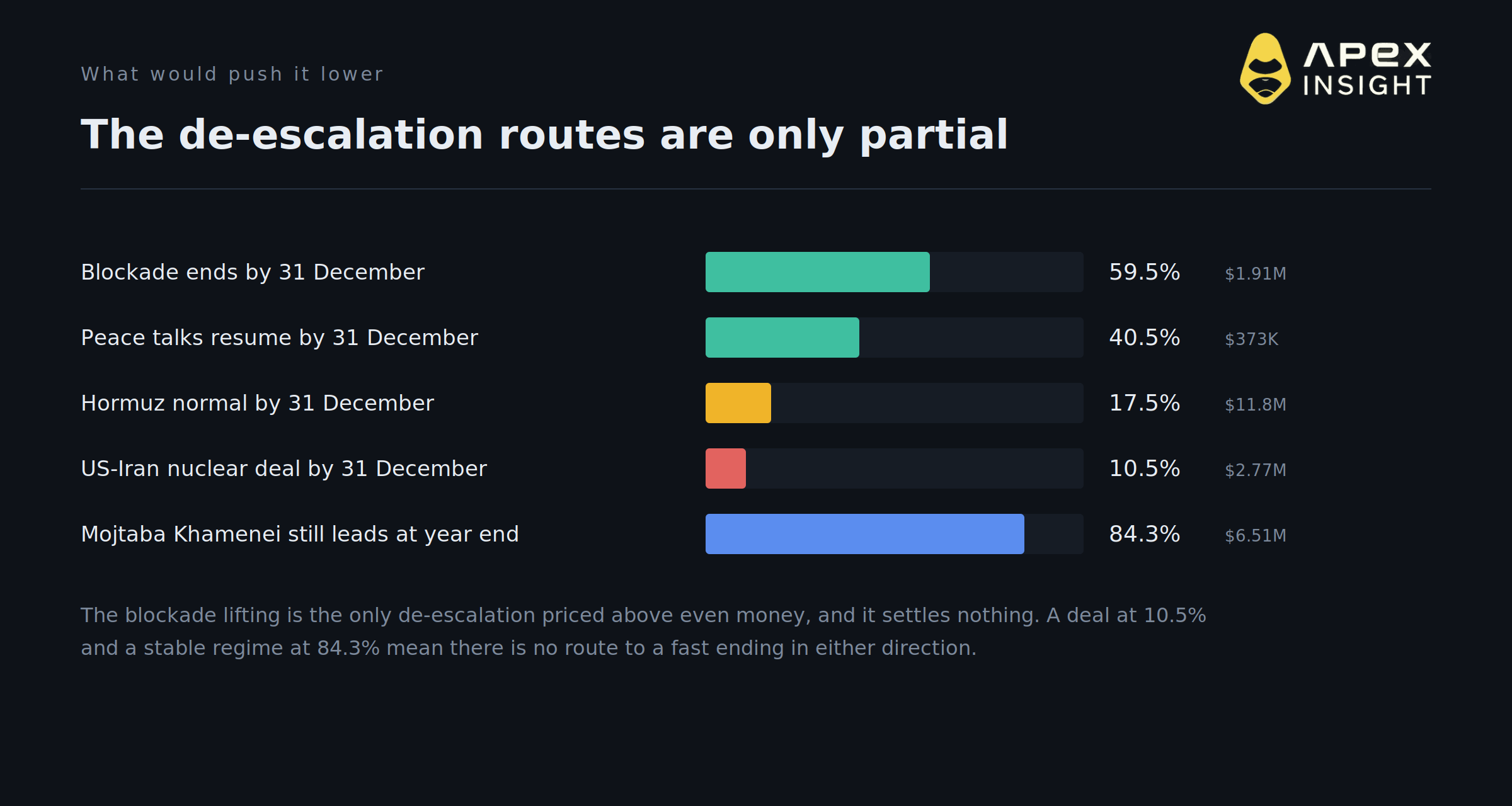
The other direction is no cleaner.
The blockade ending by 31 December prices at 59.5 percent, the only de-escalation above even money. Peace talks resuming price at 40.5 percent. Hormuz returning to normal prices at 17.5 percent. A nuclear deal prices at 10.5 percent. And Mojtaba Khamenei still leading Iran at year end prices at 84.3 percent.
Read together: the economic pressure lifts, the talks may resume, the waterway stays shut, nothing is signed and the same government remains.
There is no route to a fast ending in either direction. The escalation ladder is too thin and the de-escalation ladder stops short of a settlement.
Why the number keeps returning to fifteen
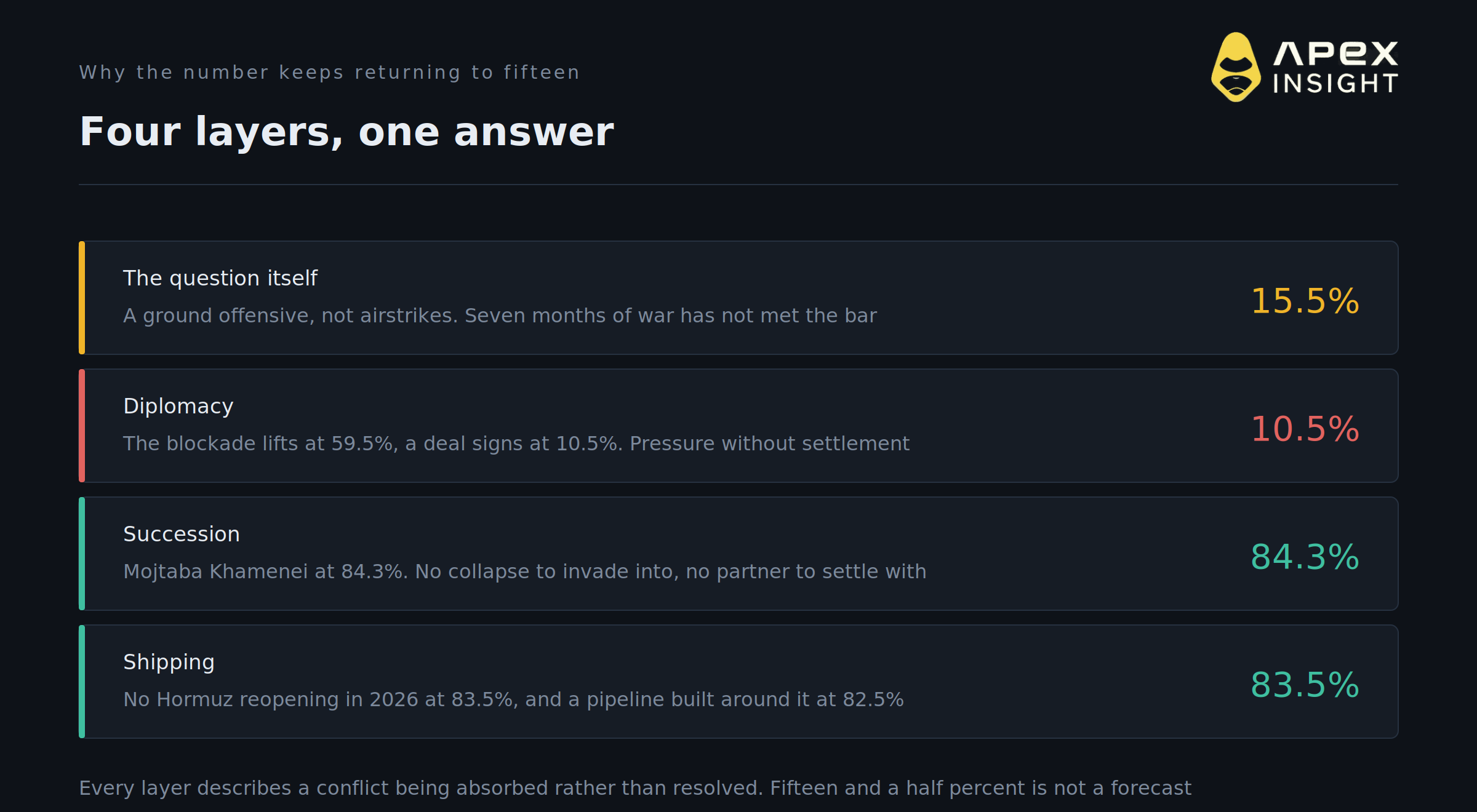
Put the four pieces of this series together and the same answer appears at every level.
The question requires a ground offensive to establish territorial control, and seven months of airstrikes, a blockade and a killed head of state have not met that bar. The diplomacy markets price the blockade lifting at 59.5 percent and a deal at 10.5 percent, which is pressure being withdrawn without a settlement. The succession market prices Mojtaba Khamenei at 84.3 percent, so there is no collapse to invade into and no partner who will concede. And the shipping markets price no Hormuz reopening in 2026 at 83.5 percent while pricing the pipeline built around it at 82.5 percent.
Every layer describes a conflict being absorbed rather than resolved.
Fifteen and a half percent is not a forecast that the United States invades Iran. It is the price of a war that has no exit priced above 60 percent, where the only thing moving above even money is the quiet withdrawal of economic pressure.
What would actually change it
Three things, in order of how early you would see them.
The Israeli ground operation market at 9 percent, because an allied offensive is the cheapest available leading indicator and the most likely thing to precede an American one.
The regime and coup markets at 6.5 and 7.5 percent, because a vacuum is the classic invitation to intervention, and both are currently priced as tails on a stable state.
And the ceasefire markets, which have resolved yes at every leg this month. Two previous pauses ended, in April and again in July, and the odds doubled within weeks each time. If a fourth breakdown comes, the March precedent says the repricing will be violent and fast.
Stage 2 has concluded
That closes Stage 2 of Political Markets Season, five pieces on the US invasion of Iran before 2027: what the question actually asks, what the diplomacy markets expect instead, why the regime is priced to survive, why the Strait is not priced to reopen, and what a year of price history reveals.
Stage 3 opens on 21 September and runs to 27 September, on the US midterm elections. That is a market with a fixed date, a defined outcome and far more liquidity than anything covered so far, and the series will be back for it.
Political Markets Season is live on ApeX Omni. Four stages, four political markets, a 6,000 USDT prize pool.
Spot prediction trading on Polymarket order books. No leverage, no liquidation, no KYC. Trade the odds, not the outcome.
We appreciate your continued support.
Published by ApeX. For informational and educational purposes only. Not investment advice, and not a forecast or endorsement of any political or military outcome. Trading involves risk, including total loss.