





Bitcoin finished last week down 1.33%. In the same week, Coinbase fell 6.33%, Circle 5.98% and Bitmine 7.11%.
On Thursday alone, the day the Nasdaq had its worst session since April 2025, every one of those names fell about twice as much as bitcoin did.
That gap is the whole article. The asset barely moved. The companies built on it did not get the same week, and the reason is sitting in a bill that has not been written yet.
US markets are closed for the weekend, so every figure here is measured to Friday's close. These contracts keep printing through Saturday and Sunday on thin order flow that reflects positioning rather than the underlying, so no weekend price is used anywhere.
Here are six things the tape shows.
1. Bitcoin had a quiet week. The companies did not
Start with the spread.
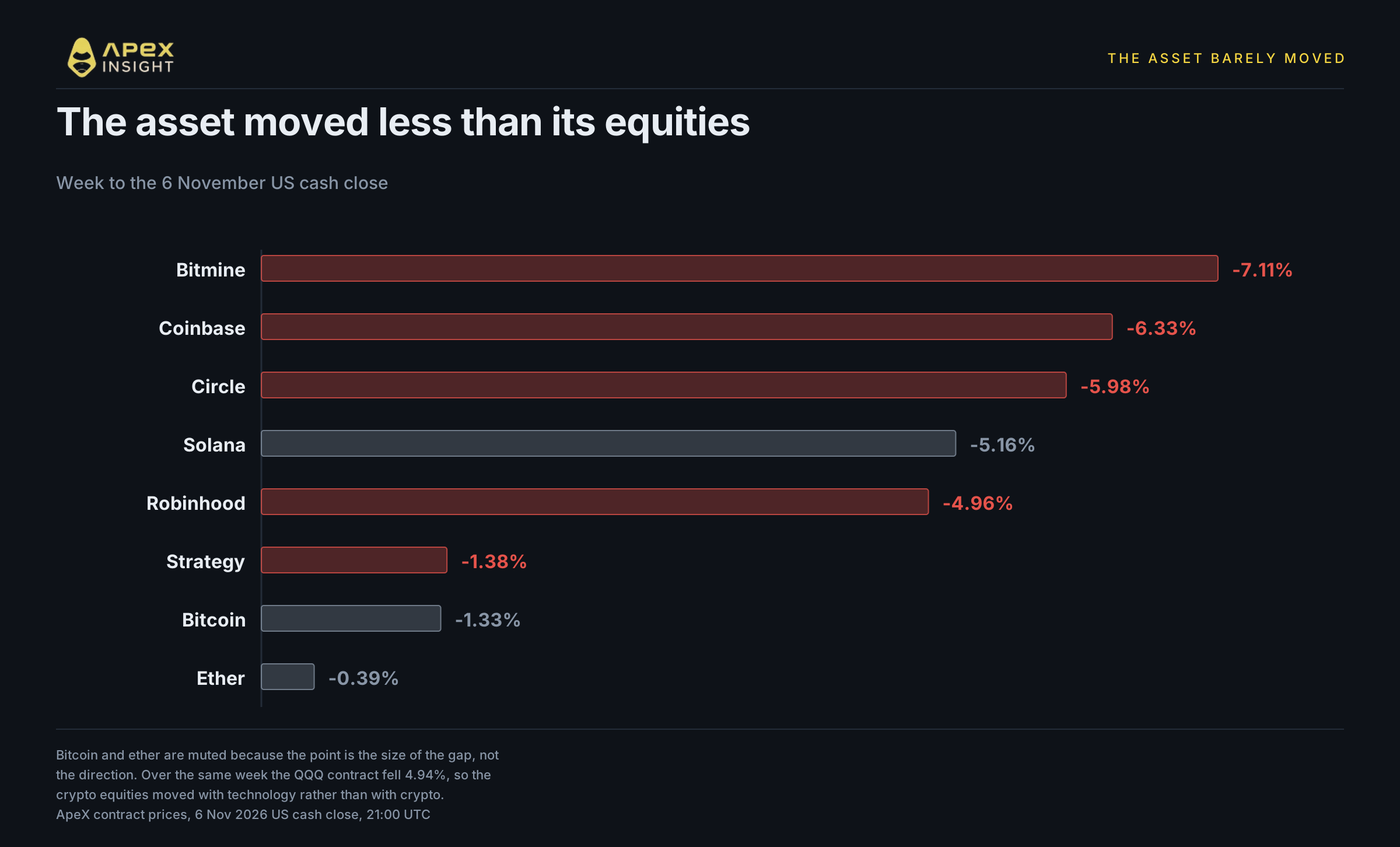
Over the week bitcoin fell 1.33% and ether 0.39%. Against that, Bitmine fell 7.11%, Coinbase 6.33%, Circle 5.98% and Robinhood 4.96%.
One asset does complicate this, and it is worth naming rather than leaving out. Solana fell 5.16%, which is equity-sized rather than bitcoin-sized. So the clean split is not assets against equities; it is bitcoin and ether against almost everything else, Solana included.
Put as a ratio, Coinbase moved 4.7 times bitcoin over the week, Circle 4.5 times and Bitmine 5.3 times. For comparison, the QQQ contract fell 4.94%, which is 3.7 times bitcoin.
So the crypto equities did not trade like crypto last week. They traded like high beta technology stocks, and slightly worse than the index.
2. On Thursday they all moved as one
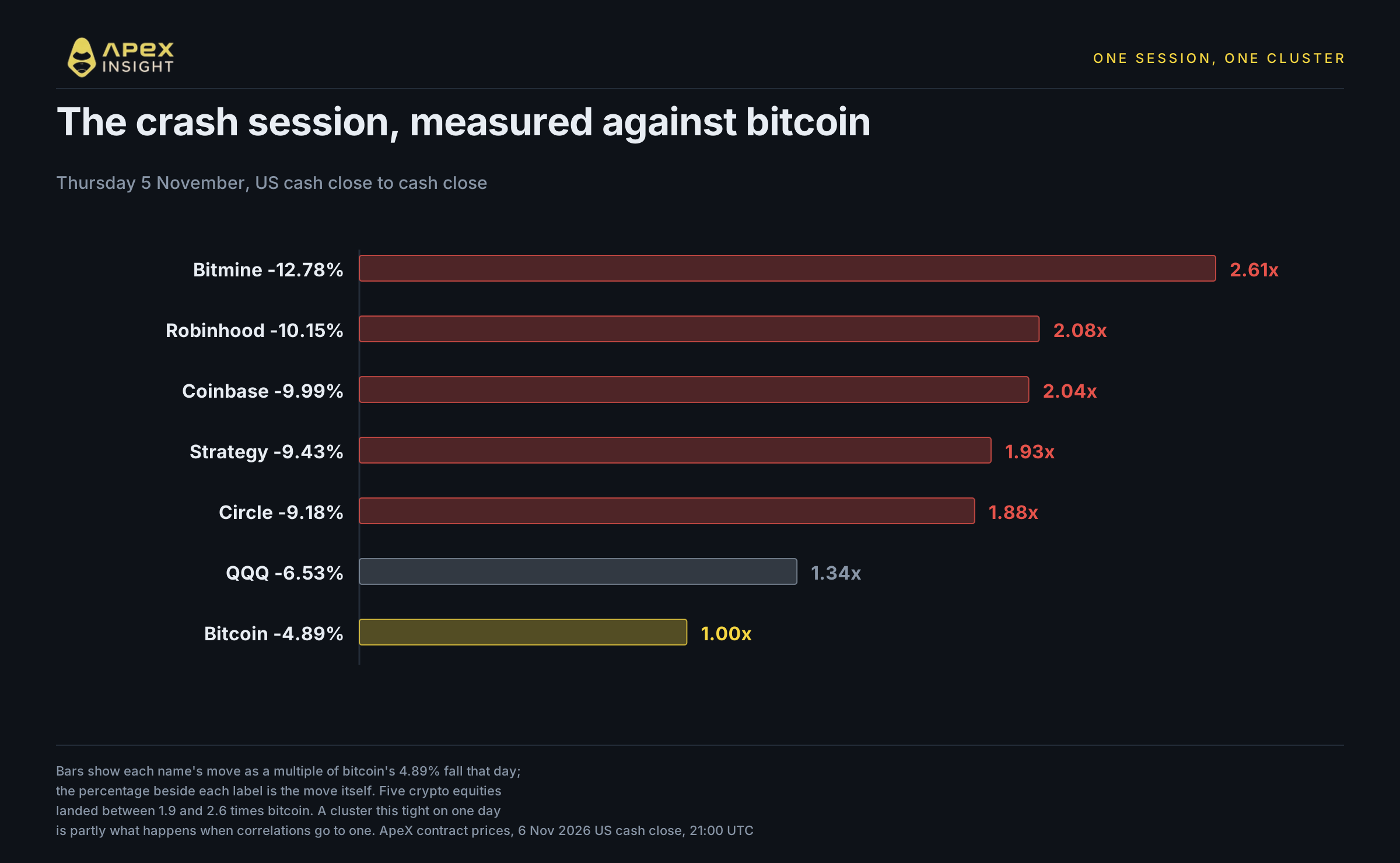
Thursday 5 November is where this is cleanest, because it was a single violent session rather than a week of drift.
Bitcoin fell 4.89% that day. Coinbase fell 9.99%, Robinhood 10.15%, Strategy (formerly MicroStrategy) 9.43%, Circle 9.18% and Bitmine 12.78%. Every one of them landed roughly between 1.9 and 2.6 times bitcoin's move, clustered tightly around two. That tightness is partly a property of how it is measured: these are contract prices over a US close to close window, and the same names measured on cash closes cluster lower, nearer 1.5 to 1.8 times.
The Nasdaq fell 5.52% and the QQQ contract 6.53%. So on the day, the crypto equities behaved like a leveraged bet on the Nasdaq, not like a bet on bitcoin.
One session is one session, and a cluster this tight across five names on one day is partly just what happens when correlations go to one in a selloff. The weekly numbers in section 1 are the better evidence, because they survive a bounce.
3. The exception is the one that mostly just holds bitcoin
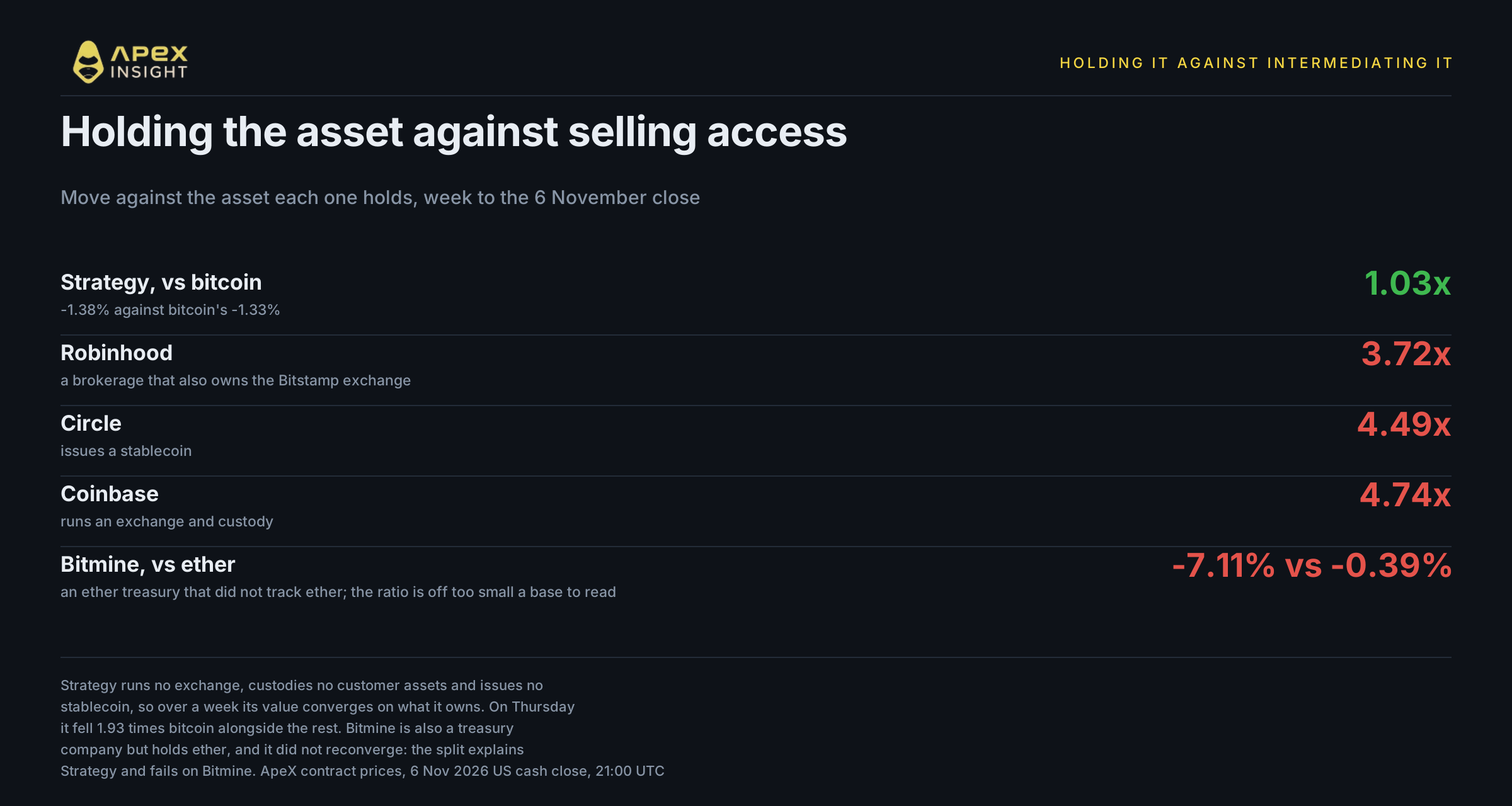
Here is the detail that turns a pattern into an explanation.
Strategy fell 1.38% over the week against bitcoin's 1.33%. That is a ratio of 1.03, which is to say it tracked bitcoin almost exactly, while Coinbase moved nearly five times as much.
Strategy is the one name here whose business is, in substance, holding bitcoin. It still sells analytics software, but the software is a rounding error next to the holdings. It does not run an exchange, it does not custody customer assets and it does not issue a stablecoin. Over a week, its value converges on the value of what it owns.
Note that it did not escape Thursday: on the crash session it fell 9.43%, or 1.9 times bitcoin, right alongside the others. Intraday, in a liquidation, it trades like every other high beta name. Given a week, it reconverges on its holdings. The two timeframes are measuring different things, and it is worth being precise about which one supports which claim.
And the tidy version of this breaks on the other holder here. Bitmine is also a treasury company, but an Ethereum one: it began as a bitcoin miner, pivoted in mid 2025, and is chaired by Tom Lee. It held about 6.0 million ether in early October, roughly 94% of its assets, alongside a couple of hundred bitcoin, cash and a few equity stakes, and it still runs ancillary mining and hosting. So it is a less pure holder than Strategy, which matters for what follows. Measured against the asset it actually holds, it fell 1.81 times ether on Thursday, in line with everything else, and then did not reconverge at all. On the week it is down 7.11% while ether is down 0.39%. The ratio of those two is eighteen, but that number means nothing: any ratio taken off a base of less than half a percent is noise, and the honest statement is simply that one fell and the other did not.
So "holders track the asset" explains Strategy and fails on Bitmine. The difference may be size, liquidity, the purity of the holding, or the premium a smaller treasury vehicle trades at against the value of its holdings. A week of prices cannot separate those, and this piece is not going to pretend otherwise.
4. What the Democrats are reportedly weighing
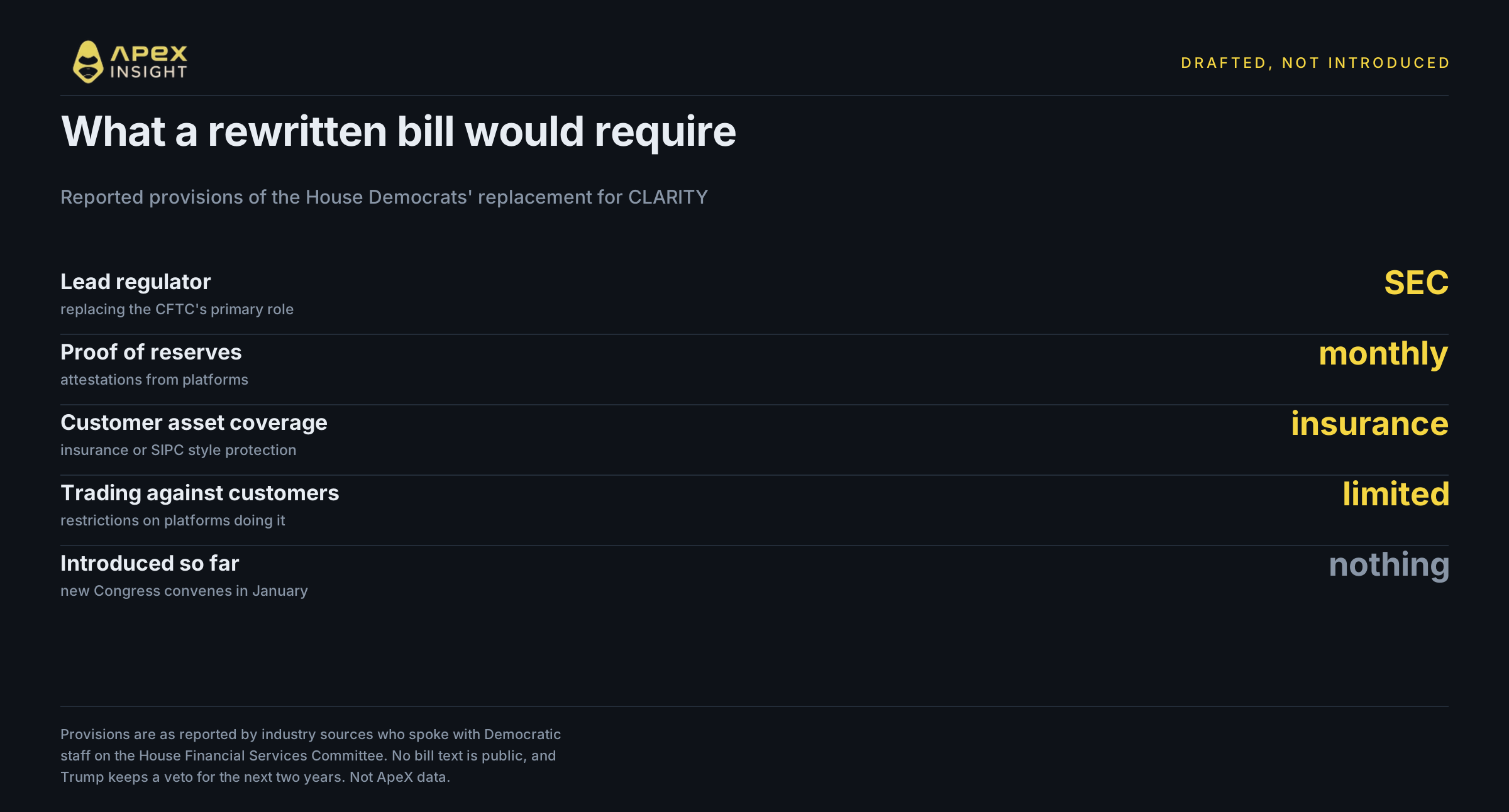
Now the part that explains the spread.
The CLARITY Act passed the House 294 to 134 in July 2025 and was blocked in the Senate on 15 September 2026. After taking both chambers on 3 November, House Democrats are discussing a replacement market structure bill, not yet public, described by industry sources who have spoken with Democratic staff on the House Financial Services Committee.
The plan reportedly builds on Representative Maxine Waters' 2025 amendment, the Crypto Investor and Consumer Bill of Rights. Its provisions include 24/7 customer service requirements, insurance or SIPC style coverage for customer assets, stricter custody rules, monthly proof of reserves attestations, and limits on platforms trading against their own customers. It is also expected to carry ethics provisions restricting crypto activity by the President and other federal officials. It would also give the SEC a larger role over spot digital commodity markets and the CFTC a smaller one.
The industry's read is blunt. TD Cowen's Jaret Seiberg said the climate may make it "impossible to advance a version of Clarity that the crypto sector could back". Duke's Lee Reiners put it shorter: "CLARITY is dead." Republicans familiar with the Democratic effort call it a messaging bill.
For scale on what is at stake for the industry, it spent more than $200 million on the midterms and lost both chambers anyway.
Two caveats that matter. Nothing has been introduced, let alone passed, and the new Congress does not convene until January. And Trump keeps a veto for the next two years, so even a bill that clears both chambers has a further obstacle.
5. The rules target the businesses, not the asset
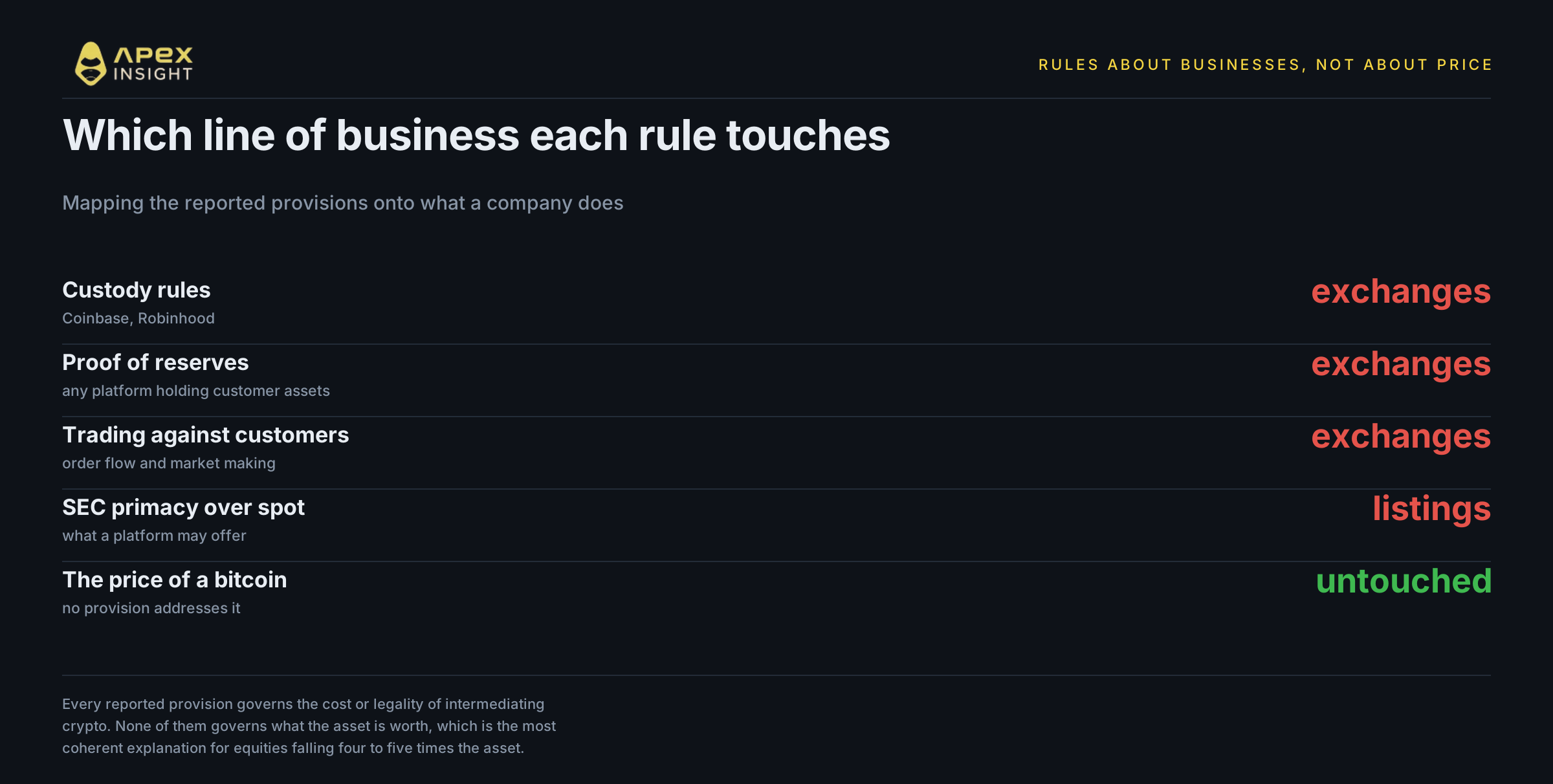
Read that list of provisions again with the price action next to it.
Custody rules, proof of reserves attestations and limits on trading against customers are rules about running an exchange. Insurance and customer service requirements are rules about holding customer assets. A larger SEC role over spot markets is a rule about what a platform may list and how.
Not one of the platform provisions is a rule about what a bitcoin is worth. They are rules about the cost and the legality of operating the businesses that sit between a customer and the asset, which is exactly the set of companies that fell three to five times harder than the asset itself.
The ethics provisions are the exception, and they cut the other way. A restriction on officials issuing or endorsing digital assets is a rule that bears directly on the value of particular tokens, which is why the Trump coin fell 17% while XRP rose 3.9% on the result.
That is the most coherent explanation for the spread, and it fits the Strategy exception in section 3 precisely: a company with no exchange, no customer custody and no stablecoin has very little exposed to a bill of this shape.
The counter-argument deserves stating. These five names are not five independent observations. They are correlated, high beta US listed stocks that fall together in any risk-off week, and Thursday's two-times cluster is as consistent with simple beta as with policy. The weekly spread is better evidence than the daily, and even that cannot separate regulation from the broader technology selloff this series has been covering all week. The honest position is that both are present and this piece cannot weigh them.
6. Five days, one pattern
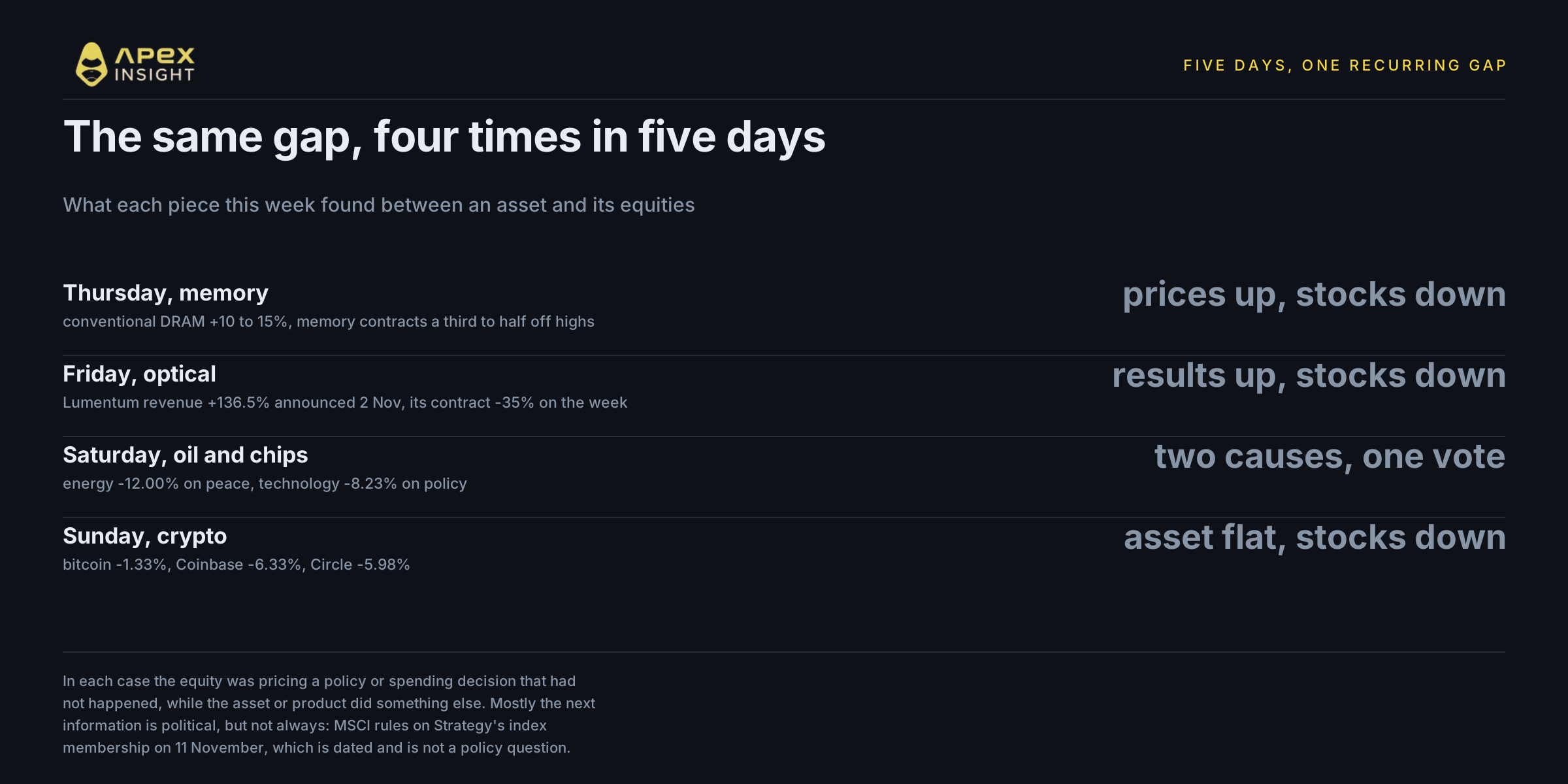
This is the last piece in a five day run, and the same shape has turned up in four of them.
On Thursday, conventional DRAM contract prices were rising 10% to 15% this quarter while the memory contracts we track sat a third to half below their own June highs. In Friday's piece, Lumentum had grown revenue 136.5%, guided up and agreed to be acquired, all announced that Monday, and its contract still fell 35% on the week. On Saturday, oil fell on an expected peace rather than on demand, while chips fell on expected regulation. Today, bitcoin is flat and the companies that sell access to it are down 5% to 7%.
Four different corners of the market, one recurring gap: between what a thing is worth and what the companies attached to it are worth. In each case the equity was pricing a policy or a spending decision that had not happened, while the underlying asset or product was doing something else entirely.
That is not a prediction about any of them. It is an observation about what this particular market has spent a week paying attention to, which is politics rather than numbers.
One correction to that framing, because it matters. Most of these trades resolve on a timetable nobody has published, but not all. MSCI rules on 11 November on whether to remove Strategy from its indices, with any change effective after the 30 November close, and Strategy puts index-linked holdings at around 3% of its basic shares. That is a dated, non-political catalyst three days from now, and it is also a live alternative explanation for how Strategy traded this week that this piece cannot rule out.
Trade crypto stocks
Go long or short Coinbase, Circle and Strategy from the same account you trade Bitcoin in.
The exchanges and the issuer. The names most exposed to a market structure bill.
HOOD-USDT, a brokerage that also owns the Bitstamp exchange
CRCL-USDT, a stablecoin issuer that now also runs a national trust bank
The holders. Treasury companies that mostly own the asset rather than intermediate it. Strategy holds bitcoin, Bitmine mostly holds ether.
The assets themselves. What all of the above are ultimately exposed to.
Every ApeX price in this piece is a perpetual contract price. TradFi contracts settle against an index rather than the underlying asset, and ApeX lists them separately from its crypto perpetuals in its own contract data.
Trading perpetual futures carries a high risk of loss and leverage magnifies losses as fast as gains. Nothing here is financial advice.
If you need any help, feel free to reach out to our team on Discord.
Website: https://www.apex.exchange
Twitter: https://twitter.com/OfficialApeXdex
Telegram: https://t.me/ApeXdex
Methodology: all contract moves are computed from ApeX klines. Hourly bars are start-stamped, so the price at hour H is the close of the bar stamped H minus one. The week runs from the 30 October US cash close to the 6 November US cash close; the US close was 20:00 UTC on 30 October and became 21:00 UTC when daylight saving ended on 1 November, so the two ends of the window use different clock times. Thursday's session runs from the 4 November close to the 5 November close. Bitcoin, ether and Solana trade continuously, and house practice measures them on the calendar day; this piece compares them directly against equity contracts, so every asset is measured over the same US-close to US-close window instead, and calendar day figures would differ slightly. Ratios to bitcoin and ether are computed from unrounded returns, so dividing the rounded percentages printed here will give a slightly different figure. They are a description of what happened, not a beta estimate: five names over one week is far too little data for that. US markets are closed for the weekend and no Saturday or Sunday price is used, because weekend prints in these contracts are thin. Legislative details, index levels and all quotations are from the linked sources and are not ApeX data. Figures as at the 6 November 2026 US cash close, 21:00 UTC.