




Note: All market prices are as of 18 September 2026. Several sub-markets here carry five figures or less, which is flagged where it matters.
1. The succession held
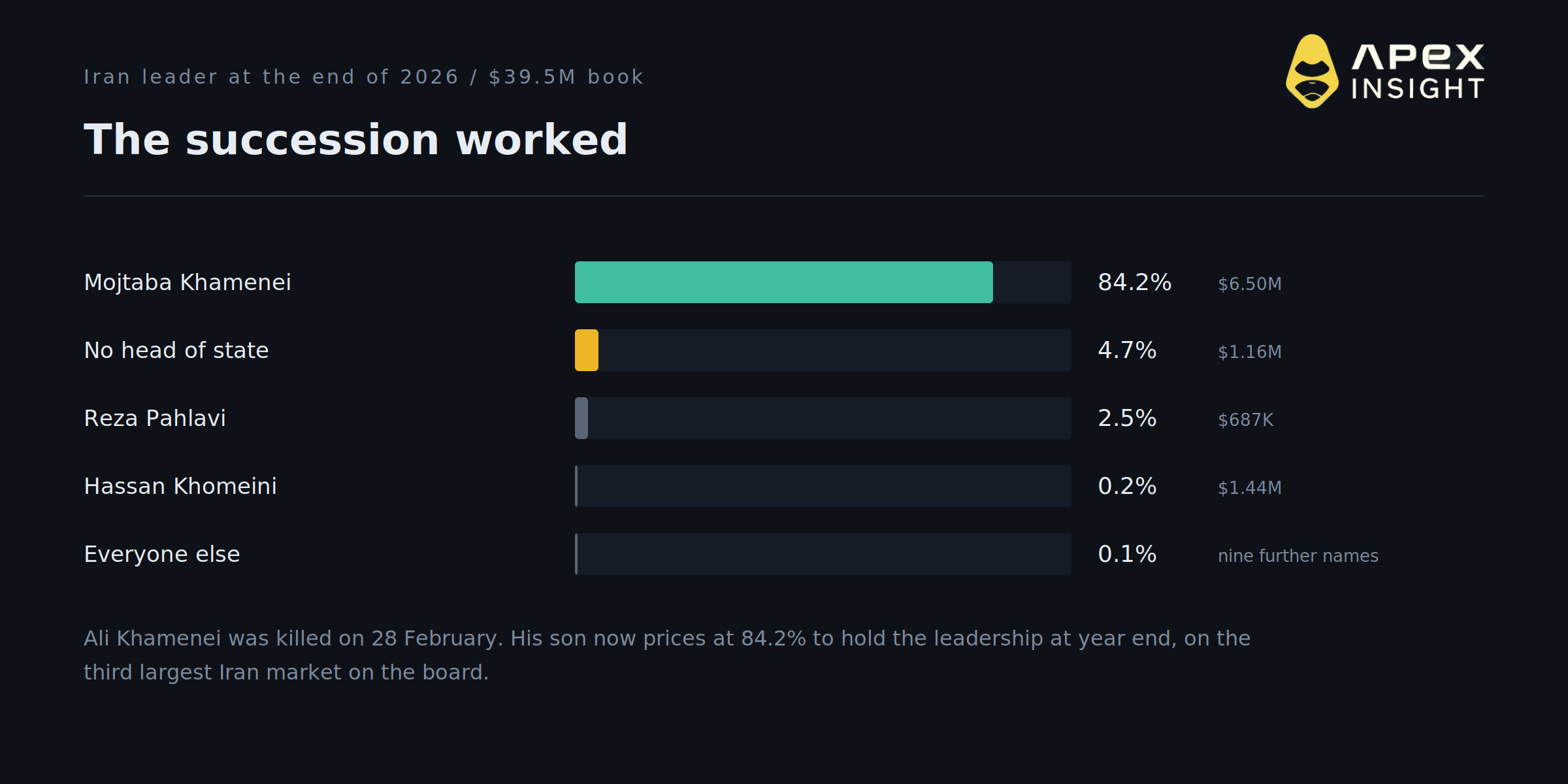
Mojtaba Khamenei prices at 84.2 percent to be Iran's leader at the end of 2026. No head of state prices at 4.7 percent, Reza Pahlavi at 2.5 percent, Hassan Khomeini at 0.2 percent, and nine further names at 0.1 percent each.
A decapitation strike on a head of state is the kind of event that is supposed to produce instability. Seven months on, the market prices the transfer of power as close to settled.
Worth noting where the volume sits, because it repeats a pattern from earlier in this series. The winning name carries $6.50M. Hassan Khomeini, at 0.2 percent, carries $1.44M. Hassan Shariatmadari, at 0.1 percent, carries $3.16M. Seyed Hossein Mousavian, also at 0.1 percent, carries $3.69M. The losing names hold several times the money of the leading one.
2. Every route out of the regime is a tail
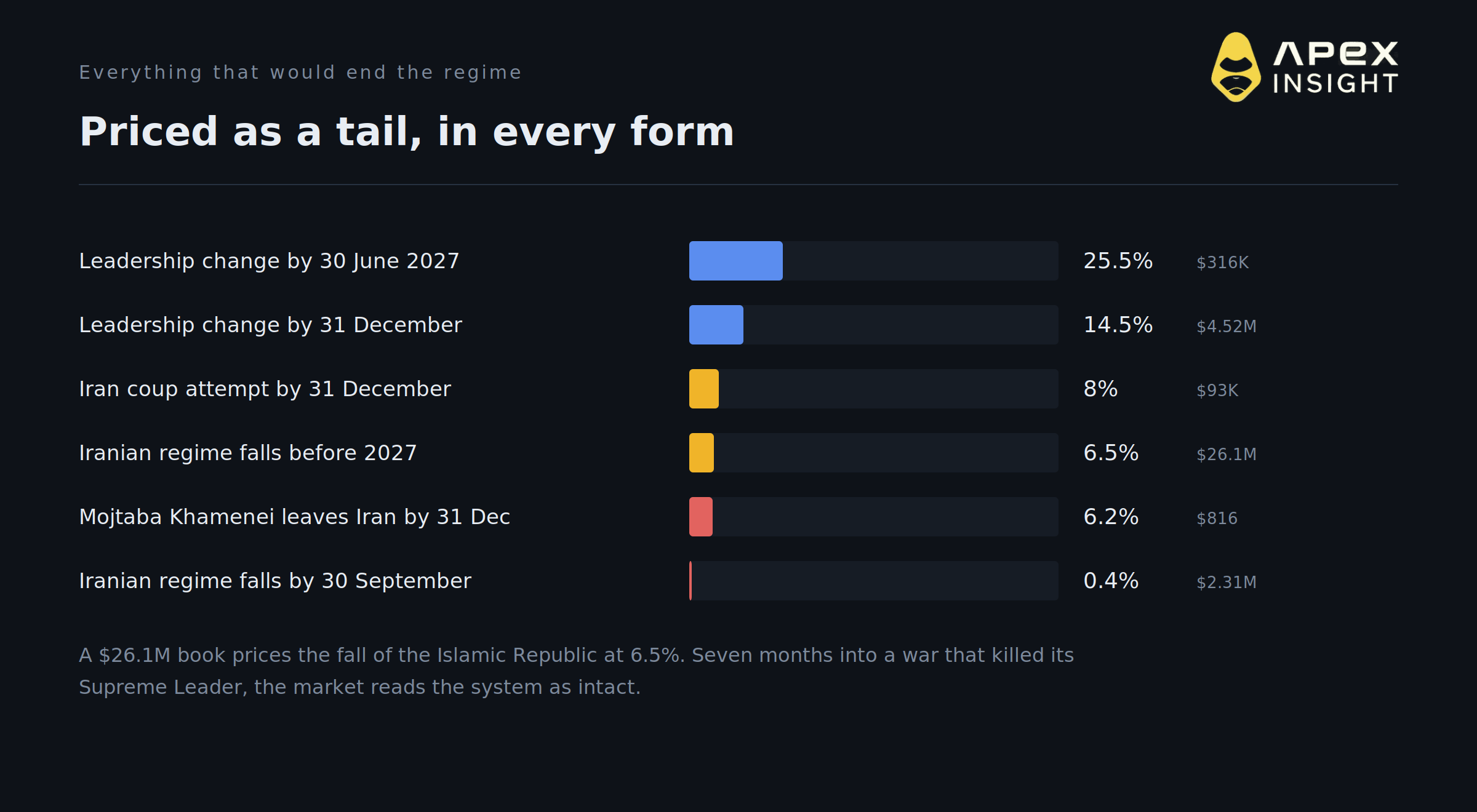
Leadership change by 30 June 2027 prices at 25.5 percent. By 31 December, 14.5 percent. A coup attempt by year end prices at 8 percent. The regime falling before 2027 prices at 6.5 percent on a $26.1M book. Mojtaba leaving Iran prices at 6.2 percent.
The regime falling by 30 September prices at 0.4 percent.
Earlier legs of the leadership change market, covering March, April, July and August, all resolved no.
So across every framing the market offers, from a negotiated transition to a coup to outright collapse, nothing prices above one in four and most of it sits below one in ten.
3. The most expensive losing position in the complex
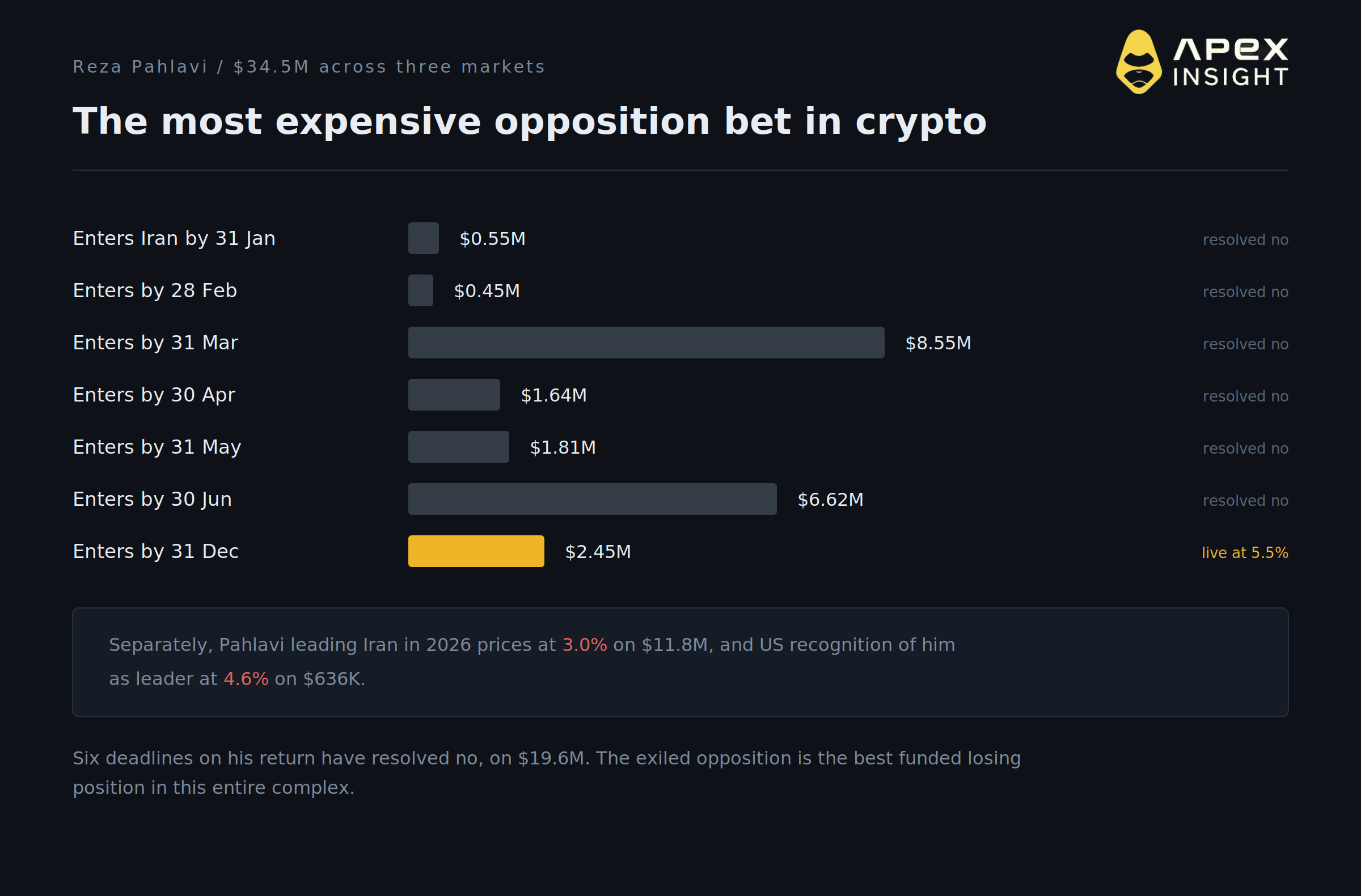
Reza Pahlavi, son of the last Shah, is the focus of three separate markets carrying $34.5M between them.
Six deadlines on whether he would enter Iran have resolved no, covering January through June, on $19.6M of volume. The March leg alone carried $8.55M and the June leg $6.62M. The live December contract prices at 5.5 percent.
Separately, Pahlavi leading Iran in 2026 prices at 3 percent on $11.8M, and the United States recognising him as leader prices at 4.6 percent.
That is a great deal of capital committed to a restoration, and essentially all of it has lost. Whatever the exiled opposition's political standing, the market has been consistent and expensive about its odds all year.
4. The state holds and the currency does not
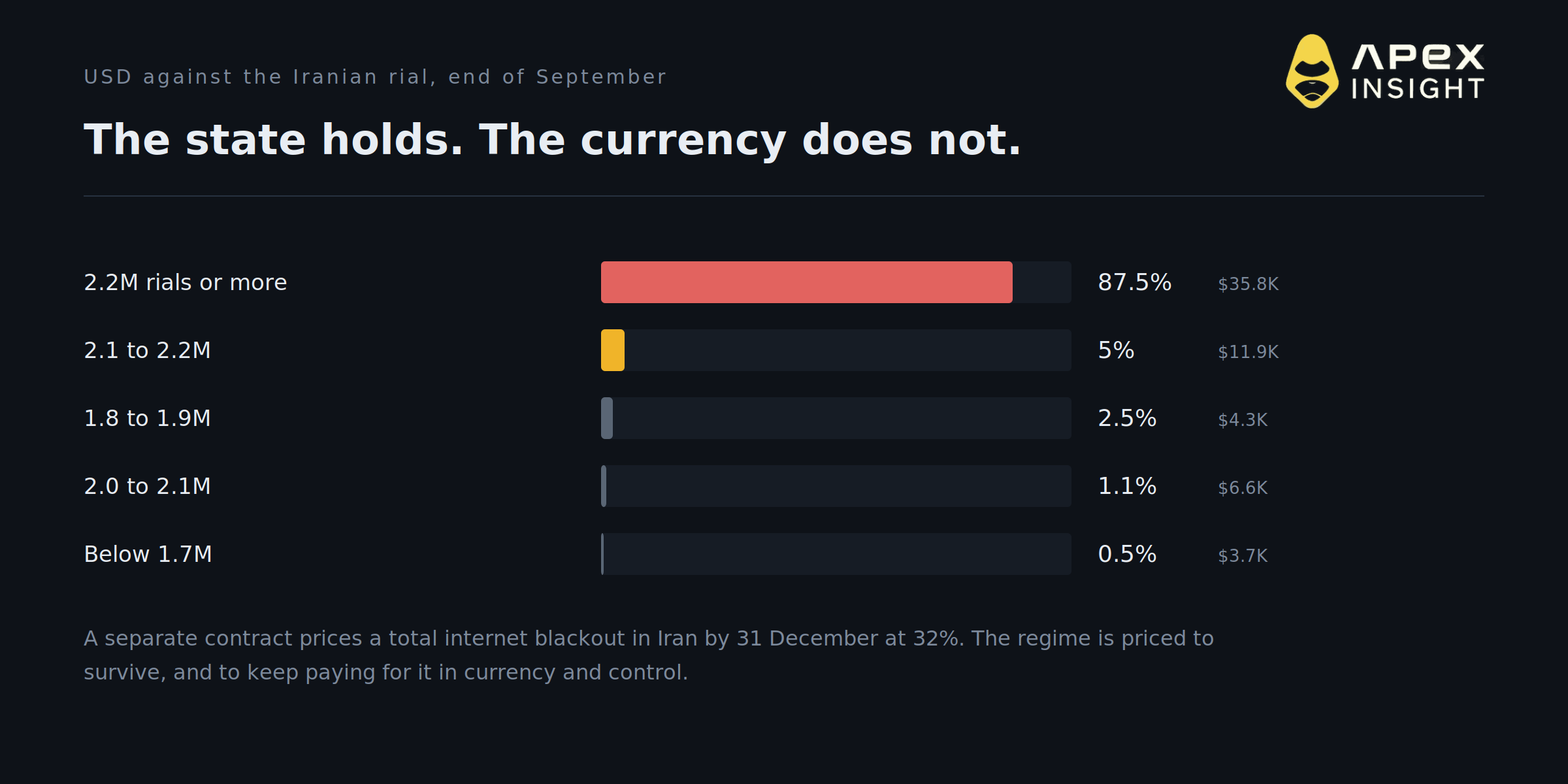
The dollar against the Iranian rial at the end of September prices 2.2 million or more at 87.5 percent. Everything below 2.1 million prices in low single digits.
A separate contract prices a total internet blackout in Iran by 31 December at 32 percent.
Those two numbers describe the cost of the stability in sections one and two. The regime is priced to survive, and to keep paying for survival in currency debasement and control of information. That is a different picture from either collapse or normality, and it is the one the market has settled on.
5. Why stability holds the invasion price
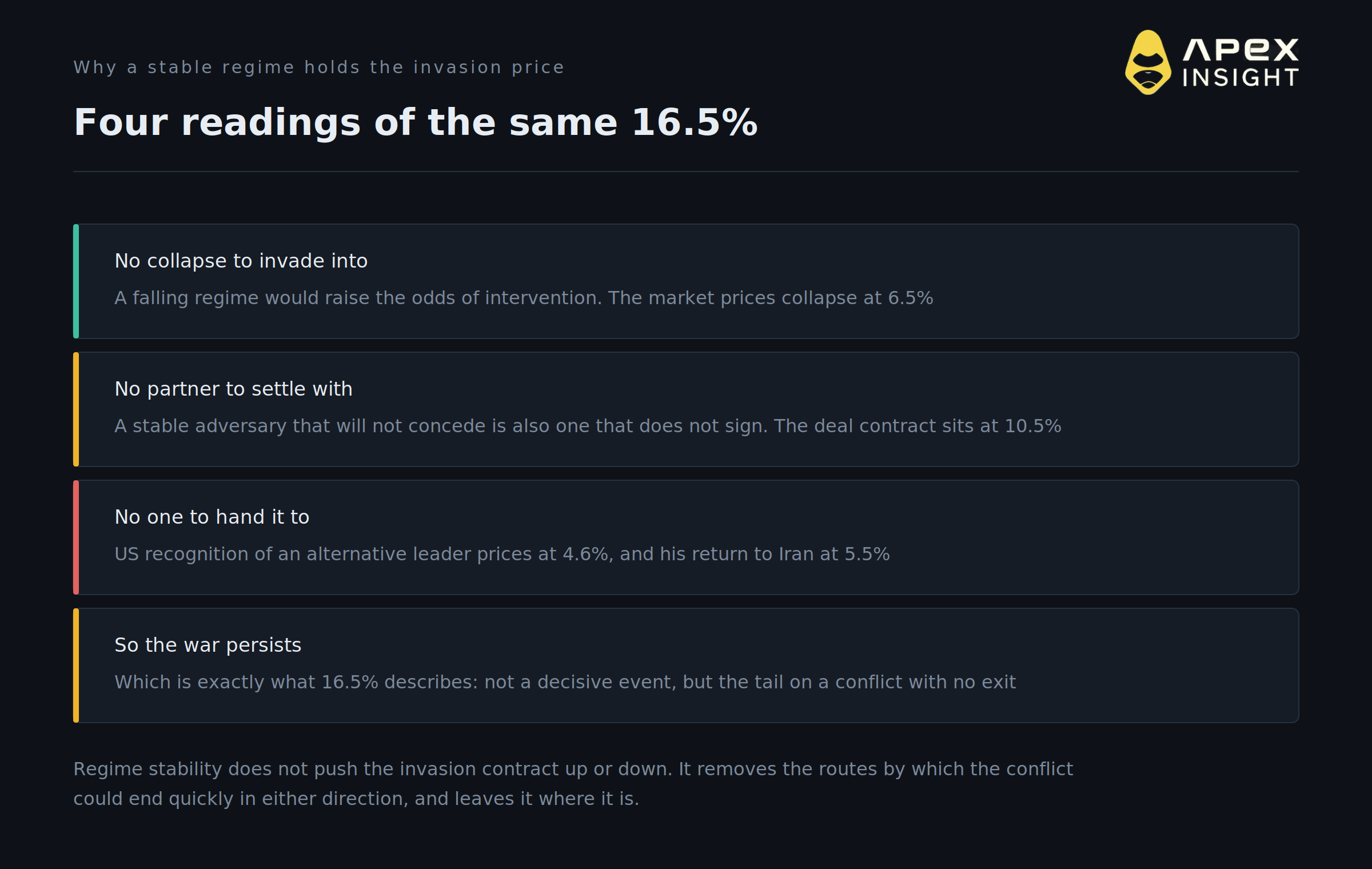
This is the part that matters for Stage 2.
A collapsing regime would raise the odds of intervention, because a vacuum invites one. The market prices collapse at 6.5 percent, so that route is closed.
A stable adversary that will not concede is also one that does not sign. The nuclear deal contract covered in the last piece sits at 10.5 percent, and the central American demand at 4.5 percent.
And there is no alternative government to hand anything to. US recognition of Pahlavi prices at 4.6 percent and his return to Iran at 5.5 percent.
So regime stability does not push the invasion contract up or down. It removes the routes by which this conflict could end quickly in either direction, and leaves it where it is. A 16.5 percent on a ground offensive is not a forecast of a decisive event. It is the tail on a war that has no exit priced above 60 percent except the blockade quietly being lifted.
The succession board, ranked
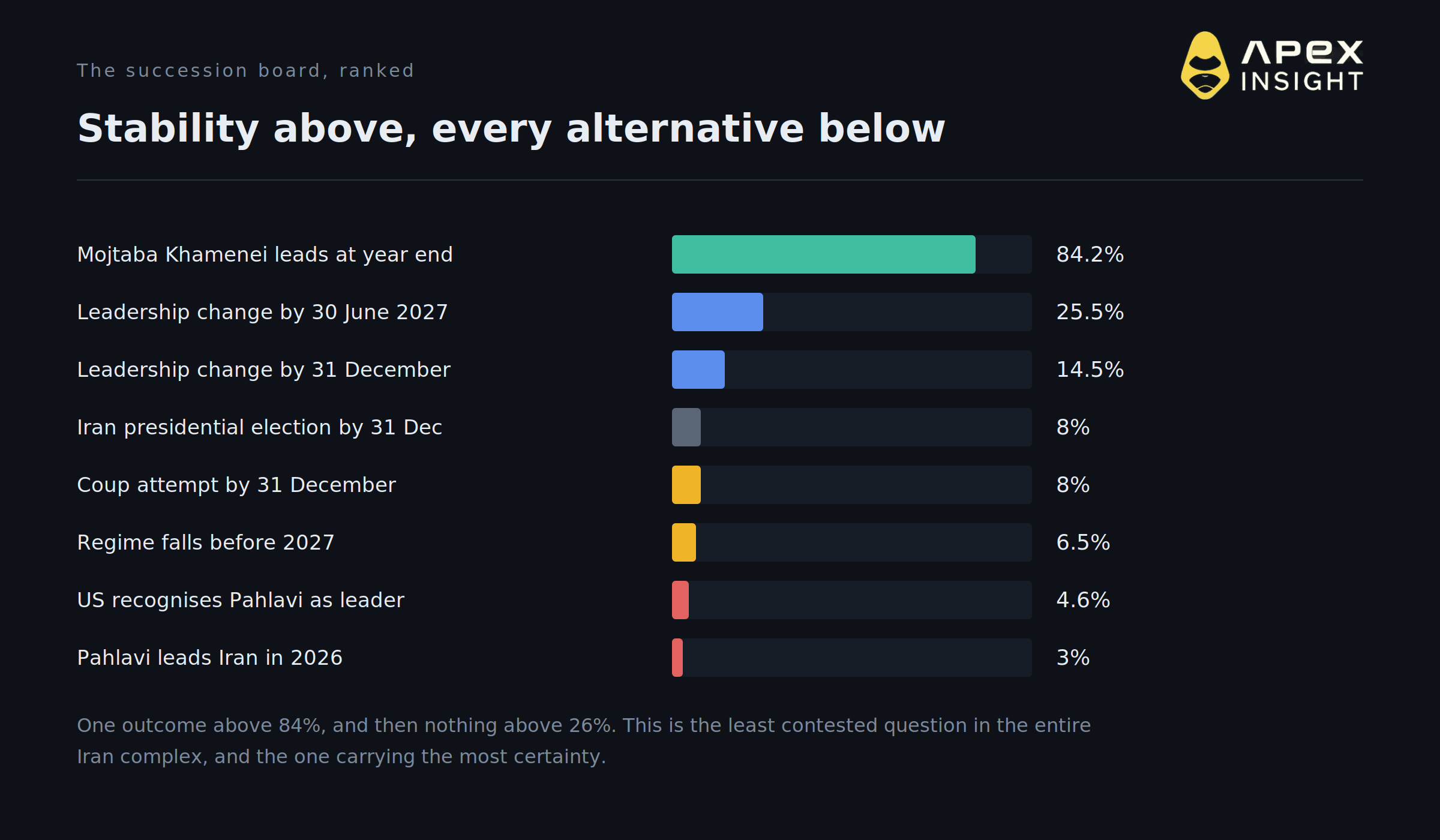
Mojtaba Khamenei leading at year end at 84.2 percent. Then leadership change by mid-2027 at 25.5 percent, by December at 14.5 percent, a presidential election at 8 percent, a coup attempt at 8 percent, regime collapse at 6.5 percent, US recognition of Pahlavi at 4.6 percent and Pahlavi leading at 3 percent.
One outcome above 84 percent, and then nothing above 26.
For a country seven months into a war that killed its Supreme Leader, closed its main waterway and pushed its currency past two million to the dollar, that is a remarkable amount of agreement about who is in charge.
The next piece looks at the shipping and oil markets underneath all of this, and what they say about how long the pressure lasts.
Trade it
Political Markets Season is live on ApeX Omni. Four stages, four political markets, a 6,000 USDT prize pool. Stage 2 is the US invasion of Iran before 2027.
Spot prediction trading on Polymarket order books. No leverage, no liquidation, no KYC. Trade the odds, not the outcome.
We appreciate your continued support.
Published by ApeX. For informational and educational purposes only. Not investment advice, and not a forecast or endorsement of any political or military outcome. Trading involves risk, including total loss.