



Note: All market prices are as of 6 September 2026. This is a fast-moving file with several deadlines inside the next month, so these figures will shift.
1. Seventy-two points between a ceasefire and a reopening
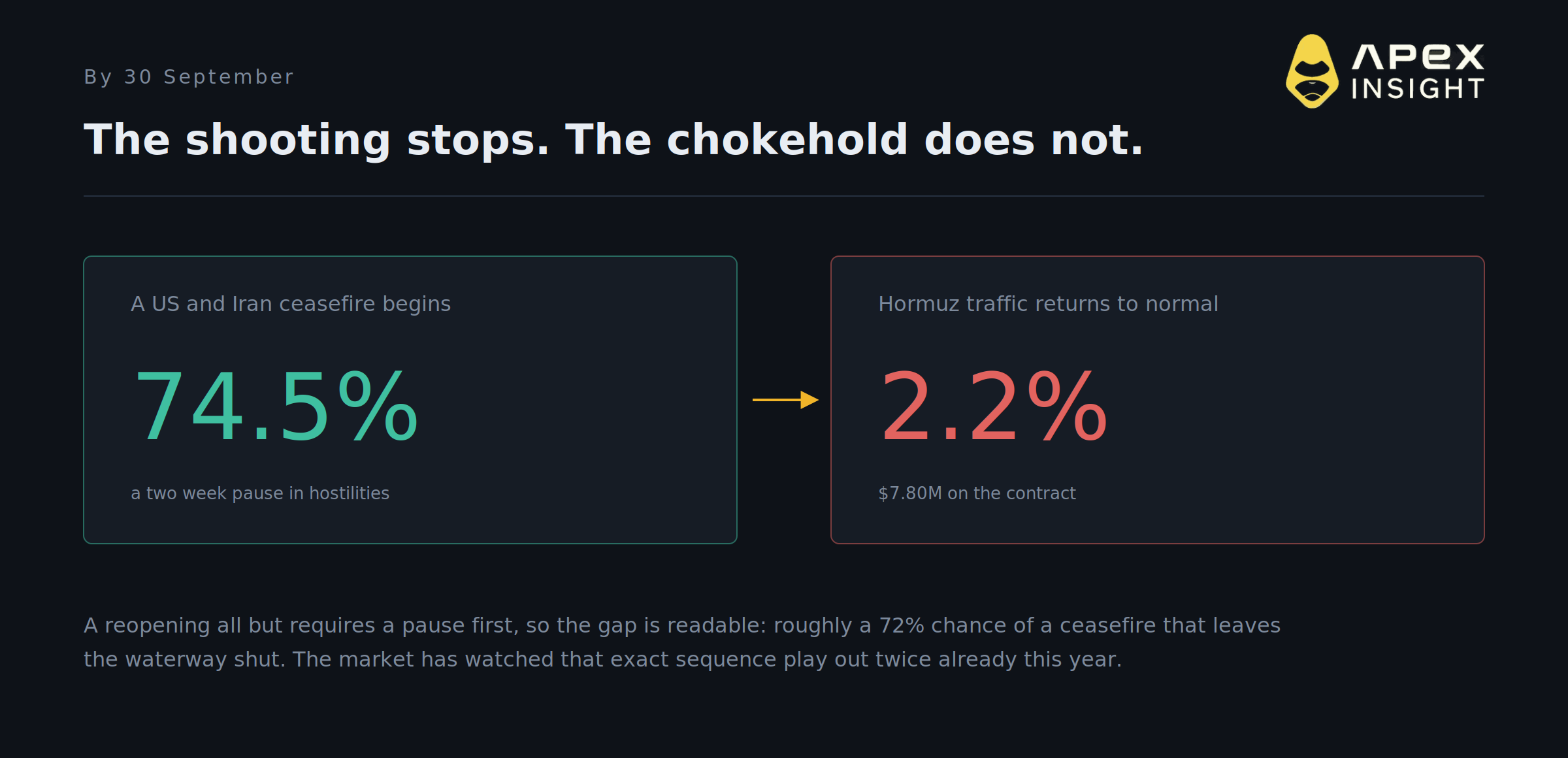
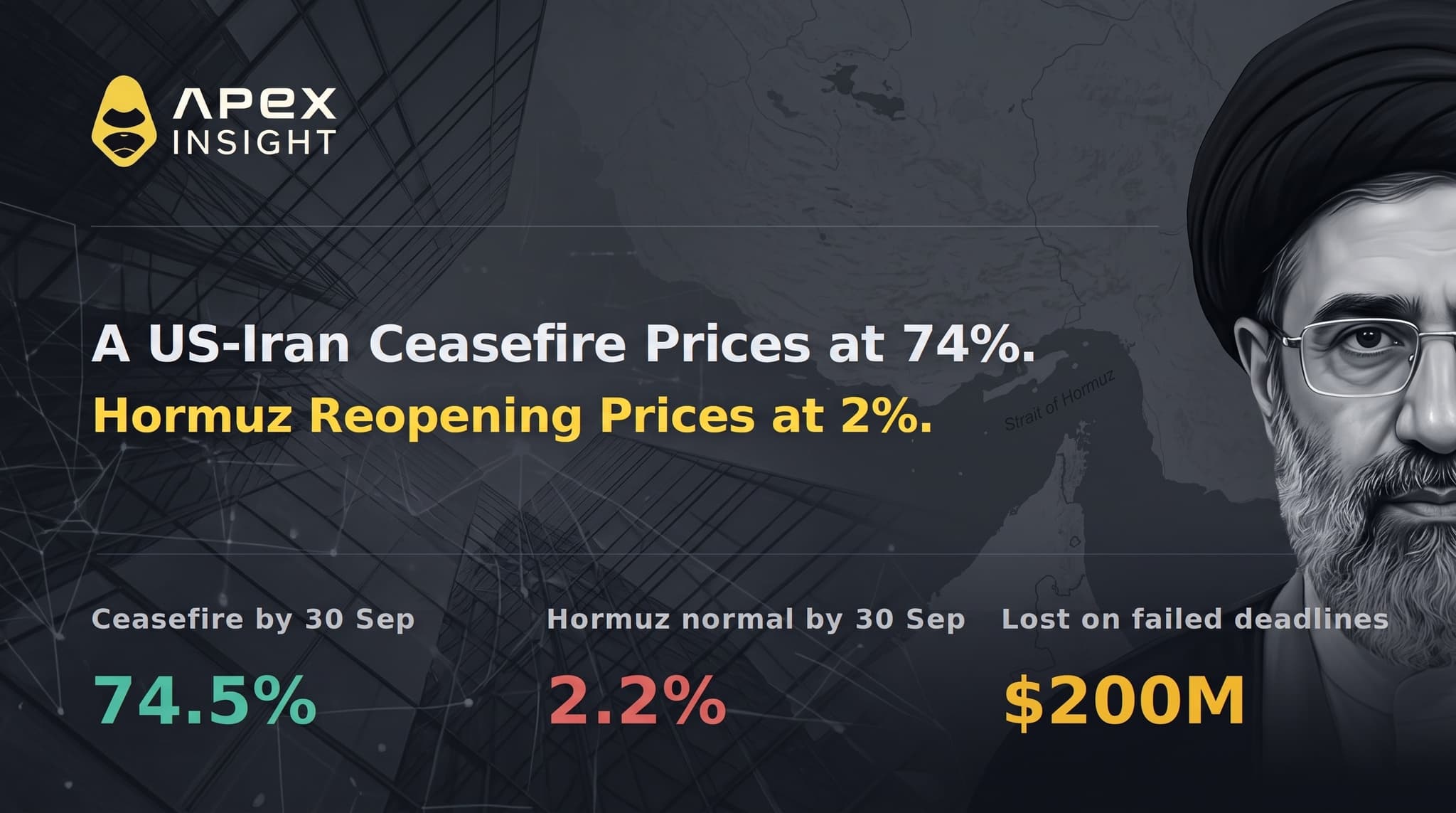
Those two contracts describe the same thirty days in the same conflict. One prices at 74.5 percent and the other at 2.2 percent.
Those numbers can be subtracted, with one assumption. The Strait is effectively unlikely to return to normal traffic while hostilities are active, so a reopening all but requires a pause first. On that basis the market is pricing roughly a 72 percent chance of a ceasefire that does not reopen the waterway.
The assumption is not airtight. Iran could in principle stand down at the Strait without a formal ceasefire, which would break the nesting. But every attempt this year has run through a negotiated pause, so treating a reopening as conditional on one is the reasonable reading.
Roughly a quarter of the world's seaborne oil and a fifth of its liquefied natural gas normally move through the Strait of Hormuz. The crisis there began on 28 February and is now in its seventh month.
If you read only the ceasefire number you would conclude the conflict is ending. If you read only the Hormuz number you would conclude nothing has changed. The market is saying both.
2. A pause is priced as likely
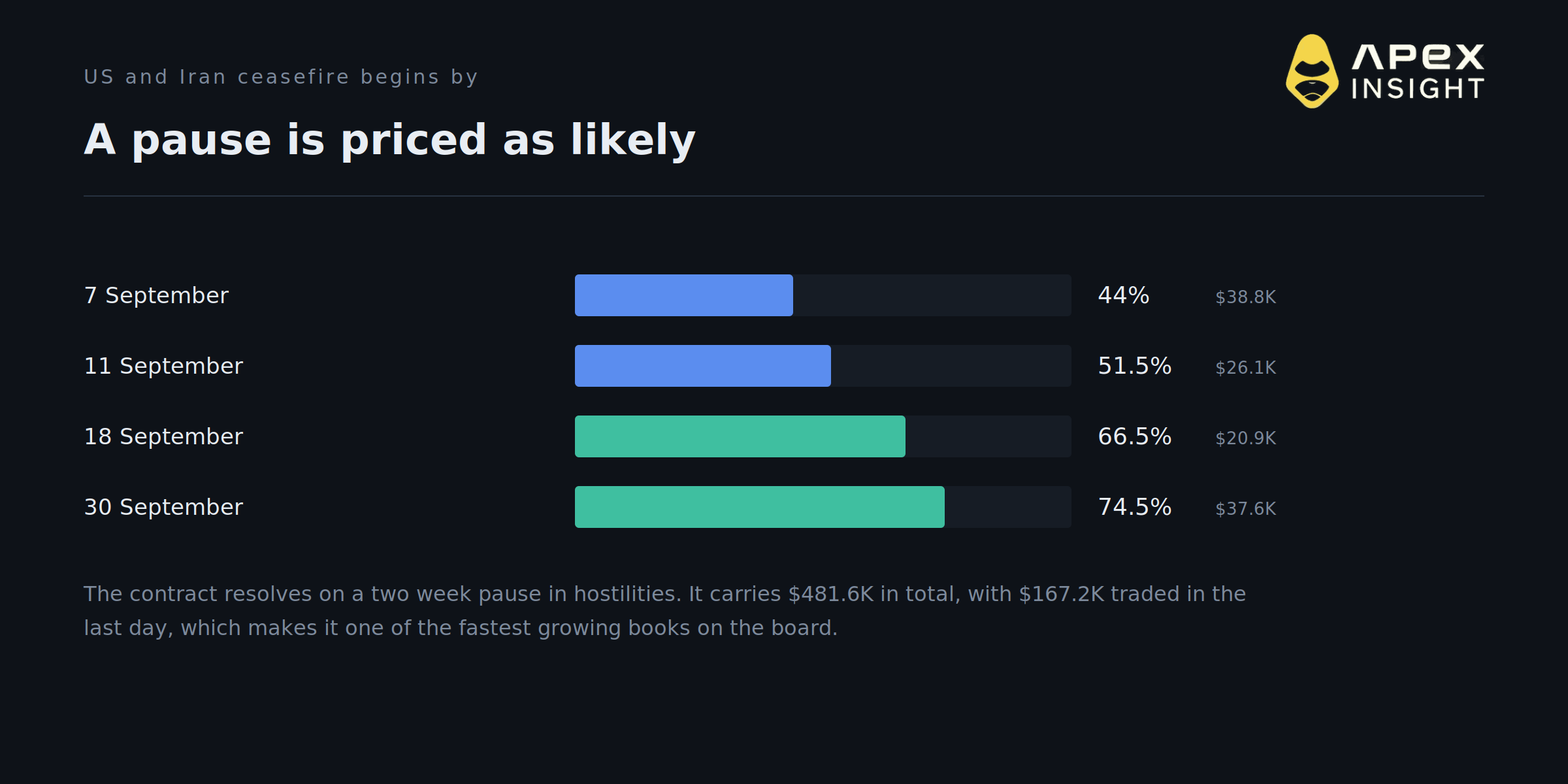
The contract resolves on an effective ceasefire defined as a two week pause in hostilities. It prices 44 percent by 7 September, 51.5 percent by the 11th, 66.5 percent by the 18th and 74.5 percent by the 30th.
The book carries $481.6K with $167.2K traded in the last day, making it one of the fastest growing markets on the board. It is also new, which is why it is thin. Read the direction confidently and the levels less so.
3. The blockade outlives every deadline set for it
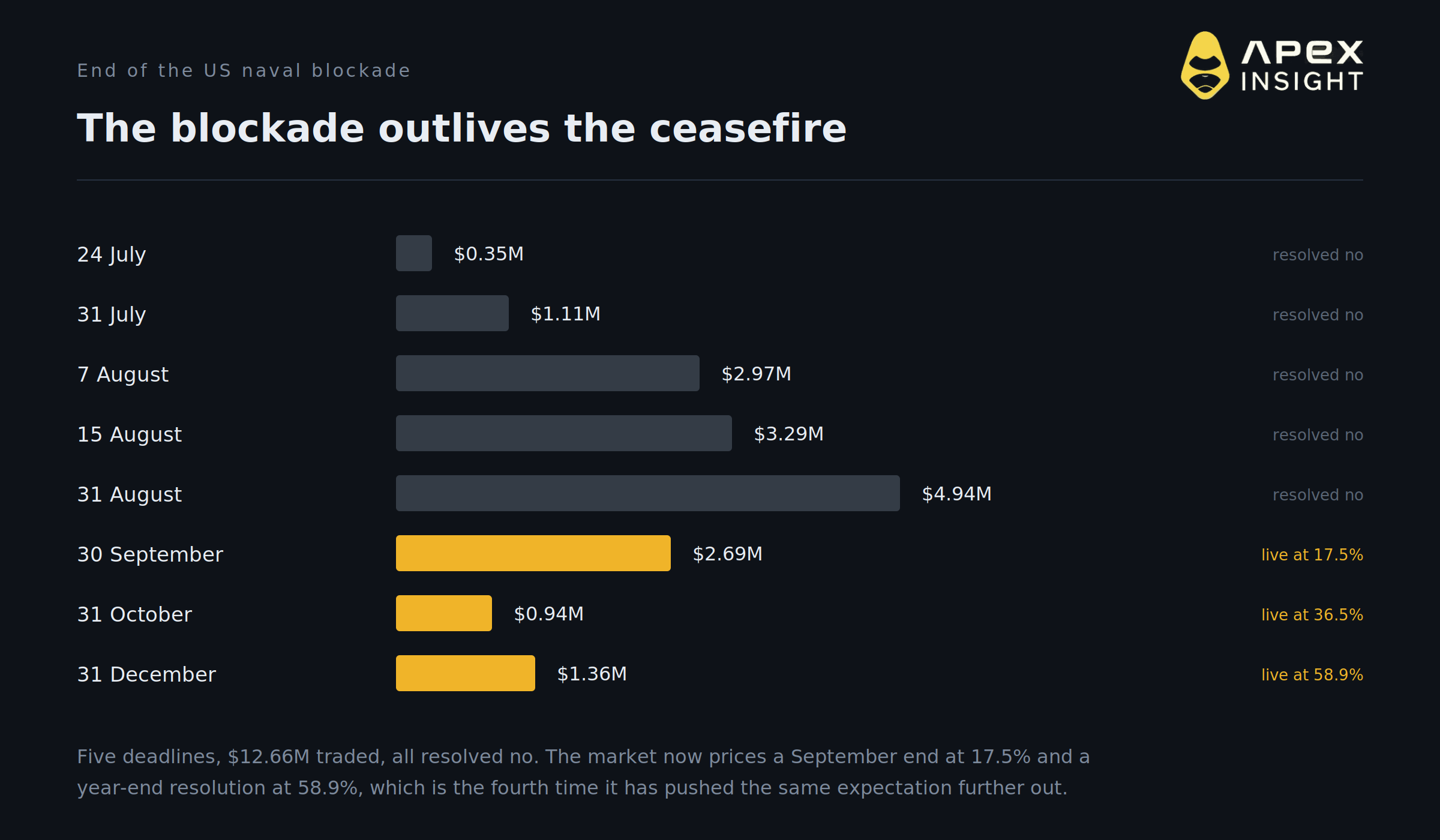
The market on the US announcing an end to the blockade has now run through five deadlines. 24 July, 31 July, 7 August, 15 August and 31 August all resolved no, with $12.66M traded across them.
What remains prices 30 September at 17.5 percent, 31 October at 36.5 percent and 31 December at 58.9 percent.
That is the fourth time this year the same expectation has been pushed further out rather than repriced downward. The blockade began on 13 April, was lifted on 17 June under a memorandum, and was reimposed on 14 July after Iran struck three commercial vessels that bypassed its approved route. It has been in force since.
4. The waterway is not priced to reopen this year
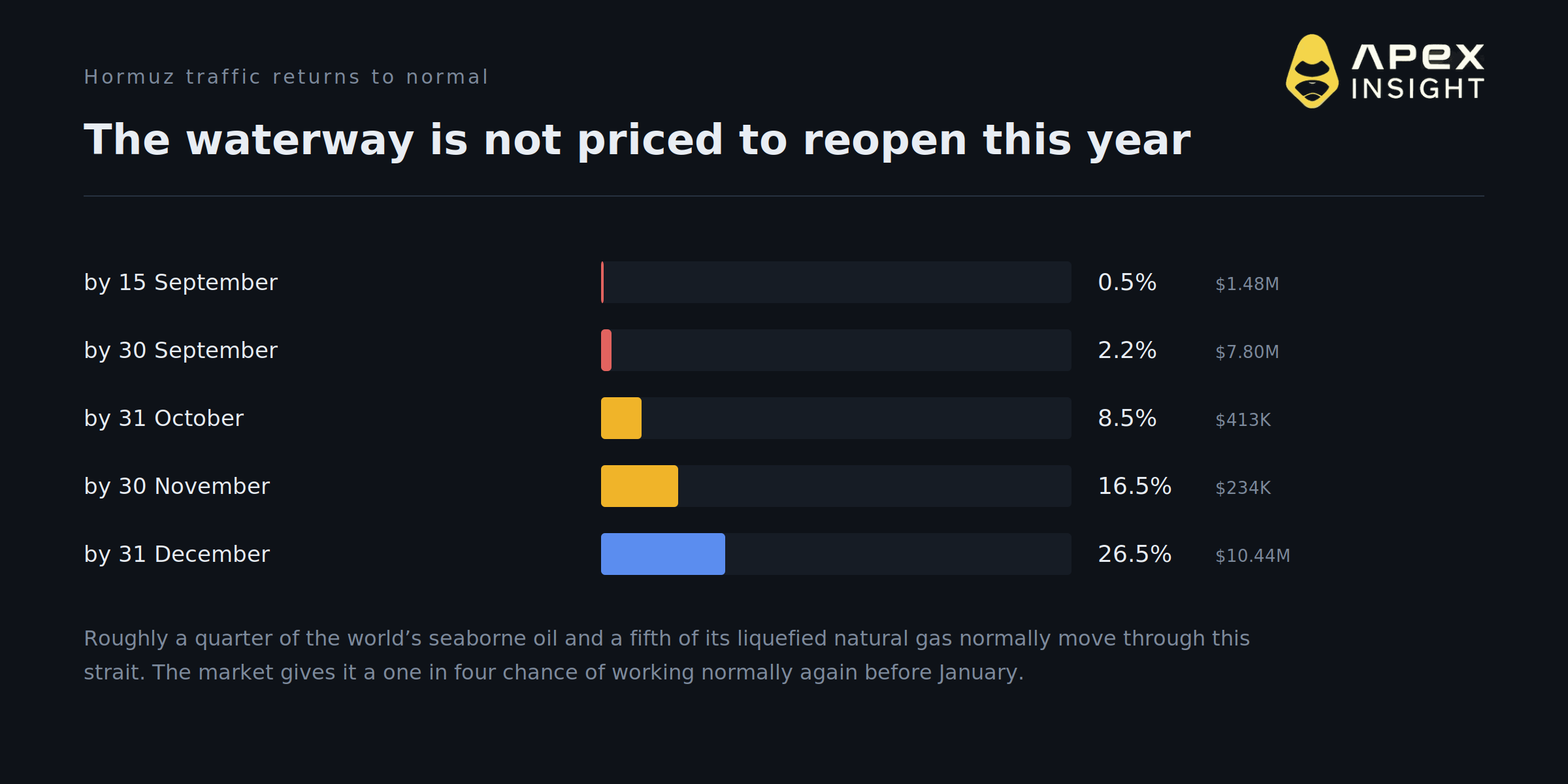
Hormuz traffic returning to normal prices at 0.5 percent by 15 September, 2.2 percent by 30 September, 8.5 percent by 31 October and 26.5 percent by 31 December.
The December contract carries $10.44M and the September one $7.80M, so these are among the more deeply traded numbers in the whole complex.
A one in four chance that the world's most important oil chokepoint works normally again before January is the single most consequential number on this board, and it is the one least reflected in how most markets are priced.
5. This has happened twice already
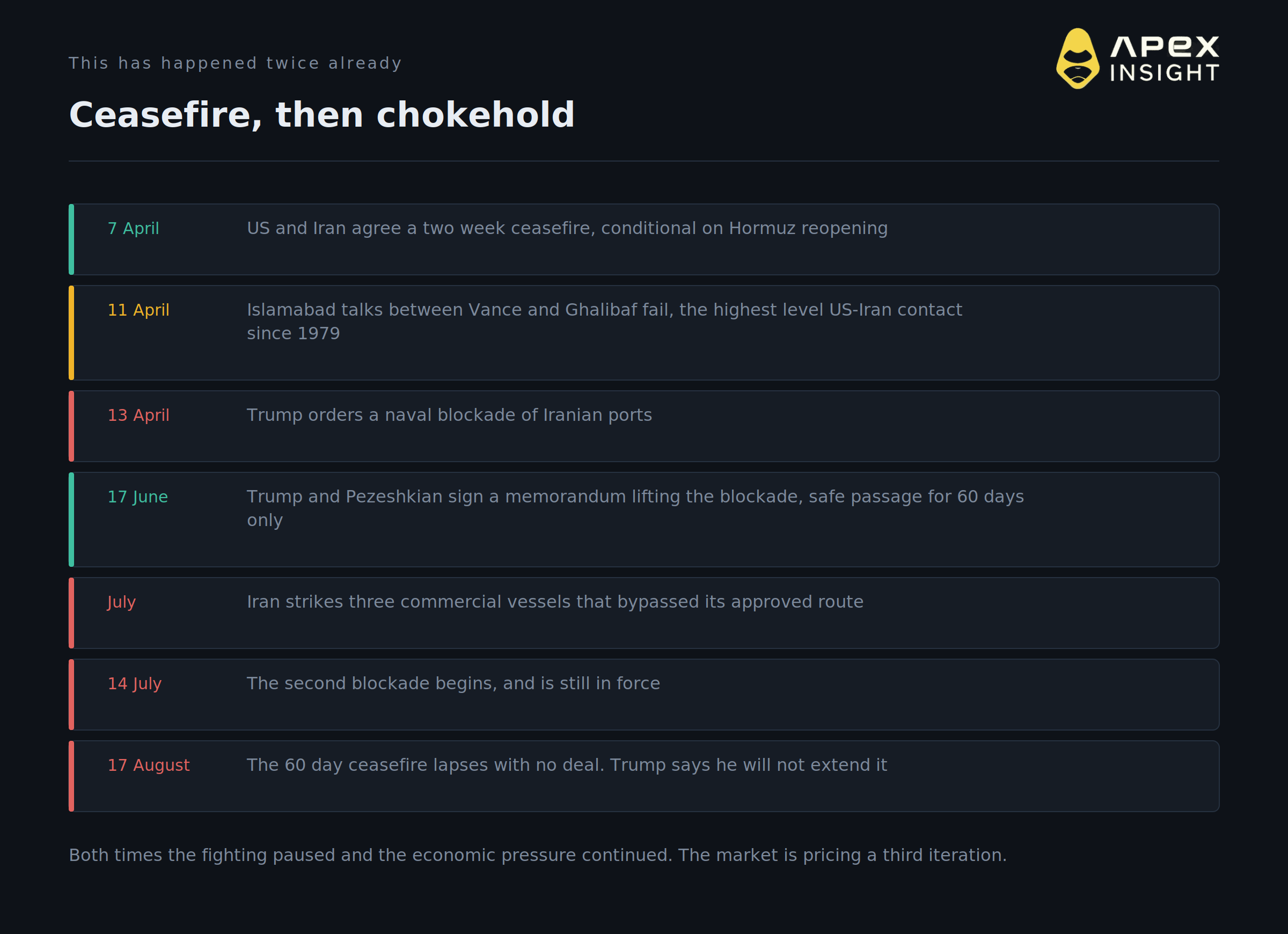
The pattern the market is pricing is not a guess. It is a repeat.
On 7 April the US and Iran agreed a two week ceasefire, explicitly conditioned on reopening the Strait. Talks in Islamabad between Vice President Vance and parliament speaker Ghalibaf, the highest level direct US-Iran contact since 1979, failed on 11 and 12 April. Two days later Trump ordered a naval blockade of Iranian ports.
On 17 June Trump and President Pezeshkian signed a memorandum declaring the removal of the blockade and safe passage for commercial vessels, for 60 days only, with future administration of the Strait to be determined by Iran in consultation with Oman and Gulf states. In July the conflict resumed. The second blockade began on 14 July.
On 17 August the 60 day arrangement lapsed with no deal, and Trump said he was not looking to extend it.
Twice now, the fighting has paused and the economic pressure has continued. The board is pricing a third.
6. Two hundred million dollars, wrong in both directions
This is the part worth sitting with, because it is unusual.
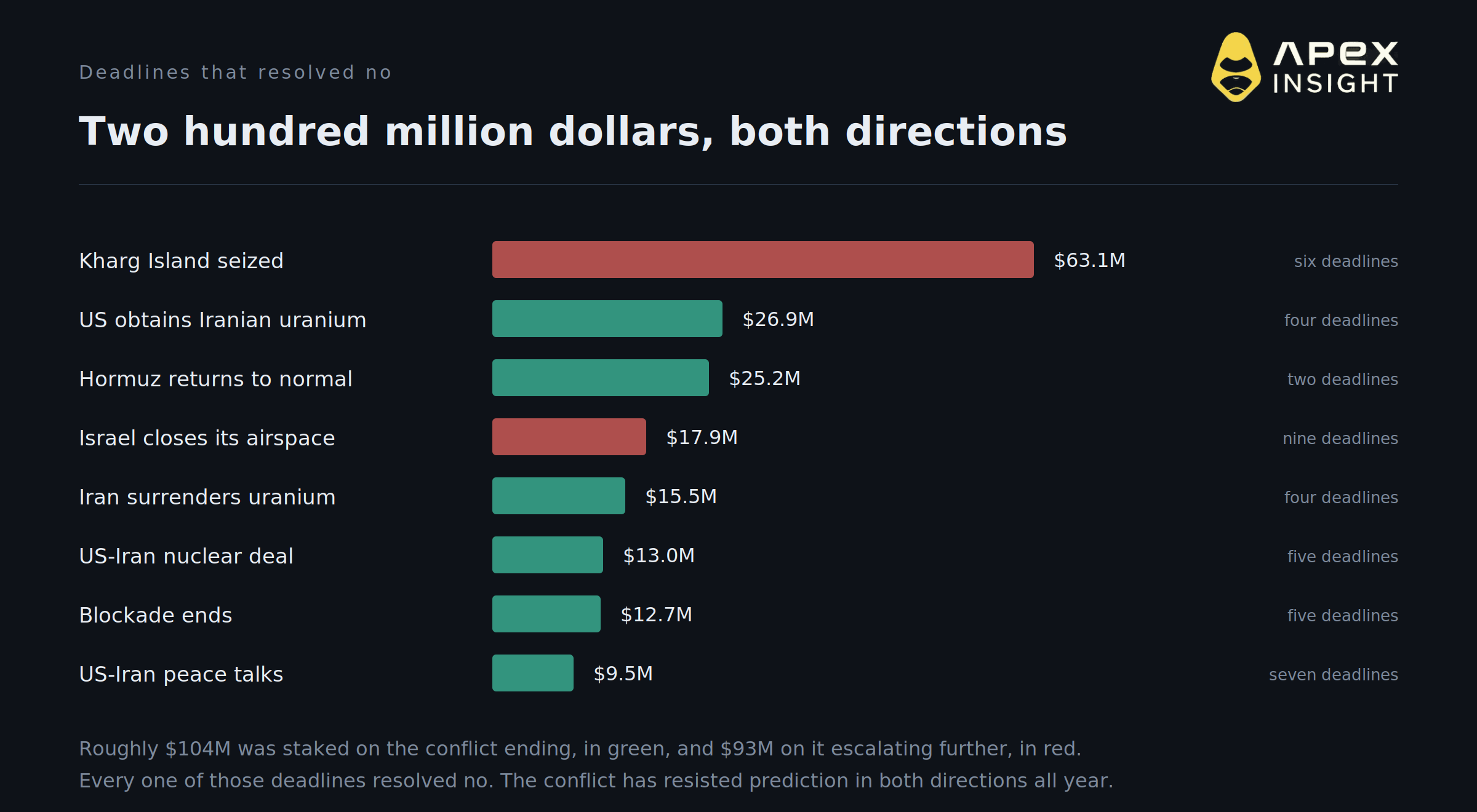
Roughly $104M has been staked across deadlines that required the conflict to end or de-escalate: the US obtaining Iranian uranium, Hormuz returning to normal, Iran surrendering its stockpile, a nuclear deal, the blockade ending, and peace talks convening. All of them resolved no.
Roughly $93M has been staked on the opposite: Kharg Island falling out of Iranian control, Israel closing its airspace, Iran closing its own, Bab el-Mandeb closing. All of those resolved no too.
Both sides of this trade have been comprehensively wrong all year. The conflict has not ended and it has not escalated. It has frozen, and almost nobody priced that.
7. The single most expensive wrong call
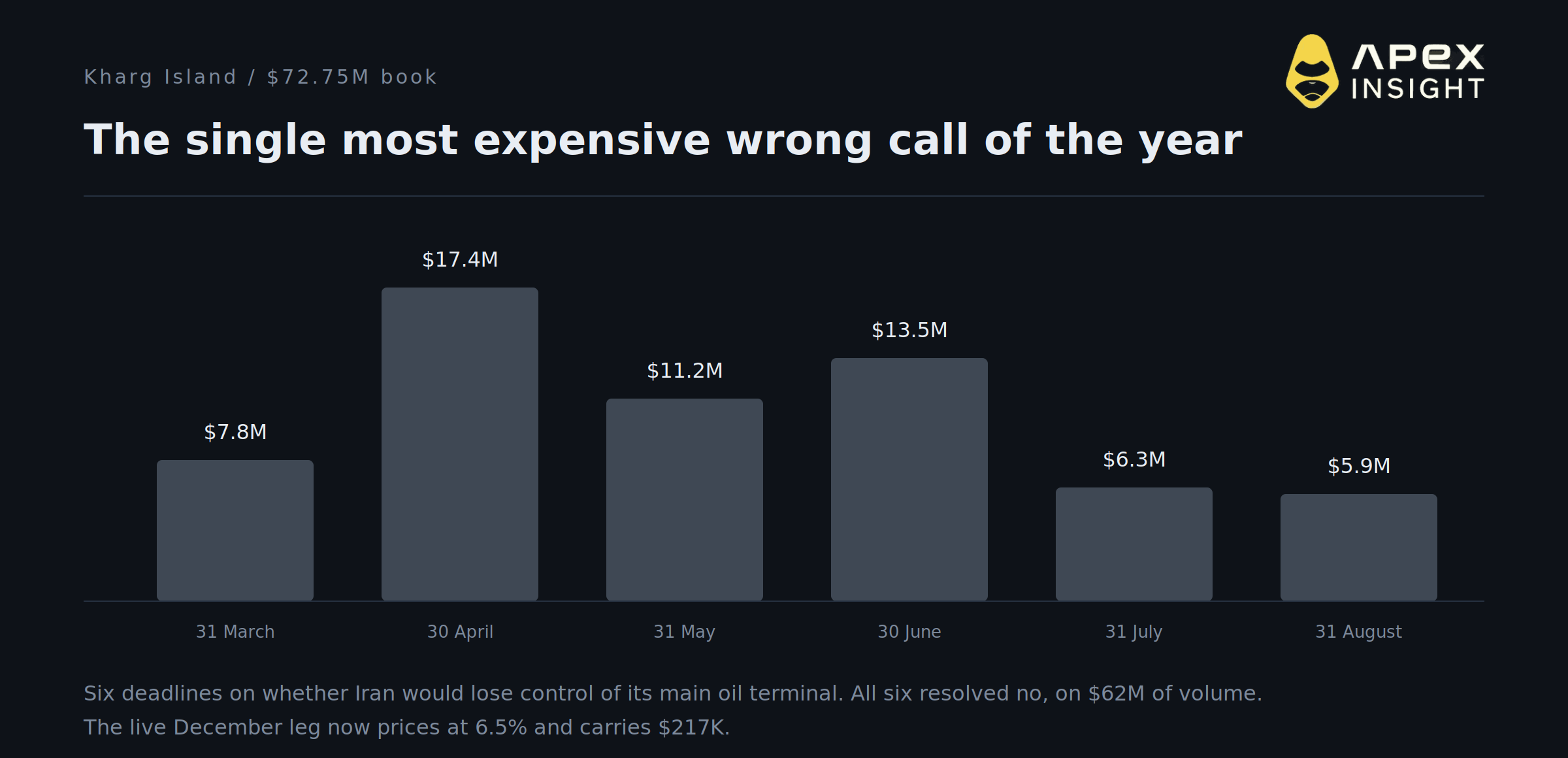
Kharg Island, Iran's main oil export terminal, carries $72.75M. Six deadlines have asked whether it would fall out of Iranian control: 31 March, 30 April, 31 May, 30 June, 31 July and 31 August. All six resolved no, on roughly $62M of volume.
The April leg alone carried $17.37M and the June leg $13.46M.
The live December contract now prices at 6.5 percent and carries $217K. Almost everyone who traded this has left.
8. One thing did hold
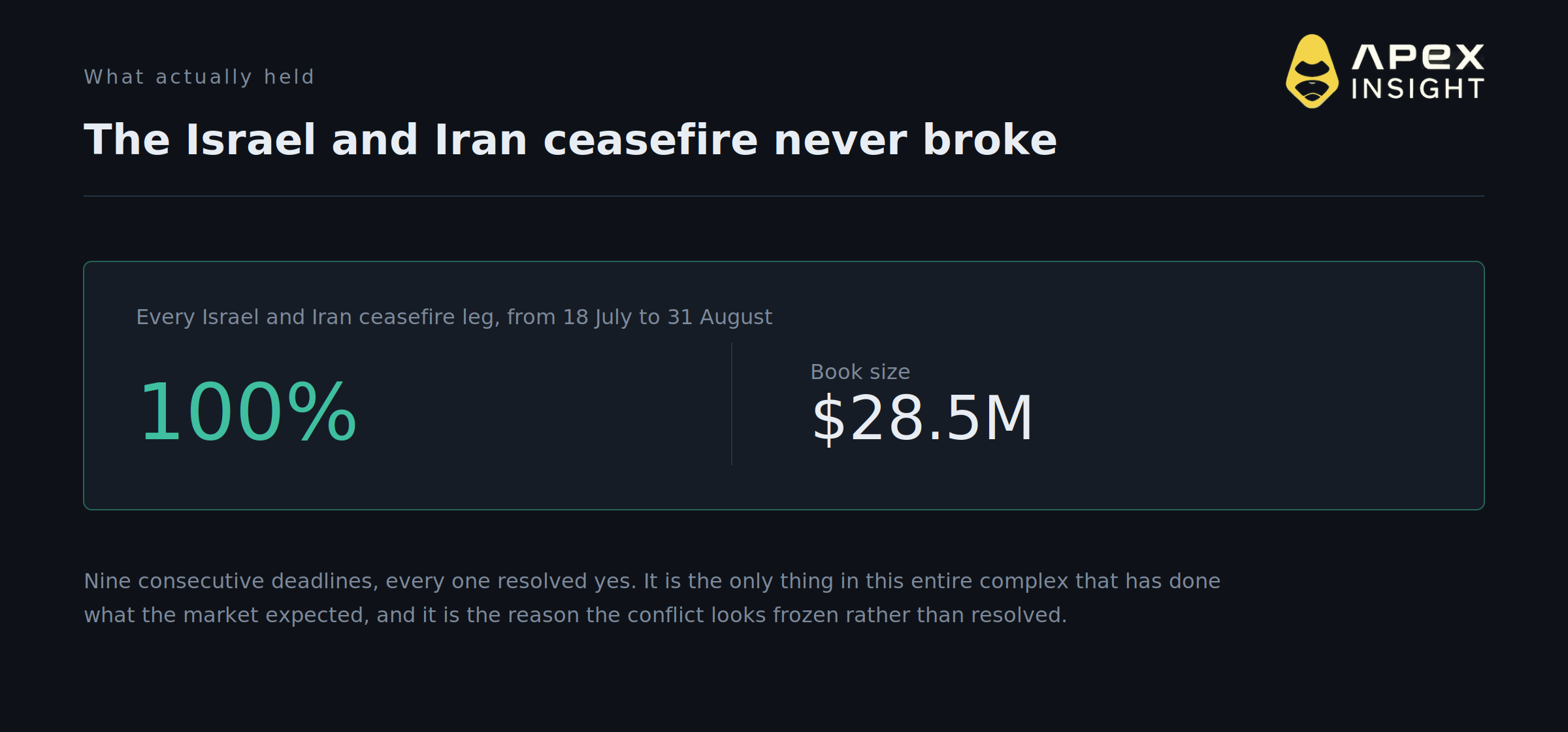
The Israel and Iran ceasefire has held through every deadline the market has set for it, nine consecutive legs from 18 July to 31 August, each resolving at 100 percent, on a $28.5M book.
It is the only contract in this entire complex that has done what the market expected.
That is also the clearest evidence for the frozen framing. The direct fighting between Israel and Iran stopped and stayed stopped. Everything downstream of it, the blockade, the strait, the uranium, the talks, has not moved at all.
9. The transmission into everything else
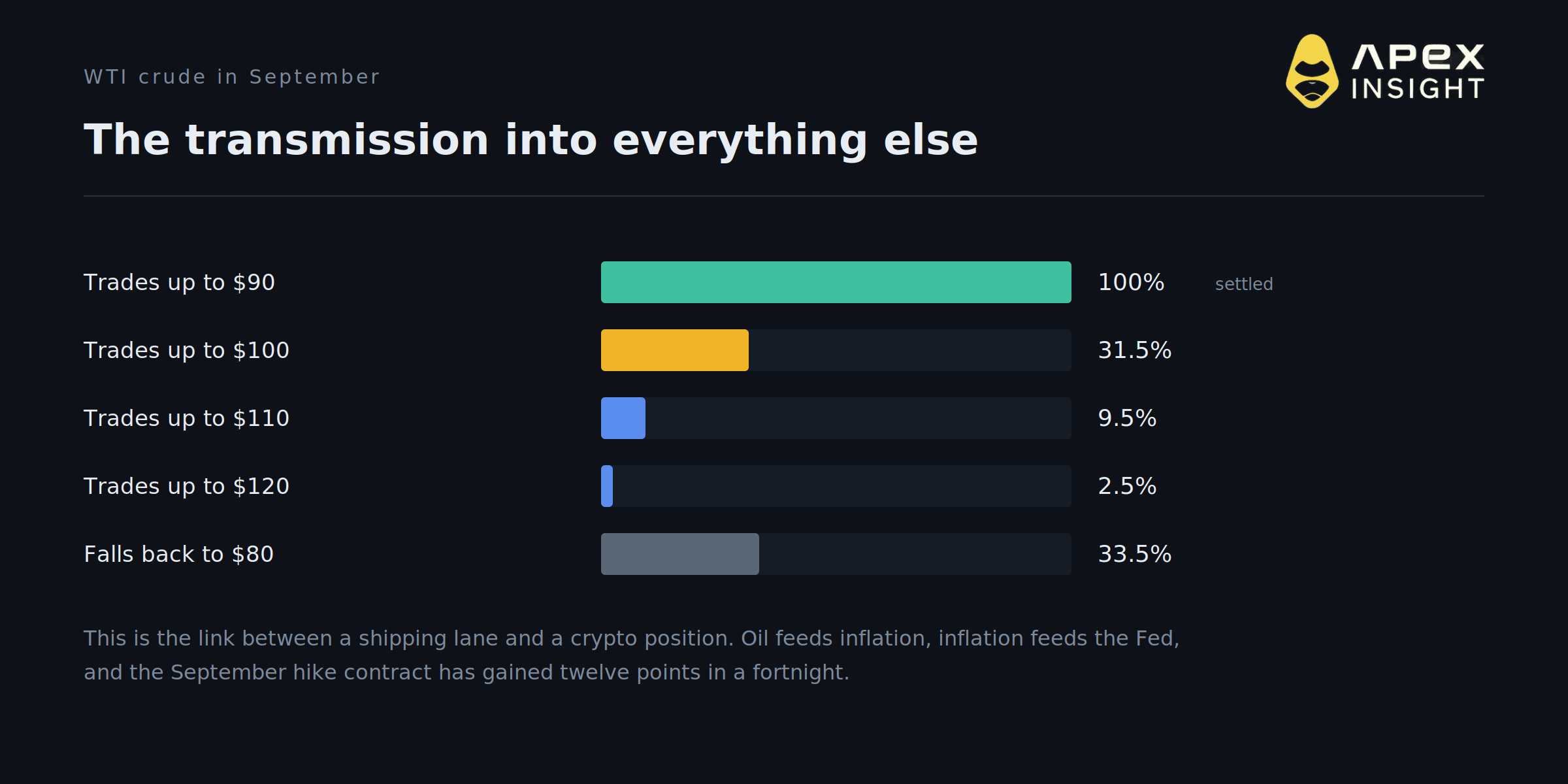
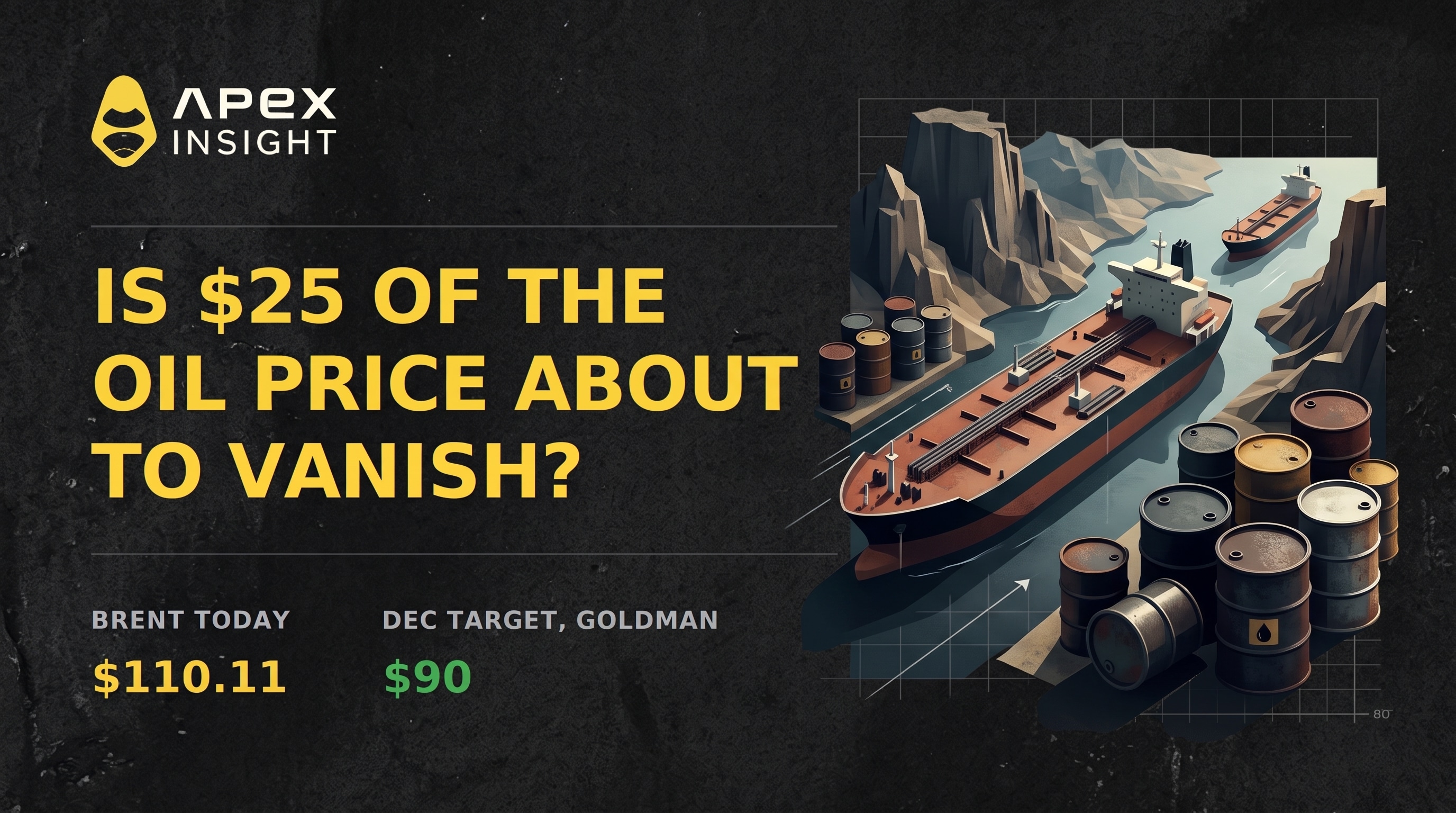
WTI has already printed $90 this month. Trading up to $100 prices at 31.5 percent, $110 at 9.5 percent and $120 at 2.5 percent. Falling back to $80 prices at 33.5 percent.
This is the link between a shipping lane and a crypto position, and every step of it is priced on the same board. Oil feeds inflation, inflation feeds the Fed, and the September rate decision has moved twelve points toward a hike in a fortnight.
Anyone trading crypto on a macro view is trading this conflict whether they have looked at it or not.
10. The regime is not priced to fall
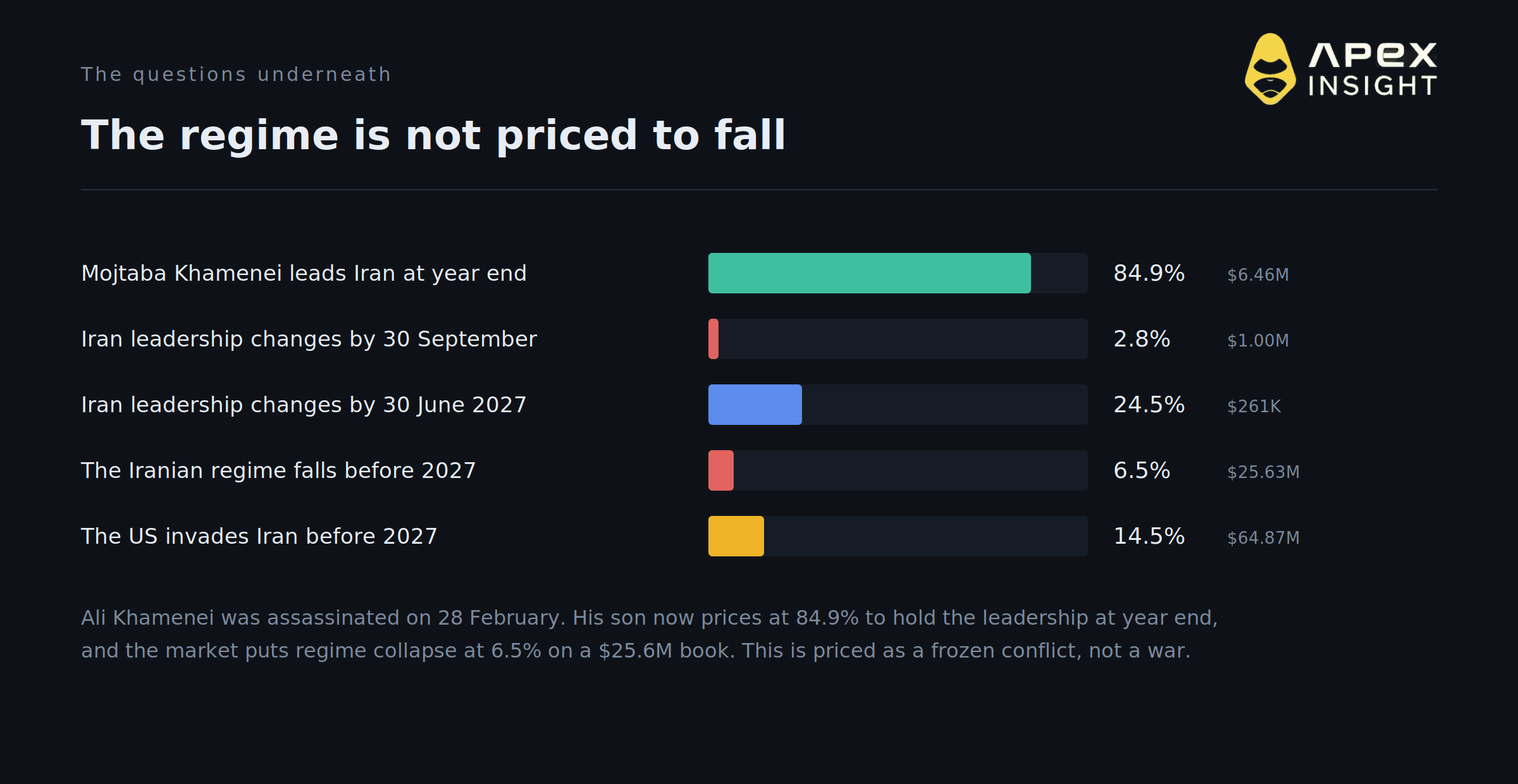
Ali Khamenei was assassinated on 28 February in the strikes that began the war. His son Mojtaba now prices at 84.9 percent to hold the leadership at year end, on a $6.46M leg.
A change of Iranian leadership by 30 September prices at 2.8 percent, and by 30 June 2027 at 24.5 percent. The Iranian regime falling before 2027 prices at 6.5 percent on a $25.63M book. A US invasion before 2027 prices at 14.5 percent on $64.87M.
None of that is priced as a war heading toward resolution. It is priced as a frozen conflict with a stable adversary, which is precisely the configuration that keeps a chokepoint closed indefinitely.
What this adds up to
The market is pricing a ceasefire at three in four and the reopening of the Strait at one in fifty, over the same month. Read together, that is a forecast of a pause without a settlement, which is exactly what the past two attempts produced.
The evidence for it is the graveyard. Roughly $200M has been lost betting this conflict would either end or escalate, across more than thirty deadlines, and the outcome has been neither every single time.
Two things to watch. The new ceasefire contract, because a book that grew from nothing to $482K in days is where new information is arriving fastest. And the December Hormuz contract at 26.5 percent, because it is the deepest number here and the one that decides whether oil stays a live input to the Fed's decision into next year.
Where to watch it
Every market in this article is live on ApeX Omni, where Polymarket's order books are integrated directly: the same liquidity and the same settlement source, minus the KYC. The board carries the ceasefire and blockade ladders alongside the Hormuz contracts, the oil strikes and the Fed decision, which means the whole chain from a shipping lane to a crypto price sits on one screen with the volume behind each leg visible.
We appreciate your continued support.
Published by ApeX. For informational and educational purposes only. Not investment advice, and not a forecast or endorsement of any political or military outcome. Trading involves risk, including total loss.