




Note: All market prices are as of 4 September 2026 and legislative status as of that date. The cloture vote is scheduled for 15 September, so these numbers will move considerably between now and then.
1. The price fell as the money poured in
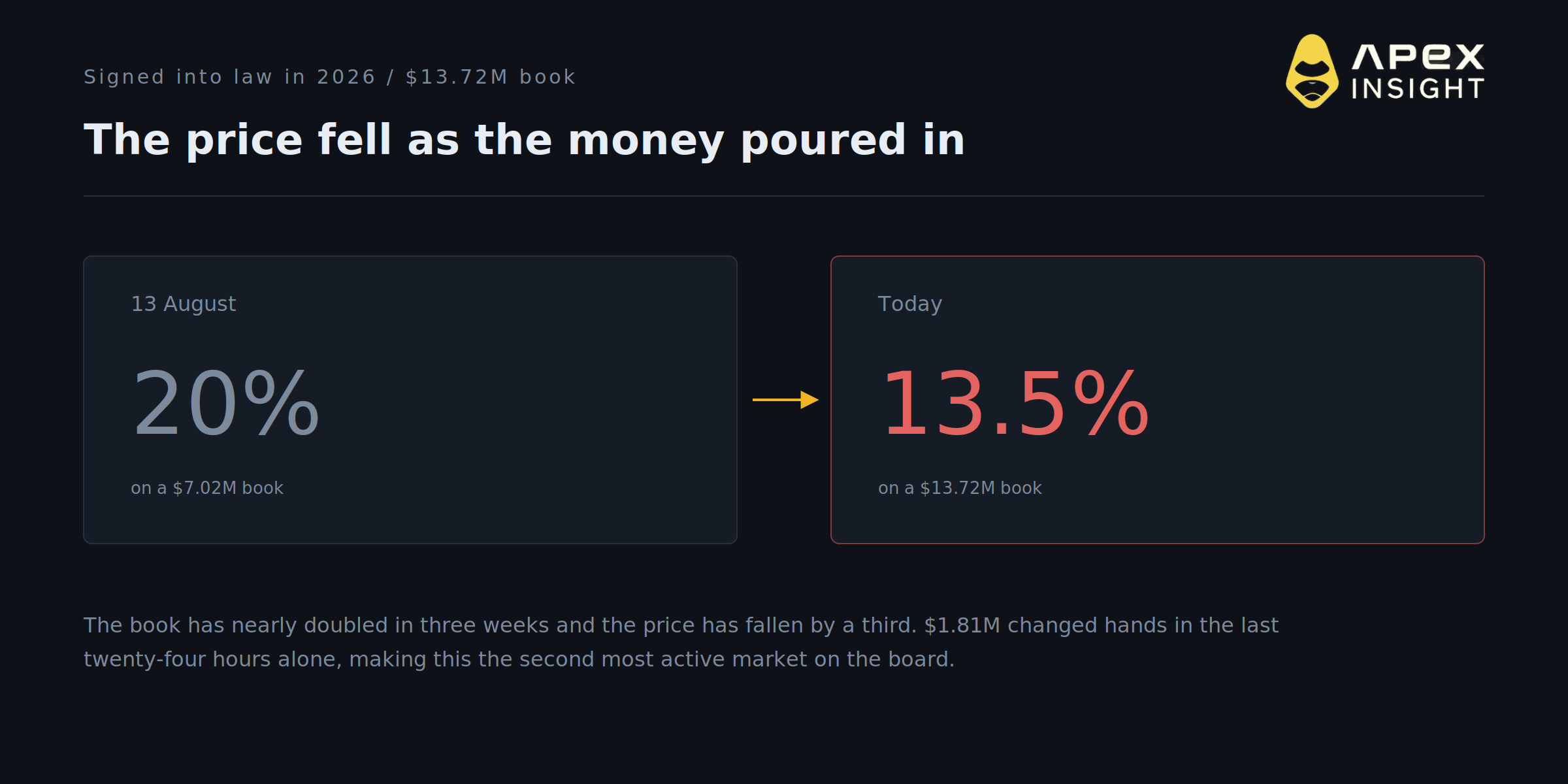
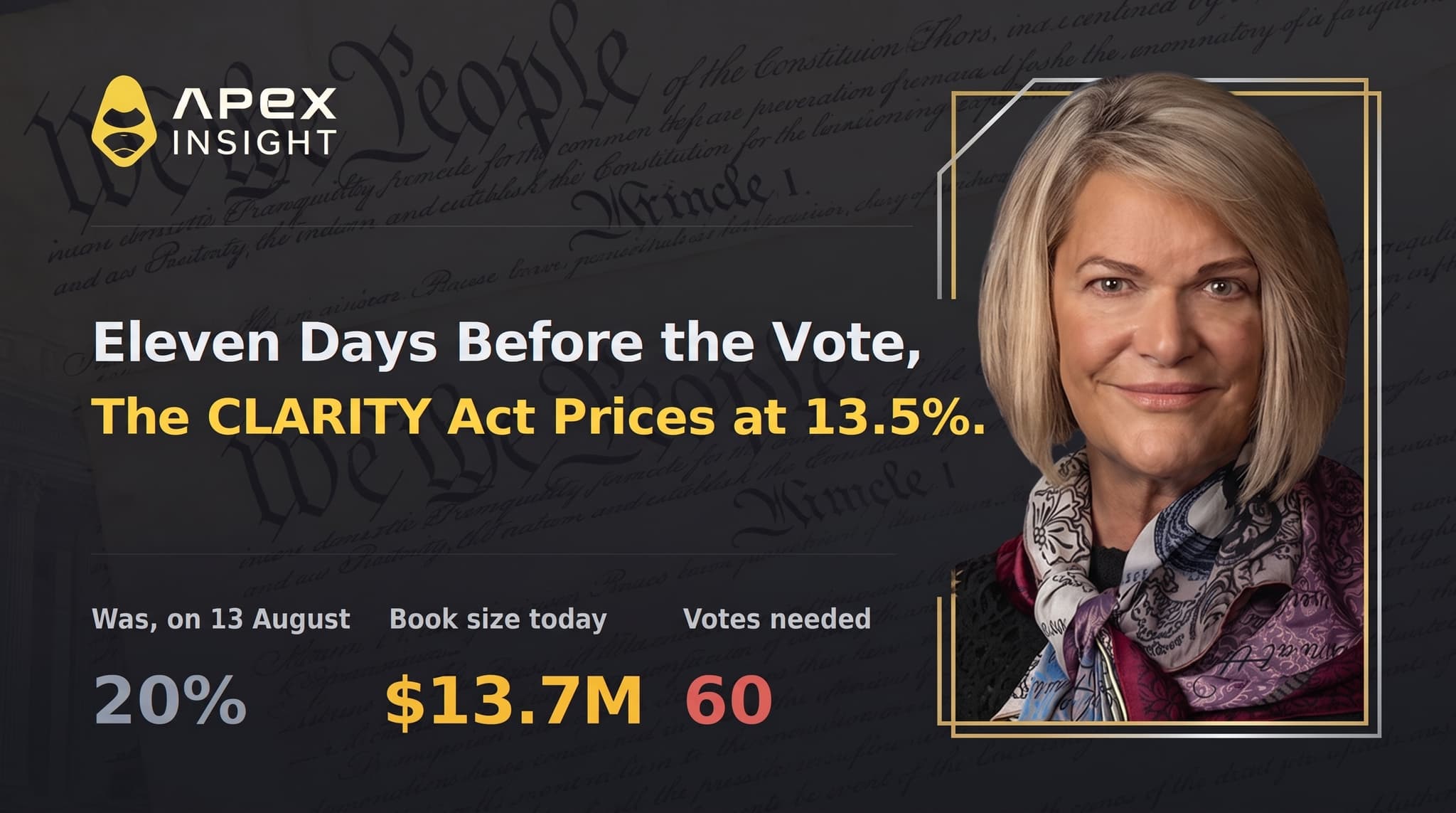
On 13 August the contract priced at 20 percent, which was already being described as a record low. It now prices at 13.5 percent.
Over the same period the book nearly doubled, from $7.02M to $13.72M. Yesterday alone saw $1.81M change hands.
That combination is unusual and worth pausing on. A price falling on rising volume is a market actively repricing rather than one quietly losing interest, which is what the same contract did earlier in the year when deadlines passed and the money simply left.
2. The vote is not what most coverage says it is
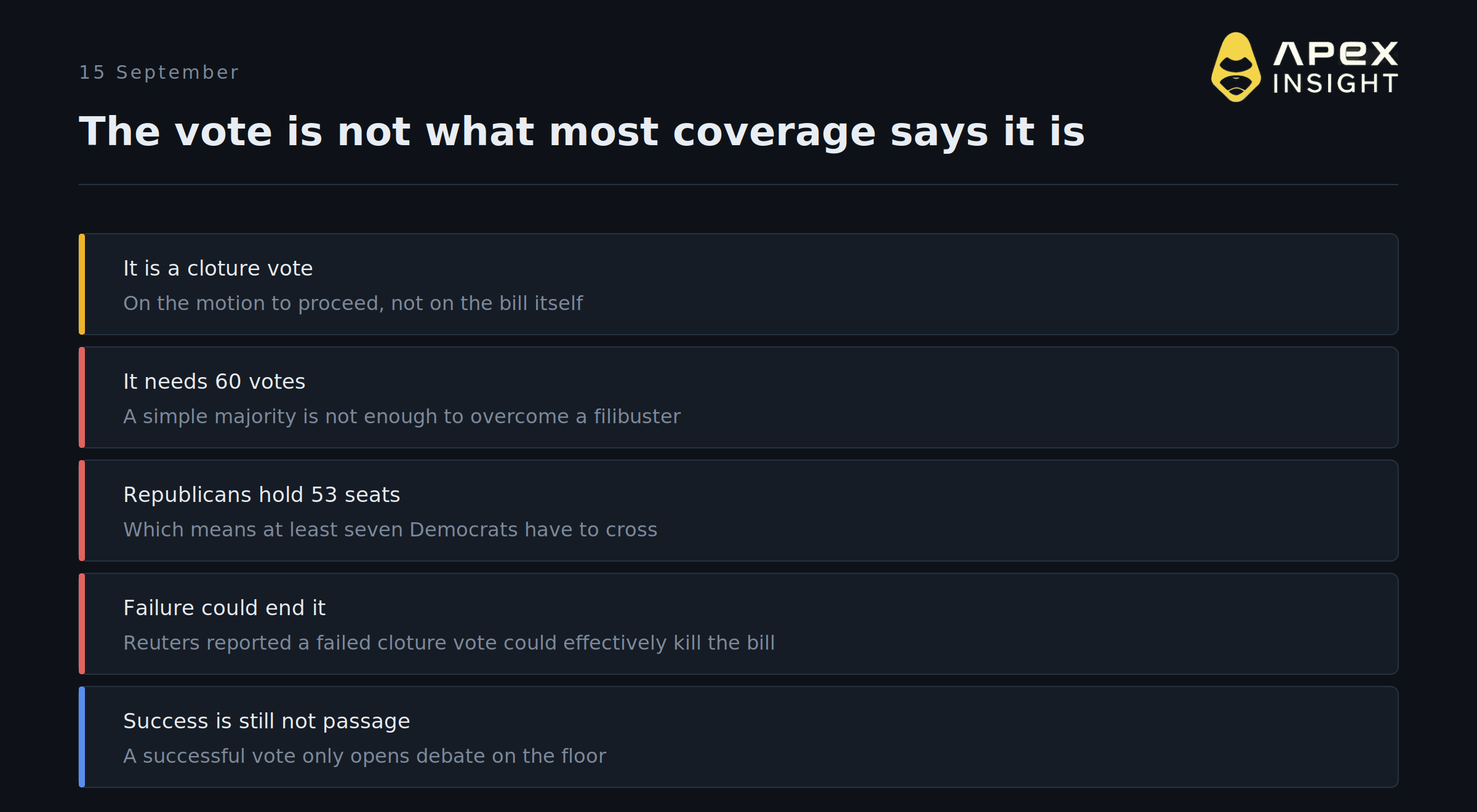
Majority Leader John Thune filed cloture on the motion to proceed on 8 August, hours before the Senate recessed, which set the 15 September date.
That vote is not on the bill. It is on whether to begin debating the bill. It requires 60 votes to overcome a filibuster. Republicans hold 53 Senate seats, so at least seven Democrats have to cross.
Reuters reported that a failed cloture vote could effectively kill the measure. Success, meanwhile, only opens floor debate. Both facts are usually missing from the headline version.
3. Nine points separate the vote from the law
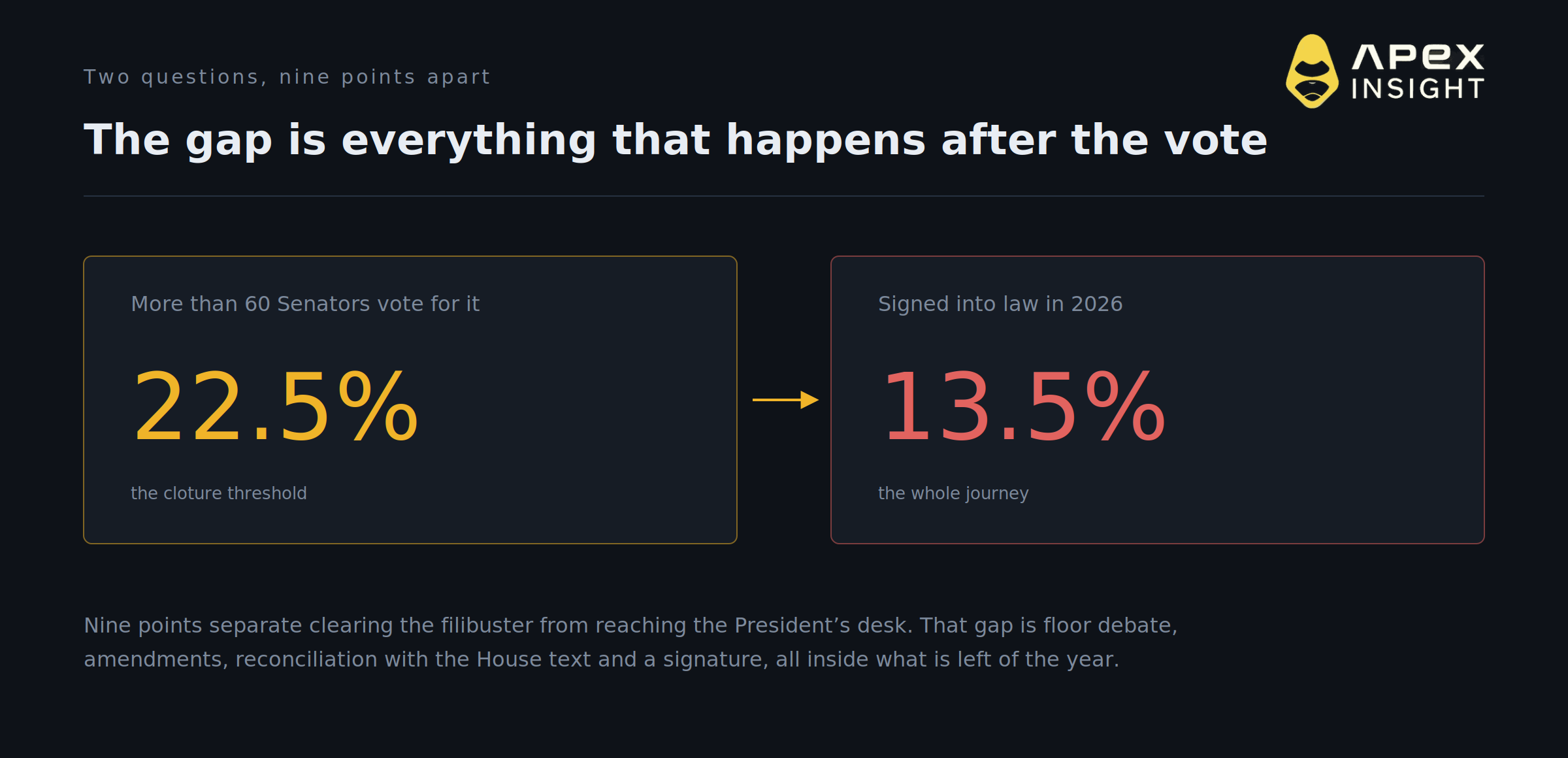
More than 60 Senators voting for it prices at 22.5 percent. Signed into law in 2026 prices at 13.5 percent.
Those two numbers describe different things and the nine points between them is the price of everything that happens after cloture: floor debate, amendments, a final passage vote, reconciliation with the House text which may require a conference committee, and a presidential signature, all inside what is left of the calendar.
So even conditional on clearing the filibuster, the market gives the bill roughly a three in five chance of finishing the journey this year.
4. Almost every Senator has been marked down
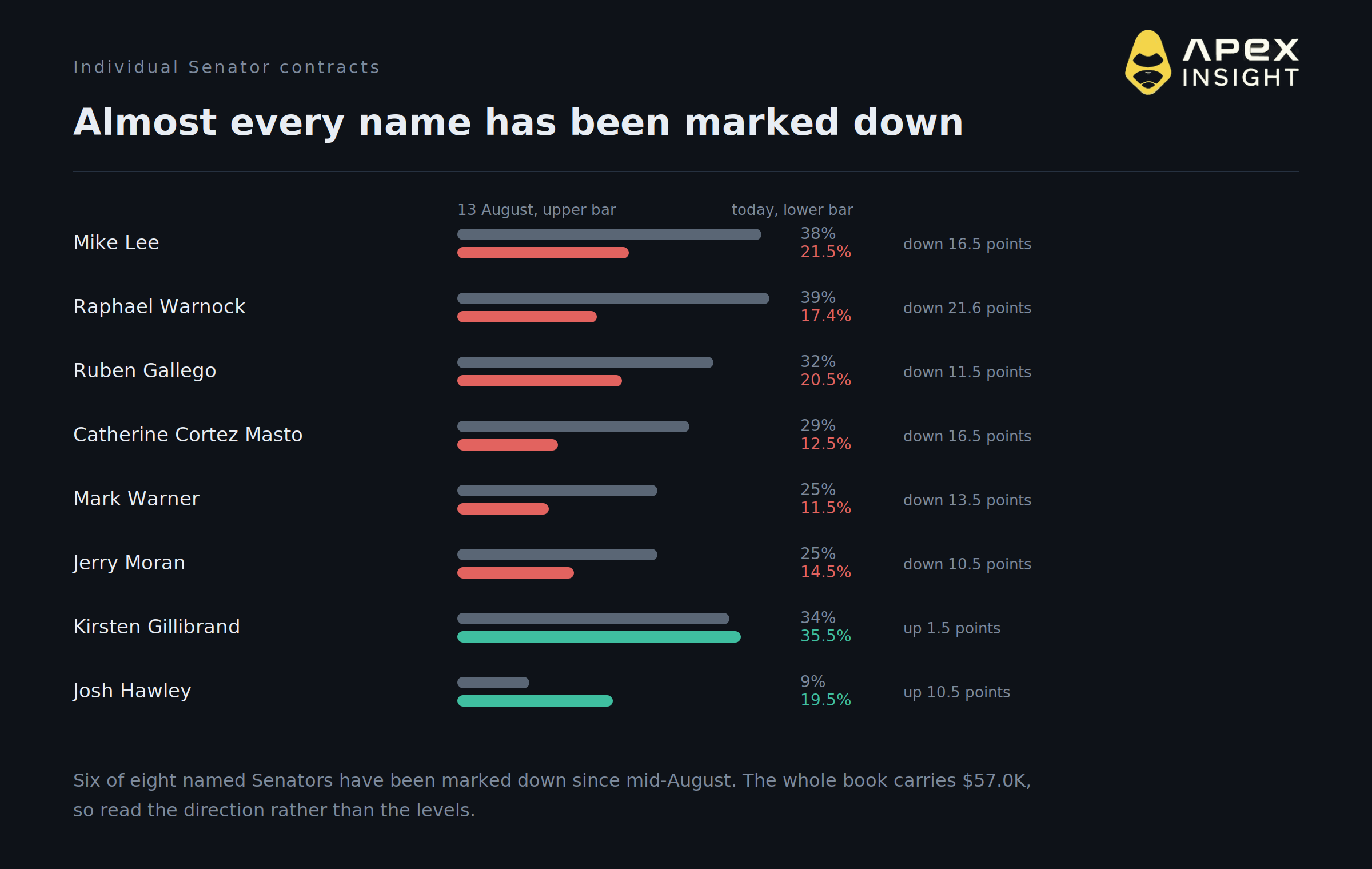
Six of the eight named Senators tracked since mid-August have been marked down. Raphael Warnock has fallen 21.6 points to 17.4 percent, Mike Lee 16.5 points to 21.5 percent, Catherine Cortez Masto 16.5 points to 12.5 percent, Mark Warner 13.5 points to 11.5 percent.
Two have moved up. Josh Hawley is up 10.5 points to 19.5 percent, and Kirsten Gillibrand, one of the Democrats most often named as a bellwether, is up 1.5 points to 35.5 percent and remains the highest priced Democrat on the board.
Read the direction here rather than the levels. The entire Senator book carries $57.0K, so these are indicative prices rather than tested ones.
5. The vote-count ladder never gets above one in three
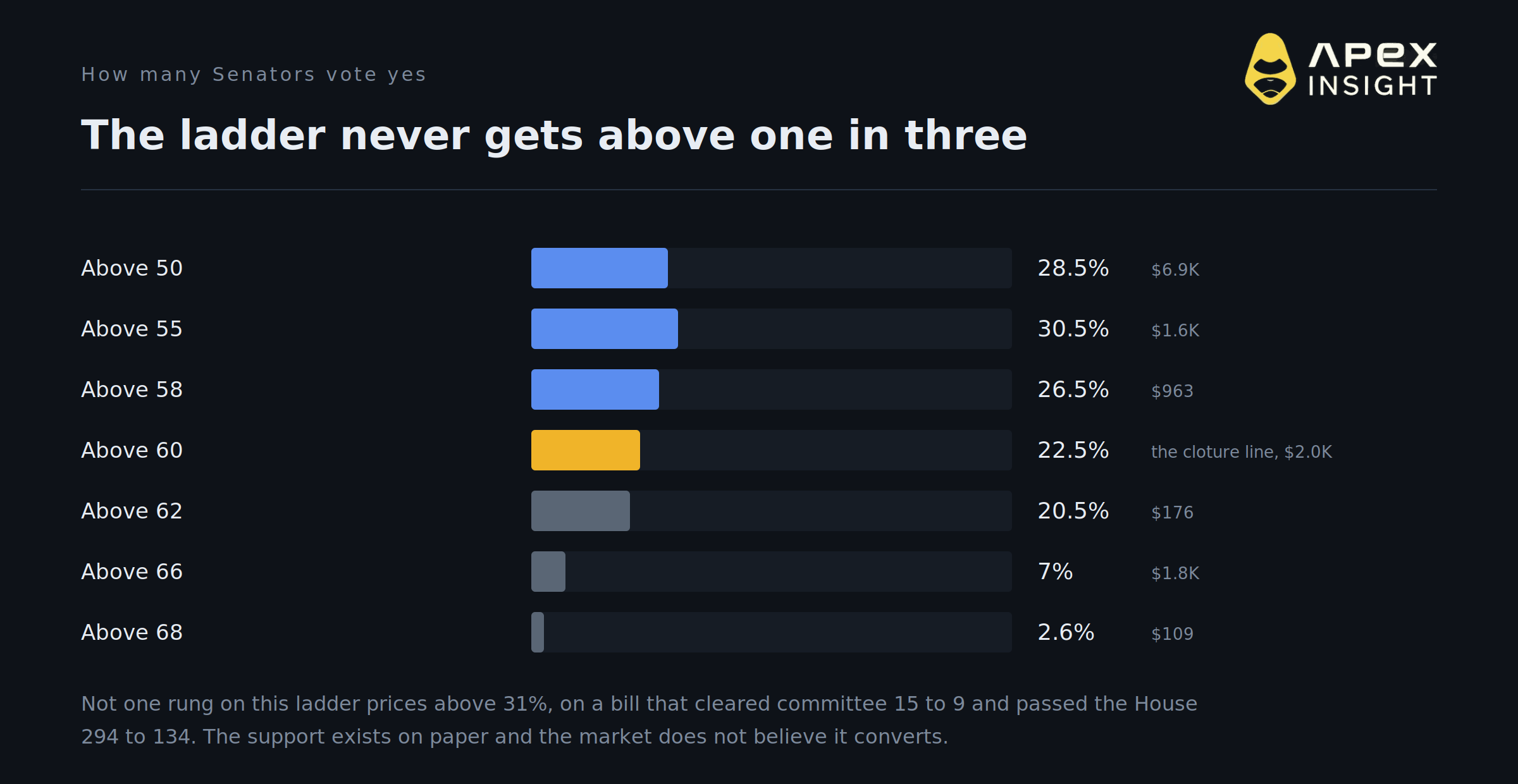
Above 50 prices at 28.5 percent, above 55 at 30.5 percent, above 58 at 26.5 percent, above 60 at 22.5 percent and above 66 at 7 percent.
Not one rung prices above 31 percent. This is a bill that passed the House 294 to 134 in July 2025 and cleared the Senate Banking Committee 15 to 9 in May 2026, the first time a broad digital asset framework had passed a congressional committee.
The support exists on paper. The market does not believe it converts into 60 votes on a Tuesday in September.
6. What is actually blocking it
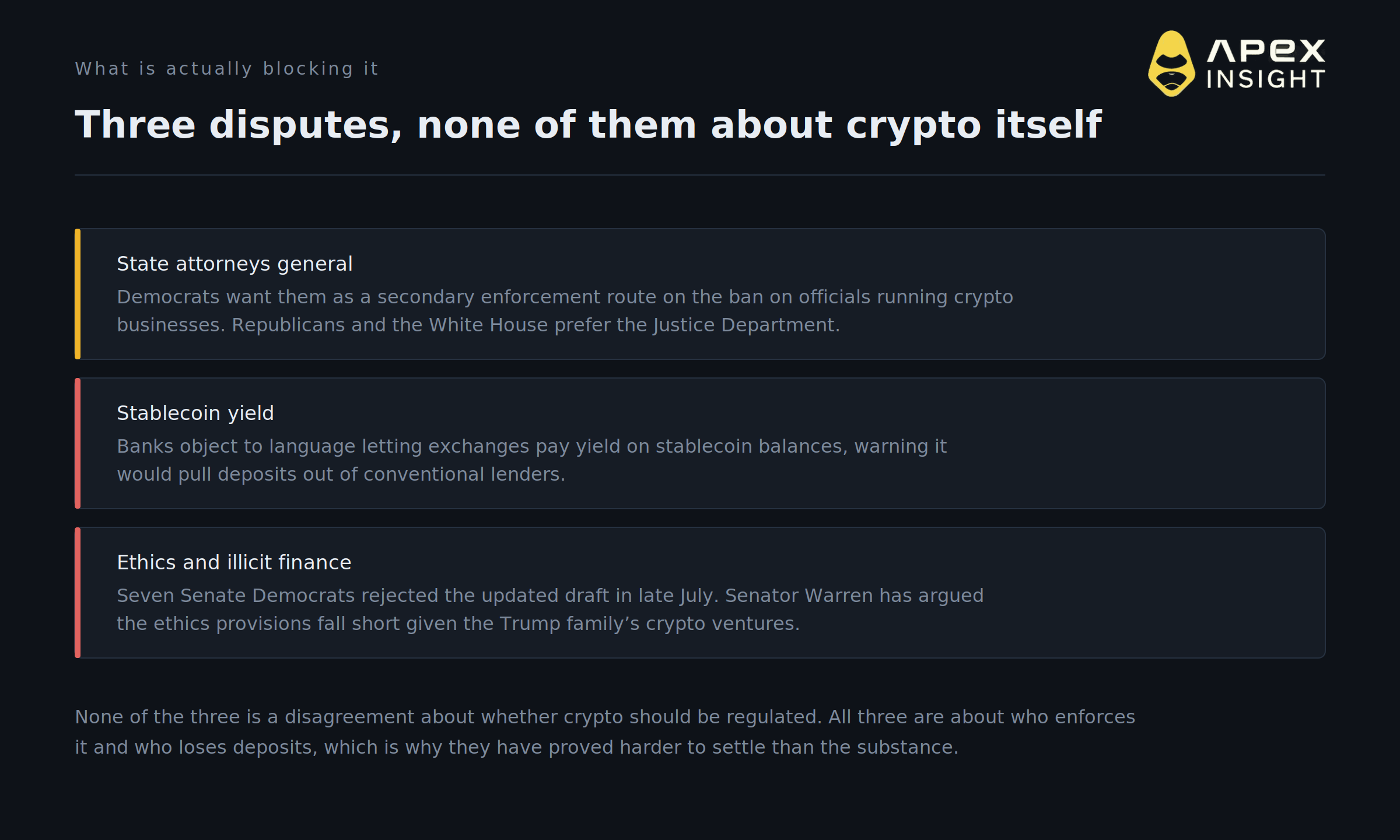
The central enforcement fight is over whether state attorneys general should have secondary power to enforce the bill's ban on government officials operating crypto businesses. Democrats want that route. Republicans and the White House prefer the Justice Department.
The banking sector has objected separately to language permitting exchanges to offer yield on stablecoin balances, warning it would siphon customer deposits from conventional lenders.
Underneath both, seven Senate Democrats rejected the updated draft in late July on consumer protection, illicit finance, ethics and market integrity. Senator Elizabeth Warren has argued the ethics provisions fall short given the Trump family's own crypto ventures.
None of these is an argument about whether crypto should be regulated. All three are about who enforces the rules and who loses deposits, which is exactly why they have been harder to settle than the substance.
7. Fourteen working days
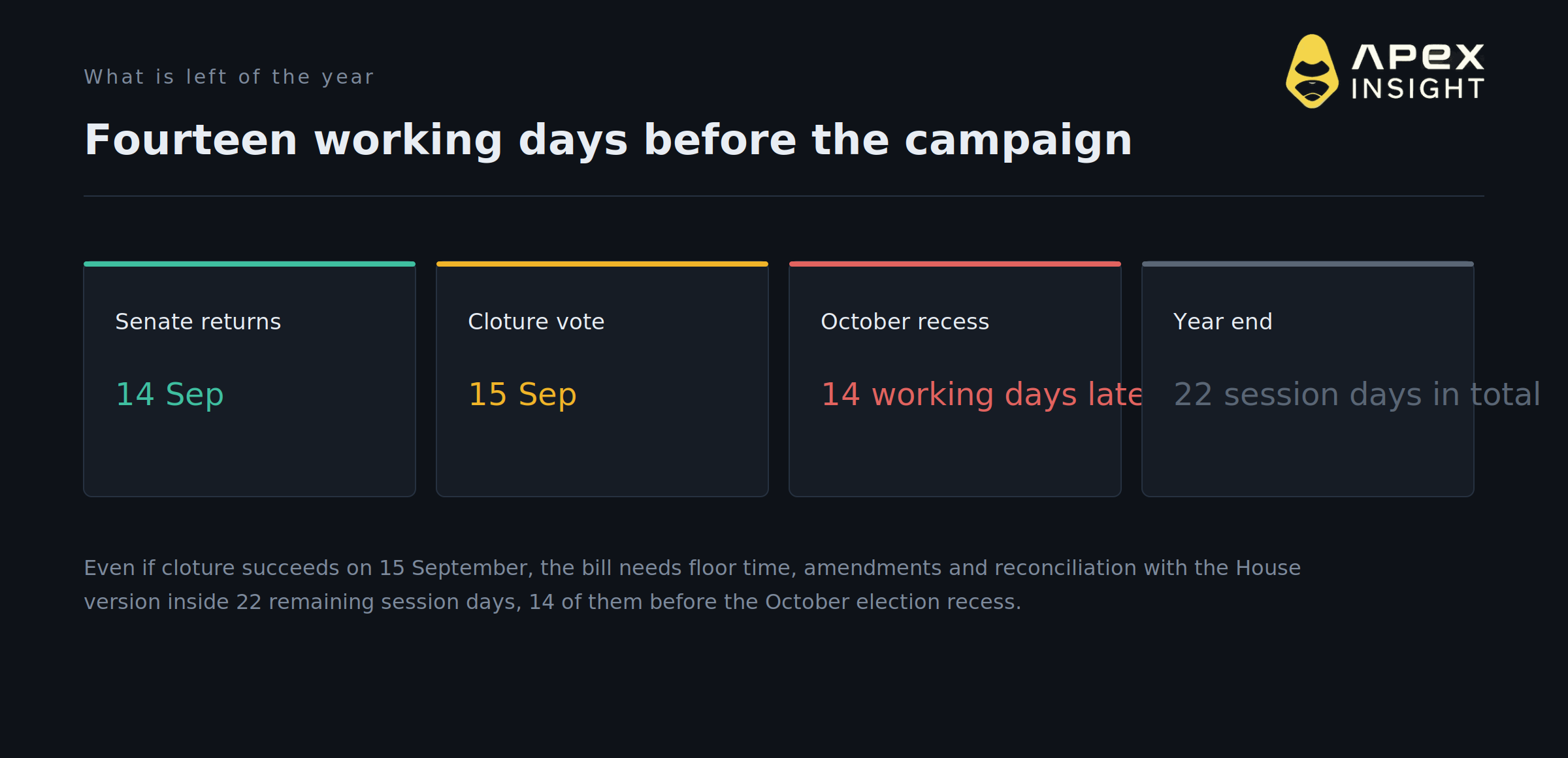
The Senate returns on 14 September. It has 14 working days before an October election recess and 22 session days in total through the end of the year.
Into that window the bill needs a successful cloture vote, floor time, amendments, a passage vote and reconciliation with a House version that differs from the Senate text. Then a signature.
The calendar has been the binding constraint on this bill all year, and each delay has made it tighter rather than merely later.
8. A second market prices the category higher than the bill
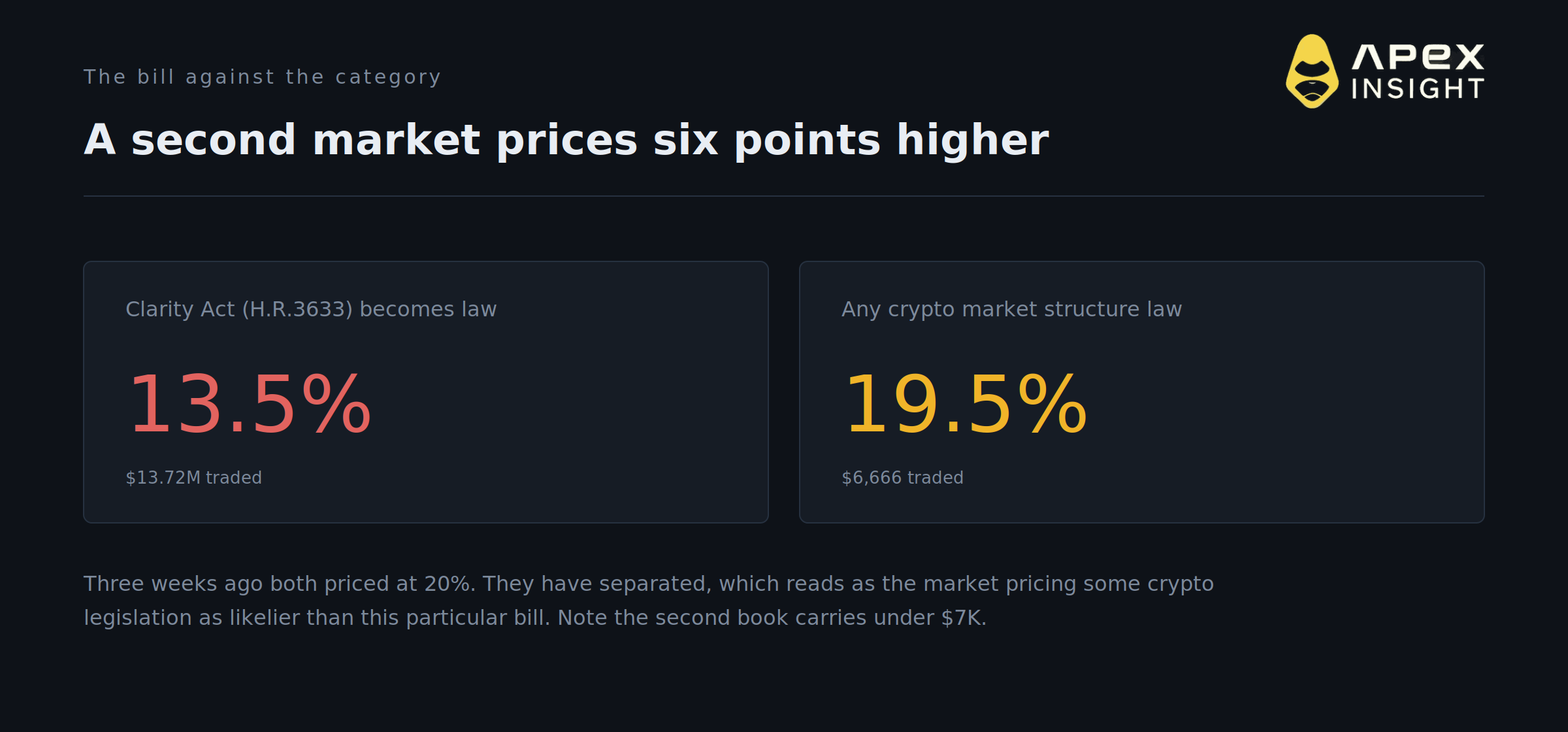
A separate contract asks whether any crypto market structure legislation becomes law in 2026. It prices at 19.5 percent.
Three weeks ago that market and the CLARITY Act contract both priced at 20 percent, and I noted at the time that two independently quoted books landing on the same number was good evidence the figure was not an artefact of one crowd.
They have now separated by six points. The reading is that the market sees some crypto legislation as likelier than this particular vehicle, which is what you would expect if participants think the substance survives but H.R.3633 does not.
One caveat: the second book carries under $7K, so this is a suggestive divergence rather than a firm one.
9. Crypto has stopped watching
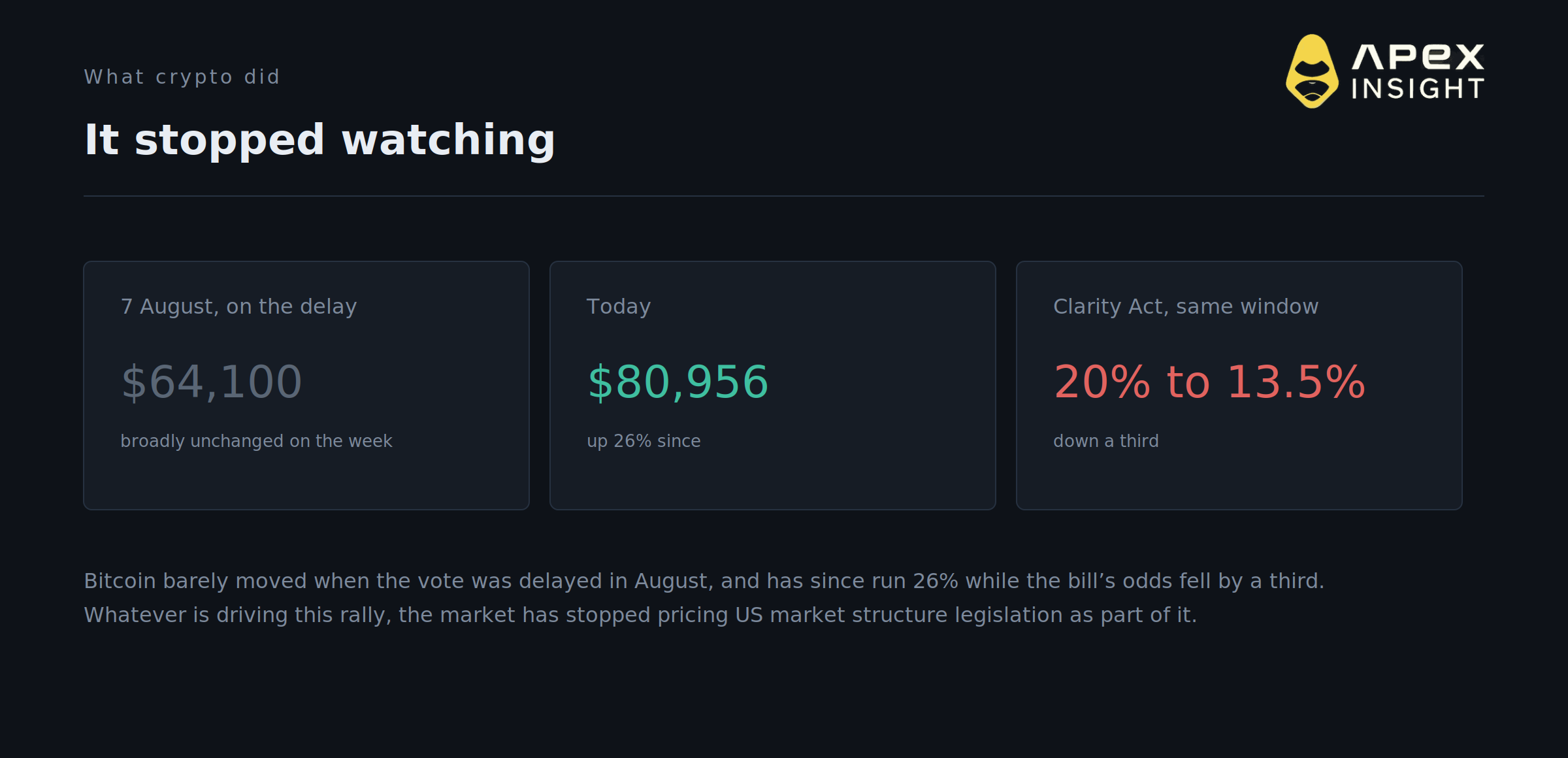
When the delay was confirmed on 6 August, Bitcoin traded between roughly $64,100 and $64,400 and was broadly unchanged on the week. It sits at $80,956 today, up around 26 percent.
Over the same window the bill's odds fell by a third.
For two years, US market structure legislation was cited as one of the primary catalysts for the next crypto leg higher. Whatever is driving this rally, the market has stopped pricing that legislation as part of it, and the two series have moved in opposite directions since August.
10. What to watch on 15 September
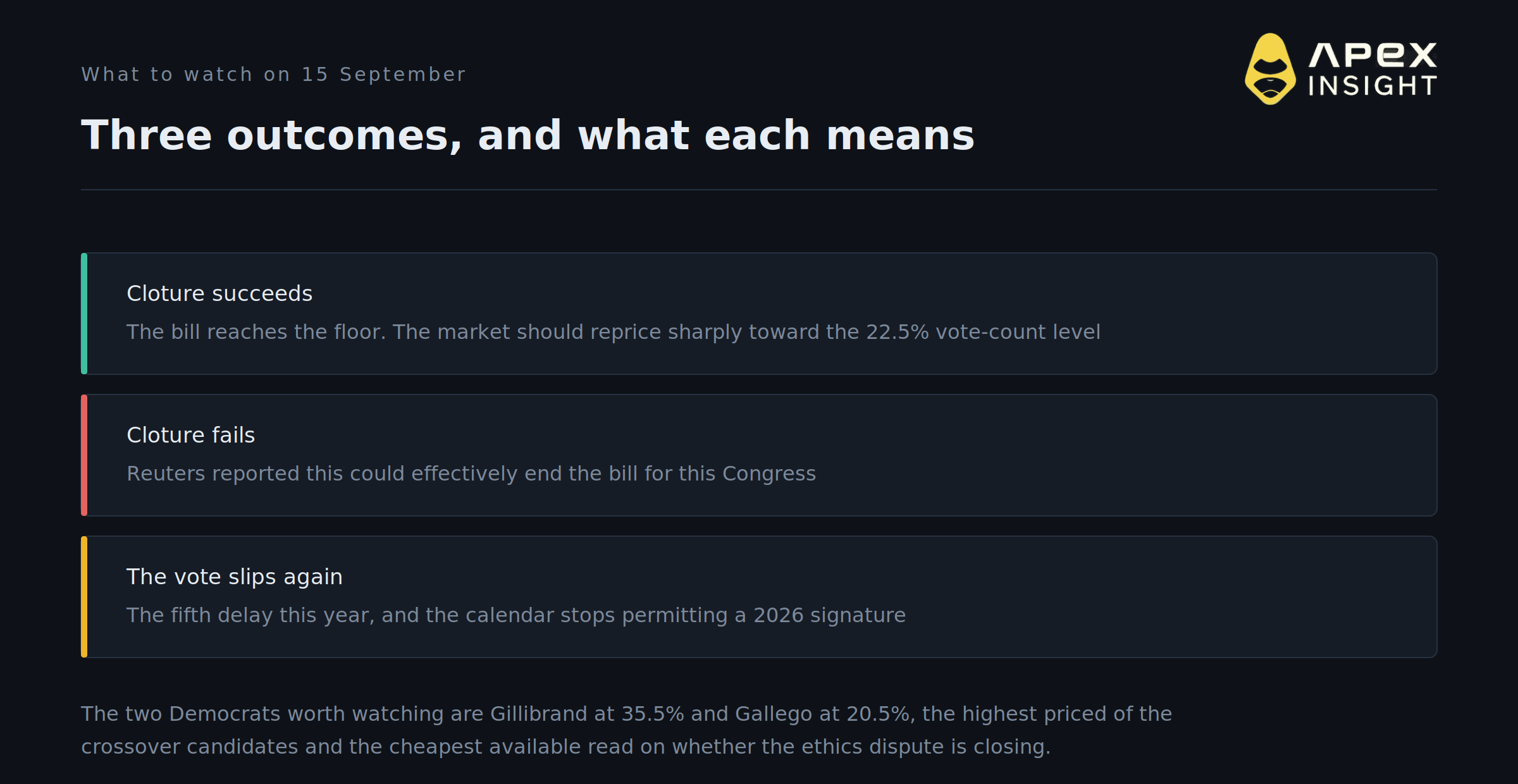
Three things can happen. Cloture succeeds and the bill reaches the floor, in which case the headline contract should reprice sharply toward the 22.5 percent that the vote-count ladder implies. Cloture fails, which Reuters reported could effectively end the bill for this Congress. Or the vote slips again, which would be the latest in a series of delays and would leave the calendar no longer permitting a 2026 signature.
The cheapest available read between now and then is the pair of Democratic contracts. Gillibrand at 35.5 percent and Gallego at 20.5 percent are the highest priced crossover candidates, and movement in either is the earliest signal that the ethics dispute is closing.
What this adds up to
The last time I wrote about this bill, the argument was that it had the votes and might not have the calendar. Three weeks later the market has grown more pessimistic on both counts. The headline contract is down a third on double the volume, the vote-count ladder tops out at 31 percent, and six of eight named Senators have been marked lower.
The vote on 15 September is the cleanest binary left on the crypto policy board. It has a fixed date, a defined threshold of 60 votes, and a reported consequence if it fails. Almost nothing else in this space resolves that cleanly.
And crypto, which spent two years treating this bill as a catalyst, has rallied 26 percent while its odds collapsed. One of those two things is mispriced.
Where to watch it
Every market in this article is live on ApeX Omni, where Polymarket's order books are integrated directly: the same liquidity and the same settlement source, minus the KYC. The board carries the headline legislation contract alongside the vote-count ladder and the individual Senator markets, with the volume behind each leg visible, so you can tell at a glance which numbers are deep enough to act on and which are a handful of participants.
We appreciate your continued support.
Published by ApeX. For informational and educational purposes only. Not investment advice, and not a forecast or endorsement of any political or policy outcome. Trading involves risk, including total loss.