



Note: All market prices are as of 9 September 2026. The FOMC decision lands on 16 September, three days after Stage 1 of Political Markets Season closes.
1. A consensus dying in one line
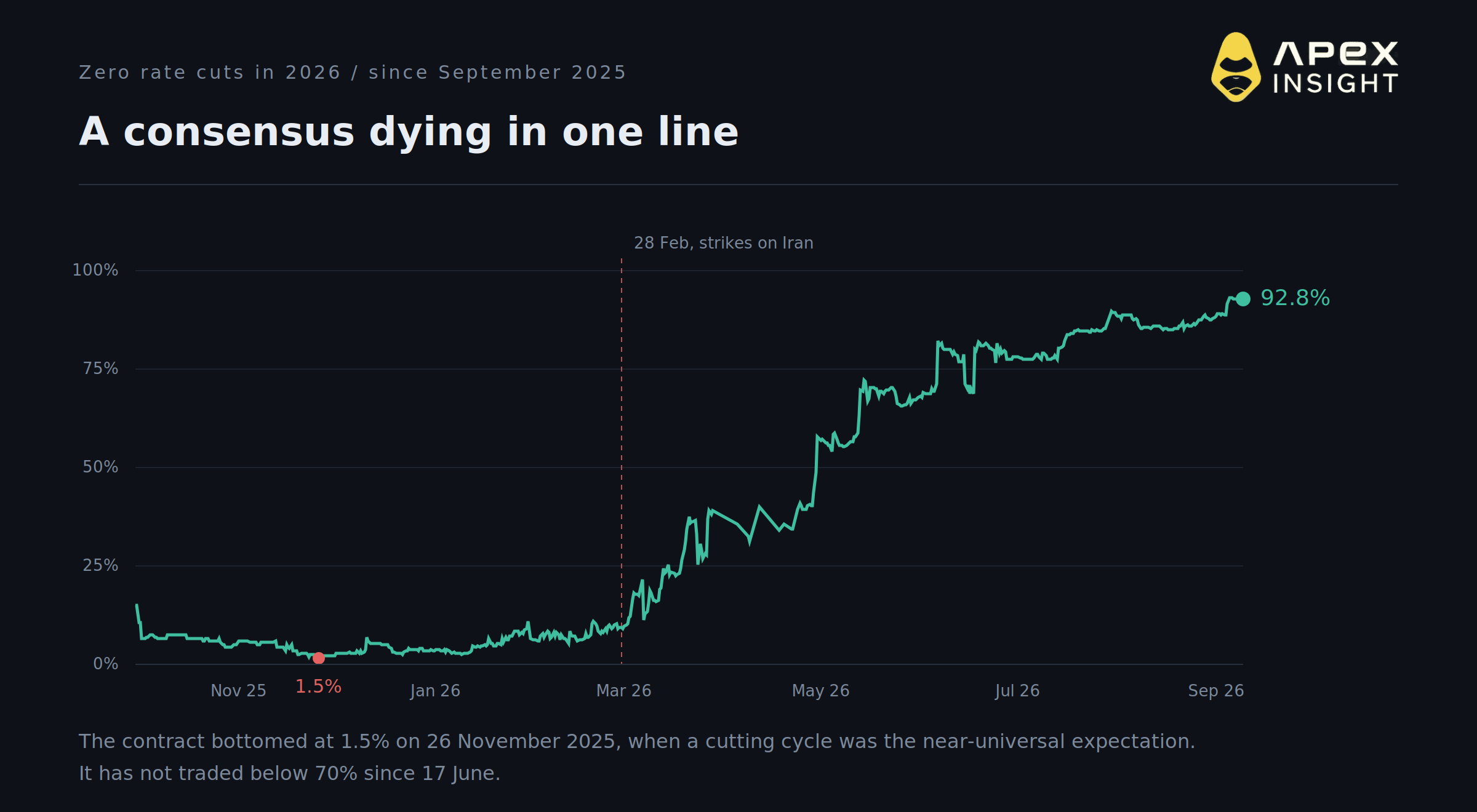
The contract bottomed at 1.5 percent on 26 November 2025. At that point a cutting cycle was close to a universal expectation, and paying anything for the opposite was paying for a tail.
It crossed 50 percent in early May, reached 80 percent by June, and has not traded below 70 percent since 17 June. Today it sits at 92.8 percent on a $51.7M book.
Ten months, and a near-certainty inverted into a near-certainty the other way.
2. The turn was Iran, not the Fed
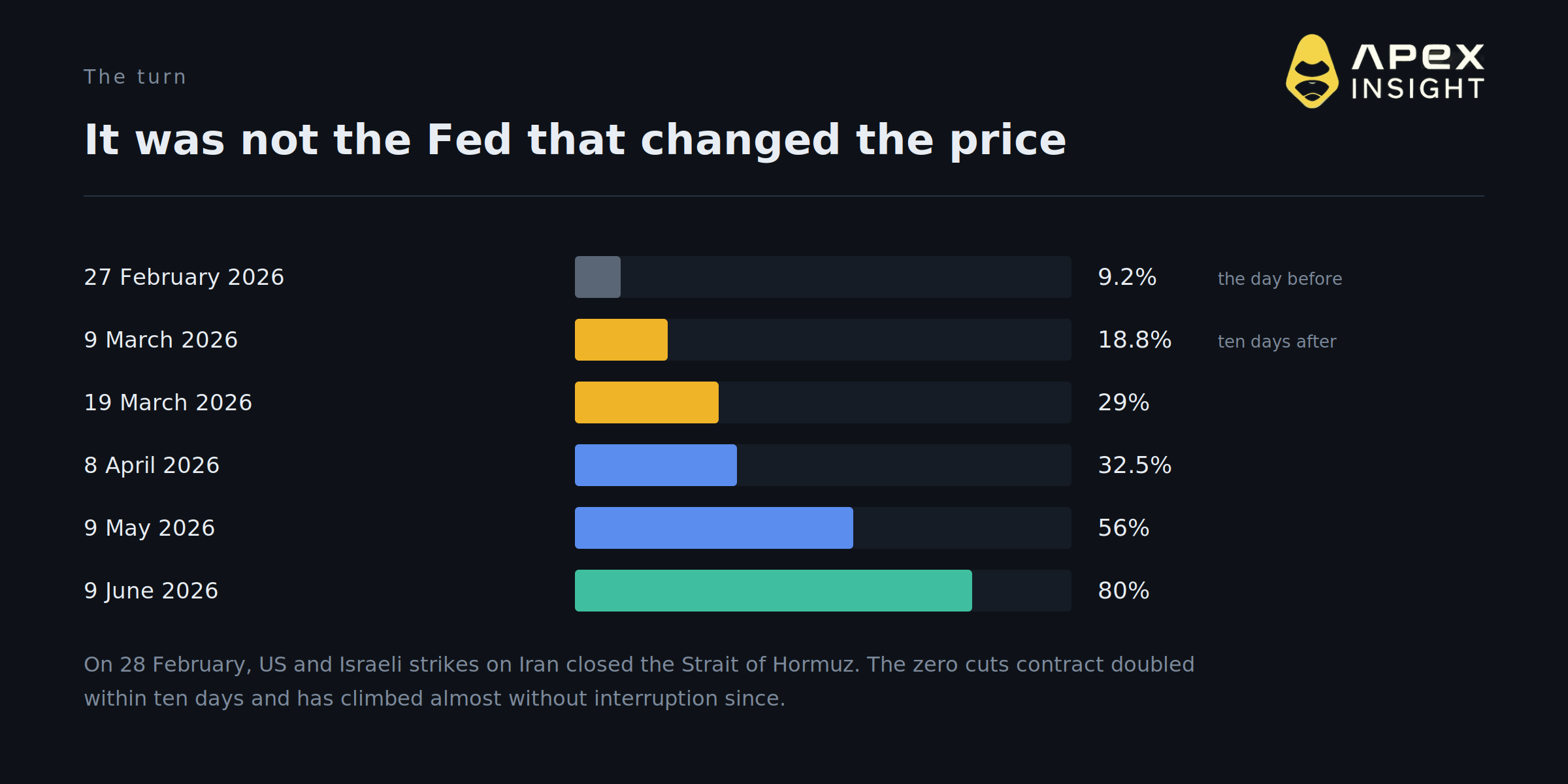
On 27 February the contract priced at 9.2 percent. On 28 February, US and Israeli strikes on Iran killed Supreme Leader Ali Khamenei and Iran closed the Strait of Hormuz.
By 9 March the contract priced at 18.8 percent. By the 19th, 29 percent. By April, 32.5 percent. By May, 56 percent. By June, 80 percent.
It doubled inside ten days of the strikes and has climbed almost without interruption since. No Fed meeting produced that move. A chokepoint did.
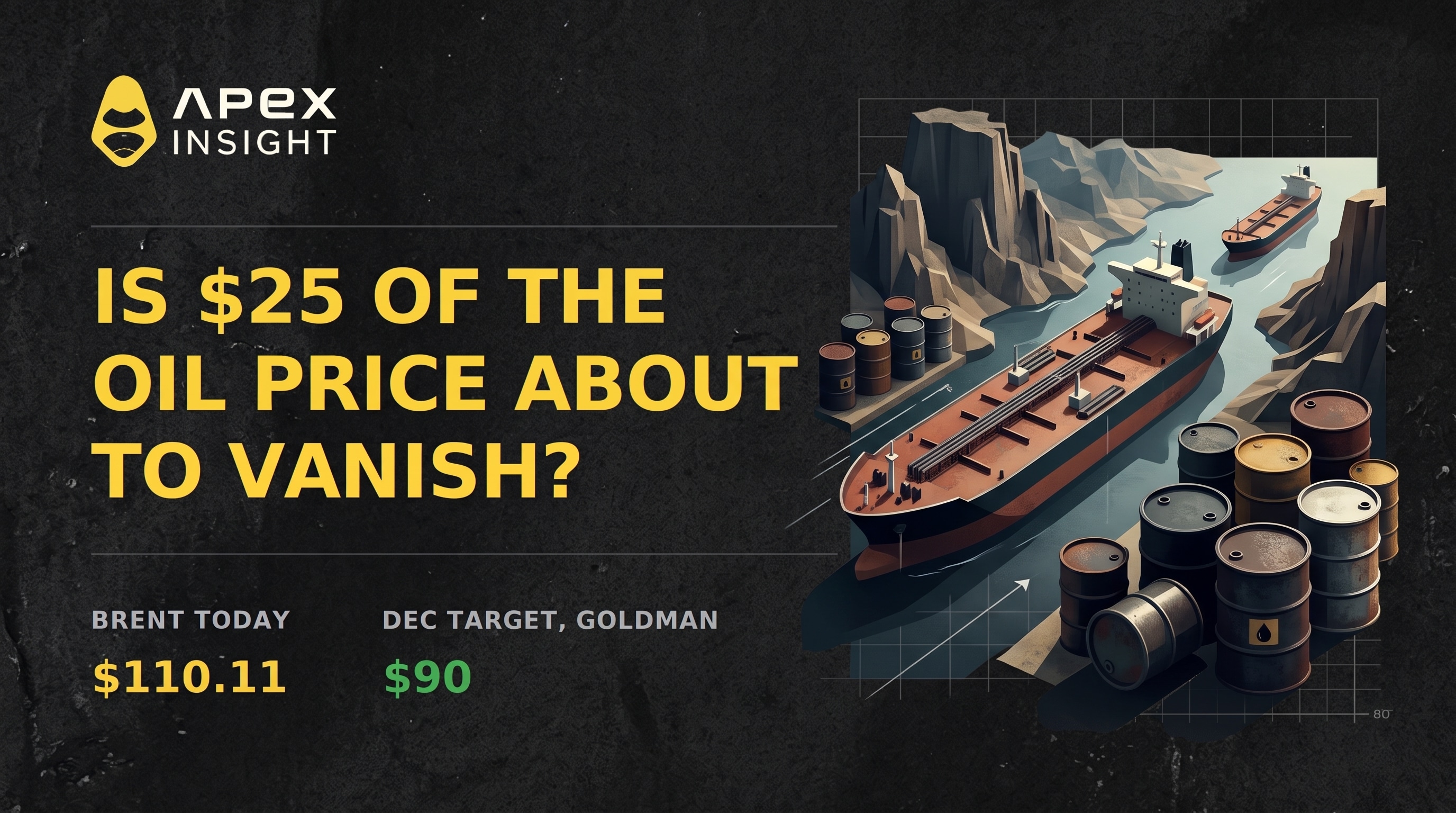
Roughly a quarter of the world's seaborne oil moves through the Strait. WTI has printed $90 this month, and the market on Hormuz traffic returning to normal by year end prices at 20.5 percent on a $10.9M book. Supply pressure that does not resolve is inflation pressure that does not resolve, and a central bank facing that does not cut.
3. Zero and one cut are the entire distribution
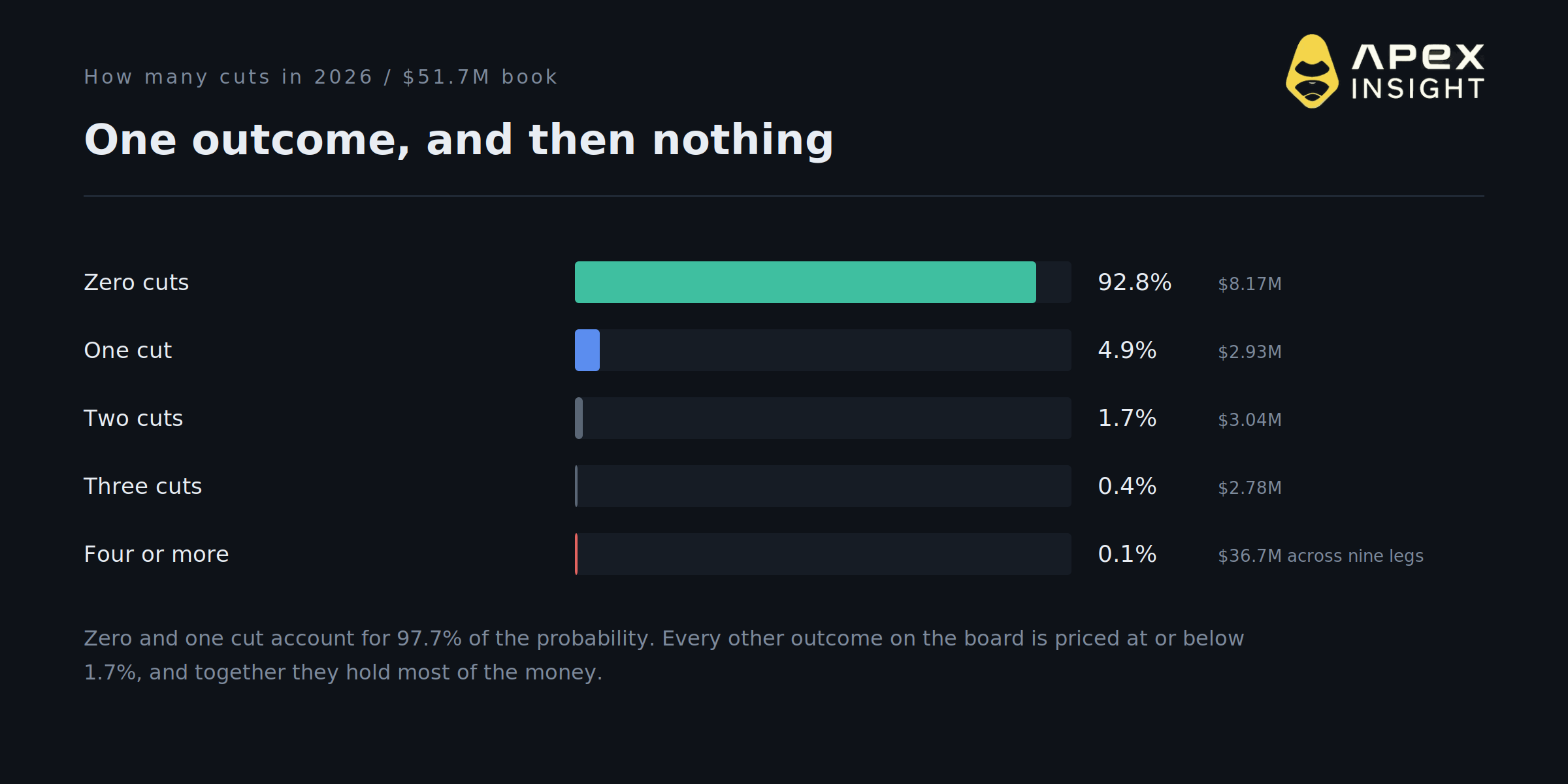
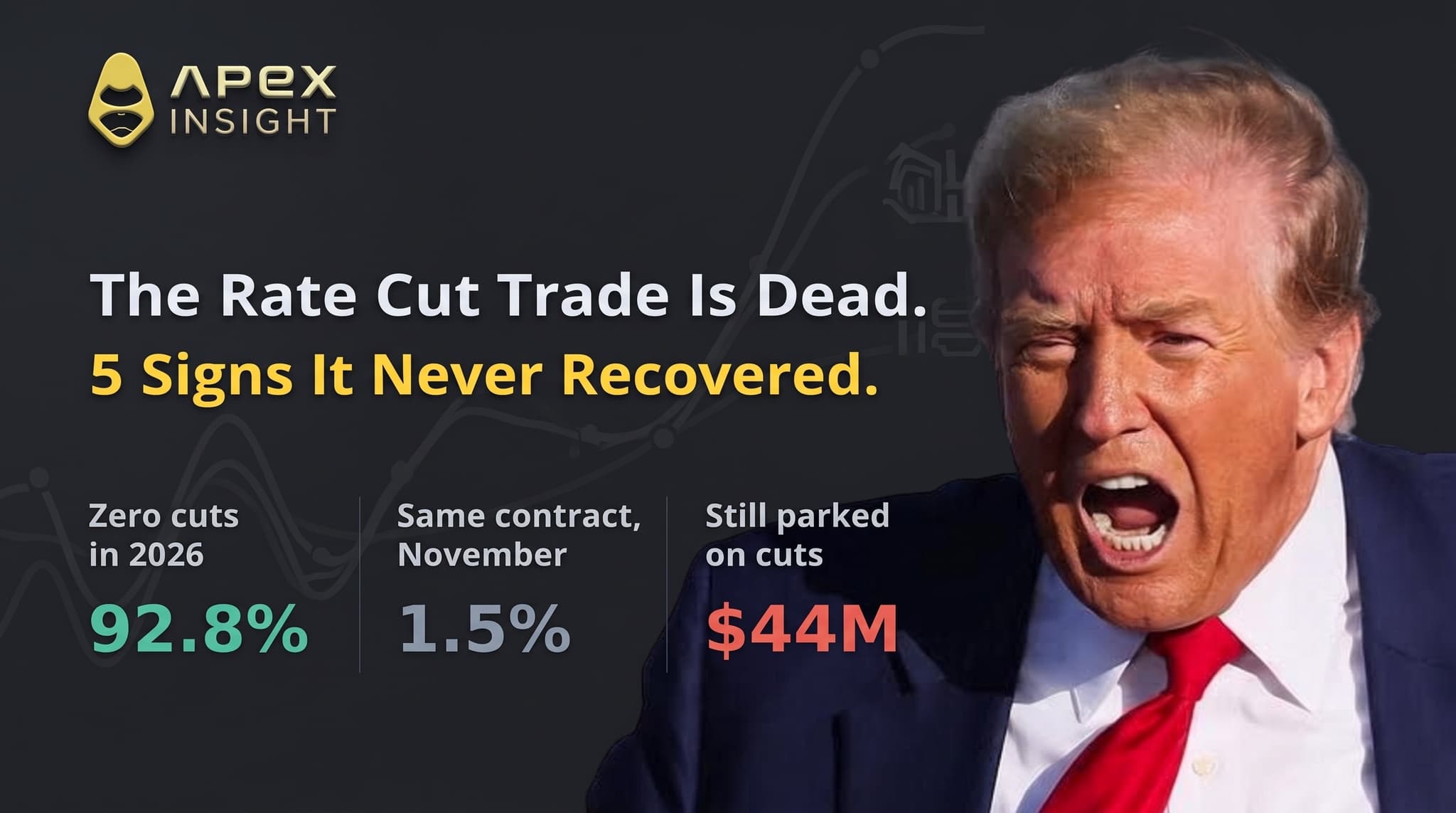
Zero cuts prices at 92.8 percent and one cut at 4.9 percent. Together that is 97.7 percent of the probability.
Two cuts prices at 1.7 percent, three at 0.4 percent, and every outcome from four cuts upward prices at 0.1 percent.
For context on how far this has moved, a year ago the modal expectation across most sell-side forecasts was three or four cuts in 2026. Those outcomes now price at four tenths of one percent and one tenth of one percent respectively.
4. A second, separate book says the same thing
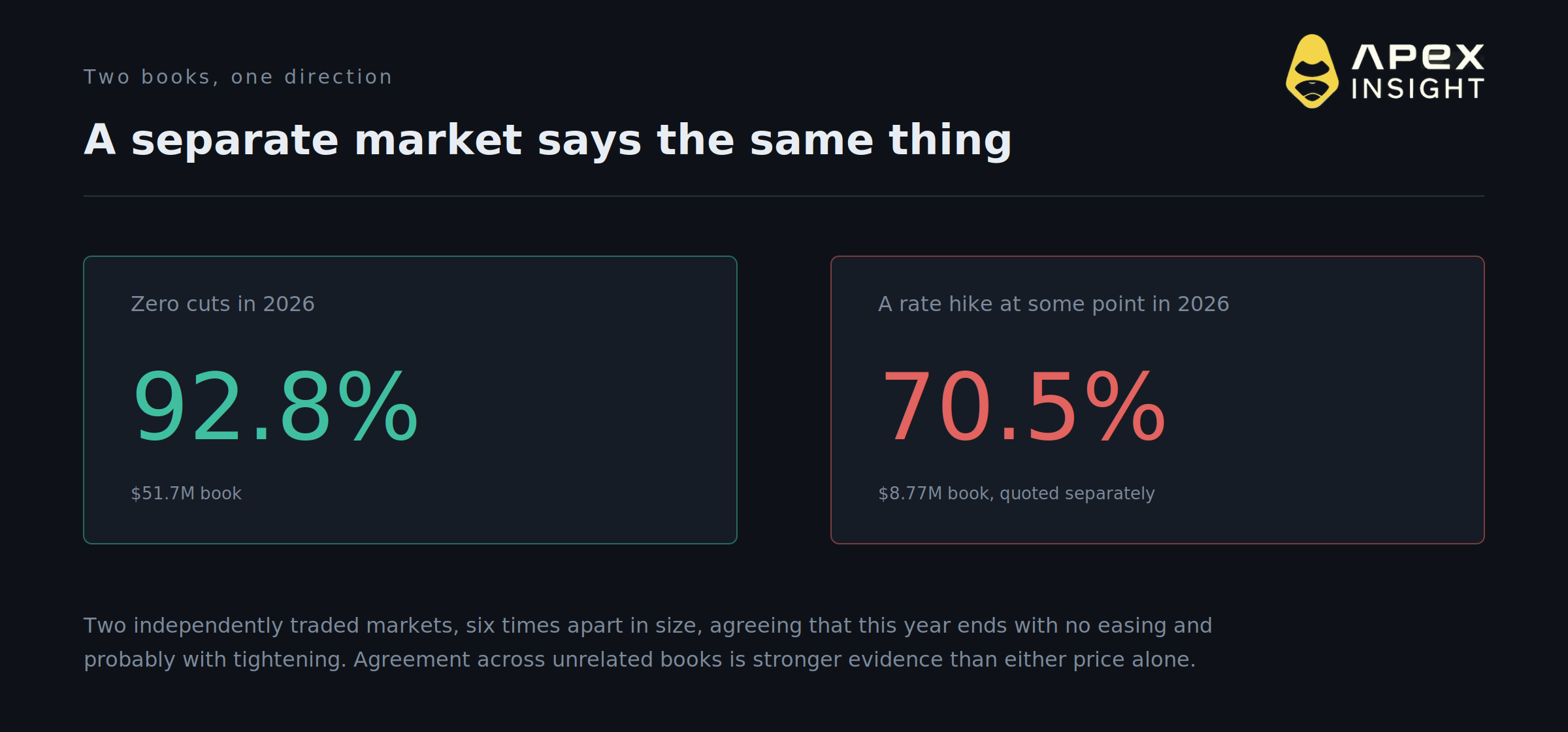
A different market asks whether the Fed hikes at all in 2026. It prices at 70.5 percent on $8.77M, quoted independently of the cuts book.
The two agree. One says no easing this year at 92.8 percent, the other says active tightening at 70.5 percent, and neither needs the other to be true.
Agreement across unrelated books is stronger evidence than any single price, because the participants and the liquidity are different. When a $51.7M market and an $8.77M market point the same direction, the number is less likely to be an artefact of one crowd.
5. Forty-four million dollars is still sitting on it
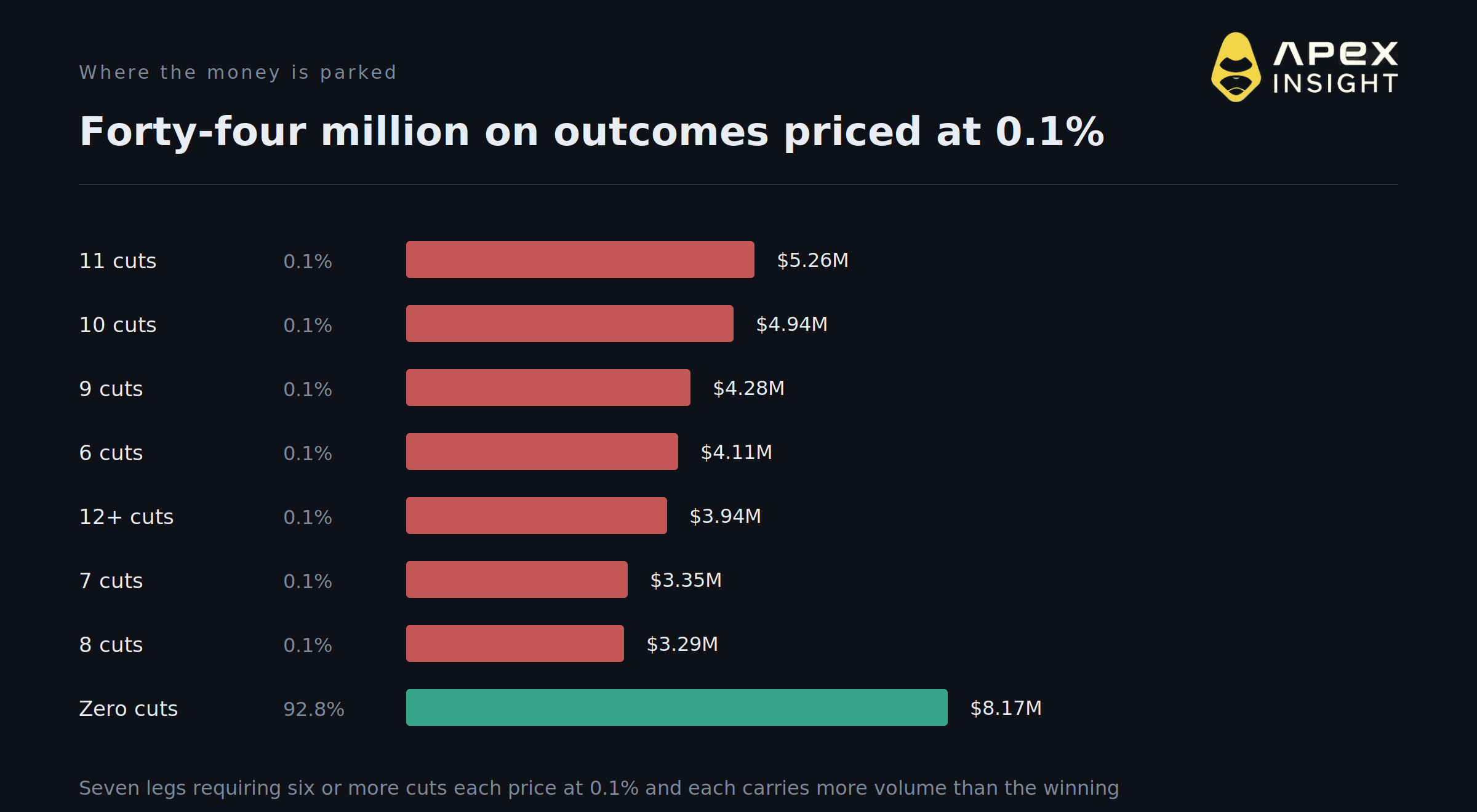
Here is where the trade's death is most visible.
The eleven-cut leg carries $5.26M and prices at 0.1 percent. Ten cuts carries $4.94M, nine cuts $4.28M, six cuts $4.11M. Seven separate legs requiring six or more cuts each price at 0.1 percent, and together the dead legs hold roughly $44M.
The winning outcome, zero cuts at 92.8 percent, carries $8.17M. So the outcomes the market has ruled out hold more than five times the volume of the one it expects.
The same pattern runs through the September book.
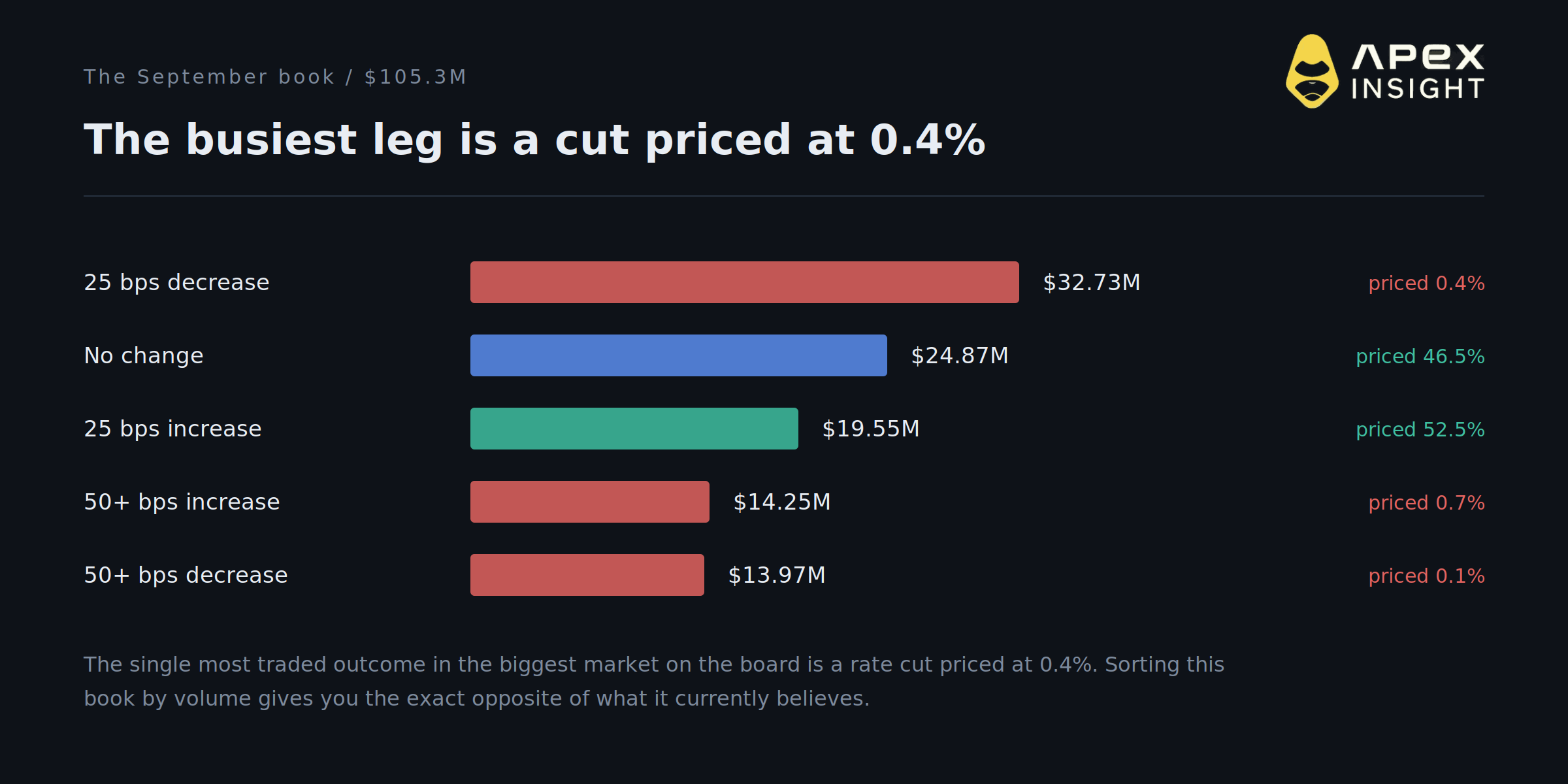
In the biggest market on the board, the single most traded outcome is a 25 basis point cut carrying $32.73M and priced at 0.4 percent. No change carries $24.87M and the increase, which leads at 52.5 percent, carries $19.55M.
Sort that book by volume and you get precisely the opposite of what it believes. That is the clearest lesson available on why traded size is a record of where a price has been rather than a measure of conviction in where it is.
Where this goes
Tomorrow the series looks at where rates actually end up, which is a different question from whether the Fed moves next Tuesday. The end-2026 book has a clear modal outcome, and it sits a quarter point above where we are now.
Trade it
Political Markets Season is live on ApeX Omni. Four stages, four political markets, a 6,000 USDT prize pool. Stage 1 is the Fed Decision in September, running to 13 September 00:00 UTC.
Spot prediction trading on Polymarket order books. No leverage, no liquidation, no KYC. Trade the odds, not the outcome.
We appreciate your continued support.
Published by ApeX. For informational and educational purposes only. Not investment advice, and not a forecast or endorsement of any policy outcome. Trading involves risk, including total loss.