



Published 25 November 2026
The biggest hour in Nvidia's November happened while Nasdaq's regular session was closed.
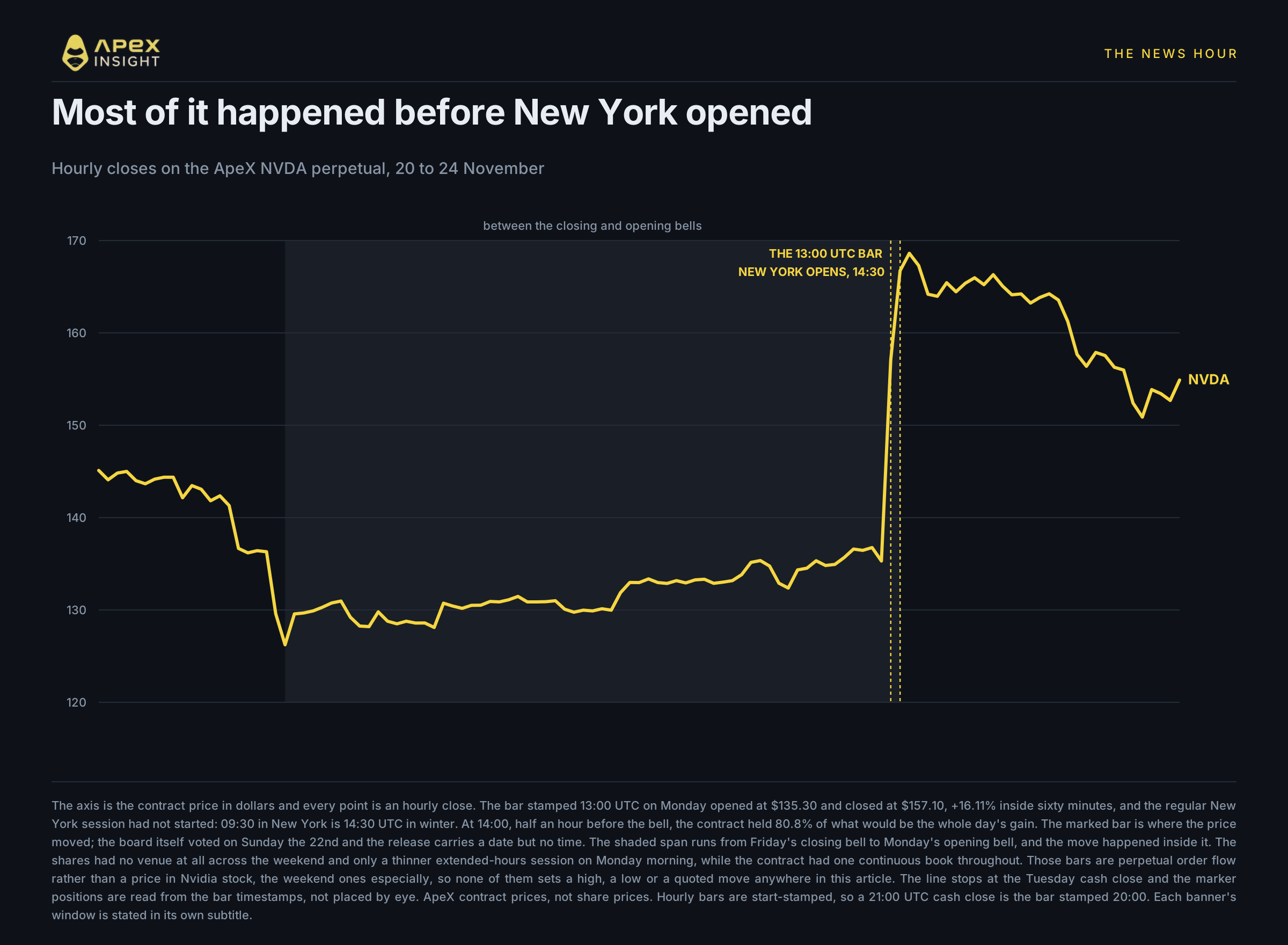
At 13:00 UTC on Monday 23 November, our NVDA perpetual opened at $135.30. Sixty minutes later it closed at $157.10. That single bar is a 16.11% move, the largest hour the contract has had all month by a factor of more than two and a half, and the opening bell in New York was still half an hour away. At that point, 14:00 UTC, the contract had already banked 80.8% of everything it would gain that day.
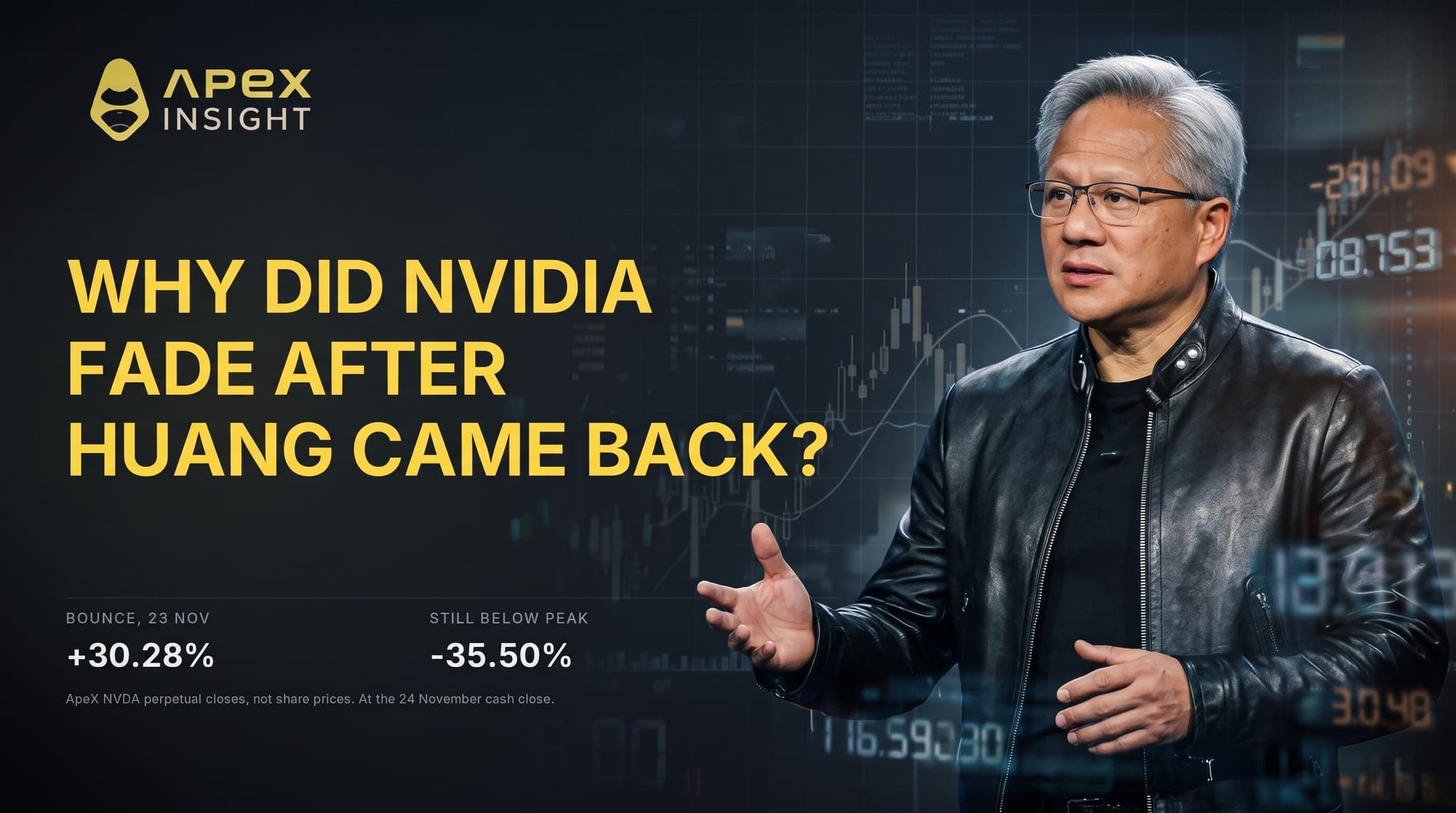
Then it faded. The contract closed Monday at $164.45, well below the $171.47 it touched mid-morning, and on Tuesday it fell another 5.81% to $154.90. Jensen Huang is back in the chair, the contract is up 22.71% across two sessions, and it is still 35.50% below where it closed on 5 October.
This piece is about the gap between those two facts.
1. The bounce was real, and smaller than it looked
Start with the filing rather than the headlines. Nvidia's Form 8-K records that "On November 22, 2026, the Board of Directors of NVIDIA Corporation reinstated Jen-Hsun Huang as NVIDIA's President, Chief Executive Officer and member of the Board of Directors, effective immediately." The board acted on the Sunday. The press release went out on the Monday, and says the vote was unanimous and followed "a series of discussions and meetings with Mr. Huang, after which the Board was satisfied with respect to Mr. Huang's candor and ability to lead NVIDIA."
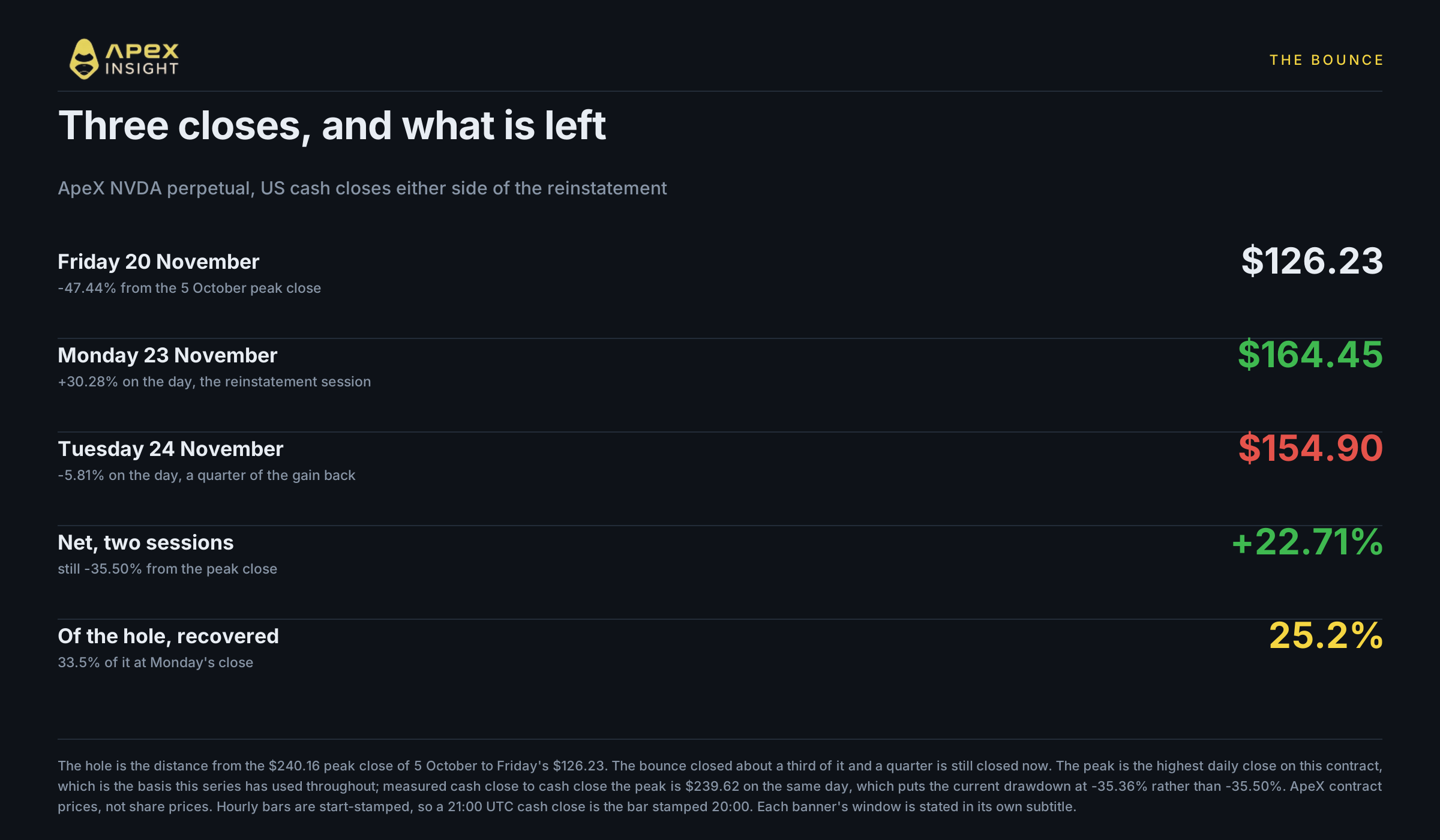
Three cash closes frame what the market did with that. Friday 20 November: $126.23. Monday: $164.45. Tuesday: $154.90.
Two details in those numbers are easy to miss.
The first is that the lowest print of that whole Friday on our contract came in the closing-bell hour itself. The week did not drift out, it ended on the floor. That is part of why Monday's percentage looks so violent. A 30.28% gain measured off a capitulation close is not the same animal as a 30.28% gain measured off a calm one.
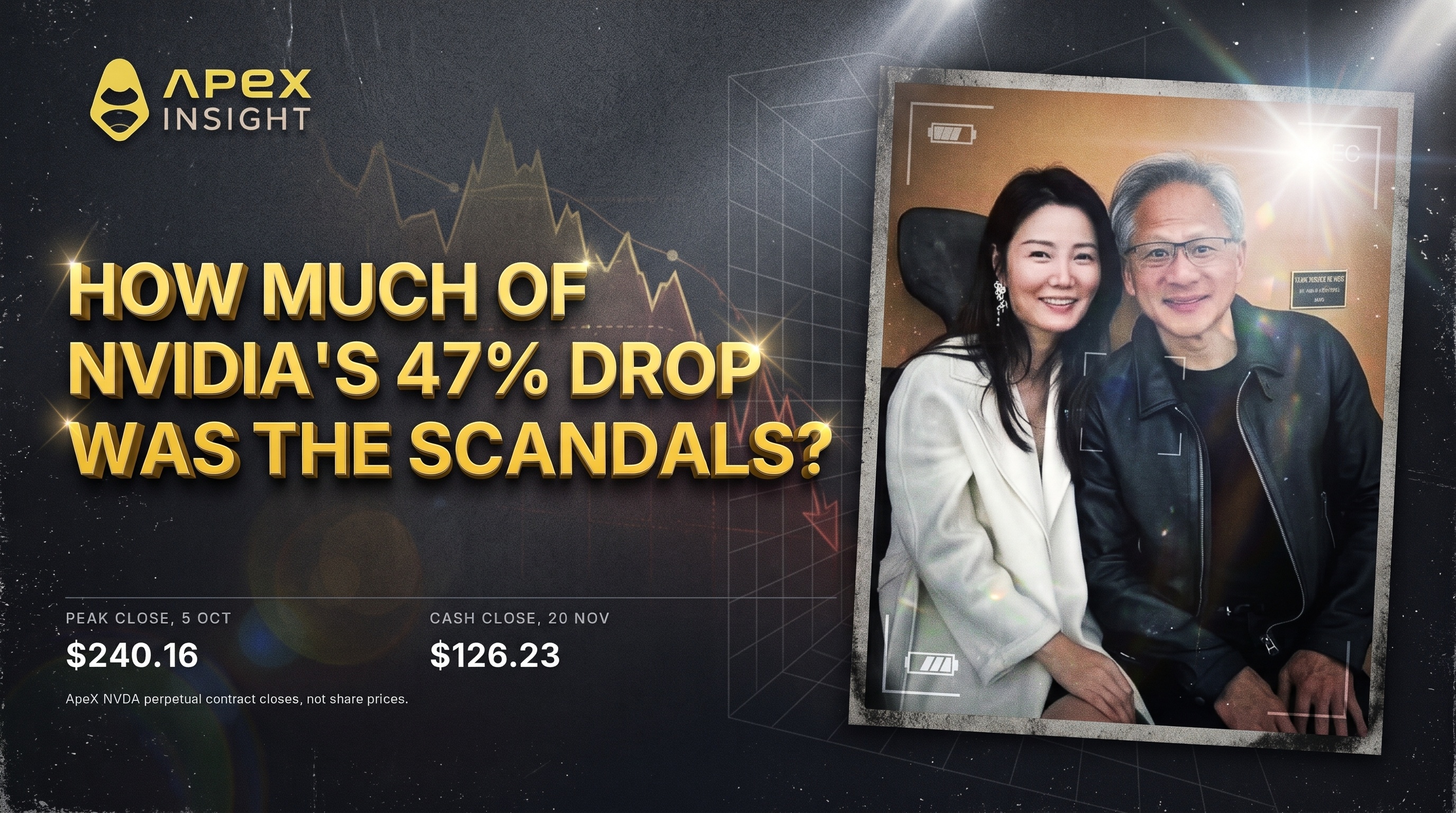
The second is the denominator. Nvidia's peak close was $240.16 on 5 October. The distance from there to Friday was the hole. Monday's rally closed 33.5% of it. After Tuesday, 25.2% is closed. A reader who sees "+30%" and reads "recovered" has the wrong picture: three quarters of the fall is still there.
2. Most of the move happened before New York opened
Be precise about what was shut, because the easy version of this point is wrong.
US shares have a regular session of six and a half hours, 14:30 to 21:00 UTC in winter, wrapped in extended-hours sessions that start as early as 09:00 UTC. So the announcement did not land in a vacuum: Nvidia shares could change hands in Monday's early session, on thinner books and wider spreads, and many retail accounts cannot reach that session at all.
What did not exist was any US share venue across the weekend, and the board voted on the Sunday. Of the roughly 65 hours between Friday's closing bell and Monday's opening bell, about 56 had no US share trading of any kind: four hours of late session on the Friday and five and a half of early session on the Monday were the only windows open. The contract had one continuous book the whole way through, which is why the chart above shows the repricing happening inside the shaded band.
The sequence, hour by hour:
Through the weekend the contract drifted up from Friday's $126.23 into the mid-130s;
At 13:00 UTC on Monday it went from $135.30 to $157.10, a 16.11% move in one bar, with a high of $157.64;
By 14:00 UTC, half an hour before the bell, it held 80.8% of what would be the day's whole gain;
The regular session opened at 14:30 into a contract that had already done most of the work;
The high of the day, $171.47, came in the hour stamped 15:00 UTC, inside the first ninety minutes of that session;
From that high it drifted down 4.09% into the 21:00 close.
That last point matters more than it looks. The peak of enthusiasm was not the close. It was mid-morning, and the rest of the session was a slow sale.
A caveat the chart carries and the prose should repeat: weekend bars on an equity contract are perpetual order flow, not a price in Nvidia stock. They are shown because the repricing genuinely happened there, but no high, low or quoted move anywhere in this article is taken from one.
3. Monday lifted the complex, not one boardroom
The obvious reading of Monday is that one company fixed one governance problem. The tape disagrees.
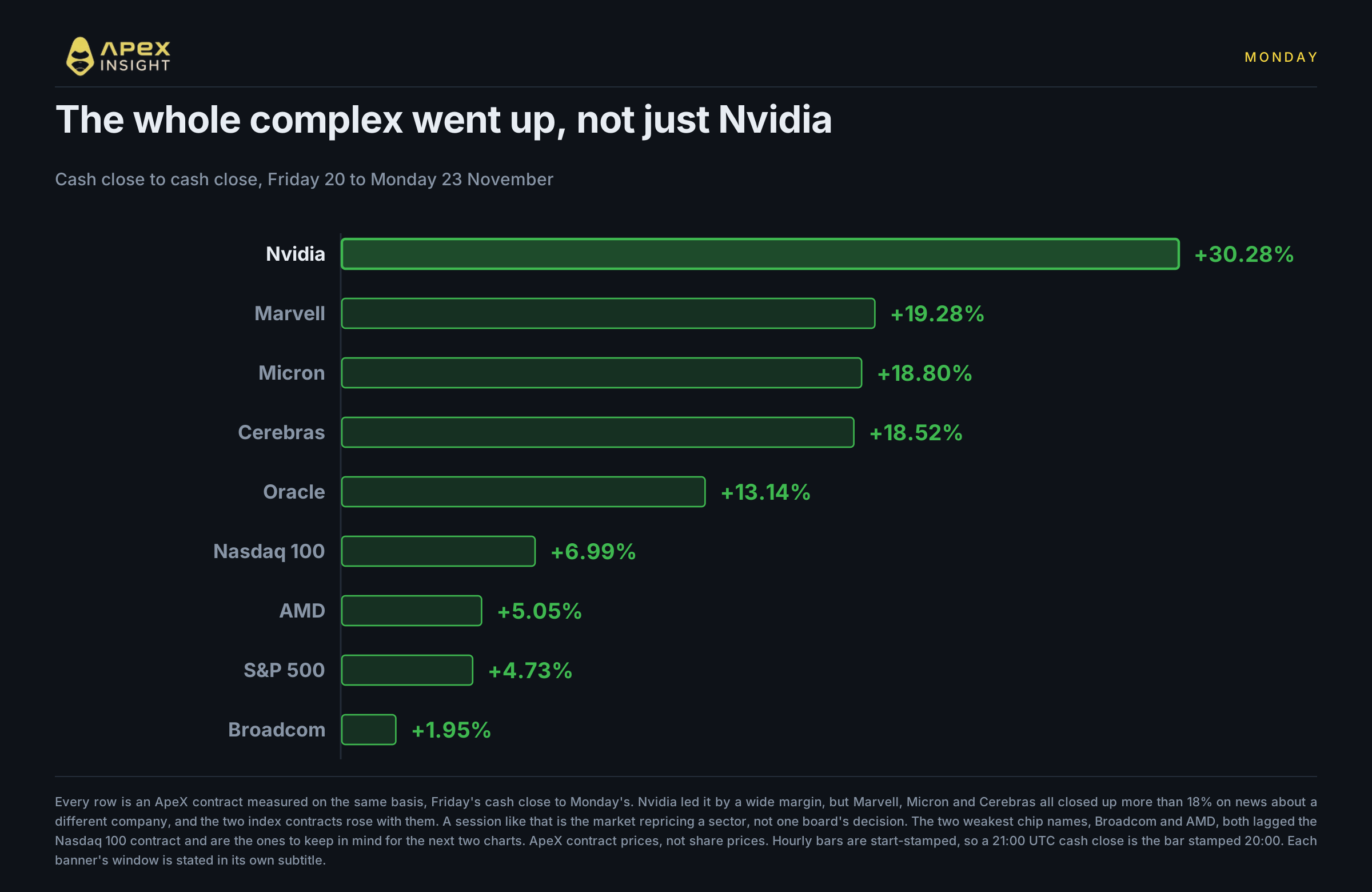
Measured on the same basis, Friday's cash close to Monday's, Marvell closed up 19.28%, Micron 18.80% and Cerebras 18.52%. None of them has a chief executive who was reinstated that weekend. Oracle added 13.14%. The Nasdaq 100 contract rose 6.99% and even the S&P 500 contract rose 4.73%.
A session where an entire sector moves together on one company's news is usually the market repricing something broader: in this case, the odds that the AI trade's problem was specific and solvable rather than general and structural.
Nvidia still led it by a wide margin, and that margin is the genuinely company-specific part. But two of the chip names are worth holding on to. Broadcom managed 1.95% and AMD 5.05%, the weakest two in that group. Both lagged the Nasdaq 100 contract's 6.99%, which means that on the best day the AI trade has had in weeks, two of its largest names underperformed the index they sit inside. They are the two to watch in the next two sections.
4. Tuesday sent the bill to everyone else
On Tuesday the complex gave it back, and it did not give it back evenly.
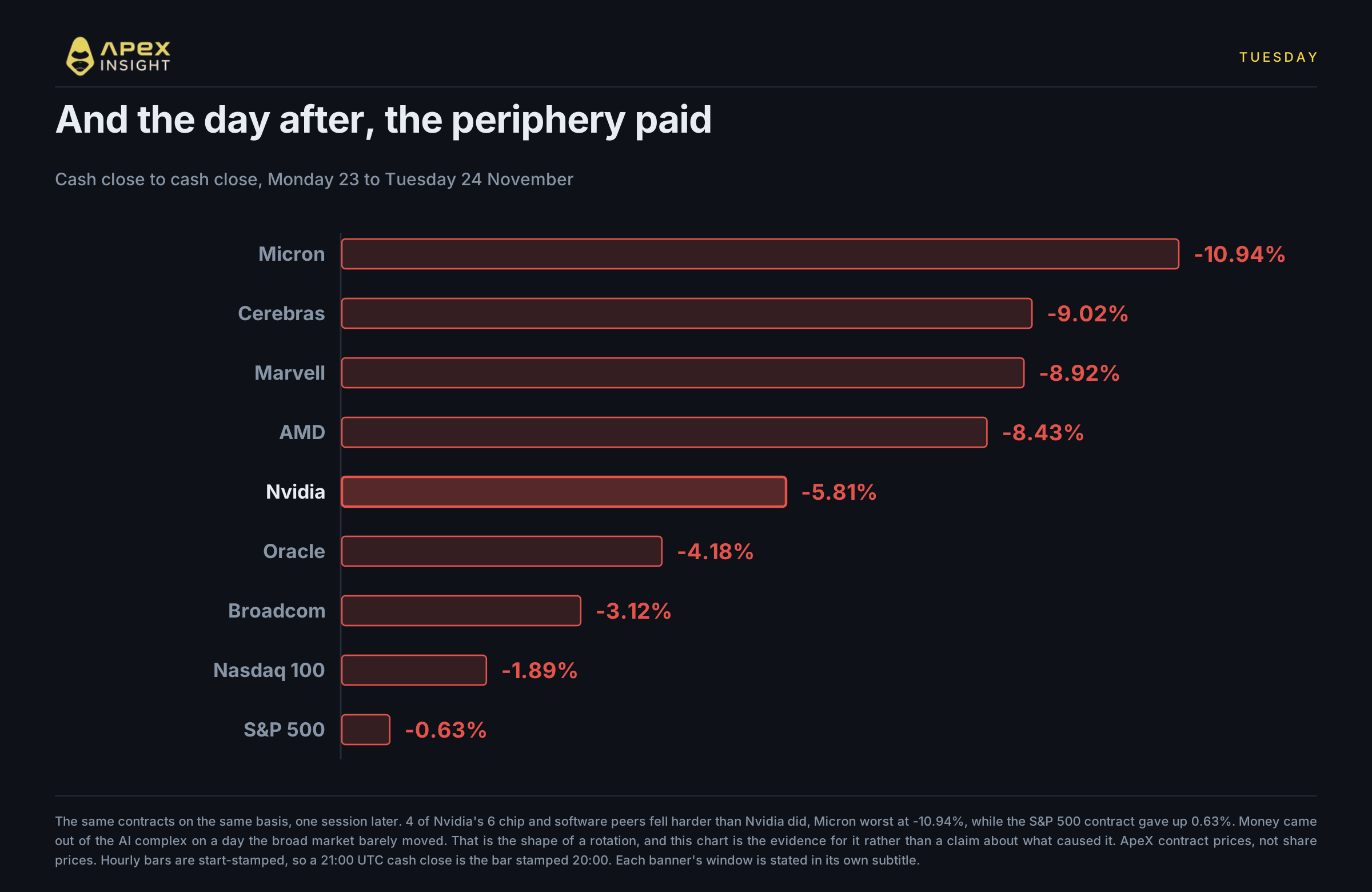
Nvidia fell 5.81%. Micron fell 10.94%, Cerebras 9.02%, Marvell 8.92% and AMD 8.43%. Four of Nvidia's six chip and software peers here fell harder than the company the news had been about. Meanwhile the S&P 500 contract lost 0.63% and the Nasdaq 100 lost 1.89%.
Set those two groups side by side and the shape is clear enough. Money left the AI complex on a day when the broad market barely moved. That is what rotation looks like on a tape: not a general sell-off, but capital walking out of one set of names while the index holds.
The honest limit on that reading is that a chart shows you what happened, not why, and we are not in a position to prove a cause. What we can say is that whatever lifted the periphery on Monday did not survive contact with Tuesday. The most coherent explanation on the evidence is that the sector borrowed a single company's good news and found it did not transfer, and a reader is entitled to weigh that against the two charts rather than take it on trust.
Across the whole episode, from Monday's $171.47 high to Tuesday's $150.58 low, Nvidia's contract travelled 12.18% in the wrong direction.
5. Nvidia kept its bounce, two peers went backwards
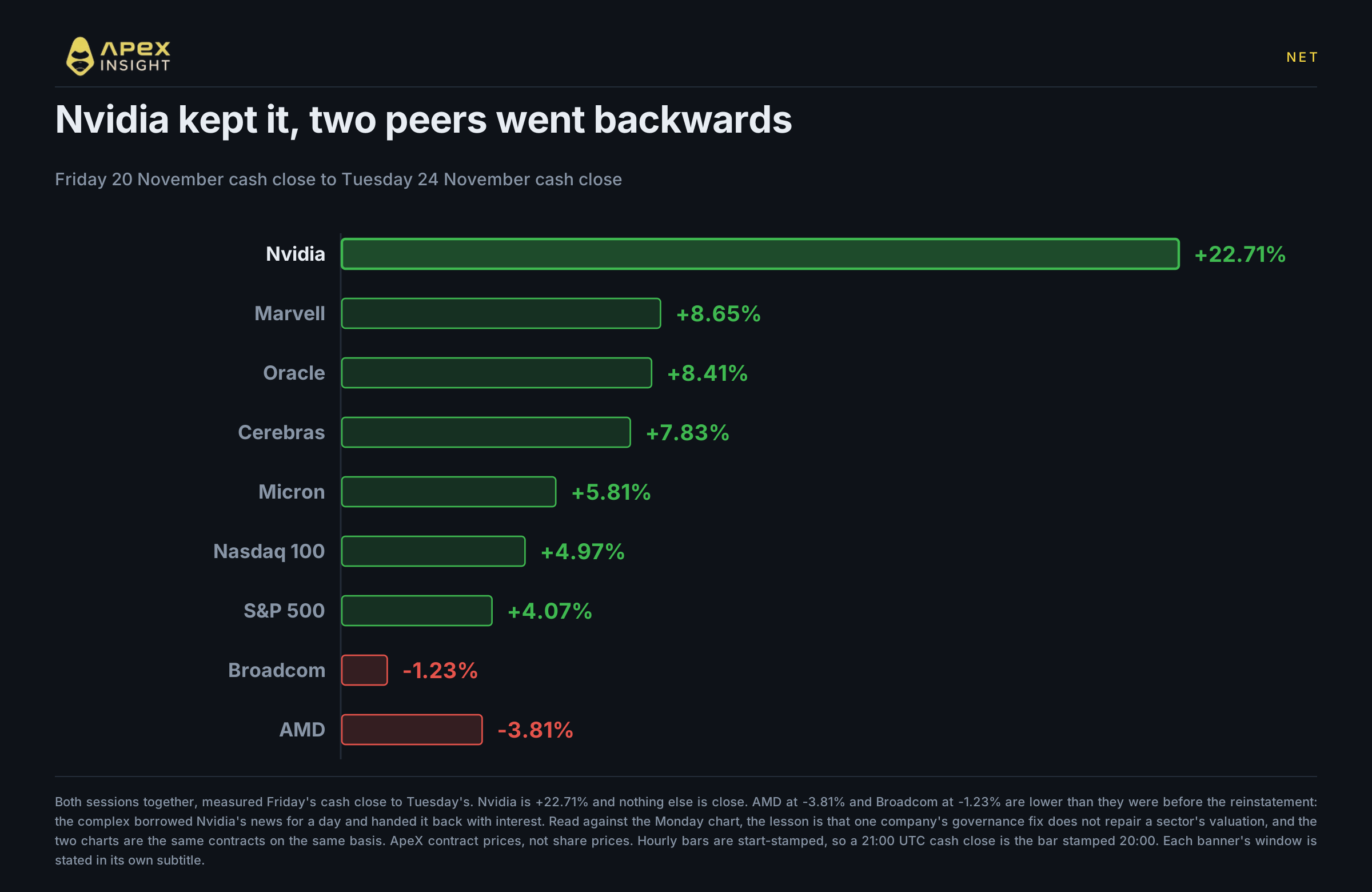
Put both sessions together, Friday's cash close to Tuesday's, and the scoreboard sorts itself out.
Nvidia is up 22.71%. The next closest is Marvell at 8.65%, then Oracle 8.41%, Cerebras 7.83% and Micron 5.81%. All real gains, and all a fraction of what the same names were holding on Monday evening.
Then the two at the bottom. Broadcom finished the two sessions at minus 1.23% and AMD at minus 3.81%. Both are lower than they were before the reinstatement was announced.
That is the fact the bounce narrative cannot absorb. A stretch that delivered about the best governance news Nvidia could have asked for left two of its largest peers worse off than they started. One company's fix does not repair a sector's valuation, and for AMD and Broadcom it did not hold for even two days.
6. The calendar Huang walked back into
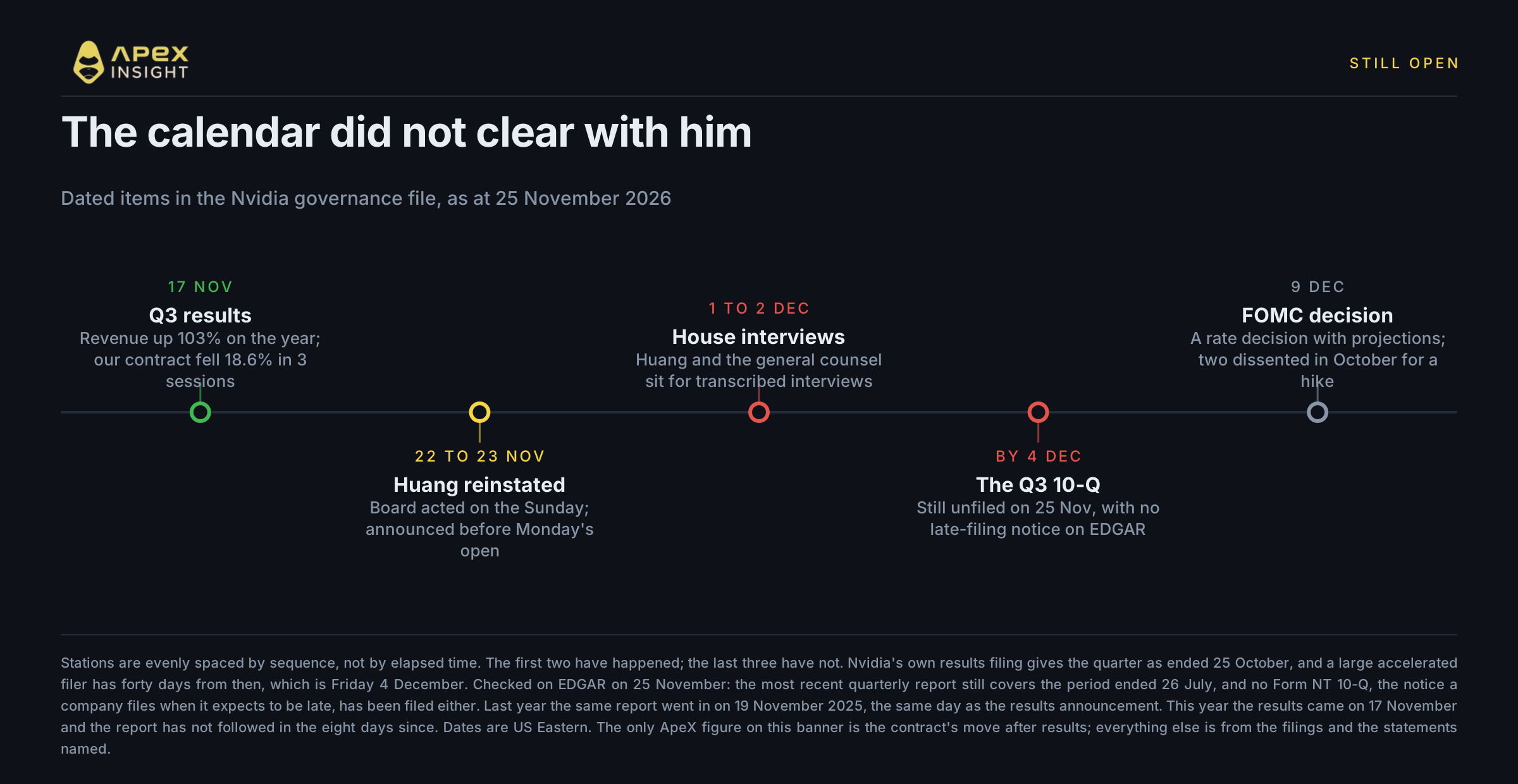
The reinstatement settled who runs Nvidia. It settled very little else, and most of what is unsettled has a date on it.
The investigation is still running. The board's own release cuts both ways, and both halves belong here. It says the board "received input from senior levels of the United States government, and based on that input, the Board is confident that Mr. Huang's reinstatement poses no national security risk." It also says the committee of independent directors examining reports that Huang was the target of a foreign intelligence effort "will proceed to conclusion", and that the committee has retained independent counsel. The same release announces a new National Security and Export Control Committee and a search for a Chief Compliance Officer. A company that considered the matter closed would not be staffing for it.
Congress was not persuaded. On the day of the reinstatement the chairs of three House committees said the board's process did not resolve their concerns and confirmed that Huang and general counsel Tim Teter will sit for transcribed interviews on 1 and 2 December as previously planned.
The regulatory question moved, and the reporting on it disagrees with itself. A civil SEC probe was reported on 17 November, described there as examining whether Nvidia's disclosures misled investors. Reuters reported on 20 November that the inquiry covers the company's accounting practices, citing people briefed on the matter, while also saying the original report could not establish the probe's focus. So the existence of an inquiry is twice reported and its scope is not settled, which is worth saying plainly rather than picking the version that reads worse. Nvidia says it will continue to cooperate with ongoing government investigations and inquiries.
And the quarterly report is late. This one is checkable rather than reported, so we checked it. Nvidia's results filing gives the quarter as ended 25 October. A large accelerated filer has forty days from a quarter end to file its Form 10-Q, which puts the deadline on Friday 4 December. As of 25 November, Nvidia's EDGAR record shows its most recent 10-Q still covering the period ended 26 July, and no Form NT 10-Q, the notice a company files when it expects to miss a deadline. Last year the equivalent report went in on 19 November 2025, the same day as the results announcement. This year results came on 17 November and nothing has followed in the eight days since.
Behind all of it sits the Fed's own meeting on 8 and 9 December, which carries fresh projections. Worth noting which way that one points, because the reflex is to assume a cut. At the October meeting the committee held the target range at 3.75 to 4.00% and two members dissented, both of whom wanted to raise it.
None of that is a prediction. It is a list of dates, and the first of them falls six days from publication.
Trade the move on ApeX
The NVDA perpetual, trading 24/7 including both weekend days.
The two sessions in this piece are the argument for why a market that never closes is not a gimmick. The decision was taken on a Sunday, when the shares had no venue at all, and announced before the regular session opened. Four fifths of Monday's move was priced before the opening bell.
The name itself:
NVDA, the contract every figure above is drawn from
The peers that borrowed the rally and gave it back:
AMD and AVGO, the two that finished the two sessions lower than they started
MU and MRVL, up more than 18% on Monday and down more than 8% on Tuesday
The benchmarks the rotation left behind:
A scheduling note. US markets are shut on Thursday 26 November for Thanksgiving and close early on Friday the 27th, at 18:00 UTC, which leaves this week with 23 hours of regular session against a normal 32.5. TradFi contracts on ApeX keep trading through both. None of the dated items above falls in this short week: the interviews and the filing deadline land between 1 and 4 December, a full five sessions, and the Fed decision the week after that.
Trading perpetual futures and other leveraged products carries a high risk of loss, and you can lose some or all of your funds. Nothing here is financial advice.
If you need any help, feel free to reach out to our team on Discord.
Website: https://www.apex.exchange
Twitter: https://twitter.com/OfficialApeXdex
Telegram: https://t.me/ApeXdex
Methodology. Every price in this article is from the ApeX NVDA, AMD, MU, AVGO, CBRS, MRVL, ORACLE, QQQ and SPY perpetual contracts, not from the underlying shares, and the two differ. Equity contracts are measured US cash close to cash close, which is 21:00 UTC in winter; hourly bars are start-stamped, so that close is the bar stamped 20:00. The forming bar is excluded, and at the time of writing the 25 November US session had not opened, so the most recent complete cash close is 24 November. The peak used for drawdowns is the highest daily close on the contract, $240.16 on 5 October, which is the basis this series has used throughout; measured cash close to cash close the peak is $239.62 on the same day and the current drawdown is 35.36% rather than 35.50%. Weekend bars appear in the hourly chart because the contract trades every calendar day while the shares do not, and they are perpetual order flow rather than share prices: none of them sets a high, a low or a quoted move here. The nine contracts tracked are a hand-picked basket, and a group of semiconductor names is not a set of independent observations. TradFi contracts on ApeX settle against an index rather than the underlying asset, and ApeX lists them separately from its crypto perpetuals in its own contract data.