





Published 20 November 2026
In November 2026, two perpetual DEXs saw funds leave user and market maker accounts without authorisation. The striking part was not the amounts. It was what remained intact while the money moved.
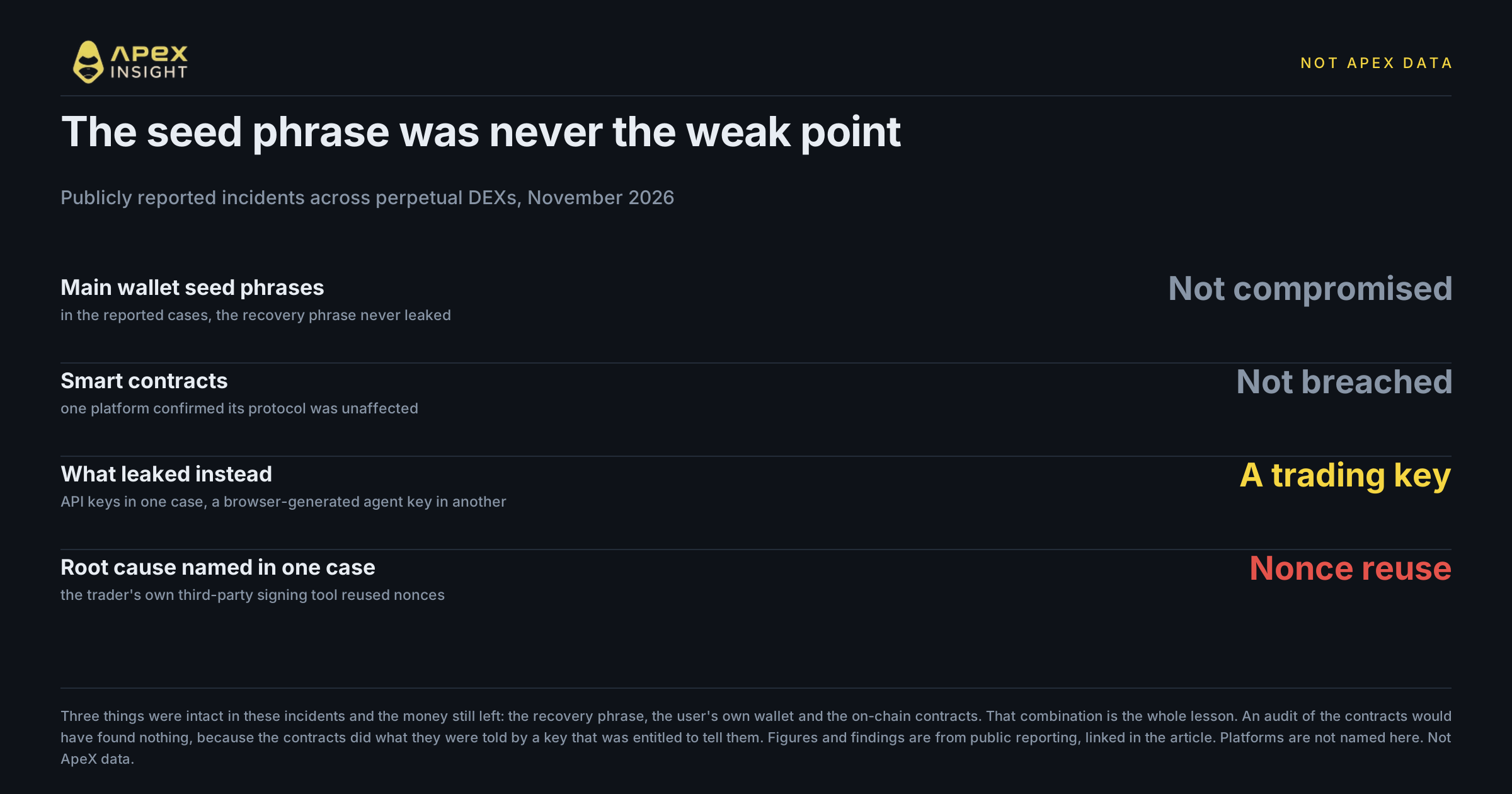
In both reported cases the seed phrases were never compromised and the smart contracts were never breached. In one case the account holder said no transaction was signed and the wallet's private key was not exposed. A contract audit would have found nothing wrong, because the contracts did exactly what a properly authorised key told them to do.
So why are attackers going after trading keys rather than wallets? Because on some platforms a trading key is worth as much as one. If a single credential can place orders and also move funds, stealing it is as good as stealing the wallet, and it is far easier to reach.
This article explains what actually failed, and how ApeX Omni is built so that a single leaked credential does not reach your balance.
The seed phrase was never the weak point
Two incidents from the same fortnight show the pattern.
On 16 November, one perpetual DEX paused withdrawals after a breach linked to a leaked trading API key, stating that its protocol and smart contracts were unaffected. About $10.4 million in USDC left in a single withdrawal, and researchers put the total closer to $15.5 million across two market maker accounts.
Its post-mortem traced the leak to signing software the trader used outside the platform, which reused cryptographic nonces and so let anyone watching the resulting signatures reconstruct the private key. Withdrawals reopened the same day, and its guardian mechanism froze what remained, letting its security council return about $5 million to the affected trader.
That detail is worth sitting with, because it cuts against the easy reading. The platform said its own code was not at fault, it responded within hours, and about half of the sum that left the contract came back. The money still left, because one credential was entitled to move it.
Four days earlier, a user of another platform alleged that an agent key drained their account in 44 minutes, describing 33 bitcoin sold and roughly 4.56 million USDT moved in seven internal transfers. That platform said it had formed an investigation team. The allegation is the user's account of events rather than a confirmed finding.
Set the amounts aside and look at what was true in both. The recovery phrase was safe. The user's own wallet was safe. The on-chain code was safe. The money left anyway.
That is why "our contracts are audited" is an incomplete answer to "are my funds safe". An audit examines whether the contracts do what they are told. It does not examine who is allowed to tell them.
One key should not hold both powers
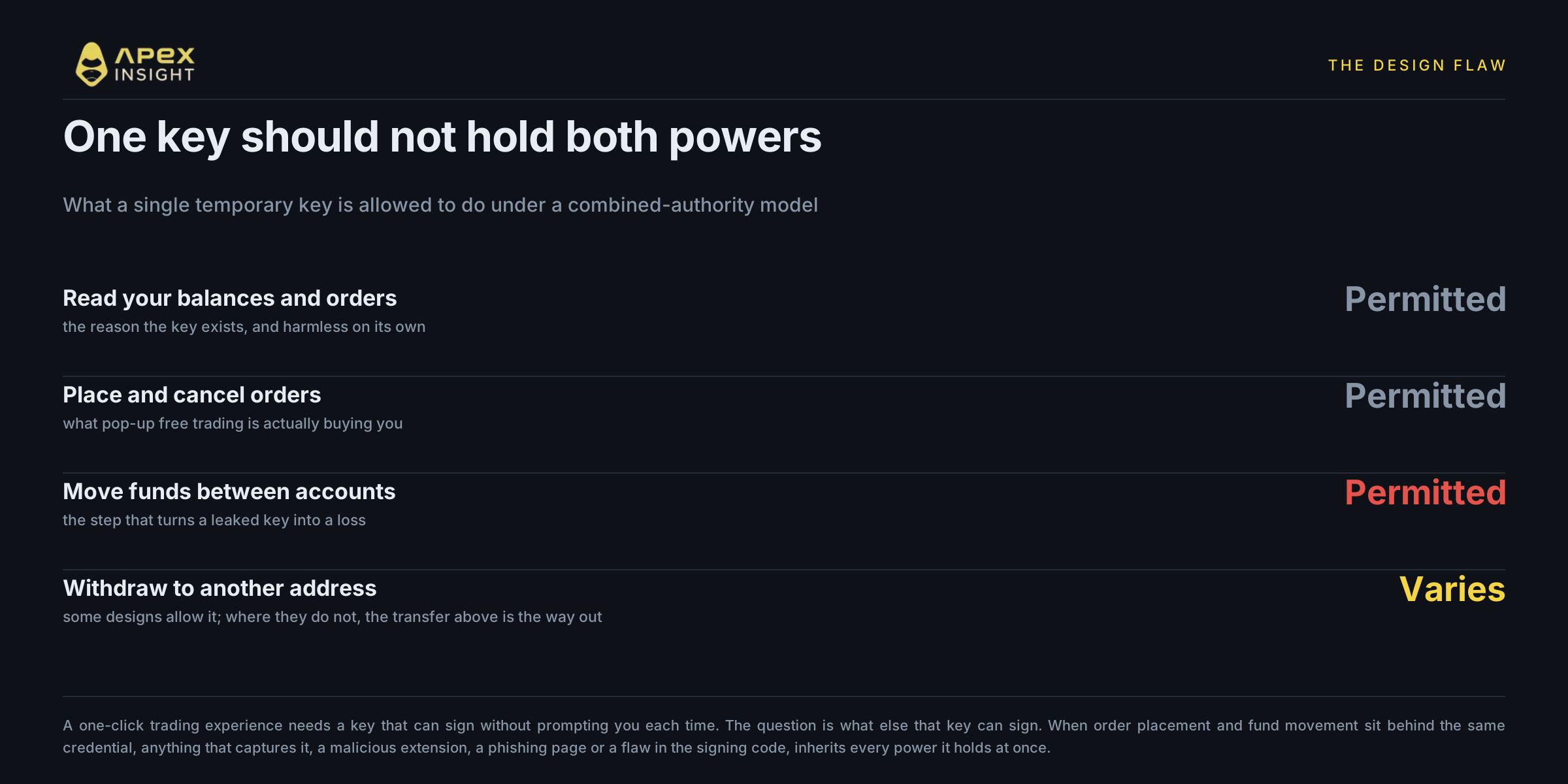
Perpetual trading has a user experience problem. Signing every order in a wallet pop-up is unusable at any speed, so platforms generate a temporary key in the browser that can sign on your behalf without prompting. That part is reasonable, and common across the sector.
The question is what else that key is allowed to sign.
Under a combined-authority model, one credential can read your account, place and cancel orders, move funds between accounts, and in some designs withdraw. Each permission is defensible alone. Together they mean that anything capturing the key inherits every power it holds, all at once. A malicious browser extension, a phishing page, or a flaw in the signing code itself does not need your seed phrase. It already has something that the settlement layer will obey.
The internal transfer is the step that matters most, and it is the one people overlook. A key that cannot withdraw to an external address can still be dangerous if it can move value between accounts, because an attacker who controls a destination account only needs the transfer. That is close to what the post-mortem reporting described in that case: the platform's API keys could not move funds straight from a victim's account to an external wallet, so value was moved internally into a pool the attacker already controlled, and left from there.
ApeX Omni splits access into two key systems
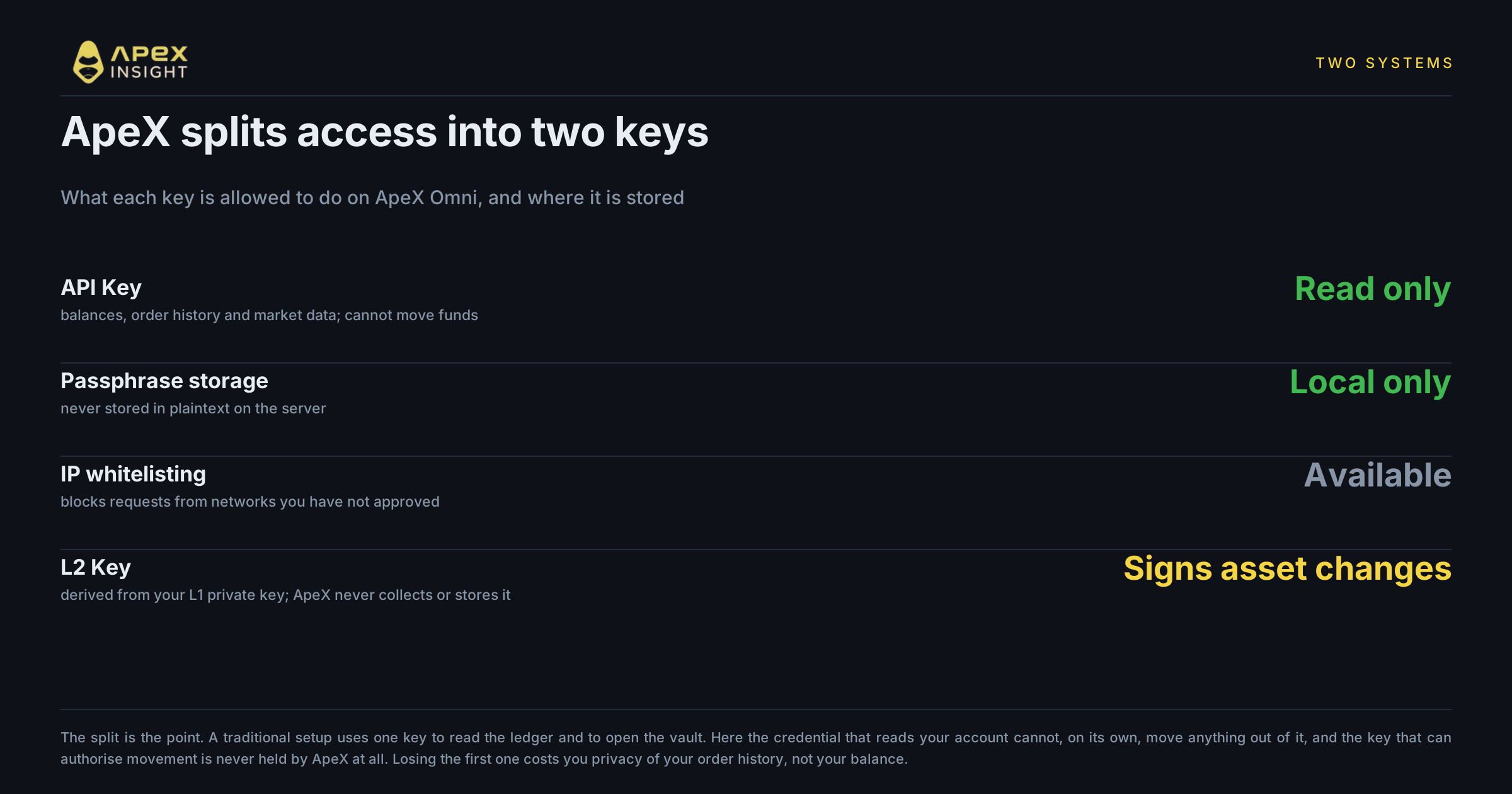
A traditional single-key setup uses the same key to inspect the ledger and to open the vault. ApeX Omni separates those jobs into two independent systems.
The API Key is a read-only inspector. Generated when you connect a wallet and log in, it comprises a Key, a Secret and a custom Passphrase. It is limited to reading: account balances, order history and market data. It cannot initiate a fund movement. The server never stores the Passphrase in plaintext, so credentials live on your own device rather than in a central store that becomes a target. It also supports IP whitelist binding, so once you enable it, requests from networks you have not approved are refused even if the credentials are exposed.
The L2 Key signs changes to asset state. It is an asymmetric key pair derived deterministically from your Ethereum mainnet private key. ApeX neither collects nor stores it. That is what non-custodial means in practice: there is no copy of the signing key on our side to leak, subpoena or mishandle.
The useful consequence is what each loss costs you. If your API Key leaks, an attacker learns what you hold and what you have traded. That is a privacy problem and it is not, by itself, a solvency problem, because the credential cannot move anything on its own.
Moving money needs both signatures
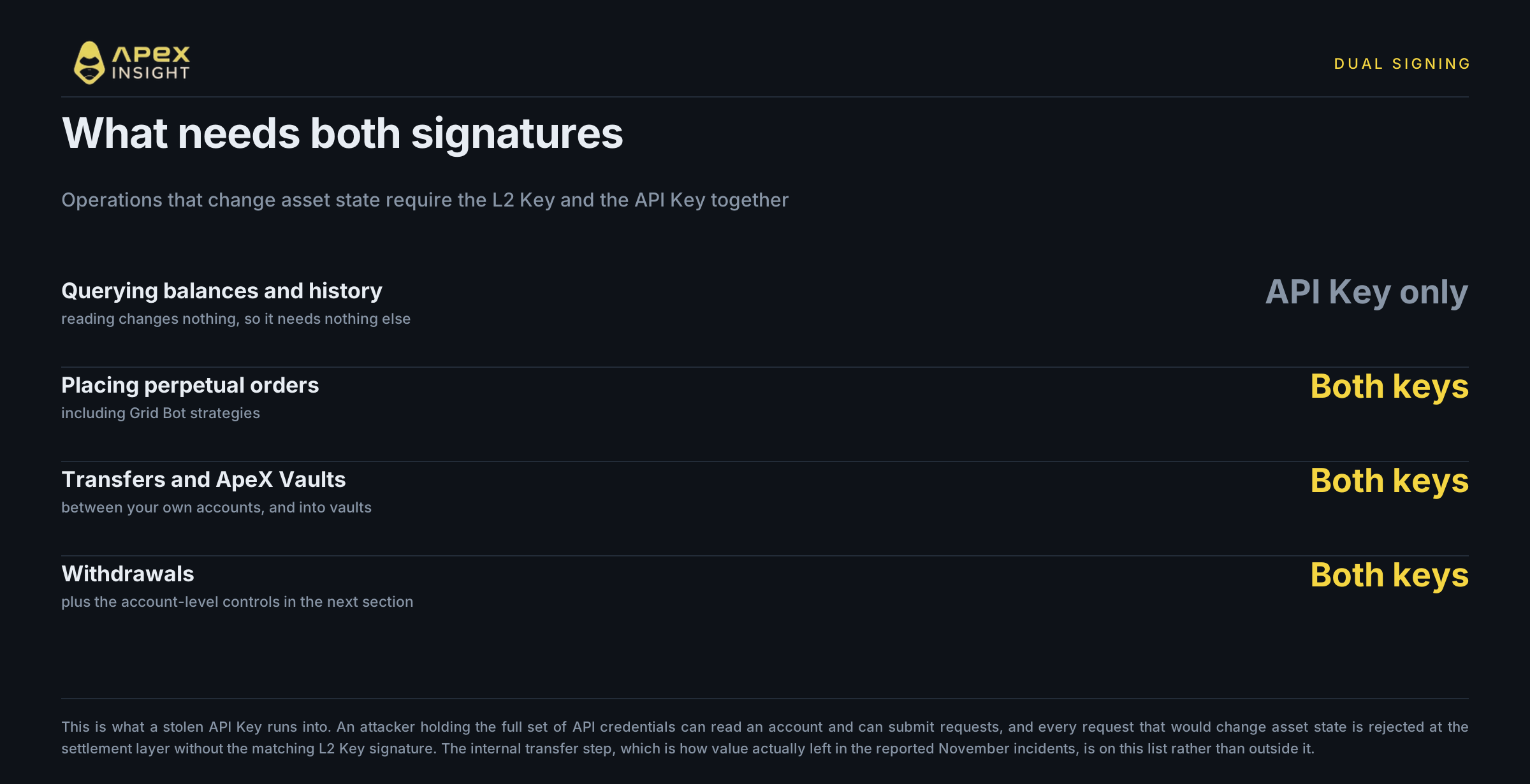
Reading an account requires API Key authentication alone. Any operation that changes asset state requires the L2 Key and the API Key together, enforced by the risk engine rather than by the interface.
Operations on that list include placing perpetual orders and creating Grid Bot strategies, transfers between your own accounts, subscribing to ApeX Vaults, and initiating withdrawals.
Consider the scenario directly. An attacker obtains your complete set of API credentials and tries to drain the account through anomalous trades or transfers. Every state-changing request is rejected at the settlement layer, because the matching L2 Key signature is absent. A compromised API Key, on its own, does not produce a loss.
Note where the internal transfer sits. It is on the dual-signature list, not outside it. The step that carried value out in the reported November incidents is one of the operations this design treats as asset movement rather than as routine account activity.
The fair question at this point is what happens if the L2 Key leaks instead. The answer is that it is a different kind of exposure, because of where that key comes from. It is derived from your Ethereum mainnet private key, which means it is not a credential ApeX issued to you, cannot be reissued by us, and is never transmitted to or held by us. Protecting it is the same problem as protecting the wallet it descends from, which is a problem the industry already understands well. What the split achieves is that the credential we issue you, the one that reads your account, is no longer able to move money on its own. The key that matters most is the one derived from your wallet, not the one we issued you.
Withdrawals carry two more locks
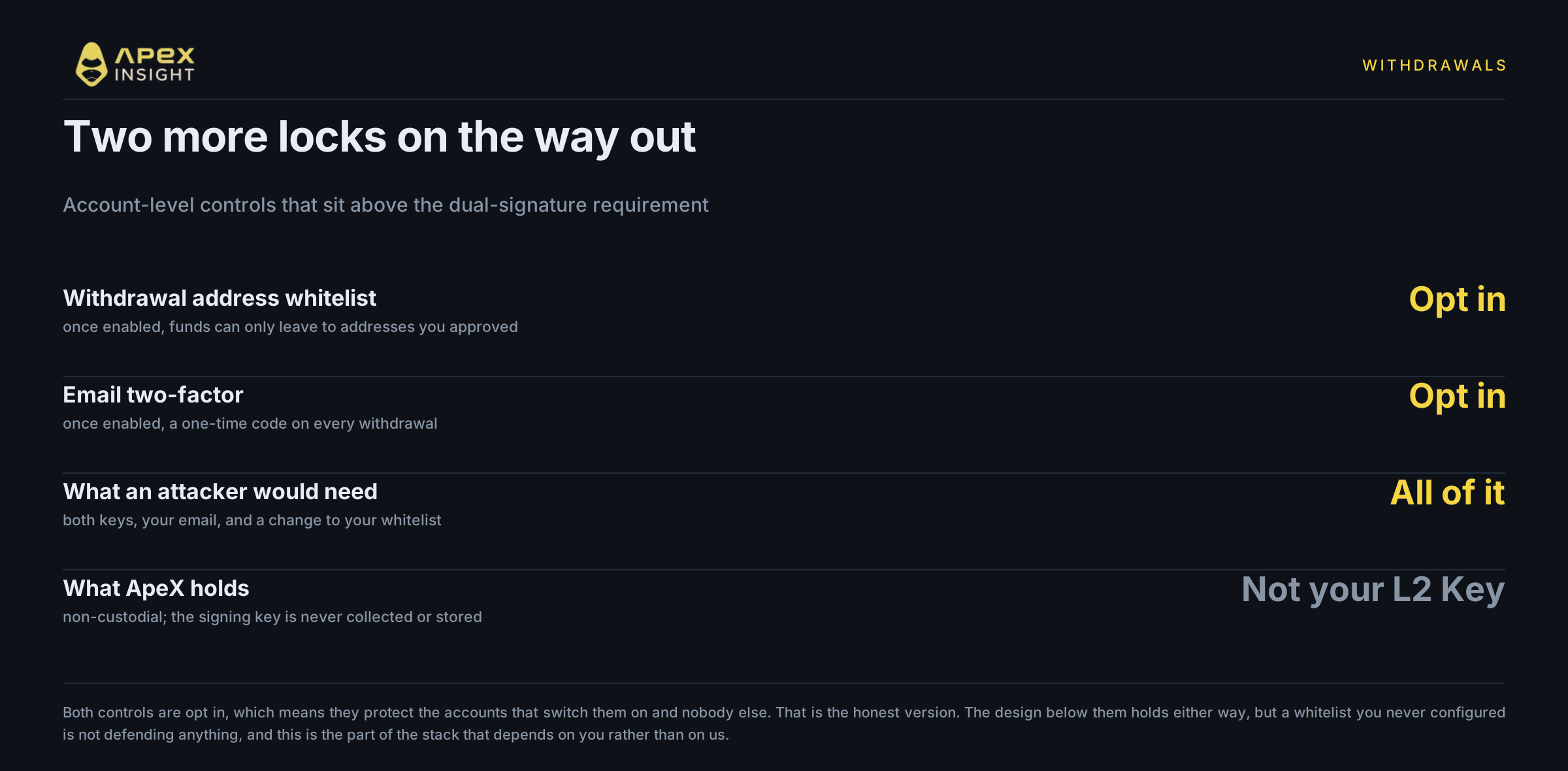
Withdrawal is the last door, so it has controls above the dual-signature requirement.
Withdrawal address whitelisting restricts withdrawals to recipient addresses you approved in advance. An attacker who somehow satisfied everything else still cannot send funds to an address that is not on your list.
Email two-factor authentication requires a one-time code sent to your linked address before a withdrawal is submitted.
Stack those together and an attacker needs the API Key, the L2 Key, access to your personal email, and the ability to change your whitelist. Compromising your local environment is not enough.
One caveat belongs here rather than in the small print: both controls are opt in. They defend the accounts that switch them on, and they do nothing for the accounts that do not. The architecture underneath holds either way, but a whitelist you never configured is not protecting anything.
What this design does not do
A security page that only lists strengths is marketing, so here is the other half.
It does not protect an account whose owner approves a malicious withdrawal. If an attacker persuades you to whitelist their address and you then confirm the email code, every control described above has functioned correctly and the money is still gone. Social engineering sits outside the threat model that key separation addresses.
It does not protect against losing the L1 wallet the L2 Key is derived from. That is the root of the tree, and if it is compromised, nothing further down helps.
It does not make the optional controls automatic. Whitelisting, email 2FA and IP binding default to off.
It does not place ApeX outside its own argument. The risk engine and settlement layer that enforce the dual signature are our infrastructure, and this piece has just argued that the interesting question is never only whether code runs correctly but who is allowed to instruct it. That question applies to us too, and a reader is right to ask it.
And it does not remove market risk, which is the risk most traders actually meet. Liquidation does not care how well your keys are separated.
What the architecture does remove is the specific failure that produced the November losses: a single leaked credential that was entitled, by itself, to move funds.
What to do about it
Four things are worth doing today, and three of them take under a minute.
Turn on the optional controls. Withdrawal address whitelisting, email 2FA and IP whitelisting are the parts of this stack that depend on you. They are off until you enable them.
Store your Passphrase offline. Not in unencrypted cloud storage, not in a messaging app. The server does not hold it in plaintext, which means a copy sitting in a chat thread is the weakest copy in existence.
Keep a clean browser for trading. One of the November incidents ran through a key generated and held in a browser. Unverified extensions can read what the page holds. A dedicated profile, or a dedicated browser, for high-value accounts removes most of that surface.
Treat a leaked API Key as serious but survivable. It is a privacy breach and an instruction to rotate credentials. It is not, by itself, a path to your balance.
Review your security settings
Turn on withdrawal address whitelisting, email 2FA and IP whitelisting.
Trading carries a high risk of loss, and leverage increases both gains and losses. No security design removes risk entirely, and the honest claim here is narrower than a guarantee: separating read access from signing authority, and requiring two independent signatures for any asset movement, removes the single-key failure that produced the November losses. The rest depends on the controls you enable and the environment you trade from. This is not financial advice.
If you need any help, feel free to reach out to our team on Discord.
Website: https://www.apex.exchange
Twitter: https://twitter.com/OfficialApeXdex
Telegram: https://t.me/ApeXdex
Methodology. This article contains no ApeX contract or market data, so no price convention applies to it. The November 2026 incident details are from public reporting and are hyperlinked at each claim; the platforms involved are not named in this article, and one of the two incidents is the affected user's own allegation rather than a confirmed finding, which is stated where it appears. Figures reported inconsistently across sources are given as a range with both figures attributed. The description of ApeX Omni's key architecture, dual-signature enforcement and withdrawal controls comes from ApeX product documentation. Withdrawal address whitelisting, email two-factor authentication and IP whitelist binding are described here as controls a user activates; confirm the current default state of each in your own account settings. Nothing here is financial advice.