



Published 21 November 2026
On Wednesday evening Anthropic priced its initial public offering at $83 a share, above its $70 to $78 range, selling 980 million shares for a deal size of $81.3 billion, of which about $1.9 billion went to selling shareholders rather than the company. That is the largest sum ever raised at pricing, ahead of the $75 billion SpaceX raised in June, though SpaceX's total rose to $85.7 billion after it sold extra shares following its listing.
On Thursday the shares opened at $111.50 and the ApeX contract printed $114.87.
Around midday on Friday the shares traded at $83.05.
That is five cents above the price institutions paid, and it came 27 hours after the opening bell. The whole of the largest listing ever done, given back between one lunchtime and the next. This piece is about what happened in between, what caused it, and what is scheduled from here that can move it again.
The week in five prices
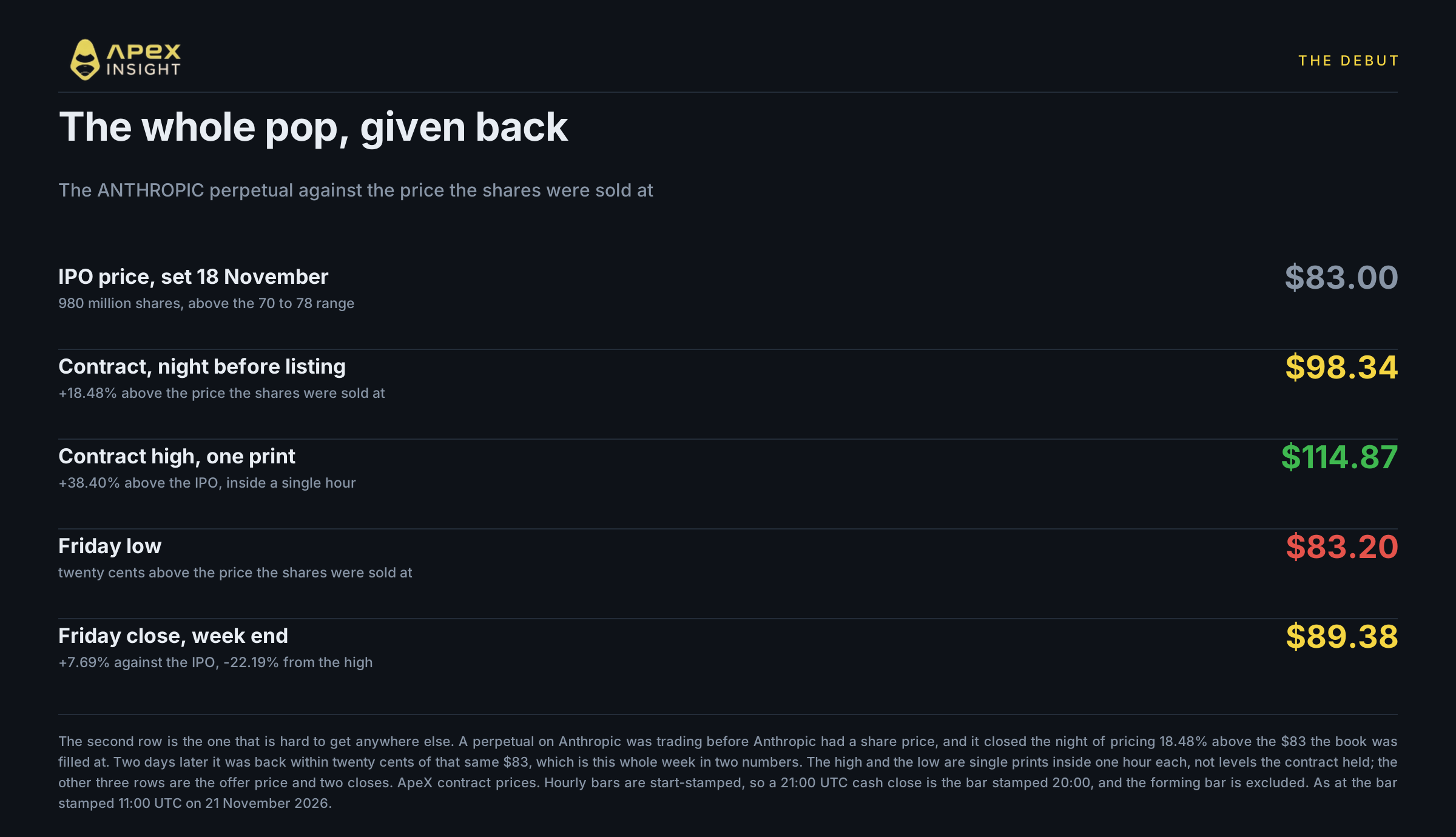
The IPO price was $83.00. The ApeX contract, which was trading before the shares existed, closed the night before listing at $98.34, already 18.48% above the price institutions were paying. Its high was $114.87, 38.40% above the offer, reached and lost inside a single hour. Its low on Friday was $83.20. It closed the week at $89.38.
The shares traced the same path a few cents away. They closed their first session at $97.17, up 17.1%, then fell 8.50% on Friday to close at $88.91, with a low of $83.05 on volume of just over 400 million shares.
So the contract and the share ended the week 47 cents apart, a gap of 0.53%. That is wider than the 23 cents they closed Thursday at. A wider gap is what you would expect on a far more violent day, and it is still close enough that the two can be read as one market.
The round trip is the thing. A buyer of the IPO at $83 is up 7.12%. A buyer of the opening print at $111.50 is down 20.3%. Both bought the same company inside the same twenty-four hours.
Friday, hour by hour
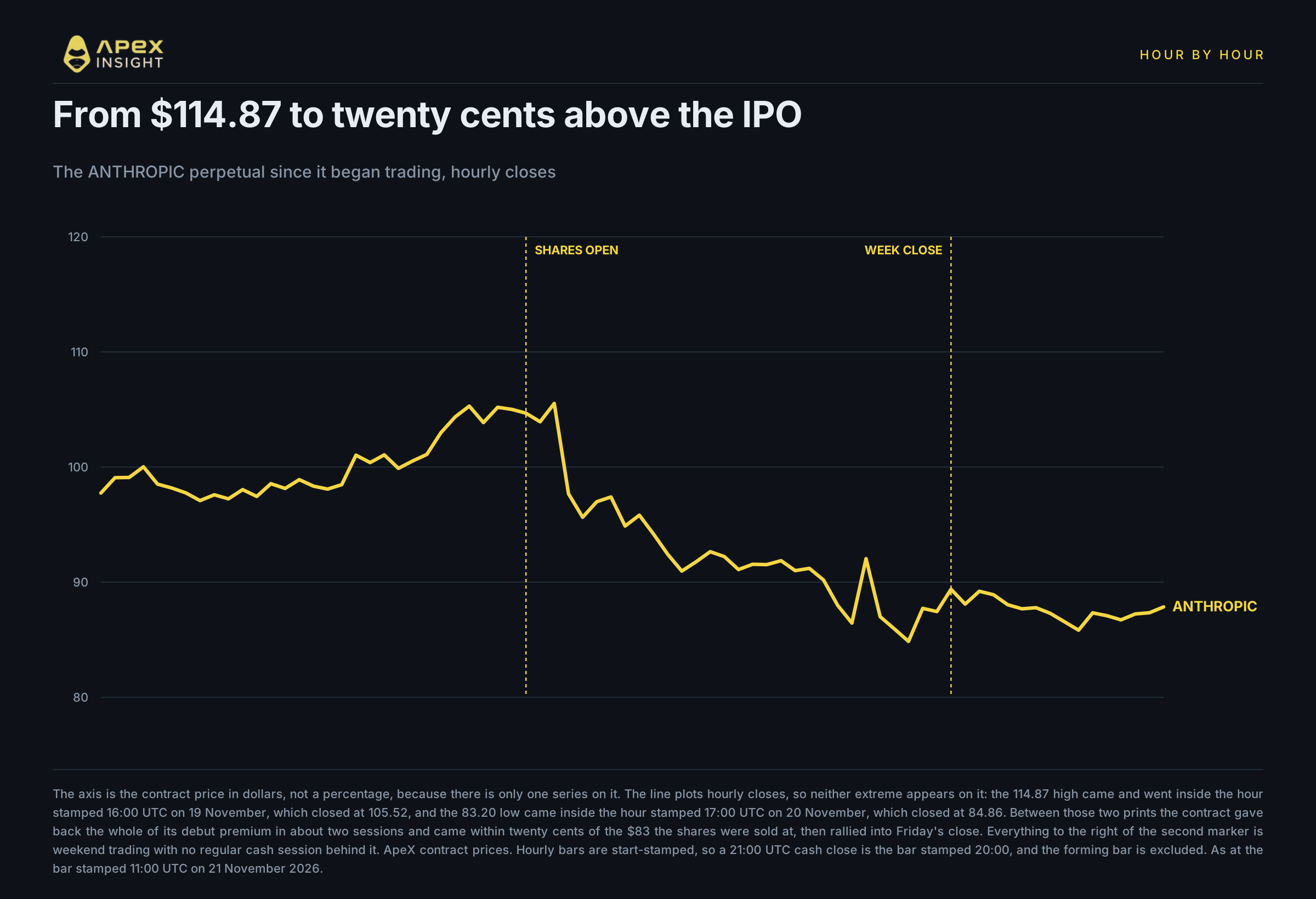
The contract's Friday is worth reading hour by hour, because the daily figures flatten a session that was anything but orderly.
It started the calendar day at $94.43, its high for Friday, and spent the European morning grinding down through $91. It fell to $83.90 in the hour before the US open, rallied above $92 in the first two hours of cash trading, gave that back within two more, and reached its low of $83.20 in the hour stamped 17:00 UTC. From there it rallied again, closing the week at $89.38, which was 7.4% above the low struck four hours earlier.
High to low, that is a range of $11.23 across the calendar day, 13.5% measured off the low, in a contract that was three days old.
The week's two extremes, the $114.87 high on Thursday and this $83.20 low, both sit inside single hours and neither appears on a line of hourly closes, which is why the chart's footnote names them. A reader who takes only the open and the close from Friday learns almost nothing about what it felt like.
What hit Anthropic
Take the Anthropic-specific part first, because the clock matters and most of the coverage ran the two stories the other way round.
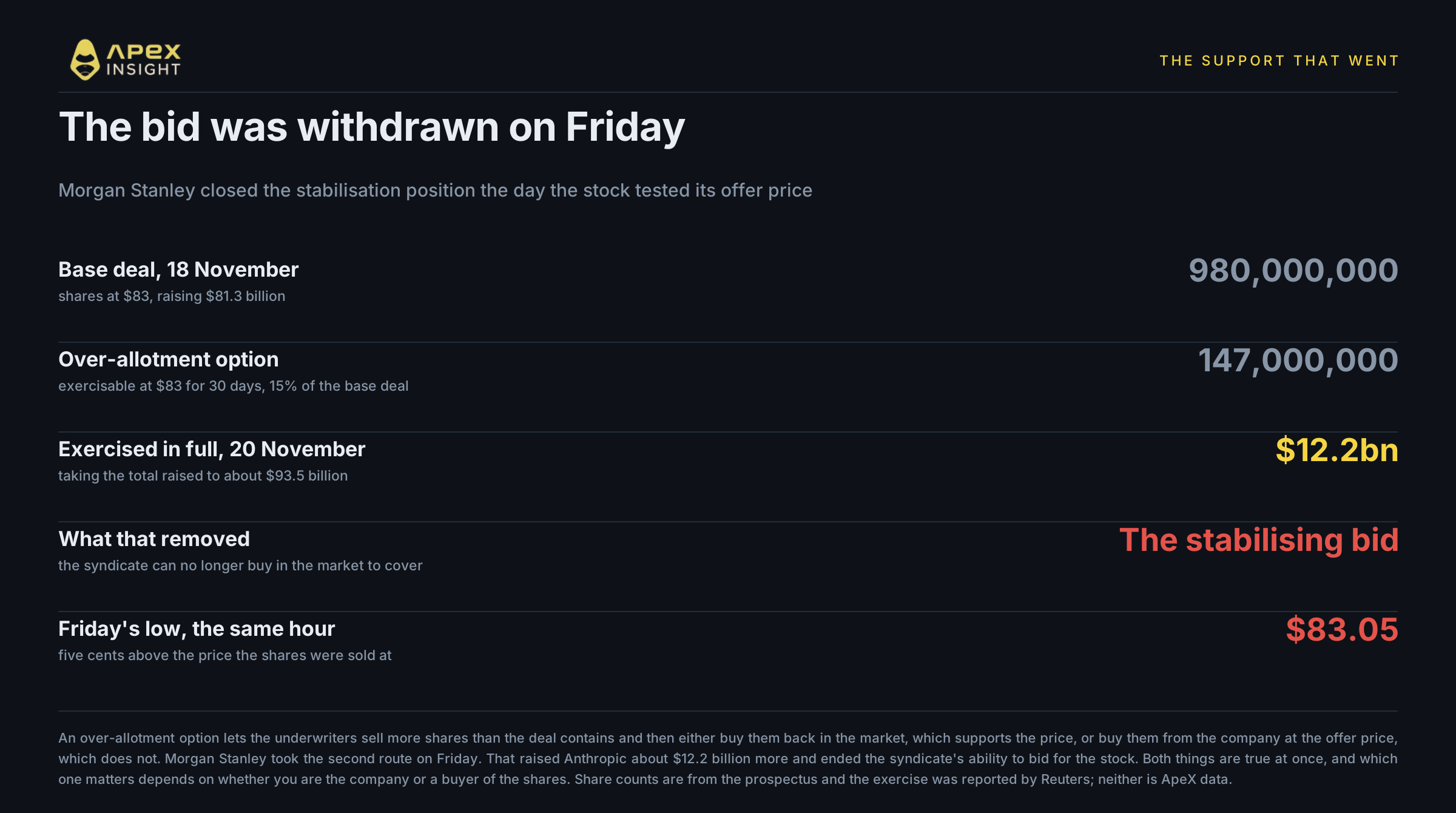
Underwriters on a large IPO sell more shares than the deal contains, leaving themselves short, and hold an over-allotment option to settle it. Here that option covered up to 147,000,000 additional shares at the offer price, exercisable for 30 days. They can close the short one of two ways. They can buy shares in the open market, which puts a real bid under a falling stock. Or they can exercise the option and buy from the company at $83, which puts no bid anywhere.
Morgan Stanley, the stabilisation agent, exercised the option in full, one day after the shares began trading. That took the total raised to roughly $93.5 billion, about $12.2 billion of it from the option. It also ended the syndicate's ability to support the price.
The timing is the part worth your attention, and it is tighter than the coverage implies. Reuters published the exercise at 17:10 UTC, quoting Anthropic at about $86 and noting it had dipped as low as $85. The low of $83.05 came inside that same hour. Carsten Hesse of Berenberg told Reuters the move helps Anthropic by increasing proceeds but hurts investors by removing a source of buying support, noting the bookrunners gave up their remaining stabilisation option after a single day just as the price neared the offer. Reuters reports that market participants questioned the timing. Morgan Stanley declined to comment.
Two things stop this from being a clean causal story, and we would rather say them than have you find them.
The first is that the fall was already well under way before any of it. Our contract traded down to $83.90 in the hour before the US cash market opened, which is hours before the exercise was reported. Whatever took Anthropic to within a dollar of its offer price was in motion before the news that removed its support.
The second is that nobody can measure the counterfactual. Stabilisation volumes are not disclosed, so no one can say whether the low would have held higher with the syndicate still bidding. What can be said is narrower and still worth knowing: the $83 level was tested in the same hour the market learned there was no longer a mechanical bid beneath it, and from here there is neither a stabilising bid nor a syndicate short left to cover.
What hit the complex
The bigger story on Friday arrived later, and it was not about Anthropic at all.
At 19:16 UTC, about two hours after Anthropic's low, Reuters reported that the SEC is scrutinising potential accounting issues at Nvidia, citing two people briefed on the matter. Reuters could not determine what those issues are, and could not determine when the inquiry opened. Nvidia was already down more than 6% before the report published and about 13% shortly after it. It closed at $125.53, down 14.01%, on volume about 262% above its three-month average, having by that publication's reckoning shed roughly $2.5 trillion from its peak.
So the SEC report cannot be what drove Anthropic to five cents above its offer price. It drove the afternoon rout and the closing levels, and it is why the week ended the way it did across the complex. It landed after Anthropic had already bottomed.
The selling was concentrated in the AI theme, though the evidence stops short of proof. On our own contracts, the Nasdaq 100 fell 5.86% on the Friday session while the S&P 500 contract fell 3.50%, a spread of 2.36 percentage points; the cash indices moved similarly, with the Dow down 1.93%, the narrowest fall of the three. Money also moved into government bonds rather than out of all risk: the ten-year Treasury yield fell 12 basis points to 4.92%.
That pattern is what a theme being repriced looks like. It is not conclusive, for a reason worth stating: a 14% day in Nvidia is mechanically amplified in a tech-weighted index and muted in a price-weighted or broad one, whatever the cause, so some of the spread is index construction rather than investor intent. And the selling was not confined. Ten of eleven sectors fell and the Russell 2000, which carries little AI exposure, fell 2.76%.
Hawkish Fed commentary landed the same day: remarks released by Governor Lisa Cook saying the policy rate is not high enough, and the Philadelphia Fed's Anna Paulson saying she is open to back-to-back rises. It would be tidy to add that to the explanation, and it would be wrong. The rate market went the other way: the whole Treasury curve rallied, the two-year fell 13 basis points, and December hike odds came down. The damage came from doubt about the AI trade itself rather than from the discount rate, and Anthropic, a company founded in 2021 and valued above a trillion dollars, sits about as far out on the duration spectrum as a listed equity gets.
Three things made the complex fragile enough for one wire story to do this much damage, and all three predate Friday.
The earnings beat did not answer the question being asked. Nvidia's quarter was enormous, with revenue up 103% year on year, and the stock fell anyway, because the market's doubt is not about whether chips are selling. It is about who is paying for them and with what.
The company itself conceded the financing concern. On Tuesday's call, interim chief executive Colette Kress said Nvidia would be far more selective about AI industry financing deals in future. That is a direct acknowledgement of the circular-financing worry, from the firm at the centre of it, and the balance sheet shows the same thing from another angle: long-term debt has risen to $32.4 billion from $7.5 billion at the start of the fiscal year.
Anthropic is not outside that loop, and its own prospectus says so. Concurrently with the offering, Google, Nvidia, AMD, Broadcom, Micron, Microsoft and TSMC agreed to buy 313,253,007 shares of Class N stock for $26.0 billion at the IPO price. Anthropic's chip and cloud suppliers put $26 billion of equity into the company that buys from them. These are disclosed agreements, and nothing here is an allegation of impropriety. But it is the same pattern the market spent Friday worrying about, and a reader weighing Anthropic against Nvidia's financing questions should know it runs through both.
There is no permanent chief executive at Nvidia. Jensen Huang resigned on 12 November and Kress is running the company on an interim basis while the board searches.
It fell less than every AI name around it
Here is the result that surprised us, and it cuts against the easy reading that a debut which fades was mispriced or thinly demanded.
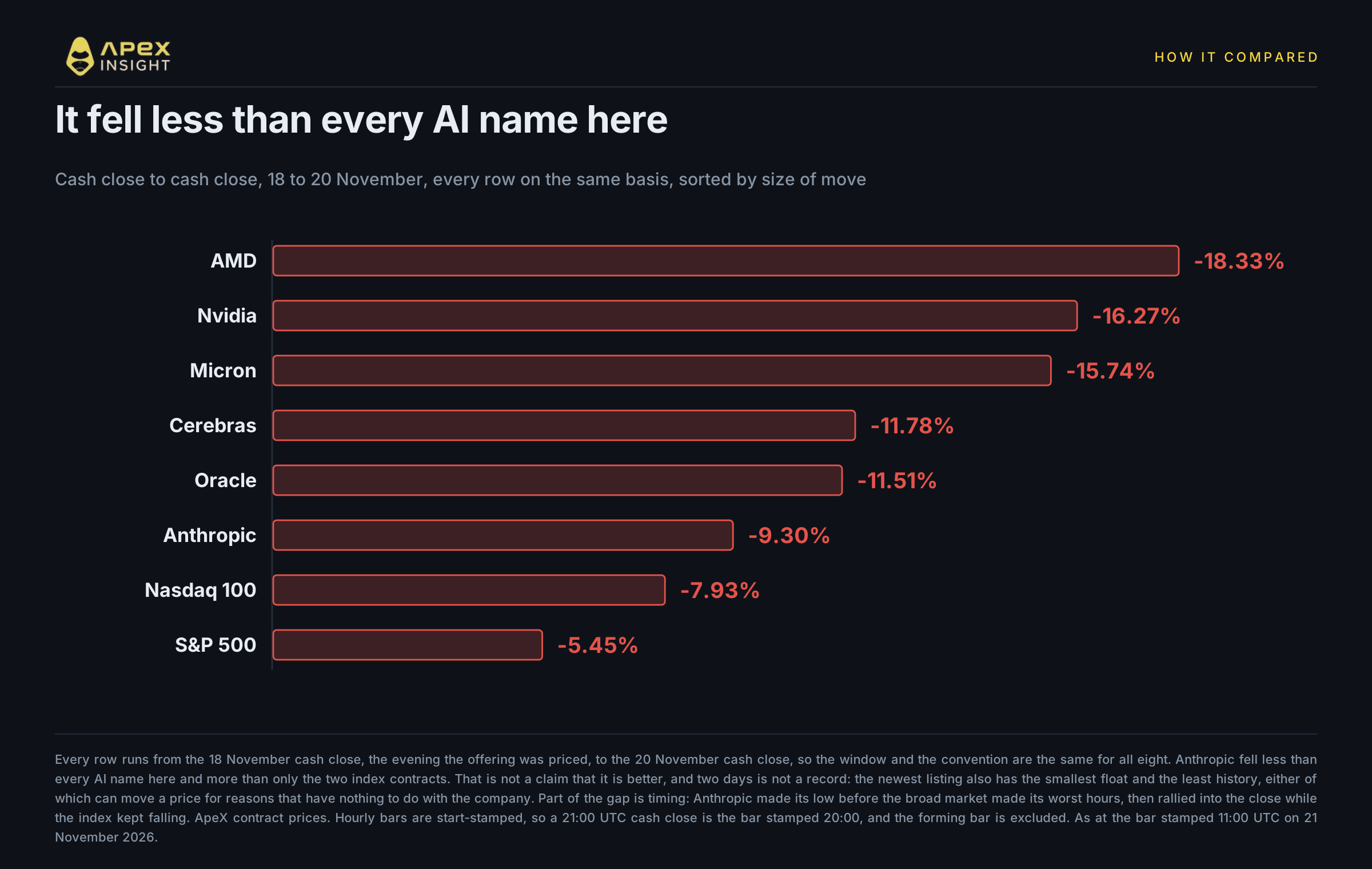
Measured cash close to cash close, from the evening the offering priced to Friday's close, with the same window and the same convention for every row: AMD fell 18.33%, Nvidia 16.27%, Micron 15.74%, Cerebras 11.78%, Oracle 11.51%, Anthropic 9.30%, the Nasdaq 100 contract 7.93% and the S&P 500 contract 5.45%.
Anthropic fell less than every other AI name on the board. The only two rows below it are the index contracts.
That is worth stating carefully, because it is easy to over-read. It does not mean Anthropic is better, safer or more highly regarded. Two sessions is not a record, and there are mechanical reasons a brand-new listing can move differently from a seasoned one: it has the smallest free float of any company in that table, no index funds yet obliged to hold or sell it, and no established body of holders sitting on gains they might want to protect. A thin float cuts both ways and it was cutting the helpful way this week.
Timing explains part of it too. Anthropic made its low about two hours before the SEC story published, and then rallied into the close while the complex kept falling. Some of its outperformance over two days is that rebound rather than steadier holders.
What it does rule out is the reading that Anthropic's debut failed. A stock that gives back its pop while the whole complex is being sold harder than it is has not been rejected by the market. It has been caught in something larger.
What is scheduled next
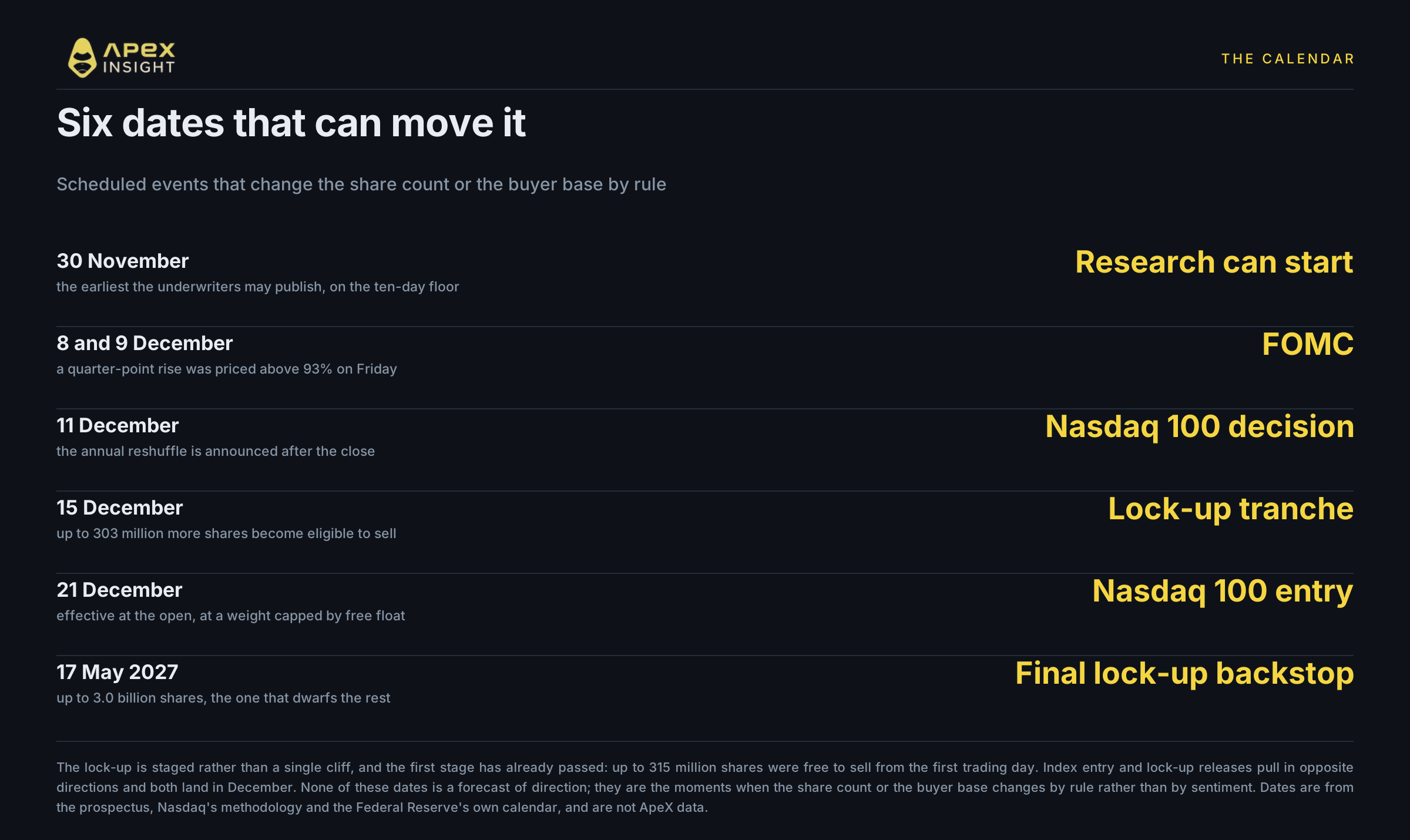
The next six months contain an unusual cluster of events that change the share count or the buyer base by rule rather than by sentiment. They pull in opposite directions.
30 November, the earliest underwriter research. FINRA sets a ten-day minimum quiet period after an IPO, and syndicates often observe longer. With 22 underwriters on this deal, the first wave of sell-side initiations is a December event. Until then the only published views are independent: KGI at Outperform with a $100 target and New Street at Buy with $105, and Seaport Research, which initiated at Neutral with no price target on Thursday, citing revenue growth that slowed sharply in the third quarter.
8 and 9 December, the FOMC. A quarter-point rise was priced at 93.6% on Friday by one futures-based monitor, down from 99.6% the day before. Friday's selloff trimmed the odds without changing the call. The meeting also carries a new dot plot, the first since the cycle's opening hike in September, which matters more to a long-duration asset than the 25 basis points itself.
15 December, the next lock-up tranche. This is the one to watch, and the standard assumption about it is wrong. Anthropic's lock-up is staged, not a single 180-day cliff, and the first stage has already passed: up to 315 million shares held by non-founder directors, officers, employees and consultants were free to sell from the first trading day. Up to 303 million more become eligible on 15 December, with further tranches on 5 January, 19 January and 2 February 2027. Then come the two that dwarf those: up to 1.7 billion shares two trading days after Anthropic releases its 2026 annual results, with five further tranches of up to 480 million each in the weeks after, and up to 3.0 billion at the earlier of two trading days after first-quarter 2027 results or 17 May 2027. That last date is a backstop, not a schedule: if Anthropic reports in late April the 3.0 billion unlocks sooner.
21 December, index entry. Anthropic is expected to enter the Nasdaq 100 at the open on Monday 21 December, announced with the annual reshuffle after the close on 11 December. Its weight will be capped, because Nasdaq counts at most three times a company's freely tradable shares, so the index demand will be far smaller than a $1.2 trillion market capitalisation suggests. The S&P 500 is not in play: it requires twelve months of trading and positive earnings, and Anthropic reported a net loss of $104.0 billion for the nine months to 30 September. That figure needs its context: almost all of it is non-cash fair-value remeasurement on convertible notes and similar instruments that converted at listing. The operating loss over the same nine months was $1.26 billion on revenue of $33.2 billion. The accounting loss is nonetheless what an index committee reads.
So December delivers lock-up supply on the 15th and index buying on the 21st, six days apart. We cannot tell you which is bigger in dollar terms: the cap rule is public, but the weight it produces is not public until the reshuffle is announced on the 11th.
What to watch, and what it hinges on
The $83 line, now that nothing is holding it. The contract's cushion over the offer price is down to 5.84% as at the bar stamped 11:00 UTC on 21 November. That cushion is the whole of what IPO buyers have, it was 38.40% on Thursday morning, and the mechanical support that existed on the way down is gone.
Nvidia, not Anthropic. On this week's evidence Anthropic trades as a high-duration AI asset rather than a single-name story. The SEC inquiry has no stated scope and no timeline, and Reuters was explicit that it could not determine the focus, so it is an overhang of unknown size rather than a quantifiable risk. If the complex stabilises, this stock likely does too, and the reverse.
Whether anyone sold into the first tranche. Only partly observable, and not yet. Rank-and-file employee sales generate no filing at all. But the same day-one tranche expressly covers non-founder directors and officers, the chief financial officer and chief accounting officer among them, and those people must file a Form 4 within two business days of a trade. None has appeared as at 21 November, which tells you nothing yet: a Thursday sale is not reportable until Monday 23 November and a Friday sale until Tuesday 24 November. Monday is the first day the question can begin to be answered.
The multiple you choose. New Street's Pierre Ferragu put Anthropic at about 8.5 times next year's sales at a $1.5 trillion fully diluted valuation, comparable to Microsoft and Alphabet rather than to higher-multiple software names. On run-rate revenue of about $81 billion against a market capitalisation near $1.18 trillion at Friday's close, the number is roughly 14.6 times. Both are defensible, and the gap between them is a single assumption: Ferragu's 8.5 times on $1.5 trillion implies next-year sales of about $176 billion, more than double the current run rate. That number is the whole disagreement. Note which one a bull case is leaning on. Note too that run-rate revenue is a company-defined measure, taken as at 31 October, which the prospectus itself warns is not a substitute for revenue and whose growth rate it expects to decline.
One more, because we publish on a Saturday and it is relevant to how you read everything above. The regular Nasdaq session does not reopen until 14:30 UTC on Monday, about sixty-five hours after Friday's close, and the shares are quotable in extended hours for about nine of those. The ANTHROPIC perpetual does not stop at all, and it has traded through the weekend to $87.85, about 1.71% below Friday's close. For most of that stretch it is a price with no cash session behind it, formed in a thinner book than the one that set Friday's close, and it should be read with that in mind rather than as a verdict on Monday.
Trade the move on ApeX
The ANTHROPIC perpetual, up to 20x, trading 24/7 including both weekend days.
Trading carries a high risk of loss, and leverage increases both gains and losses. A contract with four days of history, on a company with two completed sessions of public trading, in the middle of a sector drawdown with an open regulatory inquiry at its centre, is an unusually thin basis for confidence in either direction. This is not financial advice and none of it is a recommendation to buy or sell anything. Do your own research and size positions you can afford to lose.
If you need any help, feel free to reach out to our team on Discord.
Website: https://www.apex.exchange
Twitter: https://twitter.com/OfficialApeXdex
Telegram: https://t.me/ApeXdex
Methodology. Contract figures are from the ApeX Omni v3 API, built on 21 November 2026. All ApeX figures are the ANTHROPIC perpetual, a separate instrument from the Nasdaq-listed share, quoted in USDT; the share is quoted in USD. The two currencies typically differ by a few hundredths of a percent, which is one to four cents on an $83 price, so a contract-against-share comparison is good to a few cents rather than to one. The contract's $83.20 low is above the $83.00 offer by several times that deviation, and the $83.05 share low is a like-for-like USD comparison with no currency gap at all. Hourly bars are start-stamped, so a 21:00 UTC cash close is taken from the bar stamped 20:00, and the forming bar is always excluded. The hourly chart plots closes, so neither the 114.87 high nor the 83.20 low appears on the line; each is named in the chart's own footnote with the close of the bar containing it. The peer comparison runs from the 18 November cash close to the 20 November cash close, the same window and the same convention for all eight rows, Anthropic included; Anthropic's own 18 November cash close is 98.55, which is a different number from its 98.34 calendar-day close, and the cash figure is the one used wherever it is set against another contract. The contract's recorded history begins on 18 November 2026, so every ApeX figure here rests on four days. Share prices, index levels, the IPO terms, the over-allotment exercise, analyst ratings, lock-up dates, index-inclusion rules, Fed pricing and valuation multiples are not ApeX data and are hyperlinked at each claim. Figures are as at the bar stamped 11:00 UTC on 21 November 2026 unless a different moment is named. Nothing here is financial advice.