




On August 11 we published a guide to the 2026 midterms board. The headline finding was that the House was close to settled and the Senate was a coin flip leaning Republican. Democrats to control the Senate priced at 46.5%. Republicans were the favourite, and the article spent a long section explaining why five individual Democratic leads did not add up to a likely majority.
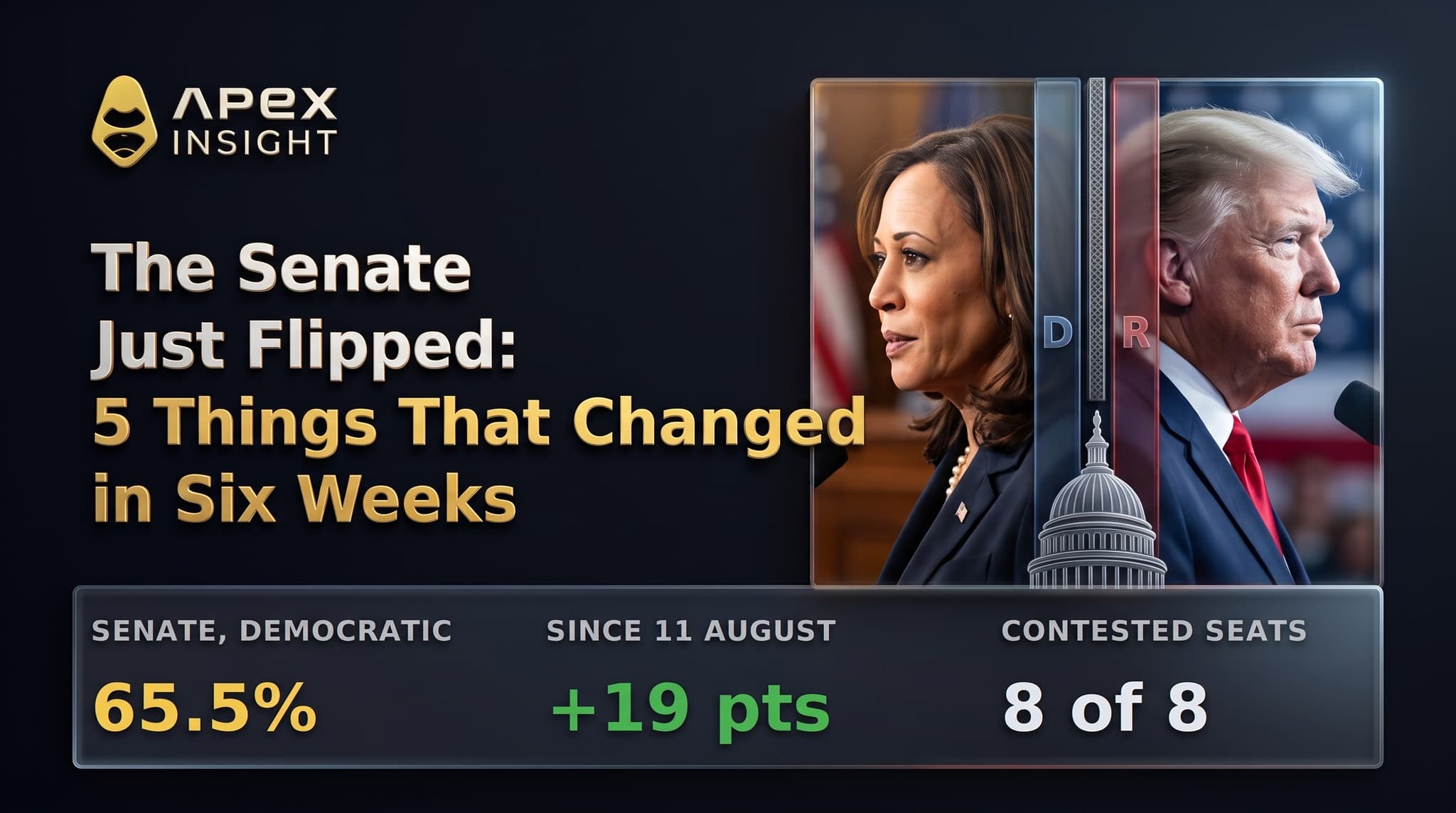
Six weeks later that number is 65.5%.
The Senate has not just moved. It has crossed over, and nineteen points of movement in six weeks is one of the largest repricings this board has produced in its fourteen-month history. Seven of those points arrived in the last seven days alone.
Here are the five things that changed, and what the money is actually saying now.
1. The crossover came the day after we published, then nothing happened for five weeks
This is the part that is easy to get wrong, so it is worth walking through the actual sequence.
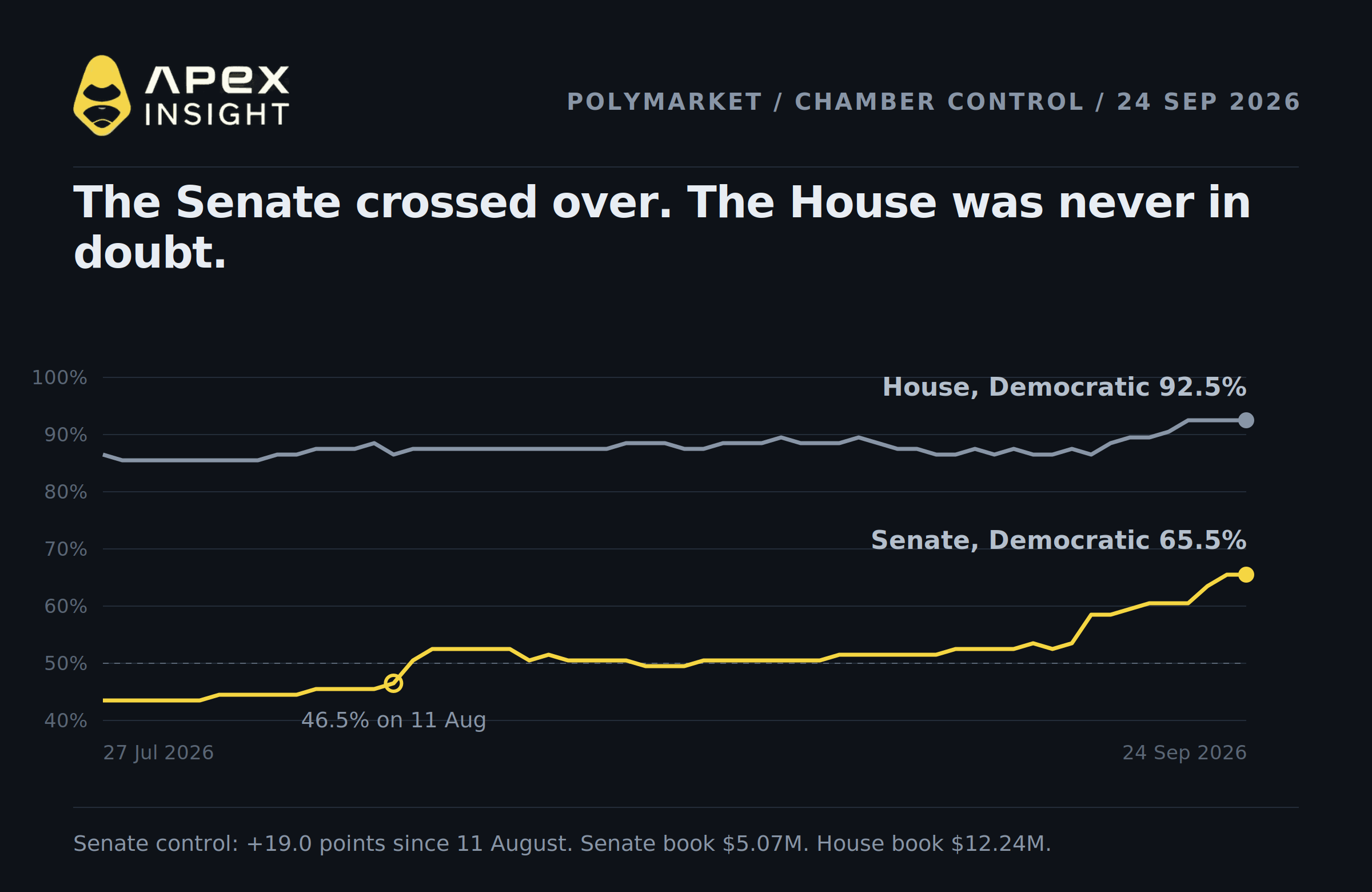
The Democratic Senate control contract traded at 45.5% on August 8 and printed 46.5% on August 11, the day our midterms guide went out. It crossed 50% the very next session, on August 12, at 50.5%.
And then it stalled. For the next five weeks it traded in a narrow band between 49.5% and 53.5%, slipping back under the line once, for three days in late August. On September 15 it was still only 53.5%, which is to say barely distinguishable from the coin flip it had been a month earlier. Anyone watching in that window would have reasonably concluded the August crossover was noise.
September 16 is when it broke out. The contract opened at 58.5%, a five point jump in a single session, and from there it went 59.5%, 60.5%, a three day pause across the weekend, 63.5% on September 22 and 65.5% on September 23. It touched 66.5% intraday today before settling back.
So the crossover and the conviction arrived five weeks apart. That distinction matters, because a price sitting just above 50% and a price sitting at 65.5% are not the same statement even though both describe a favourite.
The book carries $5.07 million in total volume with roughly $47,000 traded in the last 24 hours, and the Democratic leg alone holds $3.04 million of that. This is not a thin market drifting on nothing. On the midterms board only Balance of Power, House control and the California governor's race carry more.
The mirror image is the Republican leg at 34.5%, down six points in a week on $2.04 million.
2. Every competitive seat moved the same way, in the same week
This is the part that matters most, and it is the reason the control number moved so much further than any individual race did.
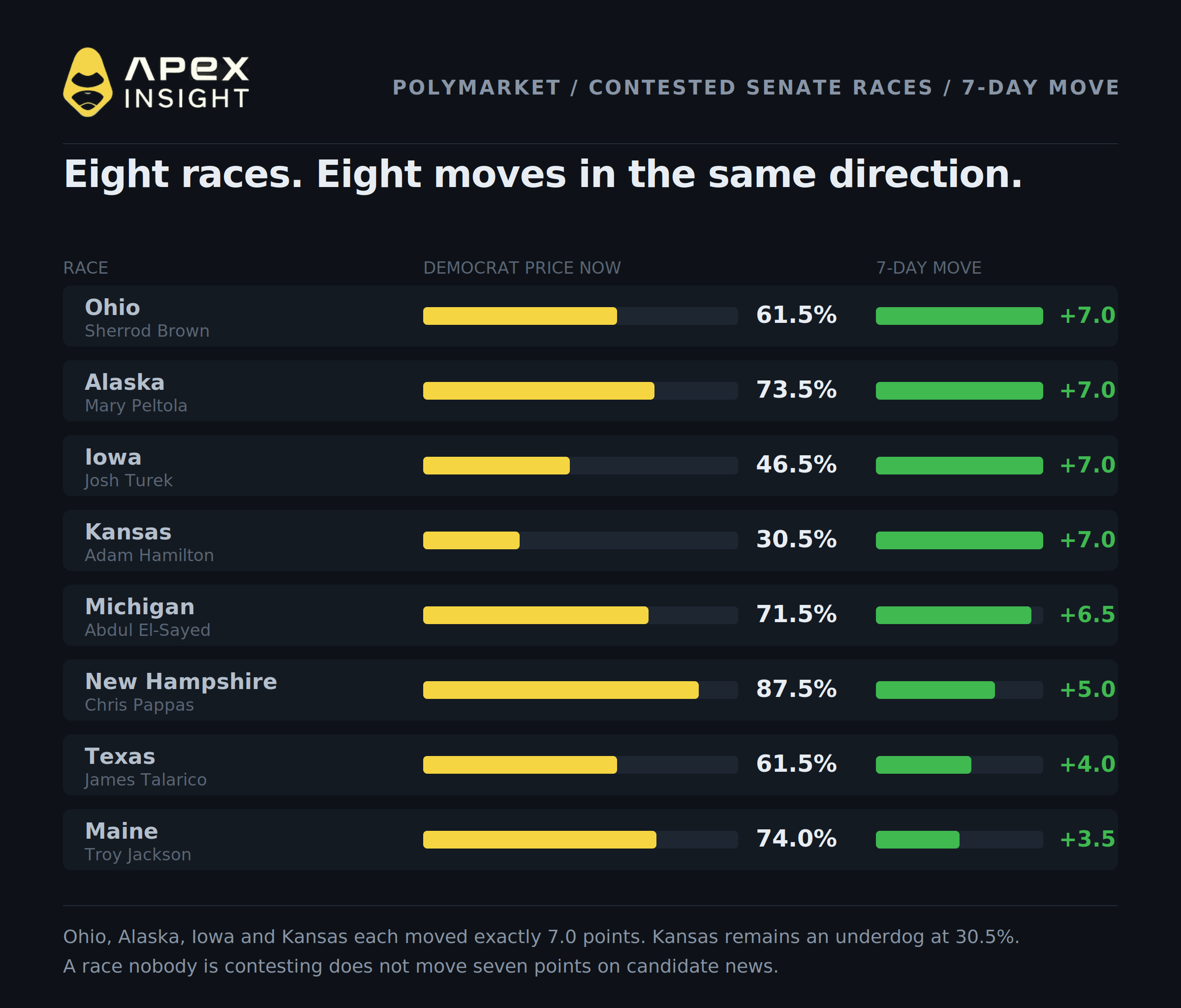
Across eight contested Senate races, not one moved against the trend in the past seven days:
Race | Democrat | Now | 7-day move |
|---|---|---|---|
Ohio | Sherrod Brown | 61.5% | +7.0 |
Alaska | Mary Peltola | 73.5% | +7.0 |
Iowa | Josh Turek | 46.5% | +7.0 |
Kansas | Adam Hamilton | 30.5% | +7.0 |
Michigan | Abdul El-Sayed | 71.5% | +6.5 |
New Hampshire | Chris Pappas | 87.5% | +5.0 |
Texas | James Talarico | 61.5% | +4.0 |
Maine | Troy Jackson | 74.0% | +3.5 |
Eight races. Eight moves in the same direction. Ohio, Alaska, Iowa and Kansas all moved exactly seven points.
Two of these need a caveat before you read the numbers. Alaska is not a two way race: it is a ranked choice contest in which four candidates advanced from the open primary, including a no-party candidate named Daniel J. Sullivan Jr., who is not the incumbent Dan Sullivan but shares his name on the ballot. Peltola's 73.5% is a price on the final round of that count, not on a head to head. And in Maine, Troy Jackson is a replacement nominee, selected at a July convention after the primary winner withdrew from the race; Maine also counts its general election by ranked choice. Neither caveat changes the direction of this week's move, but both change what the level means.
Our August article warned about correlated error, the tendency of polling to miss in the same direction across many states at once rather than independently. That was framed as a risk. This week it showed up as the engine.
When races move independently, a four point gain in one seat barely touches the control number, because it has to be multiplied against everything else staying still. When every race moves together, the joint probability compounds instead of cancelling. That is why eight races moving between 3.5 and 7 points in a single week produced a seven point move in control over the same week, and why the six week move is nineteen. The individual numbers look modest. Stacked, they are not.
Kansas is the clearest tell. Adam Hamilton is still an underdog at 30.5%. Nobody expects him to win. But he gained the same seven points as Sherrod Brown did in Ohio, and a race the market gives him less than a one in three chance of winning does not move seven points on candidate news. It moves on the national environment.
3. The Republican seat ladder is collapsing from the top
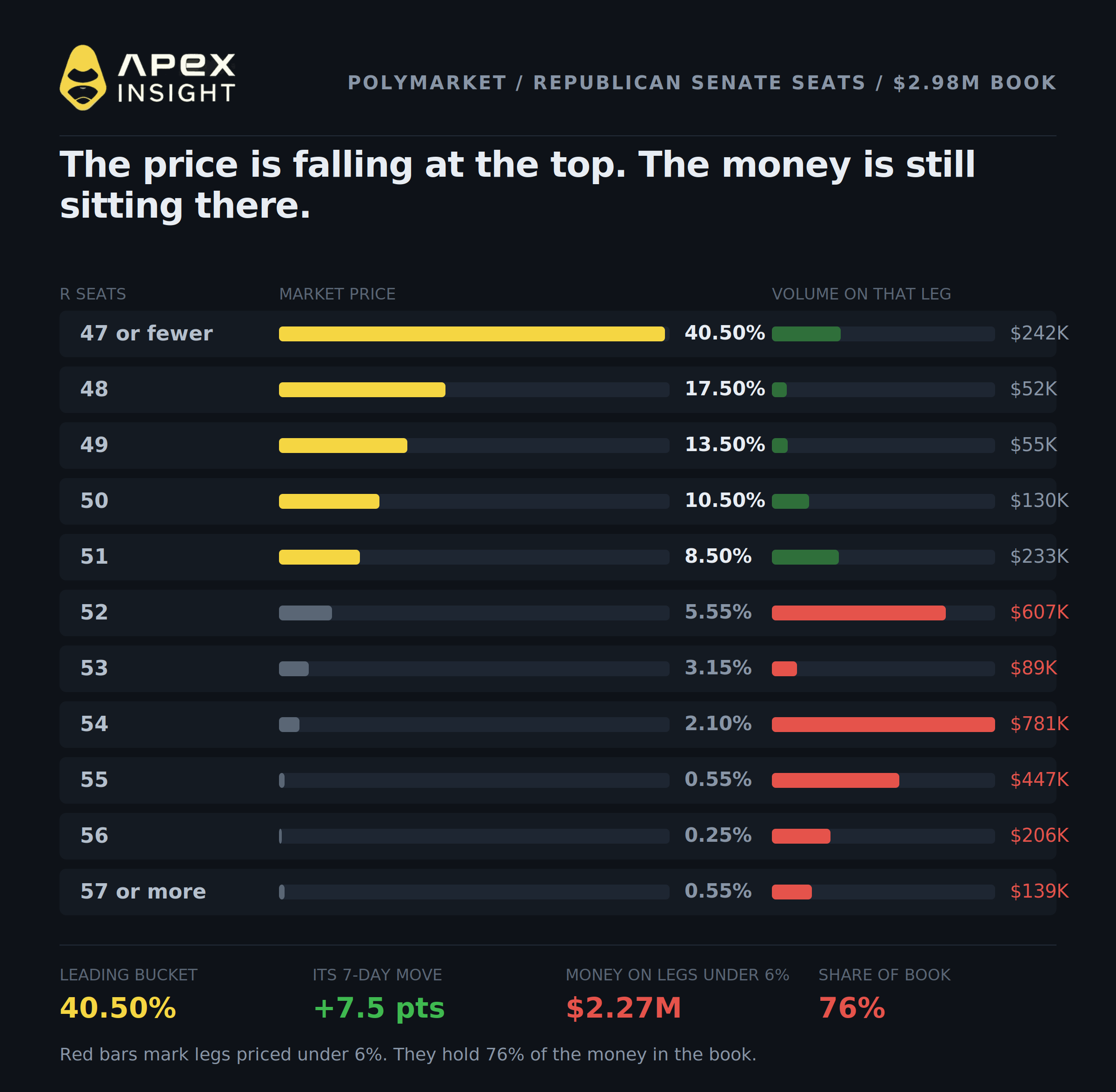
The market for how many Senate seats Republicans hold after November is where the structure becomes visible, and it carries $2.98 million.
The leading bucket is 47 seats or fewer, at 40.5%, up 7.5 points in a week. Below it: 48 seats at 17.5%, 49 at 13.5%, 50 at 10.5%, 51 at 8.5%.
Everything above 51 is being drained. 52 seats sits at 5.55%, down 1.15 points. 53 at 3.15%. 54 at 2.10%. 55 at 0.55%. 56 at 0.25%. A final bucket covers 57 or more, at 0.55%.
Now look at where the money is.
The 54 seat bucket carries $781,274, the largest position in the entire book, priced at 2.10%. The 52 bucket carries $607,300 at 5.55%. The 55 bucket carries $446,985 at 0.55%. The 56 bucket carries $206,149 at 0.25%. The 57-or-more bucket carries $139,462 and the 53 bucket $88,704.
Those six buckets are every leg priced under 6%. Together they hold $2,269,874, which is 76% of the book's $2.98 million, on outcomes the same market now prices at a combined 12.15%.
That is the pattern we keep finding across these books, and it is worth internalising. Heavy volume on a cheap leg is not conviction. It is a record of a thesis that used to be popular. Somebody bought 54 Republican seats when that looked plausible, and the position is still sitting there, marked down to two cents, waiting for November. The 47-or-fewer bucket that is actually winning carries only $241,751, less than a third of the dead position above it.
Read the price for what the market thinks. Read the volume for what it used to think.
One more thing in this book is worth flagging, because it is the kind of gap a careful reader can act on. Democratic control requires Republicans to finish at 49 seats or fewer, since a 50-50 chamber is broken by a Republican vice president. Add the three buckets that satisfy that condition, 47-or-fewer at 40.5%, 48 at 17.5% and 49 at 13.5%, and you get 71.5%. The Senate control contract prices the same event at 65.5%.
Some of that is spread. The eleven buckets in this ladder sum to 102.65% rather than 100%, which is normal for a market with a bid and an ask. Normalise for it and the ladder still implies about 69.7%. That leaves roughly four points between two books on the same platform describing an identical outcome. Either the seat ladder is running ahead of the headline contract or the headline contract is lagging. When two markets on the same event disagree by four points, the disagreement is worth more of your attention than either number on its own.
4. The House stopped being the interesting question
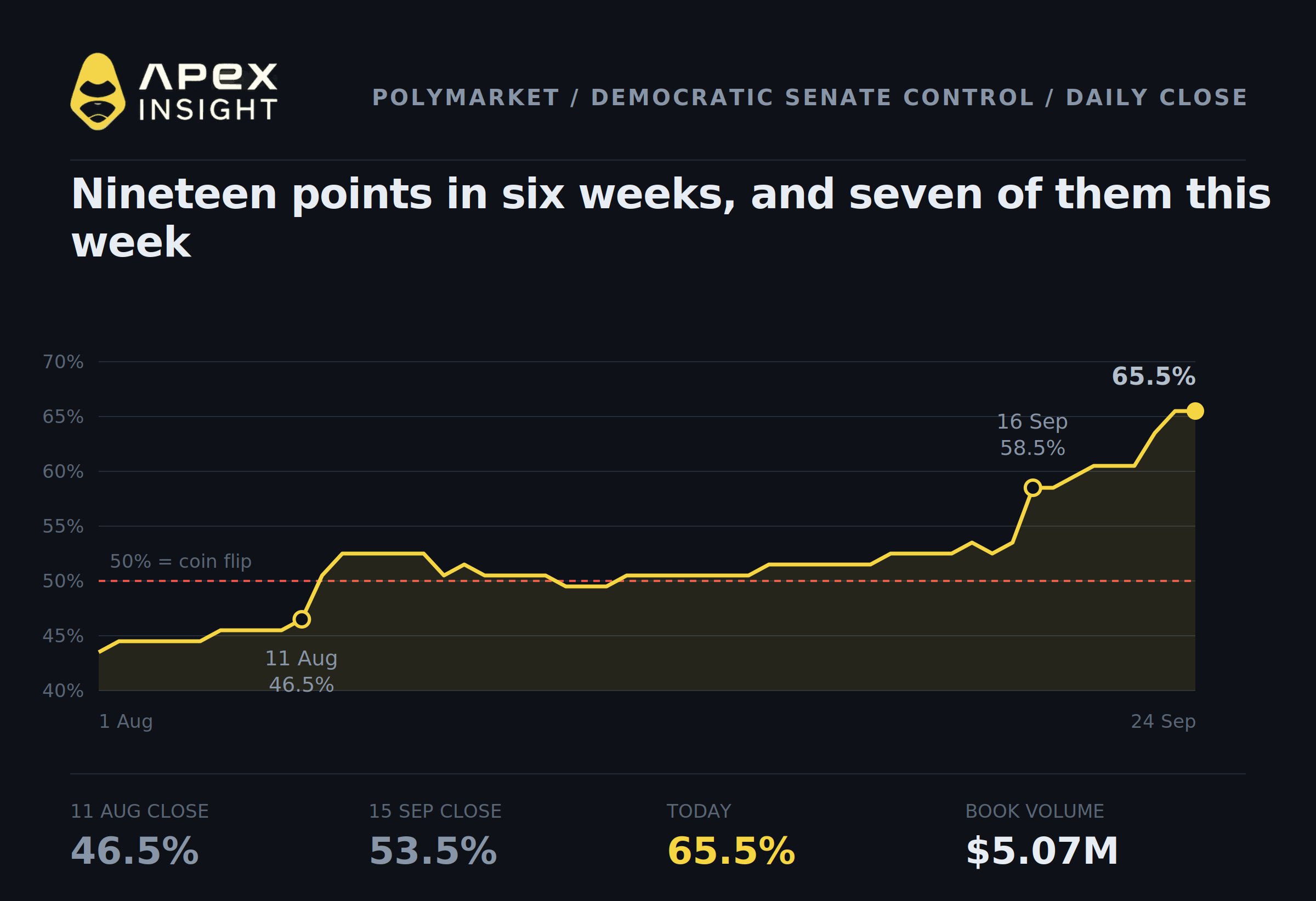
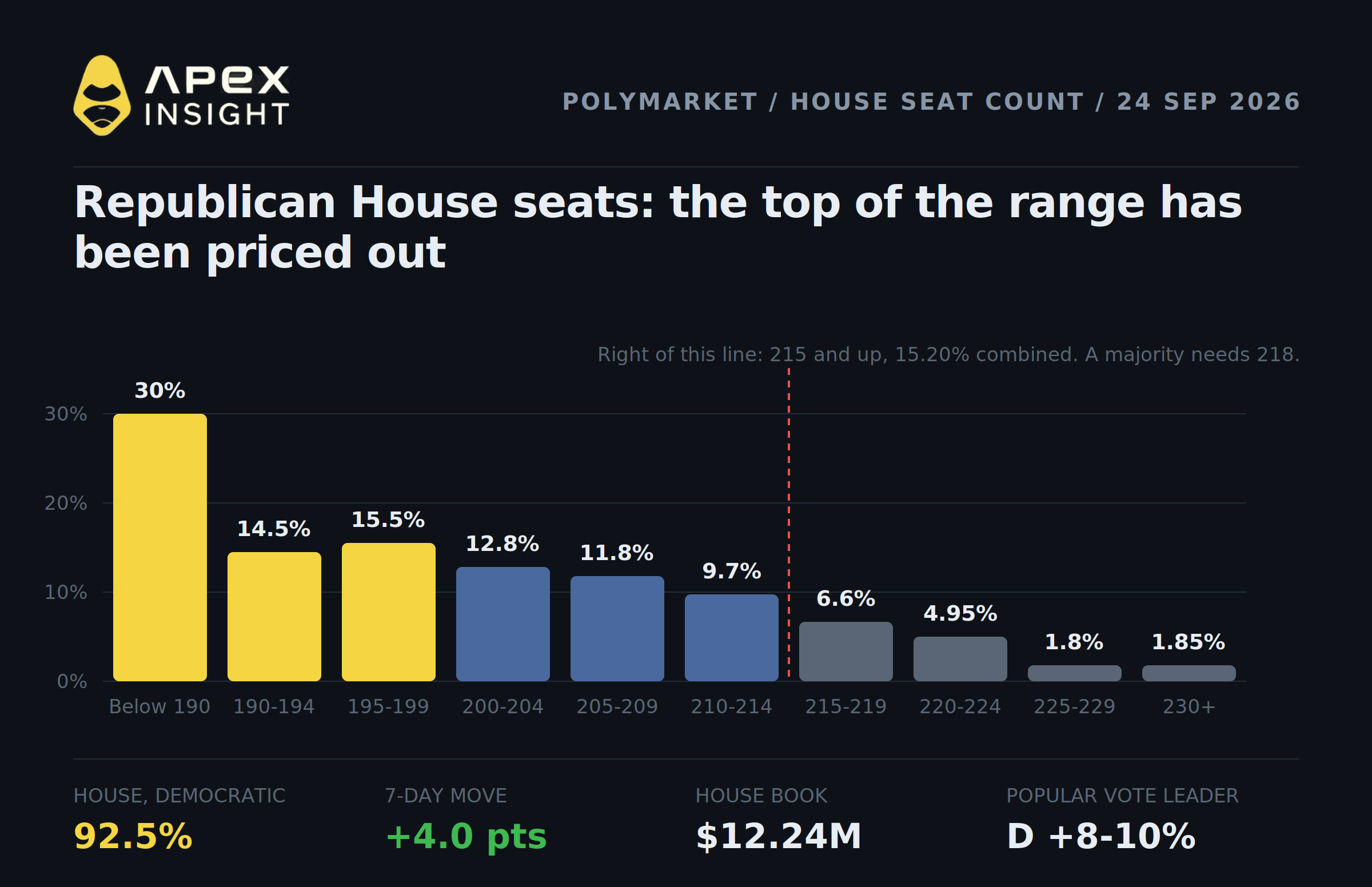
At 92.5% Democratic on $12.2 million, the House is no longer carrying meaningful uncertainty. It was 86.5% on August 11 and it gained four points this week, but a move from 88.5% to 92.5% changes very little about how you should think about November.
The seat count market tells you more. Republicans below 190 seats now leads at 30.0%, up five points in a week. 190 to 194 sits at 14.5%, 195 to 199 at 15.5% after falling 4.5 points this week. The majority threshold is 218 seats, and every bucket from 215 upward adds to just 15.20% combined.
The popular vote margin book is doing something subtler. Democrats 8 to 10% leads at 25.5%, but it fell two points this week while Democrats 12 to 14% rose 5.45 points to 12.55% and Democrats 14 to 16% rose 1.7 points. The centre of that distribution is shifting right along the scale even as the top bucket softens, which is the shape you see when a market is widening its estimate of the margin rather than sharpening it.
Both House books are saying the same thing the control price is: the question is no longer whether, it is by how much.
5. The fastest moving market on the board is the one to trust least
Two cautionary examples landed in the same week, and together they are a better lesson in reading these books than any amount of theory.
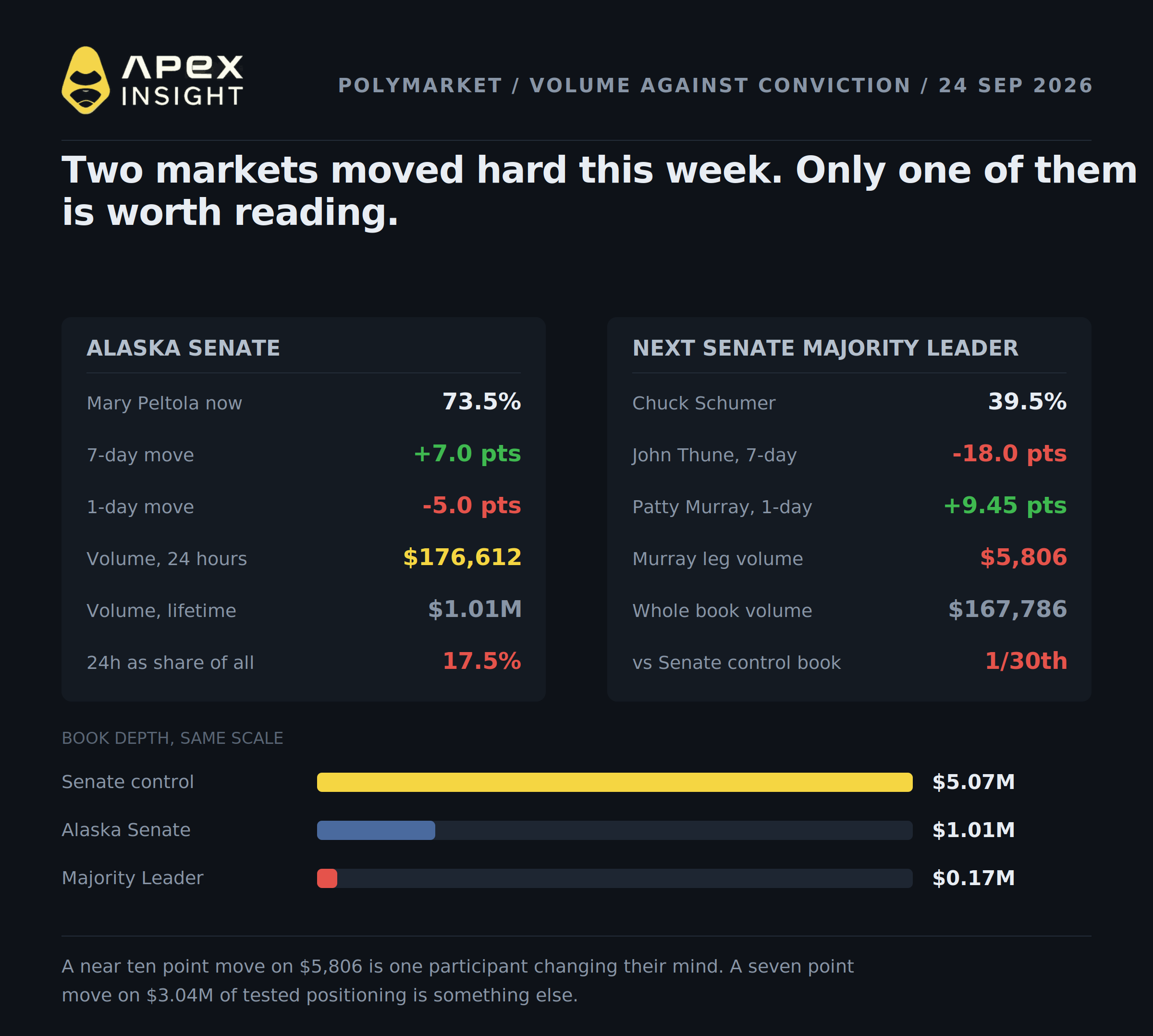
The first is Alaska. The Senate race there traded $176,612 in 24 hours against a lifetime volume of $1.01 million. That is roughly 17% of everything ever traded in that market, in a single day. Peltola is up seven points on the week at 73.5%. But she is down five points on the day. The market spiked and gave a chunk of it straight back, which is exactly what a sudden volume burst on a mid-sized book tends to produce.
The second is the Next Senate Majority Leader market, and it is a mess worth studying. John Thune fell eighteen points in a week to 26.5%. Chuck Schumer leads at 39.5%. Patty Murray sits at 10.3%, up 9.75 points on the week and 9.45 of that in the last day alone.
Murray's entire leg carries $5,806 in volume.
A near ten point move on under six thousand dollars is not information. It is one participant changing their mind. Compare that to the Senate control contract, where a seven point weekly move sits on $3.04 million of tested positioning, and the difference in what those two numbers are worth becomes obvious.
The whole leader book carries $167,786, one thirtieth of the Senate control market. It is downstream of an election that has not happened, contingent on a majority that has not been won, and thin enough that a few thousand dollars reorders it. Watch it for entertainment. Do not weight it.
What would reverse this
Nineteen points in six weeks means the market has updated hard, and markets that update hard can update back.
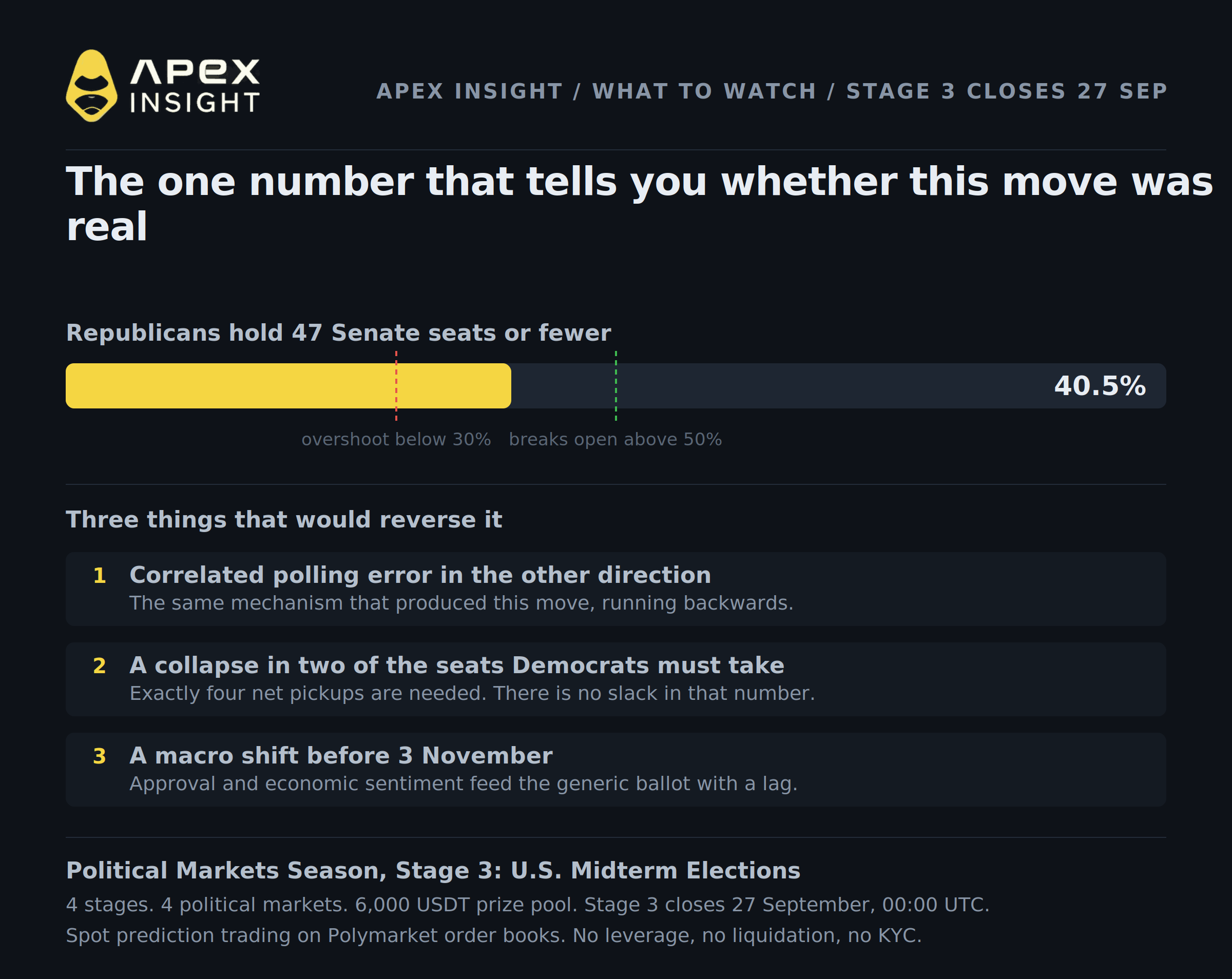
Three things would do it. A correlated polling error in the other direction, which is the same mechanism that produced this move running the other way. A collapse in two of the seats Democrats are trying to take, meaning Ohio, Texas, Maine or Alaska, or a stumble in one they are defending, such as Michigan or New Hampshire; going from 47 seats to a 51 seat majority takes exactly four net pickups, because a Republican vice president breaks a 50-50 tie, and there is no slack in that number. Or a macro shift between now and November 3, because presidential approval and economic sentiment feed the generic ballot with a lag and are upstream of nearly everything on this board.
Watch the 47-or-fewer bucket. It is the cleanest single read on this cycle right now. At 40.5% it is the market's largest bucket but it is still a minority position, which means the market believes Democrats are favoured without believing a blowout is settled. If it pushes through 50%, the seat distribution has genuinely broken open. If it falls back under 30%, this month's move was an overshoot.
Trade it
Every price in this article is live on ApeX Omni, where Polymarket's order books are integrated directly. Same liquidity, same settlement source, no KYC.
Political Markets Season is live. Four stages, four political markets, a 6,000 USDT prize pool. Stage 3 covers the U.S. Midterm Elections and runs until September 27 at 00:00 UTC, so there is still time to take a position on the board this article is built on. Spot prediction trading on Polymarket order books. No leverage, no liquidation, no KYC. Trade the odds, not the outcome.
We appreciate your continued support.
Note: All market prices and volumes in this article were taken from live Polymarket order books on September 24, 2026. August comparison figures are from the same books on August 11, 2026. Prices move continuously and will differ by the time you read this.
Published by ApeX. For informational and educational purposes only. Not investment advice, and not a forecast or endorsement of any political outcome. Trading involves risk, including total loss.