




TL;DR
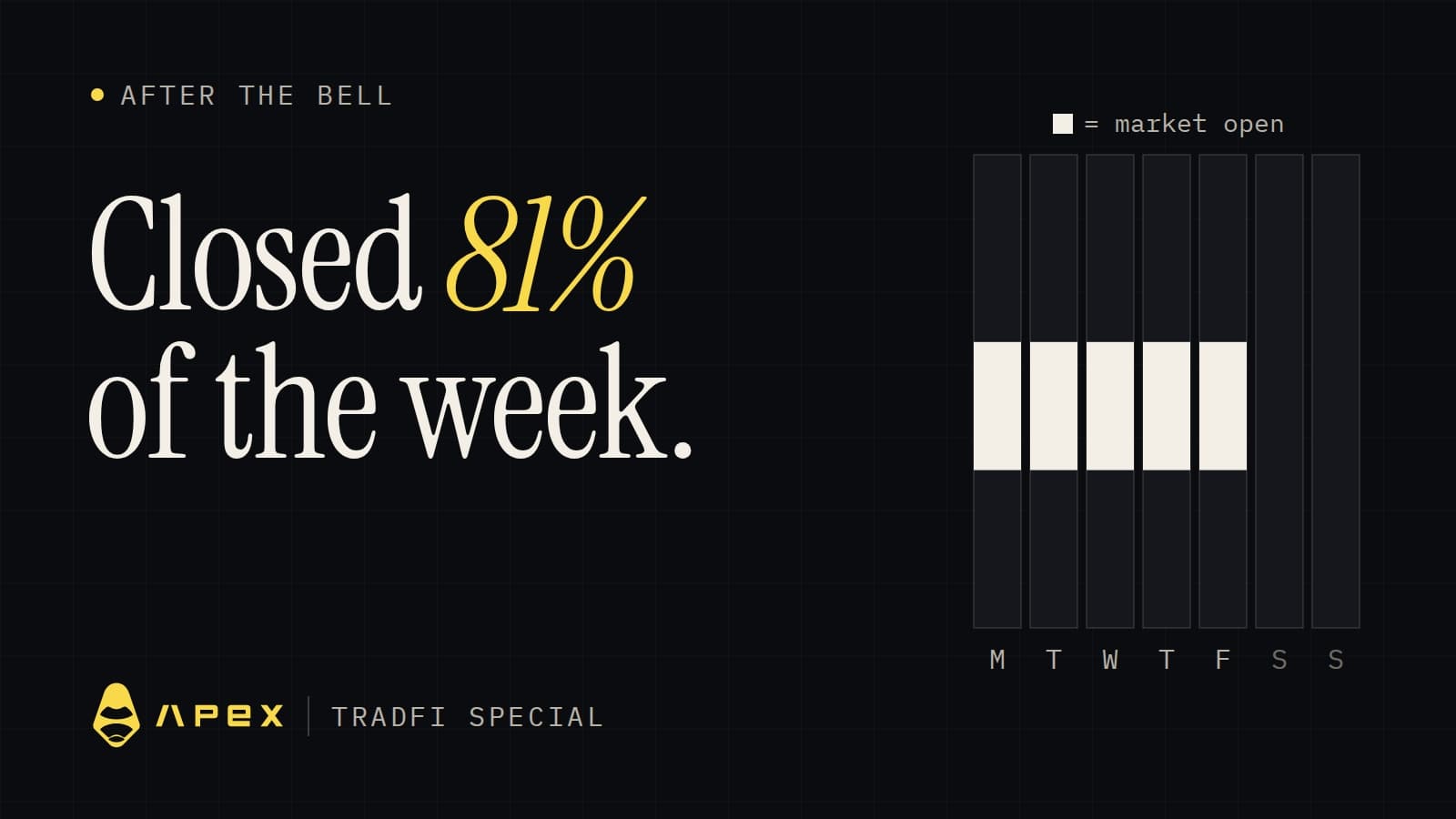
The main US stock market trades 6.5 hours a day, five days a week. It’s closed about 81% of the week.
News doesn’t stop when the market closes. Earnings, economic data and world events land at night.
Stock perps that trade 24 hours on weekdays let you react when news breaks, but they bring their own risks.
The 81% of the week nobody talks about
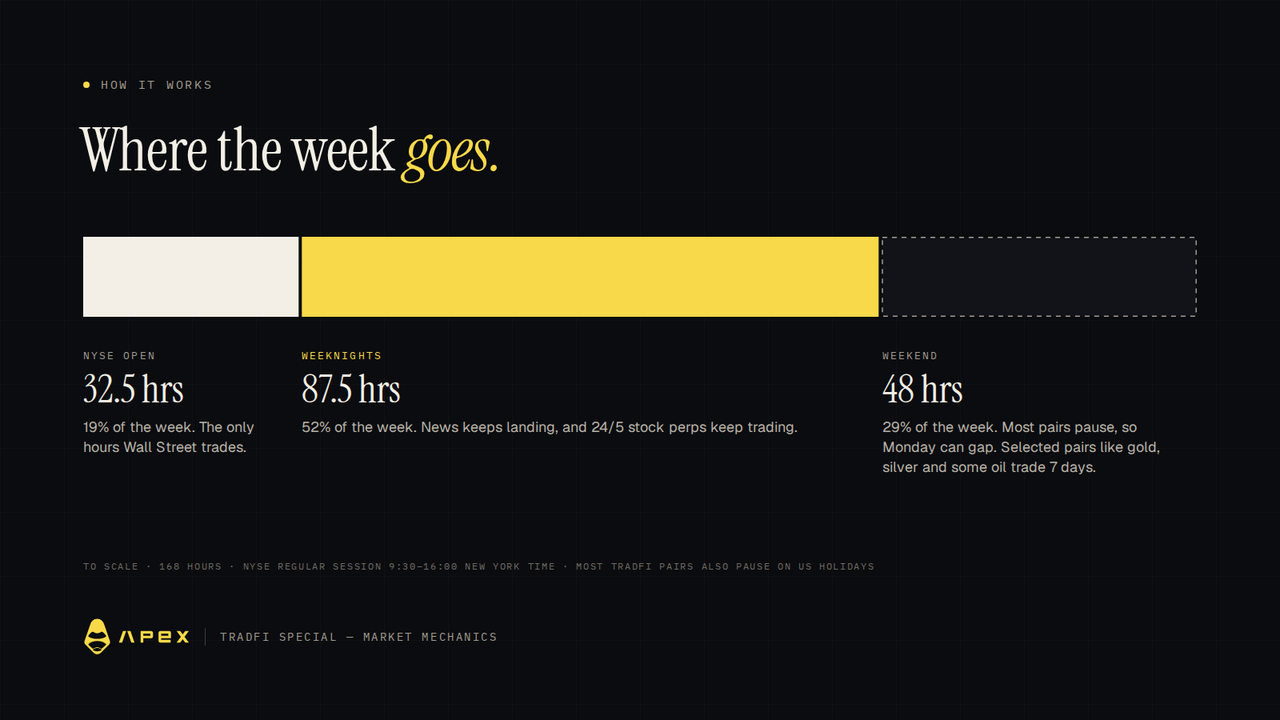
The New York Stock Exchange’s regular session runs 9:30 a.m. to 4:00 p.m. New York time, Monday to Friday. That’s 32.5 hours. A week has 168.
So the world’s biggest stock market is closed more than four-fifths of the week. Some brokers add thin extra hours around the open and close, but weekends stay dark.
But news keeps its own schedule. Many companies report earnings after the 4:00 close, and wars and policy surprises don’t wait for Monday. It all hits the price at once when trading resumes.
What a “gap” is, and why it matters
Imagine a stock closes Friday at $100. Over the weekend, the company announces bad news. On Monday it opens at $92.
Nobody got to sell at $99, $97 or $95. Traders call this a gap: a jump in price with no trading in between.
Think of a shop closed all weekend. If the supplier doubles costs on Saturday, shelf prices still change only when the doors open on Monday, all in one go.
That’s why a stop-loss doesn’t always protect you. A stop at $97 would have sold near $92, because $97 never traded.
What changes when stocks trade around the clock
Stock perps (short for perpetual contracts) track stock prices and trade far beyond normal hours. You don’t own the underlying share, and the contract never expires.
Many trade 24 hours a day on weekdays. So when a company reports at 4:30 p.m. or news breaks at 2 a.m., the price reacts straight away, moving as the story develops instead of jumping at the next open.
That means you can react to earnings the same evening, or cut or hedge a position when news breaks in another time zone. Some markets, like gold, silver and certain oil contracts, trade seven days a week.
A real weekend, and a warning
In late August 2026, a tokenized version of HIMS stock (a crypto token that tracks the share price) traded as much as 112% above its NYSE closing price over a weekend. The premium vanished within two hours of the issuer minting new tokens on Monday.
That token wasn’t a perp, and a memecoin had soaked up most of its supply. But the lesson holds: when the main market is closed, only the people trading at that moment set the price, and it can drift far until Wall Street reopens and pulls it back.
What about the weekend?
Weekday trading covers about two-thirds of the hours Wall Street is closed. The weekend is the other third, and most stock perps pause then and on US public holidays. Hold through a pause, and your position reopens wherever the market has moved. The weekend gap doesn’t disappear; you plan for it.
The part people skip: leverage
Stock perps usually offer leverage: controlling a bigger position than the money you put in. It makes small moves feel big, both ways.
The simple math: at 10x leverage, a 10% move against you can wipe out your whole deposit. At 50x, a 2% move does it. You’d be liquidated even sooner, because the platform closes positions before your margin hits zero.
Now add the hours you’re not watching. A 5% move on overnight earnings news isn’t unusual. At 10x, that’s half your margin. At 50x, you’re closed out. And if it happens during a weekend pause, you can’t act until trading resumes.
Round-the-clock trading gives you the chance to react. It doesn’t make the moves smaller, and it leaves you exposed while you sleep.
Go deeper: where the price comes from
A stock perp needs a trusted reference price, especially off-hours. Many platforms use an oracle: a service that brings outside price data onto the blockchain. Good oracles blend several professional data providers into one middle price, so a single bad quote can’t push it around. That reference sets the mark price, which values your position and triggers liquidation. It also feeds the funding rate, a small payment between buyers and sellers that keeps the perp near the reference. Off-hours, when thin trading can overshoot, that anchor matters most.
What this means for traders
Know the calendar. Earnings dates, jobs reports and central bank decisions are when stocks can jump. Check them before you open a position.
Use less leverage than you think you need. The lower the leverage, the bigger the move you can survive.
Check each market’s hours. Some pause on weekends and US holidays; some never stop.
Plan your weekend. Decide on Friday whether to hold through a pause you can’t trade out of.
Live now: TradFi Showdown on ApeX Omni
ApeX Omni’s TradFi perpetuals let you trade US stocks, gold, silver and oil with the same login and self-custody wallet you use for crypto, with no KYC. TradFi has its own balance, so transfer funds into it before you trade. Most pairs trade 24 hours a day on weekdays and pause on weekends and US public holidays. Selected pairs, including gold, silver and CLUSDT oil, trade seven days a week. Prices come from Chainlink oracle feeds.
Until October 3, 08:00 UTC, the TradFi Showdown rewards registered traders by TradFi volume: $5,000 earns a $5 TradFi Trading Bonus, $20,000 earns $15 and $50,000 earns $30. Only your highest tier counts, and the 3,000 USDT pool is first-come, first-served. Register on the campaign page before you trade.
One honest note: the bonus is small. Never trade more just to reach a tier; costs and losses can easily outweigh it.
Glossary
Regular session: the NYSE’s main trading hours, 9:30 a.m. to 4:00 p.m. New York time, weekdays.
Gap: a jump in price between one trade and the next, usually after a market closure.
Stock perp: a contract that tracks a stock’s price, has no expiry, and doesn’t give you ownership of the share.
Leverage: trading a position larger than your deposit. It magnifies gains and losses.
Liquidation: when a platform closes your position because your losses have used up most of your margin.
Oracle: a service that brings outside price data, like stock prices, onto the blockchain.
Mark price: the reference price used to value open positions and decide liquidations.
Funding rate: a regular payment between buyers and sellers of a perp that keeps its price near the reference price.
Tokenized stock: a crypto token that tracks a stock’s price.
This article is for education only and is not financial advice. Stock perps don’t give you ownership of the share. Trading perpetual futures with leverage carries a high risk of loss, including your full margin. Do your own research.