




Published 12 November 2026
At 21:00 UTC on Wednesday the New York Stock Exchange and Nasdaq closed. Nvidia had just finished a good session, up 3.10% on the ApeX contract, in a day when the whole AI complex rallied hard.
About an hour later, news broke that moved the contract more in one hour than any full session has moved it since 6 November.
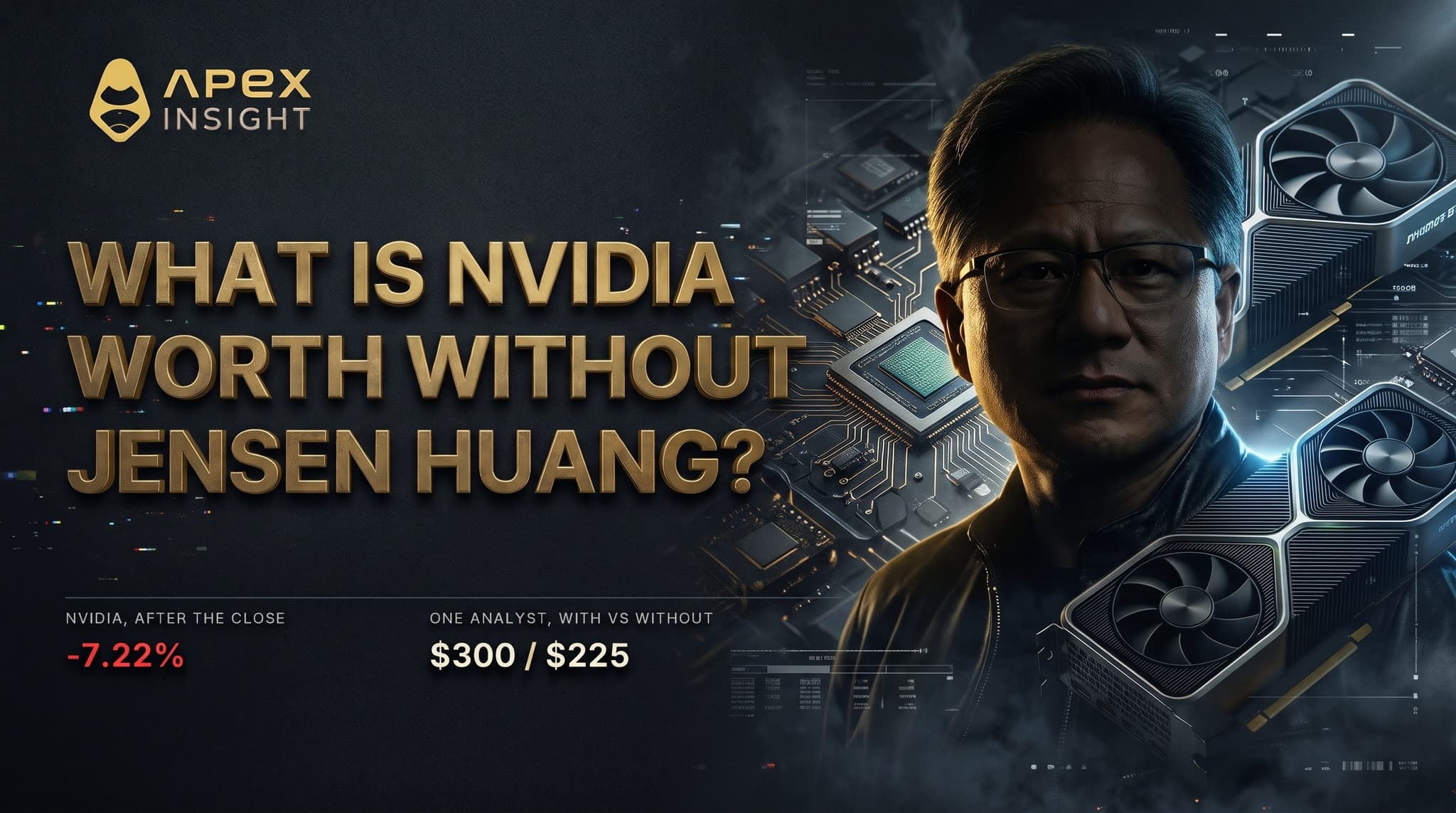
By 08:00 UTC on Thursday the ApeX Nvidia contract was down 7.22% from that cash close. The US cash market will not open again until 14:30 UTC. For seventeen and a half hours, the shares themselves could not respond at all.
The reason was a report that Nvidia's board is preparing to remove the man who co-founded it. No decision has been announced. What the overnight tape gives you is the market's own first answer to a question nobody had needed to ask before: what is this company worth without Jensen Huang?
Written at 08:00 UTC on 12 November 2026. No decision had been announced at that time. Every claim below is stamped, and this story is moving fast enough that some of it may be overtaken by the time you read it.
1. What the board actually said, and when
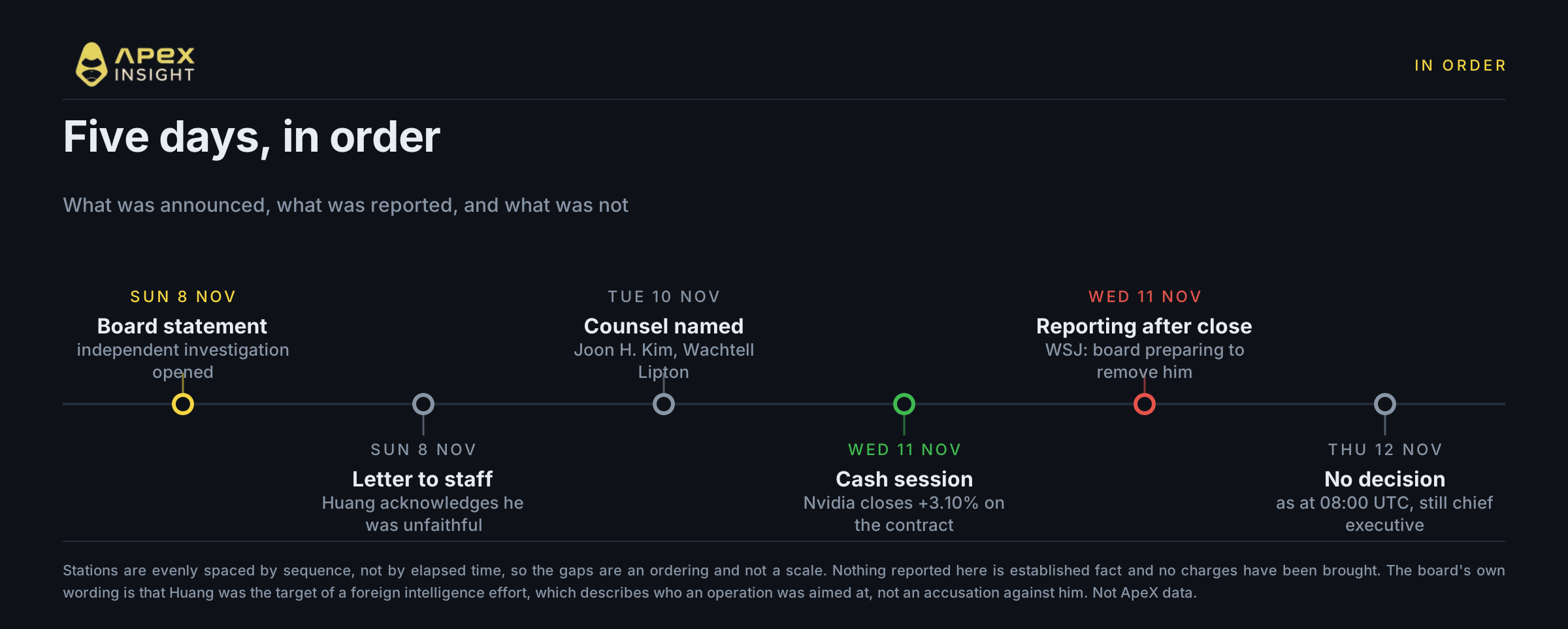
The sequence matters more than any single headline, so here it is in order.
On Sunday 8 November, Nvidia's board published a statement saying it was "initiating an independent investigation" in light of recent reporting that founder and chief executive Jensen Huang "has been the target of a foreign intelligence effort". A committee of independent directors with outside independent counsel would oversee it. The same statement said the board had no reason to believe that national security or Nvidia's secrets had been compromised, that Huang fully supported the review and had committed to cooperating, and that the board had confidence in him and his leadership team.
Read that statement carefully, because the wording is doing specific work. "Target of a foreign intelligence effort" describes someone an operation was aimed at, so the board's own phrasing is not an accusation against him. That is a point about the statement, not a verdict on the separate reporting below.
The same day, Huang wrote to staff acknowledging that he had been unfaithful to his wife, saying "I am deeply sorry", that he took full responsibility, and that he supported the investigation and would cooperate fully.
On Tuesday 10 November, the independent members of the board said they had retained Joon H. Kim, a former acting US Attorney for the Southern District of New York, and his firm Wachtell, Lipton, Rosen & Katz to conduct the investigation announced on Sunday.
On Wednesday 11 November, after the US close, the Wall Street Journal reported that the board was preparing to remove Huang, citing people familiar with the matter, following reports of two extramarital affairs. Reuters reported, via ThePrint, citing a source familiar with the matter, that the board was meeting late that evening to decide his future. Reuters did not independently verify the Journal's account of a removal being prepared. The New York Times reported a second alleged relationship involving a company executive.
The relationship at the centre of the national-security reporting is reported to involve an executive at Megaspeed, a Singapore-based company that has bought billions of dollars of Nvidia chips and hardware. US intelligence agencies are reported to suspect her of being an asset of China's Ministry of State Security. She has not been charged, Megaspeed has denied involvement in illegal chip transfers, and China has called the account baseless. This article does not name her, because her identity adds nothing to the market question and she is an uncharged private individual.
Three things are worth stating plainly, because they are easy to lose in a fast-moving story. Nothing has been proven. No charges have been brought against anyone named here. And as of 08:00 UTC on 12 November, Nvidia had announced no decision at all: Huang was still chief executive and the company had not commented on the board meeting.
What follows is about how a market prices that kind of uncertainty, not about whether any of it is true.
2. Most of the move happened in one hour, after the close
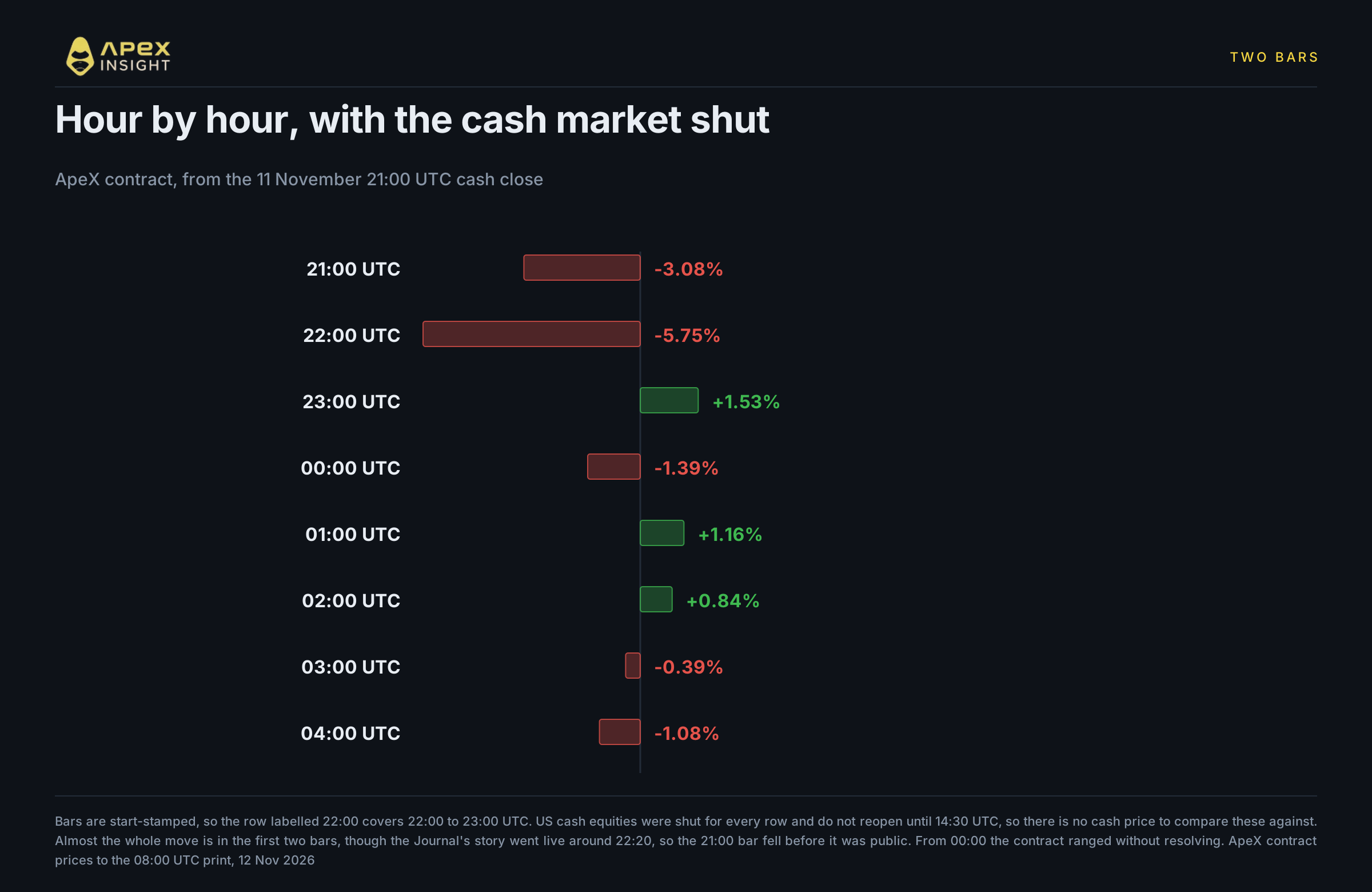
Here is the ApeX Nvidia contract, hour by hour, from the Wednesday cash close.
Hour, UTC | Open | Close | Move |
|---|---|---|---|
21:00 | 174.11 | 168.74 | -3.08% |
22:00 | 168.74 | 159.03 | -5.75% |
23:00 | 159.03 | 161.47 | +1.53% |
00:00 | 161.47 | 159.22 | -1.39% |
01:00 | 159.22 | 161.06 | +1.16% |
02:00 | 161.06 | 162.42 | +0.84% |
03:00 | 162.42 | 161.79 | -0.39% |
04:00 | 161.79 | 160.04 | -1.08% |
Almost the whole move is in two bars. The hour stamped 22:00 UTC carries a 5.75% fall, larger than any cash session Nvidia has had since 6 November, though note that is a contract hour measured against cash sessions.
One caveat on attribution, and it matters. The Journal's story went live at roughly 22:20 UTC, which is inside the 22:00 bar. The 3.08% fall in the 21:00 bar therefore happened before the report was public. Something was already moving ahead of it, and this article cannot tell you what. By 23:00 the contract had already bounced 1.53%, and from 00:00 onwards it traded in a range between roughly 159 and 162 without resolving in either direction.
The table stops at the 04:00 bar. The four hours to 08:00 stayed inside the same range and are in the figures quoted elsewhere here.
That shape is worth recognising, because it is what a market looks like when it has finished reacting and started waiting. The information arrived at once. The repricing took about two hours. Everything after that is people holding positions into an announcement that has not come.
Two caveats on reading the table. ApeX hourly bars are start-stamped, so the bar labelled 22:00 covers 22:00 to 23:00 UTC. And these are contract prices, not cash prices: the underlying shares did not trade at all during any row in that table, so there is no cash print to compare them against.
3. Nvidia fell and two rivals rose
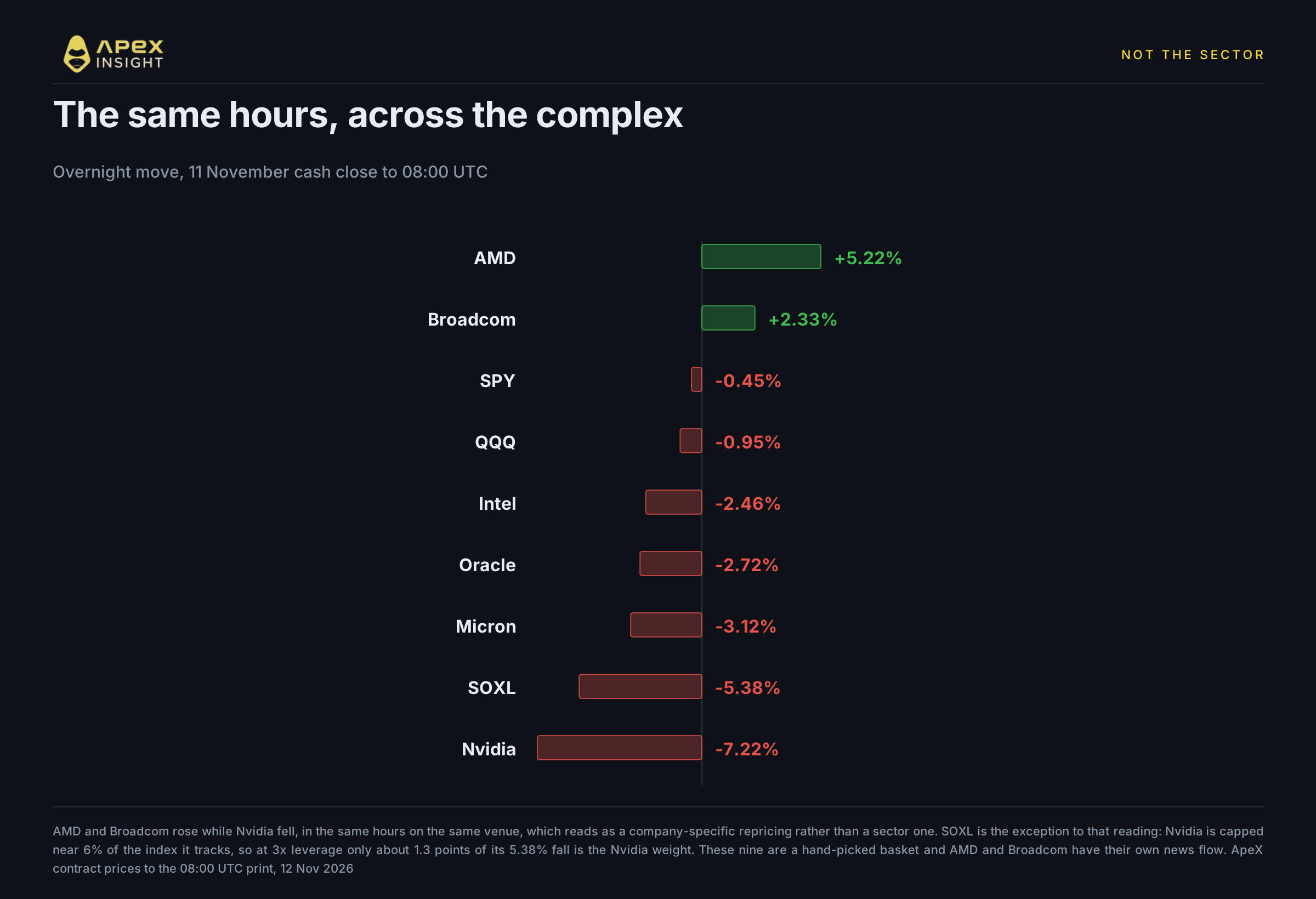
If this were a problem with artificial intelligence as an investment case, everything would have fallen together. It did not.
Over exactly the same overnight hours, from the 11 November cash close to 08:00 UTC:
Contract | Overnight | Wednesday session |
|---|---|---|
+5.22% | +4.57% | |
+2.33% | +4.13% | |
-0.45% | +1.26% | |
-0.95% | +2.24% | |
-2.46% | +7.40% | |
-2.72% | +8.89% | |
-3.12% | +12.06% | |
-5.38% | +18.05% | |
-7.22% | +3.10% |
AMD rose 5.22% and Broadcom 2.33% while Nvidia fell 7.22%. The two most direct beneficiaries of trouble at the market leader went up, in the same hours, on the same venue.
The index contracts barely moved: QQQ fell 0.95% and SPY 0.45%. SOXL fell 5.38%, and that one needs care rather than a quick read. Nvidia is capped near 6% of the semiconductor index SOXL tracks, so at three times leverage only about 1.3 points of that fall is the Nvidia weight. The rest is broader semiconductor softness, which cuts against a purely company-specific reading.
The most coherent reading is that this was priced as a Nvidia problem, not an AI problem. That is a meaningfully different thing from the sector-wide selling of last week, and it is the distinction the overnight tape makes most clearly.
One honest limit: these are nine hand-picked contracts, not a survey, and AMD and Broadcom have their own news flow that this article has not separated out. The direction is clear. The precise attribution is not.
4. Why does one person matter this much?
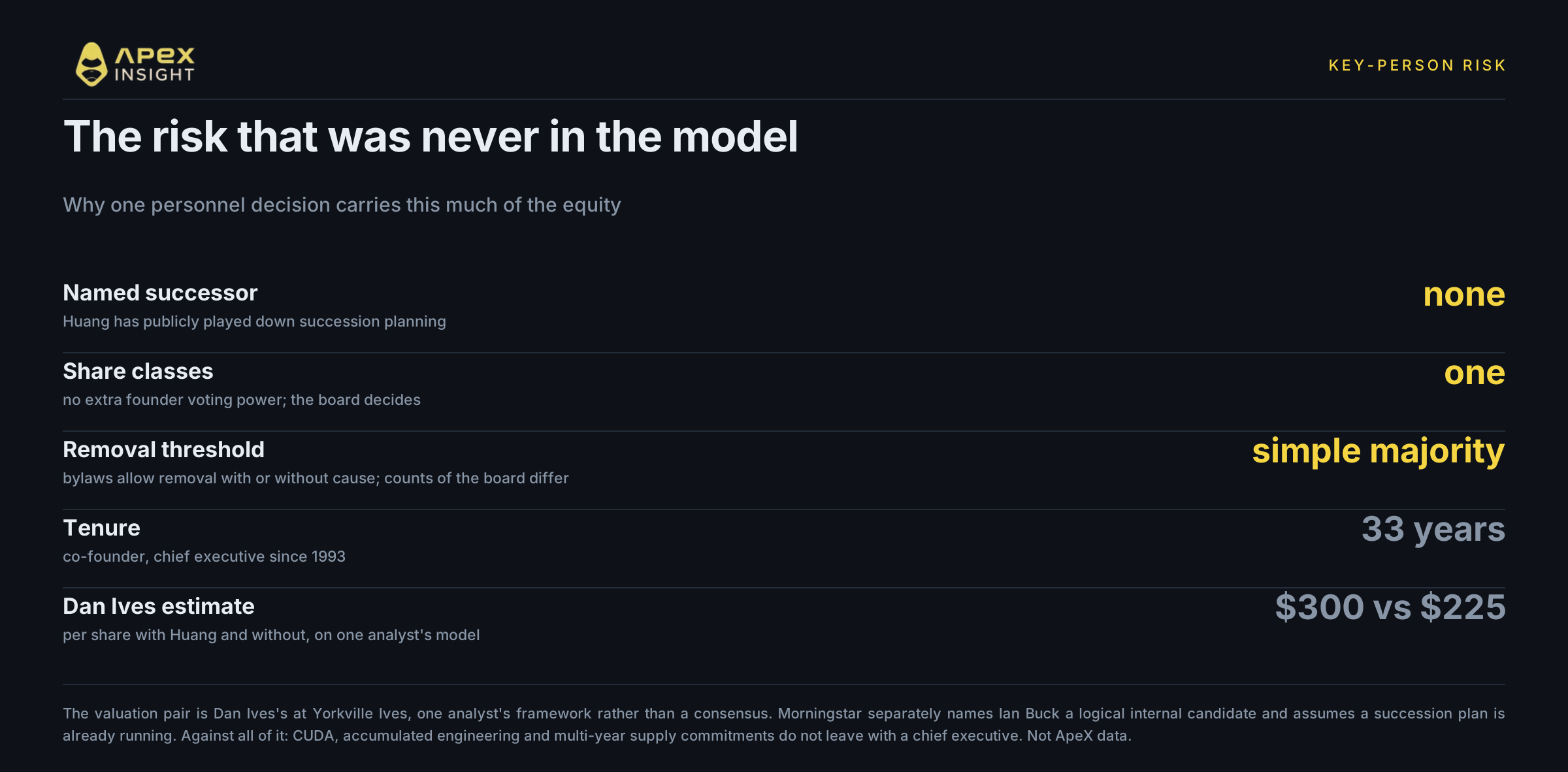
Most large companies are built so that no individual is irreplaceable. Nvidia is not most companies.
Huang is 63, co-founded the company, and has run it for more than three decades. He owns roughly 3.6% of it. Nvidia has a single class of stock, which means that stake does not come with the extra voting power founders at other technology companies hold, and his position depends on the board rather than on control. Counts of the board differ: Nvidia's May 2026 proxy listed ten members with nine independent directors, while Reuters now reports eleven, all independent apart from Huang. Either way the mechanism is the same, and it is the part that matters: under Nvidia's bylaws he can be removed "with or without cause" by a majority vote of the directors. Removing him as chief executive would not remove him from the board.
There is also no named successor. Huang has publicly played down succession planning, and Reuters and several analysts have noted that no obvious candidate exists. That is the whole of the problem in one sentence: the market is being asked to price the removal of a chief executive without being told who replaces him.
Two further details emerged on Wednesday. Bloomberg reported the board has been working with an outside search firm on possible replacements, and an interim chief executive is among the options under consideration. Neither is a name.
Two things cut the other way. Nvidia's own risk factors treat effective succession planning as a company priority, and Morningstar's analyst says he can only assume an accelerated succession plan is already underway. Neither is the same as a name.
Analysts have started putting numbers on it. Dan Ives of Yorkville Ives values Nvidia at $300 per share with Huang as chief executive and $225 without. Separately, Morningstar's Brian Colello named Ian Buck, who runs Nvidia's hyperscale and high-performance computing business, as a logical internal candidate, while saying plainly that he has no insight into the board's thinking. Treat the valuation pair as one analyst's framework rather than a consensus: it is a useful way to see the shape of the question, which is that a single personnel decision is worth roughly a quarter of the equity on that estimate.
This is what is usually called key-person risk. It is the risk that an enterprise depends so heavily on one individual that their departure changes what the business is worth. For most of Nvidia's rise it was a line in the risk factors that nobody traded on. This week it became the only thing anyone was trading.
The counter-argument deserves space. Nvidia's advantages are not personality: the CUDA software ecosystem, years of accumulated engineering, and customer relationships measured in multi-year supply commitments do not evaporate when a chief executive leaves. The company reported roughly 42,000 employees at the end of fiscal 2026, about 31,000 of them in research and development. A founder departure is a genuine shock, and it is not the same thing as the business deteriorating.
5. Wednesday's session said almost the opposite
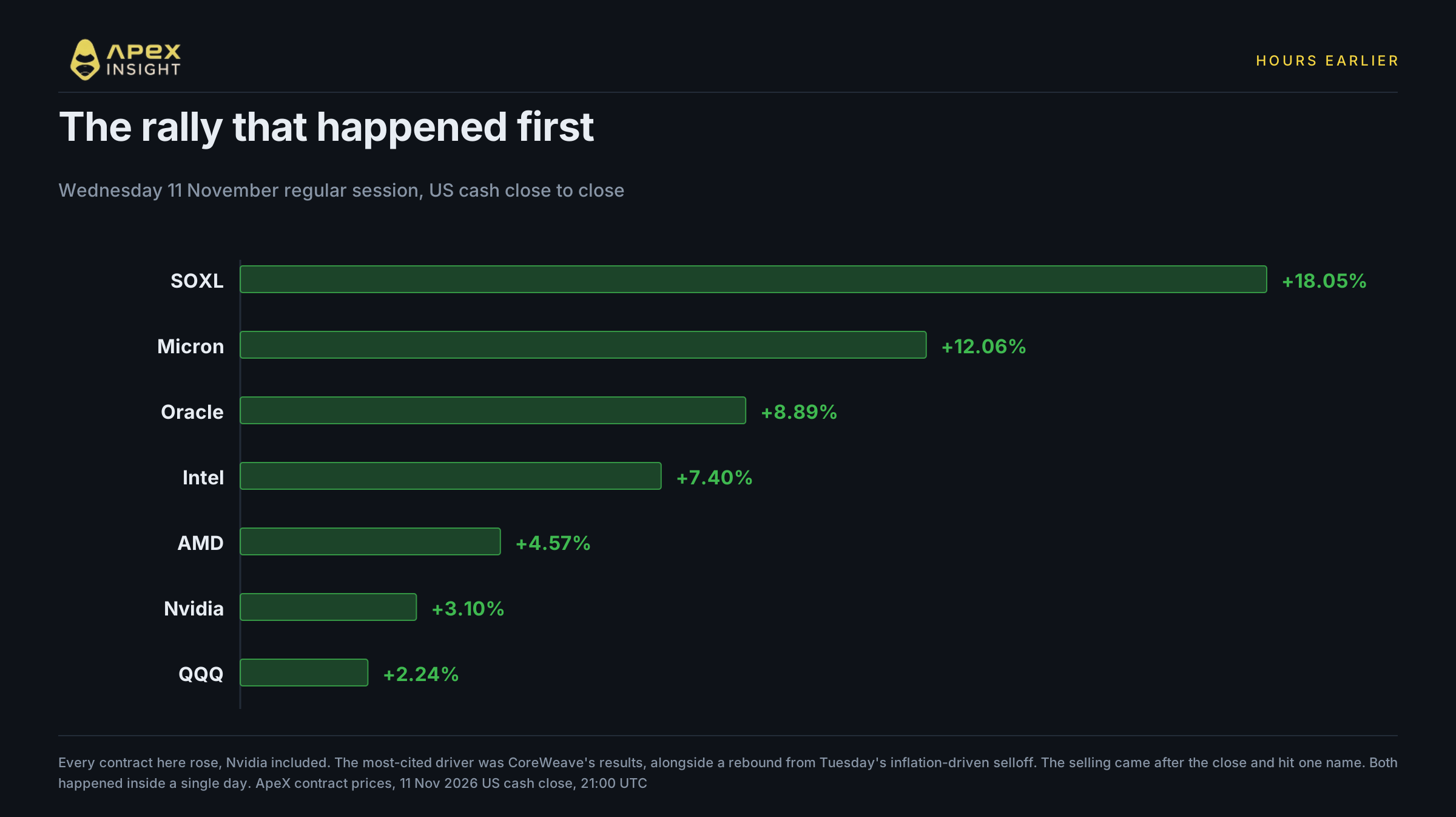
It is easy to read the overnight move backwards into the whole week. The tape does not support that.
Wednesday's regular session was one of the strongest days the AI complex has had. On the ApeX contracts, SOXL rose 18.05%, Micron 12.06%, Oracle 8.89% and Intel 7.40%. Nvidia itself rose 3.10%. The most-cited driver was CoreWeave's results, which restored confidence in AI infrastructure demand, alongside a technical rebound from Tuesday's inflation-driven selloff.
So inside a single day the market did two contradictory-looking things: it bought the AI trade aggressively, then sold Nvidia specifically and hard. Both can be true at once, and the fact that they happened in that order is the clearest evidence that the overnight move was about the company and not the sector.
For scale, if the after-hours losses hold Nvidia will have shed about $600 billion in market value since the board announced its investigation on 8 November. For the longer view, the ApeX Nvidia contract is 28.46% below its 200-day high as at the Wednesday close, and about 33.62% below it at the 08:00 UTC bar on Thursday. The high was set on 6 October. Measured from the 3 November close, before any of this reporting, the contract is down roughly 15.89% to Wednesday's close and about 21.97% including the overnight move.
6. What is dated from here
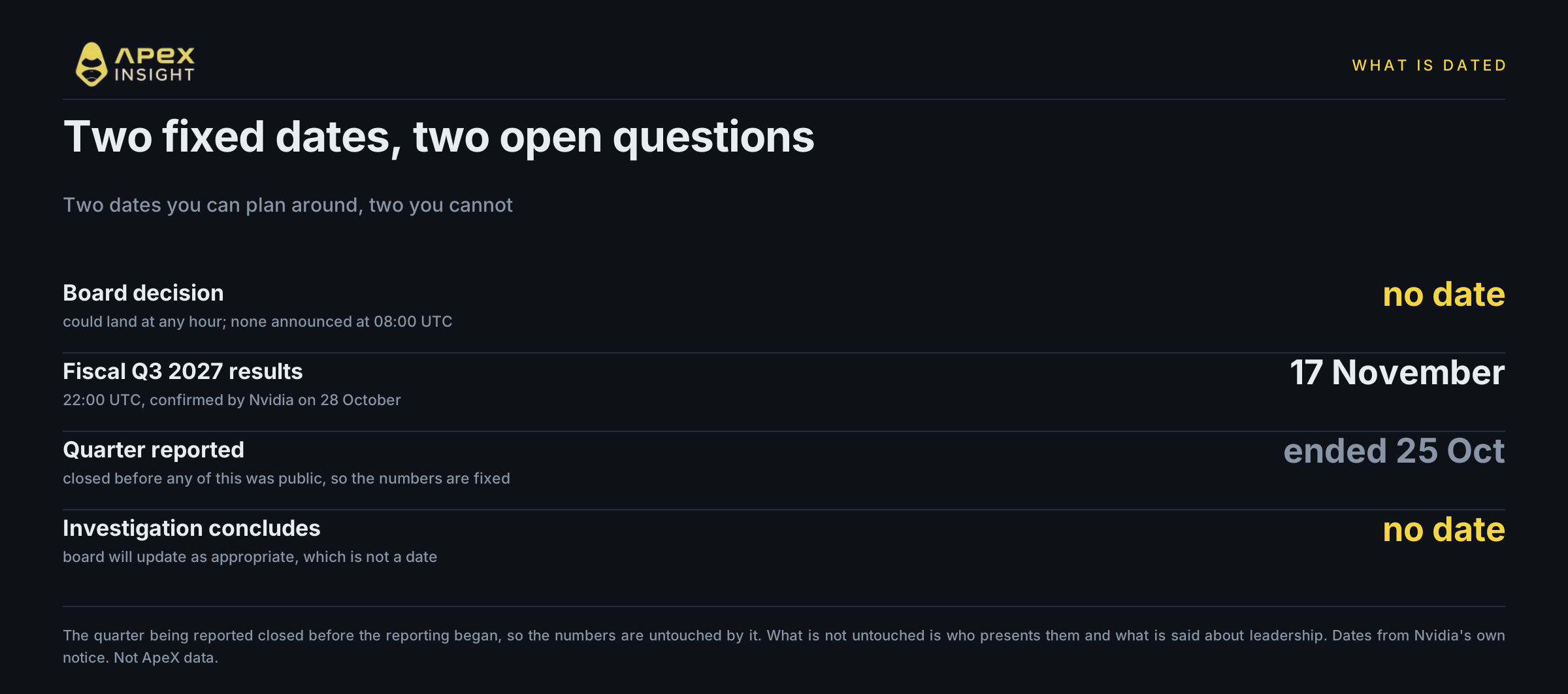
Most of this story has no timetable. Two parts of it do, and the two that do not are the ones that move the price.
Date | Event |
|---|---|
17 November | Nvidia fiscal Q3 2027 results, after the US close |
25 October | The quarter being reported already ended, so the numbers are fixed |
Not scheduled | Board decision on Huang's future |
Not scheduled | Independent investigation concludes |
Nvidia confirmed on 28 October that it will hold its third-quarter fiscal 2027 conference call on Tuesday 17 November at 2 p.m. Pacific, which is 22:00 UTC, covering the quarter that ended 25 October 2026.
That date is five days away and it creates an unusual situation. The quarter being reported closed before any of this became public, so the numbers themselves are untouched by it. What is not untouched is who presents them, what the company says about leadership, and whether a board decision lands before or after the call.
The investigation has no published deadline. The board said it would "provide further updates as appropriate", which is not a date.
For a trader the practical point is narrow and worth stating without drama: the known catalyst is 17 November, the unknown one could land at any hour, and the contract trades through both while the cash market does not.
Trade Nvidia around the clock
Go long or short Nvidia, AMD and Broadcom while the cash market is shut.
Contracts grouped by the argument they belong to, not alphabetically.
The name itself. It trades 24/5 on ApeX, so it prices news in hours when the underlying shares cannot.
NVDA-USDT, Nvidia
The two that rose on the same news. Both gained overnight while Nvidia fell.
The sector against the single name. Nvidia is capped near 6% of the index SOXL tracks, so the pair separates the single name from the sector around it.
A reminder that matters more than usual on this one. Trading carries a high risk of loss, and leverage increases both gains and losses. A position held into an unscheduled announcement is exposed to a gap in either direction, and an event like this can reverse violently on a single headline. Nothing here is financial advice, and none of it is a recommendation to buy or sell anything. Do your own research and size positions you can afford to lose.
If you need any help, feel free to reach out to our team on Discord.
Website: https://www.apex.exchange
Twitter: https://twitter.com/OfficialApeXdex
Telegram: https://t.me/ApeXdex
Methodology. Contract figures are our own arithmetic on ApeX Omni contract prices and are not exchange cash prices; the two differ, and during the overnight window described here there is no cash price at all, because US cash equities trade 14:30 to 21:00 UTC in winter. The session window runs from the 10 November US cash close to the 11 November close and the baseline window from 3 November, both at 21:00 UTC, which is the US cash close now that US daylight saving has ended; every boundary here is on standard time, so no window straddles the change. The overnight window runs from the 11 November 21:00 UTC cash close to the 08:00 UTC print on 12 November, the last price at the time of writing. Hourly bars are start-stamped, so the bar stamped 22:00 UTC covers 22:00 to 23:00 UTC. The 200-day high uses weekday bars only, because equity contracts print thin weekend bars that are order flow rather than the underlying share, and the first bar of a contract's history is excluded as a listing placeholder. The nine contracts here are a hand-picked basket, not a sample, and semiconductor names are not independent of one another. Reporting on the board, the investigation and the individuals named is from the sources hyperlinked at each claim and is not ApeX data; nothing reported is established fact and no decision had been announced at 08:00 UTC on 12 November 2026. TradFi contracts on ApeX settle against an index rather than the underlying asset, and ApeX lists them separately from its crypto perpetuals in its own contract data. Figures are as at 08:00 UTC on 12 November 2026 and will go stale quickly.