




Published 15 November 2026
Bitcoin fell to $62,000 in the early hours of Sunday morning. By then the US stock market had been closed for twenty-eight hours, the spot bitcoin ETFs had been closed for the same, and not a single share of Coinbase, Strategy or Circle had changed hands since Friday afternoon.
That is the interesting part. Not that crypto fell, which it has been doing all week, but that it fell at the one time when most of the machinery built around it was switched off.
Written on 15 November 2026 while the move is still running. Every crypto figure is measured to the bar stamped 09:00 UTC, the last one to have closed when this was written; the hour in progress is excluded everywhere, and the Sunday bounce may have extended by the time you read this.
1. What actually happened
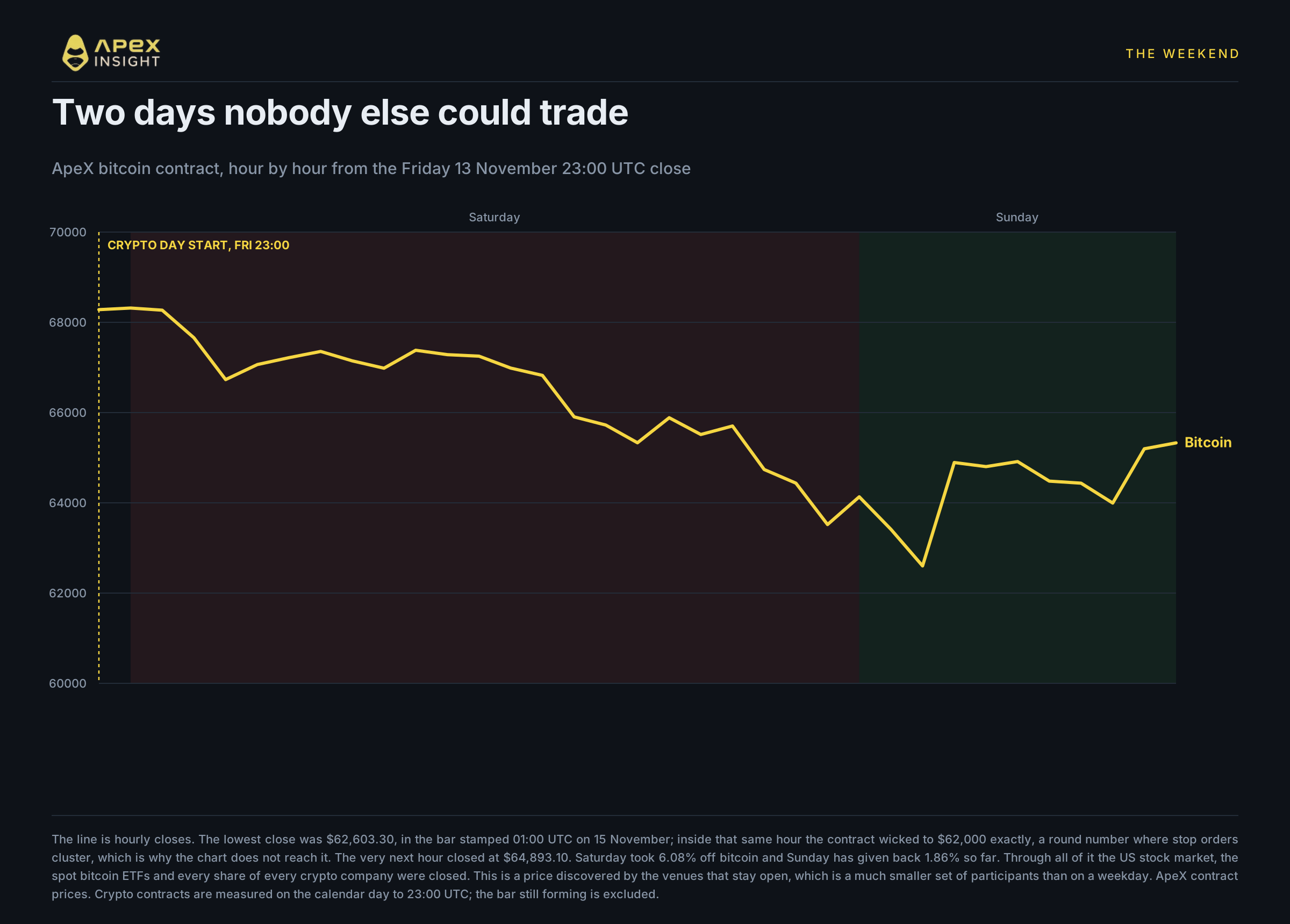
Saturday did the damage and Sunday has given some of it back. On the ApeX bitcoin contract, Saturday took 6.08% off the price. Sunday has returned 1.86% so far, leaving the weekend at -4.33% and the week at -12.71%.
The low is worth stating precisely, because the chart above plots hourly closes and the headline number is not one. The lowest hourly close was $62,603.30, in the bar stamped 01:00 UTC on 15 November. Inside that same hour the contract traded down to $62,000.00 exactly, a round number where stop orders cluster. The very next hour closed at $64,893.10.
That is a 3.66% move in one hour, immediately after the low, which tells you most of what you need to know about how thin the book was.
2. Saturday hit the small things hardest
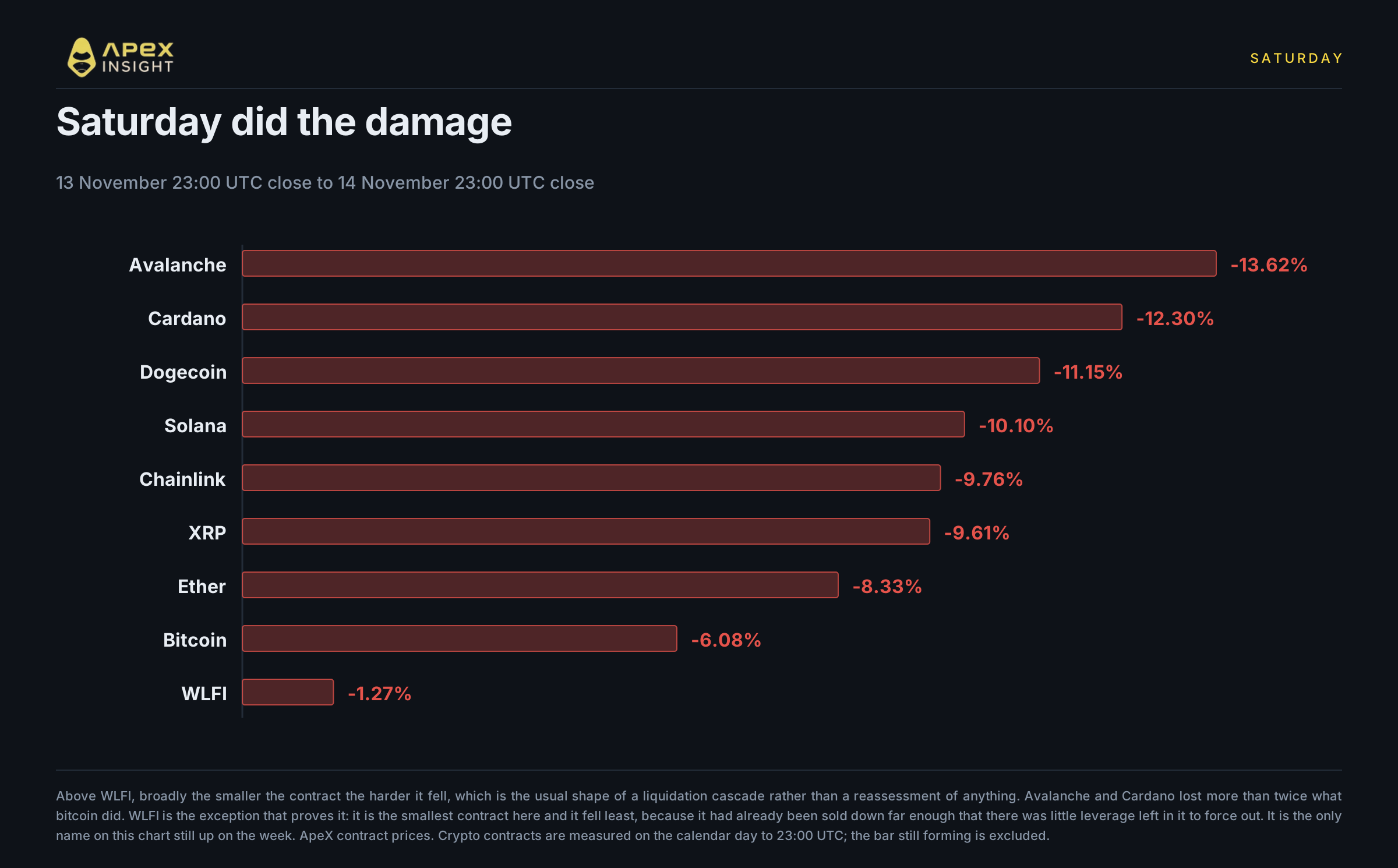
Contract | Saturday |
|---|---|
-13.62% | |
-12.30% | |
-11.15% | |
-10.10% | |
-9.76% | |
-9.61% | |
-8.33% | |
-6.08% | |
-1.27% |
Avalanche and Cardano lost more than twice what bitcoin did. That ordering, where the smaller and less liquid names fall furthest, is the usual shape of forced selling rather than of anyone deciding these assets are worth less. We found no Avalanche-specific news on Saturday.
The one break in that pattern is WLFI, which is the smallest contract in the basket and fell least, at 1.27%. Section 6 comes back to why.
3. Nobody agrees how big it was
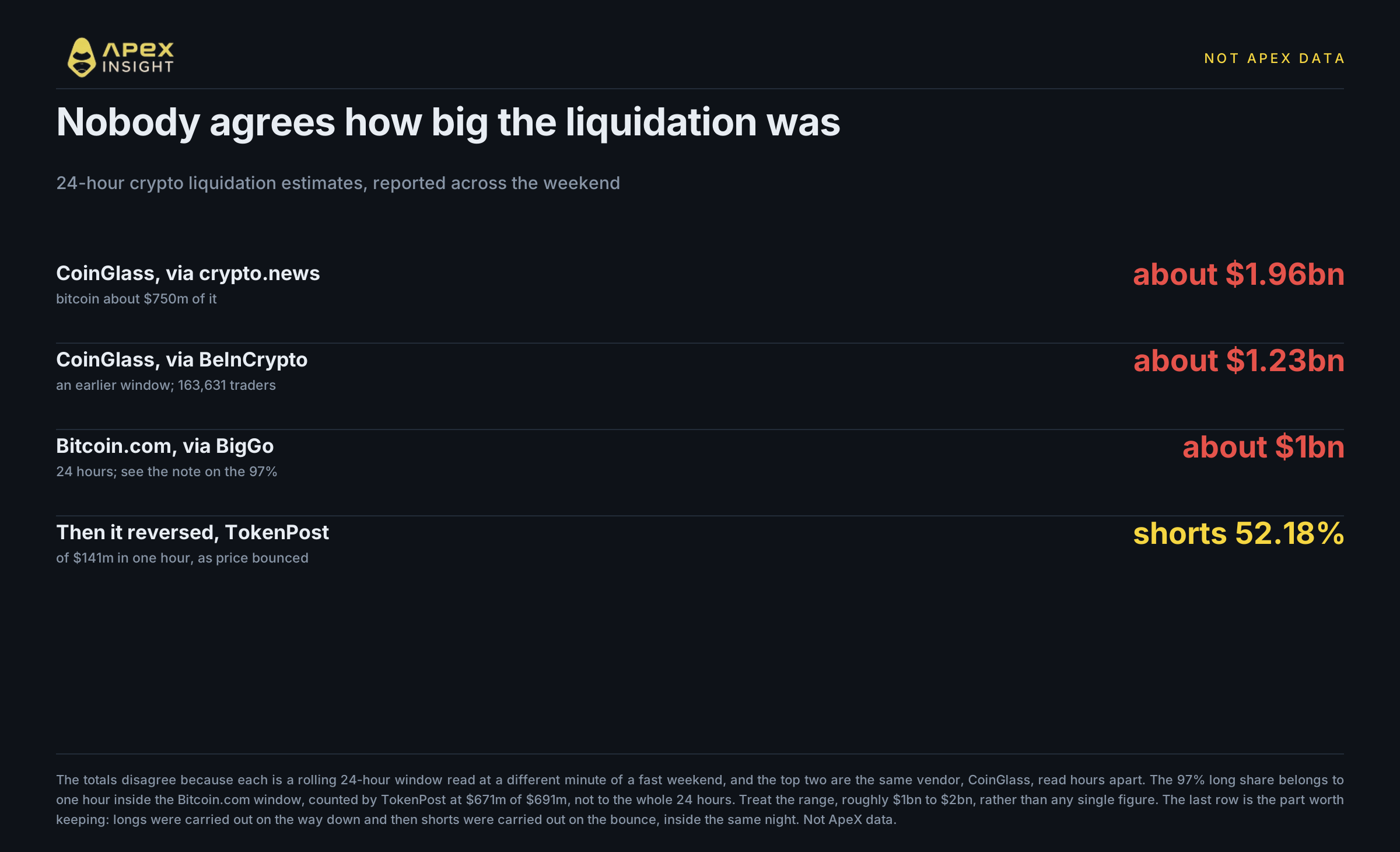
Estimates of the damage differ by a factor of two, so here is the range rather than a number.
CoinGlass data showed approximately $1.96bn in crypto liquidations over a rolling 24-hour period, with bitcoin accounting for roughly $750m, of which almost $600.5m came from longs. CoinGlass data reported by BeInCrypto put a different window at $1.23bn, with 163,631 traders liquidated. Bitcoin.com counted about $1bn over 24 hours; inside one hour of it, TokenPost counted $691m of which $671m, over 97%, was longs.
They disagree because each is a rolling 24-hour window read at a different minute of a fast weekend. Treat the range, roughly $1bn to $2bn, and treat the direction as settled: this was overwhelmingly long positions being closed for them.
Then it went the other way. In the hour ending 01:07 UTC on Sunday, longs were 84% of a $35.96m total across Binance, Bybit and OKX. Eighty minutes later, shorts were 52.18% of about $141m as bitcoin pushed back above $64,000. The people who sold the low and the people who shorted it were both carried out, inside the same night, about eighty minutes apart.
That is what a thin market does. It is not a view about bitcoin. It is what happens when forced flow meets a fraction of the usual book.
4. What was actually open
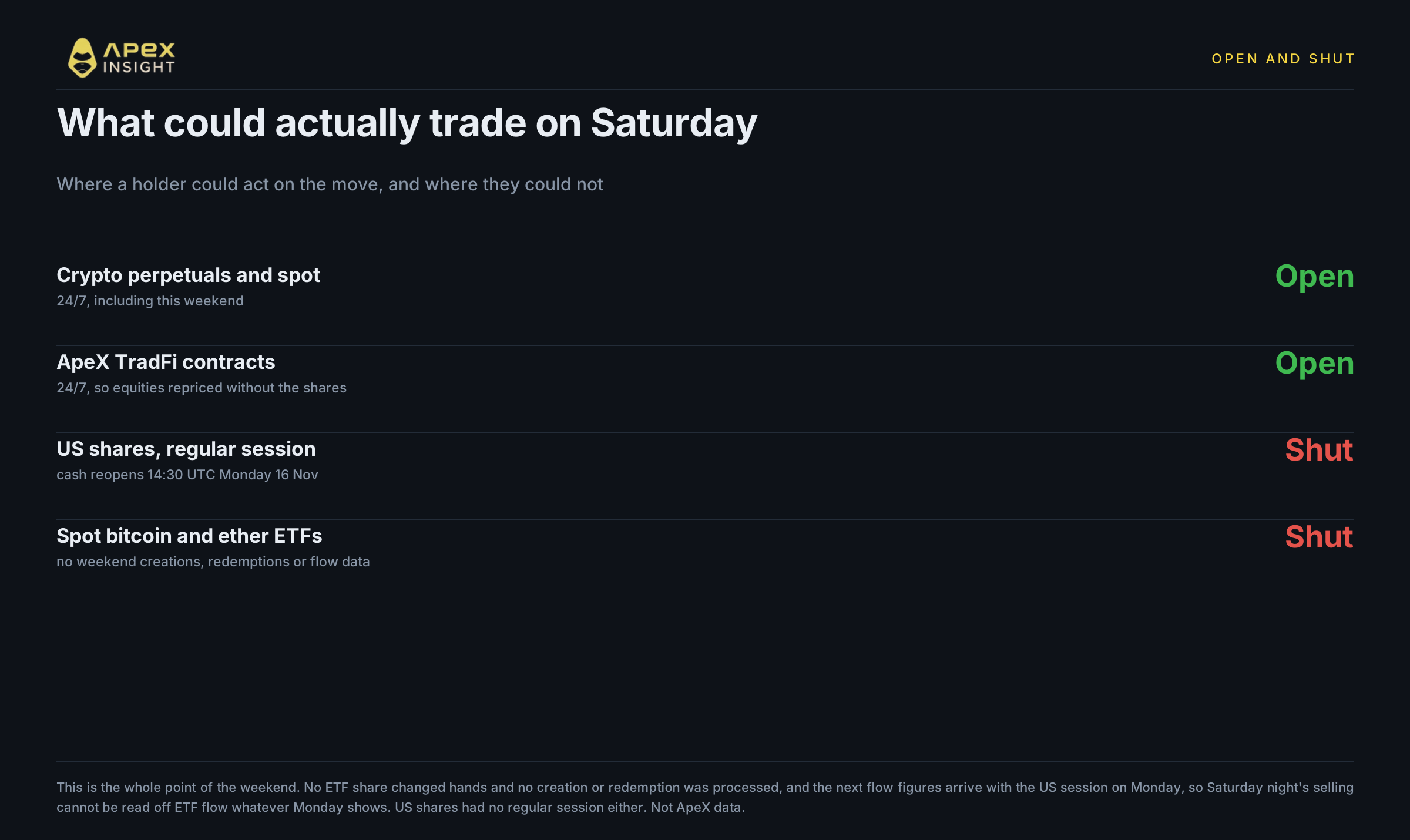
This is the part that makes a weekend crash different from a Tuesday one.
Crypto spot and perpetual markets ran all weekend, as they always do. ApeX TradFi contracts ran too, because they trade 24/7. US shares did not trade in any regular session and will not until 14:30 UTC on Monday 16 November. And the spot bitcoin and ether ETFs were shut along with them.
That last one deserves more attention than it usually gets. ETF outflows have been one of the standing explanations for this month's decline, and the explanation is reasonable on a weekday. But spot bitcoin ETFs do not trade over the weekend, and their next daily flow figures will not arrive until the US session on Monday.
So no ETF share changed hands all weekend, and no creation or redemption was processed. Saturday night's selling cannot be read off ETF flow, whatever Monday's figures show: they will describe a different thing happening at a different time.
5. The shares were shut. The contracts repriced anyway.
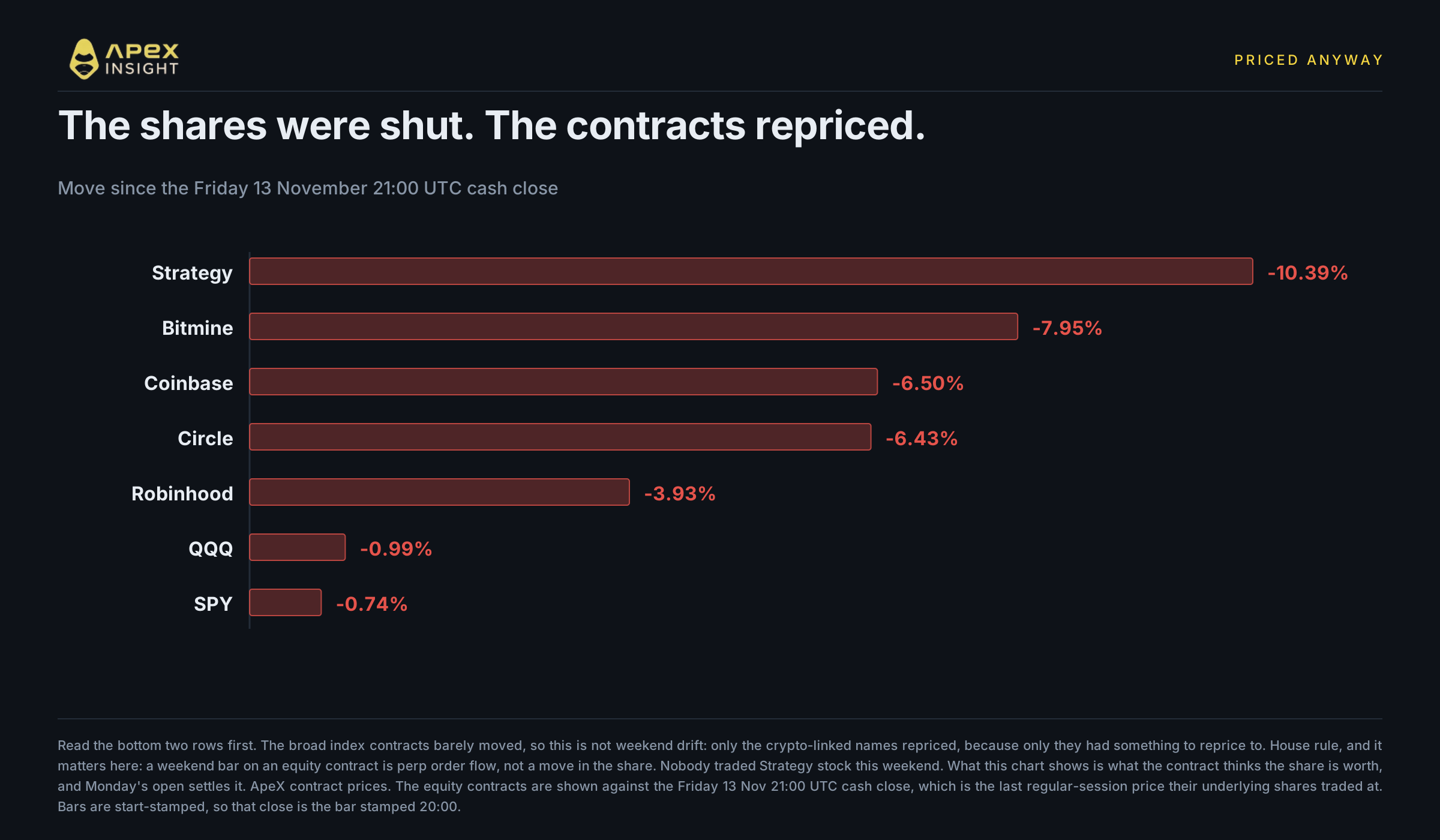
Here is where it gets genuinely unusual.
Contract | Since Friday's cash close |
|---|---|
-10.39% | |
-7.95% | |
-6.50% | |
-6.43% | |
-3.93% | |
-0.99% | |
-0.74% |
Strategy's contract is 10.39% below the last price its shares traded at. No Strategy share has traded in a regular session since Friday at 21:00 UTC, and none will until Monday.
Read the bottom two rows before you read the top one. The broad index contracts barely moved. If this were just weekend drift on thin perp volume, it would show up everywhere. It does not. Only the crypto-linked names repriced, because only they had something to reprice to.
An honest caveat, which happens to be the whole point. Our standing house rule is that a weekend bar on an equity contract is perp order flow, not a move in the underlying share, and we never quote one as if a stock had moved. That rule holds here. What this table shows is not Strategy falling 10.39%. It is the contract's best guess at what Strategy is worth given what bitcoin did while the share was frozen.
Monday's open is the test. If Strategy opens somewhere near 10% lower, the weekend contract was doing real price discovery. If it opens flat, the weekend move was noise from a thin book. Either answer is useful, and you only get to ask the question because one of the two instruments never closed.
6. One contract is still green
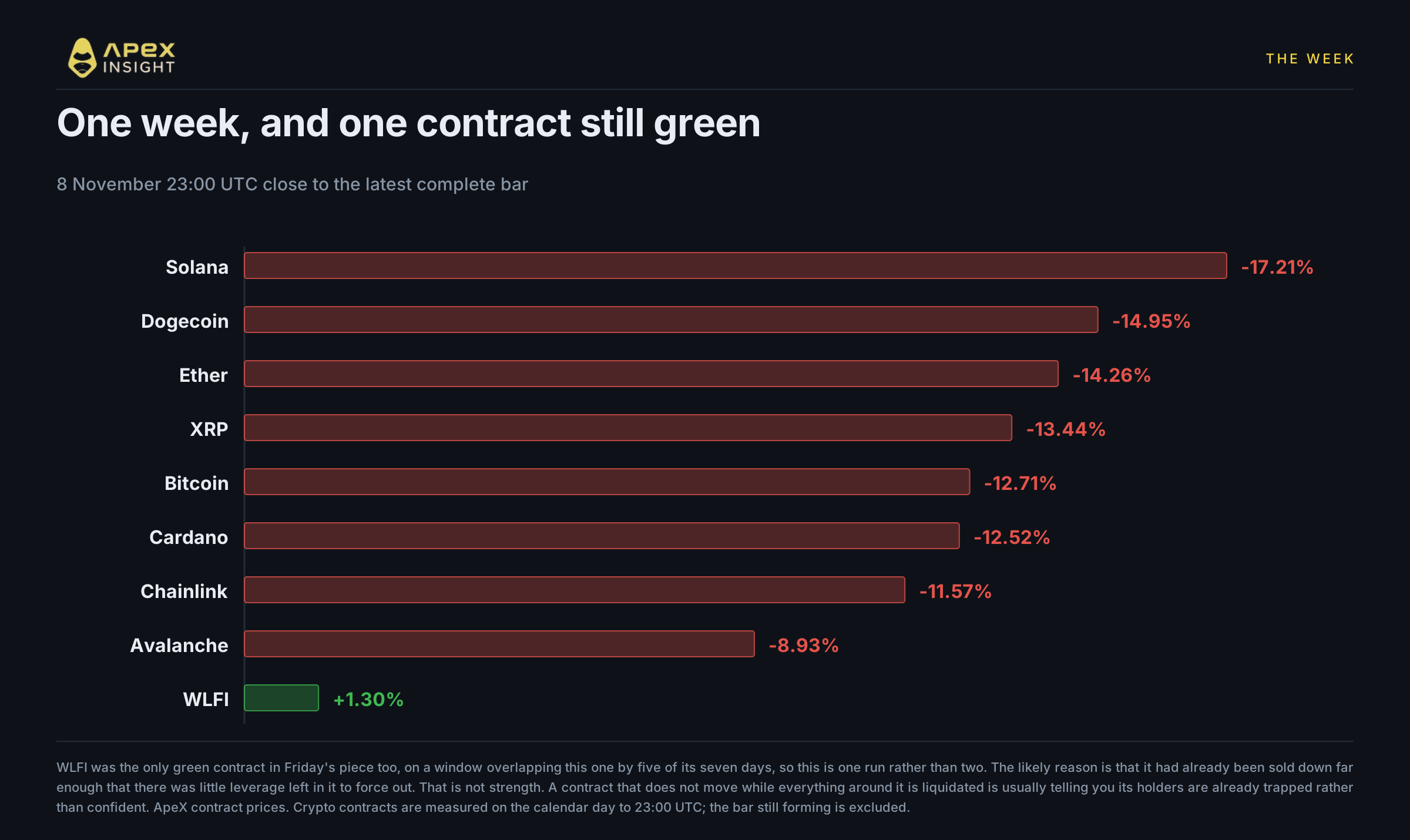
Across the week to the latest complete bar, solana is down 17.21%, dogecoin 14.95%, ether 14.26%, XRP 13.44%, bitcoin 12.71%, cardano 12.52%, chainlink 11.57% and avalanche 8.93%.
WLFI-USDT is up 1.30%.
WLFI was the only green contract in Friday's piece too, measured on a window that overlaps this one by five of its seven days, so this is one run of strength rather than two. The likely explanation is the one we gave then: it had already been sold down to a 200-day low on a tiny base, leaving little leverage in it to force out. A contract that does not move while everything around it is being liquidated is usually telling you its holders are trapped rather than confident. Going sideways through a crash is not the same as resisting one.
7. What to watch on Monday
Three things, in order of when they land.
14:30 UTC, the US cash open. Strategy, Coinbase, Circle, Bitmine and Robinhood all reprice at once, against a weekend their shares sat out. The gap between where the ApeX contracts have been trading and where the shares actually open is the cleanest read available on whether weekend perp pricing is information or noise.
The ETF flow figures. They cover Friday's session, not the weekend, and they will be reported into a market that has already moved a long way past them. Be careful with any story that uses Friday's flows to explain Saturday's price.
Nvidia on Tuesday. It is not a crypto event, but it has been one all month: this week's crypto decline moved with the AI selloff, not against it, and Nvidia reports on 17 November after the US close with an interim chief executive. If the two keep moving together, that print is a crypto catalyst whether anyone likes it or not.
Trade the move on ApeX
Crypto perpetuals up to 100x and TradFi up to 50x, trading 24/7 including weekends.
Everything below runs 24/7 on ApeX, which this weekend is not a feature note but the entire reason any of the above is observable.
The asset. BTC-USDT traded from $68,000 down to a $62,000 wick and back above $65,000 in under two days, with the hour that printed the low followed immediately by a 3.66% recovery hour.
The leveraged proxies. MSTR-USDT and BMNR-USDT are the two contracts carrying the largest gap to a share price that has not updated since Friday. That gap closes on Monday one way or the other.
The high-beta end. AVAX-USDT, ADA-USDT and SOL-USDT fell between one and a half and two and a quarter times as hard as bitcoin on Saturday, and Avalanche has given back the smallest fraction of the nine, about an eighth of its own fall. They are where thin-book moves are largest in both directions.
A weekend in which longs were liquidated on the way down and shorts on the way back up, eighty minutes apart, is an argument about position size rather than about direction. Both sides were right about where price was going and both were closed out before it got there.
Trading carries a high risk of loss, and leverage increases both gains and losses. This weekend is a direct illustration: being correct about the destination is worth nothing if the route removes you from the position first. This is not financial advice and none of it is a recommendation to buy or sell anything. Do your own research and size positions you can afford to lose.
If you need any help, feel free to reach out to our team on Discord.
Website: https://www.apex.exchange
Twitter: https://twitter.com/OfficialApeXdex
Telegram: https://t.me/ApeXdex
Methodology. Contract figures are from the ApeX Omni v3 API, recomputed on 15 November 2026. Crypto contracts trade continuously and are measured on the calendar day. Bars are start-stamped, so the bar stamped 23:00 is the last of the calendar day and closes at 00:00. Saturday therefore runs 14 November 00:00 to 15 November 00:00 UTC, Sunday from there to the last complete hourly bar, and the week from 9 November 00:00 UTC. The bar currently forming is always excluded, because a figure measured into an open bar changes on every read and cannot be reproduced afterwards. The equity and ETF contracts are shown against the Friday 13 November 21:00 UTC cash close, which is the US close now that daylight saving ended on 1 November 2026 and the last regular-session price at which their underlying shares traded. Because bars are start-stamped, that close is taken from the bar stamped 20:00, which covers 20:00 to 21:00. ApeX equity contracts trade 24/7 and print a bar every calendar day, but a weekend bar on one of them is perp order flow rather than the share, which is why section 5 describes a gap between contract and share rather than a move in a stock. Liquidation totals and ETF trading hours are from the sources hyperlinked at each claim and are not ApeX data. Figures are as at the bar stamped 09:00 UTC on 15 November 2026 and will go stale quickly, particularly if the Sunday bounce continues. Nothing here is financial advice.